
BUS 101 Lecture Chapter 5, Fall 2014
Lebanese American University · Introduction To Business · 37 pages

Showing the first 10 of 37 pages. Download the PDF to see all of it.
More BUS 101 files
Show the text of this lab
Business Essentials
9e
Ebert/Griffin
Business
Business
Management
Management
chapter five
chapter five
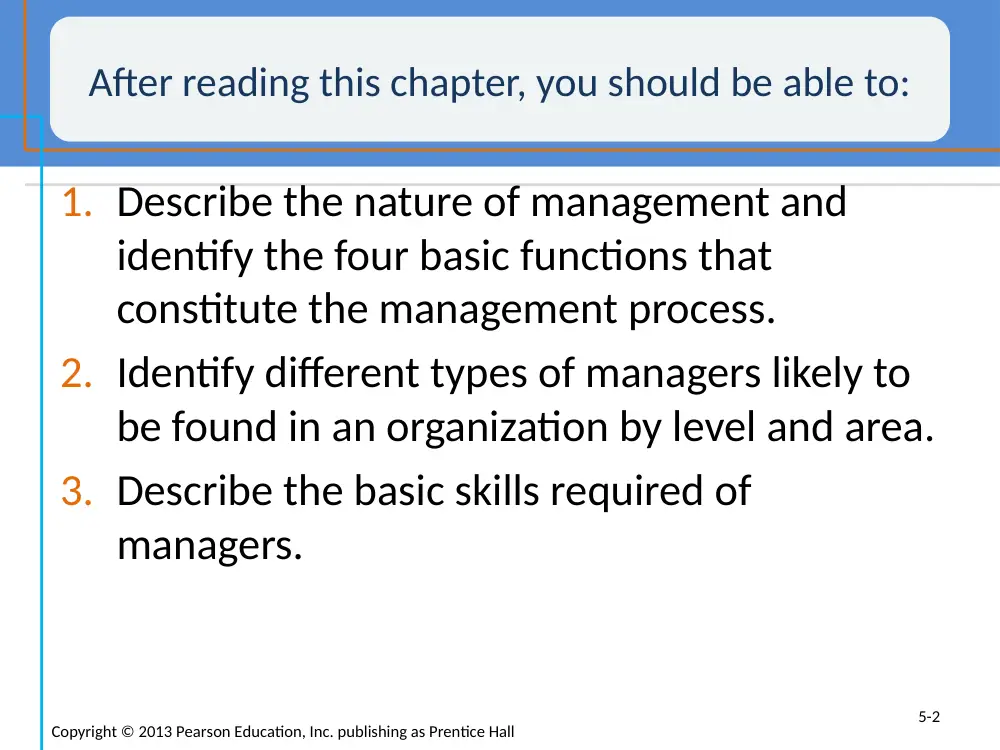
After reading this chapter, you should be able to:
1. Describe the nature of management and
identify the four basic functions that
constitute the management process.
2. Identify different types of managers likely to
be found in an organization by level and area.
3. Describe the basic skills required of
managers.
5-2
Copyright © 2013 Pearson Education, Inc. publishing as Prentice Hall
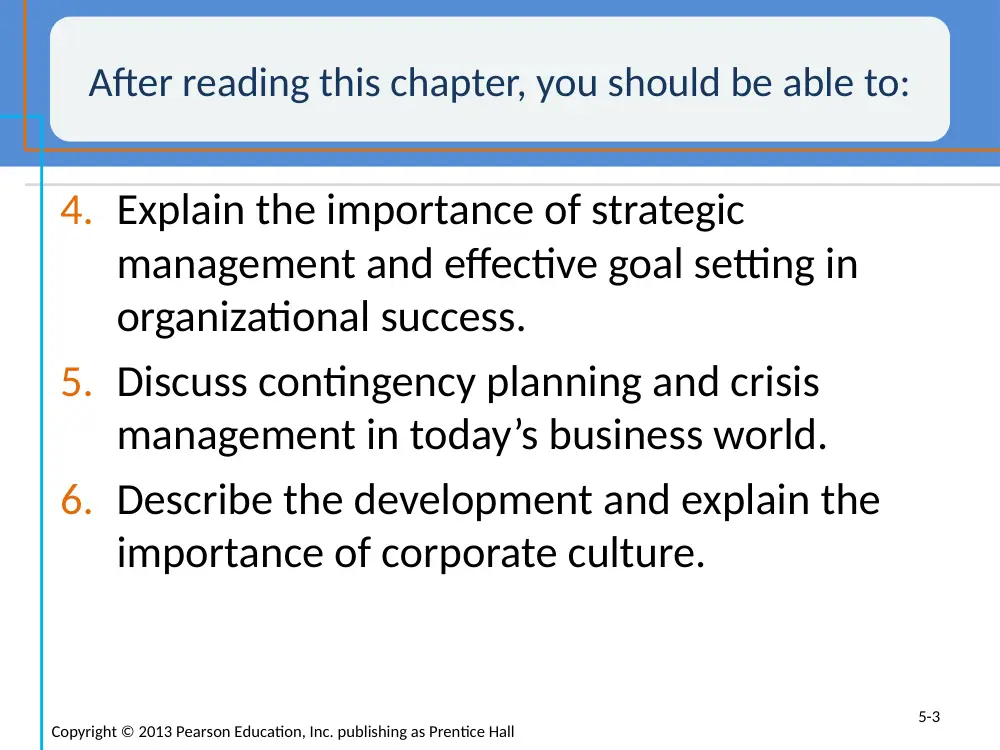
After reading this chapter, you should be able to:
4. Explain the importance of strategic
management and effective goal setting in
organizational success.
5. Discuss contingency planning and crisis
management in today’s business world.
6. Describe the development and explain the
importance of corporate culture.
Copyright © 2013 Pearson Education, Inc. publishing as Prentice Hall
5-3
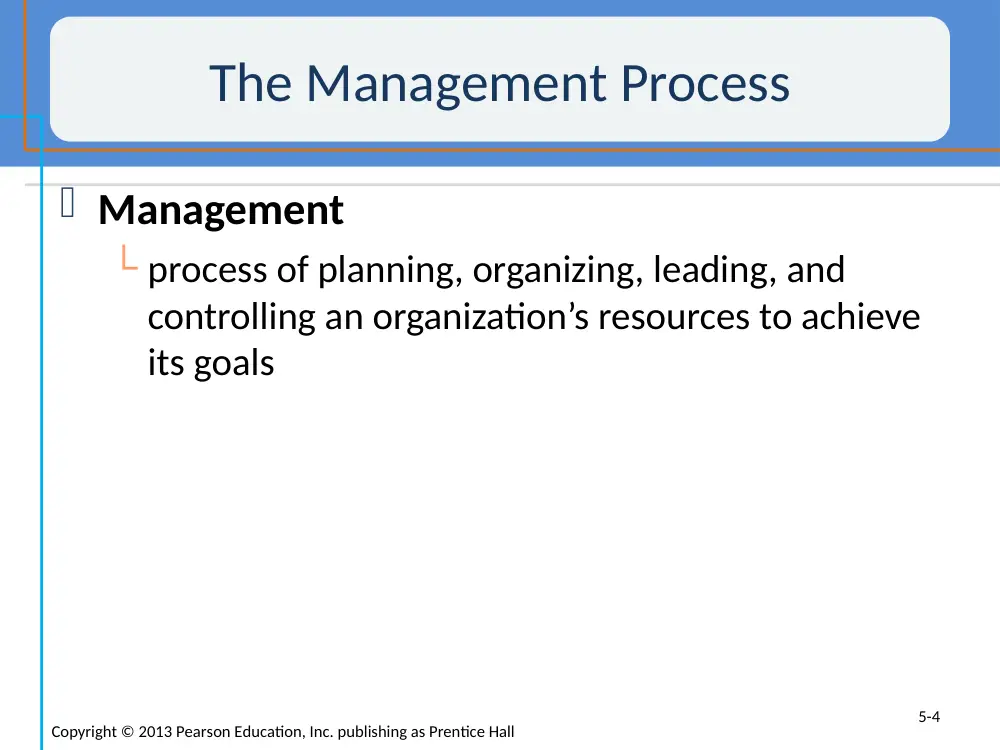
The Management Process
Management
└ process of planning, organizing, leading, and
controlling an organization’s resources to achieve
its goals
Copyright © 2013 Pearson Education, Inc. publishing as Prentice Hall
5-4
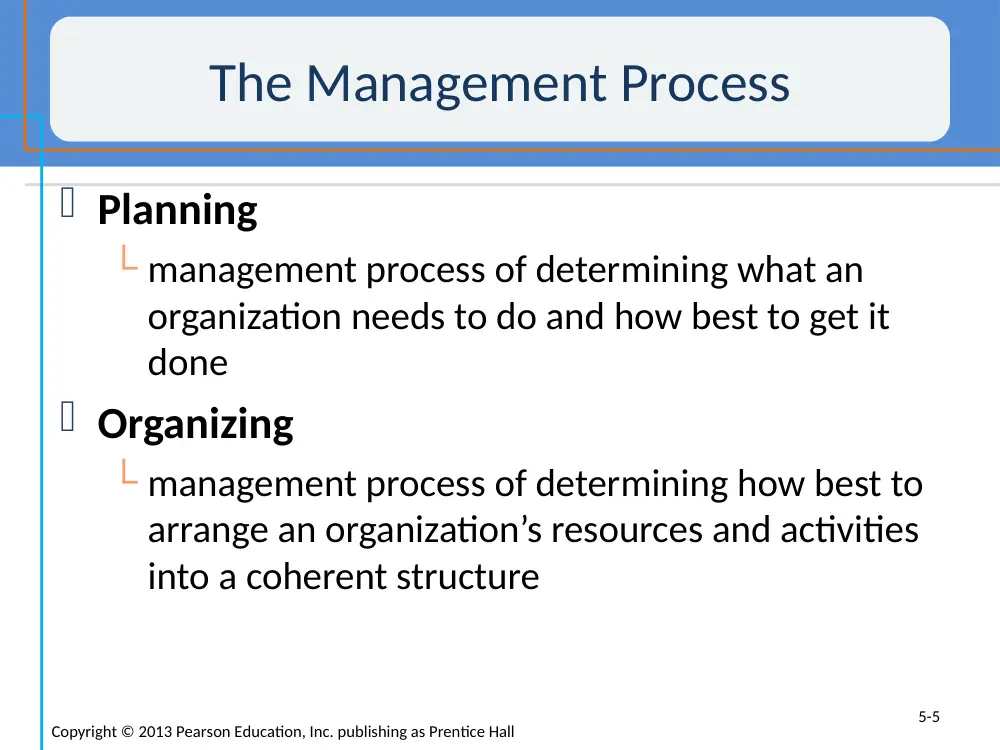
The Management Process
Planning
└ management process of determining what an
organization needs to do and how best to get it
done
Organizing
└ management process of determining how best to
arrange an organization’s resources and activities
into a coherent structure
Copyright © 2013 Pearson Education, Inc. publishing as Prentice Hall
5-5
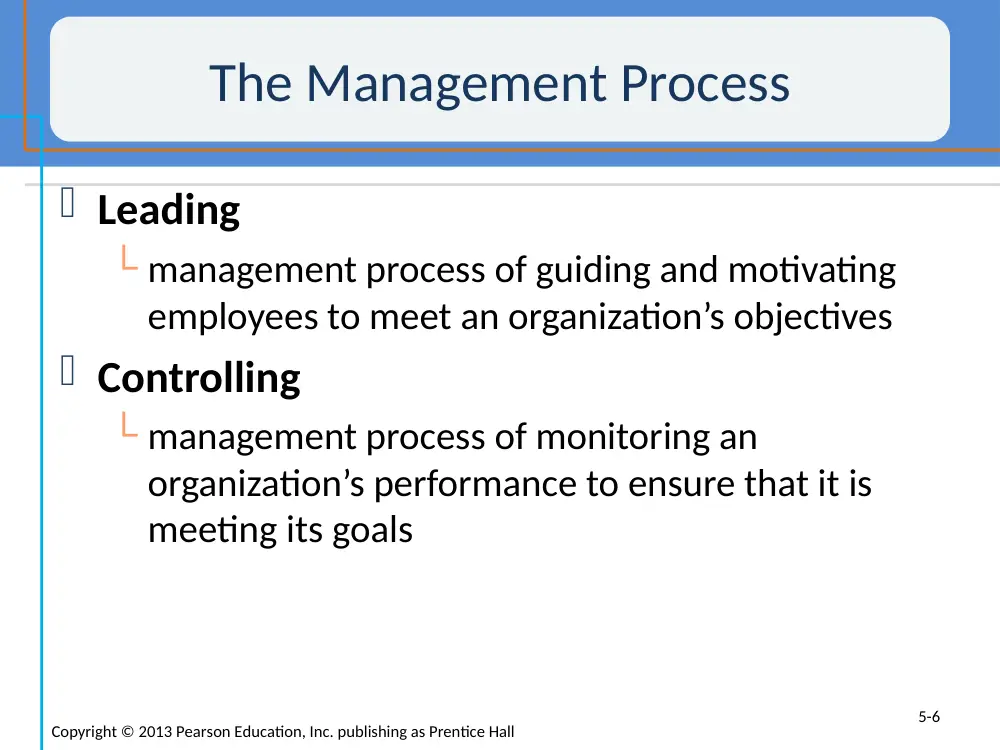
The Management Process
Leading
└ management process of guiding and motivating
employees to meet an organization’s objectives
Controlling
└ management process of monitoring an
organization’s performance to ensure that it is
meeting its goals
Copyright © 2013 Pearson Education, Inc. publishing as Prentice Hall
5-6
The Control Process
Copyright © 2013 Pearson Education, Inc. publishing as Prentice Hall
5-7
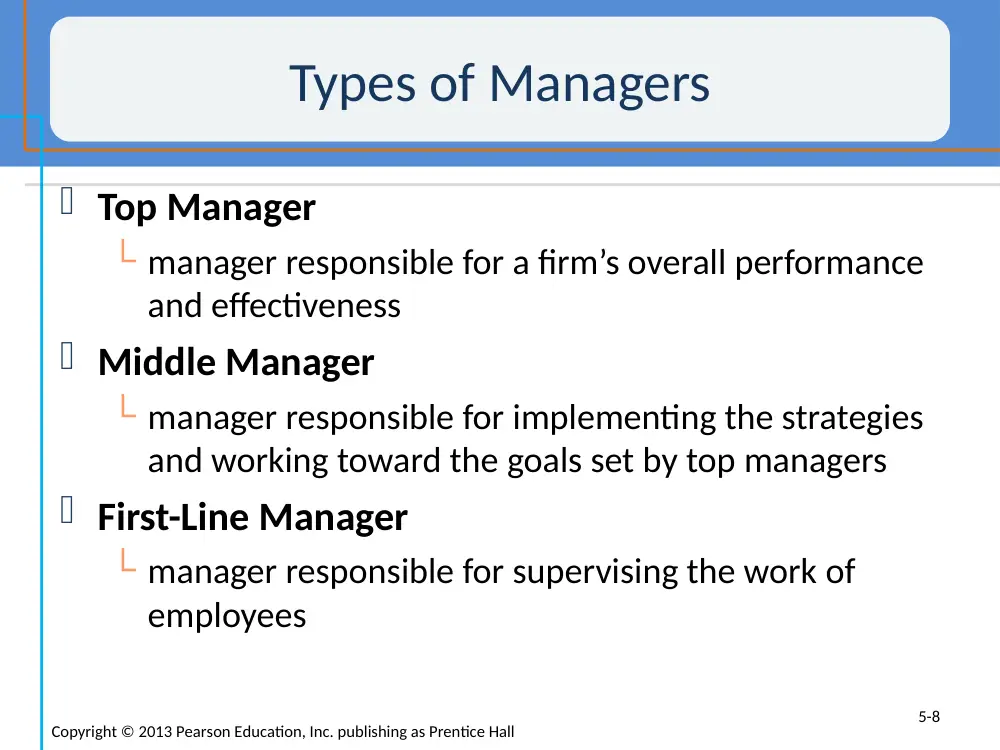
Types of Managers
Top Manager
└ manager responsible for a firm’s overall performance
and effectiveness
Middle Manager
└ manager responsible for implementing the strategies
and working toward the goals set by top managers
First-Line Manager
└ manager responsible for supervising the work of
employees
Copyright © 2013 Pearson Education, Inc. publishing as Prentice Hall
5-8
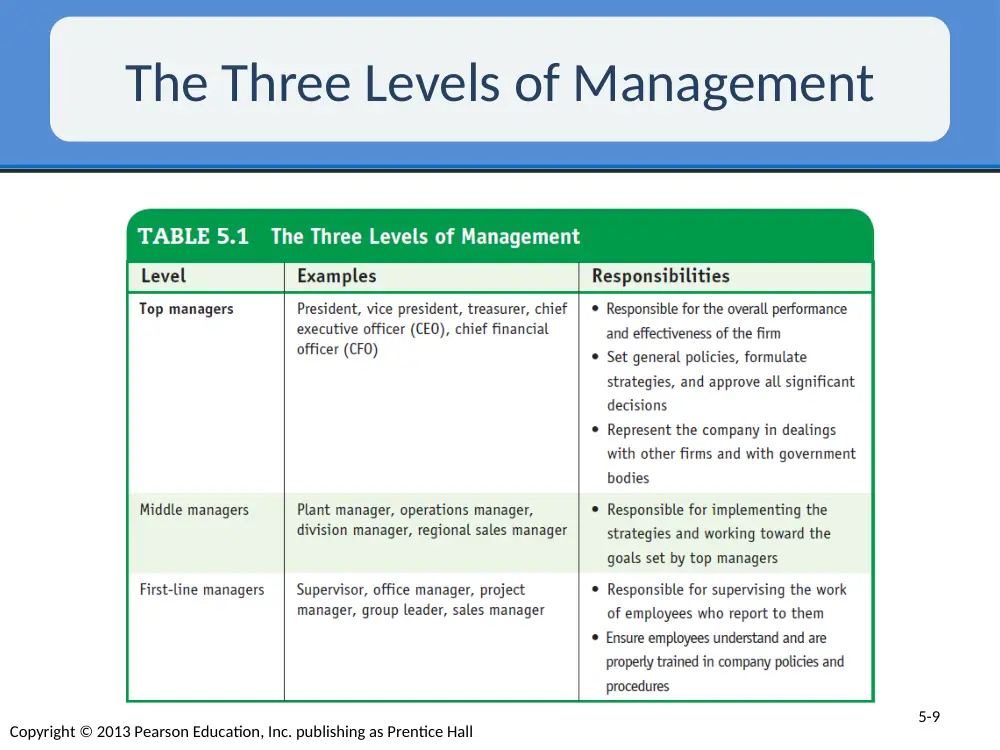
The Three Levels of Management
Copyright © 2013 Pearson Education, Inc. publishing as Prentice Hall
5-9
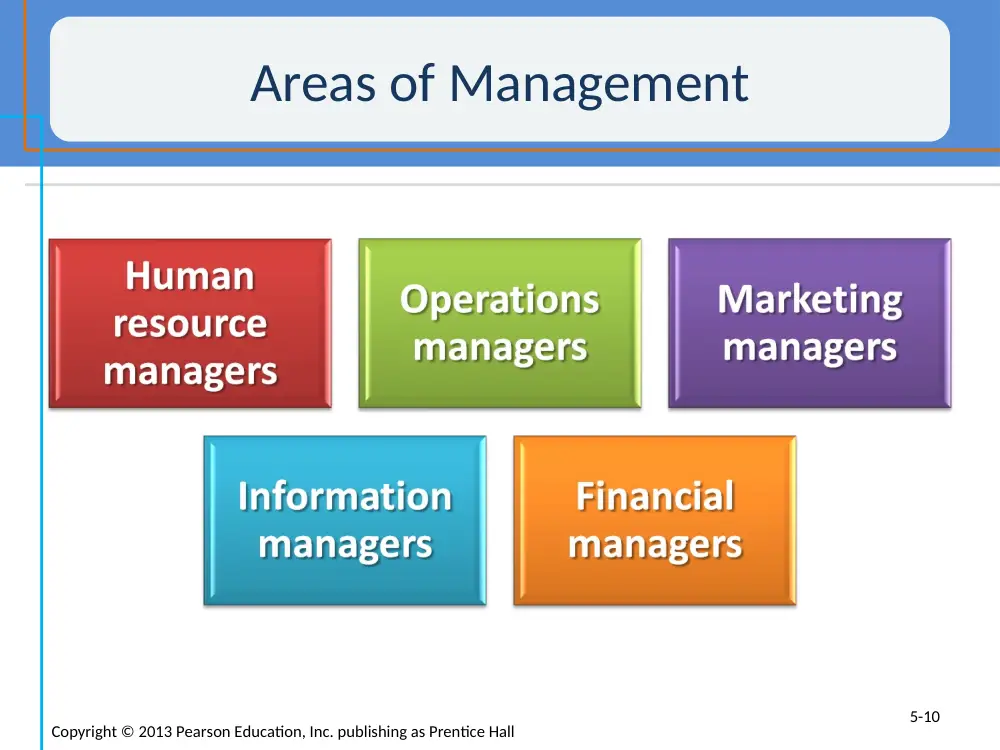
Areas of Management
Copyright © 2013 Pearson Education, Inc. publishing as Prentice Hall
5-10
Basic Management Skills
Technical Skills
└ skills needed to
perform specialized
tasks
Human Relations
Skills
└ skills in understanding
and getting along with
people
Copyright © 2013 Pearson Education, Inc. publishing as Prentice Hall
5-11
Basic Management Skills
Conceptual Skills
└ abilities to think in the abstract, diagnose and
analyze different situations, and see beyond the
present situation
Copyright © 2013 Pearson Education, Inc. publishing as Prentice Hall
5-12
Basic Management Skills
Decision-Making
Skills
└ skills in defining
problems and selecting
the best courses of
action
Time Management
Skills
└ skills associated with
the productive use of
time
Copyright © 2013 Pearson Education, Inc. publishing as Prentice Hall
5-13
Leading Causes of Wasted Time
1. Paperwork
2. Telephone calls
3. Meetings
4. E-mail
Copyright © 2013 Pearson Education, Inc. publishing as Prentice Hall
5-14
Management Skills for the Twenty-First
Century
Global Management Skills
└ Managers will need to understand foreign
markets, cultural differences, and the motives and
practices of foreign rivals.
└ Managers will also need to understand how to
collaborate with others around the world on a
real-time basis.
Copyright © 2013 Pearson Education, Inc. publishing as Prentice Hall
5-15
Management Skills for the Twenty-First
Century
Management and Technology Skills
└ New forms of technology have added to a
manager’s ability to process information while
simultaneously making it even more important to
organize and interpret an ever-increasing wealth
of input.
Copyright © 2013 Pearson Education, Inc. publishing as Prentice Hall
5-16
Strategic Management: Setting Goals
and Formulating Strategy
Strategic Management
└ process of helping an organization maintain an
effective alignment with its environment
Strategy
└ broad set of organizational plans for
implementing the decisions made for achieving
organizational goals
Copyright © 2013 Pearson Education, Inc. publishing as Prentice Hall
5-17
Setting Business Goals
Goals
└ the means by which organizations and their
managers measure success or failure at every
level
└ objective that a business hopes and plans to
achieve
Copyright © 2013 Pearson Education, Inc. publishing as Prentice Hall
5-18
Purposes of Goal Setting
Provides direction and guidance for managers
at all levels
Helps firms allocate resources
Helps to define corporate culture
Helps managers assess performance
Copyright © 2013 Pearson Education, Inc. publishing as Prentice Hall
5-19
Kinds of Goals
Mission Statement
└ organization’s statement of how it will achieve its
purpose in the environment in which it conducts
its business
Copyright © 2013 Pearson Education, Inc. publishing as Prentice Hall
5-20
Kinds of Goals
Long-Term Goal
└ goal set for an extended time, typically five years
or more into the future
Intermediate Goal
└ goal set for a period of one to five years into the
future
Short-Term Goal
└ goal set for the very near future
Copyright © 2013 Pearson Education, Inc. publishing as Prentice Hall
5-21
Hierarchy of Strategy
Copyright © 2013 Pearson Education, Inc. publishing as Prentice Hall
5-22
Types of Strategy
Corporate Strategy
└ strategy for determining the firm’s overall attitude
toward growth and the way it will manage its
businesses or product lines
Business (or Competitive) Strategy
└ strategy, at the business-unit or product-line level,
focusing on improving a firm’s competitive
position
Copyright © 2013 Pearson Education, Inc. publishing as Prentice Hall
5-23
Types of Strategy
Functional Strategy
└ strategy by which managers in specific areas
decide how best to achieve corporate goals
through productivity
Copyright © 2013 Pearson Education, Inc. publishing as Prentice Hall
5-24
Strategy Formulation
Copyright © 2013 Pearson Education, Inc. publishing as Prentice Hall
5-25
Formulating Strategy
Step 1: Setting Strategic Goals
Step 2: Analyzing the Organization and the
Environment: SWOT Analysis
Step 3: Matching the Organization and Its
Environment
Copyright © 2013 Pearson Education, Inc. publishing as Prentice Hall
5-26
Formulating Strategy
SWOT Analysis
└ identification and analysis of organizational
strengths and weaknesses and environmental
opportunities and threats as part of strategy
formulation
Copyright © 2013 Pearson Education, Inc. publishing as Prentice Hall
5-27
Formulating Strategy
Environmental
Analysis
└ process of scanning
the business
environment for
threats and
opportunities
Organizational
Analysis
└ process of analyzing a
firm’s strengths and
weaknesses
Copyright © 2013 Pearson Education, Inc. publishing as Prentice Hall
5-28
A Hierarchy of Plans
Strategic Plan
└ plan reflecting decisions about resource
allocations, company priorities, and steps needed
to meet strategic goals
Copyright © 2013 Pearson Education, Inc. publishing as Prentice Hall
5-29
A Hierarchy of Plans
Tactical Plan
└ generally short-term
plan concerned with
implementing specific
aspects of a company’s
strategic plans
Operational Plan
└ plan setting short-
term targets for daily,
weekly, or monthly
performance
Copyright © 2013 Pearson Education, Inc. publishing as Prentice Hall
5-30
Contingency Planning and Crisis
Management
Contingency Planning
└ identifying aspects of a business or its
environment that might entail changes in strategy
Crisis Management
└ organization’s methods for dealing with
emergencies
Copyright © 2013 Pearson Education, Inc. publishing as Prentice Hall
5-31
Management and the
Corporate Culture
Corporate culture
└ the shared experiences, stories, beliefs, and
norms that characterize an organization
└ helps define the work and business climate that
exists in an organization
Copyright © 2013 Pearson Education, Inc. publishing as Prentice Hall
5-32
Communicating the Culture and
Managing Change
Managers themselves must have a clear
understanding of the culture
Must transmit the culture to others in the
organization
Should maintain the culture by rewarding and
promoting those who understand it and work
toward maintaining it
Copyright © 2013 Pearson Education, Inc. publishing as Prentice Hall
5-33
Managing Change – Three Stages
1. At the highest level, analysis of the company’s
environment highlights extensive change as the
most effective response to its problems.
2. Top management begins to formulate a vision of
a new company.
3. The firm sets up new systems for appraising and
compensating employees who enforce the firm’s
new values.
Copyright © 2013 Pearson Education, Inc. publishing as Prentice Hall
5-34
Applying What You’ve Learned
1. Describe the nature of management and
identify the four basic functions that
constitute the management process.
2. Identify different types of managers likely to
be found in an organization by level and area.
3. Describe the basic skills required of
managers.
5-35
Copyright © 2013 Pearson Education, Inc. publishing as Prentice Hall
Applying What You’ve Learned
4. Explain the importance of strategic
management and effective goal setting in
organizational success.
5. Discuss contingency planning and crisis
management in today’s business world.
6. Describe the development and explain the
importance of corporate culture.
Copyright © 2013 Pearson Education, Inc. publishing as Prentice Hall
5-36
37
5-37
Copyright © 2013 Pearson Education, Inc. publishing as Prentice Hall