
CSC 320 Chapter #1, Spring 2015
Lebanese American University · Computer Organisation · 19 pages · Dr. Anonymous

Showing the first 10 of 19 pages. Download the PDF to see all of it.
More CSC 320 files
- Chapter #2 · Spring 2015ChapterView
- Chapter #3 · Spring 2015ChapterView
- Chapter #4 · Spring 2015ChapterView
- Chapter #5 · Spring 2015ChapterView
- Chapter #7 · Spring 2015ChapterView
- Chapter Conversion · Spring 2015ChapterView
- Exam For Chapter 1 · Spring 2015ChapterView
- Exam For Chapter 2 · Spring 2015ChapterView
Show the text of this chapter
Chapter 1
Computer Abstractions
and Technology
Chapter 1 — Computer Abstractions and Technology — 2
The Computer Revolution
! Progress in computer technology
! Underpinned by Moore’s Law
! Makes novel applications feasible
! Computers in automobiles
! Cell phones
! Human genome project
! World Wide Web
! Search Engines
! Computers are pervasive
§1.1 Introduction
Chapter 1 — Computer Abstractions and Technology — 3
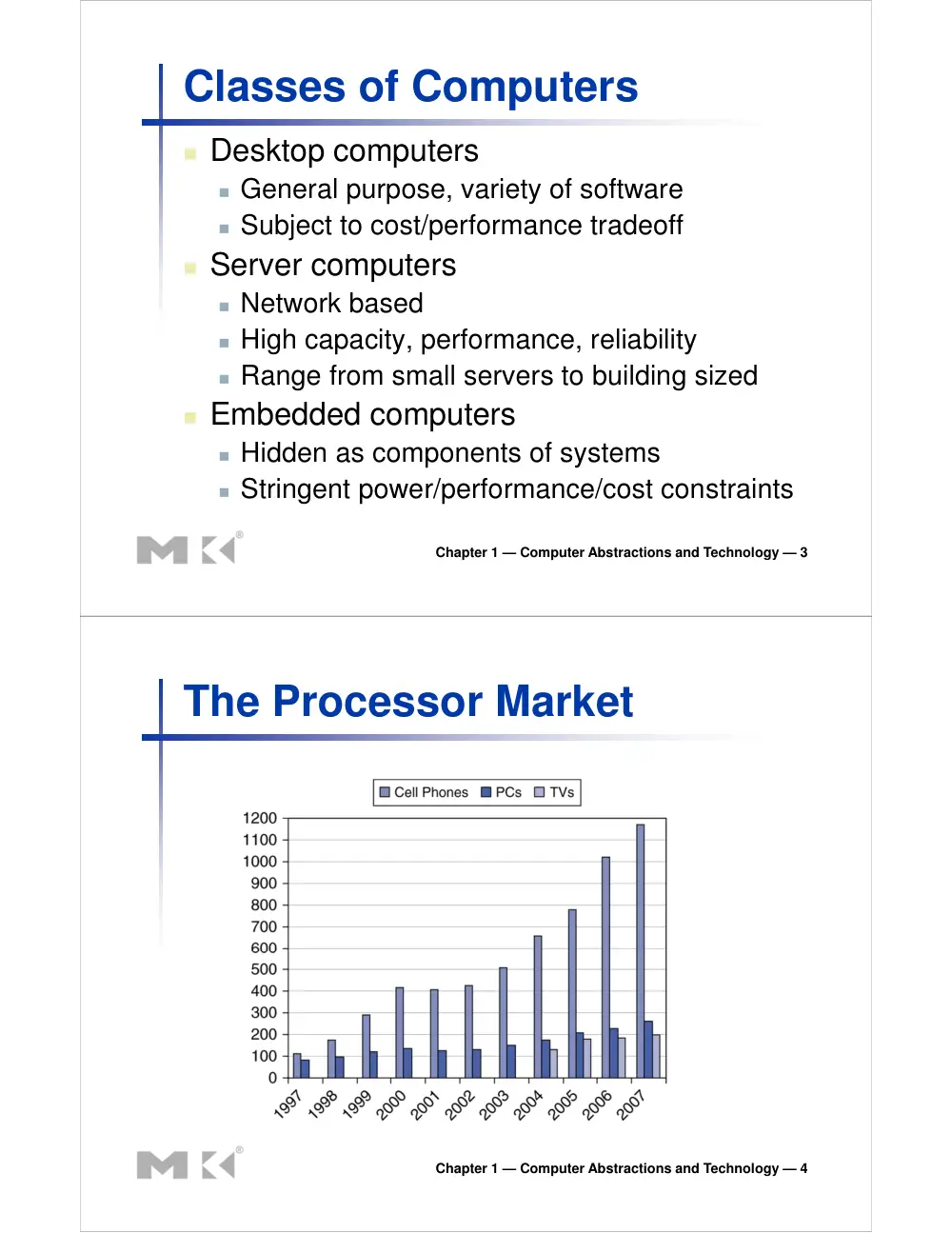
Classes of Computers
! Desktop computers
! General purpose, variety of software
! Subject to cost/performance tradeoff
! Server computers
! Network based
! High capacity, performance, reliability
! Range from small servers to building sized
! Embedded computers
! Hidden as components of systems
! Stringent power/performance/cost constraints
Chapter 1 — Computer Abstractions and Technology — 4
The Processor Market
Chapter 1 — Computer Abstractions and Technology — 6
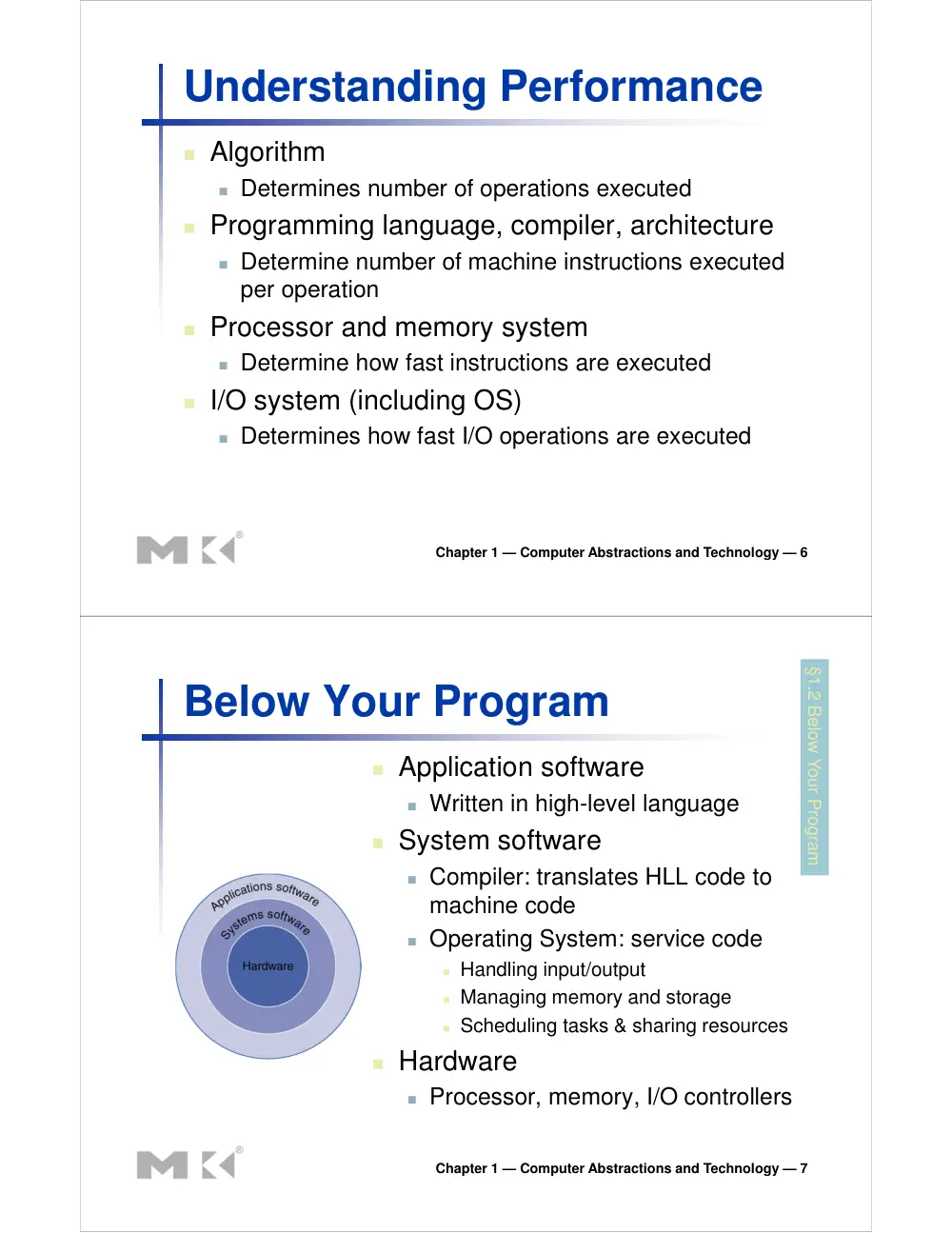
Understanding Performance
! Algorithm
! Determines number of operations executed
! Programming language, compiler, architecture
! Determine number of machine instructions executed
per operation
! Processor and memory system
! Determine how fast instructions are executed
! I/O system (including OS)
! Determines how fast I/O operations are executed
Chapter 1 — Computer Abstractions and Technology — 7
Below Your Program
! Application software
! Written in high-level language
! System software
! Compiler: translates HLL code to
machine code
! Operating System: service code
! Handling input/output
! Managing memory and storage
! Scheduling tasks & sharing resources
! Hardware
! Processor, memory, I/O controllers
§1.2 Below Your Program
Chapter 1 — Computer Abstractions and Technology — 8
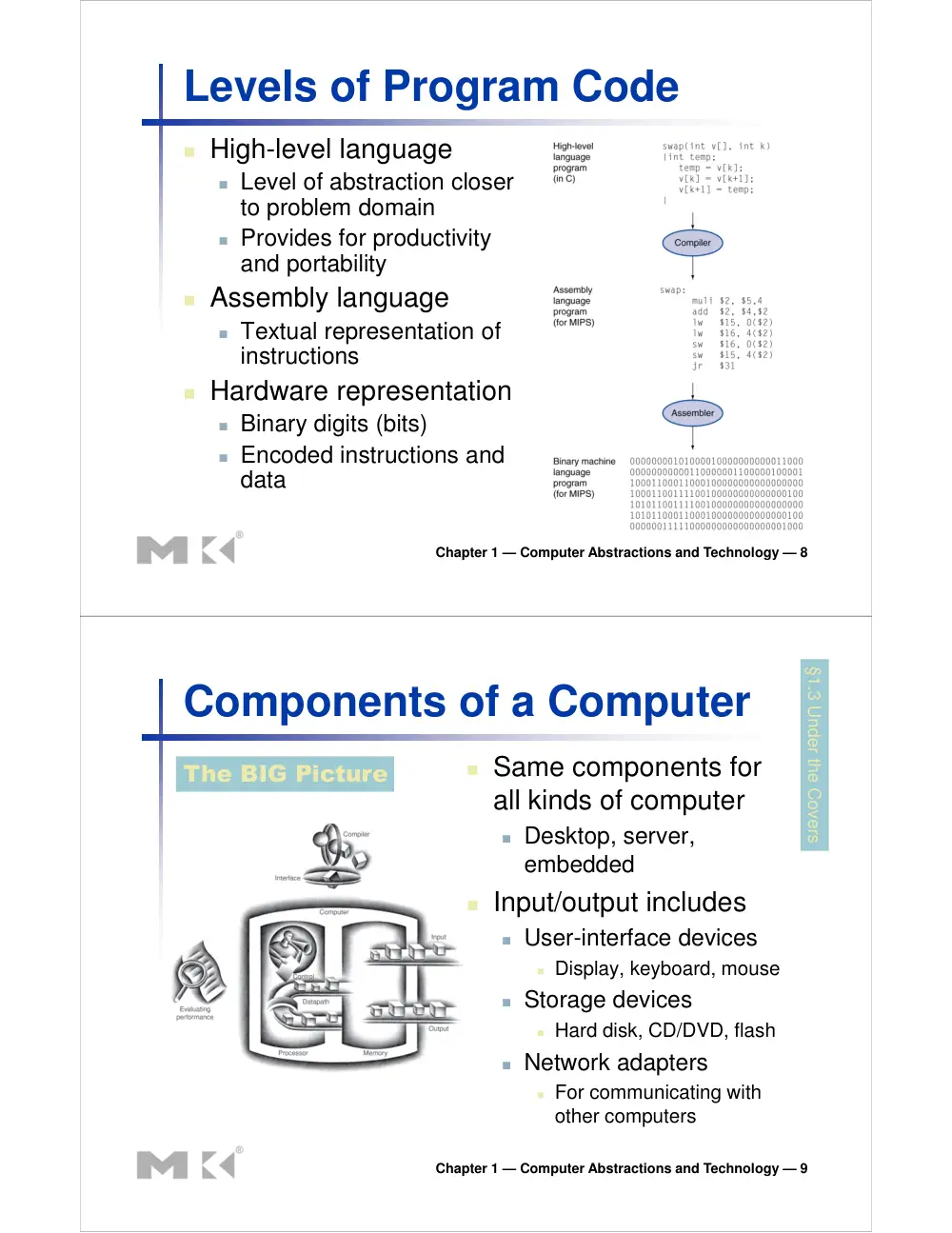
Levels of Program Code
! High-level language
! Level of abstraction closer
to problem domain
! Provides for productivity
and portability
! Assembly language
! Textual representation of
instructions
! Hardware representation
! Binary digits (bits)
! Encoded instructions and
data
Chapter 1 — Computer Abstractions and Technology — 9
Components of a Computer
! Same components for
all kinds of computer
! Desktop, server,
embedded
! Input/output includes
! User-interface devices
! Display, keyboard, mouse
! Storage devices
! Hard disk, CD/DVD, flash
! Network adapters
! For communicating with
other computers
§1.3 Under the Covers
The BIG Picture
Chapter 1 — Computer Abstractions and Technology — 13
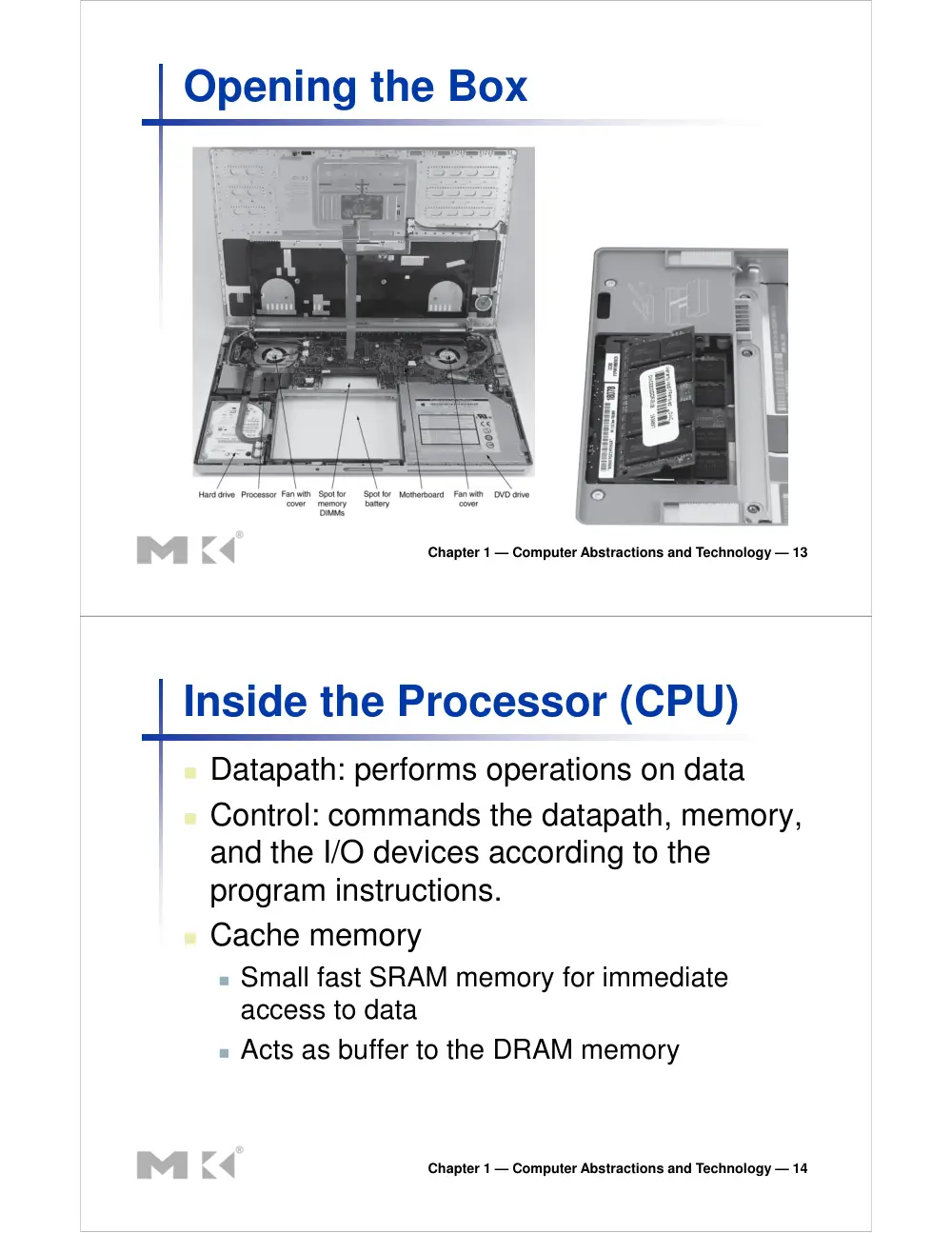
Opening the Box
Chapter 1 — Computer Abstractions and Technology — 14
Inside the Processor (CPU)
! Datapath: performs operations on data
! Control: commands the datapath, memory,
and the I/O devices according to the
program instructions.
! Cache memory
! Small fast SRAM memory for immediate
access to data
! Acts as buffer to the DRAM memory
Chapter 1 — Computer Abstractions and Technology — 16
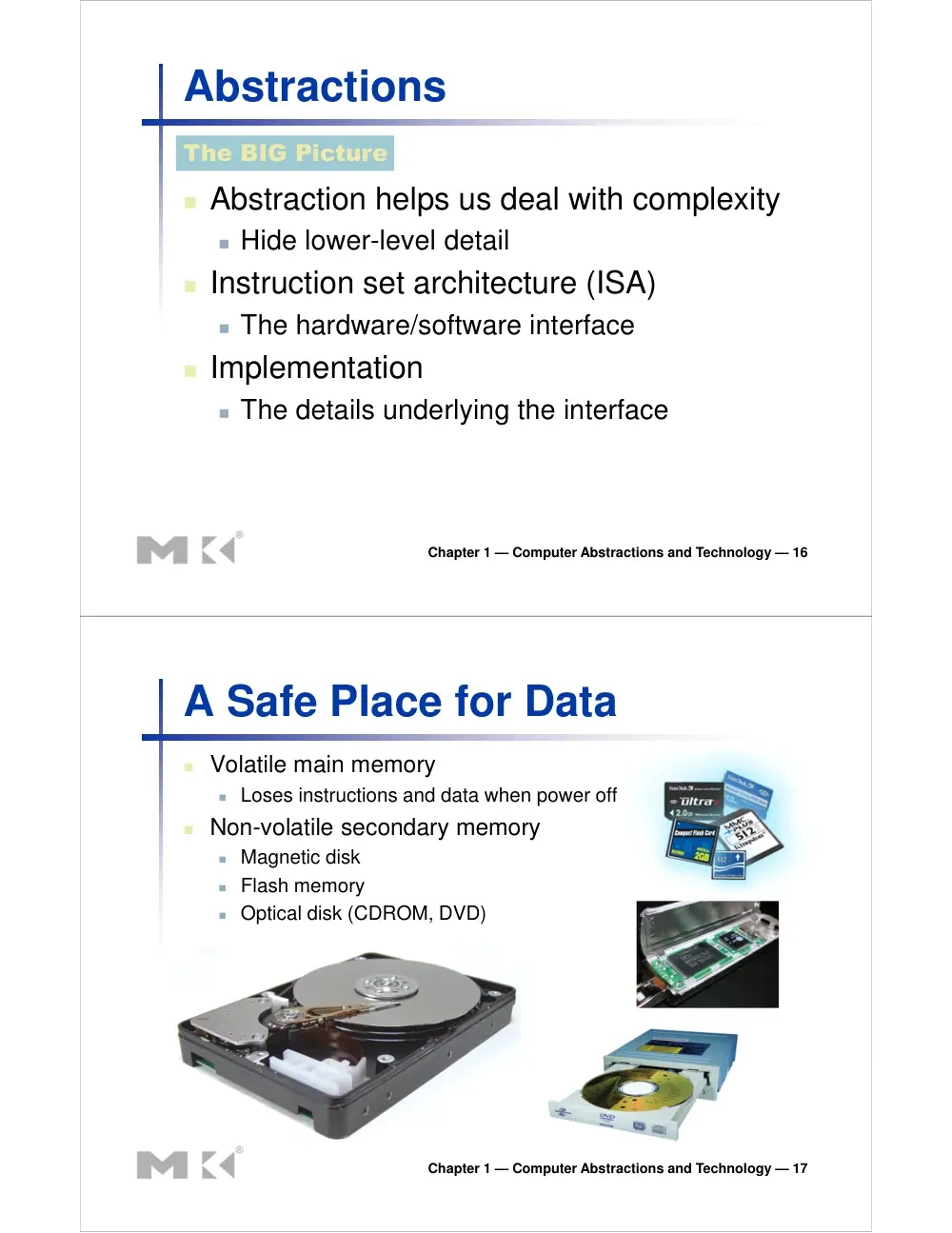
Abstractions
! Abstraction helps us deal with complexity
! Hide lower-level detail
! Instruction set architecture (ISA)
! The hardware/software interface
! Implementation
! The details underlying the interface
The BIG Picture
Chapter 1 — Computer Abstractions and Technology — 17
A Safe Place for Data
! Volatile main memory
! Loses instructions and data when power off
! Non-volatile secondary memory
! Magnetic disk
! Flash memory
! Optical disk (CDROM, DVD)
Chapter 1 — Computer Abstractions and Technology — 18
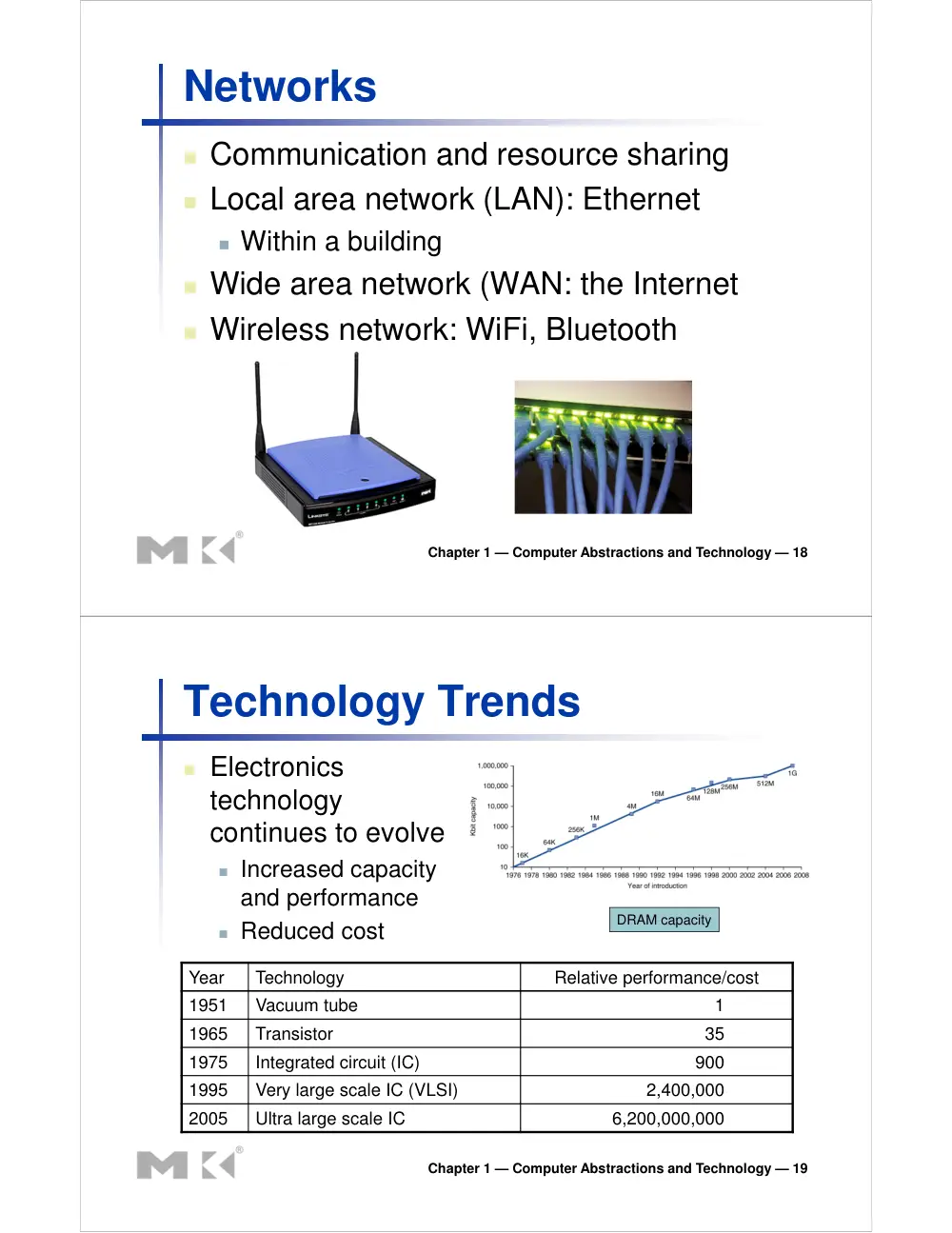
Networks
! Communication and resource sharing
! Local area network (LAN): Ethernet
! Within a building
! Wide area network (WAN: the Internet
! Wireless network: WiFi, Bluetooth
Chapter 1 — Computer Abstractions and Technology — 19
Technology Trends
! Electronics
technology
continues to evolve
! Increased capacity
and performance
! Reduced cost
Year
Technology
Relative performance/cost
1951
Vacuum tube
1
1965
Transistor
35
1975
Integrated circuit (IC)
900
1995
Very large scale IC (VLSI)
2,400,000
2005
Ultra large scale IC
6,200,000,000
DRAM capacity
Chapter 1 — Computer Abstractions and Technology — 21
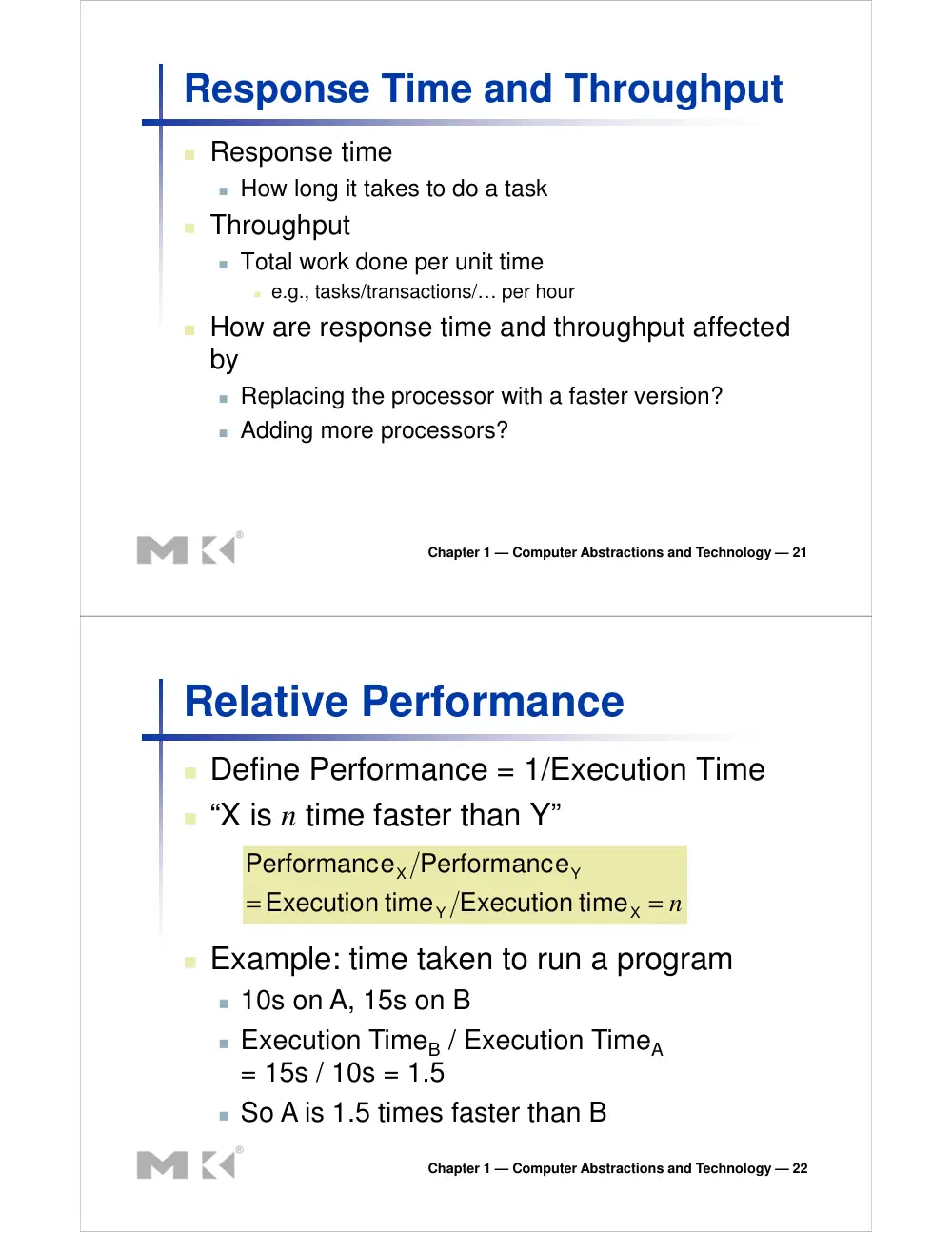
Response Time and Throughput
! Response time
! How long it takes to do a task
! Throughput
! Total work done per unit time
! e.g., tasks/transactions/… per hour
! How are response time and throughput affected
by
! Replacing the processor with a faster version?
! Adding more processors?
Chapter 1 — Computer Abstractions and Technology — 22
Relative Performance
! Define Performance = 1/Execution Time
! “X is n time faster than Y”
= n
=
X
Y
Y
X
Execution time
time
Execution
Performance
e
Performanc
! Example: time taken to run a program
! 10s on A, 15s on B
! Execution TimeB / Execution TimeA
= 15s / 10s = 1.5
! So A is 1.5 times faster than B
Chapter 1 — Computer Abstractions and Technology — 23
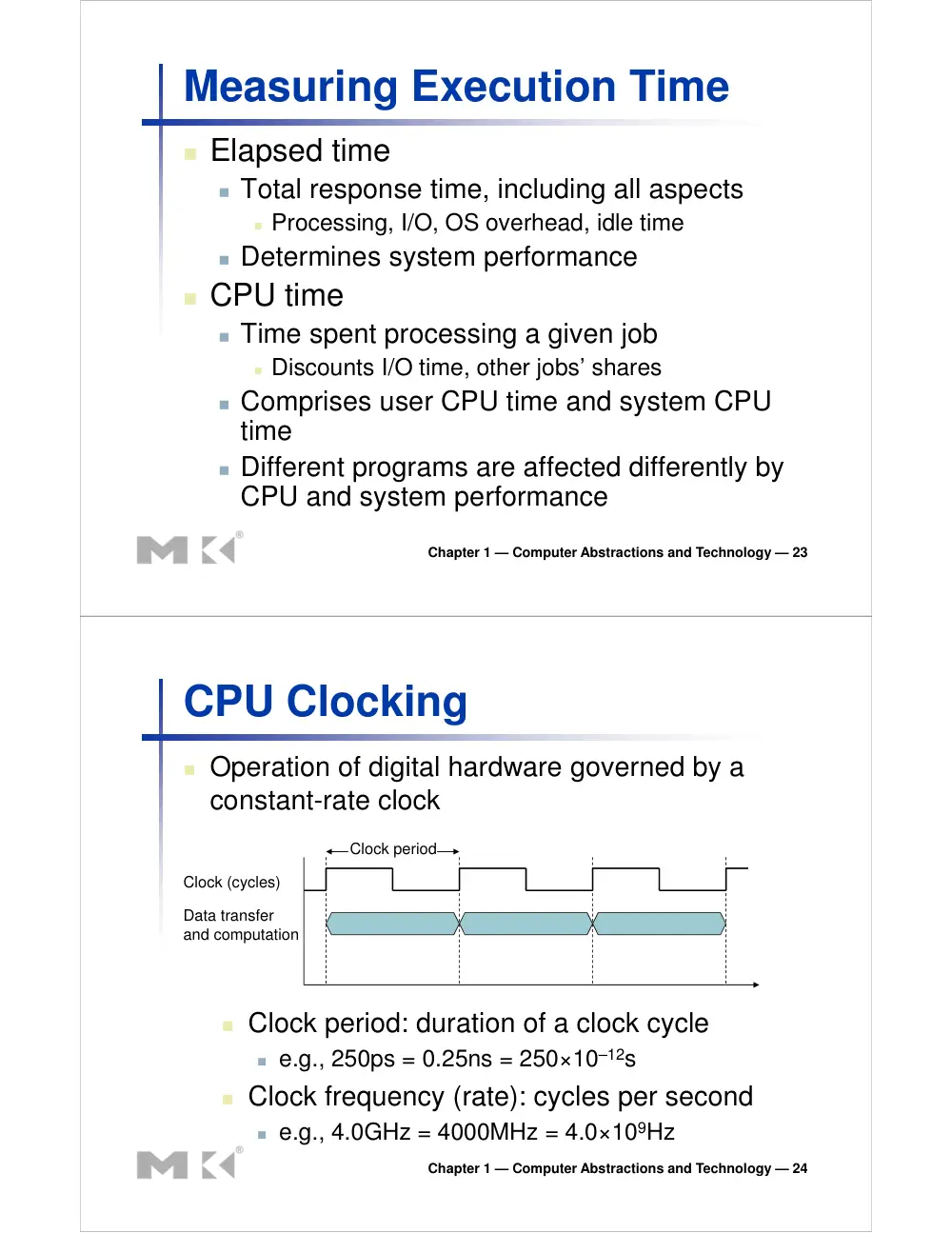
Measuring Execution Time
! Elapsed time
! Total response time, including all aspects
! Processing, I/O, OS overhead, idle time
! Determines system performance
! CPU time
! Time spent processing a given job
! Discounts I/O time, other jobs’ shares
! Comprises user CPU time and system CPU
time
! Different programs are affected differently by
CPU and system performance
Chapter 1 — Computer Abstractions and Technology — 24
CPU Clocking
! Operation of digital hardware governed by a
constant-rate clock
Clock (cycles)
Data transfer
and computation
Clock period
! Clock period: duration of a clock cycle
! e.g., 250ps = 0.25ns = 250×10–12s
! Clock frequency (rate): cycles per second
! e.g., 4.0GHz = 4000MHz = 4.0×10⁹Hz
Chapter 1 — Computer Abstractions and Technology — 26
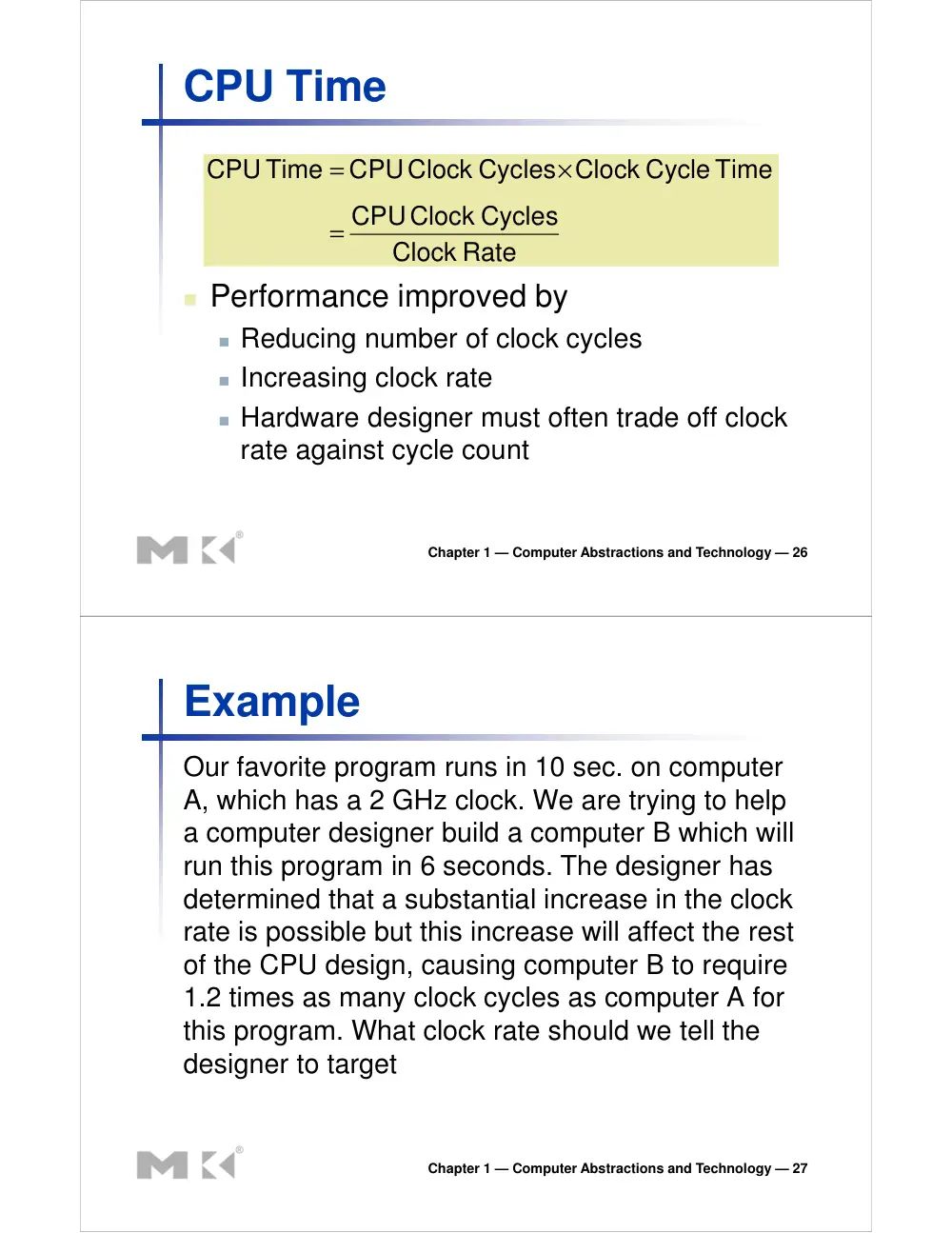
CPU Time
! Performance improved by
! Reducing number of clock cycles
! Increasing clock rate
! Hardware designer must often trade off clock
rate against cycle count
Rate
Clock
Clock Cycles
CPU
CPU Clock Cycles Clock Cycle Time
Time
CPU
=
×
=
Example
Our favorite program runs in 10 sec. on computer
A, which has a 2 GHz clock. We are trying to help
a computer designer build a computer B which will
run this program in 6 seconds. The designer has
determined that a substantial increase in the clock
rate is possible but this increase will affect the rest
of the CPU design, causing computer B to require
1.2 times as many clock cycles as computer A for
this program. What clock rate should we tell the
designer to target
Chapter 1 — Computer Abstractions and Technology — 27
Chapter 1 — Computer Abstractions and Technology — 28
CPU Time Example
! Computer A: 2GHz clock, 10s CPU time
! Designing Computer B
! Aim for 6s CPU time
! Can do faster clock, but causes 1.2 × clock cycles
! How fast must Computer B clock be?
Chapter 1 — Computer Abstractions and Technology — 29
CPU Time Example
! Computer A: 2GHz clock, 10s CPU time
! Designing Computer B
! Aim for 6s CPU time
! Can do faster clock, but causes 1.2 × clock cycles
! How fast must Computer B clock be?
4GHz
6s
10
24
6s
1.2 20 10
Rate
Clock
20 10
2GHz
10s
Clock Rate
CPU Time
Cycles
Clock
6s
Clock Cycles
1.2
Time
CPU
Clock Cycles
Rate
Clock
9
9
B
9
A
A
A
A
B
B
B
=
×
=
×
×
=
×
=
×
=
×
=
×
=
=
Chapter 1 — Computer Abstractions and Technology — 30
Instruction Count and CPI
! Instruction Count for a program
! Determined by program, ISA and compiler
! Average cycles per instruction
! Determined by CPU hardware
! If different instructions have different CPI
! Average CPI affected by instruction mix
Rate
Clock
CPI
n Count
Instructio
CPI Clock Cycle Time
Instructio n Count
Time
CPU
Cycles per Instruction
Instructio n Count
Cycles
Clock
×
=
×
×
=
×
=
Chapter 1 — Computer Abstractions and Technology — 31
CPI Example
! Computer A: Cycle Time = 250ps, CPI = 2.0
! Computer B: Cycle Time = 500ps, CPI = 1.2
! Same ISA
! Which is faster, and by how much?
Chapter 1 — Computer Abstractions and Technology — 32
CPI Example
! Computer A: Cycle Time = 250ps, CPI = 2.0
! Computer B: Cycle Time = 500ps, CPI = 1.2
! Same ISA
! Which is faster, and by how much?
1.2
500ps
I
600ps
I
TimeA
CPU
TimeB
CPU
I 600ps
1.2 500ps
I
Cycle TimeB
CPIB
Instructio n Count
TimeB
CPU
I 500ps
2.0 250ps
I
Cycle TimeA
CPIA
Instructio n Count
TimeA
CPU
=
×
×
=
= ×
×
×
=
×
×
=
= ×
×
×
=
×
×
=
A is faster…
…by this much
Chapter 1 — Computer Abstractions and Technology — 33
CPI in More Detail
! If different instruction classes take different
numbers of cycles
∑
=
×
=
n
1
i
i
i
Instructio n Count )
(CPI
Cycles
Clock
! Weighted average CPI
∑
=
×
=
=
n
1
i
i
i
n Count
Instructio
Instructio n Count
CPI
n Count
Instructio
Clock Cycles
CPI
Relative frequency
Chapter 1 — Computer Abstractions and Technology — 34
CPI Example
! Alternative compiled code sequences using
instructions in classes A, B, C
Class
A
B
C
CPI for class
1
2
3
IC in sequence 1
2
1
2
IC in sequence 2
4
1
1
! Sequence 1: IC = 5
! Clock Cycles
= 2×1 + 1×2 + 2×3
= 10
! Avg. CPI = 10/5 = 2.0
! Sequence 2: IC = 6
! Clock Cycles
= 4×1 + 1×2 + 1×3
= 9
! Avg. CPI = 9/6 = 1.5
Chapter 1 — Computer Abstractions and Technology — 35
Performance Summary
! Performance depends on
! Algorithm: affects IC, CPI
! Programming language: affects IC, CPI
! Compiler: affects IC, CPI
! Instruction set architecture: affects IC, CPI, Tc
The BIG Picture
cycle
Clock
Seconds
n
Instructio
cycles
Clock
Program
Instructions
CPU Time
×
×
=
Chapter 1 — Computer Abstractions and Technology — 38
Uniprocessor Performance
§1.6 The Sea Change: The Switch to Multiprocessors
Constrained by power, instruction-level parallelism,
memory latency
Chapter 1 — Computer Abstractions and Technology — 39
Multiprocessors
! Multicore microprocessors
! More than one processor per chip
! Requires explicitly parallel programming
! Compare with instruction level parallelism
! Hardware executes multiple instructions at once
! Hidden from the programmer
! Hard to do
! Programming for performance
! Load balancing
! Optimizing communication and synchronization
Chapter 1 — Computer Abstractions and Technology — 47
Amdahl’s Law
! Improving an aspect of a computer and
expecting a proportional improvement in
overall performance
§1.8 Fallacies and Pitfalls
unaffected
affected
improved
T
t factor
improvemen
T
T
+
=
Amdahl’s Law
! A program runs in 100 s on a computer, with
multiply operations responsible for 80 s of this
time. How much do I have to improve the speed
of multiplication if I want my program to run five
times faster?
Chapter 1 — Computer Abstractions and Technology — 48
Amdahl’s Law
! A program runs in 100 s on a computer, with
multiply operations responsible for 80 s of this
time. How much do I have to improve the speed
of multiplication if I want my program to run five
times faster?
Chapter 1 — Computer Abstractions and Technology — 49
20
80
20
+
= n
! multiply accounts for 80s/100s
! How much improvement in multiply performance to
get 5× overall?
! Corollary: make the common case fast
! Can’t be done!
Chapter 1 — Computer Abstractions and Technology — 50
Fallacy: Low Power at Idle
! X4 power benchmark
! At 100% load: 295W
! At 50% load: 246W (83%)
! At 10% load: 180W (61%)
! Google data center
! Mostly operates at 10% – 50% load
! At 100% load less than 1% of the time
! Consider designing processors to make
power proportional to load
Chapter 1 — Computer Abstractions and Technology — 51
Pitfall: MIPS as a Performance Metric
! MIPS: Millions of Instructions Per Second
! Doesn’t account for
! Differences in ISAs between computers
! Differences in complexity between instructions
6
6
6
10
CPI
rate
Clock
10
rate
Clock
CPI
n count
Instructio
n count
Instructio
time 10
Execution
Instructio n count
MIPS
×
=
×
×
=
×
=
! CPI varies between programs on a given CPU
Example
! Performance measurements for a program
! Which computer has the higher MIPS
rating?
! Which computer is faster?
Chapter 1 — Computer Abstractions and Technology — 52
Measurement
Computer A
Computer B
Instruction count
10 billion
8 billion
Clock rate
4 GHz
4 GHz
CPI
1.0
1.1
Chapter 1 — Computer Abstractions and Technology — 53
Concluding Remarks
! Cost/performance is improving
! Due to underlying technology development
! Hierarchical layers of abstraction
! In both hardware and software
! Instruction set architecture
! The hardware/software interface
! Execution time: the best performance
measure
! Power is a limiting factor
! Use parallelism to improve performance
§1.9 Concluding Remarks