
CSC 320 Chapter #7, Spring 2015
Lebanese American University · Computer Organisation · 14 pages · Dr. Anonymous

Showing the first 10 of 14 pages. Download the PDF to see all of it.
More CSC 320 files
- Chapter #1 · Spring 2015ChapterView
- Chapter #2 · Spring 2015ChapterView
- Chapter #3 · Spring 2015ChapterView
- Chapter #4 · Spring 2015ChapterView
- Chapter #5 · Spring 2015ChapterView
- Chapter Conversion · Spring 2015ChapterView
- Exam For Chapter 1 · Spring 2015ChapterView
- Exam For Chapter 2 · Spring 2015ChapterView
Show the text of this chapter
Course Learning Outcomes
�
Students shall demonstrate an understanding of the internal
organization of a computer system through assembly language.
�
Students shall design and simulate the data path and the control unit
of a simple computer based on an instruction set.
�
Students shall demonstrate an understanding of pipelining including
instruction sequencing, register value forwarding, data interlocking.
�
Students shall demonstrate an understanding of the basic
concepts of multiprocessor and multi-core designs.
�
Students shall demonstrate an understanding of the history and
possible future of the field necessary for staying at the forefront
of computing systems development (life-long learning).
Chapter 7 — Multicores, Multiprocessors, and Clusters — 1
Course Learning Outcomes
�
Students shall demonstrate an understanding of the internal
organization of a computer system through assembly language.
�
Students shall design and simulate the data path and the control unit
of a simple computer based on an instruction set.
�
Students shall demonstrate an understanding of pipelining including
instruction sequencing, register value forwarding, data interlocking.
�
Students shall demonstrate an understanding of the basic concepts
of multiprocessor and multi-core designs.
�
Students shall demonstrate an understanding of the history and
possible future of the field necessary for staying at the forefront of
computing systems development (life-long learning).
Chapter 7 — Multicores, Multiprocessors, and Clusters — 2
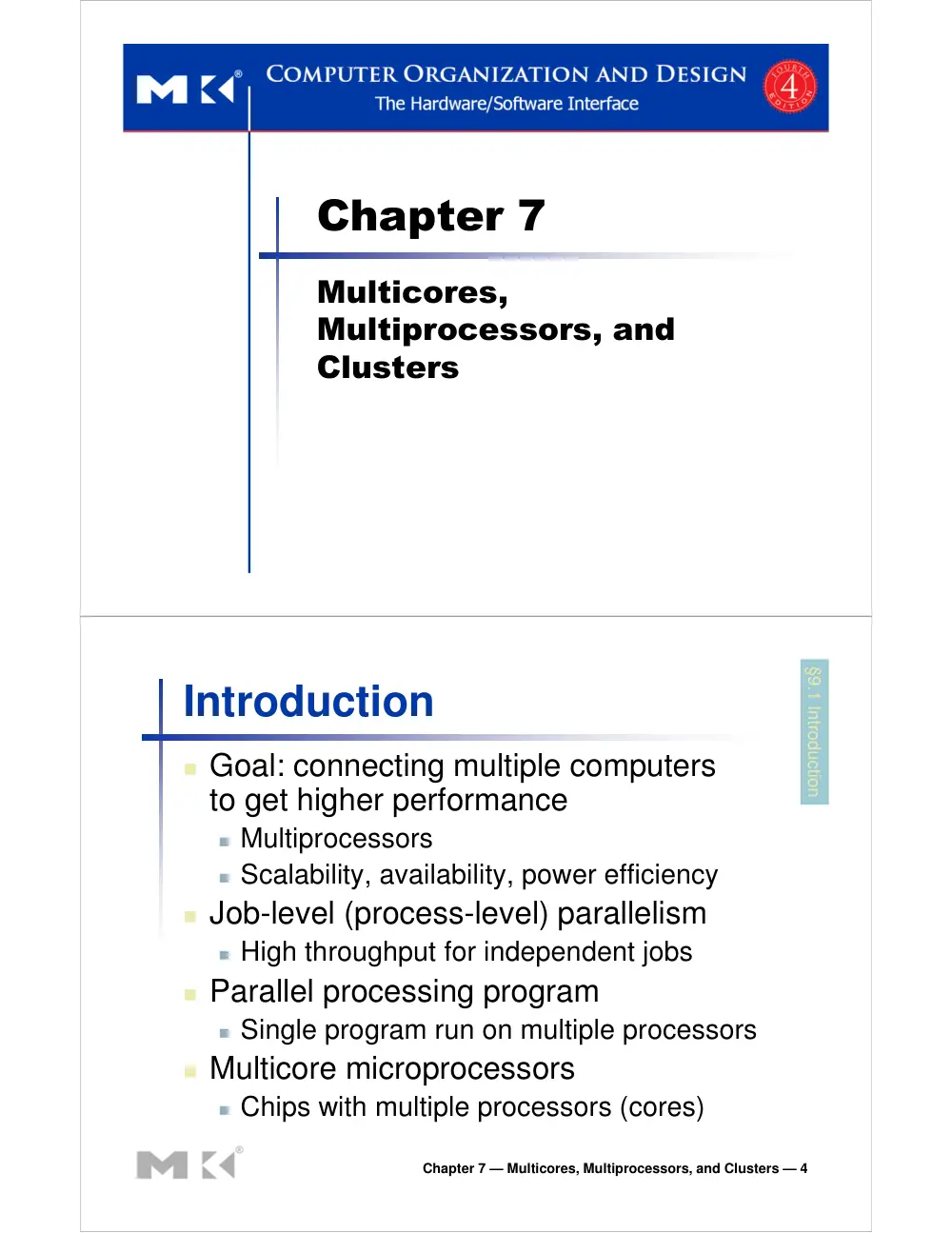
Chapter 7
Multicores,
Multiprocessors, and
Clusters
Chapter 7 — Multicores, Multiprocessors, and Clusters — 4
Introduction
� Goal: connecting multiple computers
to get higher performance
� Multiprocessors
� Scalability, availability, power efficiency
� Job-level (process-level) parallelism
� High throughput for independent jobs
� Parallel processing program
� Single program run on multiple processors
� Multicore microprocessors
� Chips with multiple processors (cores)
§9.1 Introduction
Chapter 7 — Multicores, Multiprocessors, and Clusters — 5
Hardware and Software
� Hardware
� Serial: e.g., Pentium 4
� Parallel: e.g., quad-core Xeon e5345
� Software
� Sequential: e.g., matrix multiplication
� Concurrent: e.g., operating system
� Sequential/concurrent software can run on
serial/parallel hardware
� Challenge: making effective use of parallel
hardware
Chapter 7 — Multicores, Multiprocessors, and Clusters — 7
Parallel Programming
� Parallel software is the problem
� Need to get significant performance
improvement
� Otherwise, just use a faster uniprocessor,
since it’s easier!
� Difficulties
� Partitioning
� Coordination
� Communications overhead
§7.2 The Difficulty of Creating Parallel Processing Programs
Chapter 7 — Multicores, Multiprocessors, and Clusters — 8
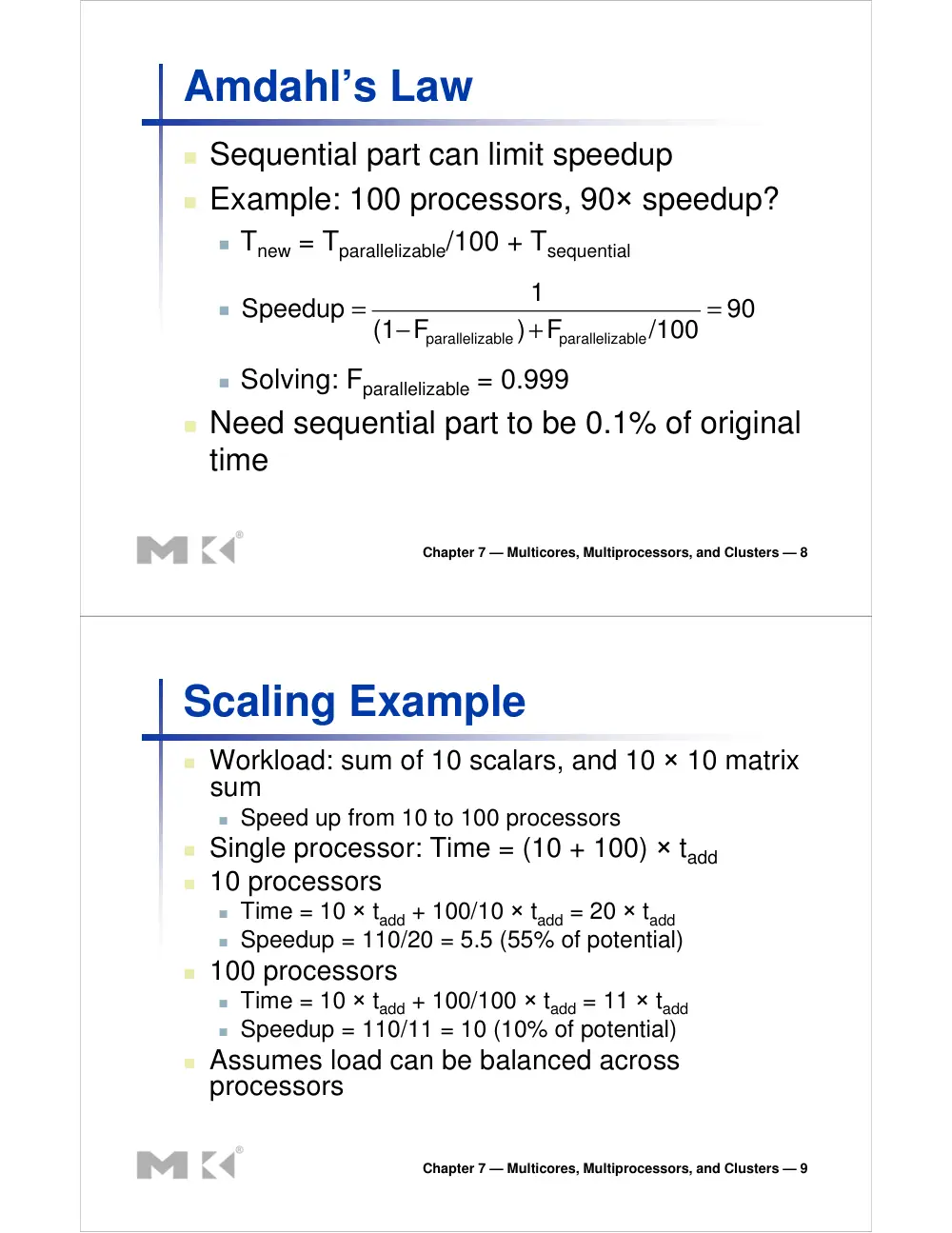
Amdahl’s Law
� Sequential part can limit speedup
� Example: 100 processors, 90× speedup?
� Tnew = Tparallelizable/100 + Tsequential
�
� Solving: Fparallelizable = 0.999
� Need sequential part to be 0.1% of original
time
90
/100
F
)
(1 F
1
Speedup
parallelizable
parallelizable
=
+
−
=
Chapter 7 — Multicores, Multiprocessors, and Clusters — 9
Scaling Example
� Workload: sum of 10 scalars, and 10 × 10 matrix
sum
� Speed up from 10 to 100 processors
� Single processor: Time = (10 + 100) × tadd
� 10 processors
� Time = 10 × tadd + 100/10 × tadd = 20 × tadd
� Speedup = 110/20 = 5.5 (55% of potential)
� 100 processors
� Time = 10 × tadd + 100/100 × tadd = 11 × tadd
� Speedup = 110/11 = 10 (10% of potential)
� Assumes load can be balanced across
processors
Chapter 7 — Multicores, Multiprocessors, and Clusters — 10
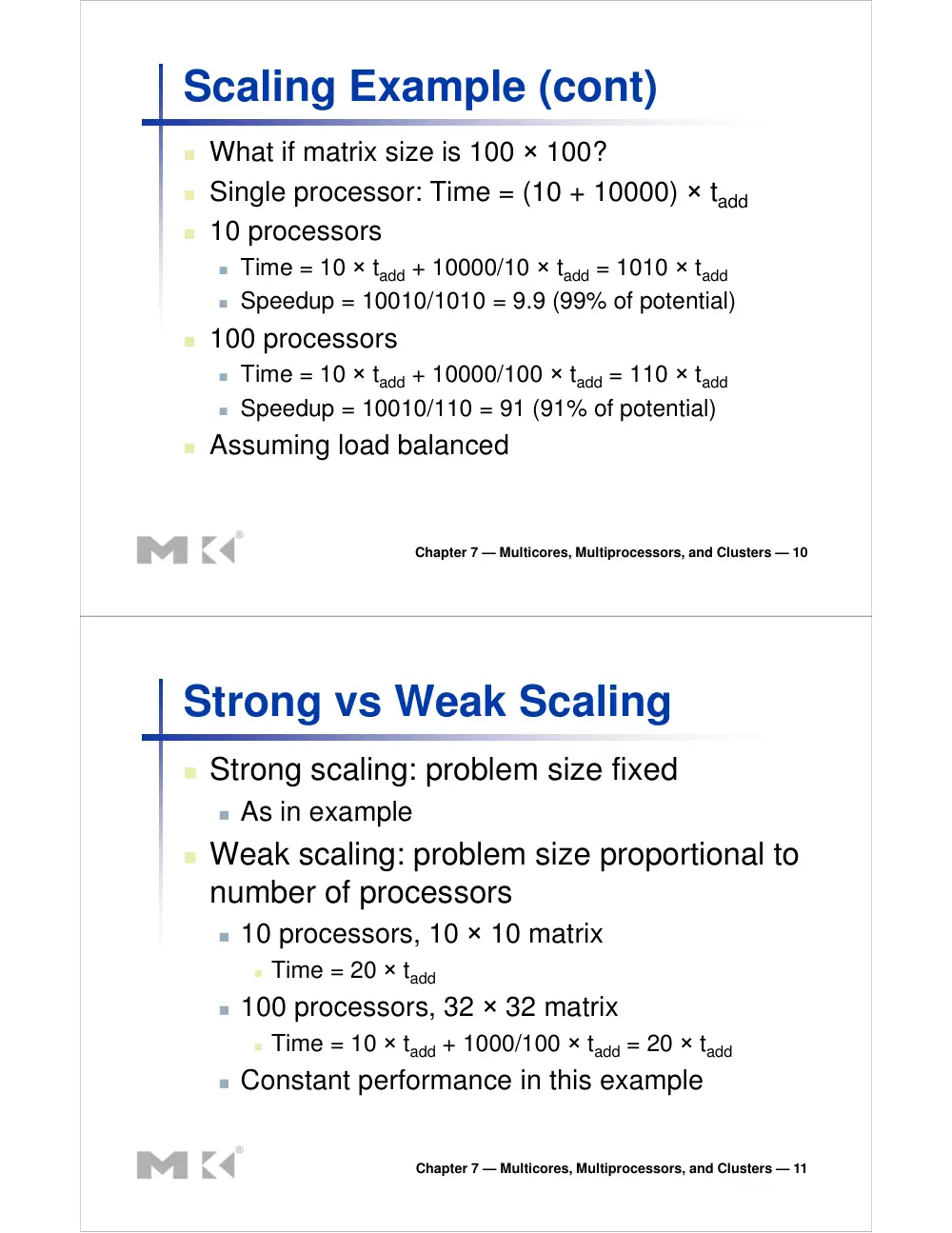
Scaling Example (cont)
� What if matrix size is 100 × 100?
� Single processor: Time = (10 + 10000) × tadd
� 10 processors
� Time = 10 × tadd + 10000/10 × tadd = 1010 × tadd
� Speedup = 10010/1010 = 9.9 (99% of potential)
� 100 processors
� Time = 10 × tadd + 10000/100 × tadd = 110 × tadd
� Speedup = 10010/110 = 91 (91% of potential)
� Assuming load balanced
Chapter 7 — Multicores, Multiprocessors, and Clusters — 11
Strong vs Weak Scaling
� Strong scaling: problem size fixed
� As in example
� Weak scaling: problem size proportional to
number of processors
� 10 processors, 10 × 10 matrix
� Time = 20 × tadd
� 100 processors, 32 × 32 matrix
� Time = 10 × tadd + 1000/100 × tadd = 20 × tadd
� Constant performance in this example
Chapter 7 — Multicores, Multiprocessors, and Clusters — 12
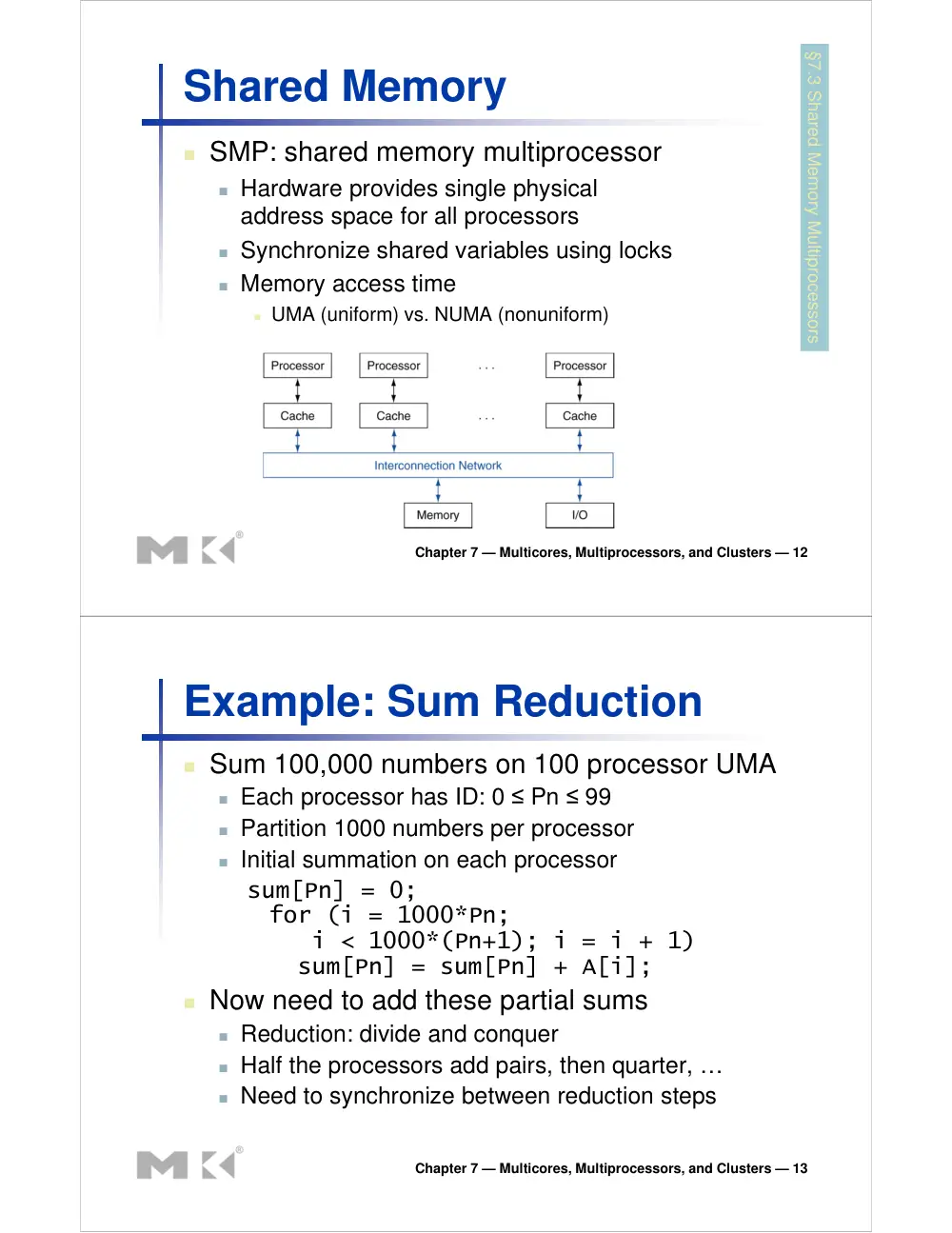
Shared Memory
� SMP: shared memory multiprocessor
� Hardware provides single physical
address space for all processors
� Synchronize shared variables using locks
� Memory access time
� UMA (uniform) vs. NUMA (nonuniform)
§7.3 Shared Memory Multiprocessors
Chapter 7 — Multicores, Multiprocessors, and Clusters — 13
Example: Sum Reduction
� Sum 100,000 numbers on 100 processor UMA
� Each processor has ID: 0 ≤ Pn ≤ 99
� Partition 1000 numbers per processor
� Initial summation on each processor
sum[Pn] = 0;
for (i = 1000*Pn;
i < 1000*(Pn+1); i = i + 1)
sum[Pn] = sum[Pn] + A[i];
� Now need to add these partial sums
� Reduction: divide and conquer
� Half the processors add pairs, then quarter, …
� Need to synchronize between reduction steps
Chapter 7 — Multicores, Multiprocessors, and Clusters — 14
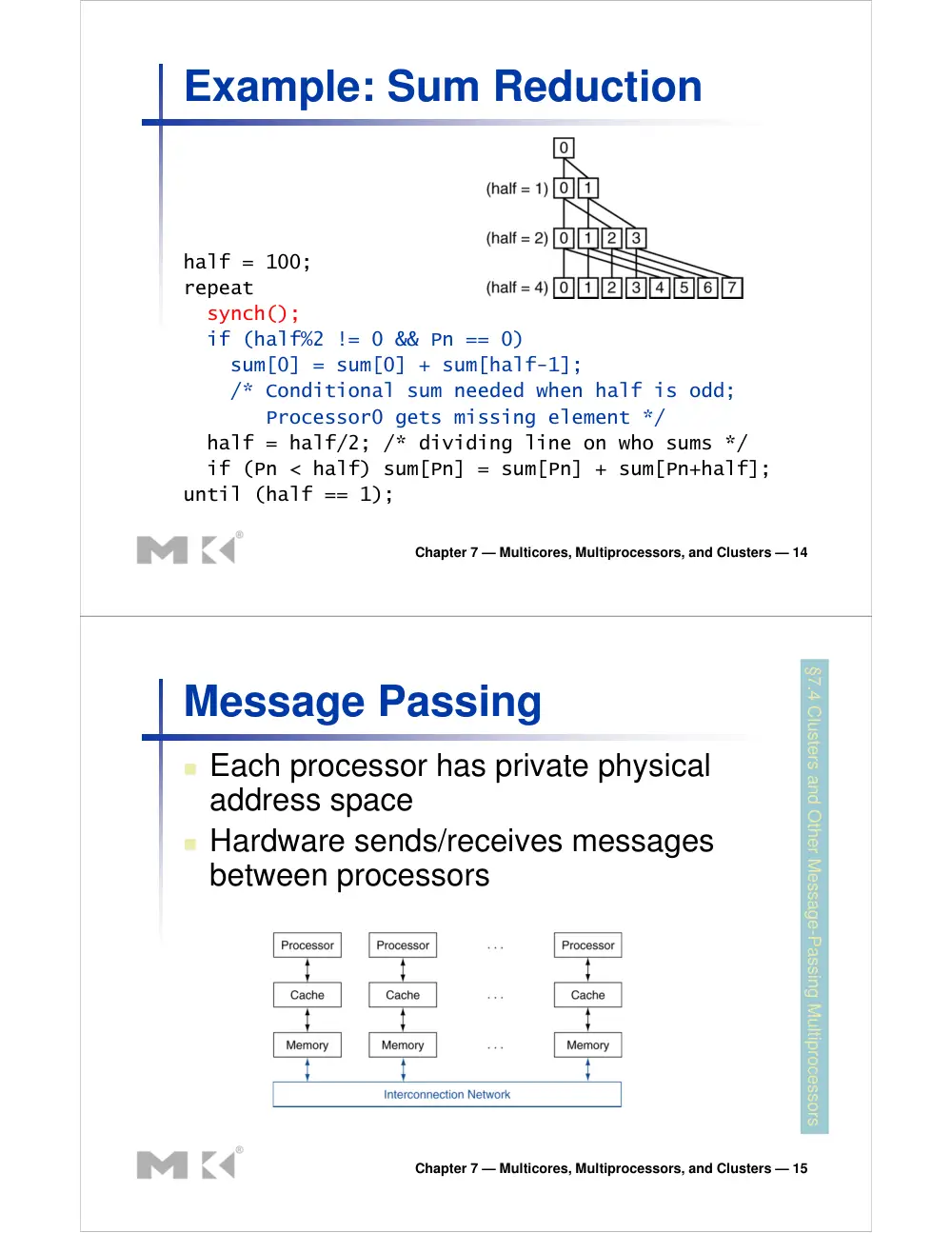
Example: Sum Reduction
half = 100;
repeat
synch();
if (half%2 != 0 && Pn == 0)
sum[0] = sum[0] + sum[half-1];
/* Conditional sum needed when half is odd;
Processor0 gets missing element */
half = half/2; /* dividing line on who sums */
if (Pn < half) sum[Pn] = sum[Pn] + sum[Pn+half];
until (half == 1);
Chapter 7 — Multicores, Multiprocessors, and Clusters — 15
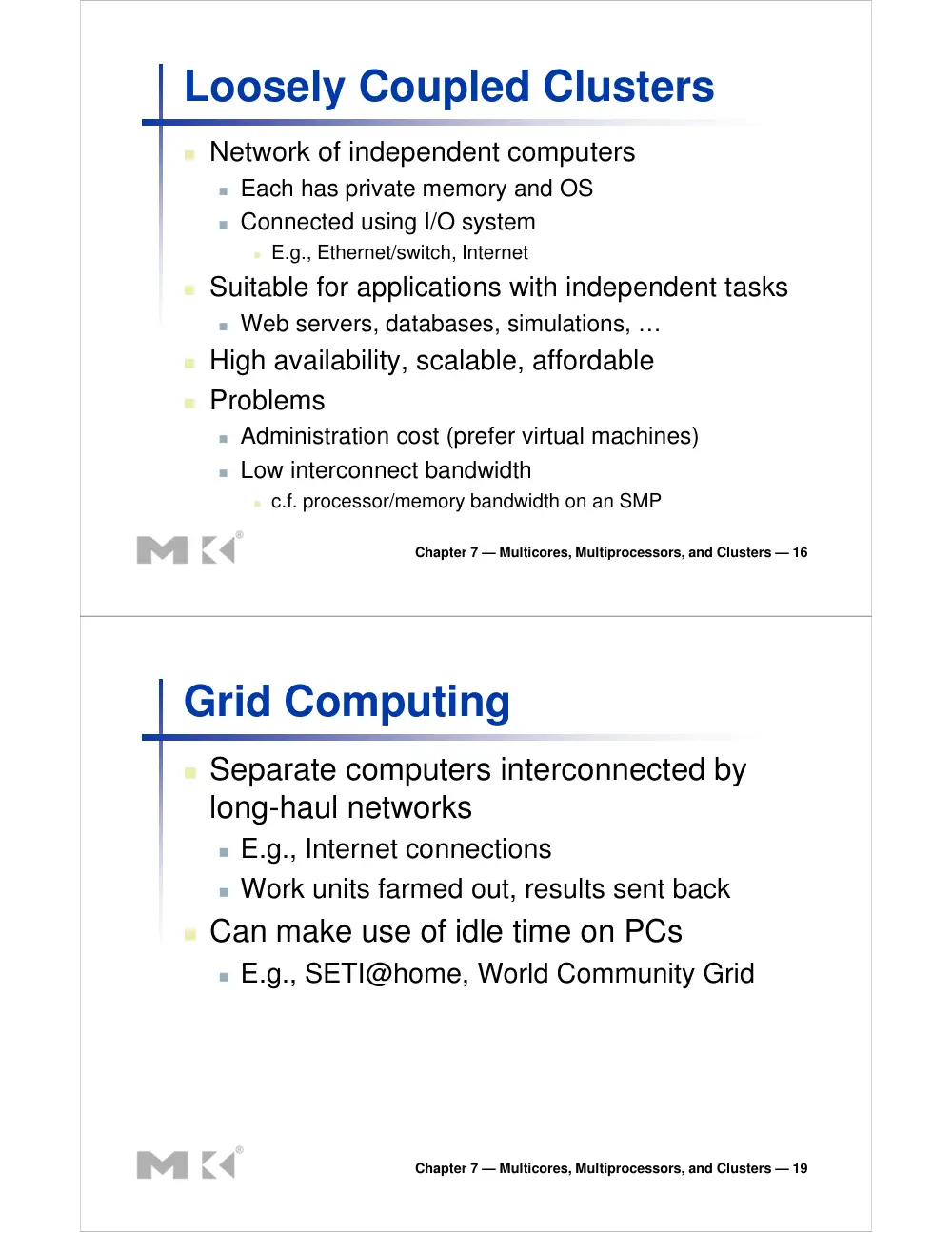
Message Passing
� Each processor has private physical
address space
� Hardware sends/receives messages
between processors
§7.4 Clusters and Other Message-Passing Multiprocessors
Chapter 7 — Multicores, Multiprocessors, and Clusters — 16
Loosely Coupled Clusters
� Network of independent computers
� Each has private memory and OS
� Connected using I/O system
� E.g., Ethernet/switch, Internet
� Suitable for applications with independent tasks
� Web servers, databases, simulations, …
� High availability, scalable, affordable
� Problems
� Administration cost (prefer virtual machines)
� Low interconnect bandwidth
� c.f. processor/memory bandwidth on an SMP
Chapter 7 — Multicores, Multiprocessors, and Clusters — 19
Grid Computing
� Separate computers interconnected by
long-haul networks
� E.g., Internet connections
� Work units farmed out, results sent back
� Can make use of idle time on PCs
� E.g., SETI@home, World Community Grid
Chapter 7 — Multicores, Multiprocessors, and Clusters — 20
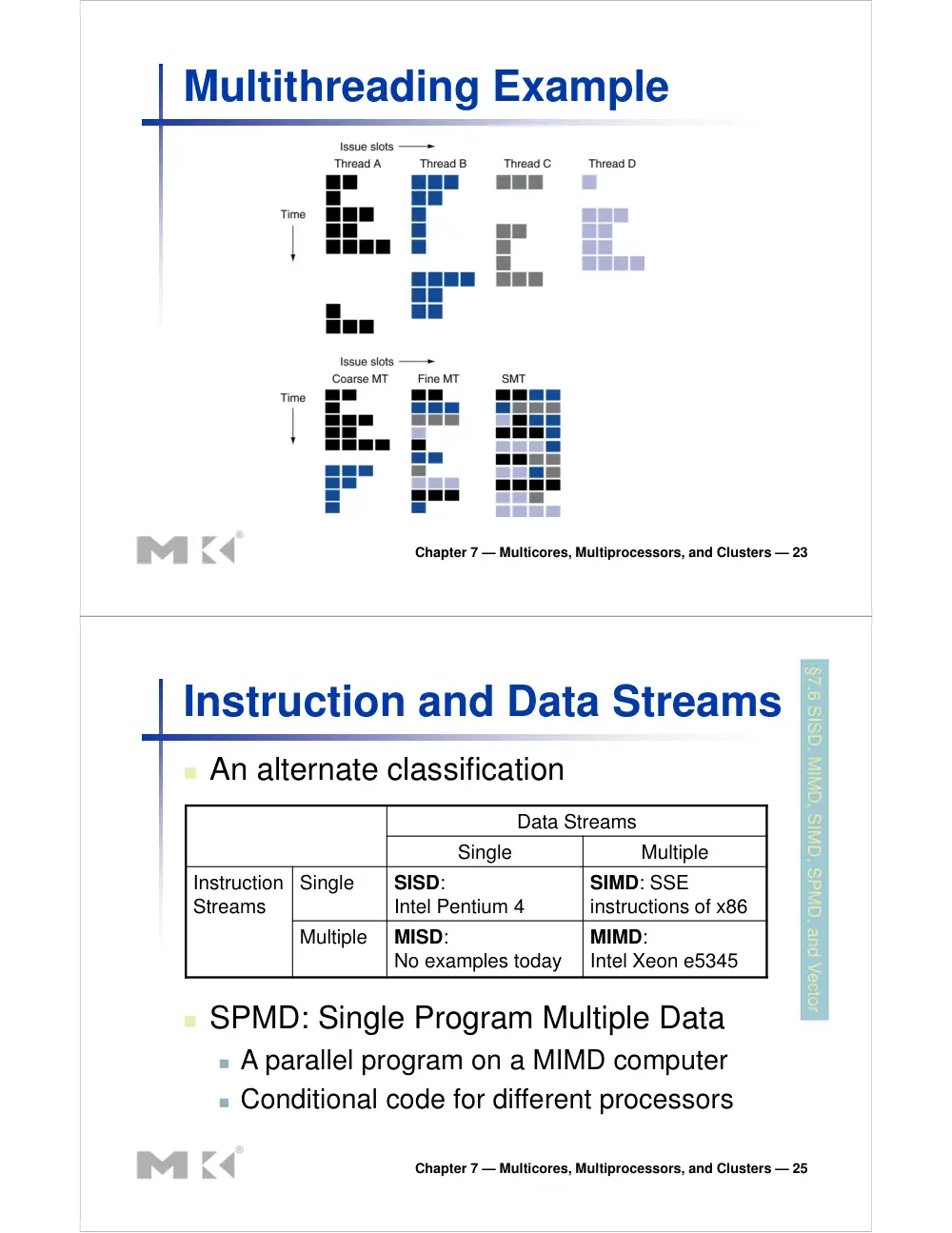
Multithreading
� Performing multiple threads of execution in
parallel
� Replicate registers, PC, etc.
� Fast switching between threads
� Fine-grain multithreading
� Switch threads after each cycle
� Interleave instruction execution
� If one thread stalls, others are executed
� Coarse-grain multithreading
� Only switch on long stall (e.g., L2-cache miss)
� Simplifies hardware, but doesn’t hide short stalls
(eg, data hazards)
§7.5 Hardware Multithreading
Chapter 7 — Multicores, Multiprocessors, and Clusters — 21
Simultaneous Multithreading
� In multiple-issue dynamically scheduled
processor
� Schedule instructions from multiple threads
� Instructions from independent threads execute
when function units are available
� Within threads, dependencies handled by
scheduling and register renaming
Chapter 7 — Multicores, Multiprocessors, and Clusters — 23
Multithreading Example
Chapter 7 — Multicores, Multiprocessors, and Clusters — 25
Instruction and Data Streams
� An alternate classification
§7.6 SISD, MIMD, SIMD, SPMD, and Vector
Data Streams
Single
Multiple
Instruction
Streams
Single
SISD:
Intel Pentium 4
SIMD: SSE
instructions of x86
Multiple
MISD:
No examples today
MIMD:
Intel Xeon e5345
� SPMD: Single Program Multiple Data
� A parallel program on a MIMD computer
� Conditional code for different processors
Chapter 7 — Multicores, Multiprocessors, and Clusters — 30
History of GPUs
� Early video cards
� Frame buffer memory with address generation for
video output
� 3D graphics processing
� Originally high-end computers (e.g., SGI)
� Moore’s Law ⇒ lower cost, higher density
� 3D graphics cards for PCs and game consoles
� Graphics Processing Units
� Processors oriented to 3D graphics tasks
� Vertex/pixel processing, shading, texture mapping,
rasterization
§7.7 Introduction to Graphics Processing Units
Chapter 7 — Multicores, Multiprocessors, and Clusters — 32
GPU Architectures
� Processing is highly data-parallel
� GPUs are highly multithreaded
� Use thread switching to hide memory latency
� Less reliance on multi-level caches
� Graphics memory is wide and high-bandwidth
� Trend toward general purpose GPUs
� Heterogeneous CPU/GPU systems
� CPU for sequential code, GPU for parallel code
� Programming languages/APIs
� DirectX, OpenGL
� C for Graphics (Cg), High Level Shader Language
(HLSL)
� Compute Unified Device Architecture (CUDA)
Chapter 7 — Multicores, Multiprocessors, and Clusters — 33
Example: NVIDIA Tesla
Streaming
multiprocessor
8 × Streaming
processors
Chapter 7 — Multicores, Multiprocessors, and Clusters — 34
Example: NVIDIA Tesla
� Streaming Processors
� Single-precision FP and integer units
� Each SP is fine-grained multithreaded
� Warp: group of 32 threads
� Executed in parallel,
� SIMD
8 SPs
× 4 clock cycles
Chapter 7 — Multicores, Multiprocessors, and Clusters — 36
Interconnection Networks
� Network topologies
� Arrangements of processors, switches, and links
§7.8 Introduction to Multiprocessor Network Topologies
Bus
Ring
2D Mesh
N-cube (N = 3)
Fully connected
Chapter 7 — Multicores, Multiprocessors, and Clusters — 37
Multistage Networks
Chapter 7 — Multicores, Multiprocessors, and Clusters — 38
Network Characteristics
� Performance
� Latency per message (unloaded network)
� Throughput
� Congestion delays (depending on traffic)
� Cost
� Power
� Routability in silicon
Chapter 7 — Multicores, Multiprocessors, and Clusters — 54
Concluding Remarks
� Goal: higher performance by using multiple
processors
� Difficulties
� Developing parallel software
� Devising appropriate architectures
� Many reasons for optimism
� Changing software and application environment
� Chip-level multiprocessors with lower latency,
higher bandwidth interconnect
� An ongoing challenge for computer architects!
§7.13 Concluding Remarks