
ETH 201 Lecture 2, Fall 2016
Lebanese American University · Moral Reasoning · 19 pages · Dr. Mahmoud Baassiri
Showing the first 10 of 19 pages. Download the PDF to see all of it.
More ETH 201 files
Show the text of this lab
Chapter 1
Buddhist morality
Morality is woven into the fabric of Buddhist teachings and there is
no major branch or school of Buddhism that fails to emphasize the
importance of the moral life. The scriptures of Buddhism in every
language speak eloquently of virtues such as non-violence and
compassion, and the Buddhist version of the ‘Golden Rule’ counsels
us not to do anything to others we would not like done to ourselves.
Although newcomers to Buddhism are often struck by the variety of
the different Asian traditions, as divergent in form as Zen and
Tibetan Buddhism, at the level of moral teachings there is much
common ground. Some might disagree, but my own view is that
we can speak of a common moral core underlying the divergent
customs, practices, and philosophical teachings of the different
schools. This core is composed of the principles and precepts, and
the values and virtues expounded by the Buddha in the 5th century
bce and which continue to guide the conduct of some 350 million
Buddhists around the world today. The purpose of this first chapter
is to review these basic moral teachings.
Dharma
The ultimate foundation for Buddhist ethics is Dharma. Dharma
has many meanings, but the underlying notion is of a universal law
which governs both the physical and moral order of the universe.
Dharma can best be translated as ‘natural law’, a term that captures
both its main senses, namely as the principle of order and regularity
seen in the behaviour of natural phenomena, and also the idea of a
universal moral law whose requirements have been revealed by
enlightened beings such as the Buddha (note that Buddha claimed
only to have discovered Dharma, not to have invented it). Every
aspect of life is regulated by Dharma, from the succession of
the seasons to the movement of the planets and constellations.
Dharma is neither caused by nor under the control of a supreme
being, and the gods themselves are subject to its laws, as was the
Buddha. In the moral order, Dharma is manifest in the law of
karma, which, as we shall see below, governs the way moral deeds
affect individuals in present and future lives. Living in accordance
with Dharma and implementing its requirements is thought
to lead to happiness, fulfilment, and salvation; neglecting or
transgressing it is said to lead to endless suffering in the cycle
of rebirth (sam
˙ sa¯ra).
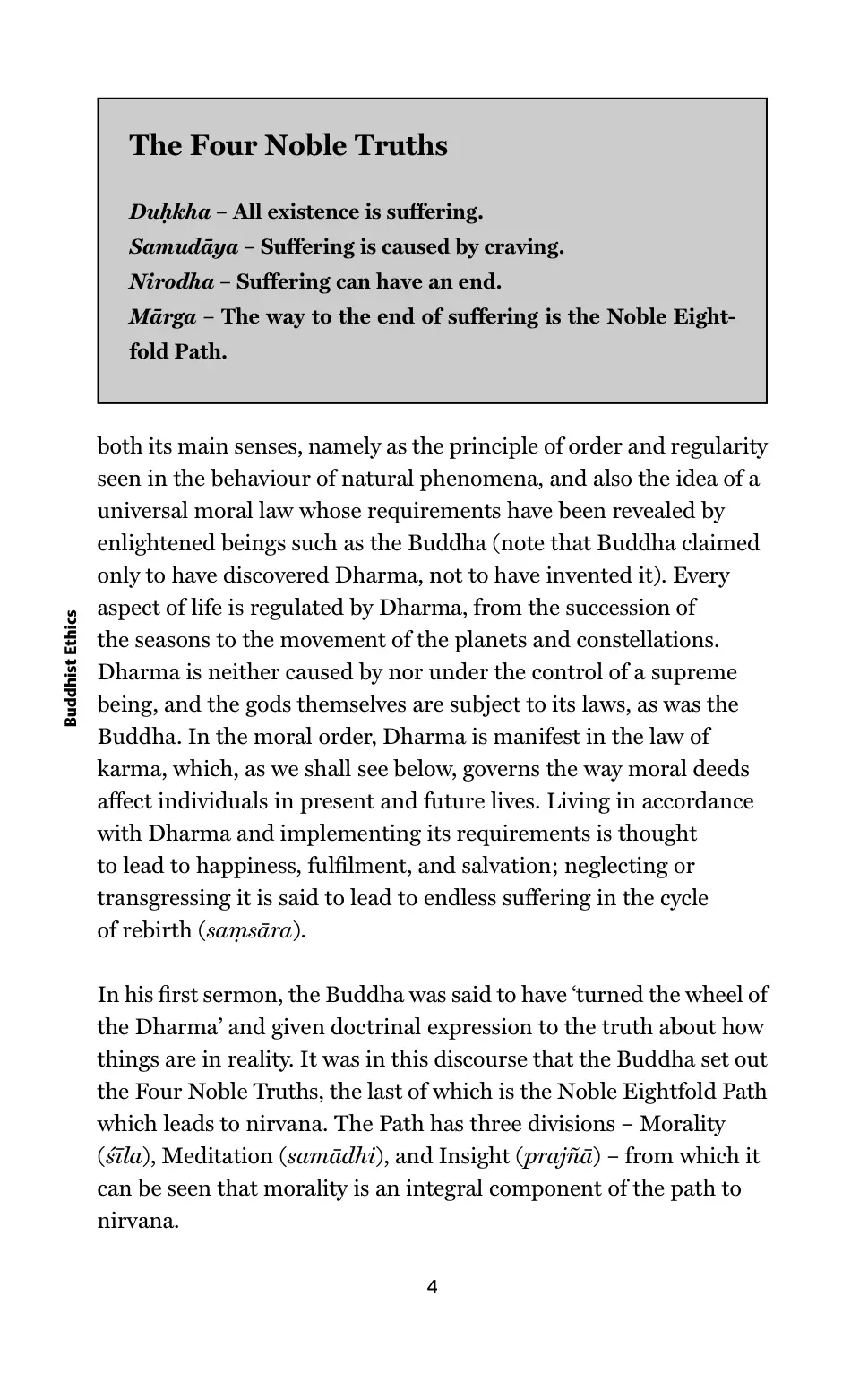
In his first sermon, the Buddha was said to have ‘turned the wheel of
the Dharma’ and given doctrinal expression to the truth about how
things are in reality. It was in this discourse that the Buddha set out
the Four Noble Truths, the last of which is the Noble Eightfold Path
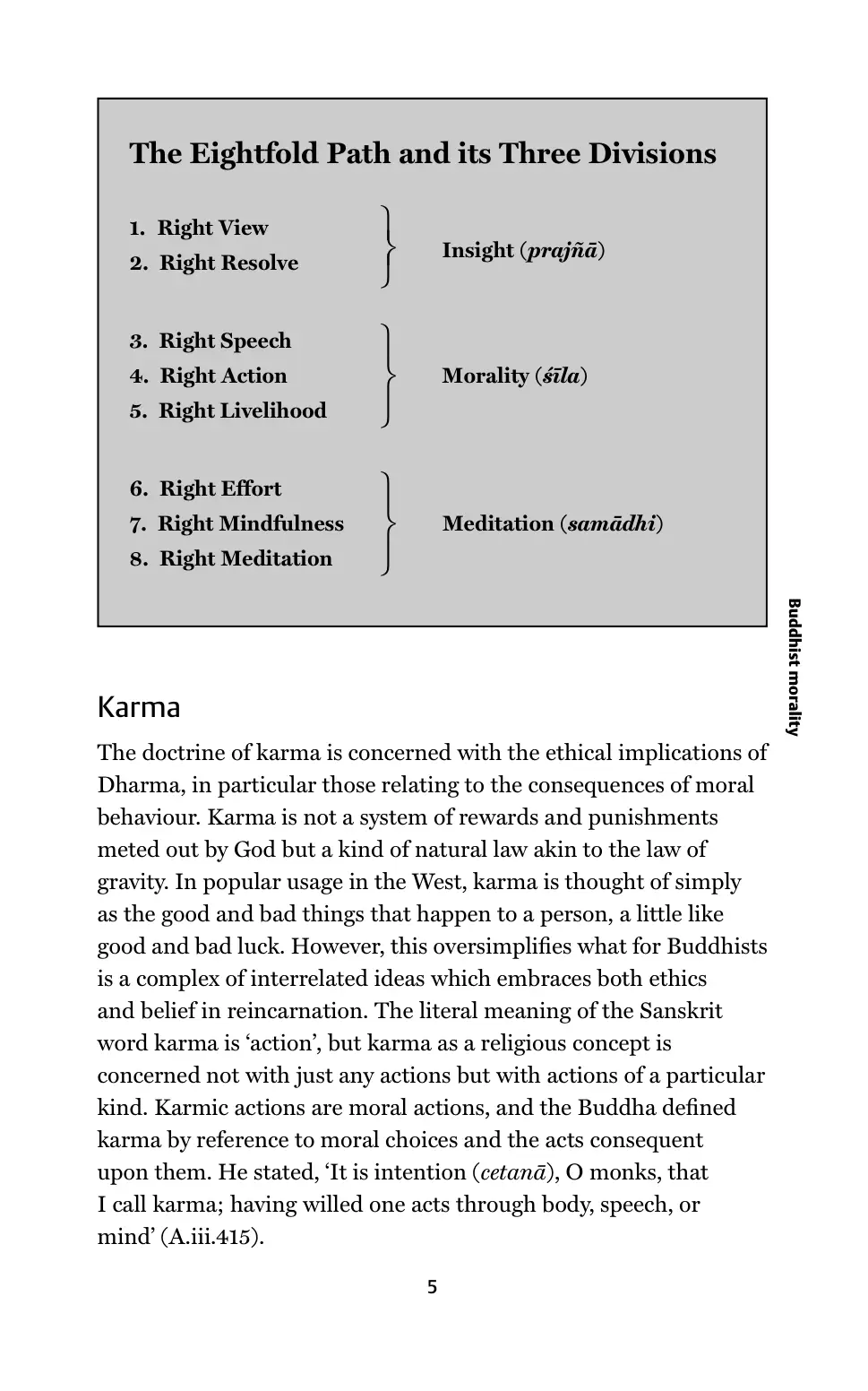
which leads to nirvana. The Path has three divisions – Morality
(s´ı¯la), Meditation (sama¯dhi), and Insight (prajña¯) – from which it
can be seen that morality is an integral component of the path to
nirvana.
The Four Noble Truths
Duh
˙
kha – All existence is suffering.
Samuda¯ya – Suffering is caused by craving.
Nirodha – Suffering can have an end.
Ma¯rga – The way to the end of suffering is the Noble Eight-
fold Path.
Buddhist Ethics
4
Karma
The doctrine of karma is concerned with the ethical implications of
Dharma, in particular those relating to the consequences of moral
behaviour. Karma is not a system of rewards and punishments
meted out by God but a kind of natural law akin to the law of
gravity. In popular usage in the West, karma is thought of simply
as the good and bad things that happen to a person, a little like
good and bad luck. However, this oversimplifies what for Buddhists
is a complex of interrelated ideas which embraces both ethics
and belief in reincarnation. The literal meaning of the Sanskrit
word karma is ‘action’, but karma as a religious concept is
concerned not with just any actions but with actions of a particular
kind. Karmic actions are moral actions, and the Buddha defined
karma by reference to moral choices and the acts consequent
upon them. He stated, ‘It is intention (cetana¯), O monks, that
I call karma; having willed one acts through body, speech, or
mind’ (A.iii.415).
The Eightfold Path and its Three Divisions
1. Right View
Insight (prajña¯)
2. Right Resolve
3. Right Speech
Morality (s´ı¯la)
4. Right Action
5. Right Livelihood
6. Right Effort
Meditation (sama¯dhi)
7. Right Mindfulness
8. Right Meditation
Buddhist morality
5
Moral actions are unlike other actions in that they have both
transitive and intransitive effects. The transitive effect is seen in the
direct impact moral actions have on others; for example, when
we kill or steal, someone is deprived of his life or property. The
intransitive effect is seen in the way moral actions affect the agent.
According to Buddhism, human beings have free will, and in the
exercise of free choice they engage in self-determination. In a
very real sense, individuals create themselves through their
moral choices. By freely and repeatedly choosing certain sorts
of things, individuals shape their characters, and through their
characters their futures. As the English proverb has it: ‘Sow an act,
reap a habit; sow a habit, reap a character; sow a character,
reap a destiny.’ The process of creating karma may be likened
to the work of a potter who moulds the clay into a finished shape:
the soft clay is one’s character, and when we make moral choices
we hold ourselves in our hands and shape our natures for good
or ill. It is not hard to see how even within the course of a single
lifetime particular patterns of behaviour lead inexorably to
certain results. Great works of literature reveal how the fate
that befalls the protagonists is due not to chance but to a
character flaw that leads to a tragic series of events. The remote
effects of karmic choices are referred to as the ‘maturation’ (vipa¯ka)
or ‘fruit’ (phala) of the karmic act. The metaphor is an agricultural
one: performing good and bad deeds is like planting seeds
that will fruit at a later date. Othello’s jealousy, Macbeth’s
ruthless ambition, and Hamlet’s hesitation and self-doubt
would all be seen by Buddhists as karmic seeds, and the tragic
outcome in each case would be the inevitable ‘fruit’ of the choices
these character-traits predisposed the individual to make.
Individuals are thus to a large extent the authors of their good
and bad fortune.
Not all the consequences of what a person does are experienced in
the lifetime in which the deeds are performed. Karma that has been
accumulated but not yet experienced is carried forward to the next
life, or even many lifetimes ahead. Certain key aspects of a person’s
Buddhist Ethics
6
next rebirth are thought of as karmically determined. These
include the family into which one is born, one’s social status,
physical appearance, and of course, one’s character and personality,
since these are simply carried over from the previous life. The
doctrine of karma, however, does not claim that everything
that happens to a person is karmically determined. Many of
the things that happen in life – like winning a raffle or catching
a cold – may simply be random events or accidents. Karma does
not determine precisely what will happen or how anyone will
react to what happens, and individuals are always free to
resist previous conditioning and establish new patterns of
behaviour.
What, then, makes an action good or bad? From the Buddha’s
definition above, it can be seen to be largely a matter of intention
and choice. The psychological springs of motivation are described
in Buddhism as ‘roots’, and there are said to be three good roots
and three bad roots. Actions motivated by greed (ra¯ga), hatred
(dves˙a), and delusion (moha) are bad (akus´ala), while actions
motivated by their opposites – non-attachment, benevolence,
and understanding – are good (kus´ala). Making progress to
enlightenment, however, is not simply a matter of having good
intentions, and evil is sometimes done by people who act from
the highest motives. Good intentions, therefore, must find
expression in right actions, and right actions are basically
those that are wholesome and do no harm to either oneself or
others. The kinds of actions that fail these requirements are
prohibited in various sets of precepts, about which more will be
said below.
Merit
Karma can be either good or bad. Buddhists speak of good karma
as ‘merit’ (pun˙ ya; Pa¯li, puñña), and much effort is expended in
acquiring it (its opposite, bad karma, is known as pa¯pa). Some
Buddhists picture merit as a kind of spiritual capital – like money
in a bank account – whereby credit is built up as the deposit on a
Buddhist morality
7
heavenly rebirth. One of the best ways for a layman to earn merit
is by supporting the sangha, or order of monks. This can be done
by placing food in the bowls of monks as they pass on their daily
alms round, by providing robes for the monks, by listening to
sermons and attending religious services, and by donating
funds for the upkeep of monasteries and temples. Merit can
even be made by congratulating other donors and rejoicing in
their generosity. Some Buddhists make the accumulation of
merit an end in itself, and go to the extreme of carrying a
notebook to keep a tally of their karmic ‘balance’. This is to
lose sight of the fact that merit is earned as a by-product of
doing what is right. To do good deeds simply to obtain good
karma would be to act from a selfish motive, and would not earn
much merit.
In many Buddhist cultures, there is a belief in ‘merit transference’,
or the idea that good karma can be shared with others, just like
money. Donating good karma has the happy result that instead
of one’s own karmic balance being depleted, as it would in
the case of money, it increases as a result of the generous
motivation in sharing. The more one gives, the more one
receives! It is doubtful to what extent there is canonical authority
for notions of this kind, although the motivation to share one’s
merit in a spirit of generosity is certainly karmically wholesome
since it would lead to the formation of a generous and benevolent
character.
Precepts
In common with Indian tradition as a whole, Buddhism expresses
its ethical requirements in the form of duties rather than rights.
These duties are thought of as implicit requirements of Dharma.
The most general moral duties are those found in the Five Precepts,
for example the duty to refrain from evil acts such as killing and
stealing. On becoming a Buddhist, one formally ‘takes’ (or accepts)
the precepts in a ritual context known as ‘going for refuge’, and the
Buddhist Ethics
8
form of words used acknowledges the free and voluntary nature of
the duty assumed.
Apart from the Five Precepts, various other lists of precepts are found,
such as the Eight Precepts (as˙t˙a¯n˙ga-s´ı¯la) and the Ten Precepts
(das´a-s´ı¯la). These are commonly adopted as additional
commitments on the twice-monthly holy days (pos˙adha; Pa¯li,
uposatha), and supplement the first four of the Five Precepts with
additional restrictions such as the time when meals may be taken.
Another set of precepts similar to the Ten Precepts is the Ten Good
Paths of Action (das´a-kus´ala-karmapatha). Precepts like these
which apply to the laity are comparatively few in number compared
to those observed by monks and nuns, as explained below.
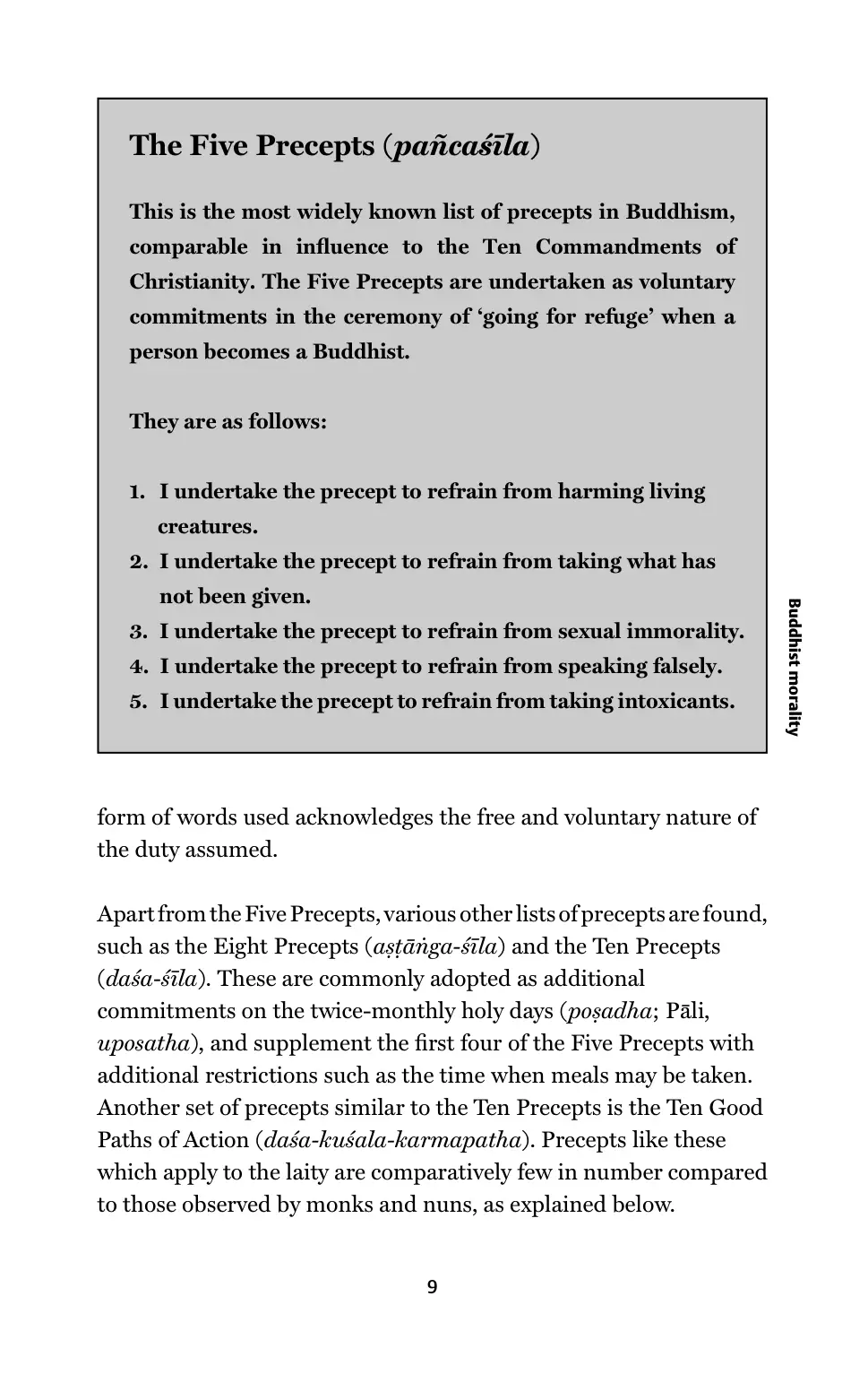
The Five Precepts (pañcas´ı¯la)
This is the most widely known list of precepts in Buddhism,
comparable in influence to the Ten Commandments of
Christianity. The Five Precepts are undertaken as voluntary
commitments in the ceremony of ‘going for refuge’ when a
person becomes a Buddhist.
They are as follows:
1. I undertake the precept to refrain from harming living
creatures.
2. I undertake the precept to refrain from taking what has
not been given.
3. I undertake the precept to refrain from sexual immorality.
4. I undertake the precept to refrain from speaking falsely.
5. I undertake the precept to refrain from taking intoxicants.
Buddhist morality
9
Vinaya
A term often found paired with Dharma is Vinaya. Particularly in
early sources, the compound ‘Dharma-Vinaya’ (‘doctrine and
discipline’) is used to denote the whole body of Buddhist teachings
and practice. Originally, the Buddhist monastic order (sangha)
existed as just another sect within a broad community of wandering
teachers and students known as parivra¯jakas or s´raman˙ as. From
these simple beginnings evolved a complex code for the regulation
of monastic life which eventually became formulated in a portion of
the canon known as the Vinaya Pit˙aka. The Vinaya Pit˙aka also
contains a large number of stories and biographical material
relating to the Buddha, as well as a certain amount of historical
matter regarding the sangha.
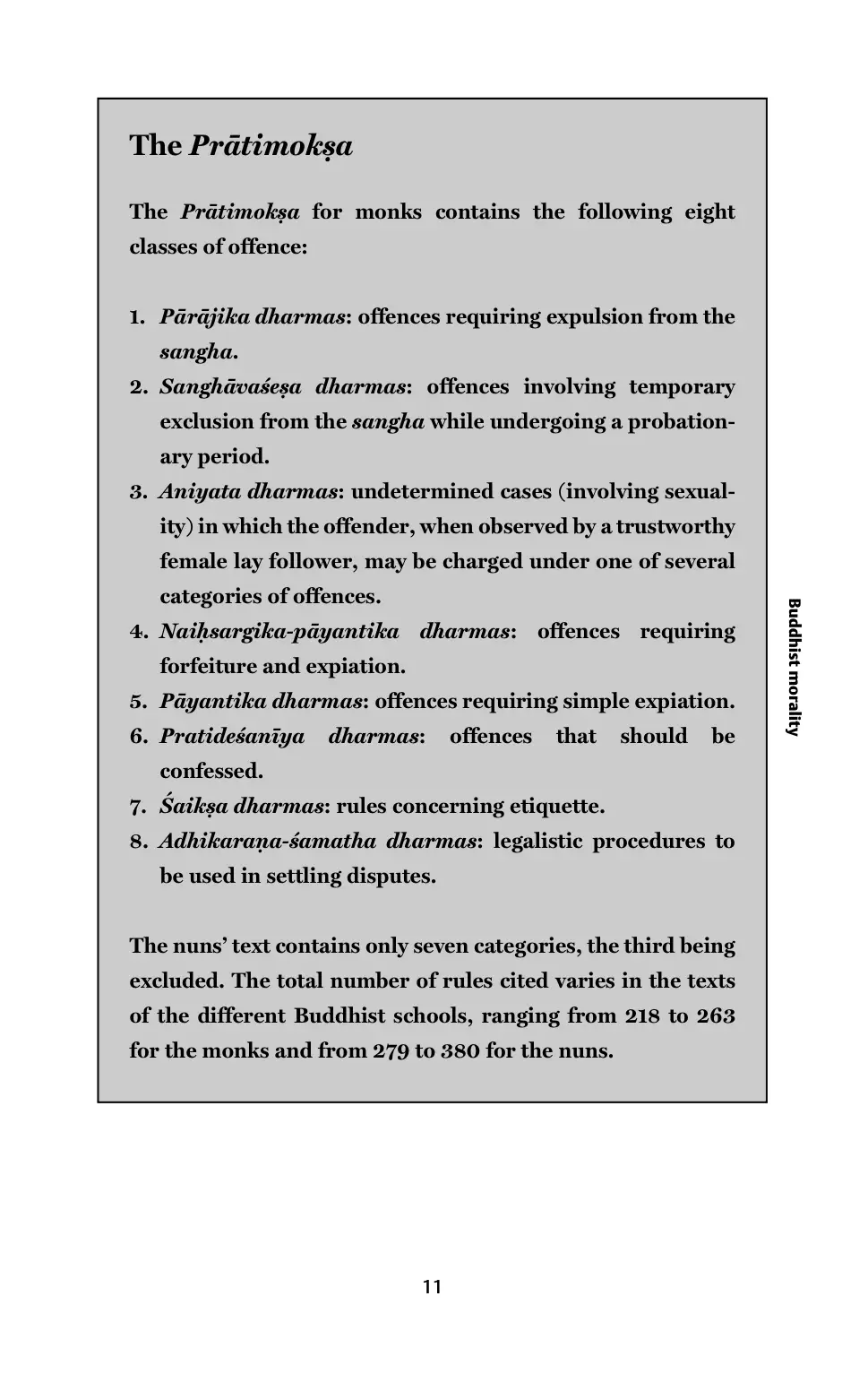
The Pra¯timoks
˙
a
The purpose of the Vinaya is to regulate in detail life within the
community of monks and nuns and also their relationship with
the laity. In its final form the text is divided into three sections,
the first of which contains the set of rules for monks and nuns
known as the Pra¯timoks˙a (Pa¯li, Pa¯timokkha). The Pra¯timoks˙a is an
inventory of offences organized into several categories according
to the gravity of the offence. It embraces not only moral questions,
such as lying and stealing, but also matters of dress, etiquette,
and the general deportment of monks and nuns. Many scholars
now agree that the Pra¯timoks˙a seems to have undergone at
least three stages of development: as a simple confession of
faith recited by Buddhist monks and nuns at periodic intervals;
as a bare monastic code ensuring proper monastic discipline;
and as a monastic liturgy, representing a period of relatively
high organization and structure within the sangha. This
inventory of offences became formalized into a communally
chanted liturgy known as the Pra¯timoks˙a-su¯tra, which is
recited as a kind of public confession at the pos˙adha, or
fast-day ceremony, on the new and the full moon days each
month.
Buddhist Ethics
10
The Pra¯timoks
˙
a
The Pra¯timoks
˙
a for monks contains the following eight
classes of offence:
1. Pa¯ra¯jika dharmas: offences requiring expulsion from the
sangha.
2. Sangha¯vas´es
˙
a dharmas: offences involving temporary
exclusion from the sangha while undergoing a probation-
ary period.
3. Aniyata dharmas: undetermined cases (involving sexual-
ity) in which the offender, when observed by a trustworthy
female lay follower, may be charged under one of several
categories of offences.
4. Naih
˙
sargika-pa¯yantika dharmas: offences requiring
forfeiture and expiation.
5. Pa¯yantika dharmas: offences requiring simple expiation.
6. Pratides´anı¯ya
dharmas:
offences
that
should
be
confessed.
7. S´aiks
˙
a dharmas: rules concerning etiquette.
8. Adhikaran
˙
a-s´amatha dharmas: legalistic procedures to
be used in settling disputes.
The nuns’ text contains only seven categories, the third being
excluded. The total number of rules cited varies in the texts
of the different Buddhist schools, ranging from 218 to 263
for the monks and from 279 to 380 for the nuns.
Buddhist morality
11
Virtues
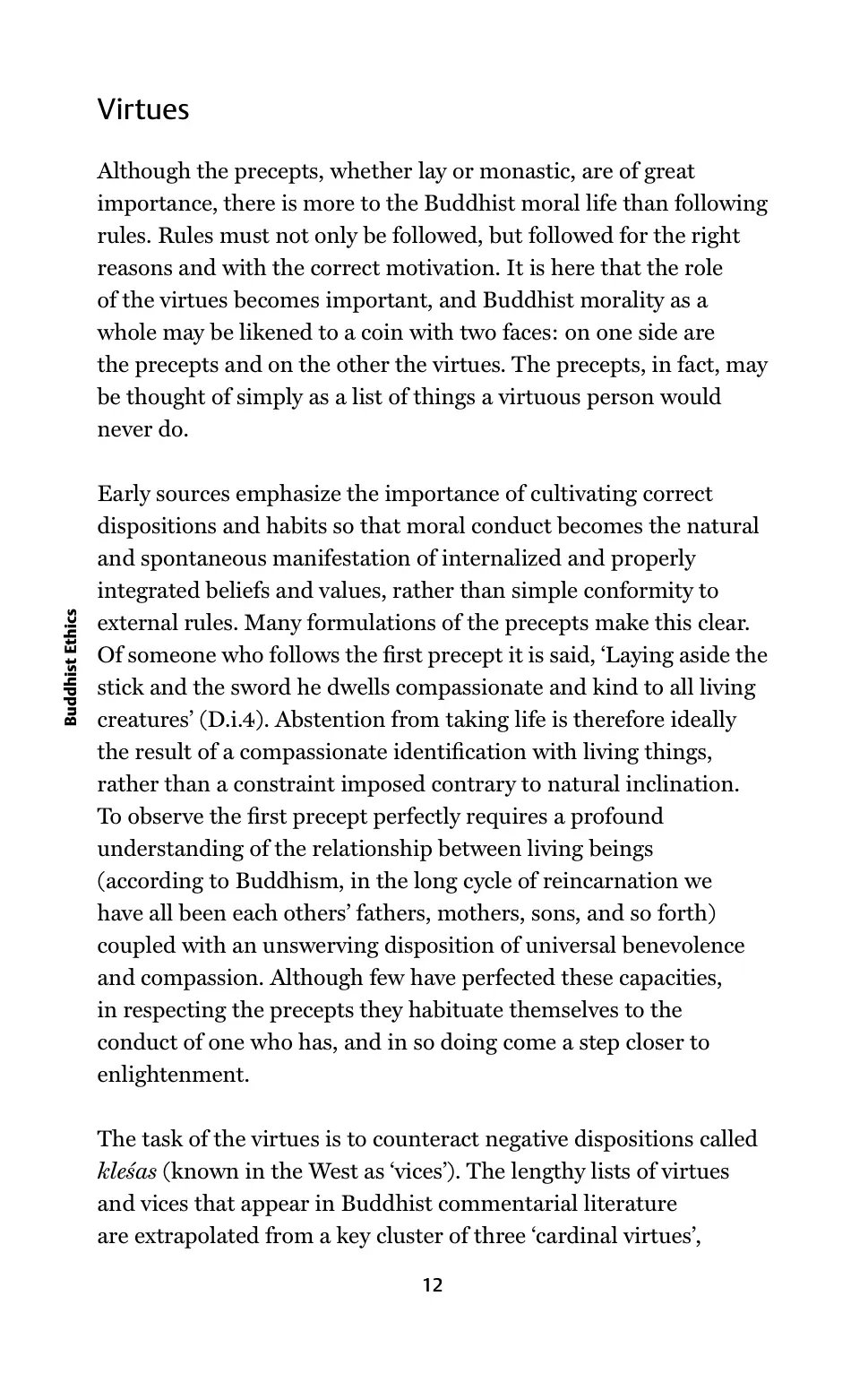
Although the precepts, whether lay or monastic, are of great
importance, there is more to the Buddhist moral life than following
rules. Rules must not only be followed, but followed for the right
reasons and with the correct motivation. It is here that the role
of the virtues becomes important, and Buddhist morality as a
whole may be likened to a coin with two faces: on one side are
the precepts and on the other the virtues. The precepts, in fact, may
be thought of simply as a list of things a virtuous person would
never do.
Early sources emphasize the importance of cultivating correct
dispositions and habits so that moral conduct becomes the natural
and spontaneous manifestation of internalized and properly
integrated beliefs and values, rather than simple conformity to
external rules. Many formulations of the precepts make this clear.
Of someone who follows the first precept it is said, ‘Laying aside the
stick and the sword he dwells compassionate and kind to all living
creatures’ (D.i.4). Abstention from taking life is therefore ideally
the result of a compassionate identification with living things,
rather than a constraint imposed contrary to natural inclination.
To observe the first precept perfectly requires a profound
understanding of the relationship between living beings
(according to Buddhism, in the long cycle of reincarnation we
have all been each others’ fathers, mothers, sons, and so forth)
coupled with an unswerving disposition of universal benevolence
and compassion. Although few have perfected these capacities,
in respecting the precepts they habituate themselves to the
conduct of one who has, and in so doing come a step closer to
enlightenment.
The task of the virtues is to counteract negative dispositions called
kles´as (known in the West as ‘vices’). The lengthy lists of virtues
and vices that appear in Buddhist commentarial literature
are extrapolated from a key cluster of three ‘cardinal virtues’,
Buddhist Ethics
12
non-attachment (ara¯ga), benevolence (adves˙a), and understanding
(amoha). These are the opposites of the three ‘roots of evil’, or
‘three poisons’, namely greed (ra¯ga), hatred (dves˙a), and delusion
(moha). Non-attachment means the absence of that selfish desire
which taints behaviour by allocating a privileged status to one’s
own needs. Benevolence means an attitude of goodwill to all
living creatures, and understanding means knowledge of
Buddhist teachings such as the Four Noble Truths. While these
are the three most basic Buddhist virtues, there are many others,
one of the most important of which is compassion (karun˙ a¯).
Buddhist sources spend a great deal of time encouraging
people to cultivate virtuous dispositions as a means of spiritual
development, and some scholars feel that given this emphasis
on the virtues Buddhist ethics is best classified as a form of
‘virtue ethics’, a suggestion we will consider further in the next
chapter.
Da¯na
One of the most important virtues for lay Buddhists in particular is
da¯na, which means ‘giving’, or generosity. The primary recipient of
lay Buddhist generosity is the sangha – since monks and nuns
possess nothing, they are entirely dependent upon the laity for
support. The laity provides all the material needs of the monastic
community, everything from food, robes, and medicine to the land
and buildings which constitute the monastic residence. In the
kat˙hina ceremony, which takes place following the annual rains
retreat in countries where Therava¯da Buddhism is practised, cotton
cloth is supplied to the monks by the laity for the purpose of making
robes. The relationship is not just one-way, for in return monks
provide Dharma teachings to the laity, and the gift of the Dharma is
said to be the highest of all gifts. At all levels of society – between
family members, friends, and even strangers – generosity is widely
practised in Buddhist countries and seen as an indication of
spiritual development. This is because the generous person, as well
as being free from egocentric thoughts and sensitive to the needs of
others, finds it easier to practise renunciation and cultivate an
Buddhist morality
13
attitude of detachment. The story of Prince Vessantara, the popular
hero of the Vessantara Ja¯taka, is well known in South Asia.
Vessantara gave away everything he owned, even down to his wife
and children! Many Therava¯da sources praise da¯na, and Maha¯ya¯na
sources emphasize the extreme generosity of bodhisattvas, who are
disposed to give away even parts of their bodies, or their lives, in
order to aid others. As we shall see below, da¯na is also the first of the
‘Six Perfections’ (pa¯ramita¯) of a bodhisattva.
Ahim
˙
sa¯
One of the most basic principles of Buddhist ethics, and one for
which Buddhism is widely admired, is ahim
˙ sa¯. Although the term
literally means ‘non-harming’ or ‘non-violence’, it embodies much
more than these negative-sounding translations suggest. Ahim
˙ sa¯ is
not simply the absence of something, but is practised on the basis of
a deeply positive feeling of respect for living beings, a moral position
associated in the West with the terms ‘respect for life’ or the ‘sanctity
of life’. The principle of respect for life as understood in Western
ethics holds that it is always morally wrong to intentionally cause
harm or injury to living creatures (some proponents of the principle
allow exceptions in cases such as self-defence, but others do not). In
India, the concept of ahim
˙ sa¯ seems to have originated among the
unorthodox renouncer (s´raman˙ a) movements, in other words
among non-Brahmanical schools like Buddhism and Jainism. These
placed greater emphasis on concern (daya¯) and sympathy
(anukampa¯) for living creatures, and an increasing empathy with
them based on the awareness that others dislike pain and death just
as much as oneself. Animal sacrifice, which had played an important
part in religious rites in India from ancient times, was rejected by
both Buddhism and Jainism as cruel and barbaric. Due in part to
their influence, blood sacrifices in the orthodox Brahmanical
tradition came increasingly to be replaced by symbolic offerings
such as vegetables, fruit, and milk. Many Buddhists – especially
followers of the Maha¯ya¯na in East Asia – have embraced
vegetarianism, since this diet does not involve the slaughter of
animals (vegetarianism is discussed further in Chapter 3).
Buddhist Ethics
14
Among the renouncers, the principle of respect for life was
sometimes taken to extremes. Jain monks, for example, took the
greatest precautions against destroying tiny forms of life such as
insects, even unintentionally. Their practices had some influence on
Buddhism; for example, Buddhist monks often used a strainer
to make sure they did not destroy small creatures in their
drinking-water. They also avoided travel during the monsoon so
they would not tread on insects and other small creatures that
became abundant after the rains. Concern is even apparent in early
sources about the practice of agriculture because of the inevitable
destruction of life caused by ploughing the earth. In general,
however, Buddhism regards the destruction of life as morally wrong
only when it is caused intentionally (in other words, when the death
of creatures is the outcome sought).
Due to its association with ahim
˙ sa¯, Buddhism is generally
perceived as non-violent and peace-loving, an impression that is
to a large extent correct. While Buddhist countries have not been
free from war and conflict, as we shall see in Chapter 5, Buddhist
teachings constantly praise non-violence and express disapproval
of killing or causing injury to living things.
Compassion
Compassion (karun˙ a¯) is a virtue that is of importance in all schools
of Buddhism but it is particularly emphasized by the Maha¯ya¯na.
In early Buddhism, karun˙ a¯ figures as the second of the four
Brahma-viha¯ras, or ‘Divine Abidings’. These are states of mind
cultivated especially through the practice of meditation. The four
are loving-kindness (metta¯), compassion (karun˙ a¯), sympathetic joy
(mudita¯), and equanimity (upekkha¯). The practice of the four
Brahma-viha¯ras involves radiating outwards the positive qualities
associated with each, directing them first towards oneself, then to
one’s family, the local community, and eventually to all beings in
the universe. In Maha¯ya¯na iconography and art, the symbolic
embodiment of compassion is the great bodhisattva Avalokites´vara,
‘the one who looks down from on high’. He is portrayed as having a
Buddhist morality
15
thousand arms extended in all directions to minister to those in
need and is constantly appealed to by those in difficult
circumstances. In the course of time in Buddhism there appeared a
doctrine of salvation by faith according to which the mere
invocation of the name of a Buddha was sufficient, given the extent
of the Buddha’s compassion, to ensure rebirth in a ‘Pure Land’, or
heaven.
2. The Bodhisattva Avalokites´vara, the embodiment of compassion,
with a thousand arms and multiple heads and faces
Buddhist Ethics
16
Maha¯ya¯na morality
The Maha¯ya¯na was a major movement in the history of Buddhism
embracing many schools in a sweeping reinterpretation of
fundamental religious ideals, beliefs, and values. Although there
is no evidence for the existence of the Maha¯ya¯na prior to the
2nd century ce, it can be assumed that the movement began to
crystallize earlier, incorporating the teachings of various existing
schools. In the Maha¯ya¯na, the bodhisattva who devotes himself to
the service of others becomes the new paradigm for religious
practice, as opposed to the arhat, or saint in the early tradition,
who is now criticized for leading a cloistered life devoted to the
self-interested pursuit of liberation. Schools that embraced
the earlier ideal are henceforth referred to disparagingly as the
Hı¯naya¯na (‘Small Vehicle’), or the S´ra¯vakaya¯na (‘Vehicle of the
Hearers’). In the Maha¯ya¯na great emphasis is placed on the twin
values of compassion (karun˙ a¯) and insight (prajña¯), and the
bodhisattva practises six special virtues known as the ‘Six
Perfections’ (pa¯ramita¯). It can be seen that three of these
(s´ı¯la, sama¯dhi, and prajña¯) coincide with the three divisions of
the Eightfold Path of early Buddhism, demonstrating both
continuity and reconfiguration in the evolving moral tradition.
The Maha¯ya¯na did not reject the ethical teachings of early
Buddhism but subsumed them under an expanded framework of its
The Six Perfections (pa¯ramita¯)
Generosity (da¯na)
Morality (s´ı¯la)
Patience (ks
˙
a¯nti)
Perseverance (vı¯rya)
Meditation (sama¯dhi)
Insight (prajña¯)
Buddhist morality
17
own, within which three levels were identified. The first level was
known as ‘Moral Discipline’ (sam
˙ vara-s´ı¯la) and consisted of the
scrupulous observance of the moral precepts. The second level was
known as the ‘Cultivation of Virtue’ (kus´ala-dharma-sam
˙ gra¯haka-
s´ı¯la) and was concerned with the accumulation of the good qualities
necessary for the attainment of nirvana. The third category was
known as ‘Altruistic Conduct’ (sattva-artha-kriya¯-s´ı¯la) and
consisted of moral action directed to the needs of others. The
Maha¯ya¯na claimed that the early followers had access only to the
first level and that their moral practices were deficient in lacking
concern for the wellbeing of others.
The Maha¯ya¯na is not a monolithic system, and there is no one
‘official’ code of ethics for either laymen or monks. The Vinayas of
the early schools were not rejected and continued to be observed by
monks and nuns alongside the new teachings recommended for
bodhisattvas in Maha¯ya¯na literature.
Skilful Means (upa¯ya-kaus´alya)
An important innovation in Maha¯ya¯na ethics was the doctrine of
Skilful Means (upa¯ya-kaus´alya). The roots of this notion are found
in the Buddha’s skill in teaching the Dharma, demonstrated in his
ability to adapt his message to the context in which it was delivered.
For example, when talking to Brahmins, the Buddha would often
explain his teachings by reference to their rituals and traditions,
leading his audience step by step to see the truth of a Buddhist
tenet. Parables, metaphors, and similes formed an important part of
his teaching repertoire, skilfully tailored to suit the level of his
audience. The Maha¯ya¯na developed this idea in a radical way by
intimating, in texts such as the Lotus Su¯tra (circa 1st century ce),
that the early teachings were not just skilfully delivered, but were a
means to an end in their entirety in the sense that they contained
nothing that could not be modified to suit the demands of changing
situations. This idea has certain implications for ethics. If the
teachings the Buddha had given were provisional rather than
ultimate, then perhaps the precepts they contain could also be of a
Buddhist Ethics
18
provisional rather than an ultimate nature? Thus the clear and
strict rules encountered in the early sources which prohibit certain
sorts of acts could be interpreted more in the way of guidelines
rather than as ultimately binding. In particular, bodhisattvas, the
new moral heroes of the Maha¯ya¯na, could claim increased latitude
and flexibility based on their recognition of the importance of
compassion. A bodhisattva takes a vow to save all beings, and there
is evidence in many texts of impatience with rules and regulations
which seem to get in the way of a bodhisattva going about his
salvific mission. The new imperative was to act in accordance with
the spirit and not the letter of the precepts, and some sources go so
far as to allow karun˙ a¯ to override other considerations, and even
sanction immoral acts, if the bodhisattva sees that so doing would
prevent or reduce suffering.
The pressure to bend or suspend the rules in the interests of
compassion results in certain texts establishing new codes of
conduct for bodhisattvas which sometimes allow the precepts to
be broken. In some of these, such as the Upa¯ya-kaus´alya-su¯tra
(circa 1st century bce), even killing is said to be justified to prevent
someone committing a heinous crime and suffering karmic
retribution in hell. Telling lies, abandoning celibacy, and other
breaches of the precepts are also said to be permissible in
exceptional circumstances. It is not always clear whether such
behaviour is held up by the texts as normative and a model for
imitation by others, or to make a point about the great compassion
of bodhisattvas, who willingly accept the karmic consequences of
breaking the precepts as the price of helping others.
In Tantric teachings, too, the precepts are sometimes set aside.
Tantra, also known as the Vajraya¯na (‘Diamond Vehicle’) or
Mantraya¯na (‘Vehicle of Mantras’), is a form of Buddhism that
developed in India in the 6th century ce and is characterized by
antinomianism (the reversal of moral norms) and the use of magical
techniques that aim to speed the practitioner to enlightenment in a
single lifetime. One