
ETH 201 Lecture 6, Fall 2016
Lebanese American University · Moral Reasoning · 29 pages · Dr. Mahmoud Baassiri
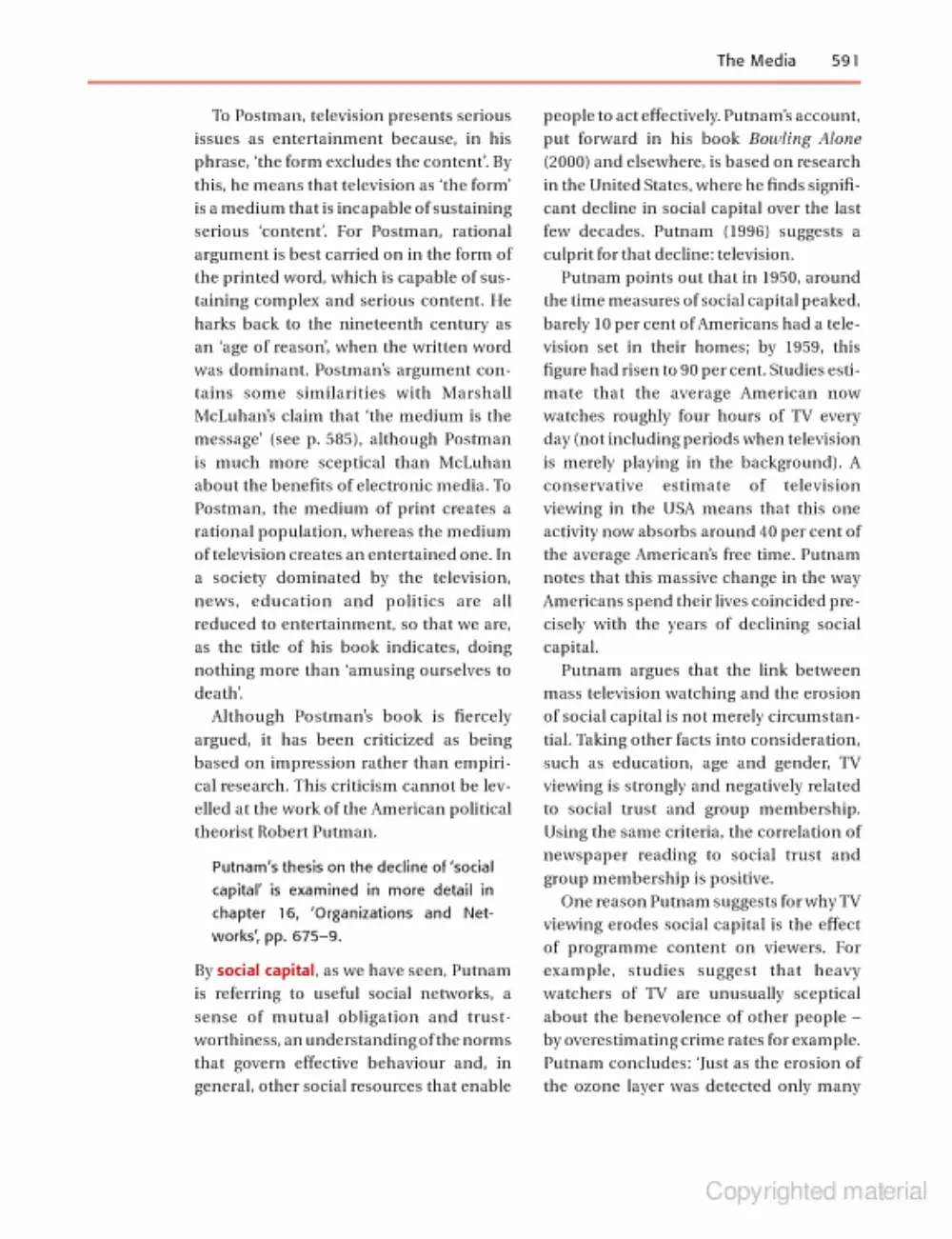
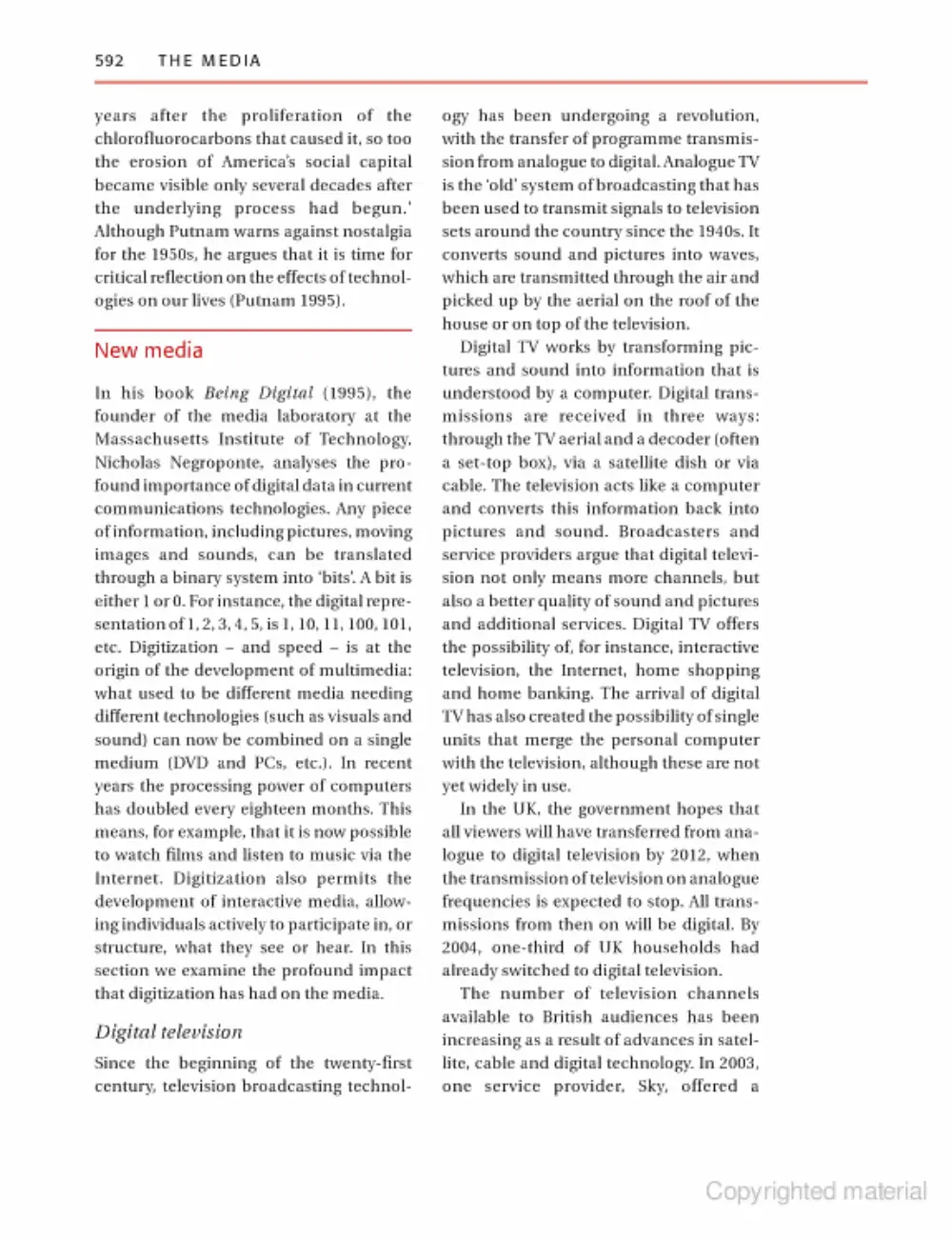
Showing the first 10 of 29 pages. Download the PDF to see all of it.
More ETH 201 files
Show the text of this lab
NM 11 SEPTEMBER 2001, terrorists
hijacked three planes and used them
te attack sites in Washington and New
York. The timing of the attacks was such
that when a plane crashed into the second
of the Twin Towers In New York, around
twenty minutes after the first tower had
been struck, it is estimated that a global
audience of two billion watched the
incident on television in real time. Almost
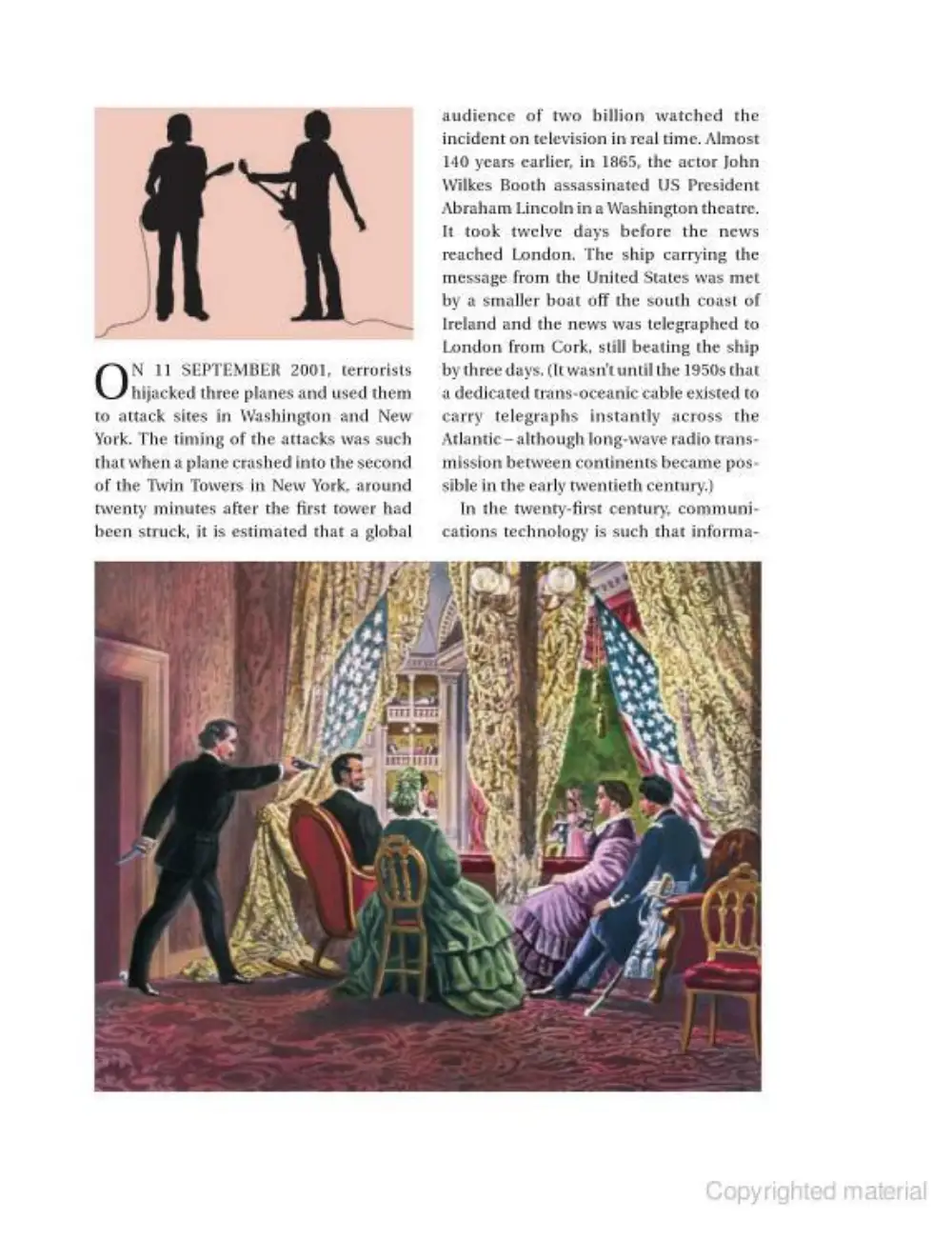
140 years earlier, in 1465, the actor John
Wilkes Booth assassinated US President
Abraham Lincoln ine Washington theatre.
It took twelve days before the news
reached London. The ship carrying the
message from the United States was moet
by # smaller boat off the south coast of
Ireland and the news was telegraphed to
Landon from Cork, still beating the ship
by three days. (it wasn'tuntil the 1950s that
a dedicated trans-oceanic cable existed ta
carry telegraphs instantly across the
Atlantic — although long-wave radio trans-
mission between continents became pos:
sible in the early twentieth century.}
In the twenty-first century, communi-
cations technology is such that informa-
The Media 585
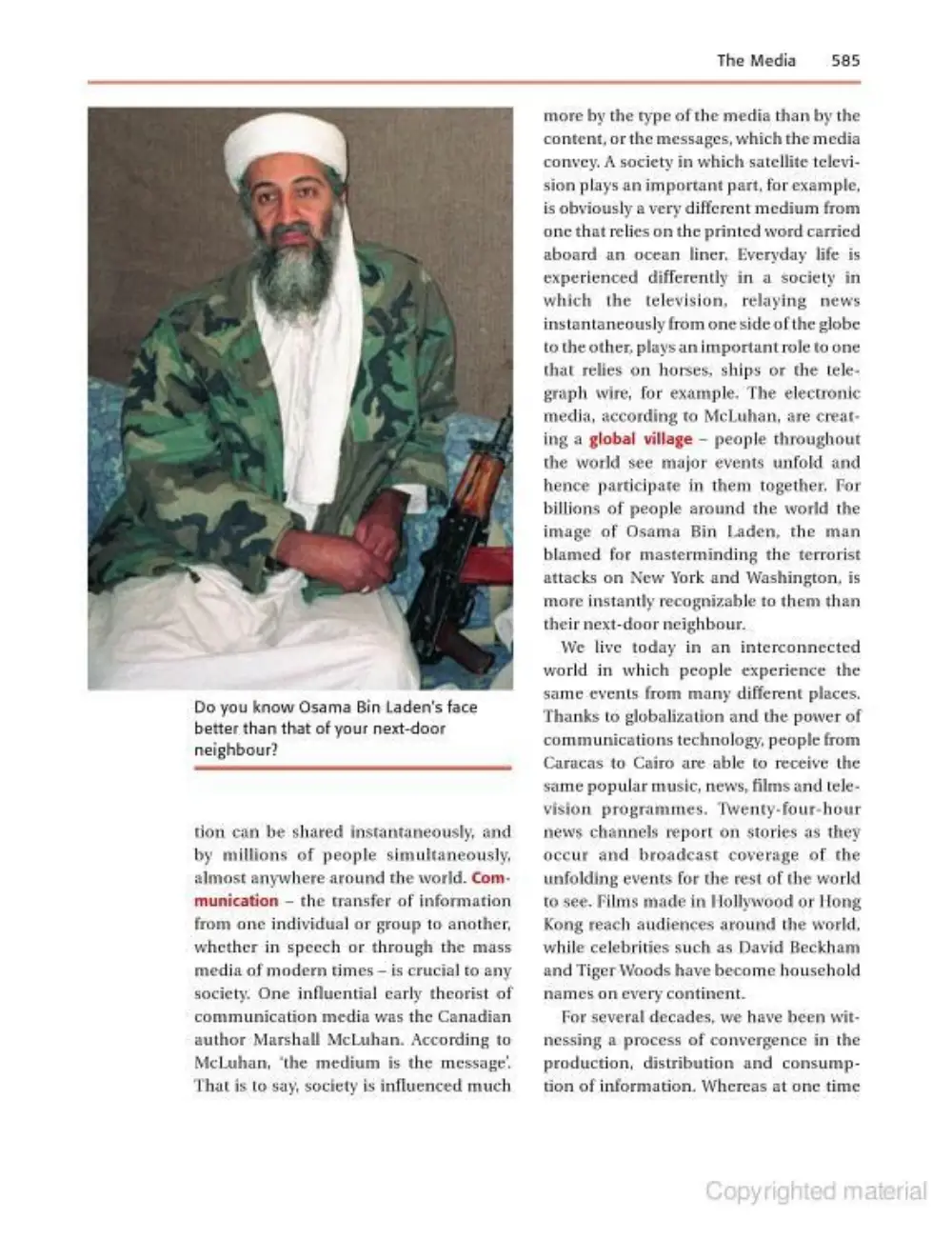
Do you know Osama Bin Laden's face
better than that of your next-door
neighbour?
Hon can be shared instantaneously, and
by millions of people simultaneously,
almost anywhere around the world. Com-
munication — the transfer of information
from one individual or group to another,
whether in speech or through the mass
media of modern times — is crucial to any
society. Qne influential carly theorist of
communication media was the Canadian
author Marshall McLuhan. According to
McLuhan, ‘the medium is the message’
That is to say, society is influenced much
more by the type of the media than by the
content, or the messages, which the media
convey, A society in which satellite televi-
sion plays an important part, for example,
is obviously a very different medium from
one that relies on the printed word carried
aboard an ocean liner. Everyday life is
experienced differently in a society in
which the television, relaying mews
instantaneously fram one site of the globe
to the other, plays an important role to one
that relies on horses, ships or the tele-
graph wire, for example. The electronic
media, according ta McLuhan, are creat-
ing a global village — people throughout
the world see major events unfold and
hence pardcipate in them together, Por
billions of people around the world the
image of Osama Bin Laden, the man
blamed for masterminding the terrorist
attacks on New York and Washington, is
mare instantly recognizable to them than
their next-door neighbour.
We live today in an interconnected
world in which people experience the
same ¢tvents from many different places,
Thanks to globalization and the power af
communications technology, people from
Caracas to Cairo are able to receive the
same popular music, news, films anal tele-
Vision programmes. Twenty-four-hour
news channels report on stories as they
oceur and broadcast coverage of the
unfolding events for the rest of the world
to see. Films made in Hollywood or Hong
Kong reach audiences around the world,
while celebrities such as David Beckham
and Tiger Woods have become household
names on every continent.
For several decades, we have been wit-
hessing & process of convergence in the
production, distribution and consump-
tion of information. Whereas at one time
566 THE MEDIA
ways of communicating, such as print,
television and film, were relatively self-
contained spheres, they have now become
intertwined to a remarkable degree. The
divisions between forms of communica-
tion are no longer as dramatic as they once
were: television, radio, newspapers and
telephones are undergoing profound
transformations as a result of advances in
technology and the rapid spread of the
Internet. While newspapers remain
central to our lives, the ways they are orga-
nized and deliver their services are chamg-
ing. Newspapers can be read online,
mobile telephone use is exploding, and
digital television and satellite broadecast-
ing services allow an unprecedented
diversity of choice for viewing audiences.
It is the Internet, however, that is at the
heart of this communications revolution.
With the expansion of technologies such
as volee recognition, broadband trans-
mission, web casting and cable links, the
Intermet threatens to erase the distine-
tions between traditional forms of media
and to become the conduit for the delivery
of information, entertainment, advertis-
ing and commerce to media audiences.
In this chapter, we'll study the transfor-
mations affecting mass media and com-
munications as part of globalization. The
mass media include a wide variety of
forms, including television, newspapers,
films, magazines, radio, advertisements,
video games and CDs. These are referred
to as ‘mass’ media because they reach
mass audiences - audiences comprised of
very large numbers of people.
We begin the study of the mass media
by considering same of the forms it can
take. We discuss older, more traditional
formes of media, such as the press, cinema,
radio and television, before looking at the
recent development of new forms of
media like the Intemet. Second, we shall
explore some of the key theoretical per-
spectives on the media. Next, we look at
the some of the issues surrounding mass
media and society, such as bias, the effects
of the media and audiences, Last, we look
atthe development ofthe mass media ina
global age.
Traditional and new media
An inportant precursor to the mass media
was the invention of the printing press iin
the mid-fifteenth century, which made the
high-speed reproduction of texts possible
for the first time. Yet, although technalog-
ical advances played a crocial part in the
development of the mass media, the influ-
ence of social, cultural and cconomic
factors must also be taken into account.
The mass media could only develop in
societies with a celatively free press and an
educated and wealthy enough population
to take advantage of it. In the last few
years, new technologies, such as the inter-
net have revolutionized the mass media
and wider society too. In the next section
we look al the development of new forms
of media; first, we examine the rise of the
mass media inthe UK, by looking at briefly
atthe press, film, radio and television.
Traditional media
The press
The development of the press in Britain
during the nineteenth century occurred at
a time of political and social unrest. The
fovernment exerted its control over the
emerging newspaper industry through
strict laws on libel and sedition, which
prevented political agitation; at the same
time, a stamp tax was imposed to ensure
that newspapers were only affordable by
the well-off. The stamp tax had unin-
tended consequences, as illegal and inex-
pensive pamphlets emerged, spreading
radical views amongst the newly indus-
trial working class. The biggest of these
pamphlets, such as William Cobbed’s
weekly Political Register, outsold the
official, ‘stamped’ press many times over
(Hall 1982),
The stamp tax - condemned by its
opponents as a ‘tax on knowledge’ — was
finally repealed in 1855 after a series of
reductions, leading many writers to hail a
golden era of British journalism marked
by a ‘transition from official to popular
control (Koss 17S]. Am alternative view
was put fonvard by James Curran and [ean
Seaton challenged this view in their his-
torical account of the British press, Power
Without Responsibility (2003). They saw
the repeal of the stamp tax as an attempt
to break the popularity of the radical press
and to boost the sales of more
‘respectable’ newspapers. For Curran and
Seaton the repeal of the stamp tax did mot
introduce a new era of press freedom, but
atime of repression and ideological
control, this time by market forces rather
than government. (The issue of media
control is discussed below, pp, 615-20.)
The newspaper was a fundamentally
important development in the history of
modern media, because it packaged many
different types of infonmation in a limited
and easily reproducible format. News-
papers contained in a single package
information on current affairs, entertain-
ment and consumer goods. The cheap
daily press was pioneered in the United
States.
The Media 587
The one-cent daily paper was originally
established in New York and then copied
in other major castern US cities. By the
early 1900s there were city or regional
newspapers covering most of the Ameri-
can states; in contrast to the smaller coun-
ties of Europe, national newspapers did
notdevelop. The invention of cheap news-
print was the key to the mass diffusion of
newspapers from the late nineteenth
century onwards,
Curran and Seaton have noted that
extra revenue from advertising enabled
the cover prices to Fall dramatically during
this period, making the newspaper afford-
able forall, They also argue that advertis-
ing undermined the radical press as
advertisers tended to place announce-
ments in papers ta which they were politi-
cally sympathetic, and to select papers
with a smaller circulation and a wealthy
readership, rather than radical papers
with a higher circulation which sold to
readers who would be unlikely to afford
the product advertised (Curran and
Seaton 2003),
By the early twentieth century mew
types of national newspaper had emerged
in the UE, such as the Gaily Meth, Daily
Express, Mirrorand the News of the Worle,
selling a mixture of news, entertainment
and patriotism to a Lirgely working-class
readership, The Timesand Daily Telegrayalt
provided more serious news analysis for
wealthier readers. Qwnership of much of
the news media hy this stage was concen-
trated anoongst a handful of rich entre-
preneurs. By the 130s Lords Beaverbrook,
Camrose, Kemsley and Rothermere
owned 50 per cent of British national and
local daily papers and 30 per cent of the
Sunday papers. Critics have argued that
the ‘press barons) as they became known,
568 THE MEDIA
used their ownership of national news-
papers to promote their own political
causes and ambitions (Curran and Seaten
2003). (We discuss the issue of media own-
ership further below: see pp. 599-601.)
For halfa century or more, newspapers
were the chief way of conveying informa-
lien quickly and comprehensively to a
mass public, Their influence has waned
with the rise of radio, cinema and -—much
mere important — television and, increas-
ingly, the Internet. Figures for newspaper
readership suggest that the proportion of
people who read a national daily paper in
Britain has declined since the early 1480s,
Among men, the proapertion of daily
newspaper readers dropped fram 7h per
centin 1981 to 60 percentin 1998-9 read-
ership levels are somewhat lower among
women, but a similar drop - from 6& per
cent to 51 per cent - has taken place
(HATSO 2000).
Online communication might well bite
further into newspaper circulation, News
information is now available online
almost instantaneously and is constantly
updated during the course of the day.
Many newspapers can also be accessed
and read online free of charge,
Film
The first film to be shown to paying cus-
tomers was in 1895 in Paris, Franee, where
the Lumiére brothers’ Arteal af the Treter
in La Clotar Station caused viewers to flee
from their seats as the screen slowly filled
with an oncoming steam engine. Whilst
the print media in the UK developed
slowly over many decades, film and the
cinema arrived much faster. The first
cinema in the UK opened im 1896 and by
1914 there were more than five hundred in
London alone. Cinema tickets could be
afforded by all classes and the decline in
working hours and rise in unemployment
in the late 19205 meant the cinema-gocrs
soon formed a mass audience.
Audience demands were soon leading
cinemas to screen two new programmes a
week, cach consisting of two films, a B-
mevie and the main feature. The demand
for new films led studies to churn out pro-
ductions to tight schedules, These films
tended to be formulaic and created by
bureaucratic organizations with a high
degree of specialization and division of
lalvcrtir,
Bureaucracy is further discussed in
chapter 16, ‘Organizations and Mel-
works, pp. 638-46.)
As the industry became more commer-
cialized a ‘star system’ emerged, with
studios encouraging interest in the per-
sonal lives of actors like Mary Pickford and
Rudolf Valentino, whose appearance in a
film would ensure a box-office hit.
By 1925, 95 per cent of the films shown
in the UR were American. Cinemas were
increasingly controlled by the American
studios which owned the distribution
rights to films. The studies could oblige
cinemas to bulk-buy future productions,
effectively freezing oul competitors. As
with the print media, ownership thad
become largely concentrated amongst a
few large corporations, The American
production of the films raises questions
about cultural imperialism ane the mass
media, which we return to below [see
pp. 626-30).
Radio and television
As audiences, we interact differently with
the radio and television from how we do
with the cinema. Radio and television
The Media 589
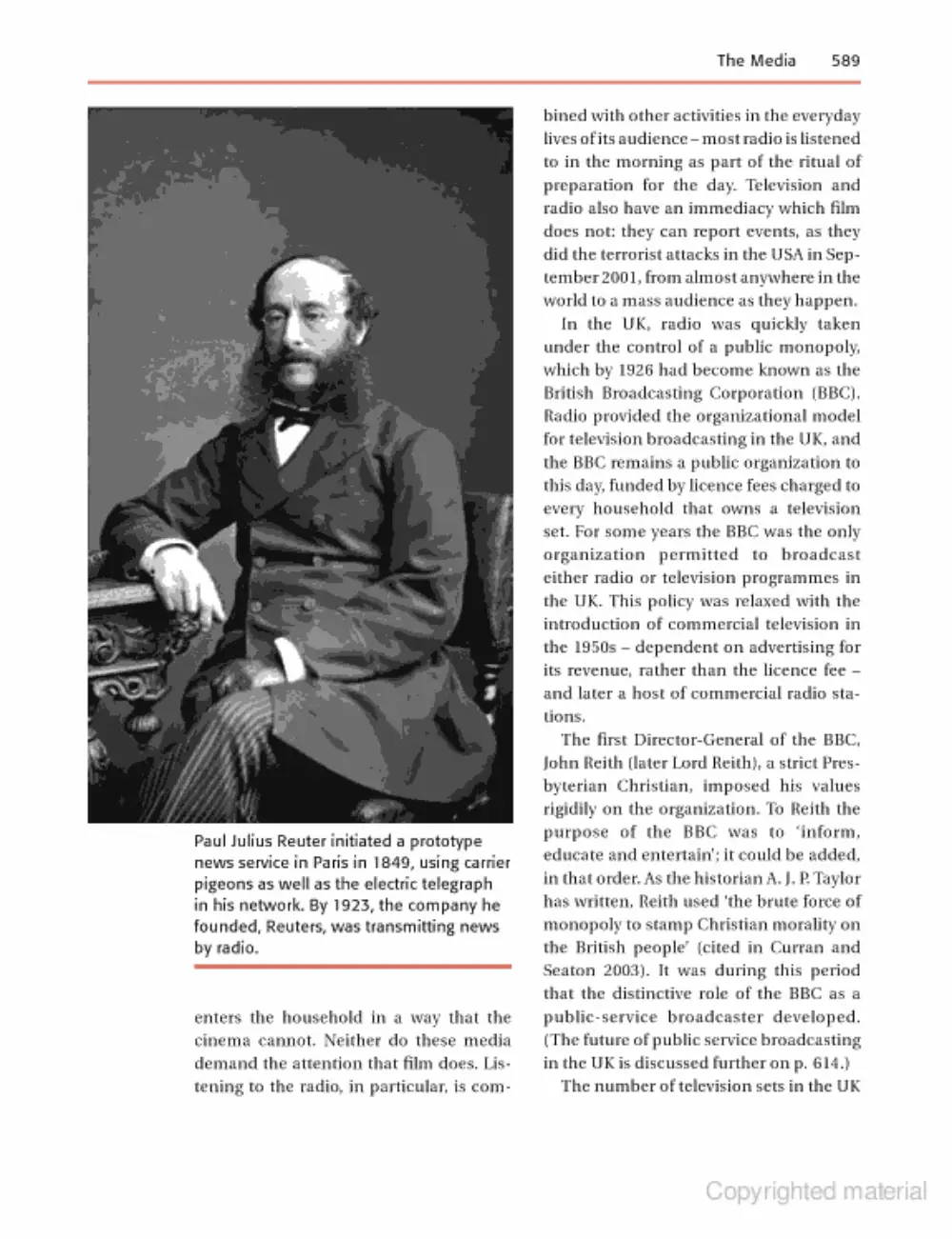
Paul Julius Reuter initiated a prototype
news service in Paris in 1844, using carner
pigeons as well as the electric telegraph
in his network. By 1923, the company he
founded, Reuters, was transmilling mews
by radia,
enters the household in a way that the
cinema cannot. Neither do these media
demand the attention that film does. Lis-
tening to the radio, in particular, is com-
bined with other activities in the everyday
lives of its audience — most radia is listened
to in the morning as part of the ritual of
preparation for the day. Television and
radio also have an immediacy which film
does not they can report events, as they
did! the terrorist attacks in the USA in Sep-
tember 2001, from almost anywhere in the
world loa mass audience as they happen.
In the UK, radio was quickly taken
under the conteol of a public monopoly,
which by 1926 had become known as the
British Broadcasting Corporation (BBC),
Radia provided the organizational model
for television broadcasting in the UK, and
the BBC remains a public organization to
this day, funded by licence fees charged ta
every household that owns a television
set. For some years the BBC was the only
organization permitted to broadcast
either radio or television programmes in
the UK. This policy was relayed with the
introduction of commercial television in
the 1950s - dependent on advertising for
its revenue, rather than the licence fee —
and later a host of commercial radio sta-
lions,
The first Director-General of the BEC,
John Reith (later Lord Reith), a strict Pres-
byterian Christian, imposed his values
rigidily on the organization. To Reith the
purpose of the BBC was to “inform,
educate and entertain: it could be added,
in thatorder. As the historian A. J. B Taylor
has written, Reith used ‘the brute force af
monopoly to stamp Christian morality on
the British people’ (cited in Curran and
Seaton 2003). Tt was during this period
that the distinctive role of the BBC as a
public-service broadcaster developed.
(The future of public service broadcasting
in the UK is discussed further on p. 614.)
The number of television sets in the UK
590 THE MEDIA
and the amount of time that people spend
viewing them increased dramatically from
the 1950s onwards. Television now domi-
nates the other media. If the current
trends in TY watching continue, by the age
of eighteen the average child born today
will have spent more time watching televi-
sion than in any other activity except
sleep. Virtually every household now pos-
sesses a TV set. In the UK, every day
around 85 per cent of adults watch televi-
sion (HMSO 2004), and the average set is
awitched on for between three and six
hours per day, Much the sane is true jin
other West European countries and in the
USA. Individuals aged four and overiin the
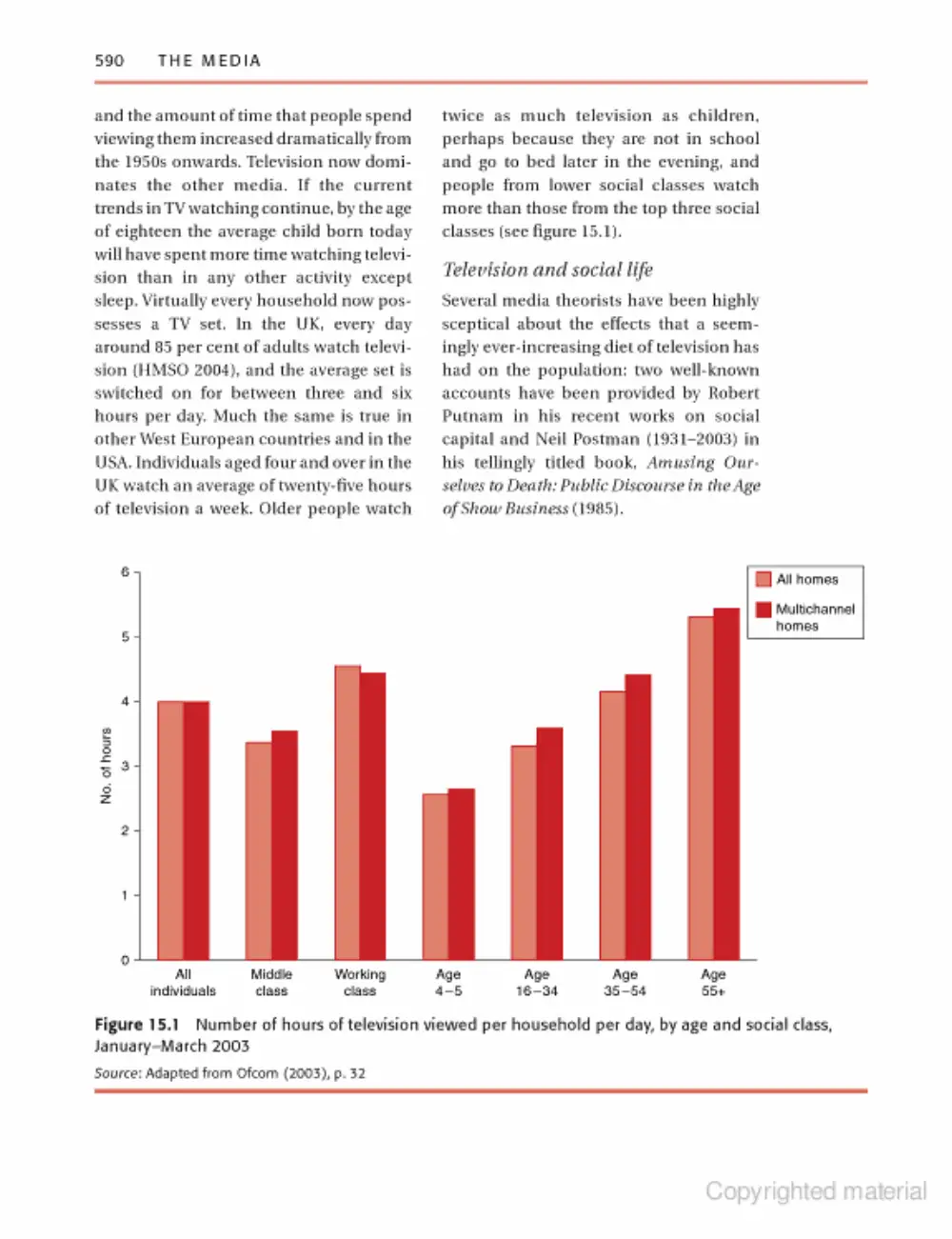
UK watch an average of twenty-five hours
of television a week. Older people watch
No. of hours.
te
44
1
a
twice as much television as children,
perhaps because they are mot in school
and go to bed later in the evening, and
people from lower social classes watch
more than those from the top three social
classes (sec figure 15.11.
Television and sectal life
Several media theorists have been highly
sceptical about the effects that a seem-
ingly ever-increasing diet of television has
had on the populatian: tee well-known
accounts have been provided by Robert
Putnam in his recent works on social
capital and Neil Postman (1941-2003) in
his tellingly titled book, Arinstag Onr-
selves to Death: Public Discourse in the Age
of Show Business (1985),
Bf Al homes
1B Multichannel
homes
Middle Vrarking
en class chaise
ae se Ln as a oe
Figure 15.1) Number of hours of television wewed per household per day, by age and social class,
January-March 2003
Source: Adapted fram Ofcom (2005), p. 32
To Postman, television presents serious
issues as entertainment because, in his
phrase, ‘the form excludes the content’ By
this, he means that television as ‘the form’
isa medium that is incapable of sustaining
serious ‘content. For Postman, rational
argument is best carried on in the form of
the printed word, which is capable of sus-
taining complex and serious content, He
harks back to the nineteenth century as
an ‘age of reason, when the written word
wis dominant, Postoian'’s argument con
tains some similarities with Marshall
MeLuhan’s claim that ‘the medium is the
message’ [see p. 565), although Postman
is much more sceptical than McLuhan
about the benefits of electronic media. To
Postman, the medium of print creates a
rational population, whereas the medium
oftelevision creates an entertained one. In
a society dominated by the television,
news, education and polities are all
reduced to entertainment, so that we are,
as the tithe of his book indicates, doing
nothing more than ‘amusing ourselves to
death’
Although Postman's book is fiercely
argued, it has been criticized as being
based on impression rather than empiri-
cal research, This criticism cannot be ley-
elled at the work of the American political
theorist Robert Putman.
Putnam's thesis on the decline of ‘social
capital is examined in mare detail in
chapter 15, ‘Organizations and Net-
works) pp. 675-9.
By social capital, as we have seen, Putnam
is referring to useful social networks, a
sense of mutual obligation and trust-
worthiness, an understanding of the norms
that govern effective behaviour and. in
general, other social resources that enable
The Media 591
people to act effectively. Putnam’ account,
put forward in his book Bowling Alone
(2000) and elsewhere, is based on research
inthe United States, where he finds signifi-
cant decline in social capital over the last
few decades. Putnam (1996) suggests a
culprit for that decline: television.
Putnam points out that in 1950, around
the time measures of social capital peaked,
barely 10 per cent of Americans had a tele-
vision set in their homes; by 1959, this
figure had risen to 90 percent. Studies esti-
mate that the average American now
watches roughly four hours of TY every
day (not including periods when television
is merely playing in the background), A
conservative estimate of television
viewing in the USA means that this one
activity now absorbs around 40 percent of
the average Americans free time. Putnam
notes that this massive change in the way
Americans spend their lives coincided pre-
cisely with the years of declining social
capital,
Putnam argues that the link between
mass television watching and the erosion
of social capital is mot merely circurmstan-
tial. Taking other facts into consideration,
such as education, age and gender, TV
viewing is strongly and negatively related
to secial trust and group membership,
Ushag the same criteria, the correlation of
hewspaper reading to social trust and
proup membership is positive,
One reason Putnam suggests forwhy T¥
wewing erodes social capital is the effect
of programme content on viewers, For
example, studies suggest that heavy
watchers of TV are unusually sceptical
about the benevolence of other people —
by overestimating crime rates forexample.
Putnam concludes: ‘Just as the erosion of
the ozone layer was detected only many
5o2 THE MEDIA
years after the proliferation of the
chlorofluorocarbons that caused it, so too
the crosion of America’s social capital
became visible only several decades atter
the underlying process had begun.’
Although Putnam warns against nostalgia
for the 1950s, he argues that it is time for
critical reflection on the effects of techneol-
ogies on our lives (Putnam 1995),
New media
In his book Beleg Dlgiral (1995), the
founder of the media laboratery at the
Massachusetts Institute of Technology,
Nicholas Negroponte, analyses the pro-
found importance of digital data in current
communications technologies. Any piece
ofinformation, including pictures, moving
images and sounds, can be translated
through a binary system into “bits. A bit is
either | ord. For instance, the digital repre-
sentation of 1,2,3,4,5,is 1, 10,11, 100, 101,
etc. Digitization - and speed - is at the
origin of the development of multimedia:
what used to be different media needing
different technologies (such as visuals and
sound) can now be combined on a single
medium (DVD and PCs, ete. In recent
years the processing power of computers
has doubled every eighteen months, This
means, for example, that itis now possible
te watch films and listen ta music via the
Internet, Digitization also permits the
development of interactive media, allow-
ingindividuals actively to participate in, ar
structure, what they see or hear. In this
section we examine the protound impact
that digitization has had om the media.
Digital! television
Since the beginning of the twenty-first
century, television broadcasting technol-
ogy has been undergoing a revolution,
with the transfer of programme transmis-
sion from analogue to digital. Analogue TY
is the ‘old’ system of broadcasting that has
been used to transmit signals to television
sets around the country since the 1940s, [t
converts sound and pictures into waves,
which are transmitted through the air and
picked up by the aerial on the reef of the
house or on top of the television.
Digital TV works by transforming pic-
tures and sound inte information that is
understood by a computer, Digital trars-
missions are received in three ways:
through the TV aerial and a decoder (often
a set-top box), via a satellite dish or via
cable, The television acts like a computer
and converts this information back inte
pictures and sound. Broadcasters and
service providers argue that digital televi-
sion not only means more channels, but
alse a better quality of sound and pictures
and additional services. Digital TV offers
the possibility of, for instance, interactive
television, the Internet, home shopping
and home banking. The arrival of digital
TV has also created the possibility of single
units that merge the personal computer
with the television, although these are not
yet widely in use.
In the UE, the government hapes that
all viewers will have transferred from ara-
logue to digital television by 2012, when
the transmission of television on analogue
frequencies is expected to stop. All trans-
missions from then on will be digital. By
2004, one-third of WK households had
already switched to digital television.
The number of television channels
available to British audiences has been
increasing as a result of advances in satel-
lite, cable and digital technology. In 2003,
one service provider, Sky, offered a