
ETH 201 Lecture Introduction, Fall 2016
Lebanese American University · Moral Reasoning · 19 pages · Dr. Mahmoud Baassiri



Showing the first 10 of 19 pages. Download the PDF to see all of it.
More ETH 201 files
Show the text of this lab
Moral Questions
Everyone is interested in ethics. We all have our own ideas about
what is right and what is wrong and how we can tell the difference.
Philosophers and bishops discuss moral "mazes" on the radio.
People no longer behave as they should.
So we're told. But there have always been "moral panics". Plato
thought 4th century B.C. Athens was doomed because of the wicked
ethical scepticism of the Sophist philosophers and the credulity of his
fellow citizens.
3
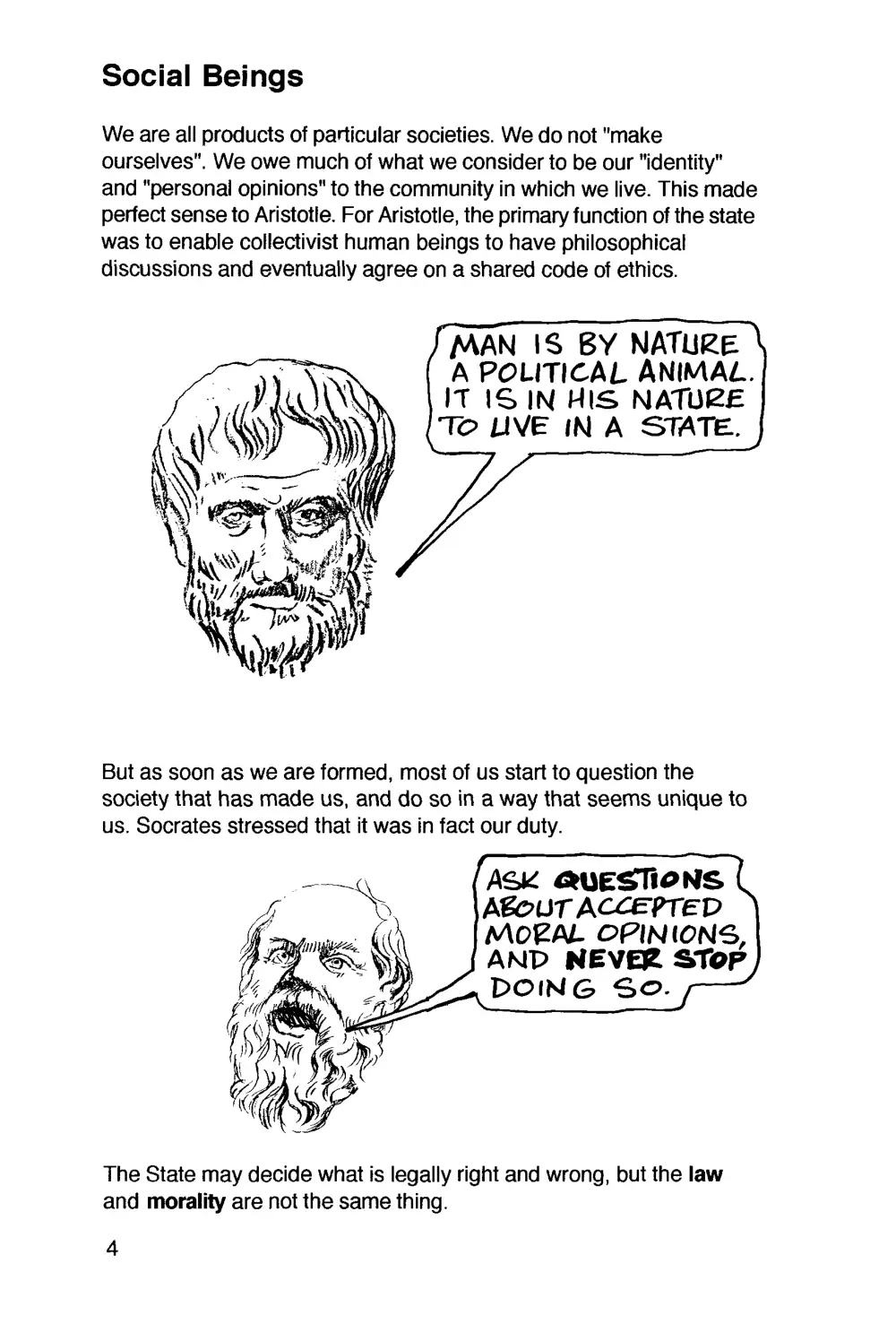
Social Beings
We are all products of particular societies. We do not "make
ourselves". We owe much of what we consider to be our "identity"
and "personal opinions" to the community in which we live. This made
perfect sense to Aristotle. For Aristotle, the primary function of the state
was to enable collectivist human beings to have philosophical
discussions and eventually agree on a shared code of ethics.
But as soon as we are formed, most of us start to question the
society that has made us, and do so in a way that seems unique to
us. Socrates stressed that it was in fact our duty.
The State may decide what is legally right and wrong, but the law
and morality are not the same thing.
4
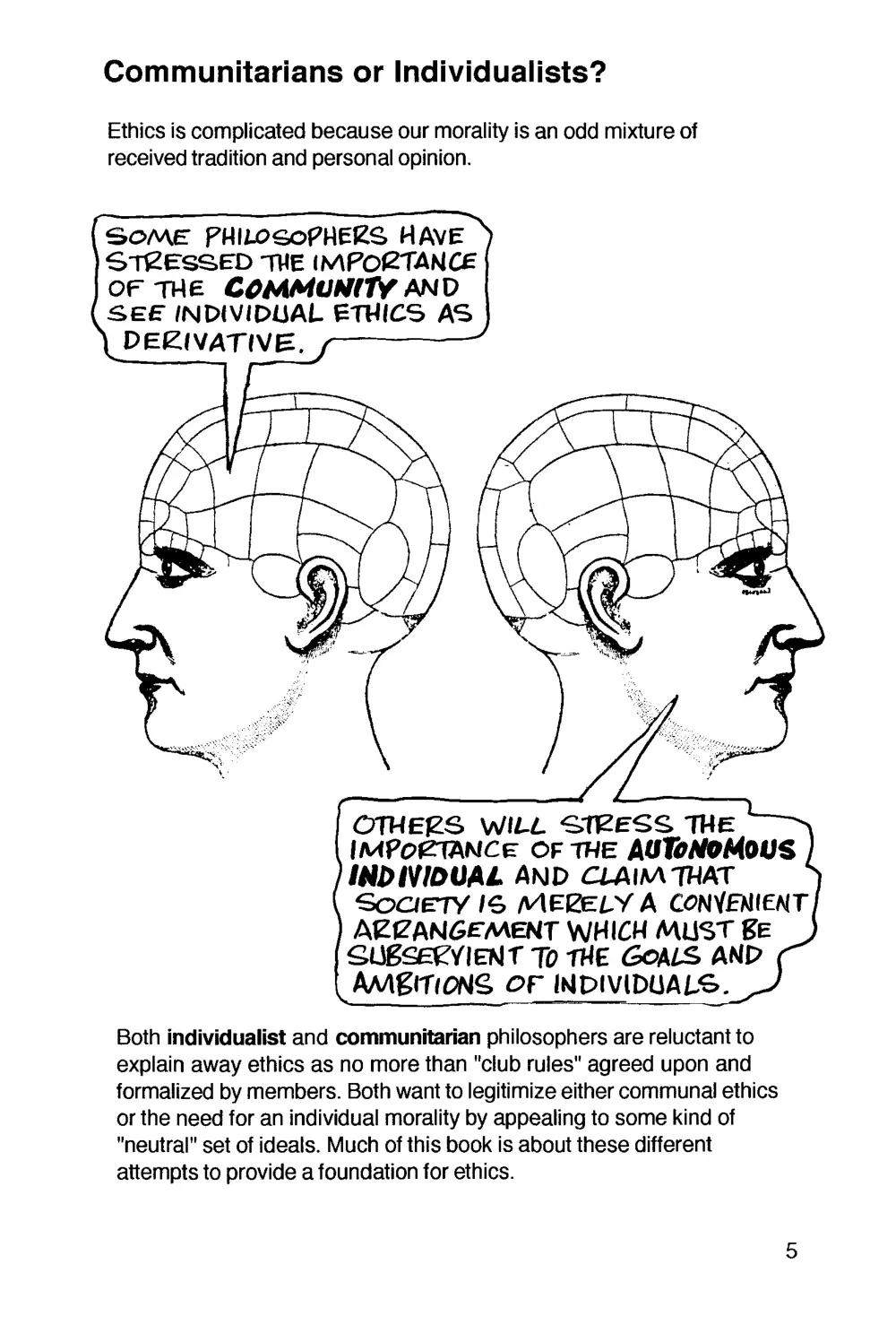
Communitarians or Individualists?
Ethics is complicated because our morality is an odd mixture of
received tradition and personal opinion.
Both individualist and communitarian philosophers are reluctant to
explain away ethics as no more than "club rules" agreed upon and
formalized by members. Both want to legitimize either communal ethics
or the need for an individual morality by appealing to some kind of
"neutral" set of ideals. Much of this book is about these different
attempts to provide a foundation for ethics.
5
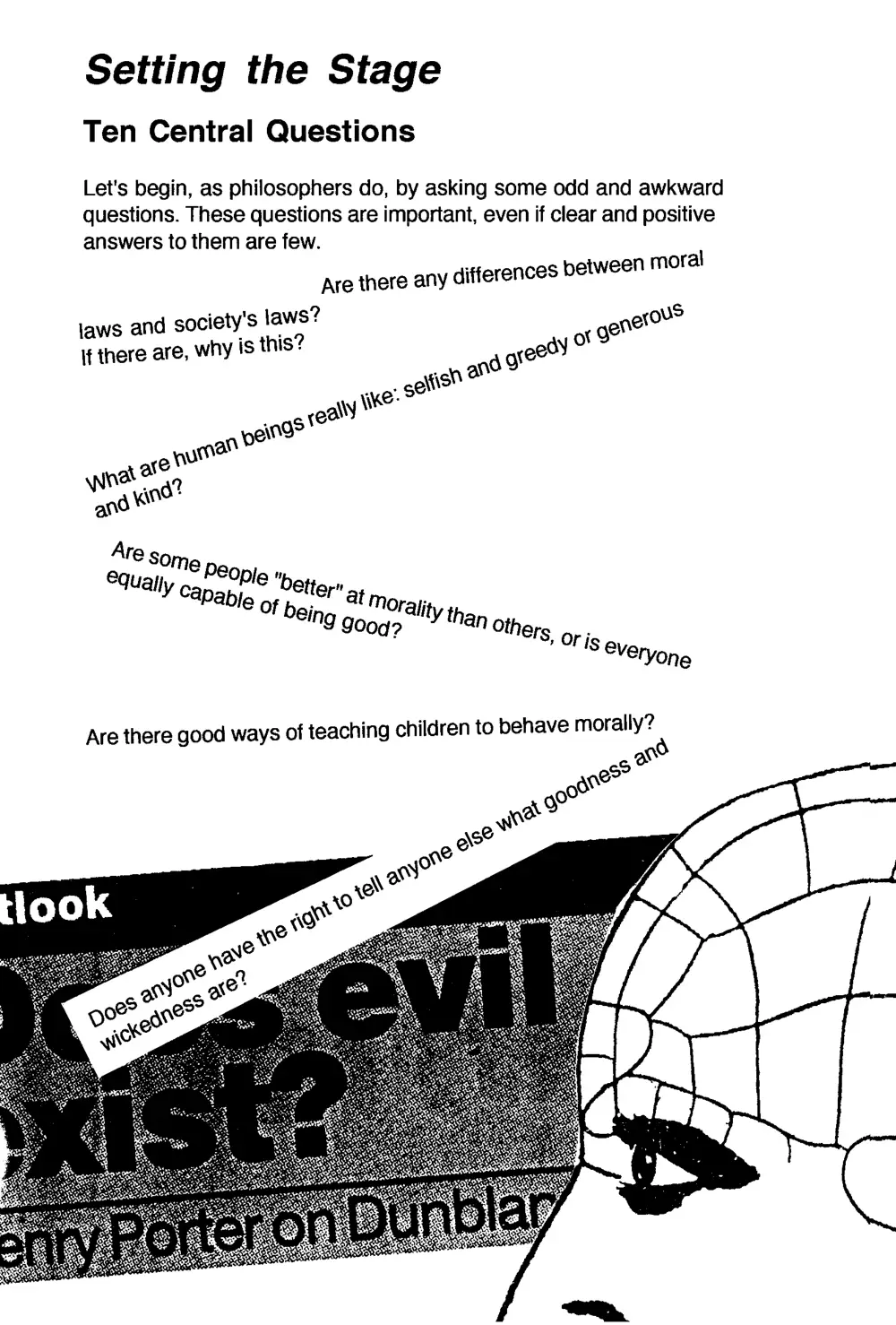
Setting the Stage
Ten Central Questions
Let's begin, as philosophers do, by asking some odd and awkward
questions. These questions are important, even if clear and positive
answers to them are few.
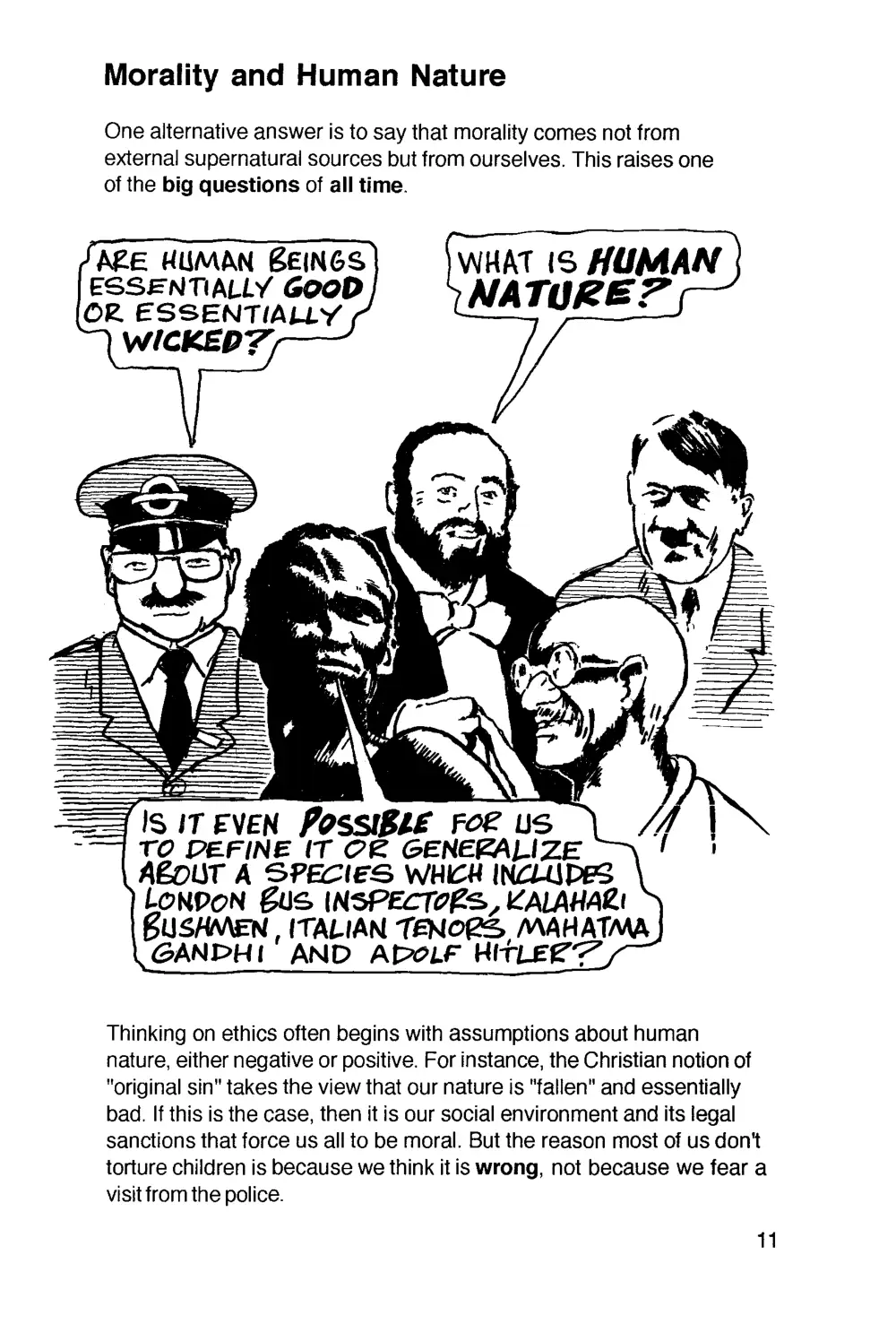
Morality and Human Nature
One alternative answer is to say that morality comes not from
external supernatural sources but from ourselves. This raises one
of the big questions of all time.
Thinking on ethics often begins with assumptions about human
nature, either negative or positive. For instance, the Christian notion of
"original sin" takes the view that our nature is "fallen" and essentially
bad. If this is the case, then it is our social environment and its legal
sanctions that force us all to be moral. But the reason most of us don't
torture children is because we think it is wrong, not because we fear a
visit from the police.
11
This negative Christian verdict is an example of the "programmed"
view of human nature. There is an opposite "Romantic" view of
human nature which assumes it to be positively programmed for good.
Men may kill other men in different uniforms because society
encourages them to do so, but their genetic instincts might be to do
things like play football and drink beer with each other.
12
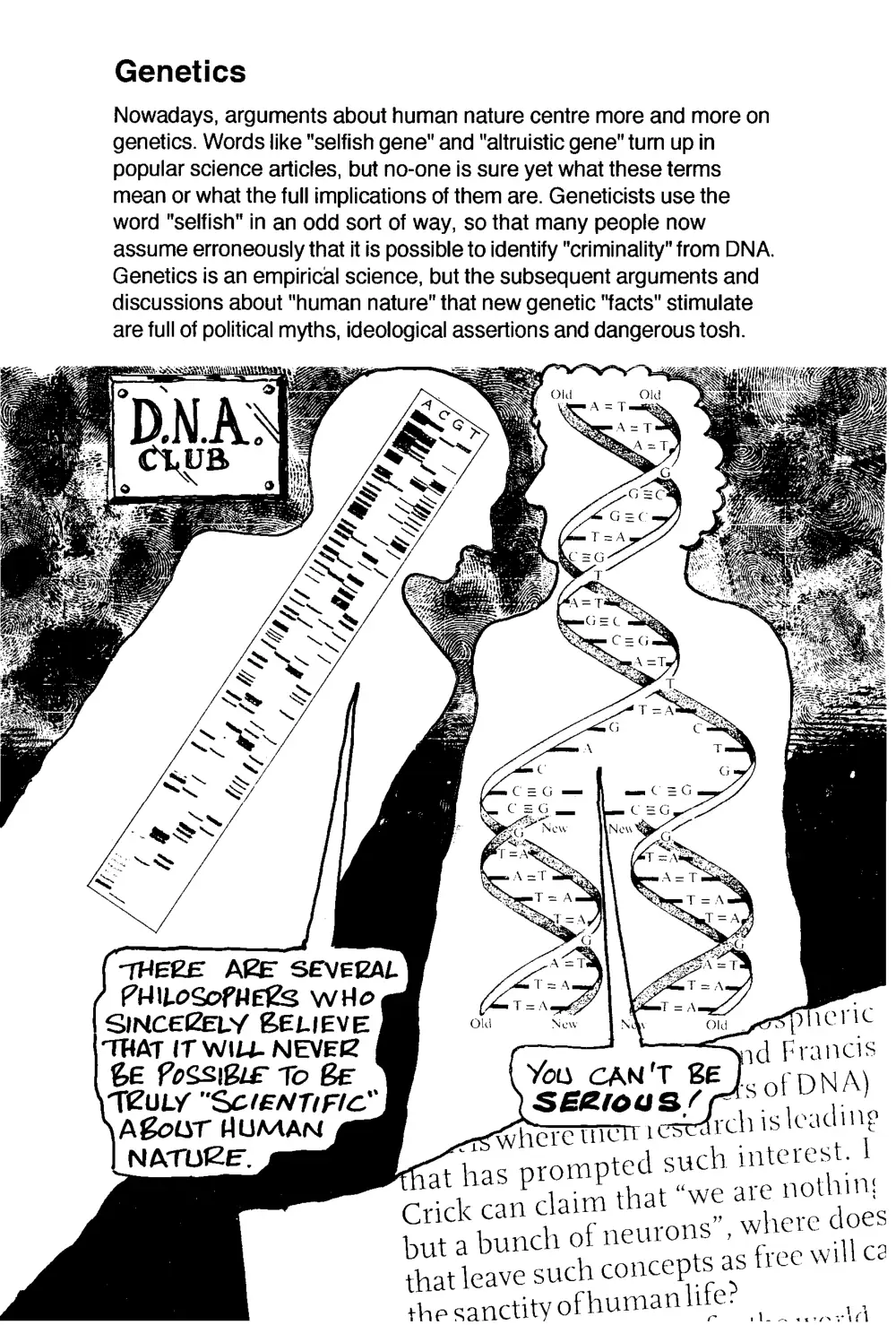
Genetics
Nowadays, arguments about human nature centre more and more on
genetics. Words like "selfish gene" and "altruistic gene" turn up in
popular science articles, but no-one is sure yet what these terms
mean or what the full implications of them are. Geneticists use the
word "selfish" in an odd sort of way, so that many people now
assume erroneously that it is possible to identify "criminality" from DNA.
Genetics is an empirical science, but the subsequent arguments and
discussions about "human nature" that new genetic "facts" stimulate
are full of political myths, ideological assertions and dangerous tosh.
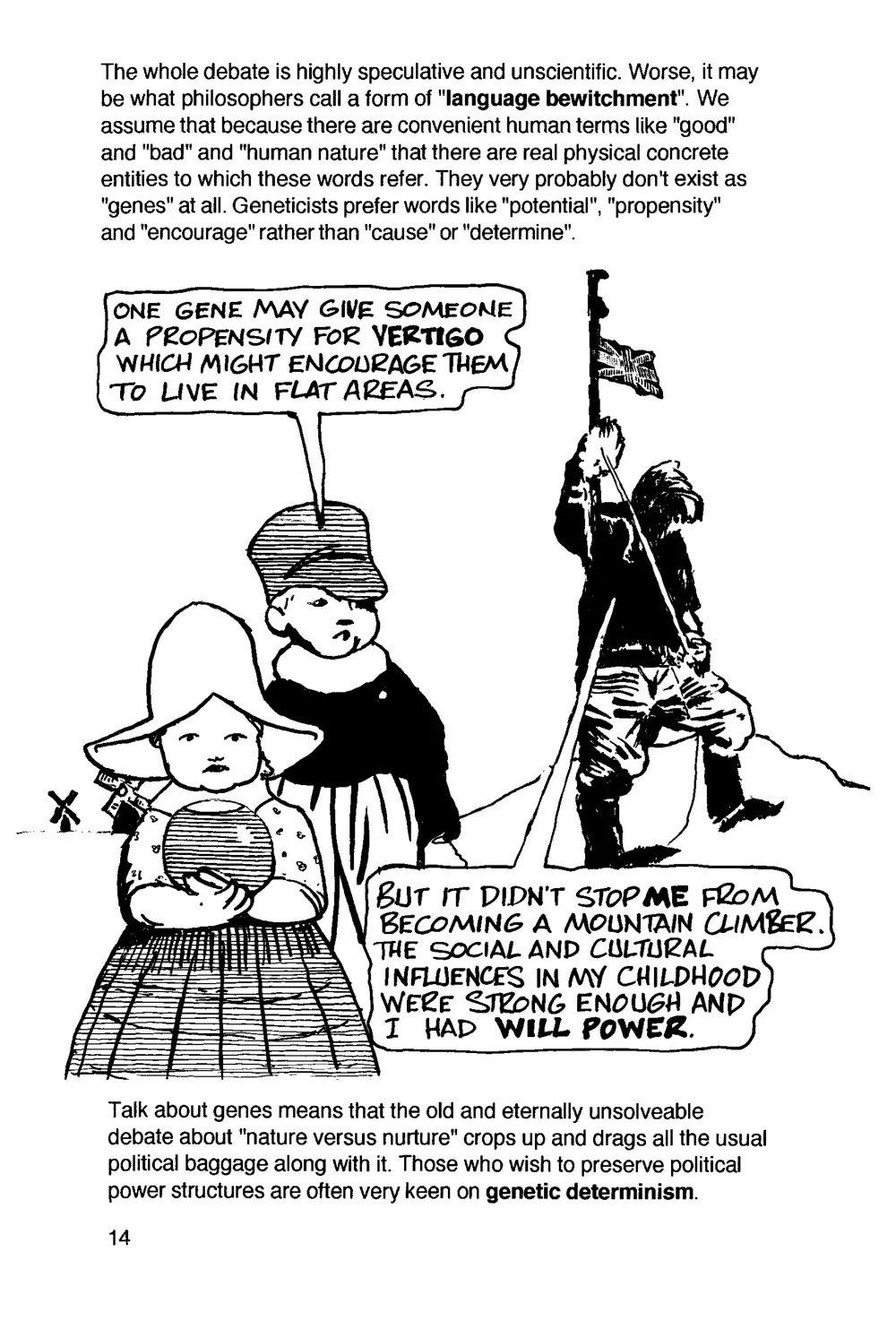
The whole debate is highly speculative and unscientific. Worse, it may
be what philosophers call a form of "language bewitchment". We
assume that because there are convenient human terms like "good"
and "bad" and "human nature" that there are real physical concrete
entities to which these words refer. They very probably don't exist as
"genes" at all. Geneticists prefer words like "potential", "propensity"
and "encourage" rather than "cause" or "determine".
Talk about genes means that the old and eternally unsolveable
debate about "nature versus nurture" crops up and drags all the usual
political baggage along with it. Those who wish to preserve political
power structures are often very keen on genetic determinism.
14
Do We Have Any Choice?
Some philosophers maintain that DNA and social environment have
little or no influence on the sorts of people we become and the moral
choices that we make. We are almost wholly autonomous individuals
who make our own moral decisions in life and therefore we alone are
responsible for all the good and bad things that we do. After all,
without free will, we are little more than robots and cannot be moral
beings at all. It is a commonplace in ethics that "ought implies can".
You can't even begin to talk about morality, unless you assume that
human beings have freedom to choose.
Nevertheless, "commonsense" views like these can be naive or prejudiced.
A brutal society can often have a strong negative influence on the formation
of someone's moral character.
15
Is Society to Blame?
Even if DNA has little or no influence on our moral character, perhaps
we are still products of our social and cultural environment. At birth, we
are blank sheets of paper that are gradually written on by parents,
teachers, peer groups, the media and all sorts of other ideological
forces. The influence of society on our moral personalities is infinitely
stronger than any genetic inheritance and almost totally responsible for
everything that makes us both human and moral. This means that it is
nonsense to talk about some absurd fiction like "human nature", as if it
has some kind of pre-societal existence. This view is held by many
sociologists:
16
Human nature might either be wholly plastic, and subsequently given
"ethical shape" by social forces, or a programmed bundle of moral
software. What puzzles philosophers is the variation in ethical beliefs
held by different societies at different times.
17
Moral Relativism
The recognition of this wide variety of ethical beliefs and practices is
usually called moral relativism. Differences in moral belief exist
between different countries and tribes, but can also exist between
different subcultures within a society, or between different classes.
History also demonstrates how time alters moral beliefs.
Nowadays there are very different sets of moral beliefs held by
feminists and religious fundamentalists about abortion.
18
Ethical Absolutism
If there are all of these moral beliefs floating around, which one is right?
How could we prove that one belief was right and others wrong?
Most ethical relativists would say that there are no possible ways of
deciding, and no such thing as moral "knowledge" at all. This kind of
scepticism has worried other philosophers who think that there must
surely be a set of universal moral rules that are always true.These
philosophers are often called "Universalists", "Realists" or "Absolutists".
All three would say that it was always wrong to sacrifice babies,
regardless of the beliefs of the culture that encouraged or allowed this
practice.
19
The danger of Ethical Absolutism is that it can legitimize one
powerful culture imposing its own local moral values on all others, by
claiming a monopoly on the moral "truth".
Westerners have also been witness to, and a cause of, the
wholesale destruction of hundreds of unique cultures with their own
ethical beliefs. Now we make some inadequate attempts to protect
"innocent" and "primitive" tribal cultures and wring our hands in shame
when we hear of their annihilation. We send out anthropologists and
leave our Bibles and underwear at home.
20
Relativism versus Absolutism
Now most Western liberals and academics would not interfere with the
moral beliefs and customs of other cultures.
An ethical absolutist would then smile rather smugly and get us to
admit that perhaps there are a few universal moral rules that are
always true, wherever you are, like:
21
Another Absolutist Reply
Some societies may look as if they go in for weird immoral behaviour,
different from our own, but there seem to be a few fundamental core
values like "Murder is wrong" that are always followed. A tribe may
burn widows and sacrifice children in the belief that this is for the
ultimate long-term heavenly good of the victims involved, but they don't
sanction the murder of widows and children as such. Absolutists say
that Relativists only look at what people do, not at what they actually
believe.
Absolutists say that human morality is like this - there is real "moral
knowledge". Some moral beliefs are "true" and some aren't, it's just
that we haven't figured out how to prove which is which yet.
22
Are They Both Wrong?
Although the differences between Relativists and Absolutists are clear
enough, they both face certain problems. Absolutists have to explain
what the "core" moral rules are, and why they've selected the ones
they have. Absolutists claim that the core moral rules are generally
those "foundational" ones that enable societies to exist. But there can
be problems with this definition of core values.
Yet most Relativists also believe in one absolute moral rule: "Don't
interfere with other cultures".
23
The Problem of Moral Knowledge
The main difference between Relativists and Absolutists lies in their
disagreement about the possibility of moral beliefs ever becoming true
or proven. Relativists are often "subjectivists" who say that moral
beliefs are really no more than subjective feelings about behaviour
which can never achieve the status of facts.
It is now time that we surveyed the history of ethical beliefs. We
will limit ourselves to Western ideas, beginning with the Ancient
Greeks, although many of the positions expressed could equally well
be found in other non-Western cultures.
24