
ETH 201 Lecture 5, Fall 2016
Lebanese American University · Moral Reasoning · 20 pages · Dr. Mahmoud Baassiri
Showing the first 10 of 20 pages. Download the PDF to see all of it.
More ETH 201 files
Show the text of this lab
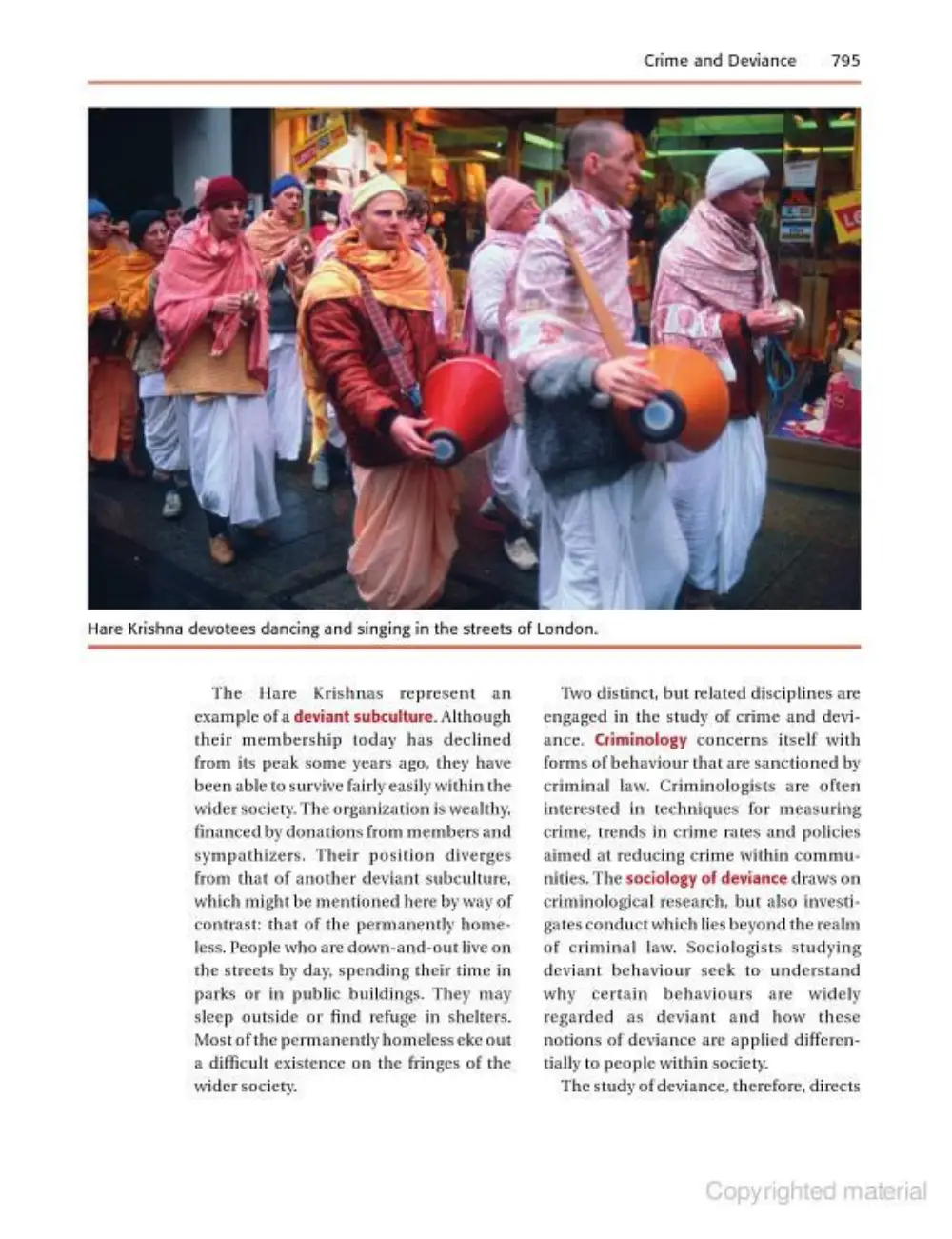
Again, such views have also been widely
criticized. Even if there were an overall
relationship between bodily type and
delinquency, this would show nothing
about the influence of heredity. People of
the muscular type may be drawn towards
0 awe Afar ermal nn
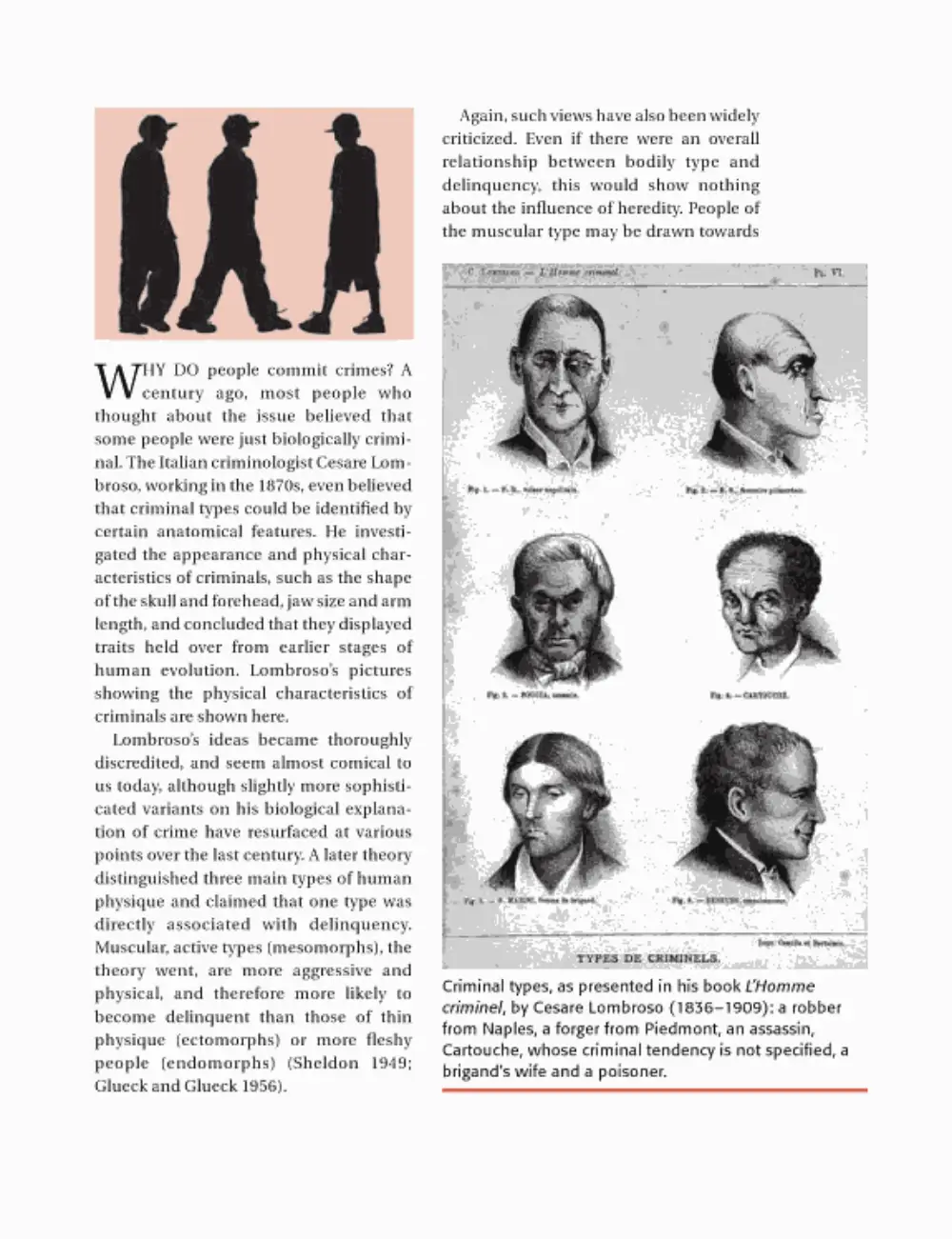
HY DO peaple commit crimes? A
century age, most people whoa
thought about isstie believed that
some people were just biologically crimi-
nal. The Italian criminologist Cesare Lom
brose, Working inthe 187s, even believed
that criminal types could be identified by
certain anatomical features. He investi-
pated the appearance and physical char-
acteristics of criminals, such as the shape
of the skull and forehead, jaw size and arm ied
length, and concluded that they displayed
traits held over from earlier stages of
human evolution. Lombroso's pictures
showing the physical characteristics of
Fak — Bt tee pemeertns
Pe & CNTR
criminals are shown here,
Lombrose’s ideas became thoroughly
discredited, and seem almost comical to
us today, although slightly mere sophisti-
cated variants on his biological explana- |
tion of crime have resurfaced at various ls
points over the last century. A later theary
'
!
distinguished three main types of human
physique and claimed that one type was Fig. — ALAC: Bia te Brg gt = FESR, emesis
directly associated with delinquency.
Muscular, active types [mesomeorphs), the
theory went, are more apgre » and
physical, and therefore more likely to
become delinquent than these of thin
physique fectomorphs) or more fleshy
people [endomorphs) (Sheldon 1949;
Glueck and Glueck 1956).
Begs Ceet ee 6 Prtiemes
SS
TYPES DE CHIMINELS.
Criminal types, as presented in his book {Homme
cnminel, by Cesare Lombrosa (1836-1909); a robber
from Naples, a forger from Piedmont, an assassin,
Cartouche, whose criminal tendency is not specified, a
brigand's wife and a poisoner.
criminal activities because these offer
opportunities for the physical display of
athleticism. Morcover, nearly all studies in
this field have been restricted to delin-
quents in reform schools, and it may be
that the tougher, athletic-looking delin-
quents are more liable to be sent to such
schools than fragile-looking, skinny ones.
Some jodividuals might be inclined
towards irritability and aggressiveness,
and this could be reflected im crimes of
physical assault on others. Yet there is no
decisive evidence that any traits of per-
sonality are inherited im this way, and,
even if they were, their conmection to
criminality would at most be only a
distant one,
lf biological approaches to criminology
do not satisfactorily answer our question:
‘Why do people commit crimes?’ is
psychology more successful? Psychologi-
cal approaches to criminality have
searched for explanations of deviance
within the individual, not society. But
where biological approaches focus on
physical features which predispose indi-
viduals to crime, psychological views con-
centrate on personality types. Much early
criminological research was camied out in
prisons and other institutions, such as
asylums, In these settings, ideas about
psychiatry were influential. Emphasis was
placed on the distinetive traits of crimi-
nals = including ‘feeble: mindedness’ and
‘moral degeneracy. Hans Eysenck (1964),
for example, has suggested that abnormal
mental states are inherited: these can
either predispose an individual to crime or
ceeate problems in the process of social-
ization,
Some have suggested that in a minority
of individuals, am amoral, or psycho-
pathic, personality develops. Psychopaths
Crime and Deviance 793
are withdrawn, emotionless characters
who act impulsively and rarely experience
sensations of guilt. Some psychopaths
delight in violence for its own sake. Indi-
viduals with psychopathic traits do some-
times commit violent crimes, but there are
major problems with the concept of the
psychopath. Itisin'tat all clear that psycho-
pathic traits are inevitably criminal,
Nearly all studies of people said to possess
these characteristics have been of con-
Viele prisoners, and their personalities
Inevitably tend to be presented negatively,
lf we describe the same traits positively,
the personality type sounds quite differ-
ent, and there seems no reason why
people of this sort should be inherently
criminal.
Psychological theories of criminality
can at best explain only some aspects of
crime. While some criminals may possess
personality characteristics distinct from
the remainder of the population, it is
highly improbable that the majority of
criminals do so, There are all kinds of
crime, and it is implausible to suppose
that those whe commit them share some
specific psychological characteristics.
Both biological and psychological
approaches lo criminality presume that
deviance is a sign of something ‘wrong’
with the individual, rather than with
society. They see crime as caused by
factors outside an individual's contre,
embedded either in the bady or the mind,
Therefore, if scientific criminology could
successfully identify the causes of crime,
itwould be possible to treat those causes.
In this respect, both biological and
psychological theories of crime are pasiti-
vistin nature. As we learned in our discus-
sion of Auguste Comte in chapter 1, posi-
tivism is the belief that applying matural
794 CRIME AND DEVIANCE
scientific methods to the study of the
social world can reveal its basic truths. In
the case of positivist criminology, this led
to the belicfthat empirical research could
pinpoint the causes of crime and in turn
make recommendations about how to
eradicate it.
Early positivist criminology came under
greal criticism from later generations off
scholars. They argued that any satisfac-
tory account of the nature of crime must
be sociological, for what crime is depends
on the social instinutions of a soclery, Over
time, attention shifted away from individ-
ualistic explanations of crime, of the kind
we have looked at above, to sociological
theories thar stress the social and cultural
contextin which crime and deviance takes
place. Any full answer to our question:
‘Why do people commit crimes?’ must be
sociological, and itis most likely to start by
questioning the terms implicit im the
question. What do we mean by crime and
deviance?
In this chapter we look at several soci-
ological explanations for crime and
deviant behaviour, First, however, we look
mere closely at what we mean by terms
such as ‘deviance’ and ‘crime’ Later in the
chapler we examine crime in the UK,
before turning to some of the important
issues concerning the victims and perpe-
traters of crime.
Basic concepts
Deviance may be defined as non-confor-
mity to a piven set of monms that are
accepted by a significant number of
people in a community or society. No
society, as has already been stressed, can
be divided up in a simple way between
those who deviate from norms and those
who conform to them. Most of us on some
occasions transpress generally accepted
rules of behaviour. We may, for example,
have at some point committed minor acts
of theft, like shoplifting or taking small
items from work - such as office nobepa-
per anc pens — for personal use, Al some
point in cur lives, we may have exceeded
the speed limit, made prank phone calls or
smoked marijuana.
Deviance and crime are not syreny-
mous, although in many cases they
overlap, The concept of deviance is much
broader than that of crime, which refers
only to non-conformist conduct that
breaks a law. Many farms of deviant
hehaviour are not sanctioned by law,
Thus, studies of deviance might examine
phenomena as diverse as naturalists
(nudists), rave culture and New Age travel-
lers.
The concept of deviance can be applicd
both to individual behaviour and to the
activity of groups. An illustration is the
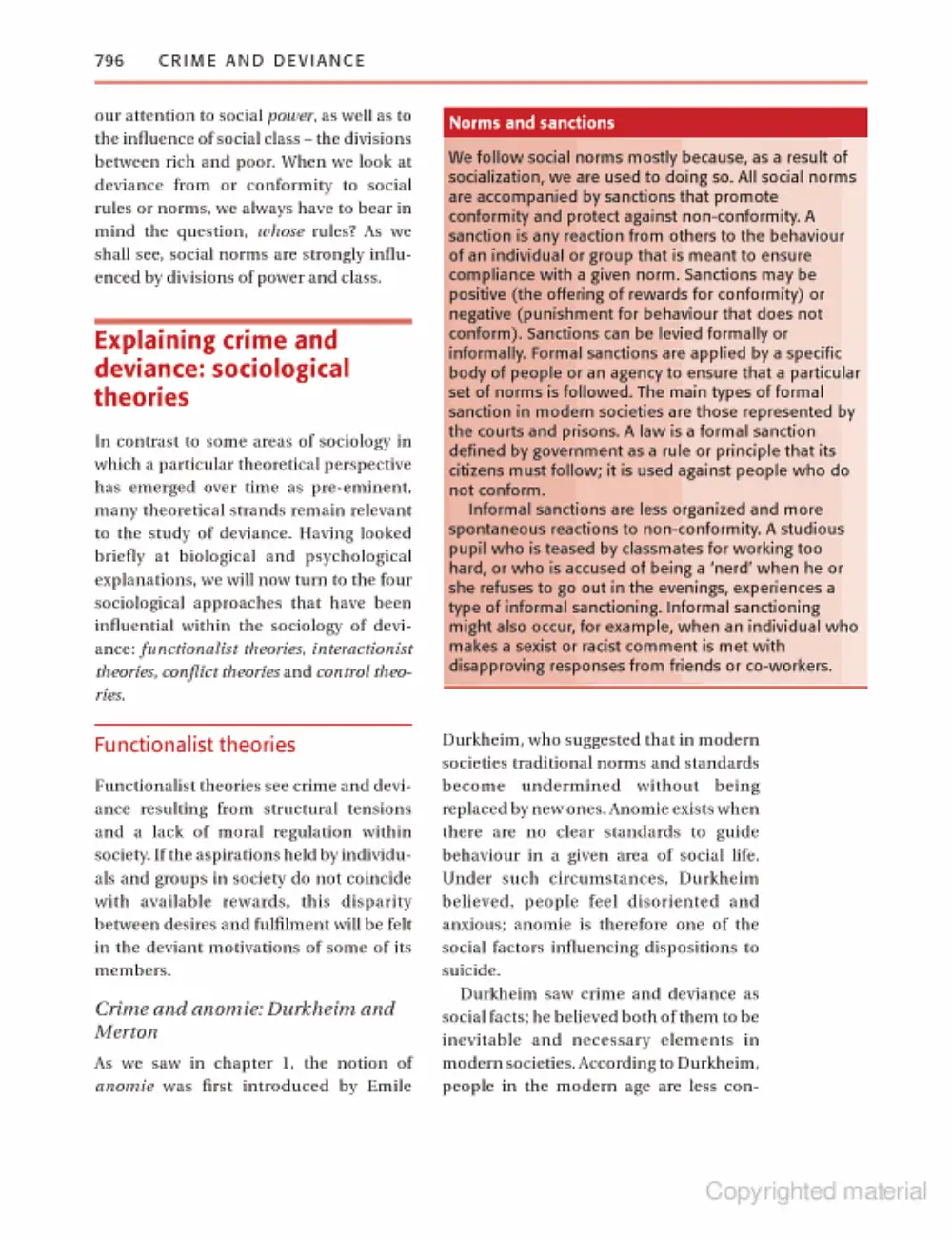
Hare Krishna cult, a religious group whose
beliefs and mode of life are different from
these of the majority of people in Britain.
The cult was first established in the 19605
when Sril Prabhupada came to the West
from Lidia to spread the word of Krishna
consciousness. He aimed his message
particulary at young people who were
drug users, proclaiming that one could
‘stay high all the time, discover eternal
bliss’ by following his teachings. The Hare
Krishnas became a familiar sight, dancing
and chanting in the streets, running vege-
tarian cafés and distributing literature
about their beliefs to passers-by. They are
generally regarded in a tolerant light by
most of the population, even if their views
secm somewhat eccentric.
Crime and Deviance 795
The Hare Krishnas represent an
example of a deviant subculture. Although
their membership today has declined
from its peak some years ago, they have
been able to survive fairly easily within the
whler society, The organization is wealthy,
financed by donations from members and
sympathizers, Their position diverges
from that of another deviant subculture,
which might be mentioned here by way of
contrast: that of the permanently home-
less. People who are down-and-out live on
the streets by day, spending their time in
parks or in public buildings. They may
sleep outside or find refuge in shelters.
Most ofthe permanently homeless eke out
a difficult existence on the fringes of the
wider society.
Hare Krishna devotees dancing and singing in the streets of Londan.
‘Two distinet, but related disciplines are
engaged in the study of crime and devi-
ance. Criminology concerns itself with
formes of behaviour that are sanctioned by
criminal law, Criminologisis are often
interested in techniques for measurckag
crime, trends In erime rates and polictes
timed at reducing crime within commu-
nities, The sociology of deviance draws on
criminological research, but alsa investi-
gates conduct which lies beyond the realm
of criminal law. Sociologists studying
deviant behaviour seck to understand
why certain behaviours are widely
regarded as deviant and how these
notions of deviance are applied differen-
tially te people within society.
The study of deviance, therefore, directs
FOG CRIME AND DEVIANCE
our attention to social power, as well as to
the influence of social class -— the divisions
between rich and poor, When we look at
deviance from or conformity to secial
rules or norms, we always have to bear in
mind the question, wsese rules? As we
shall see, social norms are strongly influ-
enced by divisions of power and class.
Explaining crime and
deviance: sociological
theories
In contrast to same areas of sociology in
which a particular theoretical perspective
has emerged over thie as pre-eminent,
many theoretical strands remain relevant
to the study of deviance. Having looked
briefly at biological and psychological
explanations, we will now turn to the four
sociological approaches that have been
influential within the sociology of devi-
ance: functionalist theories, interactianist
theories, conflict theories and confral theo-
ries,
Functionalist theories
Functionalist (heories see crime and devi-
ance resulting from structural tensions
and a lack of moral regulation within
society. [the aspirations held by individu-
als and groups in society do not coincide
with available rewards, this disparity
benveen desires and fulfilment will be felt
in the deviant motivations of sone of its
members.
Crime and anomie: Durkheim and
iWertan
As we saw in chapter 1, the notion of
qremie was first introduced by Emile
We follow social norms mostly because, as a result of
socialization, we are used to doing so. All social norms
are accompanied by sanctions that promote
conformity and protect against non-conformity. A
sanction is any reaction from others to the behaviour
of an individual ar group that is meant ta ensure
compliance with a given norm. Sanctions may be
positive (the offering of rewards for conformity) or
negative (punishment for behaviour that does not
canform). Sanctions can be levied formally or
informally. Formal sanctions are applied by a specific
body of people or an agency to ensure that a particular
set of norms is followed. The main types of formal
sanction in modern societies are those represented by
the courts and prisons. A law is a formal sanction
defined by government as 4 rule or principle that its
citizens must follow, it is used against people who do
not conform.
Informal sanctions are less organized and more
Spontaneous reactions to non-conformity, A studious
pupil who is teased by classmates for working too
hard, or who is accused of being a ‘nerd’ when he or
she refuses to go out in the evenings, expenences a
type of informal sanctioning. Informal sanctioning
might also occur, for example, when an individual who
makes a sexist or racist comment is met with
disapproving responses fram friends or co-workers,
Durkheim, who suggested that in modern
societies traditional norms and standards
become undermined without being
replaced by new ones. Anomie exists when
there are no clear standards to guide
behaviour in a given area af social life,
Under such circumstances, Durkheim
believed, people feel disoriented and
anxious: anomle is therefore one of the
social factors inthiencing dispositions ta
suicide.
Durkheim saw crime and deviance as
social facts: he believed both of them to be
inevitable and mecessary clements in
modem societies. According to Durkheim,
people in the modern age are bess con-
strained than they were im traditional soci-
eties. Because there is more room for indi-
vidual choice in the modern world, it is
inevitable that there will be some non-
conformity. Durkheim recognized that
there would never be a complete consen-
sus in any society about the norms and
values which govern it.
Deviance is also necessary for society,
according to Durkheim; it fulfils two
important functions. First, deviance has
an edapive function. By introducing new
ideas arvl challenges into society, devi-
ance is an innovative force. It brings about
change. Second, deviance promotes
boundary miafntendece between “good
and bad" behaviours inseciety. A criminal
event can provoke a collective response
that heightens proup solidarity and cla-
tities social norms. For example, residents
ofa neighbourhood facing a problem with
drug dealers might join together in the
aftermath of a drug-related shooting and
commit themselves to maintaining the
area asa drug-free zone.
Durkheim's ideas on crime and devi-
ance were influential in shifting attention
from individual explanations to social
forces. His notion of anomie was drawnon
by the American sociologist Robert Kk.
Merton, who constructed a highly influen-
Hal theary of deviance that located the
source of crime within the very structure
of American socery (Merton 1957},
Merton modified the concept ofanomie
ta refer to the strate put on individuals’
behaviour when accepted norms conflict
with social reality. In American society —
and to same degree in other industrial
societies — generally held values empha-
size material success, and the means of
achieving success are supposed to be self-
discipline and hard work. Accordingly,
Crime and Deviance 7o7
people who really work hard can succeed,
no matter what their starting point in life.
This idea is not in fact valid, because most
of the disadvantaged are given only
limited conventional opportunities for
advancement, or none at all. Yet those
who do net ‘succeed’ find themeches con-
demned for their apparent inability to
make material progress, In this situation,
there is great pressure to try to get ahead
by any means, legitimate or illegitimate,
According to Merton, then, deviance is a
by-product of economic inequalithes and
the lack of equal opportunities,
Merton identities five possible reactions
to the tensions between soclally endorsed
values and the limited means of achieving
them. Conformiiss accept both generally
held values and the conventional means
of realizing them, whether or not they
meet with success. The majority of the
population fall inte this category. Imnowa-
fors continue to accept socially approved
values but use illegitimate or illegal means
to follow them. Criminals who acquire
wealth through illegal activities exemplify
this type.
Ritnelists conform to socially accepted
standards, although they have lost sight af
the values behind these standards. The
rules are followed for their own sake
without a wider end in vlew, ina compul-
sive way, A ritualist would be someone
who dedicates herself toa boring job, even
though it has ne career prospects and proa-
vides few rewards. Retreatises have aban-
doned the competitive outlook altogether,
thus rejecting beth the dominant values
and the approved means of achieving
them. An example would be the members
of a self-supporting commune. Finally,
rebels reject both the existing values and
the means but wish actively to substitute
798. CRIME AND DEVIANCE
hew ones and reconstruct the social
system. The members of radical political
proups fall inte this category.
Merton's writings addressed one of the
main puzzles in the study of criminology:
at a time when society as a whole is
becoming more affluent, why do crime
rates continue to rise? By emphasizing the
contrast between rising aspirations and
persistent inequalities, Merton points toa
sense of relative deprivation as an impor-
tant clement in deviant behaviour.
The idea of relative deprivation was dis-
cussed in chapter 10, ‘Poverty, Social
Exclusion and Welfare’, pp. 341-3.
Subcultural explanations
Later researchers located deviance in
terms of subcultural groups that adopt
norms that encourage or reward criminal
behaviour. Like Merton, Albert Cohen saw
the contradictions within American
society as the main cause of crime. But
while Merton emphasized individual
deviant responses to the tension between
Values and means,
responses occurring collectively through
subcultures, In Delingnent Boys (1955),
Cohen argued that boys im the lower
working class who are frustrated with their
positions in life often join together in
delinquent subcultures, such as gangs.
These subcultures reject middle-class
values and replace them with norms that
celebrate defiance, such as delinquency
and other acts of non-conformity.
Richard A. Cloward and Lloyd E. Olin
(1960) agreed with Cohen that most delin-
quent vouths emerge from the lower
working class. But they argue that the boys
most at ‘risk’ are those who have neverthe-
less internalized middle-class values and
Cohen saw the
have been encouraged, on the basis of
their ability, to aspire towards a middle-
class future. When such boys are unable to
realize their goals, they are particularly
prone to delinquent activity. In their study
of boys’ gangs, Cloward and Ohlin found
that delinquent gangs arise in subcultural
communities where the chances of
achieving success legitimately are small,
such as among deprived ethnic minor-
ilies,
Defining deviance
Many peaple take it for granted that a
well-structured society is designed ta
prevent deviant behavior from occurring,
But, as we have seen, functianalists fol-
lowing Emile Durkheim argued otherwise,
Durkheim believed that deviance has an
important part to play in a well-ordered
society. He argued that by defining what is
deviant, we become aware of what is not
deviant and thereby become aware of the
standards we share as members of a
society. Itis not necessarily the case, then,
that we should aim to eliminate deviance
completely. It is more likely that society
needs to keep it within acceptable limits.
Seventy years alter Durkheim's work
appeared, the sociologist Kai Erikson pub-
lished Wayeard Partiens, a study of devi-
ance lin New England iin the United States
during the seventeenth century, Eriksen
sought ‘to test (Durkheim's) mation that
the mimber of deviant offenders a com-
munity can afford te recognize is likely to
remain stable over time’. His research led
him te conclude that:
a community's capacity for handling devi-
ance, let us say, can be roughly estimated by
counting its prisen cells ane hospital beds,
its polloenien and psychiatrists, it courts
and clinies.... The agencies of control
often seem to define their job as that of
keeping deviance within bounds rather
than obliterating italtagether. (1966)
Erikson advanced the hypothesis that
societies need their quotas of deviance
and that they function in such a way as to
keep them intact.
What does a society do when the
amount of deviant behaviour gets out of
hand? In ‘Defining Deviance Down, acon-
troversial article written in 1993, tem years
before his death, the American academic
and politician Daniel Patrick Moynihan
argued that the levels of deviance in US
society had increased beyond the point
that it could afford to recognize. As a
result, we have been ‘redetining deviance
S028 00 exempt much conduct previously
stigmatised’, and also quietly raising the
‘normal’ level so that behaviour seen as
abnormal by an earlier standard is no
longer considered to he se.
How has American society gone about
this? One example that Moynihan gave
was the deinstitutionalization movement
within the mental health professian that
began in the 1950s, Instead of being forced
into institutions, the mentally ill were
treated with tranquillizers and released,
As a result, the oumber of psychiatric
patients in New York dropped from 93,000
in 1955 te 11,000 by 1992,
What happened to all of those psychiat-
ric patents? Many of them became the
homeless people whoa we see sleeping
rough in New York. In ‘defining deviance
down, people sleeping on the street are
defined not as insane, but as persons
lacking affordable housing. At the same
time, the “nermal’ acceptable level of
crime has risen. Moynihan points out that
after the St Valentines Day massacre in
1924, in which seven gangsters were mur-
Crime and Deviance 799
dered, America was outraged. Today,
violent gang murders are so common that
there is hardly a reaction. Moynihan also
sees the underreporting of crime as
another form of ‘normalizing’ it. As he
concludes: ‘We are petting used to a lot of
behaviour that is not good for us.’
Evetluertion
Functionalist theories rightly emphasize
connections between conformity and
deviance in different social contexts, Lack
ofapportunity for success in the terms of
the wider sociery is the main differentlat-
ing factor between those who engage in
criminal behaviour and these whe do nat,
We should be cautious, however, about
the idea that people in poorer commu-
nities aspire to the same level of success as
more affluent people. Most tend to adjust
their aspirations to what they sec as the
reality of their situation. Merton, Cohen
and Cloward and Oblin can all be criti-
cized for presuming that middle-class
values have been accepted throughout
society. It would also be wrong to suppose
thata mismatch of aspirations and oppor-
tunities is confined to the less privileged.
There are pressures towards criminal
aclivity among other groups too, as indi-
cated by the so-called white-collar crimes
of embezzlement, fraud and tax evasion,
which we will study later.
Interactionist theory
Sociologists studying crime and deviance
in the interactionist tradition focus on
deviance as a socially constructed phe-
homenon. They reject the idea that there
are types of conduct that are inherently
‘deviant’. Rather, interactionists ask how
behaviours initially come to be defined as
800 CRIME AND DEVIANCE
deviant and why certain groups and mot
others are labelled as deviant.
Labelling theary
One of the most important approaches to
the understanding of criminality is called
labelling theory. Labelling theorists inter-
pretdeviance notas a set of characteristics
of individuals or groups, but as a process
of interaction between deviants and non-
tleviants. In their view, we must discover
why some peaple come to be tagged with
a ‘deviant label in order to understand the
nature ofdeviance itself,
People who represent the forces of law
and order, or are able to impose defini.
tions of conventional morality on others,
do most of the labelling. The labels that
create categories of deviance thus express
the power structure of society. By and
large, the cules in terms of which deviance
is defined are framed by the wealthy for
the poor, by men for women, by older
people for younger people, and by ethnic
majorities for minority groups. For
example, many children wander inte
other people's gardens, steal fruit or play
truant. In an affluent neighbourhood,
these might be regarded by parents, teach-
ers and police alike as innocent pastimes
ofchildhood. In poor areas, they might be
seen as evidence of tendencies towards
juvenile delinquency. Qnee a child is
labelled a delinquent, he or she is stigmas
Hzed as a criminal and is likely to be con-
sidered untrustworthy by teachers and
prospective employers. In both instances
the acts are the same, but they are
assigned different meanings.
Howard Becker is one of the sociologists
most closely associated with labelling
theory, He was concemed to show how
deviant identities are produced through
labelling rather than through deviant
motivations or behaviours. According to
Becker, ‘deviant behaviour is behaviour
that people so label. He was highly critical
of criminological approaches which
claimed a clear division between ‘normal’
and ‘deviant. For Becker, deviant behav-
iour is met the determining factor in
becoming ‘deviant. Rather there are pro-
cesses unrelated to the behaviour itself
which exercise a preat influence on
whether or not a person is labelled as
deviant. A person's dress, manner of
speaking, or country of origin could be the
key factors that determine whether or not
the deviant label is applied.
Labelling theory cane te be associated
with Becker's studies of marijuana
amokers (Recker 1963). In the early 1960s,
amoking marijuana was a marginal activ-
ity within subcultures rather than the life-
style choice it is today. Becker found that
becoming a marijuana smoker depended
on one’s acceptance into the subculture,
close association with experienced users
and one's attitudes towards non-users.
Labelling not only affects hew others
see an individual, but also influences the
individuals sense of self. Edwin Lemert
(1972) advanced a model for understamd-
ing how deviance can either coexist with
or become central to one’s identity, Lemvert
argued that, contrary to what we might
think, deviance is actually quite comunon:
place and people usually get away with it,
For example, some deviant acts, such as
traffic violations, rarely come to light,
while others, such as snnall-scale thett
from the workplace, are often ‘overlooked’.
Lement called the initial act of tramsgres-
sion primary deviance. In most cases,
these acts remain ‘marginal’ to the
person's self-identity —a process occurs by