
MEE 320 Chapter 9, Spring 2018
Lebanese American University · Strength of Material · 32 pages · Dr. Carine Habchi



Showing the first 10 of 32 pages. Download the PDF to see all of it.
More MEE 320 files
Show the text of this chapter
MEE 320: Strength of Materials
Chapter 9
Deflection of Beams
MEE 320: Strength of Materials
2
Introduction
A new aspect in the design of beams will
be considered in this chapter. Previously
we designed beams for strength. In this
part we will consider design of beams
including the maximum deflection of the
beam in the design specifications.
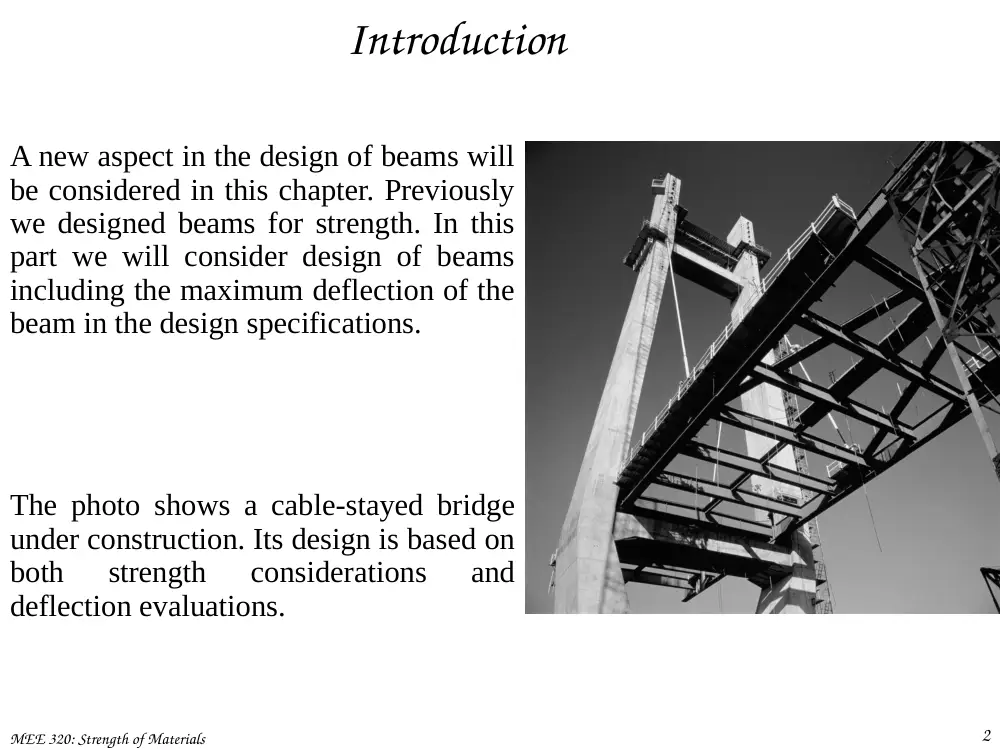
The photo shows a cable-stayed bridge
under construction. Its design is based on
both
strength
considerations
and
deflection evaluations.
MEE 320: Strength of Materials
3
Deformation Under Transverse Loading
Relationship between bending moment and
curvature for pure bending.
EI
M x
( )
1
Example: Cantilever beam subjected to
concentrated load at the free end.
EI
Px
1
Curvature varies linearly with x
At the free end A,
At the support B,
Px
M x
)
(
A
M
0
0)
(
PL
EI
PL
L
M
B
( )
MEE 320: Strength of Materials
4
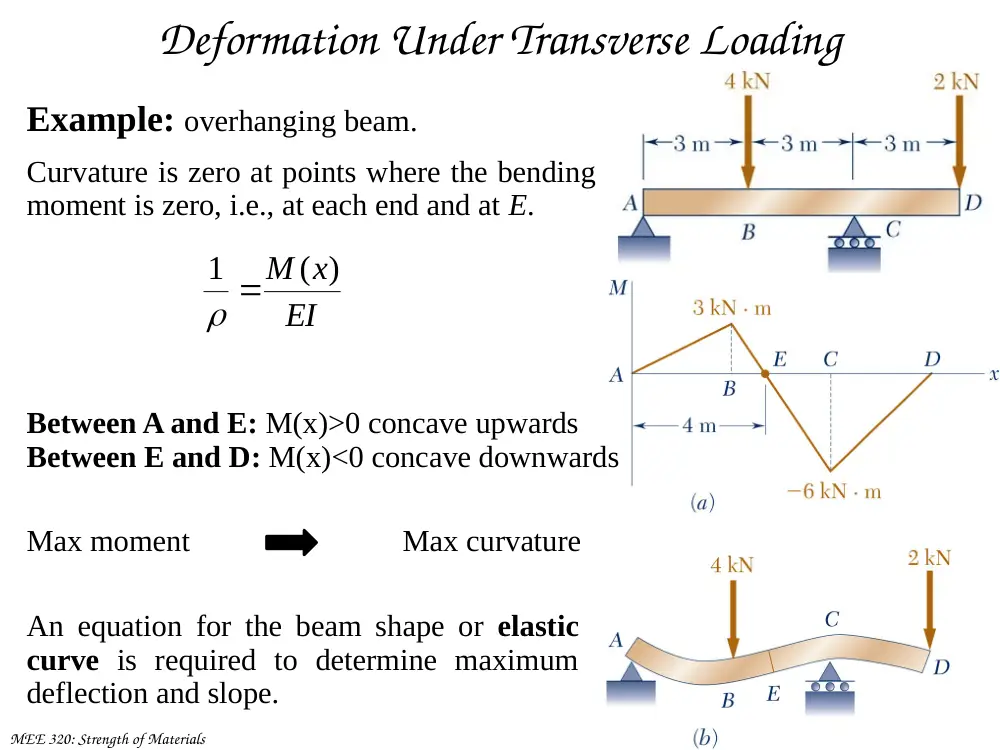
Curvature is zero at points where the bending
moment is zero, i.e., at each end and at E.
EI
M x
( )
1
Between A and E: M(x)>0 concave upwards
Between E and D: M(x)<0 concave downwards
Max moment Max curvature
An equation for the beam shape or elastic
curve is required to determine maximum
deflection and slope.
Deformation Under Transverse Loading
Example: overhanging beam.
MEE 320: Strength of Materials
5
Equation of the Elastic Curve
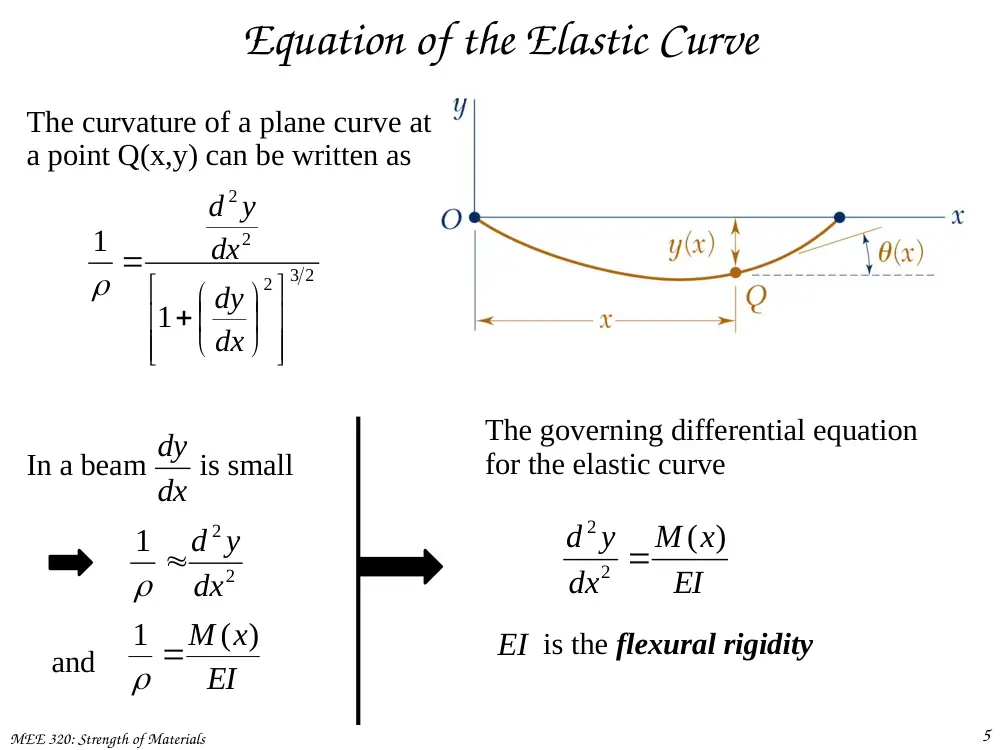
The curvature of a plane curve at
a point Q(x,y) can be written as
3 2
2
2
2
1
1
dx
dy
dx
y
d
2
2
1
dx
d y
In a beam is small
dx
dy
and
EI
M x
( )
1
The governing differential equation
for the elastic curve
EI
x
M
dx
d y
)
(
2
2
EI is the flexural rigidity
MEE 320: Strength of Materials
6
Equation of the Elastic Curve
2
1
0
0
1
0
C
C x
M x dx dx
y
EI
C
M x dx
dx
dy
EI
x
x
x
Integrate the governing differential equation twice with respect to x
x
dx
dy
tan
)
(
2
2
M x
dx
EI d y
The constants C1 and C2 are calculated
from the boundary conditions
Beam deflection
x
y
Beam slope
MEE 320: Strength of Materials
7
Equation of the Elastic Curve
Determination of C1 and C2
Three cases for statically determinant beams,
– Simply supported beam
0
,0
B
A
y
y
– Overhanging beam
– Cantilever beam
0
,0
A
yA
2
1
0
0
1
0
C
C x
M x dx dx
y
EI
C
M x dx
EI
x
x
x
0
,0
B
A
y
y
MEE 320: Strength of Materials
8
Example 1
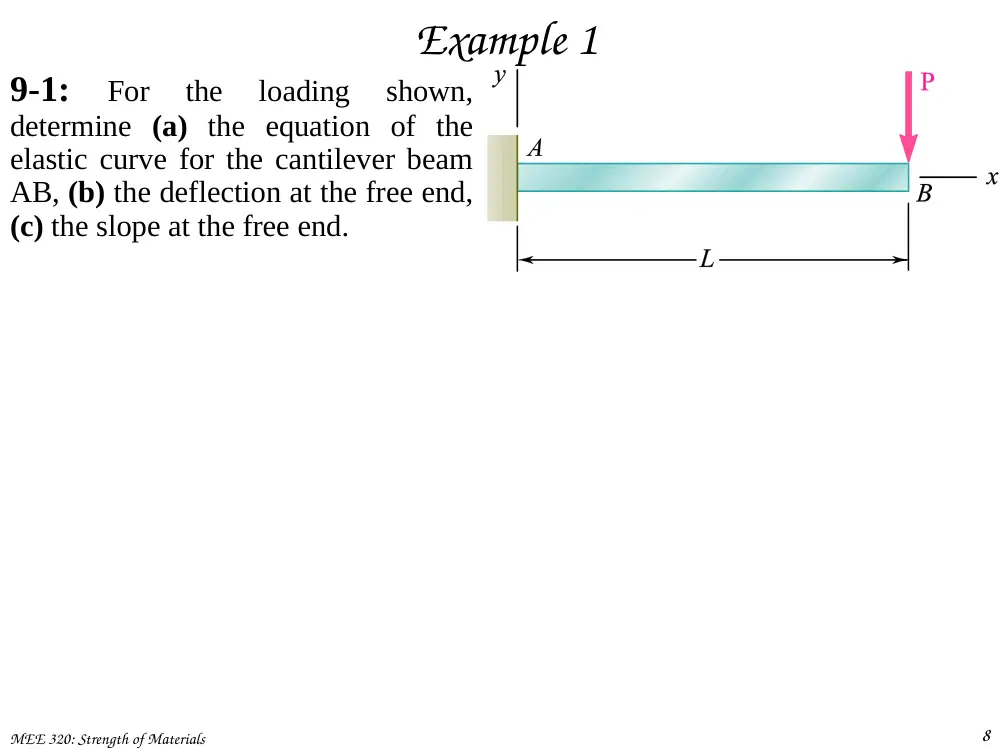
9-1:
For
the
loading
shown,
determine (a) the equation of the
elastic curve for the cantilever beam
AB, (b) the deflection at the free end,
(c) the slope at the free end.
MEE 320: Strength of Materials
9
Example 1
MEE 320: Strength of Materials
10
Example 1
MEE 320: Strength of Materials
11
Example 2
9-8: For the beam and loading
shown, determine (a) the equation
of the elastic curve for portion AB
of the beam, (b) the slope at A, (c)
the slope at B.
MEE 320: Strength of Materials
12
Example 2
MEE 320: Strength of Materials
13
Example 3
9-15: For the beam and loading
shown, knowing that a = 2 m, w =
50 kN/m, and E = 200 GPa,
determine (a) the slope at support
A, (b) the deflection at point C.
MEE 320: Strength of Materials
14
Example 3
MEE 320: Strength of Materials
15
Direct Determination of the Elastic Curve
Equation for beam displacement becomes
x
w
dx
d y
EI
dx
d M
4
4
2
2
4
3
2
2
3
1
2
1
6
1
C
C x
C x
x
C
dx dx dx w x dx
y x
EI
Integrating four times yields
For a beam subjected to a distributed load,
w x
dx
dV
dx
d M
V x
dx
dM
2
2
Constants C1, C2, C3 and C4 are determined
from boundary conditions.
MEE 320: Strength of Materials
16
Statically Indeterminate Beams
Conditions for static equilibrium yield
0
0
0
A
y
x
M
F
F
In a statically indeterminate beam, the
deflection equations are used to solve for
the reactions of the beam
The beam deflection equations,
which
introduces
2
unknowns but provides 3
additional equations from
the boundary conditions:
0
0
0
0
0
y
L
x
x
y
x
2
1
0
0
1
0
C
C x
M x dx dx
y
EI
C
M x dx
EI
x
x
x
MEE 320: Strength of Materials
17
Example 4
9-21: For the beam and
loading shown, determine the
reaction at the roller support
MEE 320: Strength of Materials
18
Example 4
MEE 320: Strength of Materials
19
Example 5
9-26: Determine the reaction at the
roller support and draw the bending
moment diagram for the beam and
loading shown.
MEE 320: Strength of Materials
20
Example 5
MEE 320: Strength of Materials
21
Example 6
9-33: Determine the reaction at
A and draw the bending moment
for the beam and loading shown.
MEE 320: Strength of Materials
22
Example 6
MEE 320: Strength of Materials
23
Method of Superposition
Procedure is facilitated by tables of solutions
for common types of loadings and supports.
For beams subjected to several concentrated or distributed loads:
• Compute separately the deformation of each of the applied loads
• The deformation of the combined load is found by adding the
deformation of individual loads.
MEE 320: Strength of Materials
24
Example 7
9-65: For the cantilever beam and
loading shown, determine the slope
and deflection at the free end.
MEE 320: Strength of Materials
25
Example 7
MEE 320: Strength of Materials
26
Example 7
MEE 320: Strength of Materials
27
Example 8
9-80: For the uniform beam
shown, determine (a) the reaction
at A, (b) the reaction at B.
MEE 320: Strength of Materials
28
Example 8
MEE 320: Strength of Materials
29
Example 8
MEE 320: Strength of Materials
30
Example 9
9-82: For the uniform beam
shown, determine the reaction at
each of the three supports.
MEE 320: Strength of Materials
31
Example 9
MEE 320: Strength of Materials
32
Example 9