
CSC 212 Final with Solution, Spring 2005
Notre Dame University–Louaize · Program Design and Data Abstraction I · 6 pages · with solution

More CSC 212 files
- Final with Solution · Spring 2008Final exam · with solutionView
- Chapter 1 · Spring 2013ChapterView
- Chapter 2 · Fall 2013ChapterView
- Chapter 2 · Spring 2013ChapterView
- Chapter 3 · Fall 2013ChapterView
- Chapter 3 · Spring 2013ChapterView
- Chapter 3 · Spring 2013ChapterView
- Chapter 4 Arrays · Fall 2013ChapterView
Show the text of this final exam
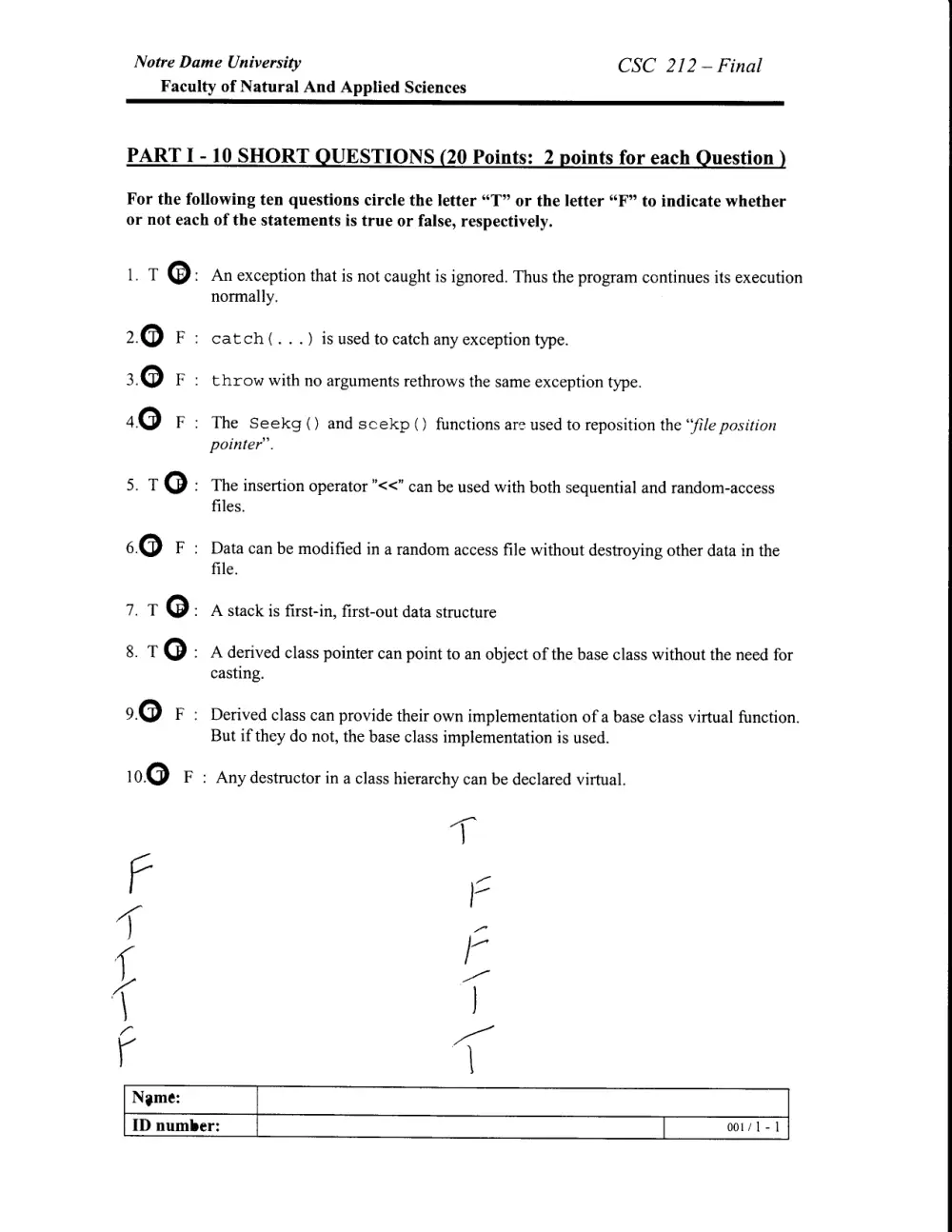
Notre Dame University CSC 212 — Final
Faculty of Natural And Applied Sciences
PART I - 10 SHORT QUESTIONS (20 Points: 2 points for each Question )
For the following ten questions circle the letter “T” or the letter “F” to indicate whether
or not each of the statements is true or false, respectively.
1. T @ : An exception that is not caught is ignored. Thus the program continues its execution
normally.
2.0 F : catch(...) is used to catch any exception type.
3.0 F : throw with no arguments rethrows the same exception type.
AG) F : The Seekg() and scekp() functions are used to reposition the “file position
pointer”.
5. T «) : The insertion operator "<<" can be used with both sequential and random-access
files.
6@ F : Data can be modified in a random access file without destroying other data in the
file.
7.7 @ : A stack is first-in, first-out data structure
8. T OQ : A derived class pointer can point to an object of the base class without the need for
casting.
re) F : Derived class can provide their own implementation of a base class virtual function.
But if they do not, the base class implementation is used.
10. F : Any destructor in a class hierarchy can be declared virtual.
T
F je
an >
| Ir
x 7
“7
T
Name:
ID number: ool/ 1-1
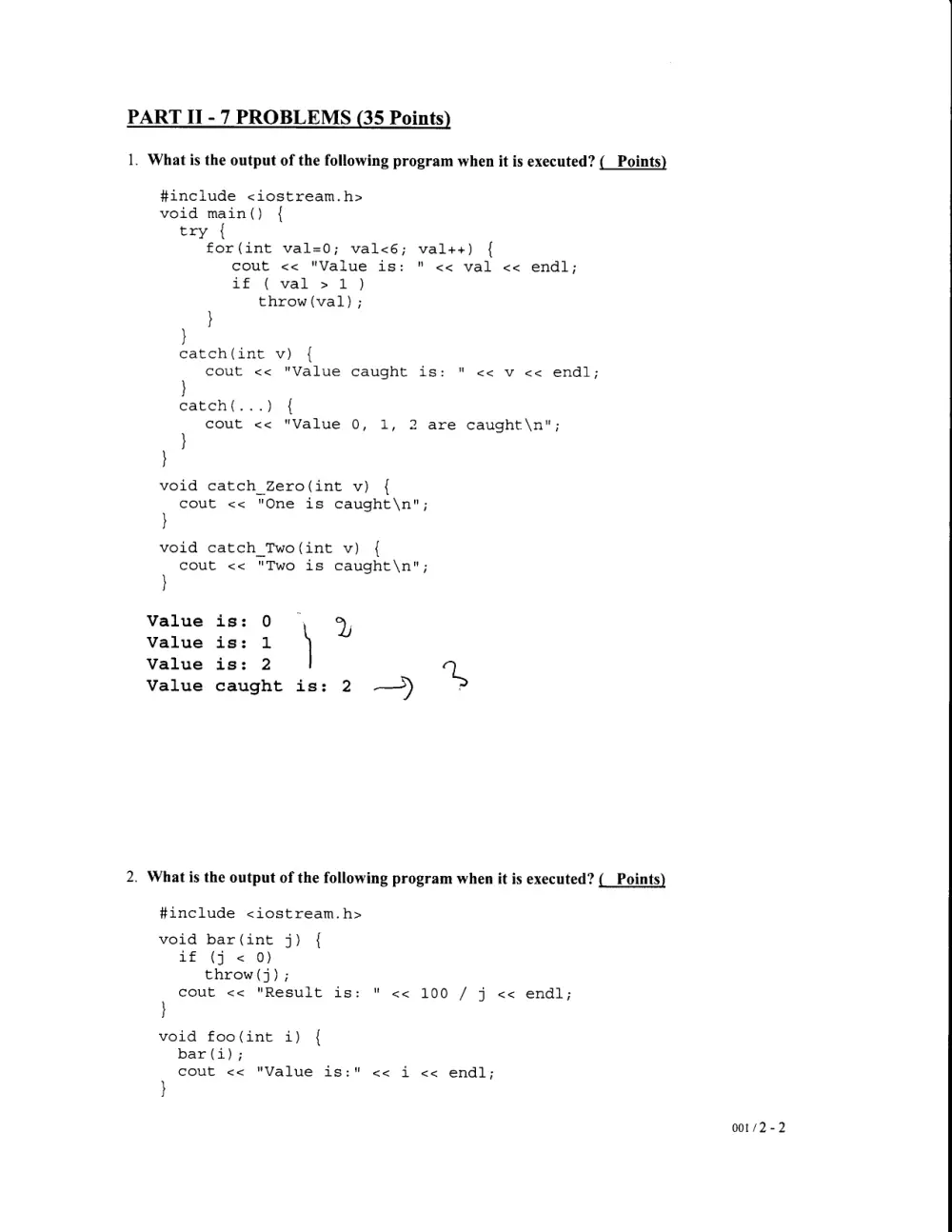
PART II - 7 PROBLEMS (35 Points)
1. What is the output of the following program when it is executed? (_ Points)
#include <iostream.h>
void main() {
try {
for(int val=0; val<6; val++) {
cout << "Value is: " << val << endl;
if ( val > 1)
throw (val) ;
}
}
catch(int v) {
cout << "Value caught is: " << v << endl;
}
catch(...) {
cout << "Value 0, 1, 2 are caught\n";
}
}
void catch _Zero(int v) {
cout << "One is caught\n";
}
void catch_Two(int v) {
cout << "Two is caught\n";
}
Value is: 0 %
Value is: 1 }
Value is: 2
Value caught is: 2 —>) 4
2. What is the output of the following program when it is executed? (_ Points)
#include <iostream.h>
void bar(int j) {
if (j < 0)
throw(j);
cout << "Result is: " << 100 / j << endl;
}
void foo(int i) {
bar (i);
cout << "Value is:" << i << endl;
}
001/2-2
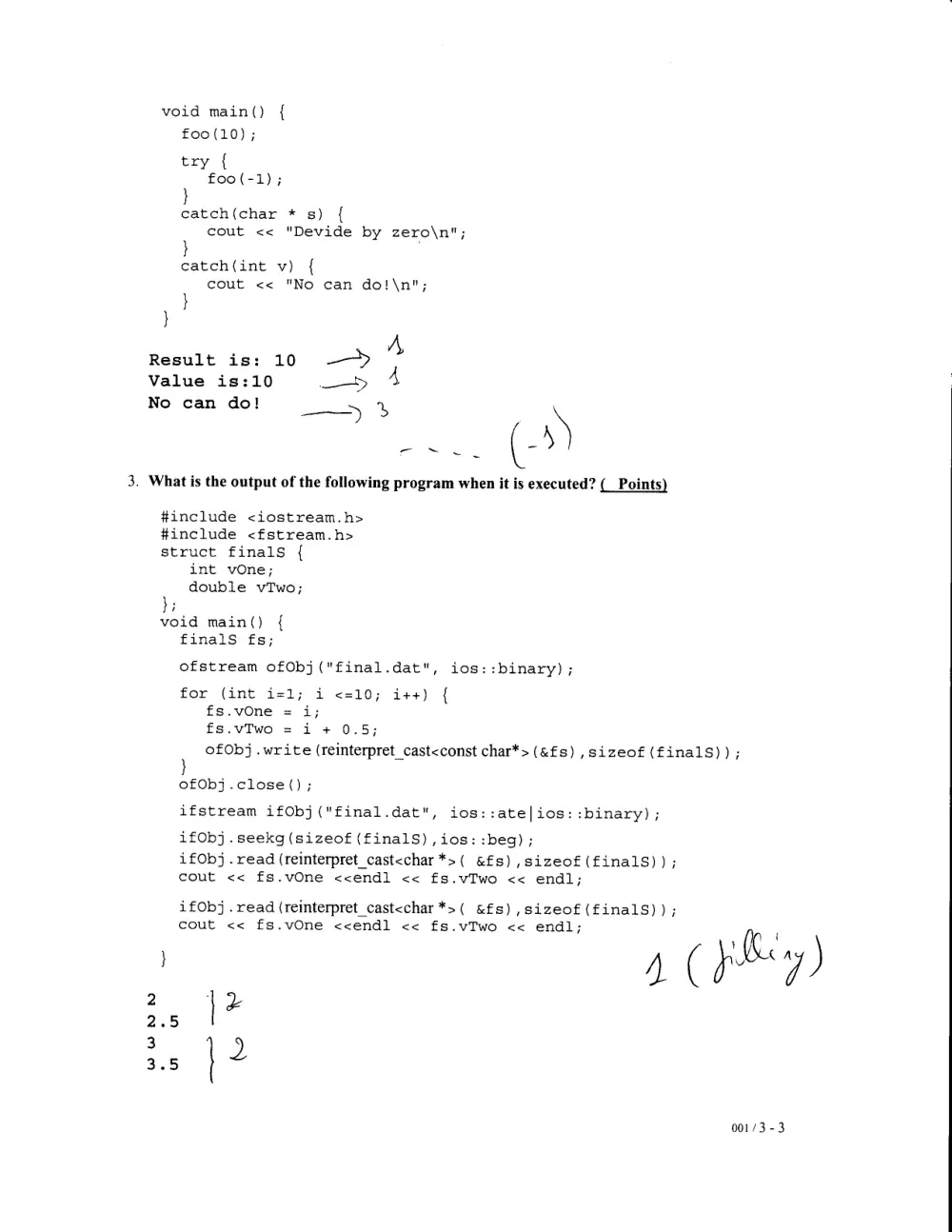
void main() {
£00 (10);
try {
foo(-1);
}
catch(char * s) {
cout << "Devide by zero\n";
} :
catch(int v) {
cout << "No can do!\n";
}
A
Result is: 10 —
Value is:10 — 4
No can do! > 4
-
3. What is the output of the following program when it is executed? (_ Points)
#include <iostream.h>
#include <fstream.h>
struct finals {
int vOne;
double vTwo;
};
void main() {
finals fs;
ofstream ofObj ("final.dat", ios::binary) ;
for (int i=1; i <=10; i++) {
fs.vOne = i;
fs.vTwo = i + 0.5;
of0bj . write (reinterpret_cast<const char*>(&fs) , sizeof (finalS)) ;
}
ofObj.close();
ifstream ifObj("final.dat", ios::ate|ios::binary) ;
ifObj .seekg (sizeof (finalS),ios: :beg) ;
ifObj . read (reinterpret_cast<char *>( &£s) , sizeof (finalS) );
cout << fs.vOne <<endl << fs.vTwo << endl;
ifObj . read (reinterpret_cast<char *>( &fs) , sizeof (finals) ) ;
cout << fs.vOne <<endl << fs.vTwo << endl;
_ 0 (py)
,
WWN ND
ul
001/3-3
Given a data file "TEST.DAT" with 6 records of different integer values
What is printed following the execution if this program? (Points) 87
#include <iostream.h> 43
#include <fstream.h> 10
class myFile { 23
public: 65
myFile(char * nm) { 12
ifo.open(nm,ios::in) ;
}
void mk() { bm = ifo.tellg()};}
void ps(long mk) { ifo.seekg(mk, ios: :beg) ;}
void go() { ps(bm);}
int gt() {
int i;
ifo >> i;
return i;
}
private:
ifstream ifo;
long bm;
}i
void main() {
myFile mf("test.dat") ;
cout << mf.gt() << "- '"
cout << mf.gt() << " - ";
cout << m£.gt() << " - ";
mf .mk () ;
mf .ps (0)
cout << mf.gt() << "- ";
mf.go();
cout << m£.gt() << endl;
} J ;
4
87 - 43 - 10 - 87 - 23
4. What is the output of the following program when it is executed? (_ Points)
#include <iostream.h>
template <class T>
class arrc {
public:
arrC(int sz) {
szV = sz;
arr = new T[sz];
}
void f£1(T);
void ot() const;
private:
int szV;
T inv;
T *arr;
};
001/4-4
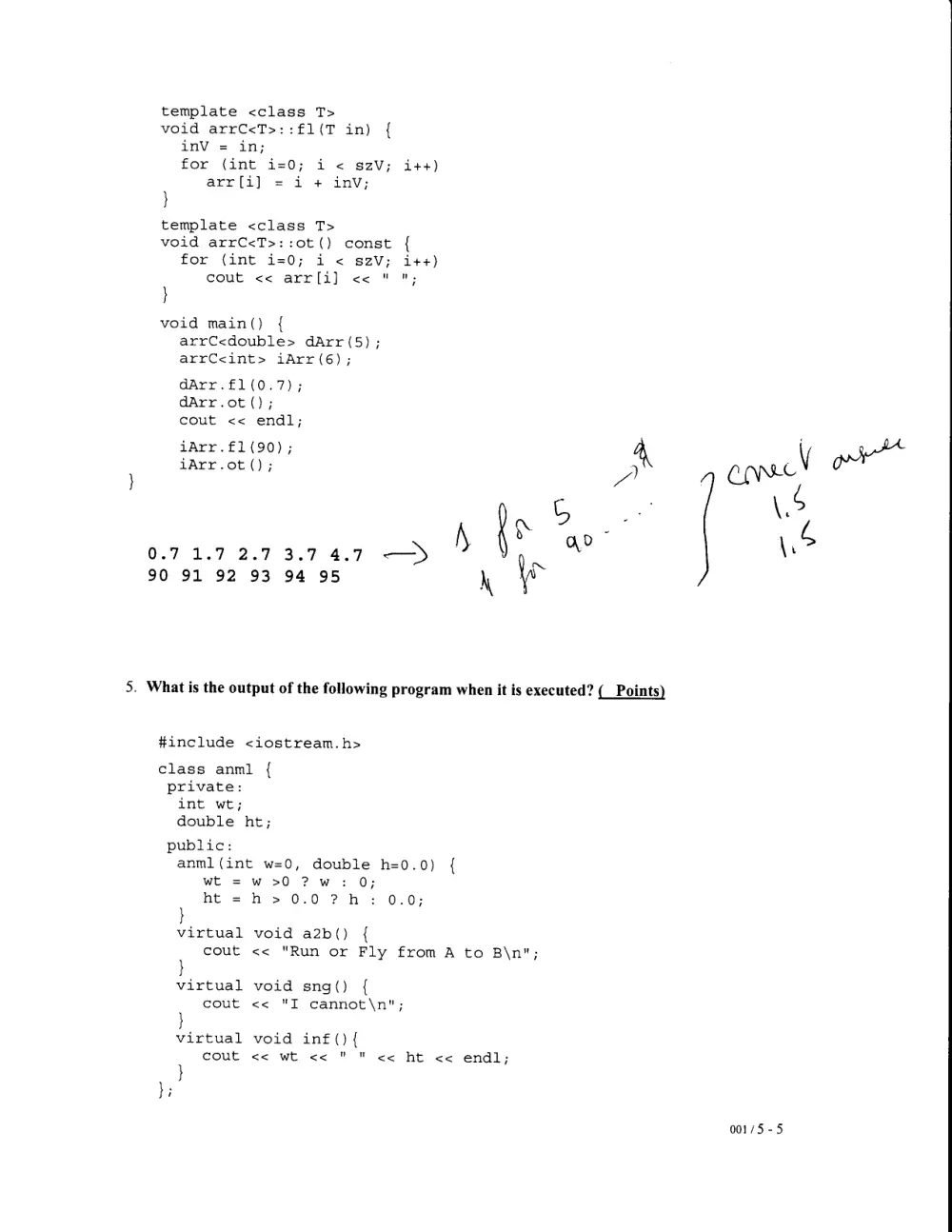
template <class T>
void arrC<T>::f1(T in) {
inV = in;
for (int i=0; i < szV; i++)
arr[i] = i + inv;
}
template <class T>
void arrC<T>::ot() const {
for (int i=0; i < szV; i++)
cout << arr[i] «<< ""
}
void main() {
arrC<double> dArr(5);
arrC<int> iArr (6);
dArr.£1(0.7);
dArr.ot ();
cout << endl;
iArr.£1(90);
iArr.ot();
0.7.1.7 2.7 3.7 4.7 —)»
90 91 92 93 94 95
#include <iostream.h>
class anml {
private:
int wt;
double ht;
public:
anml(int w=0, double h=0.0) {
wt = w>0 ?w: 0;
ht = h>0.0?h: 0.0;
A 4*
,
}
virtual void a2b() {
cout << "Run or Fly from A to B\n";
}
virtual void sng() {
cout << "I cannot\n";
}
virtual void inf () {
cout << wt << " " << ht << endl;
}
5
ao
5. What is the output of the following program when it is executed? (_ Points)
001/5-5
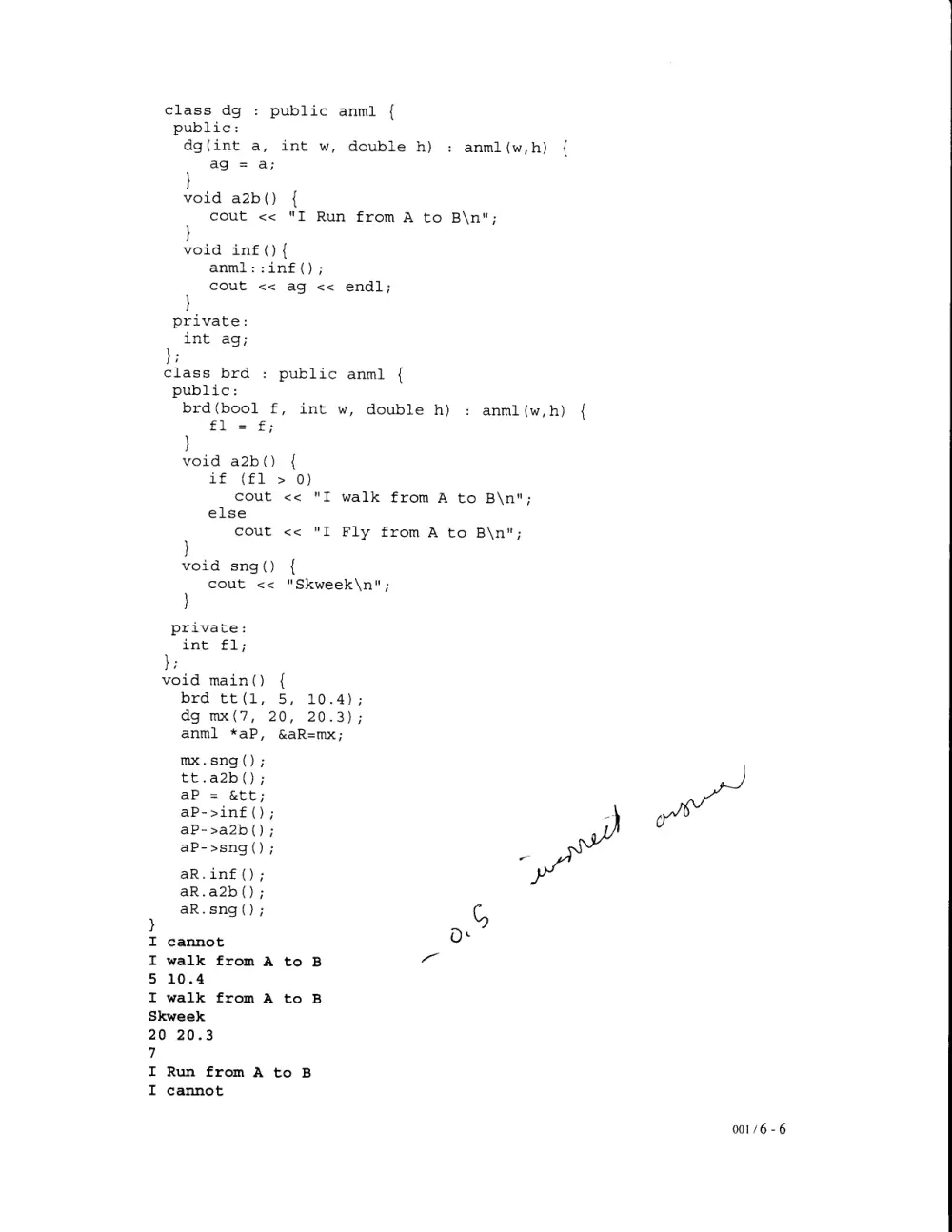
class dg : public anml {
public:
dg(int a, int w, double h) : anml(w,h) {
ag = a;
}
void a2b() {
cout << "I Run from A to B\n";
}
void inf () {
anml::inf();
cout << ag << endl;
}
private:
int ag;
}i
class brd : public anml {
public:
brd(bool f, int w, double h) : anml(w,h) {
fl = f;
}
void a2b() {
if (f1 > 0)
cout << "I walk from A to B\n";
else
cout << "I Fly from A to B\n";
}
void sng() {
cout << "Skweek\n";
}
private:
int £1;
};
void main() {
brd tt(1, 5, 10.4);
dg mx(7, 20, 20.3);
anml *aP, &aR=mx;
mx.sng();
tt.a2b();
aP = &tt;
aP->inf();
aP->a2b();
aP->sng();
aR.inf();
aR.a2b();
aR.sng();
}
I cannot Os
I walk from A to B —
5 10.4
I walk from A to B
I Run from A to B
I cannot
001/6 -6