
CSC 212 Problems For Chapter 2 with Solution, Summer 2013
Notre Dame University–Louaize · Program Design and Data Abstraction I · 21 pages · with solution



Showing the first 10 of 21 pages. Download the PDF to see all of it.
More CSC 212 files
Show the text of this chapter
// Write a C++ program that checks if an entered integer is prime or not.
// An integer is said to be prime if it is divisible by only 1 and itself.
#include <iostream.h>
int main()
{
int Number, Flag = 0;
cout << "Enter a number: ";
cin >> Number;
if ( Number <= 1 ) {
cout << Number << " is not a prime number" << endl;
}
else {
for ( int i = 2; i <= Number / 2 ; i++ ) {
if ( ( Number % i ) == 0 ) {
cout << Number << " is not a prime number" << endl;
Flag = 1;
break;
}
}
if ( Flag == 0 ) {
cout << Number << " is a prime number" << endl;
}
}
return 0;
}
/* A sample screen output look like:
Enter a number: 23
23 is a prime number
Another sample screen output look like:
Enter a number: 16
16 is not a prime number
*/
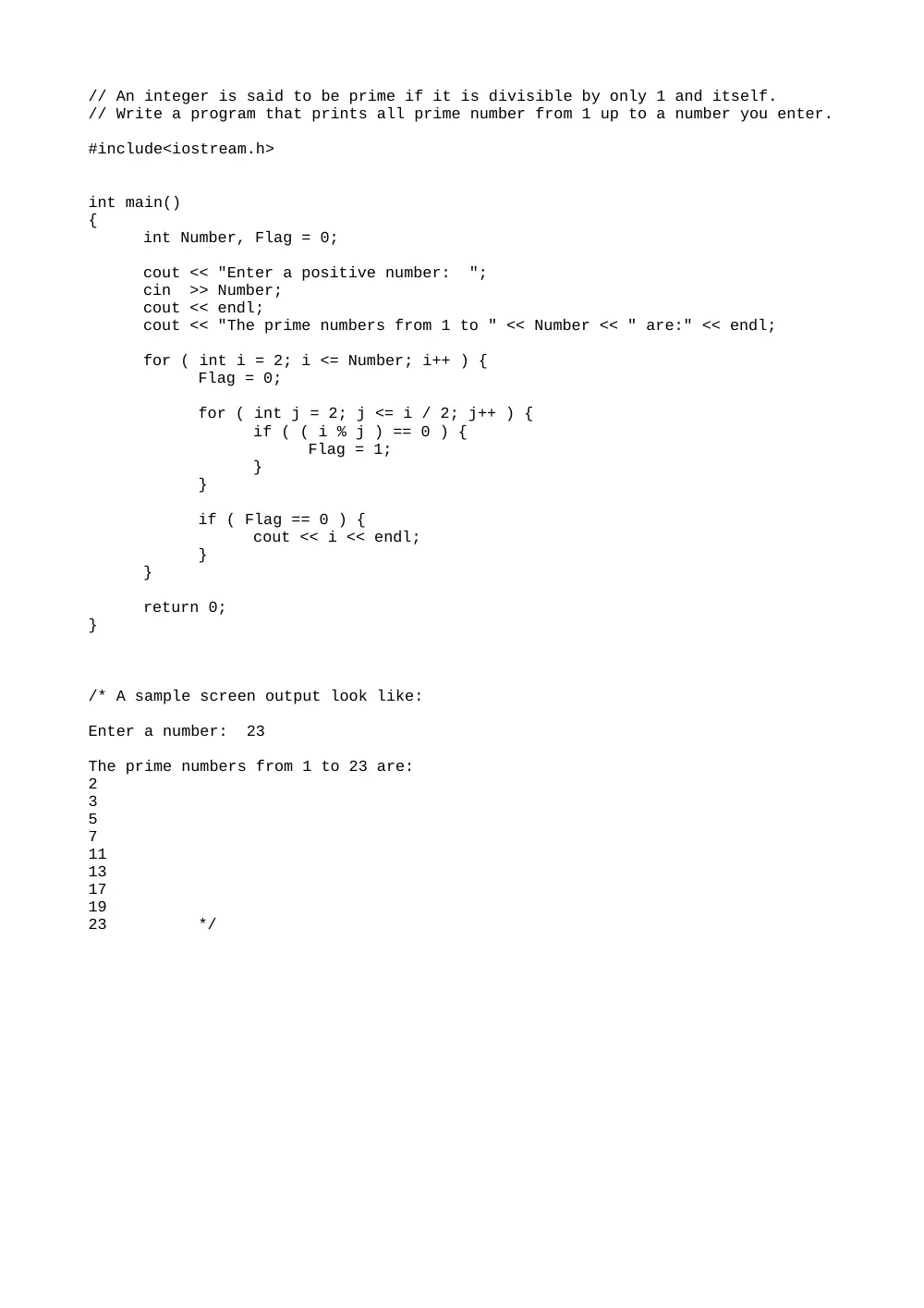
// An integer is said to be prime if it is divisible by only 1 and itself.
// Write a program that prints all prime number from 1 up to a number you enter.
#include<iostream.h>
int main()
{
int Number, Flag = 0;
cout << "Enter a positive number: ";
cin >> Number;
cout << endl;
cout << "The prime numbers from 1 to " << Number << " are:" << endl;
for ( int i = 2; i <= Number; i++ ) {
Flag = 0;
for ( int j = 2; j <= i / 2; j++ ) {
if ( ( i % j ) == 0 ) {
Flag = 1;
}
}
if ( Flag == 0 ) {
cout << i << endl;
}
}
return 0;
}
/* A sample screen output look like:
Enter a number: 23
The prime numbers from 1 to 23 are:
2
3
5
7
11
13
17
19
23
*/
Exercice Chapter 2
1
Problems
Write a C++ program that inputs a series of 10 numbers, and
determines and prints the largest of the numbers.
#include <iostream.h>
int main()
{
int counter = 0, number, largest;
cout << "Enter the first number: ";
cin
>> largest;
while(++counter < 10){
cout << "Enter the next number : ";
cin
>> number;
if(number > largest){
largest = number;
}
}
cout << "Largest is " << largest << endl;
return 0;
}
Sample Output:
Exercice Chapter 2
2
Exercice Chapter 2
3
The factorial of a nonnegative integer n is written n! (Pronounced “n
factorial”) and is defined as follows:
n! = n * (n-1) * (n-2) * ... * 1
and
n! = 1 for n = 0
For example 5! = 5 * 4 * 3 * 2 * 1 which is 120
Write a program that reads a nonnegative integer and computes and
prints its factorial.
#include <iostream.h>
int main()
{
int n = 0, number;
unsigned factorial = 1;
do {
cout << "Enter a positive integer: ";
cin >> number;
} while(number < 0);
while(n++ < number){
factorial = factorial * n;
}
cout << number << "! is " << factorial << endl;
return 0;
}
Sample Output:
Exercice Chapter 2
4
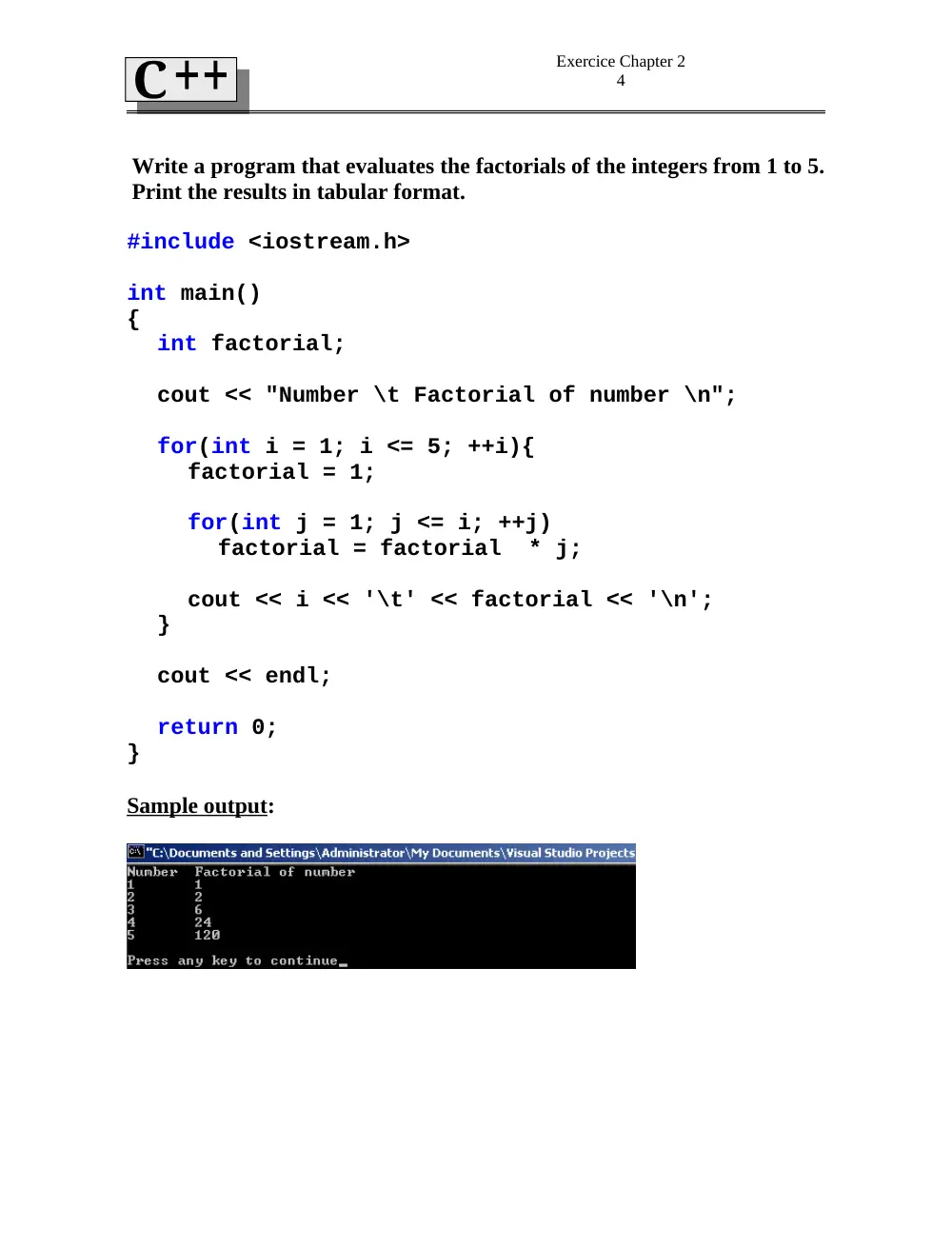
Write a program that evaluates the factorials of the integers from 1 to 5.
Print the results in tabular format.
#include <iostream.h>
int main()
{
int factorial;
cout << "Number \t Factorial of number \n";
for(int i = 1; i <= 5; ++i){
factorial = 1;
for(int j = 1; j <= i; ++j)
factorial = factorial * j;
cout << i << '\t' << factorial << '\n';
}
cout << endl;
return 0;
}
Sample output:
Exercice Chapter 2
5
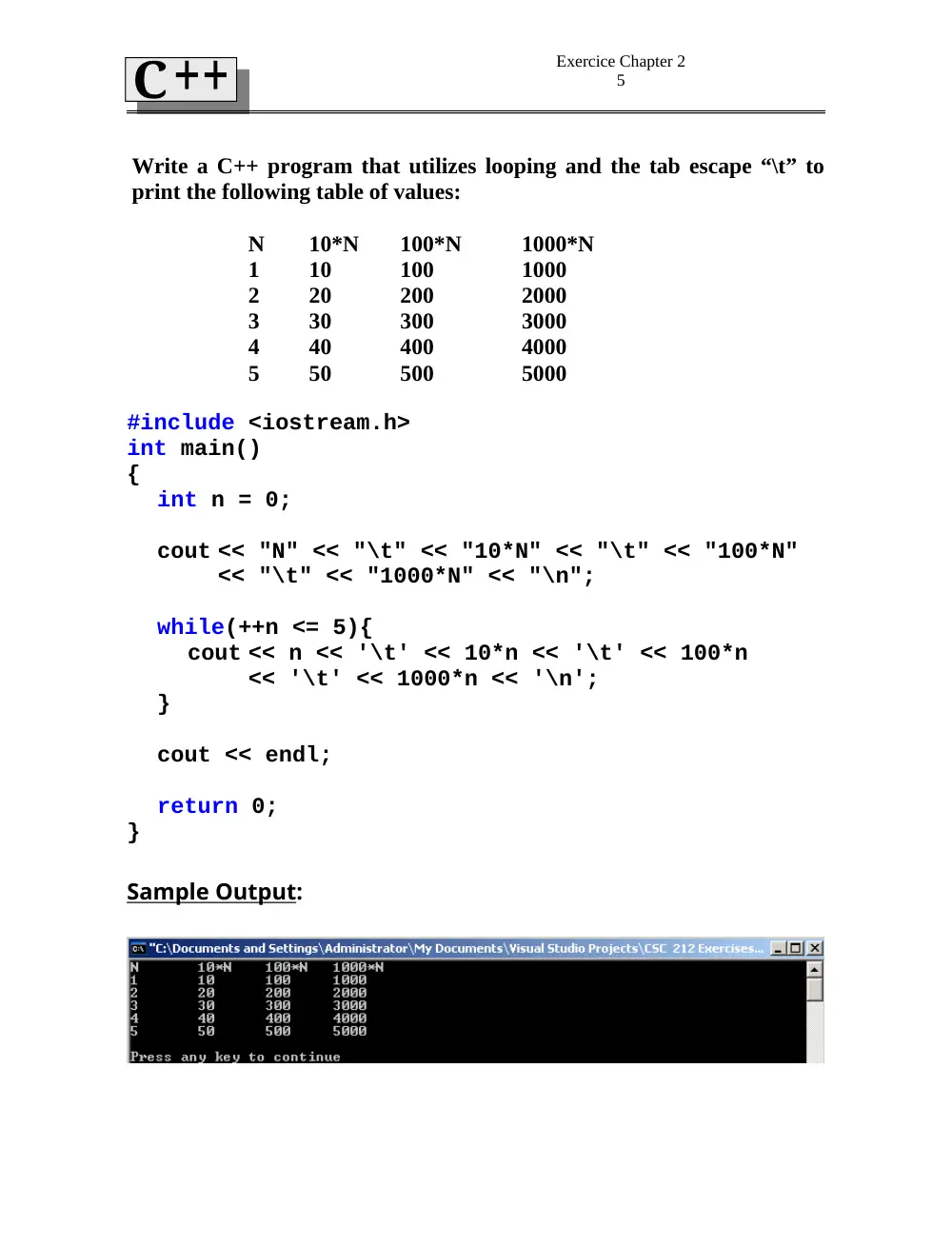
Write a C++ program that utilizes looping and the tab escape “\t” to
print the following table of values:
N
10*N
100*N
1000*N
1
10
100
1000
2
20
200
2000
3
30
300
3000
4
40
400
4000
5
50
500
5000
#include <iostream.h>
int main()
{
int n = 0;
cout << "N" << "\t" << "10*N" << "\t" << "100*N"
<< "\t" << "1000*N" << "\n";
while(++n <= 5){
cout << n << '\t' << 10*n << '\t' << 100*n
<< '\t' << 1000*n << '\n';
}
cout << endl;
return 0;
}
Sample Output:
Exercice Chapter 2
6
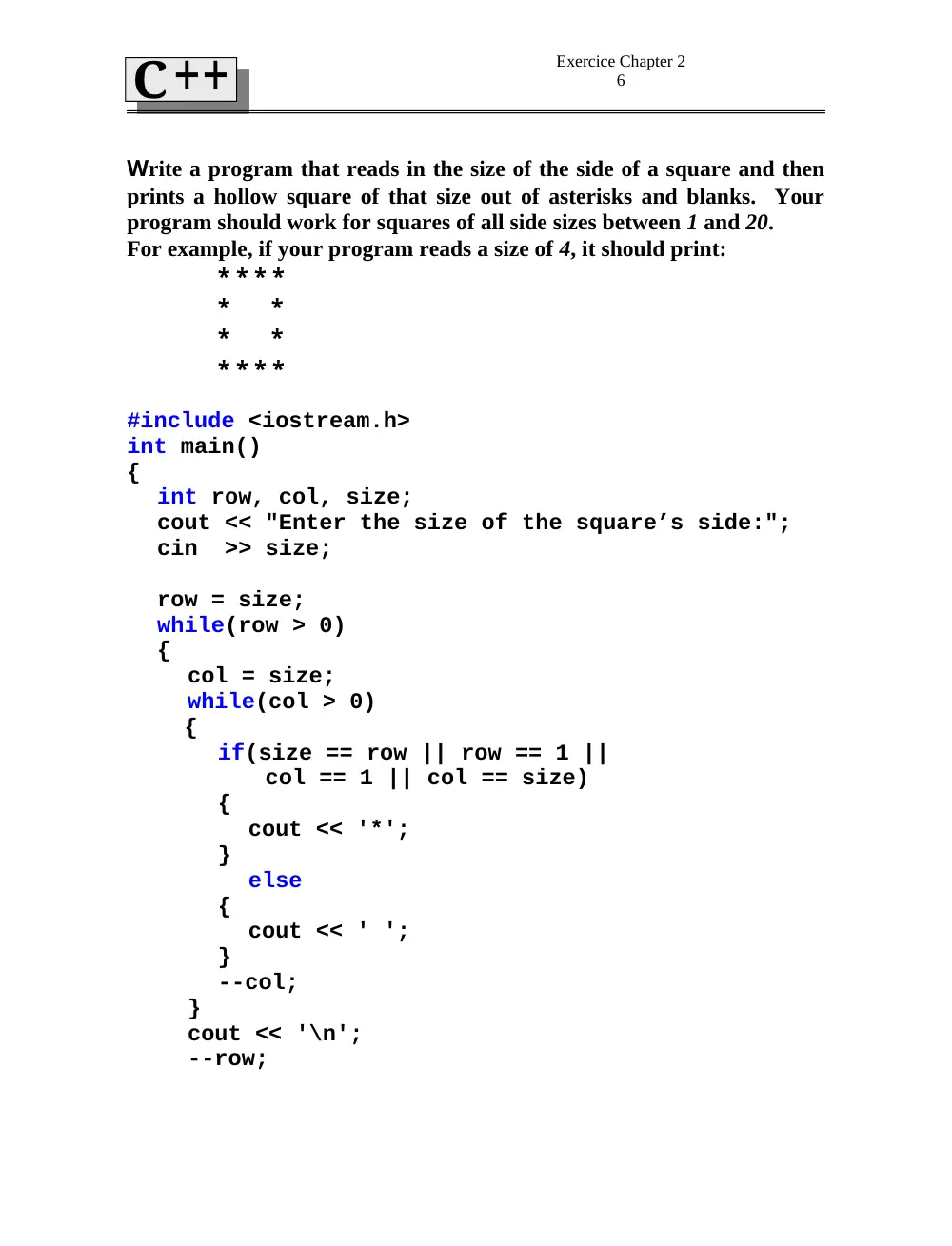
Write a program that reads in the size of the side of a square and then
prints a hollow square of that size out of asterisks and blanks. Your
program should work for squares of all side sizes between 1 and 20.
For example, if your program reads a size of 4, it should print:
* * * *
* *
* *
* * * *
#include <iostream.h>
int main()
{
int row, col, size;
cout << "Enter the size of the square’s side:";
cin >> size;
row = size;
while(row > 0)
{
col = size;
while(col > 0)
{
if(size == row || row == 1 ||
col == 1 || col == size)
{
cout << '*';
}
else
{
cout << ' ';
}
--col;
}
cout << '\n';
--row;
Exercice Chapter 2
7
}
cout << endl;
return 0;
}
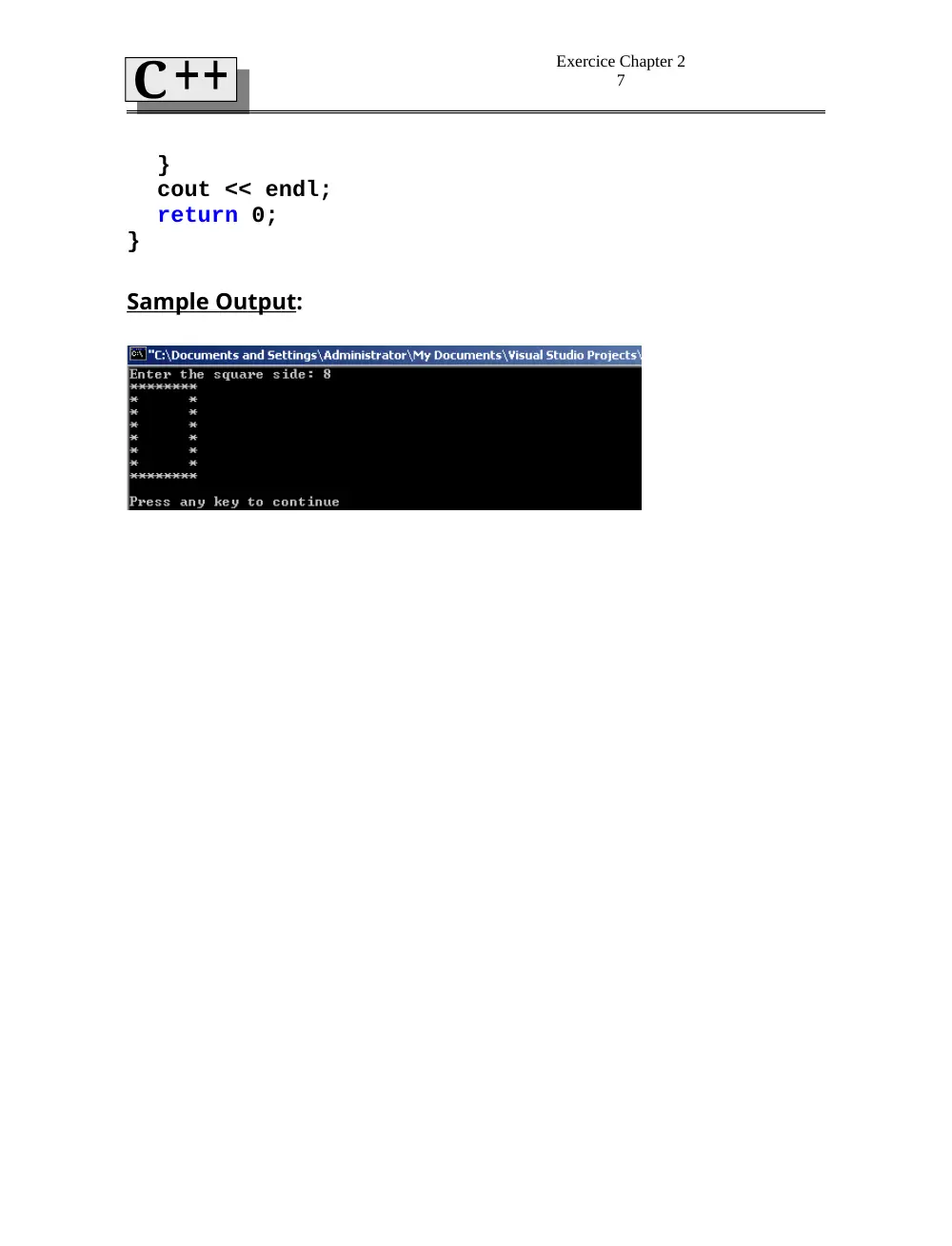
Sample Output:
Exercice Chapter 2
8
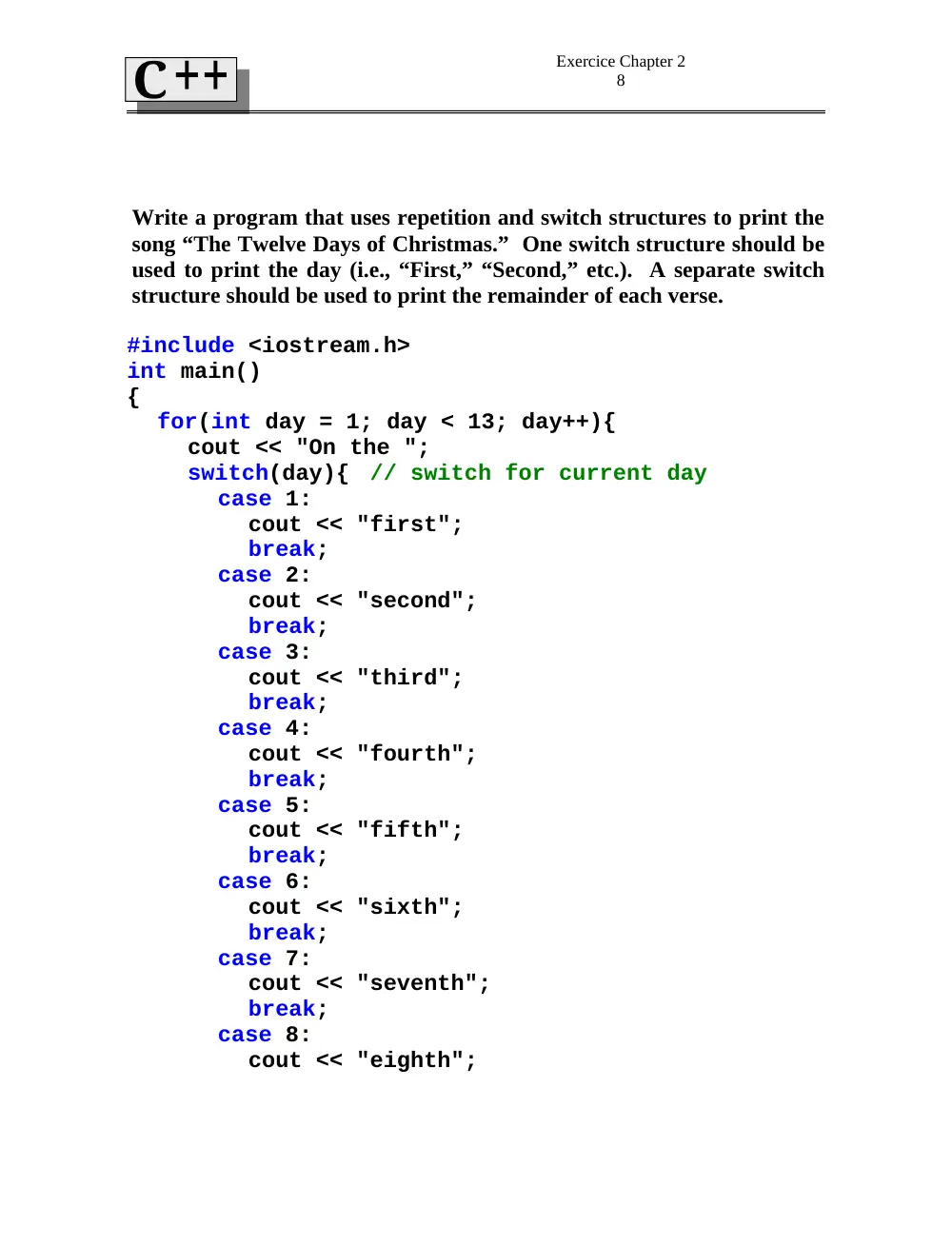
Write a program that uses repetition and switch structures to print the
song “The Twelve Days of Christmas.” One switch structure should be
used to print the day (i.e., “First,” “Second,” etc.). A separate switch
structure should be used to print the remainder of each verse.
#include <iostream.h>
int main()
{
for(int day = 1; day < 13; day++){
cout << "On the ";
switch(day){
// switch for current day
case 1:
cout << "first";
break;
case 2:
cout << "second";
break;
case 3:
cout << "third";
break;
case 4:
cout << "fourth";
break;
case 5:
cout << "fifth";
break;
case 6:
cout << "sixth";
break;
case 7:
cout << "seventh";
break;
case 8:
cout << "eighth";
Exercice Chapter 2
9
break;
case 9:
cout << "ninth";
break;
case 10:
cout << "tenth";
break;
case 11:
cout << "eleventh";
break;
case 12:
cout << "twelfth";
break;
}
cout << " day of Christmas,\n";
cout << " My true love sent to me:\n";
switch(day){
// switch for gifts
case 12:
cout << "\t Twelve drummers drumming, \n";
case 11:
cout << "\t Eleven pipers piping, \n";
case 10:
cout << "\t Ten lords a-leaping, \n";
case 9:
cout << "\t Nine ladies dancing, \n";
case 8:
cout << "\t Eight maids a-milking, \n";
case 7:
cout << "\t Seven swans a-swimming, \n";
case 6:
cout << "\t Six geese a-laying, \n";
case 5:
cout << "\t Five golden rings, \n";
case 4:
Exercice Chapter 2
10
cout << "\t Four calling birds, \n";
case 3:
cout << "\t Three French hens, \n";
case 2:
cout << "\t Two turtle doves, and \n";
case 1:
cout << "A partridge in a pear tree.\n\n";
}
}
cout << endl;
return 0;
}
Sample Output:
Exercice Chapter 2
11
Write a program that prints a diamond shape. You may use output
statements that print either a single asterisk (*) or a single blank.
Maximize your use of repetition (with nested for structures) and
minimize the number of output statements.
#include <iostream.h>
int main()
{
// top half of the diamond
for(int row = 1; row <= 5; ++row){
for(int space = 1; space <= 5 - row; ++space)
cout << ' ';
for(int ast = 1; ast <= 2 * row - 1; ++ast)
cout << '*';
cout << '\n';
}
// bottom half of the diamond
for(row = 4; row >= 1; --row){
for(int space = 1; space <= 5 - row; ++space)
cout << ' ';
for(int ast = 1; ast <= 2 * row - 1; ++ast)
cout << '*';
cout << '\n';
}
cout << endl;
return 0;
}
Sample Output:
Exercice Chapter 2
12
Exercice Chapter #2
1
What is the output of the following program?
#include <iostream.h>
void main () {
int x = 1;
for ( ; ; ) {
if ( (x++ % 15) == 0 )
break;
if ( (x % 5) != 0 )
continue;
cout << x << " ";
}
cout << endl;
}
Answer:
5 10 15
If we had:
if ( (++x % 15) == 0)
then answer is: 5 10
What is the output of the following program?
#include <iostream.h>
void main () {
int x = 10;
while ( x ) {
if ( --x == 5 )
break;
cout << x << " ";
}
cout << endl;
}
Answer:
9 8 7 6
If we had:
if ( x-- == 5 )
then answer is: 9 8 7 6 5
Exercice Chapter #2
2
What is the output of the following program?
#include <iostream.h>
void main () {
int x = 10;
while ( x )
cout << --x << “ “;
cout << endl;
}
Answer:
9 8 7 6 5 4 3 2 1 0
If we had:
cout << x-- << " "; then answer is:
10 9 8 7 6 5 4 3 2 1
What is the output of the following program?
#include <iostream.h>
void main () {
int j;
for ( j = 1; j <= 10; j++ ) {
if ( (j > 5) && (j <= 7) )
cout << j << endl;
}
cout << endl;
}
Answer:
6
7
Exercice Chapter #2
3
What is the output of the following program?
#include <iostream.h>
void main () {
int j;
for ( j = 1; j <= 10; j++ ) {
if ( (j < 5) || (j >= 7) )
cout << j << endl;
}
cout << endl;
}
Answer:
1
2
3
4
7
8
9
10
What is the output of the following program?
#include <iostream.h>
void main () {
int j;
for ( j = 1; j <= 10; j++ ) {
if ( !((j < 5) || (j >= 7)) )
cout << j << endl;
}
cout << endl;
}
Answer:
5
Exercice Chapter #2
4
6
What is the output of the following program?
#include <iostream.h>
void main () {
int i, j, k;
for ( i = 1; i <= 2; i++ )
for ( j = 1; j <= 2; j++ )
for ( k = 1; k <= 3; k++ )
cout << k << " ";
cout << endl;
}
Answer:
1 2 3 1 2 3 1 2 3 1 2 3
What is the output of the following program?
#include <iostream.h>
int main () {
int count = 0;
while ( count++ <= 5 )
cout << ( count % 2 ? "***" : "---" ) << endl;
cout << count << endl;
return 0;
}
Answer:
***
---
***
---
***
---
Exercice Chapter #2
5
7
What is the output of the following program?
#include <iostream.h>
int main () {
int j = 10, b = 5;
for ( ; b <= j; j -= 1 ) {
if ( (j % b == 0) && (j * 5 <= 25) )
continue;
if ( (j < 7) || (j >= 9) )
cout << j << endl;
}
return 0;
}
Answer:
10
9
6
What is the output of the following program?
#include <iostream.h>
void main () {
for ( int i = 45; i > 1; i = i / 5 )
cout << i++ << endl;
cout << "continue";
}
Answer:
45
9
2
continue
Exercice Chapter #2
6
What is the output of the following program?
#include <iostream.h>
void main () {
int i, j, k;
int x = 0;
for ( i = 1; i <= 5; i++ )
for ( j = 1; j <= 7; j += 2 )
for ( k = 1; k < 15; k += 3 )
x++;
cout << x << endl;
}
Answer:
100
What is the output of the following program?
#include <iostream.h>
void main () {
int x;
for ( x = 1; x <= 5; x++ ) {
switch ( x ) {
case 1:
cout << x << endl;
case 2:
cout << x << endl;
case 3:
Exercice Chapter #2
7
cout << x << endl;
break;
default:
cout << x + 1 << endl;
}
}
}
Answer:
1
1
1
2
2
3
5
6