
CSC 212 Problems For Chapter 3, Spring 2010
Notre Dame University–Louaize · Program Design and Data Abstraction I · 10 pages



More CSC 212 files
Show the text of this chapter
Problem Exercises Chapter 03
1
Problem Exercises
1.
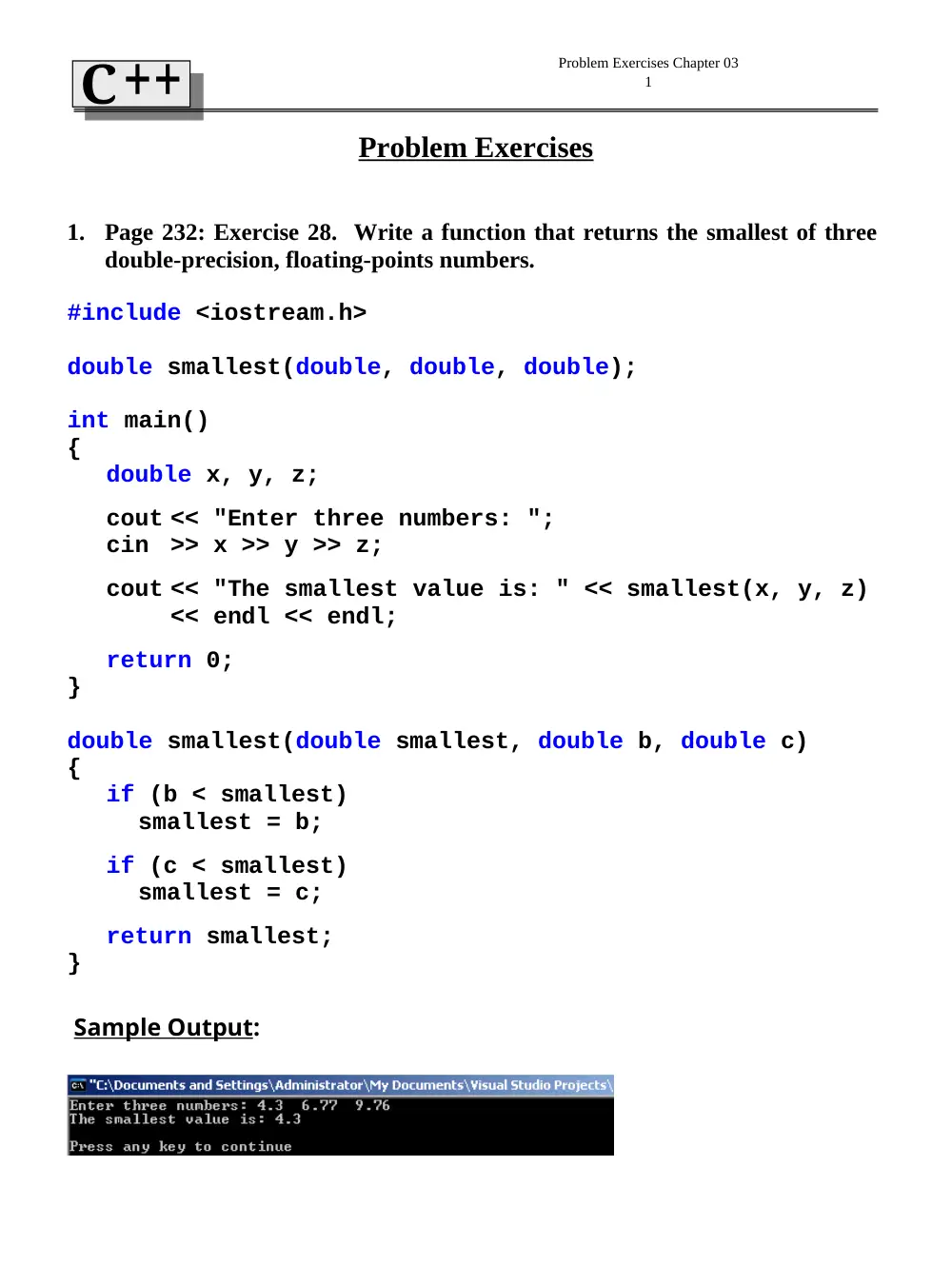
Page 232: Exercise 28. Write a function that returns the smallest of three
double-precision, floating-points numbers.
#include <iostream.h>
double smallest(double, double, double);
int main()
{
double x, y, z;
cout << "Enter three numbers: ";
cin
>> x >> y >> z;
cout << "The smallest value is: " << smallest(x, y, z)
<< endl << endl;
return 0;
}
double smallest(double smallest, double b, double c)
{
if (b < smallest)
smallest = b;
if (c < smallest)
smallest = c;
return smallest;
}
Sample Output:
Problem Exercises Chapter 03
2
Problem Exercises Chapter 03
3
2.
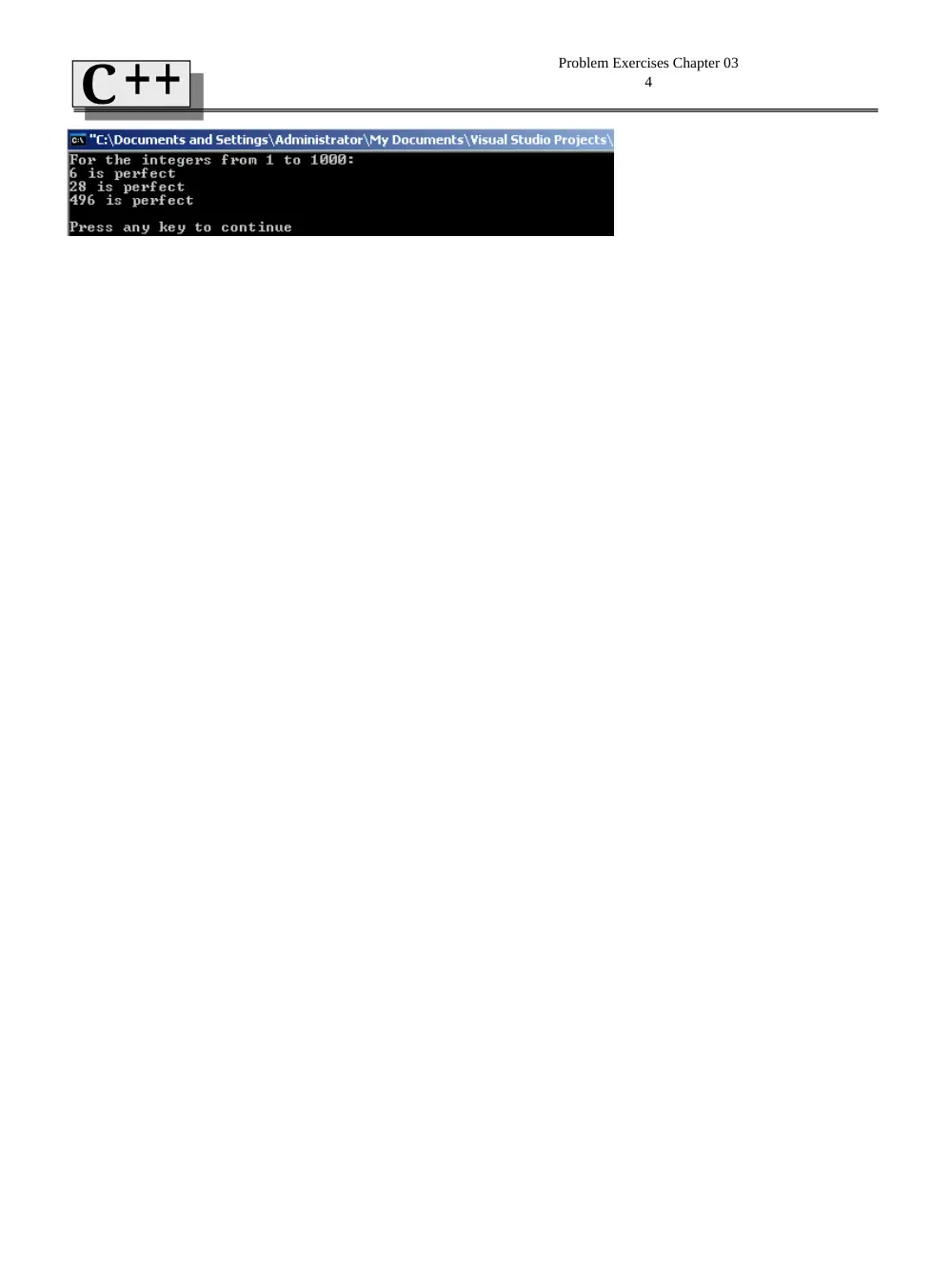
Page 232: Exercise 29. An integer is said to be a perfect number if the sum
of its factors, including 1 (but not the number itself), is equal to the number.
For example, 6 is a perfect number, because 6 = 1 + 2 + 3. Write a function
that determines whether a number is perfect. Use this function in a
program that determines and prints all the perfect numbers between 1 and
1000.
#include <iostream.h>
bool perfect(int);
int main()
{
cout << "For the integers from 1 to 1000: \n";
for (int j = 2; j <= 1000; ++j)
if ( perfect(j) )
cout << j << " is perfect \n";
cout << endl;
return 0;
}
bool perfect(int value) {
int factorSum = 1;
for (int i = 2; i <= value / 2; ++i)
if (value % i == 0)
factorSum += i;
return factorSum == value ? true : false;
}
Sample Output:
Problem Exercises Chapter 03
4
Problem Exercises Chapter 03
5
3.
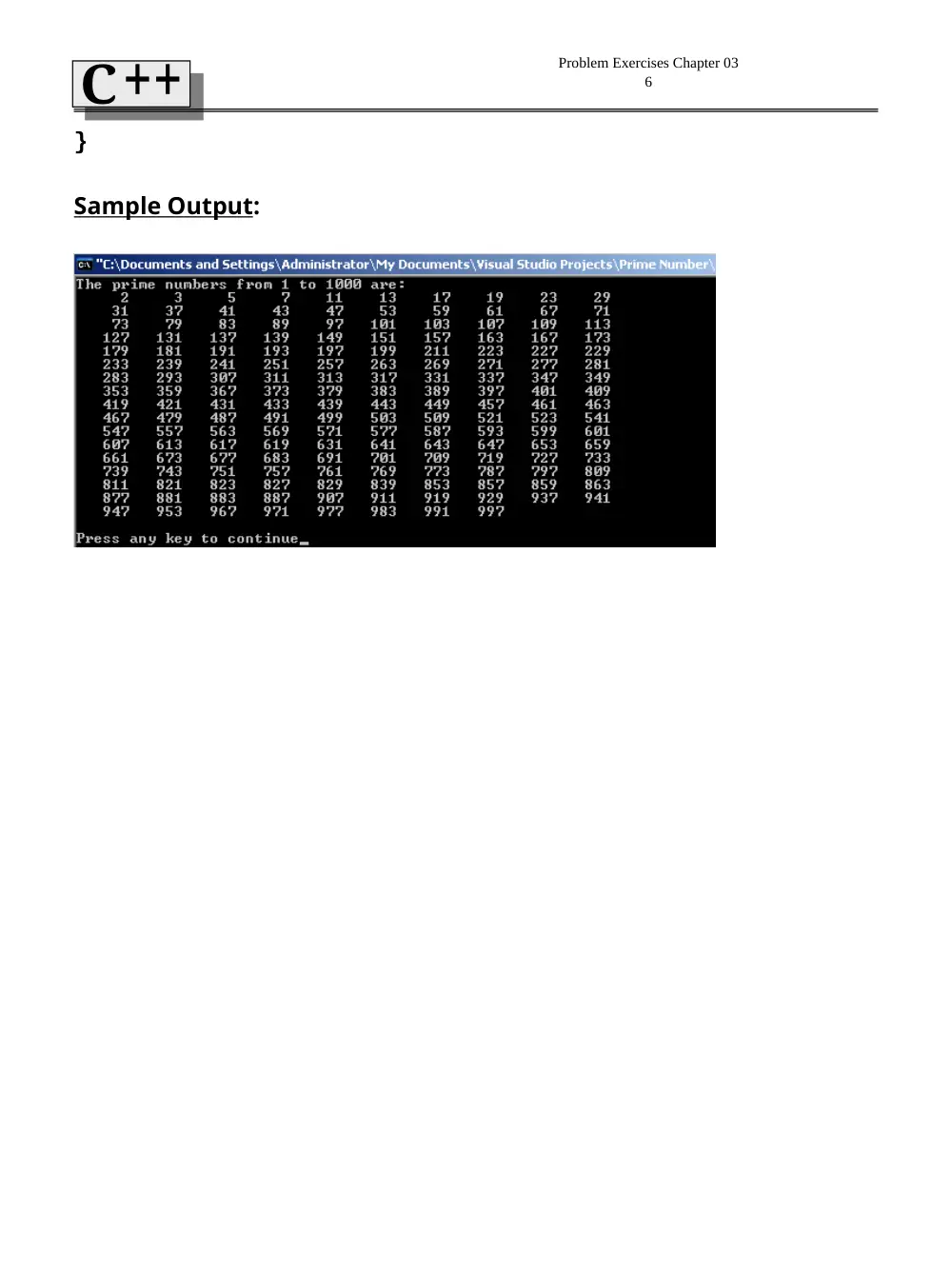
Page 232: Exercise 30. An integer is said to be prime if it is divisible by only
1 and itself. For example, 2, 3, 5 and 7 are prime, but 4, 6, 8 and 9 are not.
a) Write a function to determine if a number is prime.
b) Use this function in a program that determines and prints all the prime
numbers between 1 and 1000.
#include <iostream.h>
#include <iomanip.h>
bool prime(int);
int main()
{
int count = 0;
cout << "The prime numbers from 1 to 1000 are: \n";
for (int loop = 2; loop <= 1000; ++loop) {
if ( prime(loop) ) {
++count;
cout << setw(6) << loop;
if ( (count % 10) == 0 )
cout << '\n';
}
}
cout << endl << endl;
return 0;
}
bool prime(int n)
{
for (int loop2 = 2; loop2 <= n/2; loop2++) {
if ( (n % loop2) == 0 )
return false;
}
return true;
Problem Exercises Chapter 03
6
}
Sample Output:
Problem Exercises Chapter 03
7
4.
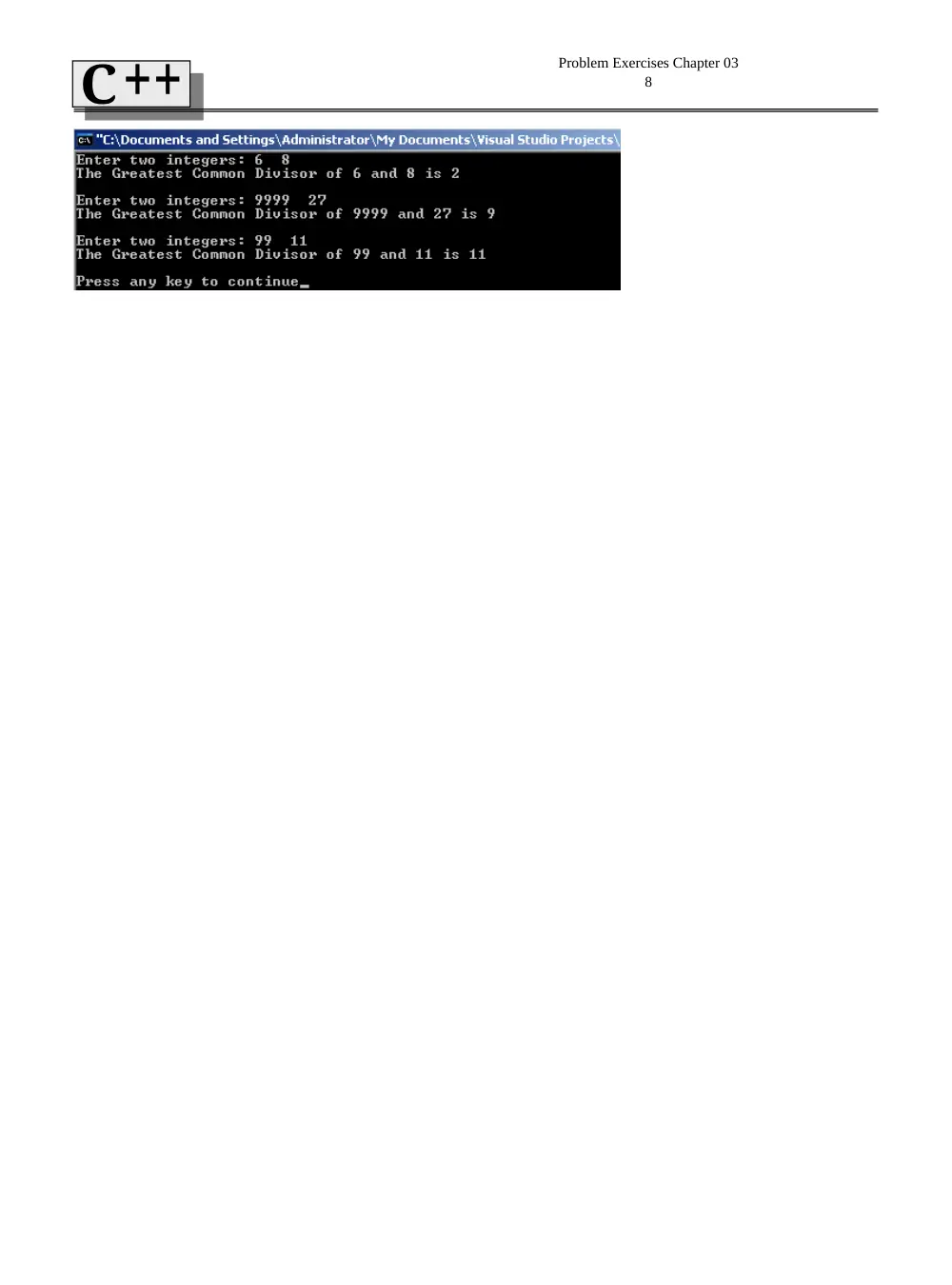
Page 232: Exercise 32. The Greatest Common Divider (GCD) of two
integers is the largest integer that evenly divides each of the number. Write
a function that returns the Greatest Common Divider of two integers.
#include <iostream.h>
int gcd(int, int);
int main() {
int a, b;
for (int j = 1; j <= 3; ++j) {
cout << "Enter two integers: ";
cin
>> a >> b;
cout << "The Greatest Common Divisor of " << a <<
" and " << b << " is " << gcd(a, b) << "\n\n";
}
return 0;
}
int gcd(int x, int y) {
int greatest = 1;
for (int i = 2; i <= ((x < y) ? x: y); ++i) {
if ( (x % i == 0) && (y % i == 0) )
greatest = i;
}
return greatest;
}
Sample Output:
Problem Exercises Chapter 03
8
Problem Exercises Chapter 03
9
5.
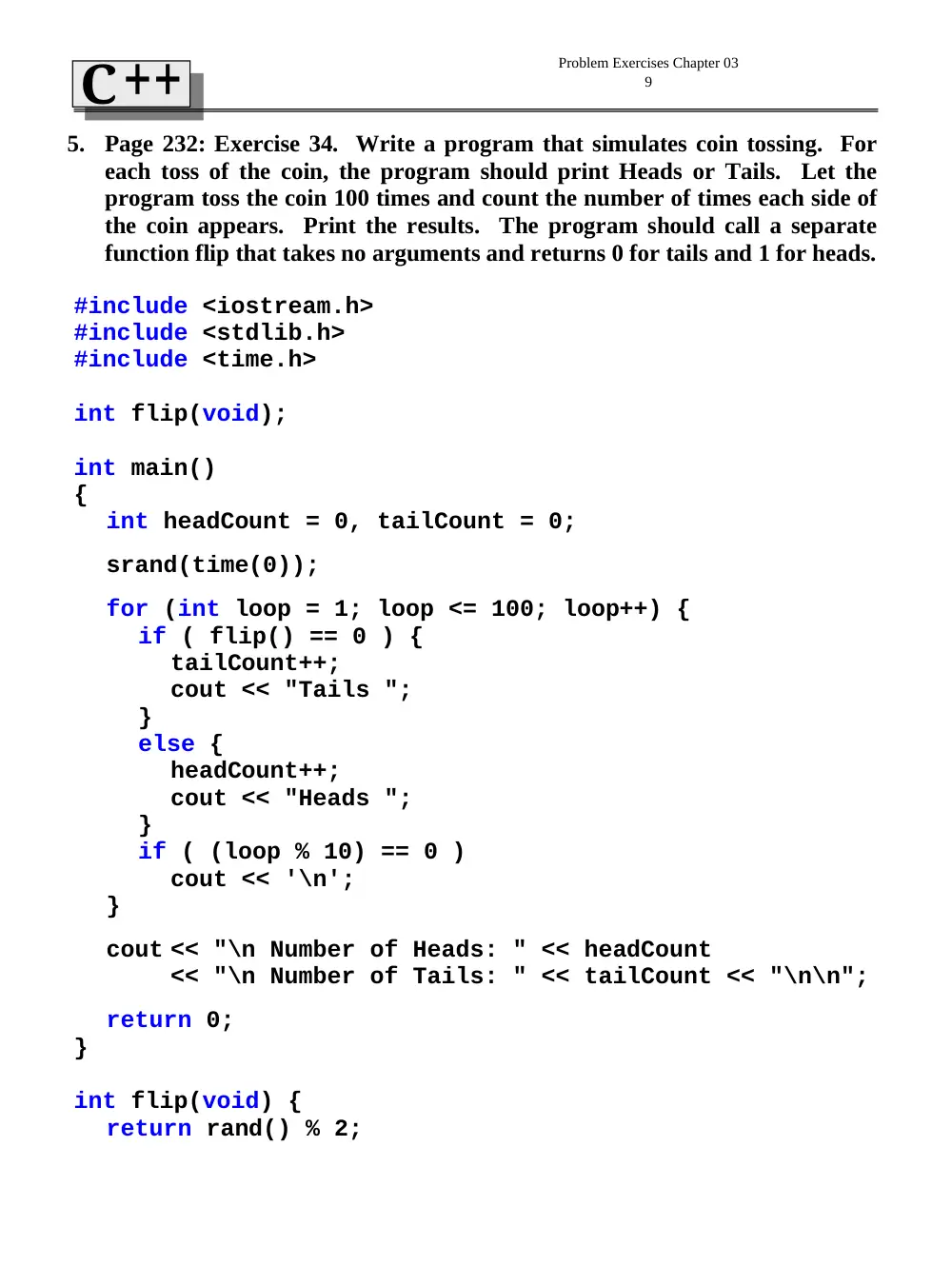
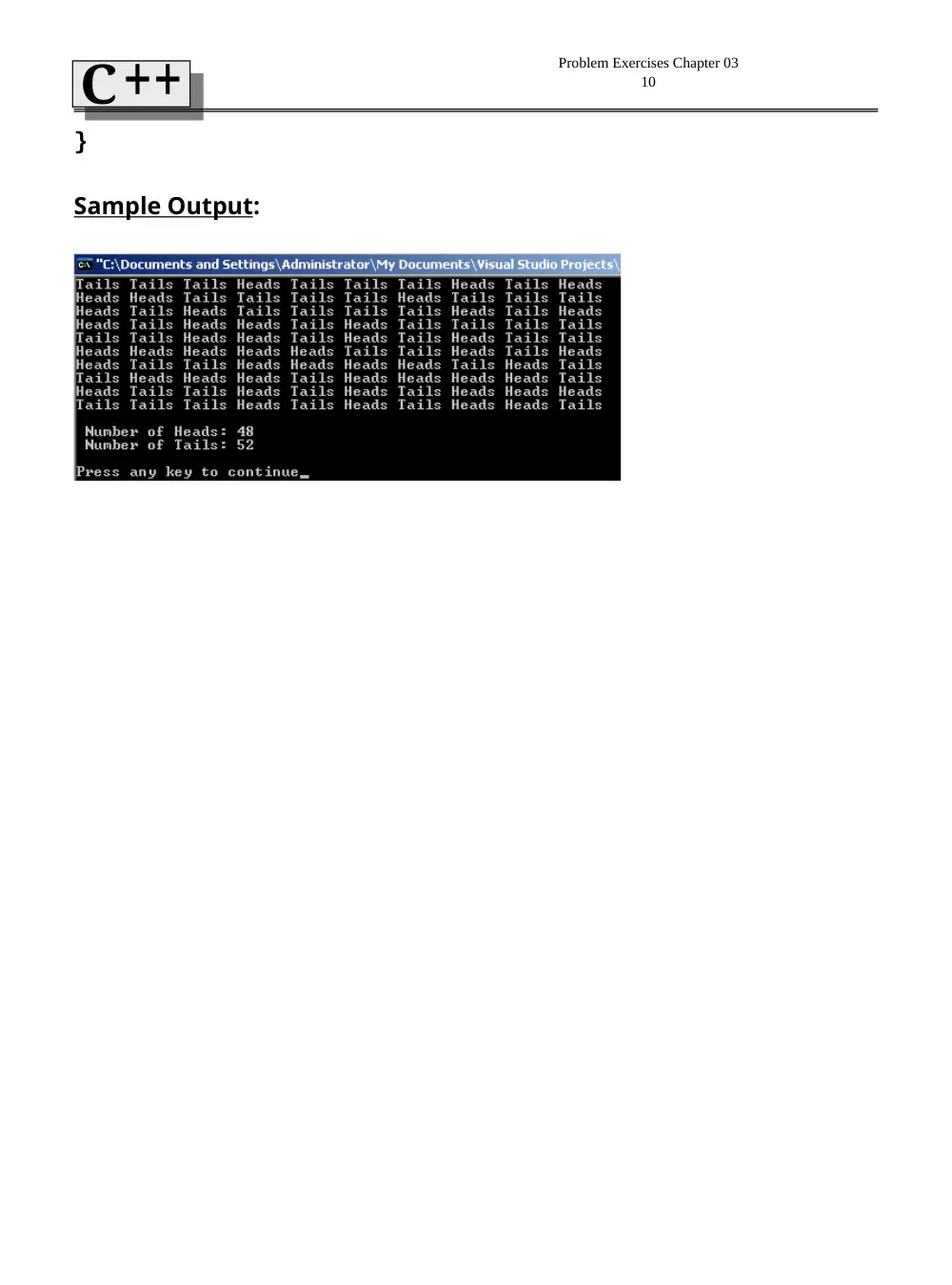
Page 232: Exercise 34. Write a program that simulates coin tossing. For
each toss of the coin, the program should print Heads or Tails. Let the
program toss the coin 100 times and count the number of times each side of
the coin appears. Print the results. The program should call a separate
function flip that takes no arguments and returns 0 for tails and 1 for heads.
#include <iostream.h>
#include <stdlib.h>
#include <time.h>
int flip(void);
int main()
{
int headCount = 0, tailCount = 0;
srand(time(0));
for (int loop = 1; loop <= 100; loop++) {
if ( flip() == 0 ) {
tailCount++;
cout << "Tails ";
}
else {
headCount++;
cout << "Heads ";
}
if ( (loop % 10) == 0 )
cout << '\n';
}
cout << "\n Number of Heads: " << headCount
<< "\n Number of Tails: " << tailCount << "\n\n";
return 0;
}
int flip(void) {
return rand() % 2;
Problem Exercises Chapter 03
10
}
Sample Output: