
CSC 213 Problems Sec 9, Fall 2007
Notre Dame University–Louaize · Program Design and Data Abstraction II · 4 pages

More CSC 213 files
- Problems Assignment 1 · Fall 2012ProblemsView
- Problems Assignment 2 · Fall 2012ProblemsView
- Problems Sec 10 · Fall 2007ProblemsView
- Problems Sec 12.2 · Fall 2007ProblemsView
- Problems Sec 12.1 · Fall 2007ProblemsView
- Problems Sec 7 · Fall 2007ProblemsView
- Problems Sec 6 · Fall 2007ProblemsView
- Problems Sec 14 · Fall 2007ProblemsView
Show the text of this problems
Exercice #9-1
1
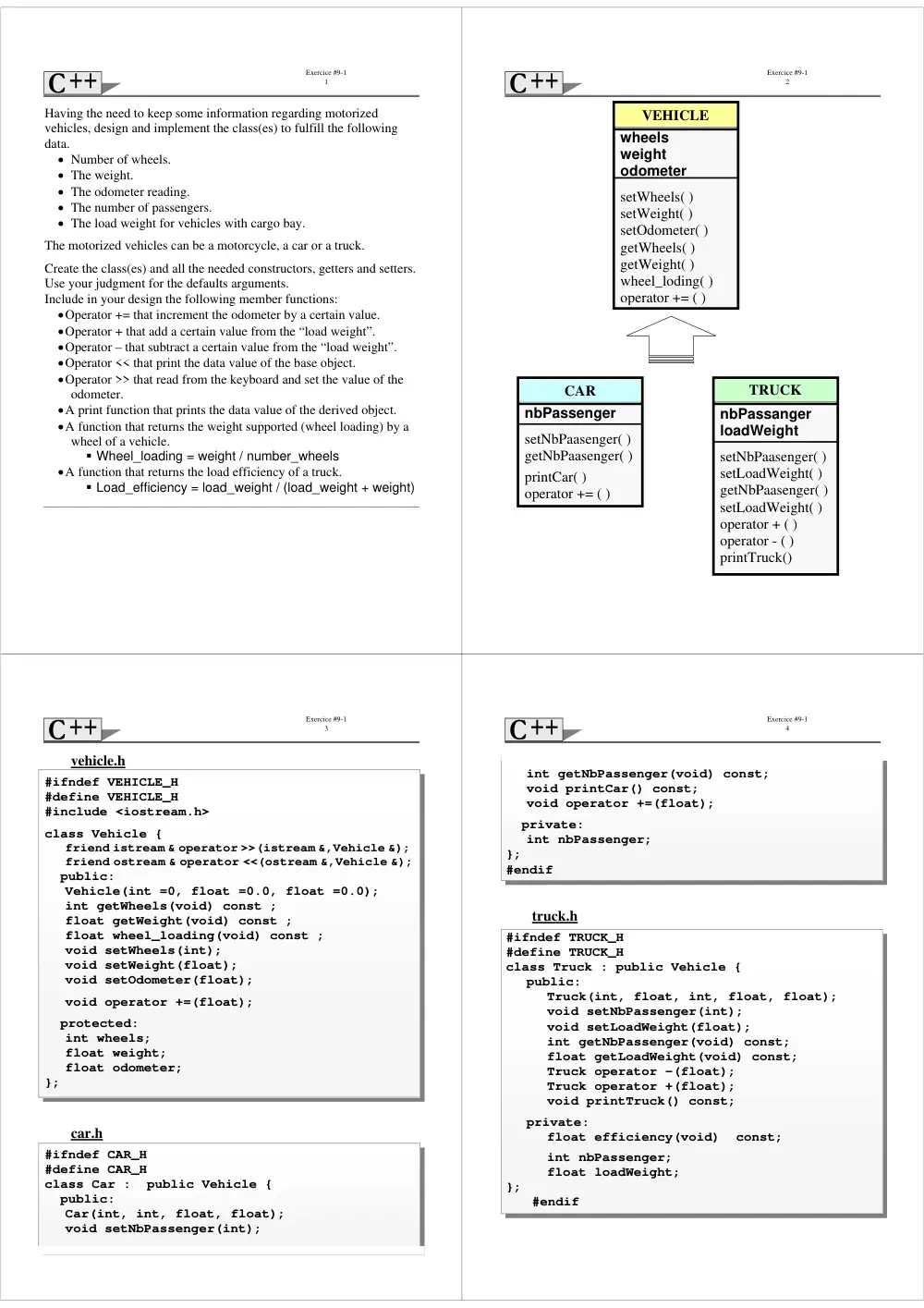
Having the need to keep some information regarding motorized
vehicles, design and implement the class(es) to fulfill the following
data.
• Number of wheels.
• The weight.
• The odometer reading.
• The number of passengers.
• The load weight for vehicles with cargo bay.
The motorized vehicles can be a motorcycle, a car or a truck.
Create the class(es) and all the needed constructors, getters and setters.
Use your judgment for the defaults arguments.
Include in your design the following member functions:
• Operator += that increment the odometer by a certain value.
• Operator + that add a certain value from the “load weight”.
• Operator – that subtract a certain value from the “load weight”.
• Operator << that print the data value of the base object.
• Operator >> that read from the keyboard and set the value of the
odometer.
• A print function that prints the data value of the derived object.
• A function that returns the weight supported (wheel loading) by a
wheel of a vehicle.
� Wheel_loading = weight / number_wheels
• A function that returns the load efficiency of a truck.
� Load_efficiency = load_weight / (load_weight + weight)
Exercice #9-1
2
nbPassanger
loadWeight
setNbPaasenger( )
setLoadWeight( )
getNbPaasenger( )
setLoadWeight( )
operator + ( )
operator - ( )
printTruck()
TRUCK
nbPassenger
setNbPaasenger( )
getNbPaasenger( )
printCar( )
operator += ( )
CAR
wheels
weight
odometer
setWheels( )
setWeight( )
setOdometer( )
getWheels( )
getWeight( )
wheel_loding( )
operator += ( )
VEHICLE
Exercice #9-1
3
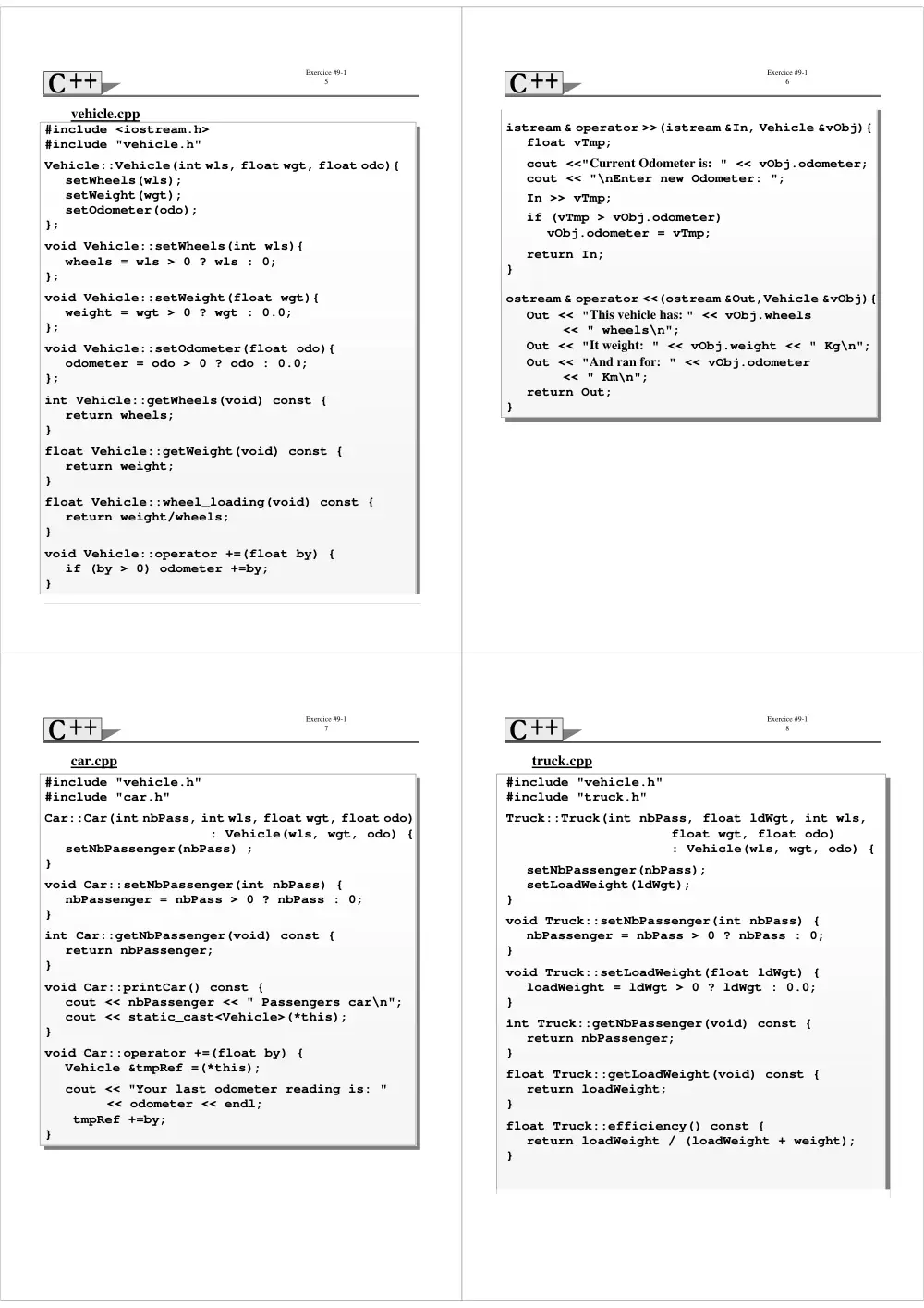
vehicle.h
#ifndef VEHICLE_H
#define VEHICLE_H
#include <iostream.h>
class Vehicle {
friend istream & operator >>(istream &,Vehicle &);
friend ostream & operator <<(ostream &,Vehicle &);
public:
Vehicle(int =0, float =0.0, float =0.0);
int getWheels(void) const ;
float getWeight(void) const ;
float wheel_loading(void) const ;
void setWheels(int);
void setWeight(float);
void setOdometer(float);
void operator +=(float);
protected:
int wheels;
float weight;
float odometer;
};
car.h
#ifndef CAR_H
#define CAR_H
class Car : public Vehicle {
public:
Car(int, int, float, float);
void setNbPassenger(int);
Exercice #9-1
4
int getNbPassenger(void) const;
void printCar() const;
void operator +=(float);
private:
int nbPassenger;
};
#endif
truck.h
#ifndef TRUCK_H
#define TRUCK_H
class Truck : public Vehicle {
public:
Truck(int, float, int, float, float);
void setNbPassenger(int);
void setLoadWeight(float);
int getNbPassenger(void) const;
float getLoadWeight(void) const;
Truck operator -(float);
Truck operator +(float);
void printTruck() const;
private:
float efficiency(void) const;
int nbPassenger;
float loadWeight;
};
#endif
Exercice #9-1
5
vehicle.cpp
#include <iostream.h>
#include "vehicle.h"
Vehicle::Vehicle(int wls, float wgt, float odo){
setWheels(wls);
setWeight(wgt);
setOdometer(odo);
};
void Vehicle::setWheels(int wls){
wheels = wls > 0 ? wls : 0;
};
void Vehicle::setWeight(float wgt){
weight = wgt > 0 ? wgt : 0.0;
};
void Vehicle::setOdometer(float odo){
odometer = odo > 0 ? odo : 0.0;
};
int Vehicle::getWheels(void) const {
return wheels;
}
float Vehicle::getWeight(void) const {
return weight;
}
float Vehicle::wheel_loading(void) const {
return weight/wheels;
}
void Vehicle::operator +=(float by) {
if (by > 0) odometer +=by;
}
Exercice #9-1
6
istream & operator >>(istream &In, Vehicle &vObj){
float vTmp;
cout <<"Current Odometer is: " << vObj.odometer;
cout << "\nEnter new Odometer: ";
In >> vTmp;
if (vTmp > vObj.odometer)
vObj.odometer = vTmp;
return In;
}
ostream & operator <<(ostream &Out,Vehicle &vObj){
Out << "This vehicle has: " << vObj.wheels
<< " wheels\n";
Out << "It weight: " << vObj.weight << " Kg\n";
Out << "And ran for: " << vObj.odometer
<< " Km\n";
return Out;
}
Exercice #9-1
7
car.cpp
#include "vehicle.h"
#include "car.h"
Car::Car(int nbPass, int wls, float wgt, float odo)
: Vehicle(wls, wgt, odo) {
setNbPassenger(nbPass) ;
}
void Car::setNbPassenger(int nbPass) {
nbPassenger = nbPass > 0 ? nbPass : 0;
}
int Car::getNbPassenger(void) const {
return nbPassenger;
}
void Car::printCar() const {
cout << nbPassenger << " Passengers car\n";
cout << static_cast<Vehicle>(*this);
}
void Car::operator +=(float by) {
Vehicle &tmpRef =(*this);
cout << "Your last odometer reading is: "
<< odometer << endl;
tmpRef +=by;
}
Exercice #9-1
8
truck.cpp
#include "vehicle.h"
#include "truck.h"
Truck::Truck(int nbPass, float ldWgt, int wls,
float wgt, float odo)
: Vehicle(wls, wgt, odo) {
setNbPassenger(nbPass);
setLoadWeight(ldWgt);
}
void Truck::setNbPassenger(int nbPass) {
nbPassenger = nbPass > 0 ? nbPass : 0;
}
void Truck::setLoadWeight(float ldWgt) {
loadWeight = ldWgt > 0 ? ldWgt : 0.0;
}
int Truck::getNbPassenger(void) const {
return nbPassenger;
}
float Truck::getLoadWeight(void) const {
return loadWeight;
}
float Truck::efficiency() const {
return loadWeight / (loadWeight + weight);
}
Exercice #9-1
9
void Truck::printTruck() const {
cout <<"This truck load is: " << loadWeight << endl
<< "It weigts: "<< weight << endl
<< "Efficiency value is: " << efficiency() << endl;
}
Truck Truck::operator -(float lWgt) {
if (lWgt < loadWeight)
loadWeight = loadWeight - lWgt;
return (*this);
}
Truck Truck::operator +(float lWgt) {
loadWeight = loadWeight + lWgt;
return (*this);
}
Exercice #9-1
10
Prog.cpp
#include <iostream.h>
#include "vehicle.h"
#include "car.h"
#include "truck.h"
void main() {
Vehicle *vehPtr;
Truck *trkPtr;
Vehicle motorcycle(2, 98.7, 3421.3);
Car fiat(4, 4, 1800, 76213.2);
Truck volvo(2, 5000, 10, 2000, 32123.5);
cout << motorcycle.getWheels() << endl;
motorcycle +=1123.5;
cout << endl << motorcycle << endl;
fiat.printCar();
fiat +=50.0;
cout << endl;
vehPtr = &fiat;
cout << *vehPtr;
volvo.printTruck();
volvo = volvo + 534.5;
volvo = volvo - 100.5;
cout << endl;
volvo.printTruck();
Exercice #9-1
11
motorcycle = fiat;
cout << endl << motorcycle << endl;
fiat.printCar();
volvo = motorcycle;
cout << endl << motorcycle << endl;
trkPtr = static_cast<Truck*>(&motorcycle);
cout << trkPtr->getWheels() <<endl;
cout << trkPtr->getNbPassenger() <<endl;
}
Syntax Error…
Unknown results…
Exercice #9-1
12
nbPassanger
loadWeight
setNbPaasenger( )
setLoadWeight( )
getNbPaasenger( )
setLoadWeight( )
operator + ( )
operator - ( )
printTruck()
TRUCK
nbPassenger
setNbPaasenger( )
getNbPaasenger( )
printCar( )
operator += ( )
CAR
wheels
weight
odometer
setWheels( )
setWeight( )
setOdometer( )
getWheels( )
getWeight( )
wheel_loding( )
operator += ( )
VEHICLE
Exercice #9-1
13
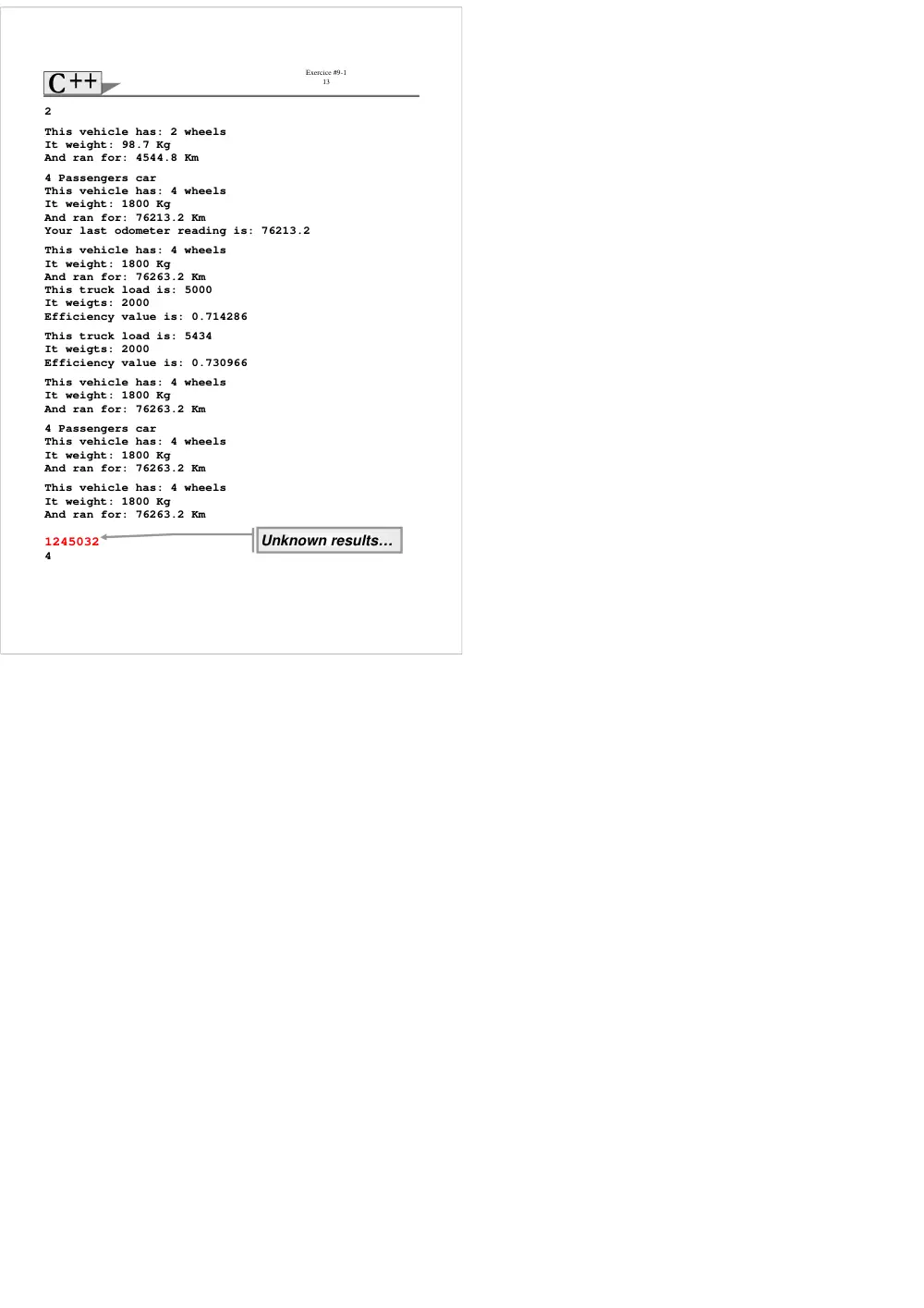
2
This vehicle has: 2 wheels
It weight: 98.7 Kg
And ran for: 4544.8 Km
4 Passengers car
This vehicle has: 4 wheels
It weight: 1800 Kg
And ran for: 76213.2 Km
Your last odometer reading is: 76213.2
This vehicle has: 4 wheels
It weight: 1800 Kg
And ran for: 76263.2 Km
This truck load is: 5000
It weigts: 2000
Efficiency value is: 0.714286
This truck load is: 5434
It weigts: 2000
Efficiency value is: 0.730966
This vehicle has: 4 wheels
It weight: 1800 Kg
And ran for: 76263.2 Km
4 Passengers car
This vehicle has: 4 wheels
It weight: 1800 Kg
And ran for: 76263.2 Km
This vehicle has: 4 wheels
It weight: 1800 Kg
And ran for: 76263.2 Km
1245032
4
Unknown results…