
ECN 212 Chapter 20, Spring 2007
Notre Dame University–Louaize · Principles of Macroeconomics · 26 pages · Mr. Hrair Hovivian
Showing the first 10 of 26 pages. Download the PDF to see all of it.
More ECN 212 files
- Problems Quest.&Answ. Chapter 5 Introduction to Macroeconomics · Spring 2012ChapterView
- Chapter 17 · Spring 2007ChapterView
- Chapter 19 · Spring 2007ChapterView
- Chapter 21 · Spring 2007ChapterView
- Chapter 22 · Spring 2007ChapterView
- Chapter 25 · Spring 2007ChapterView
- Chapter 1 · Spring 2007ChapterView
- Problems with Some Answers · Fall 2008Problems · with solutionView
Show the text of this chapter
11
Chapter 9
Chapter 9
Complex Cognitive Processes
Complex Cognitive Processes
22
Conceptual Understanding
Conceptual Understanding
Conceptual understanding is a key aspect of
Conceptual understanding is a key aspect of
learning.
learning.
Concepts
Concepts are categories that group objects,
are categories that group objects,
events, and characteristics on the basis of
events, and characteristics on the basis of
common properties.
common properties.
An important aspect of concept formation is
An important aspect of concept formation is
learning the key features, attributes, or
learning the key features, attributes, or
characteristics of the concept.
characteristics of the concept.
One of the main teaching goals is to help
One of the main teaching goals is to help
students understand concepts rather than just
students understand concepts rather than just
memorize facts.
memorize facts.
33
Conceptual Understanding (Cont’d)
Conceptual Understanding (Cont’d)
Concepts aid the process of remembering,
Concepts aid the process of remembering,
making it more efficient. They help students to
making it more efficient. They help students to
simplify and summaries information, as well as to
simplify and summaries information, as well as to
improve the efficiency of their memory,
improve the efficiency of their memory,
communication , and use of time.
communication , and use of time.
Students form concepts through direct
Students form concepts through direct
experiences with objects and events in their
experiences with objects and events in their
world as well as symbols (formulas, graphs,
world as well as symbols (formulas, graphs,
pictures).
pictures).
Some concepts are relatively simple, clear and
Some concepts are relatively simple, clear and
concrete , whereas others are more complex,
concrete , whereas others are more complex,
fuzzy and abstract.
fuzzy and abstract.
44
Promoting Concept Formation
Promoting Concept Formation
Identify the features of a concept. Use the rule-
Identify the features of a concept. Use the rule-
example strategy.
example strategy.
The strategy consists of four steps:
The strategy consists of four steps:
1. Define the concept and give clear
1. Define the concept and give clear
examples.
examples.
2. Clarify terms in the definition
2. Clarify terms in the definition
3. Give examples to illustrate the key
3. Give examples to illustrate the key
features or characteristics. Provide clear,
features or characteristics. Provide clear,
concrete examples. Relate new concepts
concrete examples. Relate new concepts
to already-known concepts
to already-known concepts
4. Provide additional examples.
4. Provide additional examples.
55
Promoting Concept Formation (Cont’d)
Promoting Concept Formation (Cont’d)
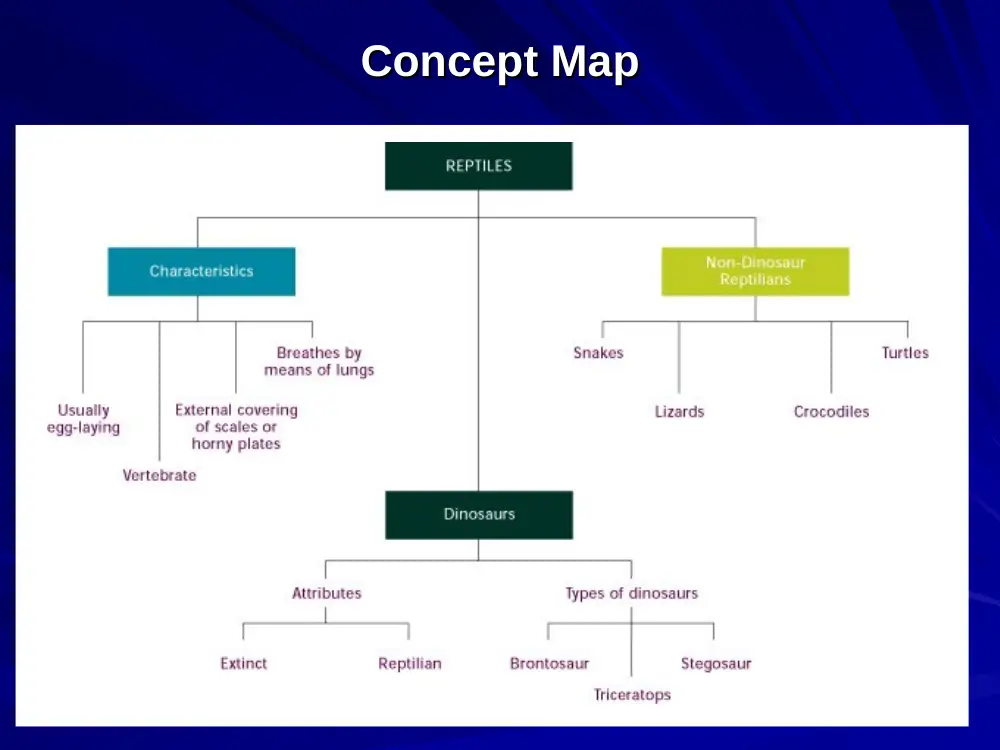
Create concepts maps .Concept maps offer a
Create concepts maps .Concept maps offer a
visual representation of a concept’s hierarchical
visual representation of a concept’s hierarchical
organization.
organization.
Develop hypotheses about what the concept is
Develop hypotheses about what the concept is
and what it is not. Help students learn what a
and what it is not. Help students learn what a
concept is and what it is not.
concept is and what it is not.
Prototype matching compares the item with similar
Prototype matching compares the item with similar
items in a category. Prototype matching refers to
items in a category. Prototype matching refers to
when students engage in a decision-making
when students engage in a decision-making
process about whether an item belongs to a
process about whether an item belongs to a
category.
category.
Concept Map
Concept Map
66
77
Thinking
Thinking
Thinking involves manipulating and transforming
Thinking involves manipulating and transforming
information in memory.
information in memory.
We think to form concepts,reason,think
We think to form concepts,reason,think
critically,make decisions, think creatively, and
critically,make decisions, think creatively, and
solve problems.
solve problems.
Students can think about the concrete and the
Students can think about the concrete and the
abstract;about the past and the future ; about
abstract;about the past and the future ; about
reality and the fantasy
reality and the fantasy
88
Reasoning
Reasoning
Reasoning is logical thinking that uses induction and
Reasoning is logical thinking that uses induction and
deduction to reach a conclusion.
deduction to reach a conclusion.
Inductive reasoning
Inductive reasoning involves reasoning from the
involves reasoning from the
specific to the general. That is , it consists of drawing
specific to the general. That is , it consists of drawing
conclusions (forming concepts) about all members of a
conclusions (forming concepts) about all members of a
category based on observing only some of its members.
category based on observing only some of its members.
When a student is asked whether a concept in math
When a student is asked whether a concept in math
class applies to other contexts , such as business or
class applies to other contexts , such as business or
science, inductive reasoning is called for.
science, inductive reasoning is called for.
Deductive reasoning
Deductive reasoning involves reasoning from the
involves reasoning from the
general to the specific. When you solve puzzles, you are
general to the specific. When you solve puzzles, you are
engaging in reasoning. When you learn about a general
engaging in reasoning. When you learn about a general
rule and then understand how it applies in similar
rule and then understand how it applies in similar
situations but not others, you are engaging in deductive
situations but not others, you are engaging in deductive
reasoning.
reasoning.
99
Critical Thinking
Critical Thinking
Critical thinking
Critical thinking involves thinking reflectively
involves thinking reflectively
and productively and evaluating the evidence.
and productively and evaluating the evidence.
Mindfulness
Mindfulness is a key to critical thinking.
is a key to critical thinking.
Mindfulness means being alert, mentally
Mindfulness means being alert, mentally
present, and cognitively flexible while going
present, and cognitively flexible while going
through life’s everyday activities and tasks
through life’s everyday activities and tasks
( Ellen Langer ,1997,2005).
( Ellen Langer ,1997,2005).
Mindful students create new ideas, are open to
Mindful students create new ideas, are open to
new information, and are aware of more than
new information, and are aware of more than
one perspective.
one perspective.
Mindless students accept what they read or hear
Mindless students accept what they read or hear
without questioning the accuracy of the
without questioning the accuracy of the
information. Mindless students become trapped
information. Mindless students become trapped
in rigid mindsets, not taking into account
in rigid mindsets, not taking into account
possible variation in contexts and perspectives.
possible variation in contexts and perspectives.
10
10
Critical Thinking (Cont’d)
Critical Thinking (Cont’d)
Langer emphasizes that asking good
questions is an important ingredient of
mindful thinking.
Langer stresses that it is important to
stress on the process of learning rather
than the outcome.
11
11
Decision Making
Decision Making
Decision making-
Decision making- involves thinking in which
involves thinking in which
individuals evaluate alternatives and make
individuals evaluate alternatives and make
choices among them.
choices among them.
Biases and flaws that affect our decision-
Biases and flaws that affect our decision-
making
making
Confirmation bias-
Confirmation bias- the tendency to search for
the tendency to search for
and use information that supports our ideas
and use information that supports our ideas
rather than refutes them
rather than refutes them
Belief perseverance
Belief perseverance - the tendency to hold on
- the tendency to hold on
to a belief in the face of contradictory evidence
to a belief in the face of contradictory evidence
12
12
Decision Making (Cont’d)
Decision Making (Cont’d)
Overconfidence bias
Overconfidence bias -
- The tendency to have
The tendency to have
more confidence in judgments and decisions
more confidence in judgments and decisions
than we should, based on past experience
than we should, based on past experience
Hindsight bias
Hindsight bias - the tendency to falsely report,
- the tendency to falsely report,
after the fact, that we accurately predicted the
after the fact, that we accurately predicted the
event.
event.
People not only are overconfident about what
People not only are overconfident about what
they predict will happen in the future
they predict will happen in the future
(overconfidence bias), but also tend to overrate
(overconfidence bias), but also tend to overrate
their past performances at prediction.
their past performances at prediction.
13
13
Creative Thinking
Creative Thinking
An important aspect of thinking is to be able to think
An important aspect of thinking is to be able to think
creatively.
creatively.
Creative Thinking
Creative Thinking is the ability to think about something
is the ability to think about something
in novel and unusual ways and come up with unique
in novel and unusual ways and come up with unique
solutions to problems.
solutions to problems.
Guilford
Guilford distinguished between
distinguished between convergent and
convergent and
divergent thinking.
divergent thinking.
Convergent Thinking:
Convergent Thinking: Produces one correct answer,
Produces one correct answer,
and a characteristic of the kind of thinking required on
and a characteristic of the kind of thinking required on
conventional intelligence tests.
conventional intelligence tests.
Divergent Thinking:
Divergent Thinking: Produces many answers to the
Produces many answers to the
same question, and is more characteristic of creativity.
same question, and is more characteristic of creativity.
14
14
Ways to Improve Creativity
Ways to Improve Creativity
Encourage Creative Thinking on an Individual and Group
Encourage Creative Thinking on an Individual and Group
Basis.
Basis.
Involve Creative People.
Involve Creative People.
Encourage Internal Motivation.
Encourage Internal Motivation.
Provide Stimulating Environments.
Provide Stimulating Environments.
Don’t Over control Students.
Don’t Over control Students.
Foster Flexible and Playful Thinking
Foster Flexible and Playful Thinking
15
15
Problem Solving
Problem Solving
Problem Solving
Problem Solving involves finding an appropriate way
involves finding an appropriate way
to attain a goal.
to attain a goal.
Steps in solving problems:
Steps in solving problems:
1.
1.
Find and frame problems:
Find and frame problems: Today teachers
Today teachers
recognized that they need to teach students the
recognized that they need to teach students the
real-world skill of identifying problems instead of
real-world skill of identifying problems instead of
offering clear-cut problems to be solved.
offering clear-cut problems to be solved.
Students should have the opportunities to locate
Students should have the opportunities to locate
and refine problems that need to be solved.
and refine problems that need to be solved.
The teachers can serve as a guide and a consultant
The teachers can serve as a guide and a consultant
in helping them to frame a meaningfully problem
in helping them to frame a meaningfully problem
and to clearly define it.
and to clearly define it.
16
16
2.
2. Develop good strategies:
Develop good strategies: Once you define and
Once you define and
identify a problem, students need to develop
identify a problem, students need to develop
strategies for solving it.
strategies for solving it.
Among the effective strategies are setting
Among the effective strategies are setting
subgoals,using algorithms, and relying on
subgoals,using algorithms, and relying on
heuristics.
heuristics.
Subgoaling:
Subgoaling: involves setting intermediate goals
involves setting intermediate goals
that put students in a better position to reach the
that put students in a better position to reach the
final goal or solution.
final goal or solution.
Algorithms:
Algorithms: are strategies that guarantee a
are strategies that guarantee a
solution to a problem. Algorithms come in
solution to a problem. Algorithms come in
different forms, such as formulas ,instructions ,
different forms, such as formulas ,instructions ,
and test of all possible solutions.
and test of all possible solutions.
Means-ends analysis:
Means-ends analysis: is a heuristic in which
is a heuristic in which
one identifies the goal (end) of a problem, assess
one identifies the goal (end) of a problem, assess
the current situation, and evaluates what needs
the current situation, and evaluates what needs
to be done (means) to decrease the difference
to be done (means) to decrease the difference
between the two conditions.
between the two conditions.
17
17
Heuristics
Heuristics are strategies or rules of thumb that
are strategies or rules of thumb that
suggest solutions to a problem, but do not ensure they
suggest solutions to a problem, but do not ensure they
will work.
will work.
Availability heuristic
Availability heuristic -
- A prediction about the
A prediction about the
probability of an event based on the event’s past
probability of an event based on the event’s past
occurrences
occurrences
Representativeness heuristic
Representativeness heuristic - Faulty decisions
- Faulty decisions
based on how well something matches a prototype-
based on how well something matches a prototype-
that is ,the most common or representative example,
that is ,the most common or representative example,
rather than its relevance to a situation
rather than its relevance to a situation
18
18
3.
3. Evaluate solutions:
Evaluate solutions: Once we solve the
Once we solve the
problem, we might not know whether our
problem, we might not know whether our
solution is effective unless we evaluate it.
solution is effective unless we evaluate it.
4.
4. Rethink and redefine problems and
Rethink and redefine problems and
solutions over time:
solutions over time: An important step in
An important step in
problem solving is to continually rethink and
problem solving is to continually rethink and
redefine problems and solutions over time.
redefine problems and solutions over time.
19
19
Obstacles to Problem Solving
Obstacles to Problem Solving
Fixation:
Fixation: is when you are fixated on a particular
is when you are fixated on a particular
strategy for solving a problem and fail to examine a
strategy for solving a problem and fail to examine a
fresh perspective.
fresh perspective.
Functional fixedness is a type of fixation in which an
Functional fixedness is a type of fixation in which an
individual fails to solve a problem because he or she
individual fails to solve a problem because he or she
views the element in terms of their usual functions.
views the element in terms of their usual functions.
A mental set up is a type of fixation in which the
A mental set up is a type of fixation in which the
individual tries to solve a problem in a way that has
individual tries to solve a problem in a way that has
worked in the past.
worked in the past.
Lack of motivation:
Lack of motivation: Some students may have great
Some students may have great
problem-solving abilities, but are not motivated to use
problem-solving abilities, but are not motivated to use
them. They lack persistence.
them. They lack persistence.
Inadequate emotional control:
Inadequate emotional control: Emotions can facilitate
Emotions can facilitate
or restrict problem solving. Too much anxiety or fear can
or restrict problem solving. Too much anxiety or fear can
restrict a student’s ability to solve a problem.
restrict a student’s ability to solve a problem.
20
20
Developmental Changes
Developmental Changes
One way that developmental changes in
problem solving have been studied is
called the rule-assessment approach.
Even young children begin to use rules to
Even young children begin to use rules to
solve problems.
solve problems.
During early childhood a child becomes
During early childhood a child becomes
capable of more flexible, goal directed
capable of more flexible, goal directed
problem solving.
problem solving.
21
21
Developmental Changes (Cont’d)
Developmental Changes (Cont’d)
At about 4 years of age, children acquire the concept of
At about 4 years of age, children acquire the concept of
perspectives, which allows them to appreciate that a
perspectives, which allows them to appreciate that a
single thing can be described in different ways.
single thing can be described in different ways.
Children become better planners during the elementary
Children become better planners during the elementary
and secondary school years.
and secondary school years.
They learn more effective strategies that help them solve
They learn more effective strategies that help them solve
problems and have more accumulated knowledge
problems and have more accumulated knowledge
(metacognitive strategies).
(metacognitive strategies).
Adolescents have an increased capacity to monitor and
Adolescents have an increased capacity to monitor and
manage their resources to effectively meet the demands
manage their resources to effectively meet the demands
of a problem-solving task. They also screen out
of a problem-solving task. They also screen out
information irrelevant to solving a problem.
information irrelevant to solving a problem.
22
22
Problem-Based Learning
Problem-Based Learning
Problem-Based Learning
Problem-Based Learning emphasizes solving
emphasizes solving
authentic problems like those that occur in
authentic problems like those that occur in
daily life.
daily life.
1.
1. Provide opportunities to solve real-world
Provide opportunities to solve real-world
problems
problems
2.
2. Monitor effective/ineffective strategies
Monitor effective/ineffective strategies
3.
3. Involve parents
Involve parents
4.
4. Improve students’ use of rules, knowledge,
Improve students’ use of rules, knowledge,
and strategies
and strategies
5.
5. Use technology effectively
Use technology effectively
23
23
Transfer
Transfer
Transfer
Transfer is applying previous experiences and
is applying previous experiences and
knowledge to learning or problem solving in a
knowledge to learning or problem solving in a
new situation. An important complex cognitive
new situation. An important complex cognitive
goal is for students to be able to apply what they
goal is for students to be able to apply what they
learn in one situation to new situations.
learn in one situation to new situations.
Types of transfer
Types of transfer
Near transfer
Near transfer is the transfer of learning to a
is the transfer of learning to a
situation that is similar to the one in which the
situation that is similar to the one in which the
initial learning took place.
initial learning took place.
Example: Near transfer occurs when a student
Example: Near transfer occurs when a student
learns to type on a typewriter then he transfers
learns to type on a typewriter then he transfers
this skill to type on a computer.
this skill to type on a computer.
24
24
Transfer (Cont’d)
Transfer (Cont’d)
Far transfer
Far transfer is the transfer of learning to a
is the transfer of learning to a
situation that is different to the one in which the
situation that is different to the one in which the
initial learning took place.
initial learning took place.
Example: If a student gets a job in an architect’s
Example: If a student gets a job in an architect’s
office and applies what he learned in geometry
office and applies what he learned in geometry
class to help the architect analyze a spatial
class to help the architect analyze a spatial
problem different from any problem the student
problem different from any problem the student
encountered in geometry class, then far transfer
encountered in geometry class, then far transfer
has occurred.
has occurred.
25
25
Transfer (Cont’d)
Transfer (Cont’d)
Low road transfer
Low road transfer is the automatic, often
is the automatic, often
unconscious, transfer of learning to a new
unconscious, transfer of learning to a new
situation
situation..
Example: When competent readers encounter
Example: When competent readers encounter
new sentences in their native language , they
new sentences in their native language , they
read them automatically.
read them automatically.
High road transfer
High road transfer is conscious and effortful
is conscious and effortful
transfer of learning to a new situation
transfer of learning to a new situation..
Example: A student might learn about the
Example: A student might learn about the
concept of subgoaling (setting intermediate
concept of subgoaling (setting intermediate
goals) in math, then after several months one
goals) in math, then after several months one
student thinks about how subgoaling might help
student thinks about how subgoaling might help
him complete a lengthy homework assignment in
him complete a lengthy homework assignment in
history.
history.
26
26
Transfer (Cont’d)
Transfer (Cont’d)
Forward-reaching transfer
Forward-reaching transfer : :Occurs when
Occurs when
student thinks about how to use
student thinks about how to use
information in a new situation. From the
information in a new situation. From the
current situation students look forward to
current situation students look forward to
how they are going to apply information to
how they are going to apply information to
a new situation.
a new situation.
Backward-reaching transfer :
Backward-reaching transfer :Occurs
Occurs
when students look back to previous
when students look back to previous
situations for information to solve
situations for information to solve
problems in a new context.
problems in a new context.