
MEN 310 Exam 1, Fall 2015
Notre Dame University–Louaize · Heat Transfer · 10 pages






More MEN 310 files
Show the text of this exam
1/10
Faculty of Engineering
Department of Mechanical Engineering
Fall 2015
MEN310 - Heat Transfer
Instructors: Dr. Charbel Habchi
Exam #1 - 10%
75 minutes (November 5, 2015 – 19:30-20:45)
Student Name: ____________________________ Student ID: _______________ Section: ____
There are 3 questions in the booklet each has several parts, please answer all parts of these questions to the
best of your ability.
Marking Scheme
Questions
Weight
Mark
Question 1
30 points
Question 2
30 points
Question 3
40 points
Total
100 points
1. Open book examination. Only original books are allowed.
2. Do not take the staple out. The exam booklet must remain intact.
3. Cheating penalty will be an “F” grade on the exam.
4. Mobile phones/devices are to be turned off and stowed away.
5. If something is not understood write your assumptions and solve the problem without asking
questions.
Good luck
2/10
QUESTION 1: Steady-State Conduction
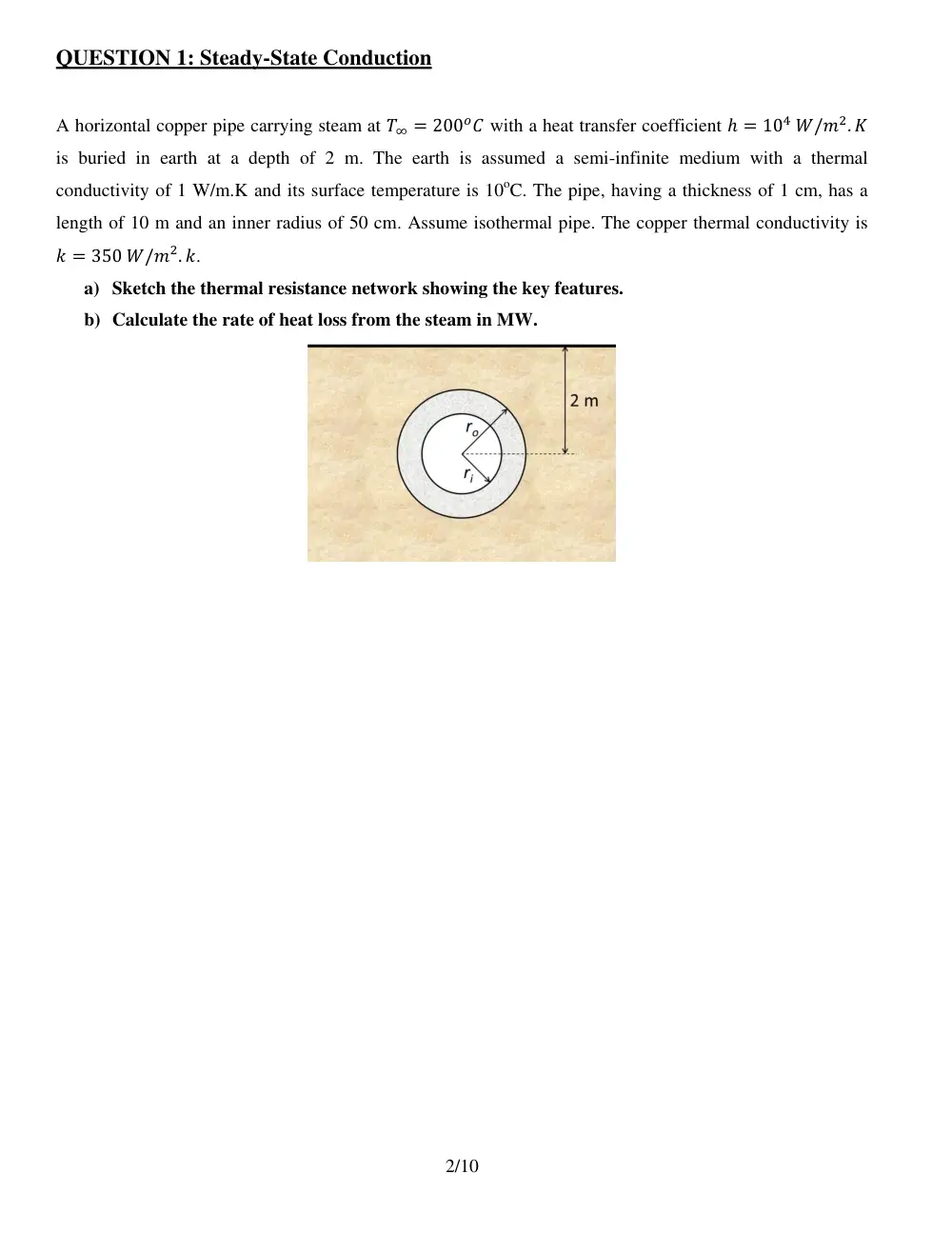
A horizontal copper pipe carrying steam at 𝑇∞ = 200𝑜𝐶 with a heat transfer coefficient ℎ = 104 𝑊/𝑚2. 𝐾
is buried in earth at a depth of 2 m. The earth is assumed a semi-infinite medium with a thermal
conductivity of 1 W/m.K and its surface temperature is 10oC. The pipe, having a thickness of 1 cm, has a
length of 10 m and an inner radius of 50 cm. Assume isothermal pipe. The copper thermal conductivity is
𝑘 = 350 𝑊/𝑚2. 𝑘.
a) Sketch the thermal resistance network showing the key features.
b) Calculate the rate of heat loss from the steam in MW.
3/10
4/10
QUESTION 2: Fins Calculation
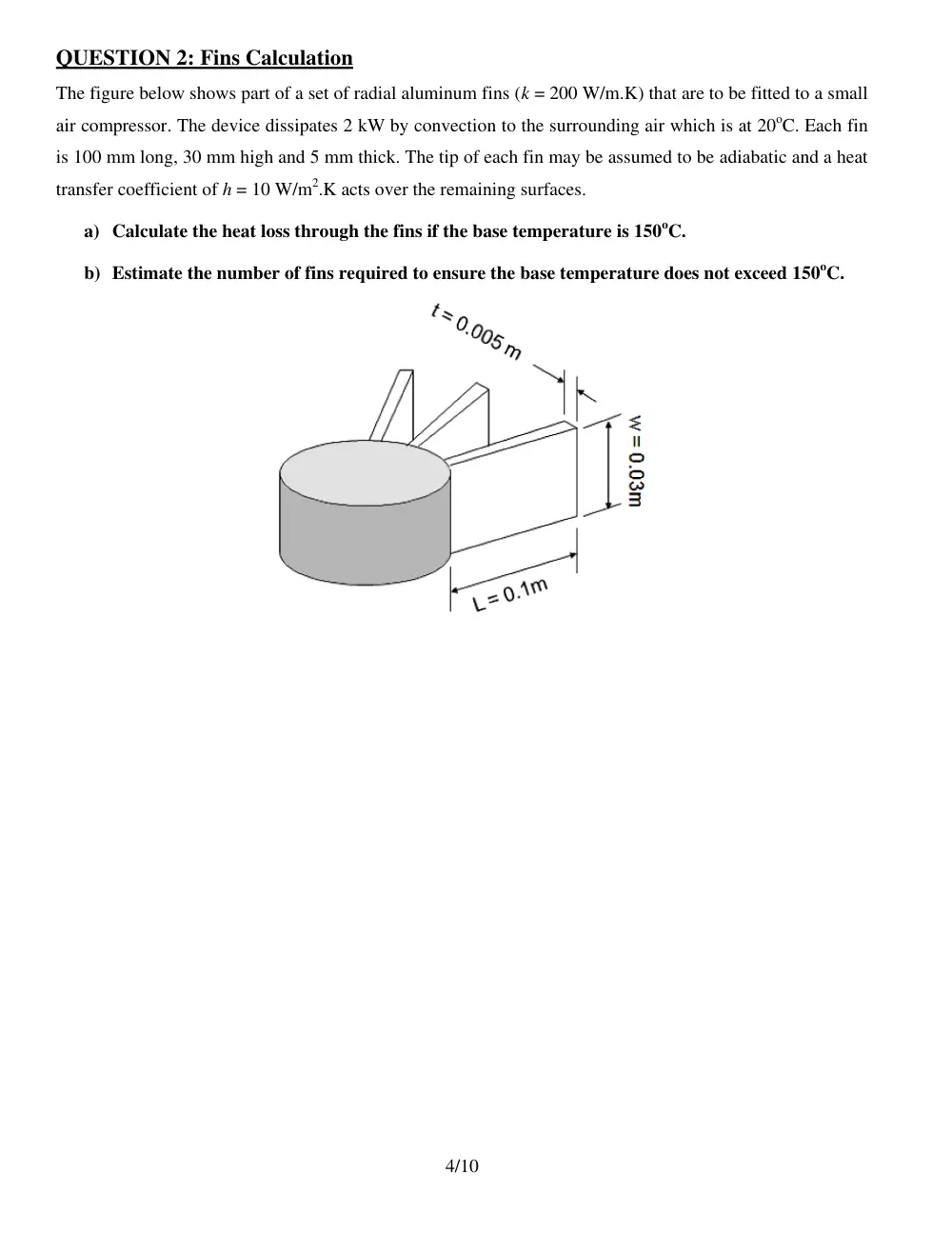
The figure below shows part of a set of radial aluminum fins (k = 200 W/m.K) that are to be fitted to a small
air compressor. The device dissipates 2 kW by convection to the surrounding air which is at 20oC. Each fin
is 100 mm long, 30 mm high and 5 mm thick. The tip of each fin may be assumed to be adiabatic and a heat
transfer coefficient of h = 10 W/m2.K acts over the remaining surfaces.
a) Calculate the heat loss through the fins if the base temperature is 150oC.
b) Estimate the number of fins required to ensure the base temperature does not exceed 150oC.
5/10
6/10
7/10
QUESTION 3: Energy Balance and Numerical Methods in Heat Conduction
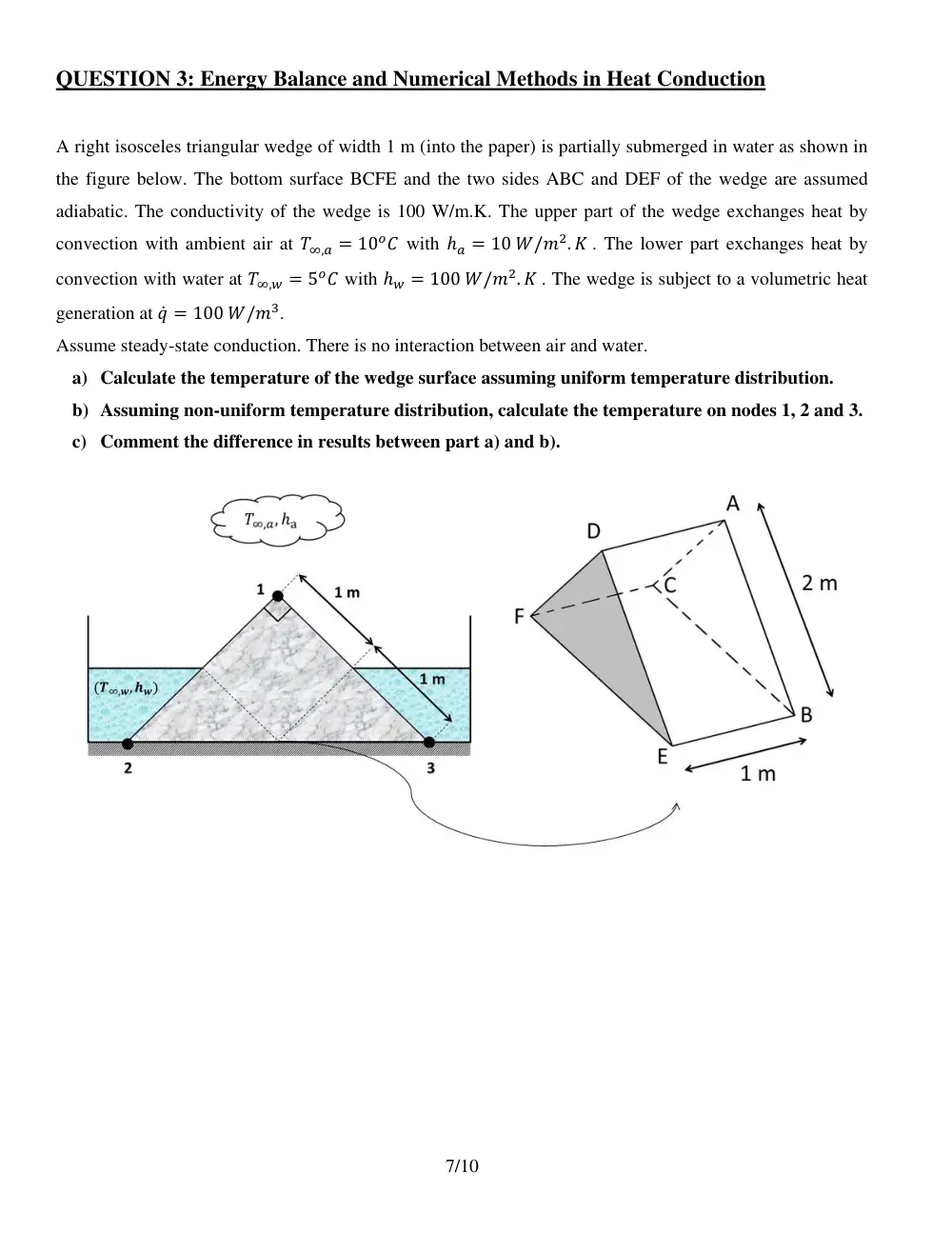
A right isosceles triangular wedge of width 1 m (into the paper) is partially submerged in water as shown in
the figure below. The bottom surface BCFE and the two sides ABC and DEF of the wedge are assumed
adiabatic. The conductivity of the wedge is 100 W/m.K. The upper part of the wedge exchanges heat by
convection with ambient air at 𝑇∞,𝑎 = 10𝑜𝐶 with ℎ𝑎 = 10 𝑊/𝑚2. 𝐾 . The lower part exchanges heat by
convection with water at 𝑇∞,𝑤 = 5𝑜𝐶 with ℎ𝑤 = 100 𝑊/𝑚2. 𝐾 . The wedge is subject to a volumetric heat
generation at 𝑞̇ = 100 𝑊/𝑚3.
Assume steady-state conduction. There is no interaction between air and water.
a) Calculate the temperature of the wedge surface assuming uniform temperature distribution.
b) Assuming non-uniform temperature distribution, calculate the temperature on nodes 1, 2 and 3.
c) Comment the difference in results between part a) and b).
8/10
9/10
10/10