
MEN 310 Exam 1 with Solution, Fall 2001
Notre Dame University–Louaize · Heat Transfer · 6 pages · with solution

More MEN 310 files
Show the text of this exam
F 9 \
Notre Dams University Faeutty of Enginecring Mechanica! Enginecring Dep.
Elce Dean
9
Sy
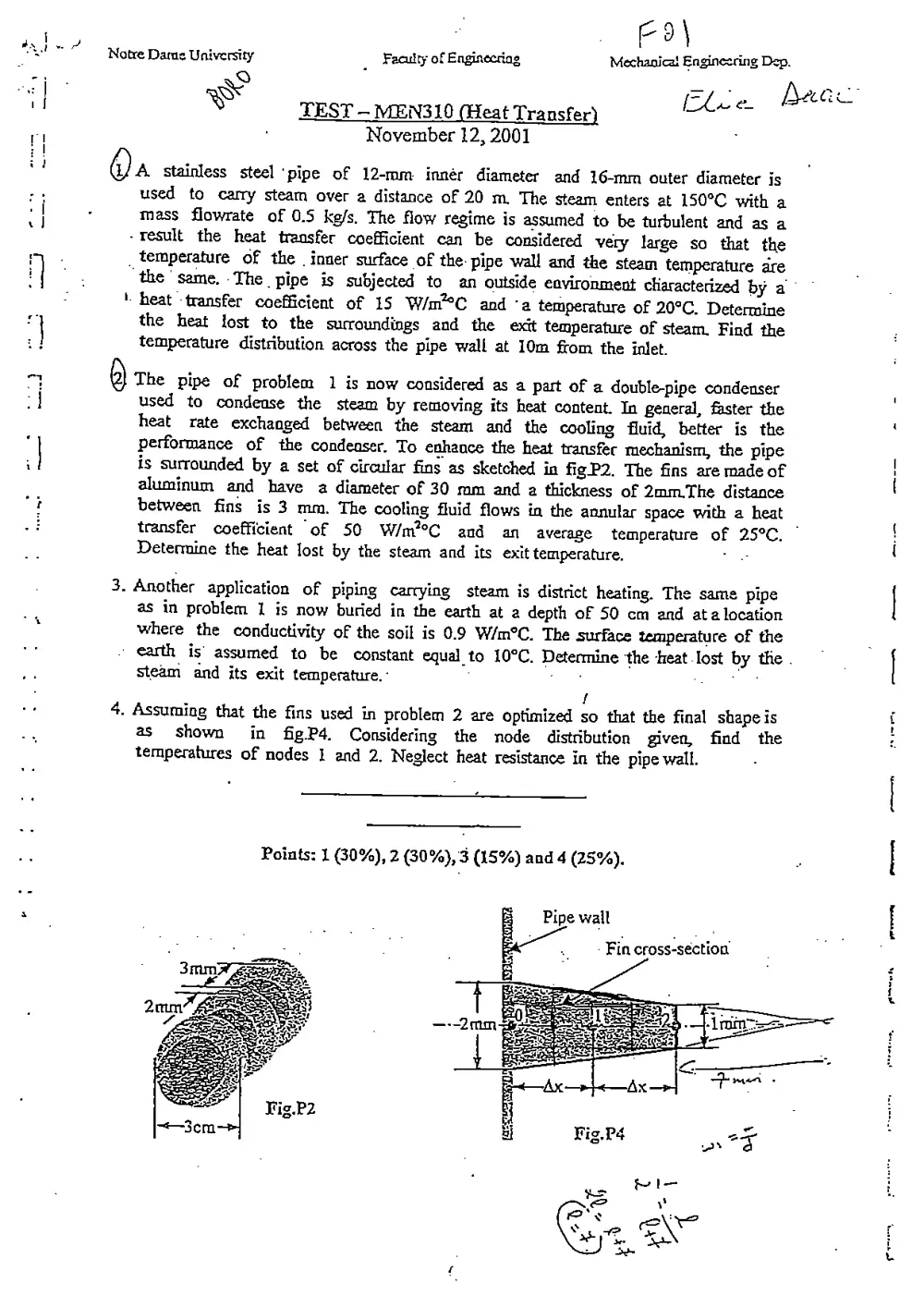
TEST —MEN310 (Heat Transfer)
November 12, 2001
Qa Stainless steel ‘pipe of 12-mm innér diameter and 16-mm outer diameter is
used to carry steam over a distance of 20 m. The steam enters at 150°C with a
mass flowrate of 0.5 ke/s. The flow regime is assumed to be turbulent and as a
-Tesult the heat transfer coefficient can be considered very large so that the
temperature of the . inner surface of the: pipe wall and the steam temperature are
‘the same, The pipe is subjected to an outside environment cliaractetized by a
- heat -transfer coefficient of 15 W/m°C and ‘a temperature of 20°C. Determine
the heat lost to the surroundings and the exit temperature of steam. Find the
temperature distribution across the pipe wall at 10m from the inlet.
6) The pipe of problem 1 is now considered as a part of a double-pipe condenser
used to condense the steam by removing its heat content. In general, faster the
heat rate exchanged between the steam and the cooling fluid, better is the
performance of the condenser, To enhance the heat transfer mechanism, the pipe
is surrounded by a set of circular fins as sketched in fig P2. The fins are made of
aluminum and have a diameter of 30 mm and a thickness of 2mm The distance
between fins is 3 mm. The cooling fluid flows in the annular space with a heat
transfer coefficient of 50 W/m?°C and an average temperature of 25°C. ©
Determine the heat lost by the steam and its exit temperature.
3. Another application of piping carrying steam is district heating. The same pipe
as in problem 1 is now buried in the earth at a depth of 50 cm and ata location
where the conductivity of the soil is 0.9 W/m°C. The surface temperature of the
steam and its exit temperature,
' earth is’ assumed to be constant equal to 10°C. Determine ‘the eat lost by the .
f
4. Assuming that the fins used in problem 2 are optimized so that the final shape is
as shown in fig-P4. Considering the node distribution given, find the
temperatures of nodes 1 and 2. Neglect heat resistance in the pipe wall.
Points: 1 (30%), 2 (30%), 3 (15%) and 4 (25%).
Pipe wail
- “Fin cross-section
Ei
—--2mm ees
C———
EH Fig. Pd her?
oe \
v aS?
Sos 7? Soe
ey, EN
ee at
ern
pees
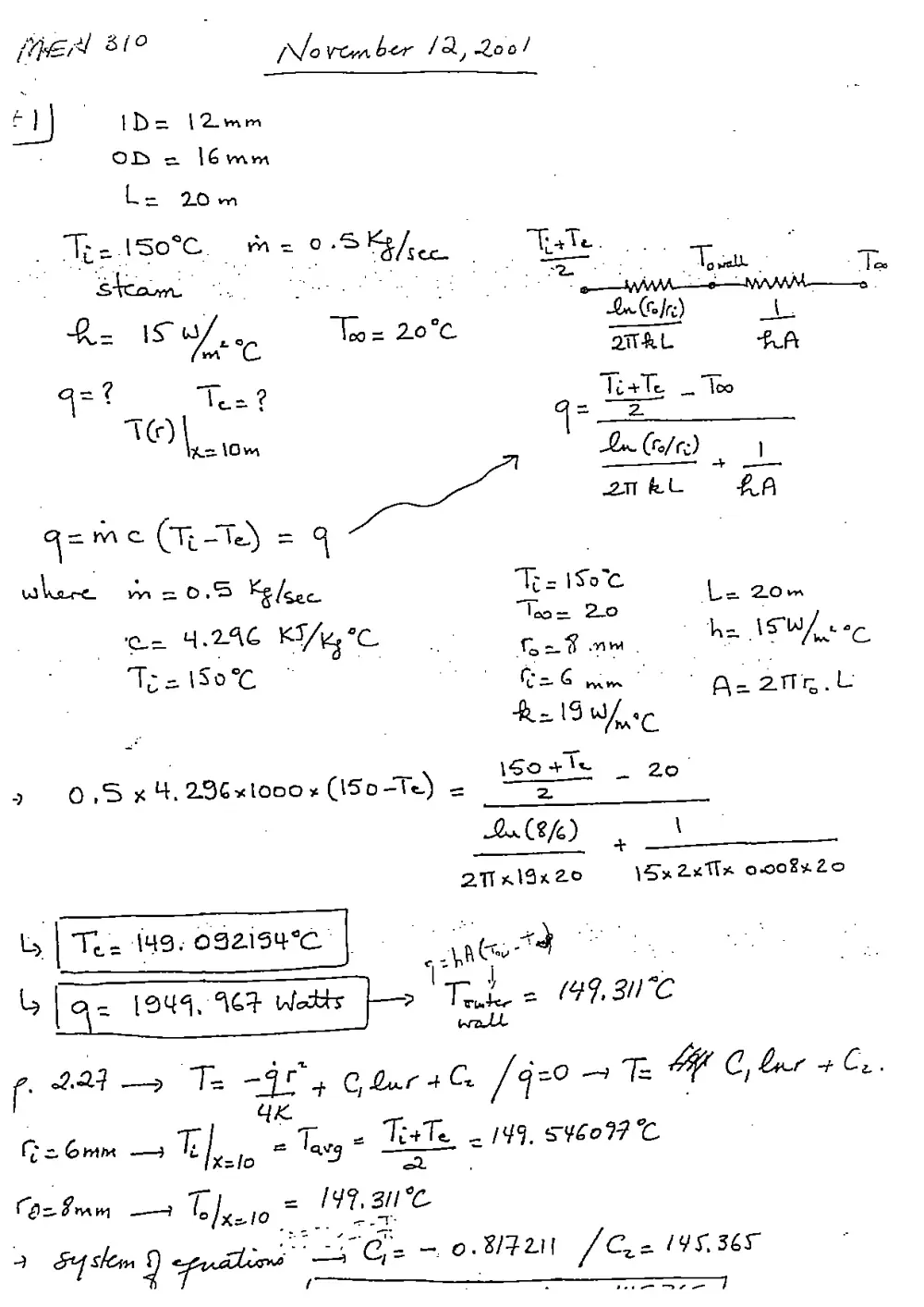
L=- 20m
Tee (SoC. ma 0 SK Tate .
‘ede ae oe : “2 vole Noyes a Vex
Q- 1S w/ T= 20° In (oft) iL!
we CC. no= 20 Cc aTRL PA
=¢ Tee 4 Teale _ loo
TO) 4° —#
As \Om Lu (tof ¢2)
+
a anki fA
A= Mc (Gr —Tle\ = q
whore mM = 0.3 Ke lee Tez soc L 20
Tea = ZO = ™
- T/v,? ~
= 4.246 KY PC 28 nm he ISW/ vec
l= is s “ _ 2
0S =6 wim Az 2tn.l
7 Re. 19 Whee
. Te
» O,S*% U 296xlooox (ISo-Te) = or - 20
24.(8/6) \
+ ~~
QT xnl9n20 \Sx Zea oo08kZo
| . a) ~3
lL ica [944,164 Weitts a Trae =f (99, 3°C
f: 22} Tz - ao C dur 4+ Ce [4° 7 F HH C, bar + Co.
. aK
= Gmm — Tehete = levy * Teste = 149, 546077 T
| T = 03 3il °C
7)
Boe Gael = Br Fe lomm _ ;
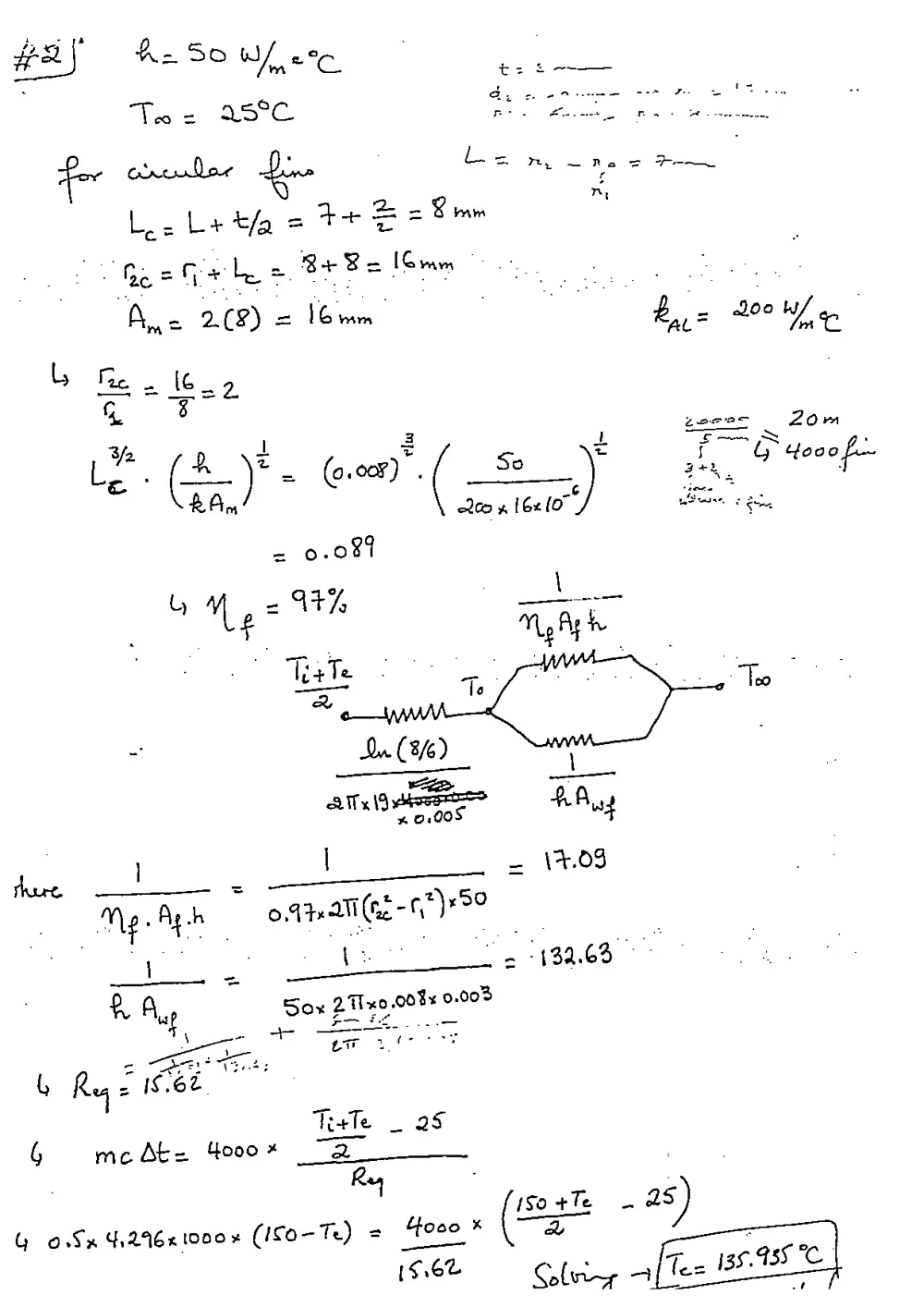
As 2.(8) = Gum bat 00 Wf en
L Tee 2 I6l2
% 8 eoreF _ 4om
Ly eof Bowe
6 jer _
RA m otco x [610 wren cB
- te, par tre
Te+Te _ 25
G me dee Yooox “a
Ruy
{Sorte _ as
£3) Table 3-/
De SOunm<= 0.5m g. 0.4 WwW r)
° ha °C.
“fs 0.008 m., coe Tes 10°C
L=Jom
é c
beae fo. S82 AEb an
PB Boh)
qs RS ATo eat 2 Rx 20L ts seb om 10)
Bn fr)
me AT. Ry¥2TL Foie“)
Qn /)
1S U.29Gx tooo x (Iso —Te) 2 BoAx 21x 20 ( Te - \o)
T ale To
Te = iSoxtTe _lo
YU Ag.su (1S <The) = (Sele -19)
:
Ulye. 3806:256 wetts | -
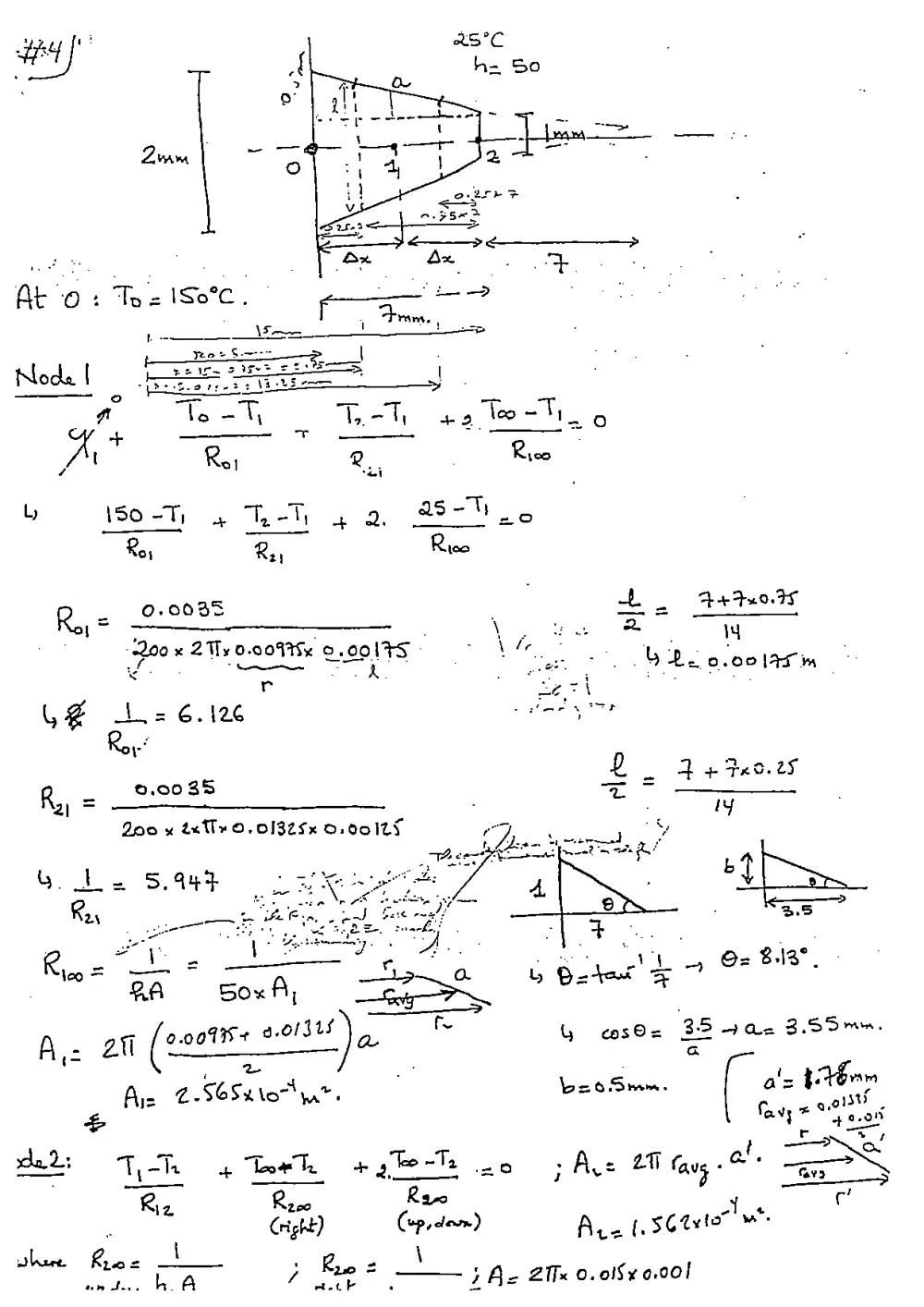
Ly iS0-T) 4 Th-T) 4 Q, S8-U Lo
Ro, Rey Rico
0.0035 ho. Axteots
a , ; - \ fe = ; 4 .
p00 x 2 Thy 0.00775: 2.00 14S \ Cus m LR. ooolrm ©
= + T, a! J
dad: T-h + Lowe Te + yer 2 1.29 p Acs 21 faug « . aia
Aa
Cright) (“prdem) Ave (S6tI
| 4 \
hore. Rie = La , Raw = otfe 21x 0.0lfx 0,00]
fie
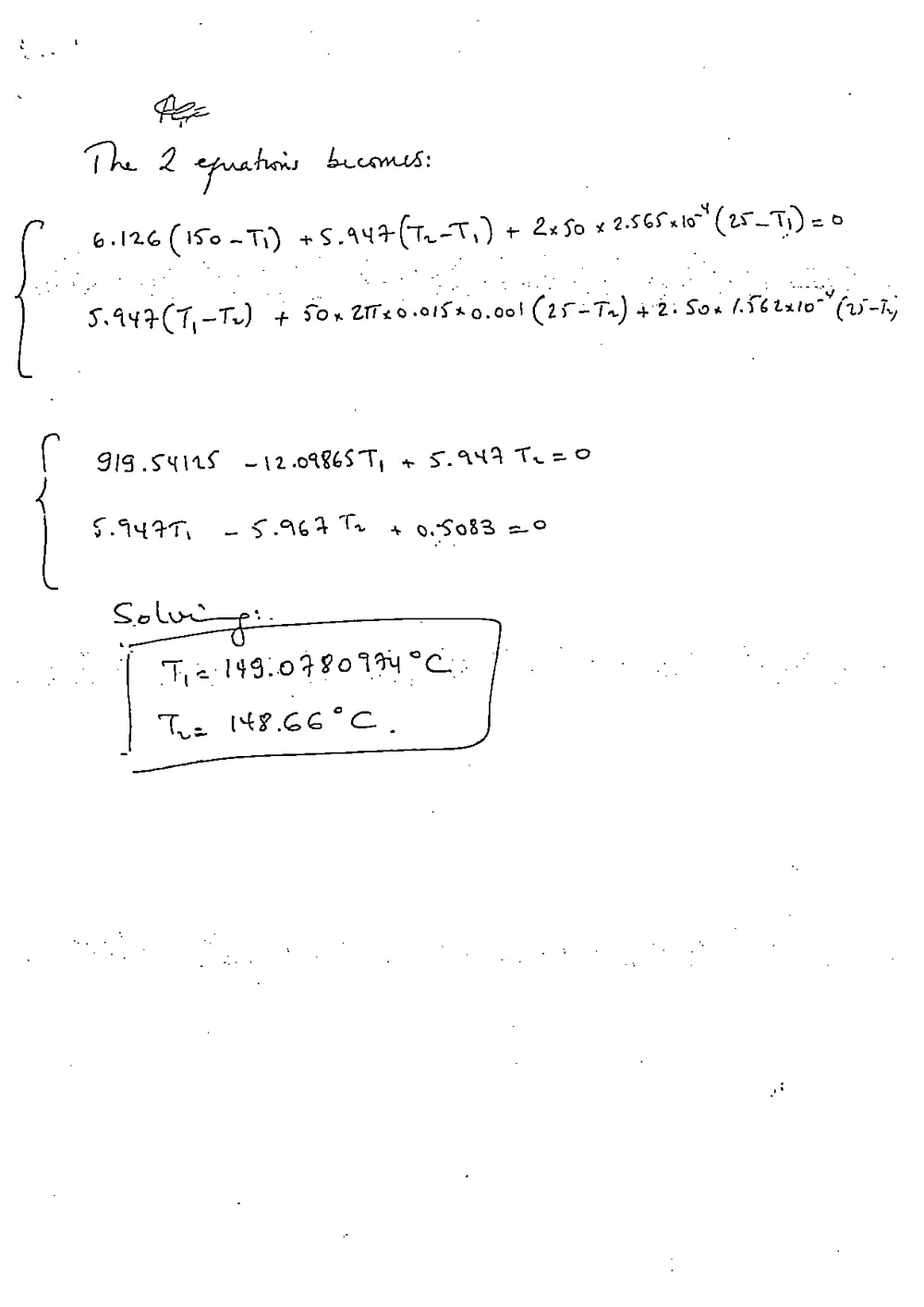
The 2 epras hes becemsts:
6.126 (1S0 ~T1) # $.444(T2-T)) + 2xfo 2.56Fu10 (25-1) 26
5.494(T,-Te) + Tox Z1T20.01S40.00! (25=Ta) 42+ Sox 156 rx107" (ry-1y
( BIg Fy ~ 12 0886S T, + TL.AN4 Tr. =O
| F.A49T, = F.AG4 Te 4 9.5083 =O
Fa 199 0F 901M MC:
Te INP.GEPC.