
MEN 310 Exam 2, Fall 2015
Notre Dame University–Louaize · Heat Transfer · 3 pages
More MEN 310 files
Show the text of this exam
MEN310 - Dr. Charbel Habchi
1/8
Faculty of Engineering
Department of Mechanical Engineering
Fall 2015
MEN310 - Heat Transfer
Instructors: Dr. Charbel Habchi
Exam #2 - 10%
75 minutes (December 10, 2015 – 8:00-9:15)
Student Name: ____________________________ Student ID: _______________ Section: ____
There are 2 questions in the booklet each has several parts, please answer all parts of these questions to the
best of your ability.
Marking Scheme
Questions
Weight
Mark
Question 1
30 points
Question 2
70 points
Total
100 points
1. Open book examination. Only original books are allowed.
2. Do not take the staple out. The exam booklet must remain intact.
3. Cheating penalty will be an “F” grade on the exam.
4. Mobile phones/devices are to be turned off and stowed away.
5. If something is not understood write your assumptions and solve the problem without asking
questions.
Good luck
MEN310 - Dr. Charbel Habchi
2/8
QUESTION 1: Lumped Capacitance Method
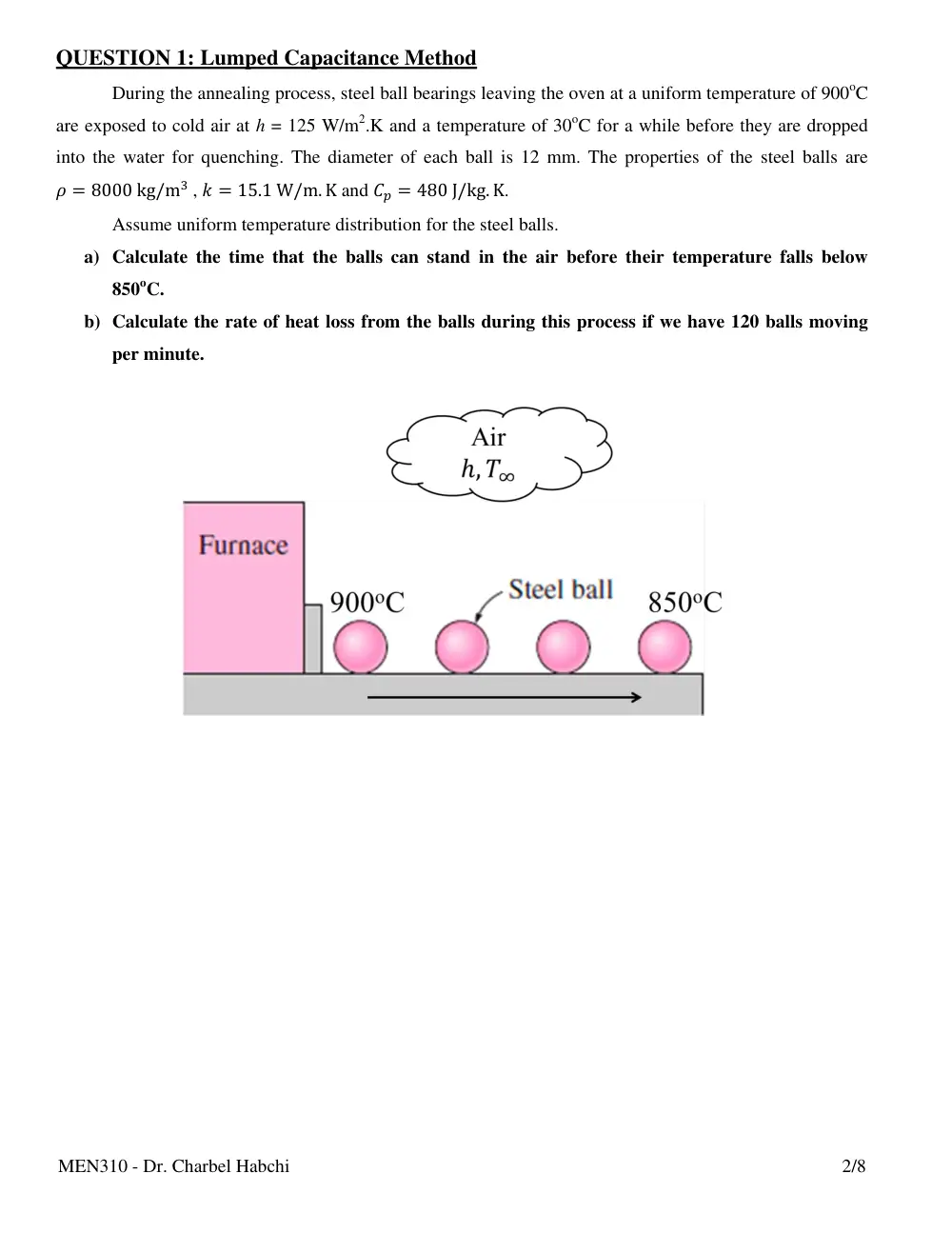
During the annealing process, steel ball bearings leaving the oven at a uniform temperature of 900oC
are exposed to cold air at h = 125 W/m2.K and a temperature of 30oC for a while before they are dropped
into the water for quenching. The diameter of each ball is 12 mm. The properties of the steel balls are
𝜌 = 8000 kg/m3 , 𝑘 = 15.1 W/m. K and 𝐶𝑝 = 480 J/kg. K.
Assume uniform temperature distribution for the steel balls.
a) Calculate the time that the balls can stand in the air before their temperature falls below
850oC.
b) Calculate the rate of heat loss from the balls during this process if we have 120 balls moving
per minute.
MEN310 - Dr. Charbel Habchi
4/8
QUESTION 2: Transient Conduction and External Convection
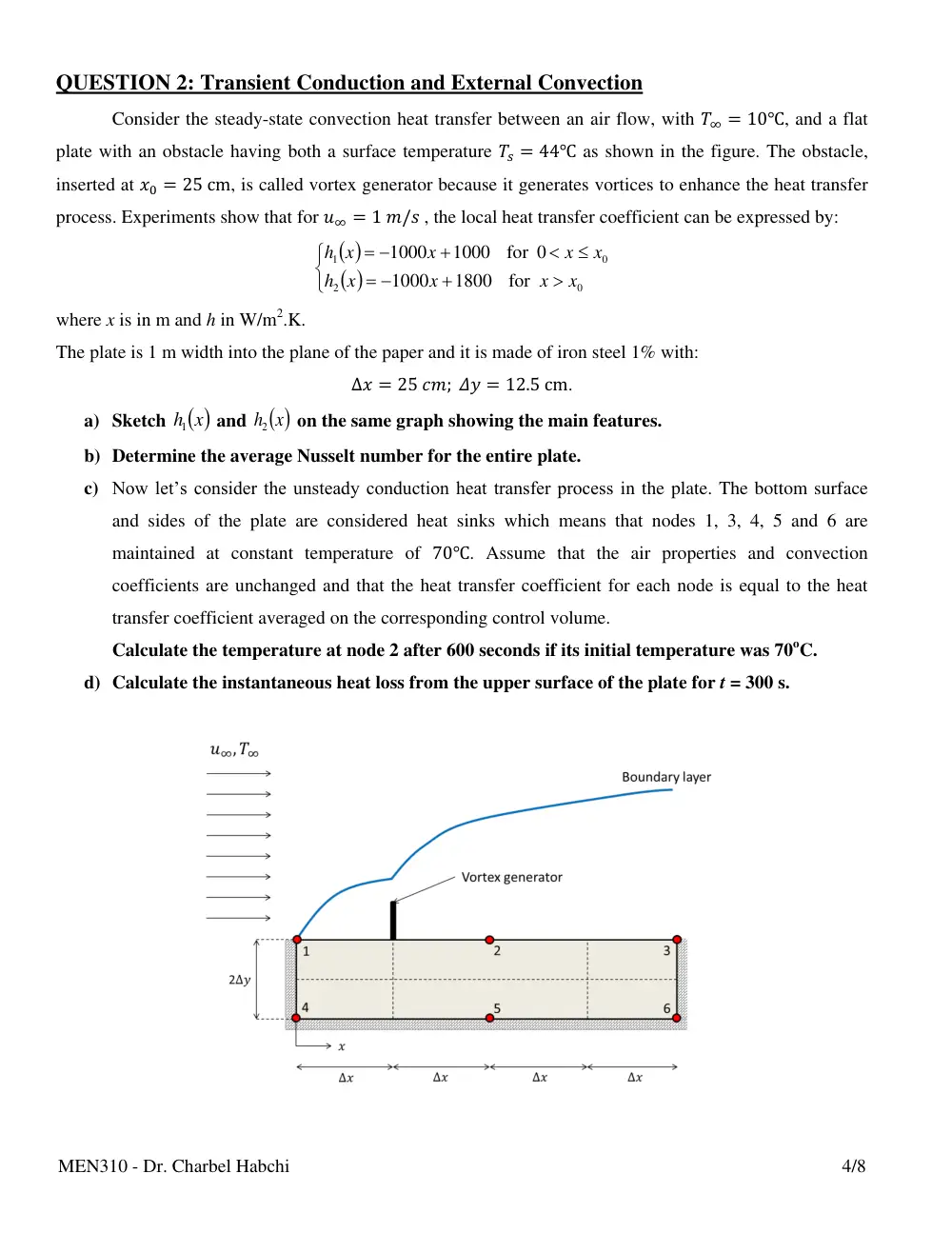
Consider the steady-state convection heat transfer between an air flow, with 𝑇∞ = 10℃, and a flat
plate with an obstacle having both a surface temperature 𝑇𝑠 = 44℃ as shown in the figure. The obstacle,
inserted at 𝑥0 = 25 cm, is called vortex generator because it generates vortices to enhance the heat transfer
process. Experiments show that for 𝑢∞ = 1 𝑚/𝑠 , the local heat transfer coefficient can be expressed by:
0
2
0
1
for
1800
1000
for 0
1000
1000
x
x
x
x
h
x
x
x
h x
where x is in m and h in W/m2.K.
The plate is 1 m width into the plane of the paper and it is made of iron steel 1% with:
Δ𝑥 = 25 𝑐𝑚; 𝛥𝑦 = 12.5 cm.
a) Sketch
h1 x
and
h2 x
on the same graph showing the main features.
b) Determine the average Nusselt number for the entire plate.
c) Now let’s consider the unsteady conduction heat transfer process in the plate. The bottom surface
and sides of the plate are considered heat sinks which means that nodes 1, 3, 4, 5 and 6 are
maintained at constant temperature of 70℃. Assume that the air properties and convection
coefficients are unchanged and that the heat transfer coefficient for each node is equal to the heat
transfer coefficient averaged on the corresponding control volume.
Calculate the temperature at node 2 after 600 seconds if its initial temperature was 70oC.
d) Calculate the instantaneous heat loss from the upper surface of the plate for t = 300 s.