
MEN 310 Exam 1 with Solution, Spring 2001
Notre Dame University–Louaize · Heat Transfer · 6 pages · with solution

More MEN 310 files
Show the text of this exam
a | | a S9\
Notre Dame University ' Faculty of Engineering - + Mechanicat Engineering Dep,
TEST—- MEN310 Heat Transfer)
March 28, 2001
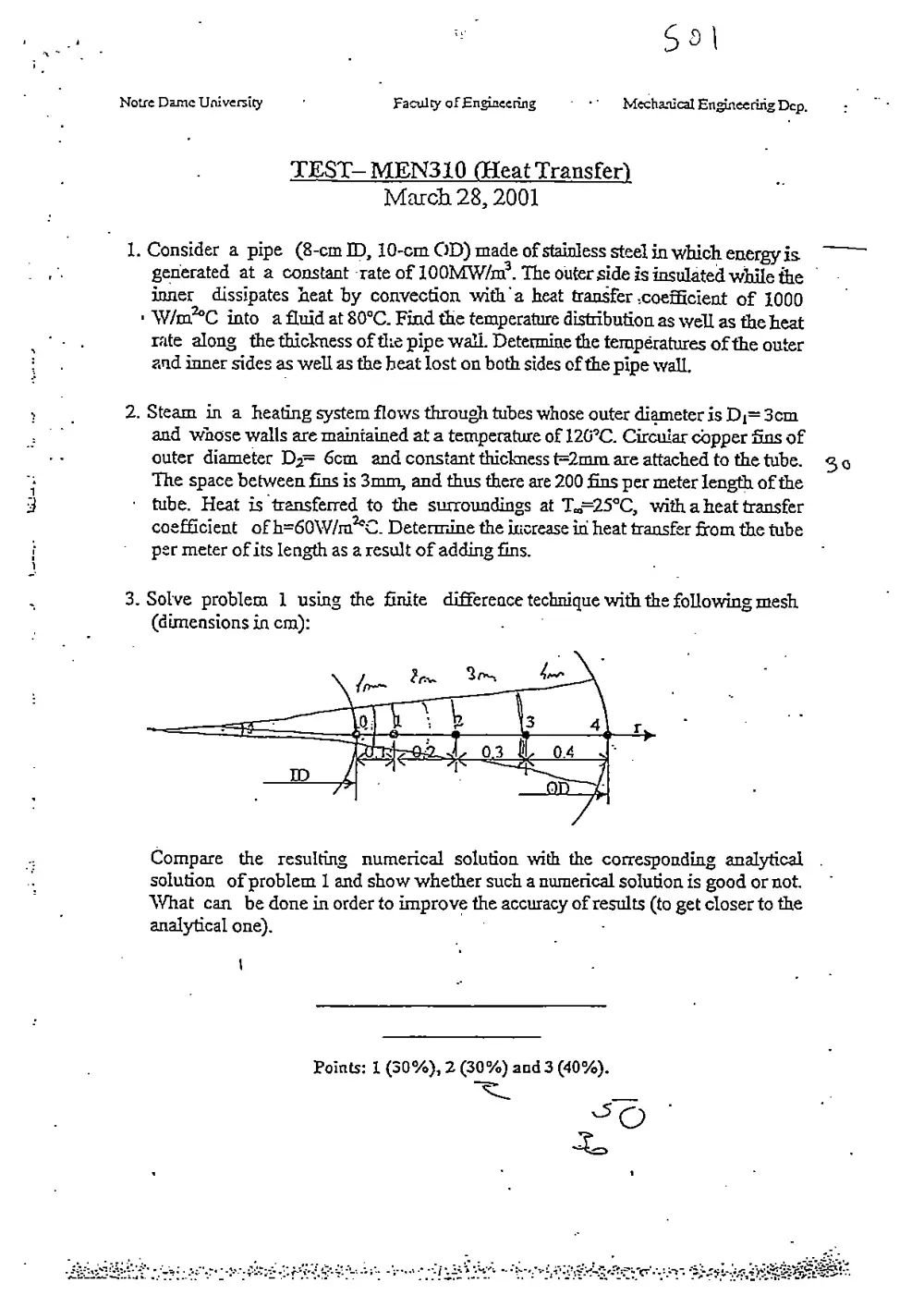
1. Consider a pipe (8-cm ID, 10-cm OD) made of stainless steel in which energyis
generated at a constant -rate of LOOMW/m’. The outer side is insulated while the | _-
nner dissipates heat by convection witha heat transfer .coefficient of 1000
' W/m”C into a fluid at 80°C. Find the temperature distribution as well as the heat
tate along the thickness of the pipe watl. Determine the températures of the outer
and inner sides as well as the heat lost on both sides of the pipe wall.
: . 2. Steam in a heating system flows through tubes whose outer diameter is Dj= 3cm
— and whose walls are mainiained at a temperature of 126°C. Circular copper ins of
outer diameter D3= 6cm and constant thickness t=2mm are attached to the tube. 39
The space between fins is 3mm, and thus there are 200 fins per meter length of the
3 ' fube. Heat is transferred to the surroundings at T.=25°C, with a heat transfer
coefficient of h=60W/m™C. Determine the increase in heat transfer from the tube
per meter of its length as a result of adding fins.
i
H
\
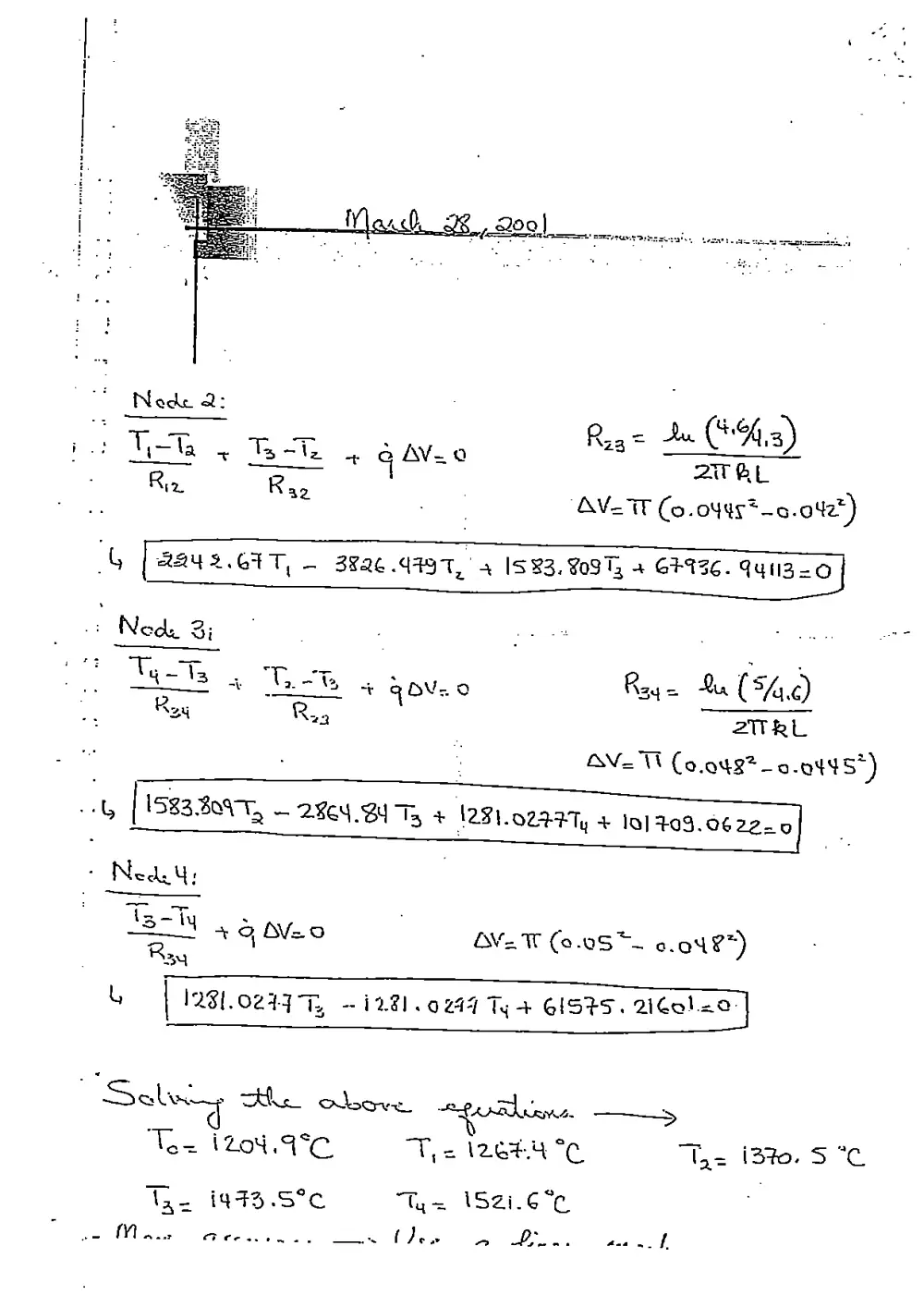
. 3. Solve problem 1 using the finite difference technique with the following mesh.
(dimensions in cm):
Compare the resulting numerical solution with the corresponding analytical .
solution of problem 1 and show whether such a numerical solution is good or not.
What can be done in order to improve the accuracy of results (to get closer to the
analytical one). :
\
Points: 1 (30%), 2 (30%) and 3 (40%).
FO
—
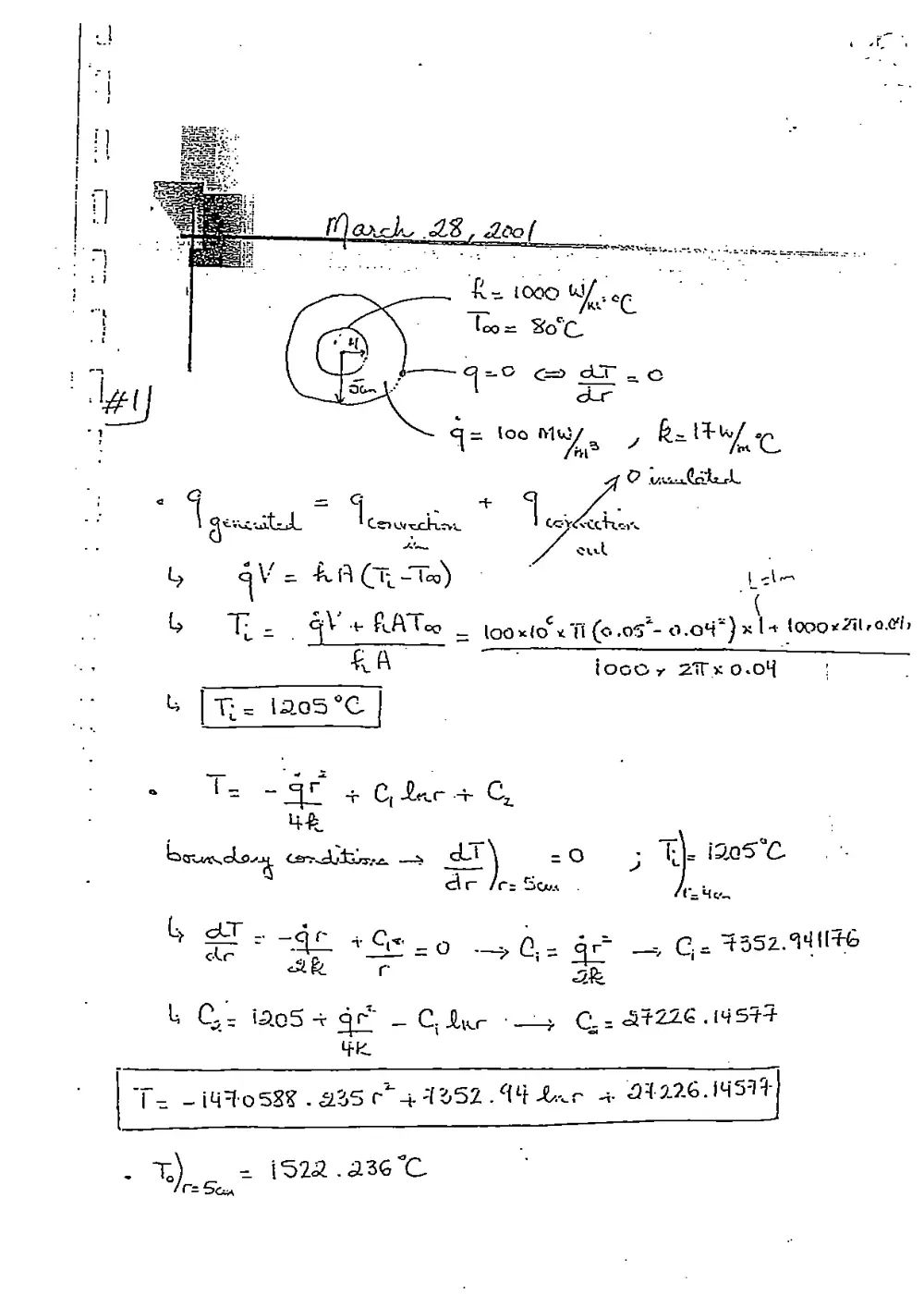
k. Fe) oo
LZ O valde dL
e { = G . + . _ :
{ qevcuile A | Ca wrechine ly Sth.
gut
l qv = AACE) * va
{, T. - qv + FAT - loo xto x Ti (« 05 - 0.04") x 1+ topoxZilroeth
A , loco, 2Tx0.04 |
b | t= 1205°C |
— Ts -9F 4G dea G
_ Tle i205°C
bouncer Cardi Biee — * =9 2 tf {40
dc Jez Sean. ete.
6 a: - “ae +h S — fe = ge — Ge 4352. WTC
AC
vo aR
L Cis 12054 Ge — Car 4 G = AFZZE 1HSTF
GE
| T- ~ {G4OS8R . 935 07 4 1BS2 V4 Lar + 24326.14594|
. 7) = {972 .4236C
C2 Say
43.3333 Wot
= S62442.
2.04 x (1205 ~¥o)= 2
Tie) = toon x 2 x
q= fA CT -Te
KA dT = = -Ka(-gr +S)
oak nek. —» q= he
cx Gi)
~The 21 0.04 -§F
% 4
ye
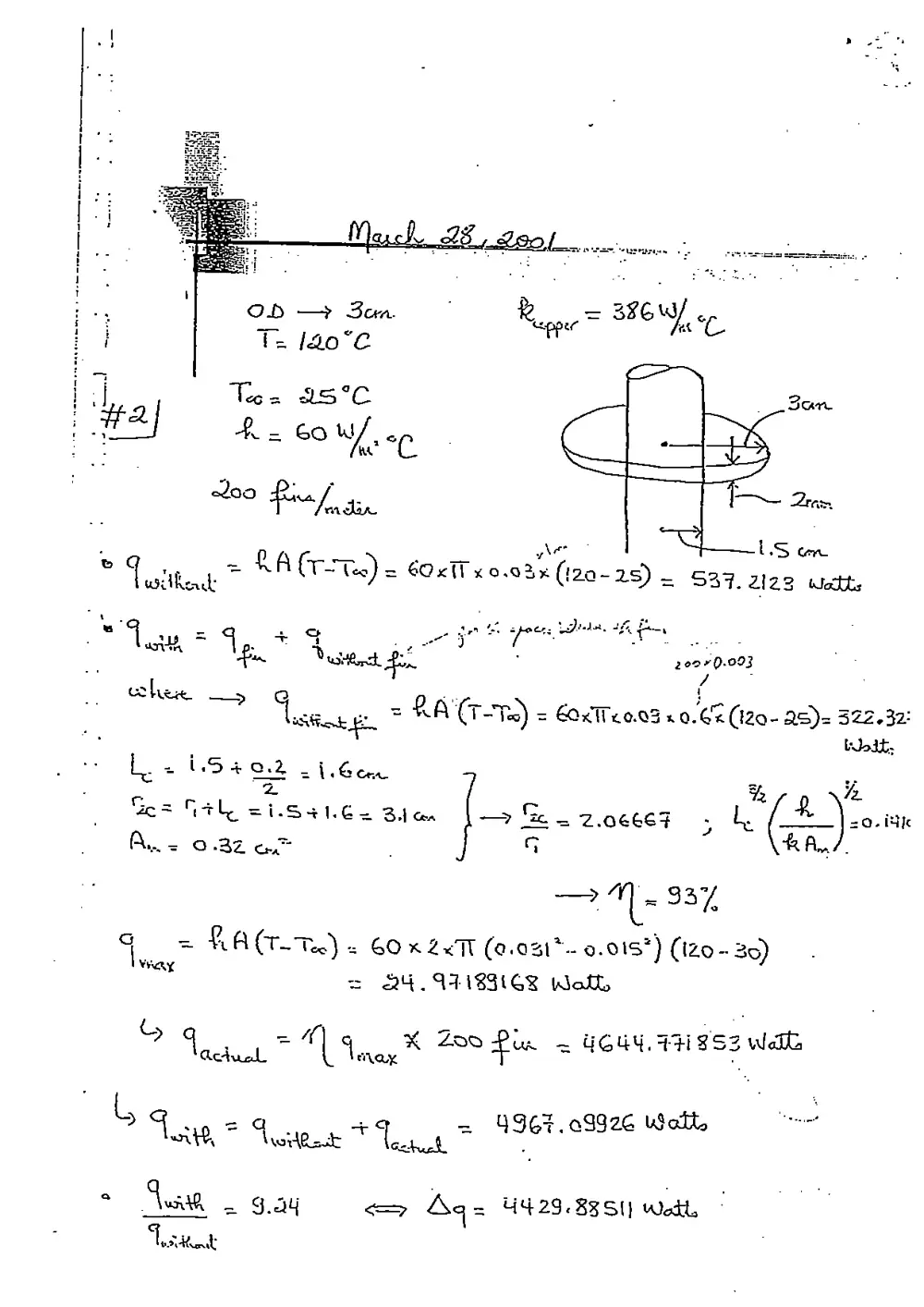
a = RA (Tt) = 60x1 10.03% (20-28) = 537, 2123 Weitts
4 + 4 7 = 57 “ft poesia. an onl _ ;
: . on . 0270.09,
fun tars fo 2 y ;
_ \ fe en _ fn. = ; as _ aso :
at = QA G - a) = G0xT20.03 « 0.6 (I29- Q5)= ee
ea
~eS4lGe BA cen —) AY. i}
%A.,/,
= 2.0666F Sk
— “- 337
G__ = RAC Te) 5 60x 2x7 (a.021*- 0.015") (120-30)
Wray = QU. AFISFIIGR Wot
P »
al
is
-} \g?
Z tr,
L =. Y9GF. 09926 Welt,
Ds, = Tastes * Tou = 186F 8
° sae = Jf <=> Ag = U4 29.8851) Wath
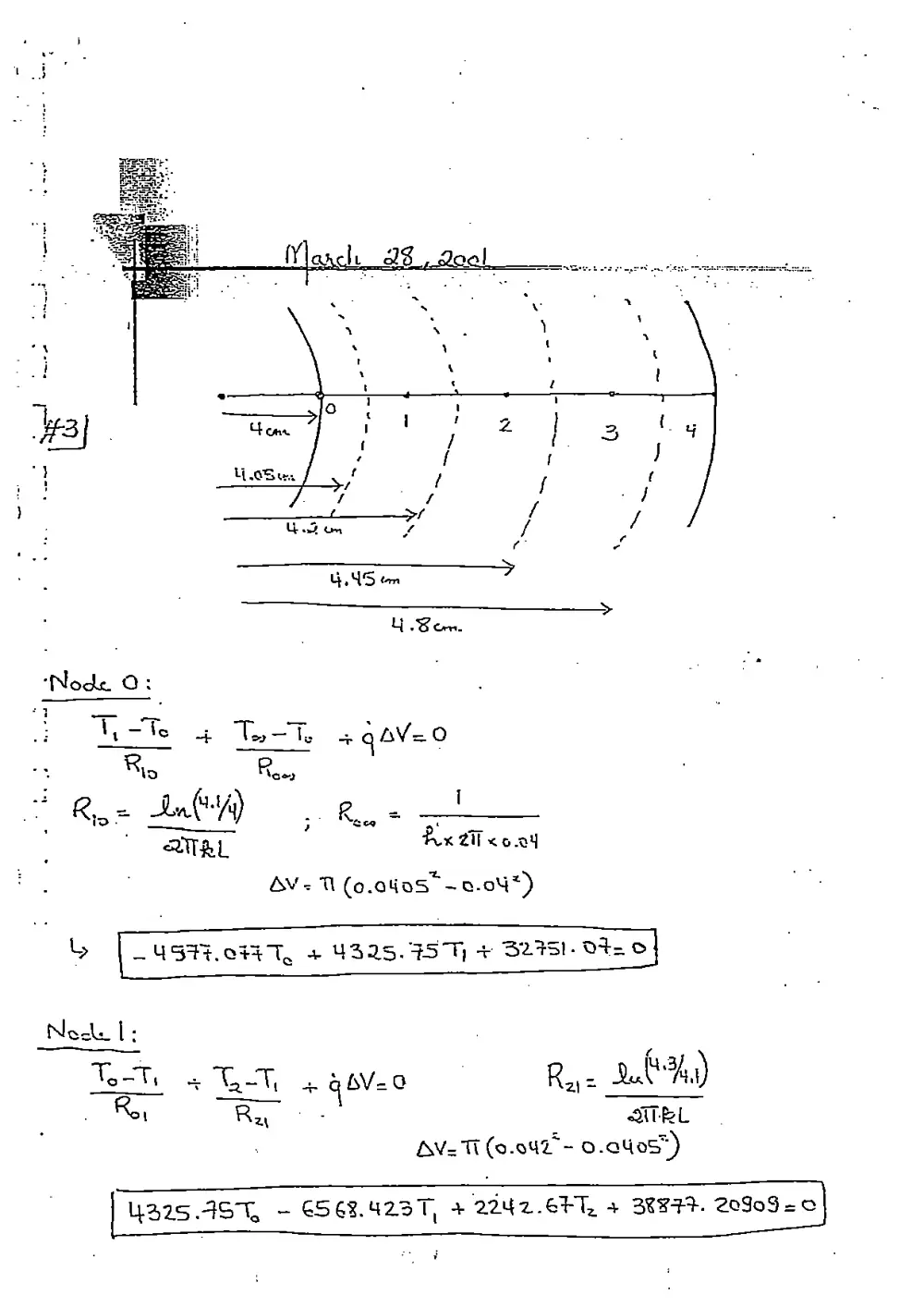
Te. may < ET / g bV= ‘) Ry = dal 3h4,1)
ot ATRL
AV= TI (0.042°- 0.0405")
U32S. 4ST, - CSER 42ST, + 22472.ETT + BVH. V090S=0
Raa = Ju OAs)
ZTAL
AVETT (o.04¥s*-0.042")
G [2848.G9T, — 386.4997, 4 IS83. 8091, 4 GF93C. 4113 =0 |
Ned. 3;
Te. Toe! (re
4-13 , T-B 5 @OVs0 Rey= £4 (5/16)
Rox
ZY Ro, . 2TT RL
AVA VW (Co.ot8?_ 0.0445")
[1583-8097 — 2864.84 Ty + 128102297, + 101203.06 22:0]