
MEN 321 Problems For Chapter 6 with Solution, Fall 2009
Notre Dame University–Louaize · Fluid Mechanics II · 128 pages · with solution

Showing the first 10 of 128 pages. Download the PDF to see all of it.
More MEN 321 files
- Problems For Chapter 11 with Solution · Fall 2009Chapter · with solutionView
- Problems For Chapter 12 with Solution · Fall 2009Chapter · with solutionView
- Problems For Chapter 4 with Solution · Fall 2009Chapter · with solutionView
- Problems For Chapter 8 with Solution · Fall 2009Chapter · with solutionView
- Problems For Chapter 9 with Solution · Fall 2009Chapter · with solutionView
- Exam 1 · Fall 2015ExamView
Show the text of this chapter
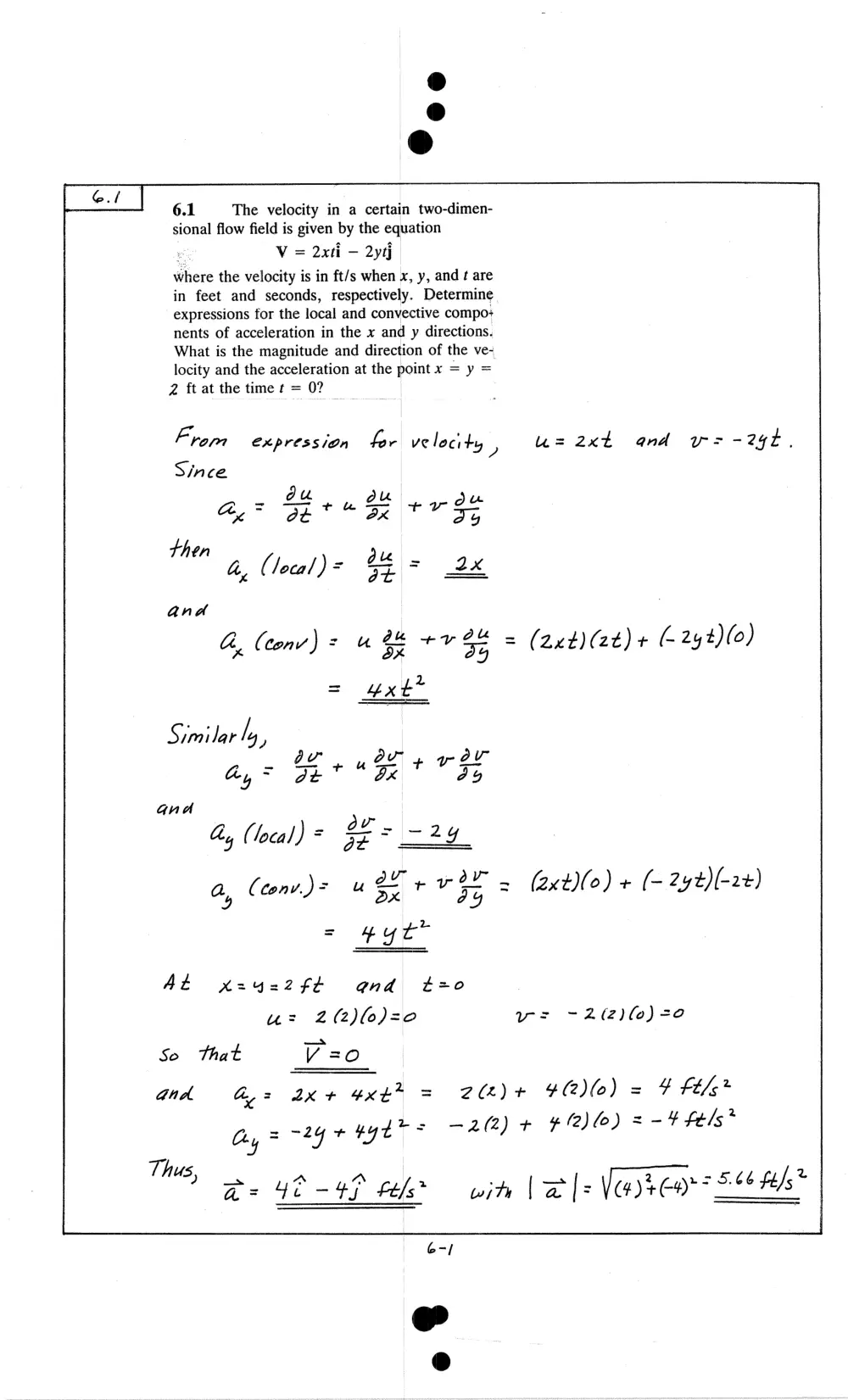
6.1
a
V = 2xti — 2ytj
The velocity in a certain two-dimen-
sional flow field is given by the equation
where the velocity is in ft/s when x, y, and ¢ are
in feet and seconds, respectively. Determine
expressions for the local and convective compo+
nents of acceleration in the x and y directions.
What is the magnitude and direction of the ve-
locity and the acceleration at the point x = y =
2 ft at the time t = 0?
From expression tor velocity , us 2xt and w= -2gt,
Since
- gu ou
A= Bete Re +e ge
then
4, (local) = au = 2x
and
: au.
A, (eons) = u oe +Y Ss = (2ut)(2t) + 6 2y44)(o)
= 4xt*
Similar ly,
7] a y)
a,= Feta ar
qnd ww
a, (local) = oe 7 24
a, (eonv)= usirv dh = (2xt)o) + (- 2yt)(-2t)
= 4yt*
At xX=422f¢t @qnd to
uz Z(2)l.)=0 vers ~2(2)(o) 20
Se That V =0
anh = 2X axe? = 202)+ ¥@)(o) = 4 ttf?
Gi, = 2g rege * —2(2) + ¢@)lo) =-4#tls*
Thus,
a= YO -4F £e/s*
6-/
Veaybens 2 5.66 Fels
with |a|
6.2
6.2 Repeat Problem 6.1 if the flow field is described by the
equation
= (3x2 + 1) — xj
where the velocity is in ft/s when x and y are in feet.
‘ 2 = —bx
From expression for velocity , us 5K +1 Ank V bxy,
Since
Ax (local) = SE = ©
area 4 (anv)= a ou + + ge = (3x41 ox) —(bxy)(o)
= 6x (3x41) = 1e x74 bx
Sim) larly,
ay Be aR 35
Or" a, (local) = 3 = O
Ay (oom) = ust + vee = (3x71) (-b5) + (~bxy)-&)
= 1gx*y 6g
At xey=! ft and tao
az3)*+1 =4 wre—-bli)i)=-6
” — ue ef f ana I7l=V 4-CbL)* = Tal 44
Gna
= 6x (FX741) = 60) [30°41] = 24 Lt/5?
lig = 1B APY by = 180'G) — 6G) = 12 $t-/s
Fs 24 4129 $47
—
a
|= VG)? G2) > 24.8 fe/s*
6-2
| |
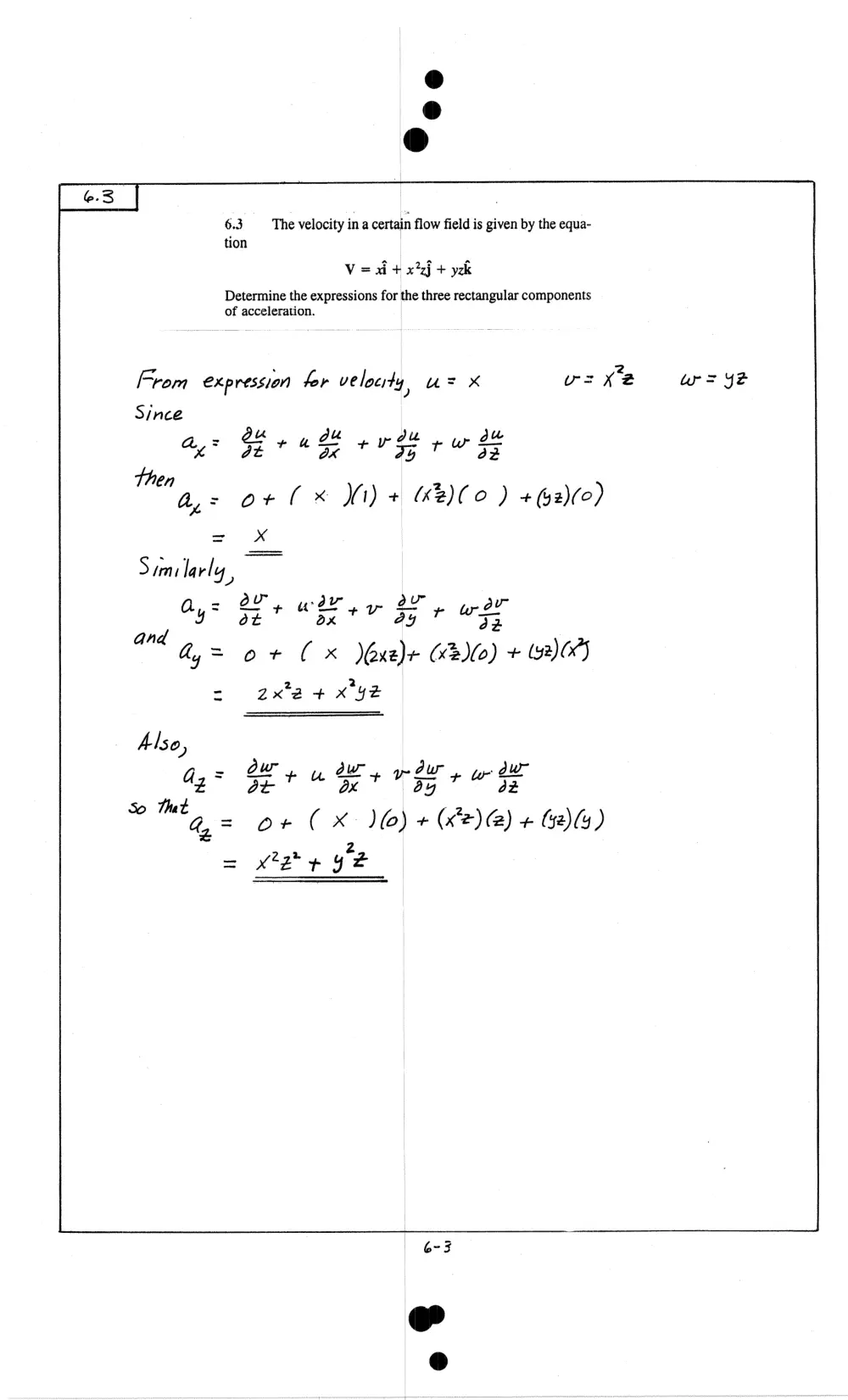
6.3 The velocity ina certain flow field is given by the equa-
tion
Vea + x2ef + yek
Determine the expressions for the three rectangular components
of acceleration.
From expression for velocity, uz x v=xXe2
Since
- ek gu Ju au
ay * ge + * RE tes te
Mena. o+ ( x Mi) + &2)C0 ) +G2)(e)
Similarly ,
0
and
ov au ow
wegen £
Dx +V ag OS
+ (XK )bxele OB)o) + 2) O75
= 2xta + x°y2
x
- ow
¥” oe7
ay = oO
Also,
= Our aw aur Jw
Gg et Ht 5G tbe
So mo o+r (xX )o)+ (x*2) (2) + Ga)(y)
2
= X*2*¢+ 49H
iT]
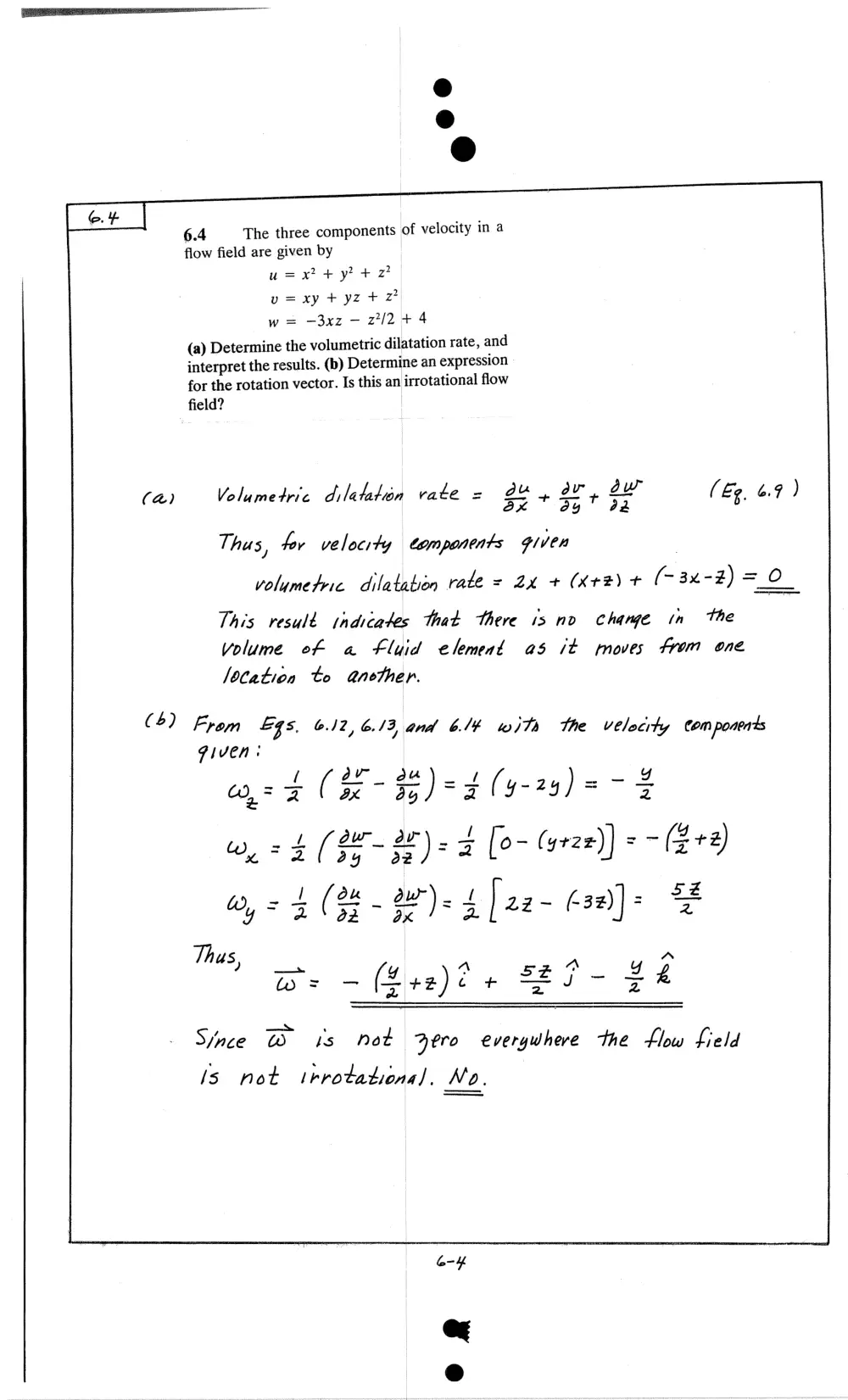
6.4 The three components of velocity in a
flow field are given by
u=xvrtyt 7
vexytyzt+2
w= -3xz —- 27/2 +4
(a) Determine the volumetric dilatation rate, and
interpret the results. (b) Determine an expression
for the rotation vector. Is this an irrotational flow
field?
(4) Volumetric dilatation vate = Z + are ou (Ee. 6.7)
Thas, tov velocity Components given
volumetric dilatation rate = 24 + (xr#) + (—3x-2) =_O_
This vresulé indicates That There is nv cChame in the
Volume of a Fluid element as /t moves from one
location to another.
(4) .
From £45. 6.12, 6.13, and 6.1% wits The velocity com ponents
Given:
oo, ¢ (5-55) =2 (9-25) =~ FZ
cog (2E- BE) = [o- Coee)] «Er
oy 2 4 (38. 2). 4 J az- 632)]= 22
Thas
Bo — (Lea)e+ sefoisg
—
Since W 1s not Aero everywhere the flow field
Is not trrotatonal. No.
o-¥
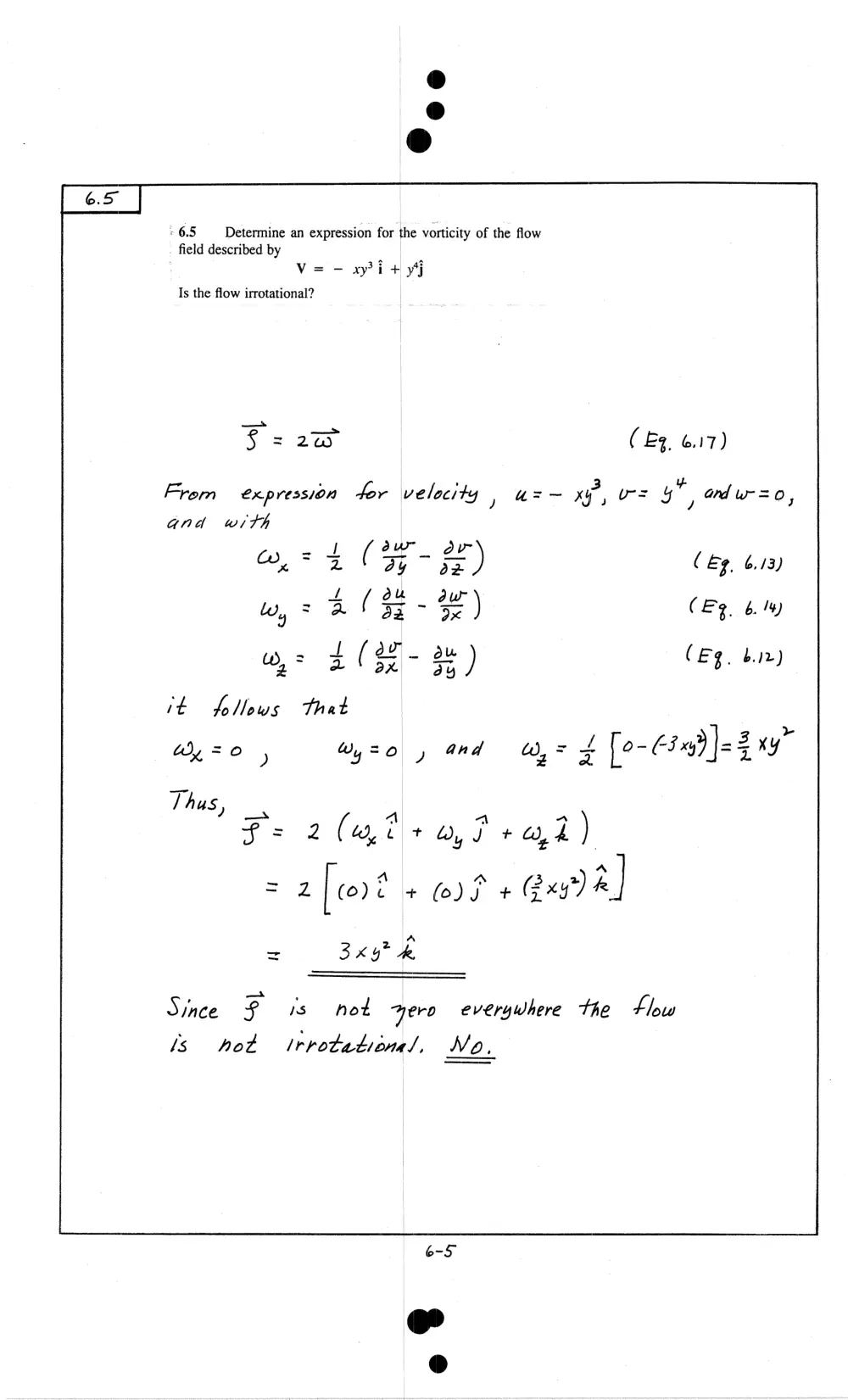
6.5
V= — xi t yj
Is the flow irrotational?
Determine an expression for the vorticity of the flow
field described by
S=2a (£4, 6.17)
Frem expression tor velocity ) “FR xy, u-= 4” ard w= 0,
and with
- aur ov
Wrz (37-2) CE, 6.13)
L au gu
ly = al Sss-%) (Ee. 6.4
t [wea
w,> 2 (SF - 34 ) (Eg. bi)
‘t follows That
>
Ay = 0 ) Wy =o ) and ,= f [o- C3) ]=3 xy
Thas, -_
S
A
3xy k
>
—_
Is hot Irrotadional, No,
6-5
2 (a0 + w, 3 +a,2)
Zz [core + (o)S aye]
Since Ff 1s hot Hero everywhere the +tlow
pd
6.6
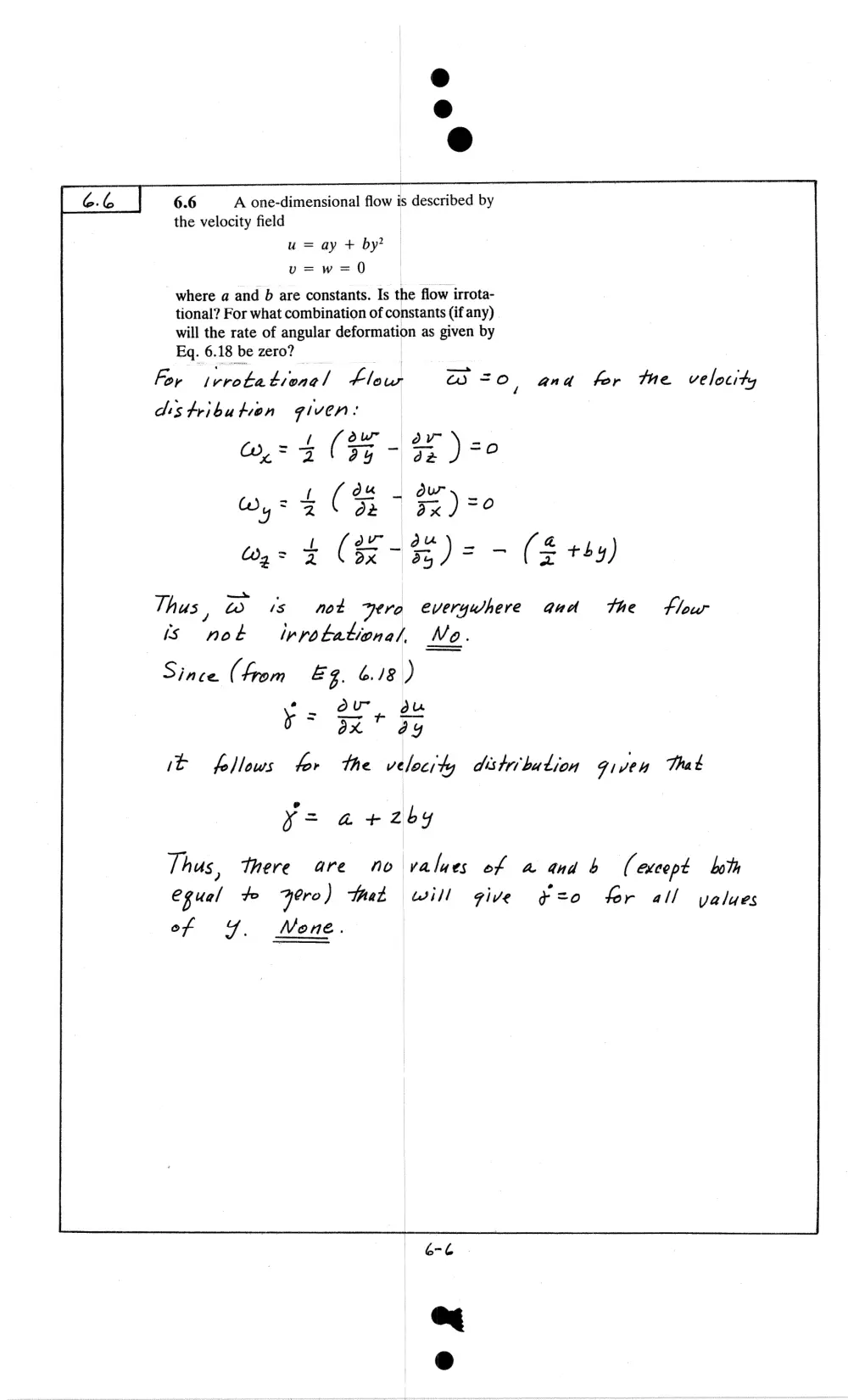
6.6 A one-dimensional flow is described by
the velocity field
u = ay + by?
v=w=0
where a and b are constants. Is the flow irrota-
tional? For what combination of constants (if any)
will the rate of angular deformation as given by
Eq. 6.18 be zero?
For trrokatsone/ #lour 20, and for the velocity
dis tribution given:
Thas , ay 1s not Were everywhere qua the flu
is not ivrobational, No.
Since (Lrom Eg. 6./8 )
*_ Ow, gu
b= ax” by
1b flows for the velocity dst bation given That
y= a+zby
Thus, there are no values of a and b (exept both
C gual fo Hero ) taat will give ¢=o for all yalues
of Z. Nene.
6-6
G.7
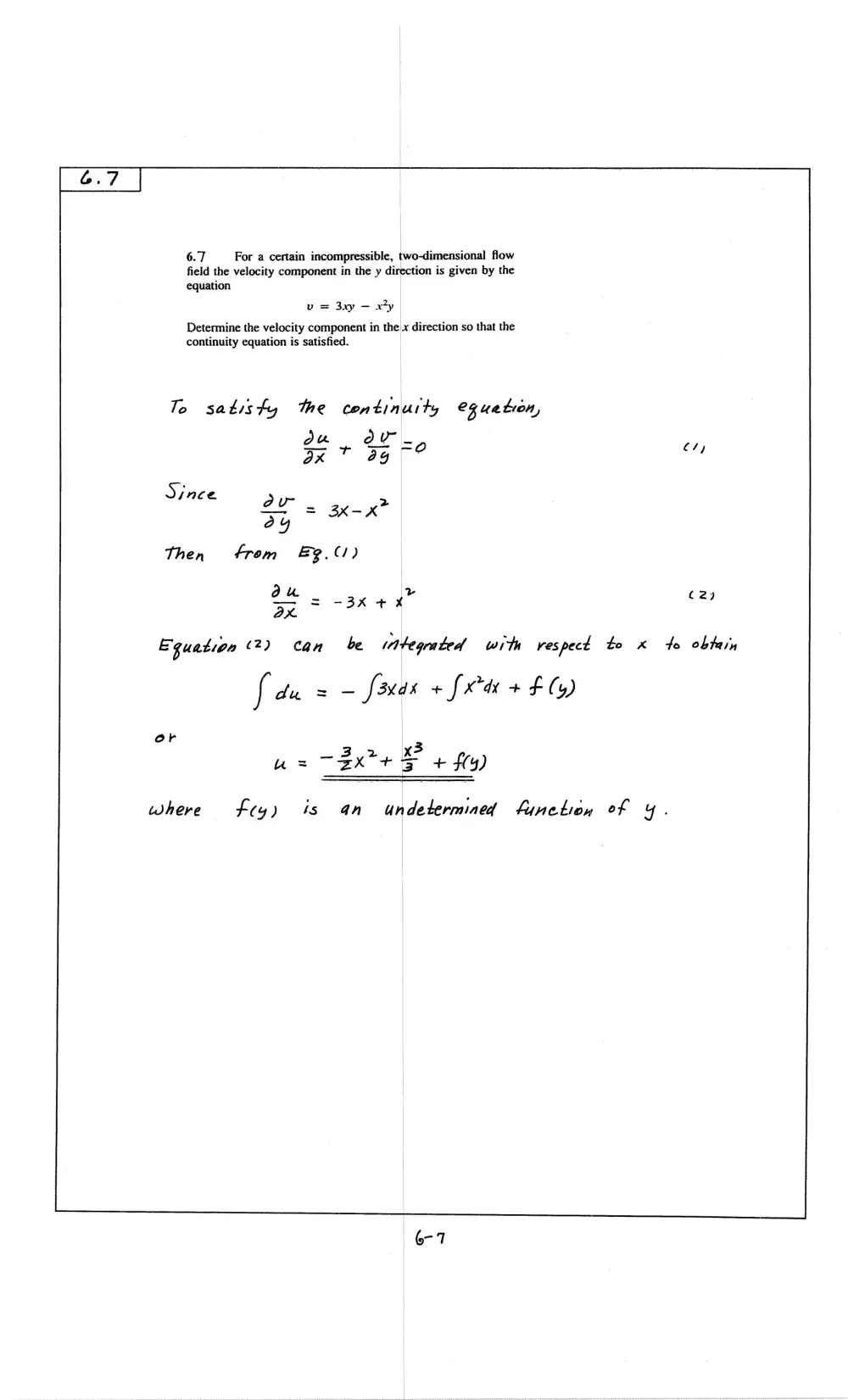
6.7 For a certain incompressible, two-dimensional flow
field the velocity component in the y direction is given by the
equation
v = 3xy — xy
Determine the velocity component in the x direction so that the
continuity equation is satisfied.
To satisty the continuity eguetion,
Since
ov = 3x-x"
oy
Then from &9.C/)
Ou _ r C2)
mx BX + Xx
E guation (2) can be ittegrated with respect to x to obtain
f tu = — [sxax + [xdr + Cy)
or
_~ 3,2, x3
us 72x +s + fy)
where Fy) ts an undetermined funetiwn of 4.
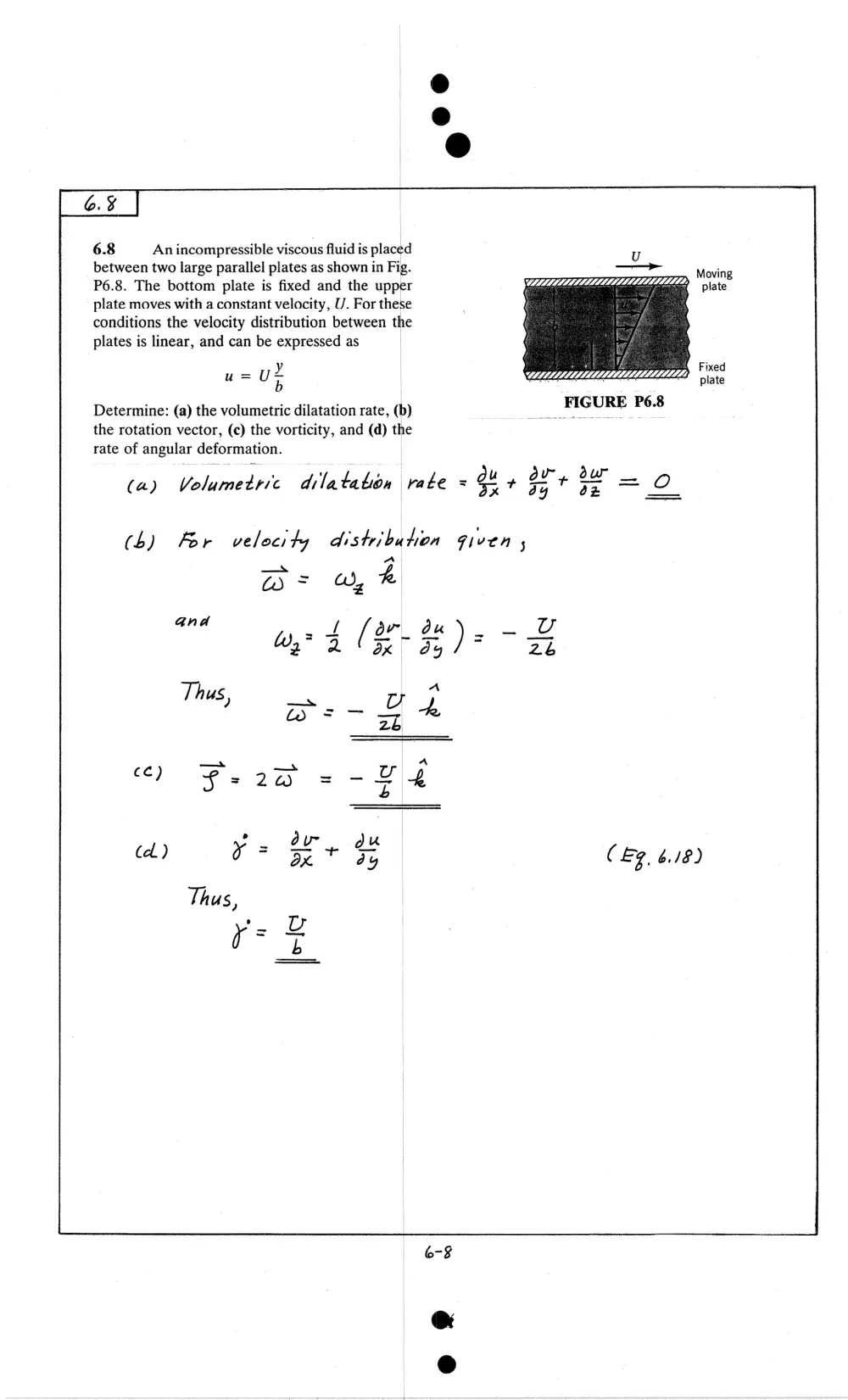
6.8 Anincompressible viscous fluid is placed
between two large parallel plates as shown in Fig.
P6.8. The bottom plate is fixed and the upper
plate moves with a constant velocity, U. For these
conditions the velocity distribution between the
plates is linear, and can be expressed as
- yz
u=U*
Determine: (a) the volumetric dilatation rate, (b)
the rotation vector, (c) the vorticity, and (d) the
rate of angular deformation.
(a) Volumetric dilatation rate = gu + a dur =O
(bh) Fr velocity distribution GIvtn s
D = Ww, e
and .1 for du), . U
w,? 4 (2- St) = ze
Thus, A
—_>__ U
dd = ae
2 2
td.) ye yr se Cg, 6.18)
Thus,
‘. oO
rT
6-3
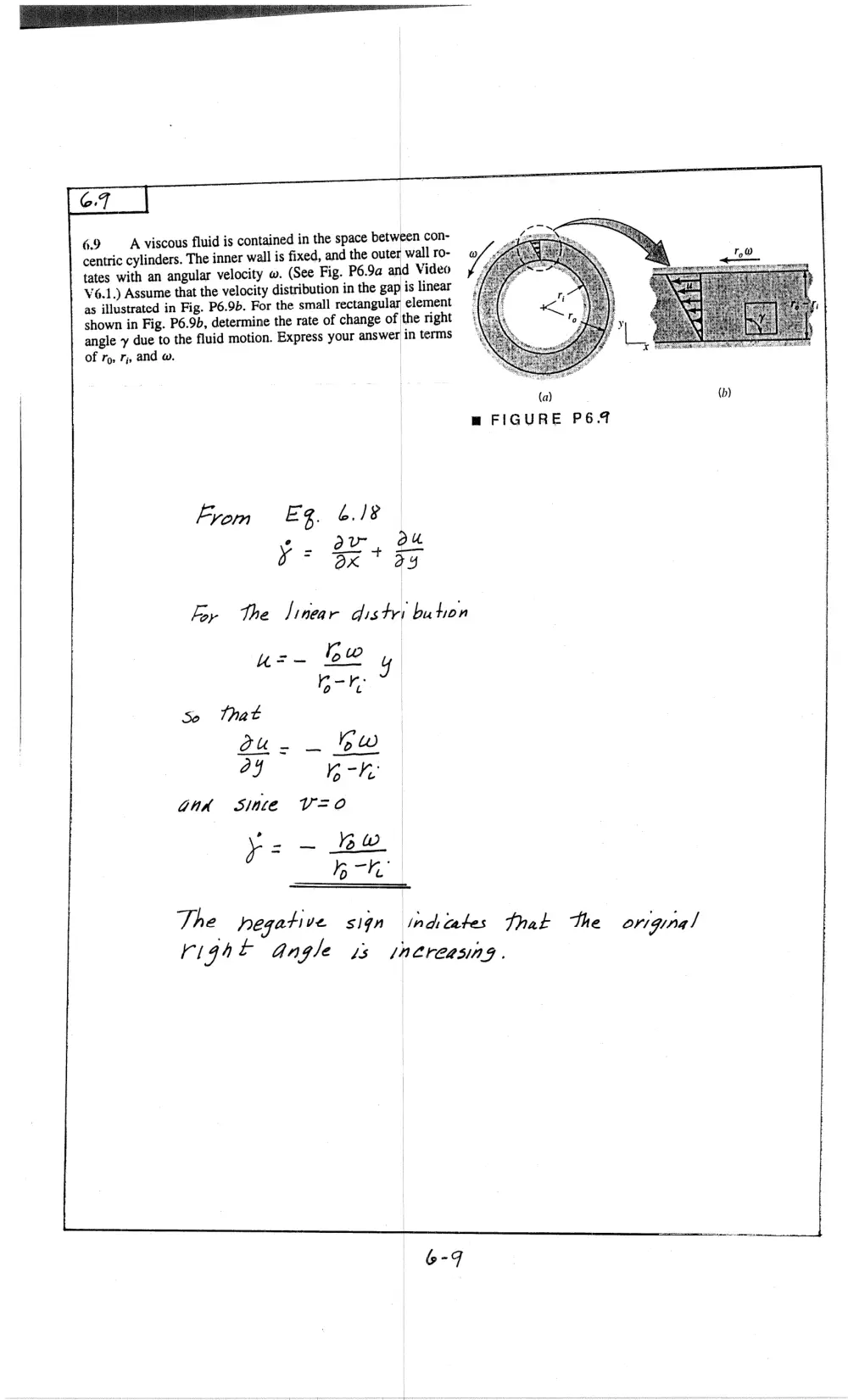
69 A viscous fluid is contained in the space between con-
centric cylinders. The inner wall is fixed, and the outer wall ro-
tates with an angular velocity w. (See Fig. P6.9a and Video
¥6.1.) Assume that the velocity distribution in the gap is linear
as illustrated in Fig. P6.9b. For the small rectangular element
shown in Fig. P6.9b, determine the rate of change of the right
angle y due to the fluid motion. Express your answer in terms
of ro, Ty, and w.
(a)
m FIGURE P69
From Eg. 4.1/8
2. ou, ou
- + —
XY? oxta3
Zor The linear distri bution
Me- Ip w 4
h-h%
So That
ou. — bw
Gnk Sinte V=0
pe = aw
hh
The negative sign indcates that The origina!
right angle 1s increasing.
(b)
6-9
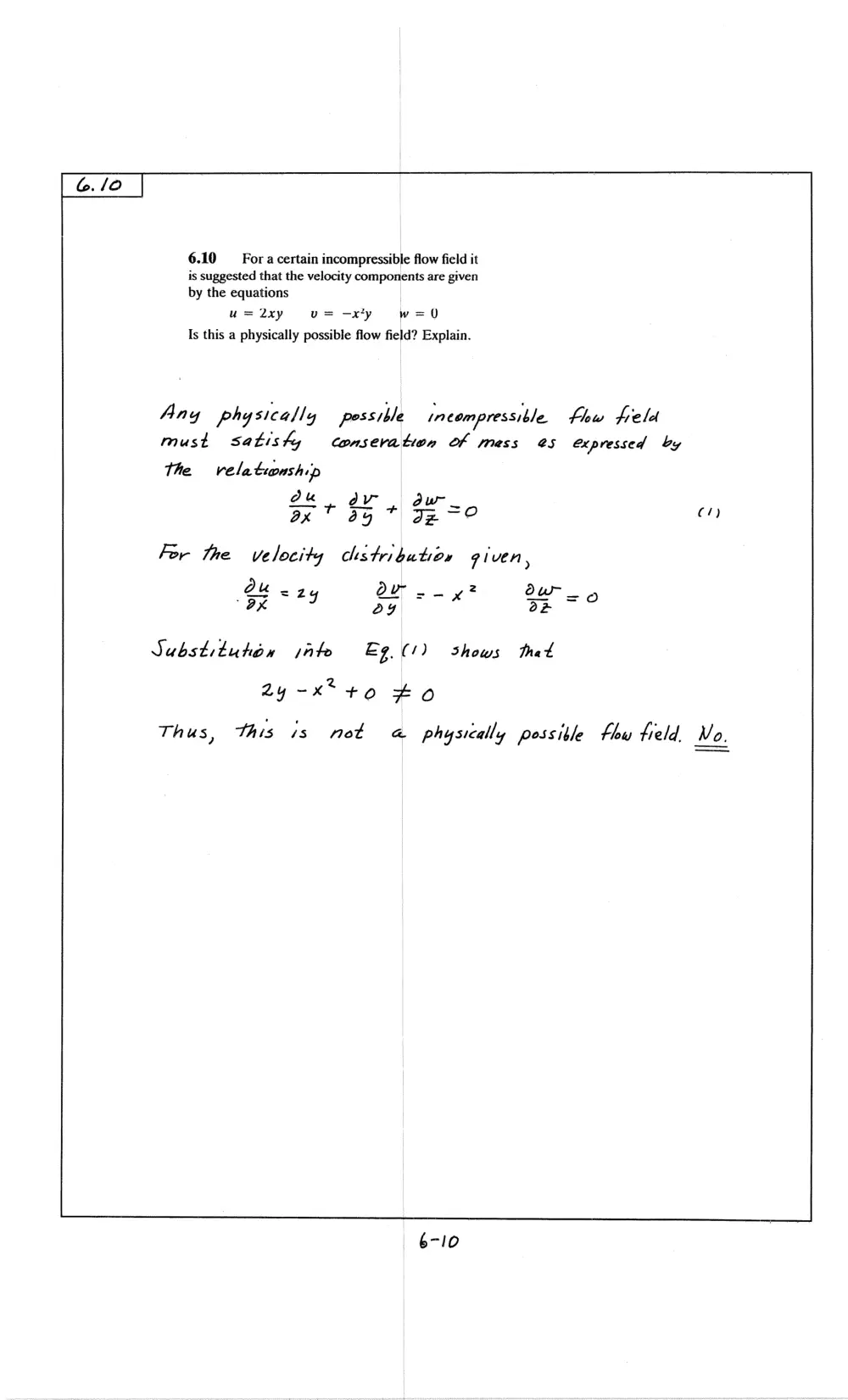
G./o
6.10 Fora certain incompressible flow field it
is suggested that the velocity components are given
by the equations
u= 2xy v= —-x’y w=0
Is this a physically possible flow field? Explain.
Ang physically possible incompressible thw freld
must satisty Conservation Of mess es expressed by
the velateonsh p
Ok a Ow _
ax" 39 * Tz ~O am
Fer the velocity chstribution given,
Ok 22 or 2 aur
ae ee -—- Xx — =
a J ay 2 °
Substituhon sate Eg.(1) shows thet
2y-x* +0 #0
Thus, This is not @ physically possitle thu field Wo,
6-lo