
MEN 321 Problems For Chapter 8 with Solution, Fall 2009
Notre Dame University–Louaize · Fluid Mechanics II · 135 pages · with solution




Showing the first 10 of 135 pages. Download the PDF to see all of it.
More MEN 321 files
- Problems For Chapter 11 with Solution · Fall 2009Chapter · with solutionView
- Problems For Chapter 12 with Solution · Fall 2009Chapter · with solutionView
- Problems For Chapter 4 with Solution · Fall 2009Chapter · with solutionView
- Problems For Chapter 6 with Solution · Fall 2009Chapter · with solutionView
- Problems For Chapter 9 with Solution · Fall 2009Chapter · with solutionView
- Exam 1 · Fall 2015ExamView
Show the text of this chapter
&.1
8.1 Rainwater runoff from a parking lot flows through
a 3-ft-diameter pipe, completely filling it. Whether flow. in
’ a pipe is laminar or turbulent depends on the value of the
Reynolds number. (See Video V8.1.) Would you expect the
flow to be laminar or turbulent? Support your answer.with
appropriate calculations.
Re = oye = VD If Re>#000 the flow is turbulent, The
corresponding velocity iso
y= Rev. (zoo0)(1.2Ix1o > £ )
~ DO” 3 fF
Most likely the velocity will be greater than this, ¢., turbulent how.
= 0.0161 #
3.2.
enter a pip
P8.2. Woul
problem if
8.2 Blue/and yellow streams of paint at 60 °F (each with a den-
sity of 1.6 slugs/ft? and a viscosity 1000 times greater than water) Yellow
Separate streams of blue and yellow paint? Explain. Repeat the |
Green?
2 in.
e with an average velocity of 4 ft/s as shown in Fig. Spli
id you expect the paint to exit the pipe as green paintor =|
the paint were “thinned” so that it is only 10 times caren 25 tt
more viscous than water. Assume the density remains the same. ALS j
FIGURE P8.2
Tf the flow is laminar the paint would exit as separate blve and
ellow streams.
’ evo _ _eVD _ 16 HE (48) (#A)
Re= He ~ “7000 fky,g ~ 1000 (2.3#xi0°* Bs)
Thus, laminar flow so bive and yellow streams,
If use fp =/04y, 9 obtain
Re = #560>4000 so have forbulent flow with natural mixing and
green paint.
Note + Check to determine if the 25 f! length js greater than the
entrance length, J,.
For laminar flow 2 =0.06 Re, or 4,=0.06 (45.6)(% fl) =0.456 f<25H
For turbulent flow 42 =44 Rel, op by = %4(¥560)4(7B i) = 2.99 ft <25H
= $5,6 <2/00
0
20
40
60
80
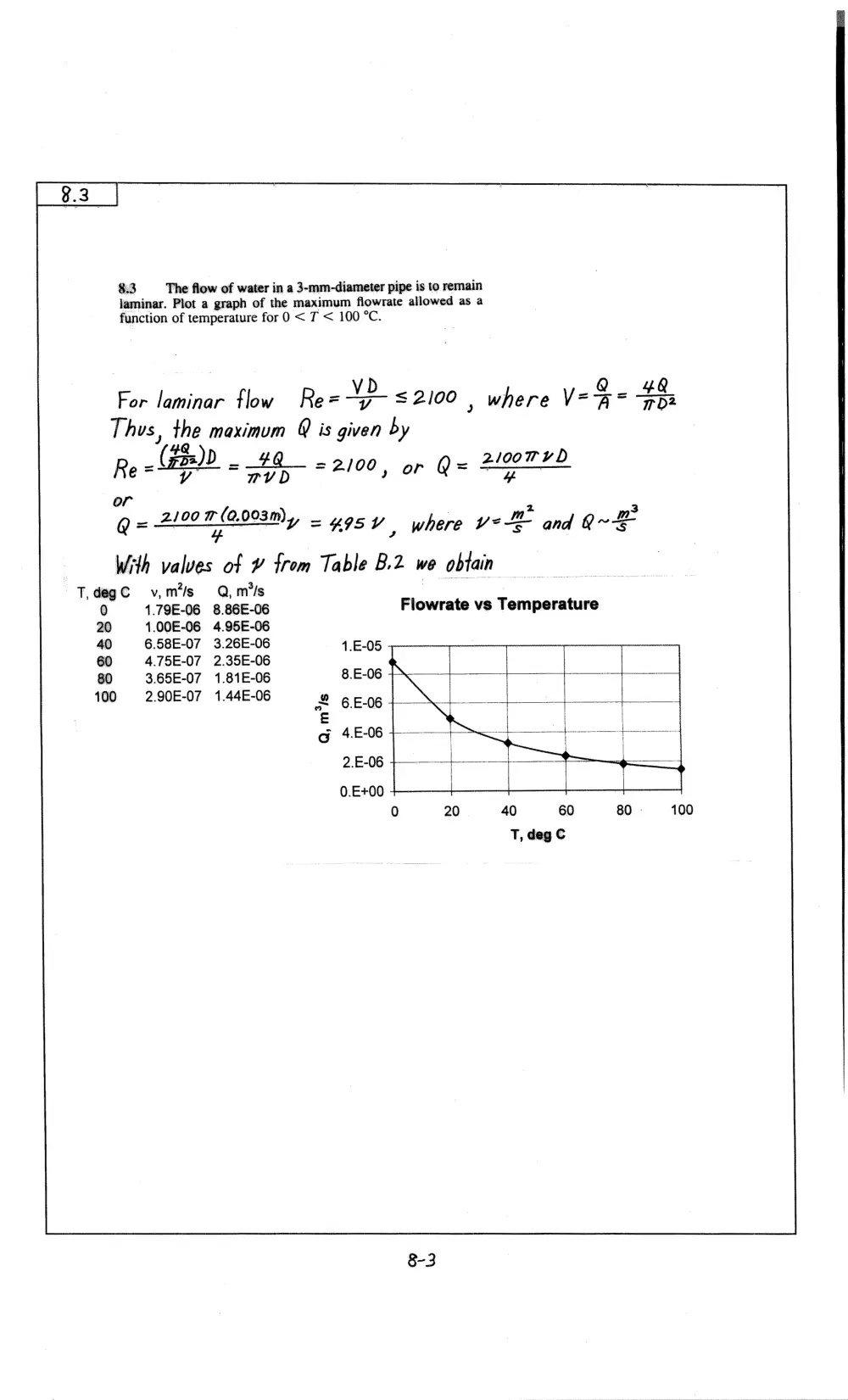
8.3 |
83 The flow of water in a 3-mm-diameter pipe is to remain
laminar. Plot a graph of the maximum flowrate allowed as a
function of temperature for 0 < T < 100 °C.
For laminar flow Re= vp $2100 , where ye$= zo
Thus, the maximum Q is given by
Re _ (os)D = #8 _=32/00, or Q= 21007 VD
V 7wvbd v7
or ( , ;
00 7 (0.003
Q= 2/0 7 oc my, = ¥95 V , where yr and Qr~
With values of ¥ from Table B.2 we obtain
T,degC v,m%s Q,miis
1.79E-06 8.86E-06 Flowrate vs Temperature
1.00E-06 4.95E-06
6.58E-07 3.26E-06 1.E-05
4.75E-07 2.35E-06
3.65E-07 1.81E-06 8.E-06 +
100 2.90E-07 1.44E-06 2 6.E-06
£
Gg 4-06 |
2.E-06
0.E+00 |
) 20 40 60 80 100
T, deg C
8-3
8.4
8,4 Air flows through a 0.08-mm-diameter
passageway in a person’s lungs at a rate of 10°”
m*/s. Is the flow laminar or turbulent? Support
your answer with appropriate calculations.
If Re= vp < 2100 the flow is laminar.
Ve = 40 _ #10)
_
A 7 D® ” F (.08%10%m)y
Thus,
Re= (0.199 #)(0.08x10 m)
e 1. ¥6 x/0* =
=0./992
= 1,09 <2100, £.e.
laminar flow
[Ee
[a5 J
8.5 Carbon dioxide at 20 °C and a pressure
of 550 kPa (abs) flows in a pipe at a rate of 0.04
N/s. Determine the maximum diameter allowed
if the flow is to be turbulent.
For turbulent flow, Re = evo > 4000 | where Q=VA -fp’y
or
Re Oe = £6. = $000
Thus -5 Ni
‘D= oar , where geQ= 0.048 and w=L4 x10”. (Table 8)
Hence, y (0, o4ty( ES)
D= 4000 7 (1,47 xjo* HS) = 0.0688 im
[8-6]
x (m) (+0.01 m)
p (mm H,0) (+5 mm)
5.0 (pipe exit)
8,6 The pressure distribution measured along 0 (tank exit) 520
a straight, horizontal portion of a 50-mm-diam- 0.5 427
eter pipe attached to a tank is shown in the table 1.0 351
below. Approximately how long is the entrance 15 288
length? In the fully developed portion of the flow. 2.0 236
what is the value of the wall shear stress? 2.5 188
3.0 145
3.5 109
4.0 73
4.5 36
0
The. entrance length extends to the fully “en, portion in
which %€ =canstant. Approximate %~ $2 to obtain the following:
From X= | fox=l)m 5p, mm H.0 a an sie Hao
4) 05 -93 OSs -/86
OS 10 ~76 0.5 ~/52
Lo LS -63 0.8 ~/26
1S 2.0 -52 0.5 -/04
2.0 2.8 - 48 0.5 -96
25 3.0 -43 0.S - 86
3.0 3.5 -36 0.5 -72
3.5 HO ~36 0S -72
40 4S ~37 Os ~74¥
45S 5.0 -36 O05 -72
Within the error on &p, the pressure gradient is constant
for X23,m Thus, 43m.
For X>3m , aa 72 lm HO rom Hal
fo VA0 im 7800/%)
Since | mm t,o x ¥,
=9008, then
Ap _ mmth® f 9,80 m2
f= 72 m mm K, set) 706 i
Since ap = Yiuk if follows that
2 “f = " o.0g0n (706!) = 8.93é
8.6
8.7
8,7 A soft drink with the properties of 10 °C
water is sucked through a 4-mm-diameter, 0.25-
m-long straw at a rate of 4 cm?/s. Is the flow at
the outlet of the straw laminar? Is it fully devel-
oped? Explain.
3,,72m 3
_ 4 10 Gm . _ -6 mt
v=-£ = pee =0.3/8% Thus, with V=1.31 x10 3 (see Table B2)
318 & (4x10, a, .
Re = VD. era m) = 471 <2/00; it is laminar flow.
Hence ,
be
Dp =0.06 Re , or L, = (0.06)(971)(4x10°m) = 0,233 m < 0.25m
or we have fully developed flow at the exit.
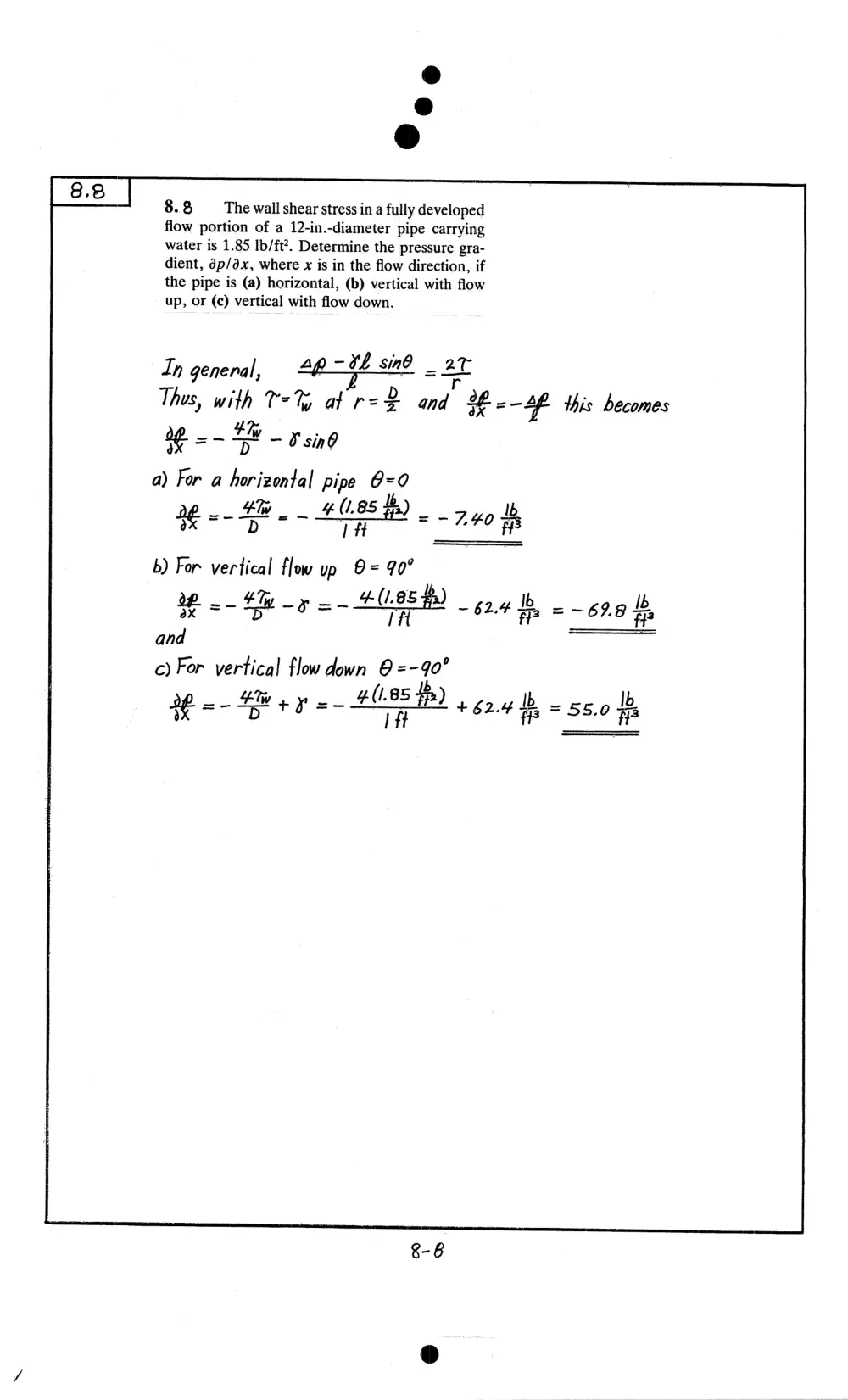
8.3 The wall shear stress in a fully developed
flow portion of a 12-in.-diameter pipe carrying
water is 1.85 Ib/ft?. Determine the pressure gra-
dient, dp/dx, where x is in the flow direction, if
the pipe is (a) horizontal, (b) vertical with flow
up, or (c) vertical with flow down.
Ln general, 2p =H sind = a
Thos, vith T=% at r=2 and 3h =o this becomes
ag = 7 - S sinO
a) For a fursontl p pipe O=O
ag —_ Hla 48S fy) |
Q D lft
b) For vertical flow up 9 = 90°
ie. Hy _y =~ 4.055) ~ 62.4 2 lb ~ 69.8 16.
itt =
Ib
- 7.40 3 rye)
fF
and
c) For vertical flow down @=-90°
1.85 +
eee eee
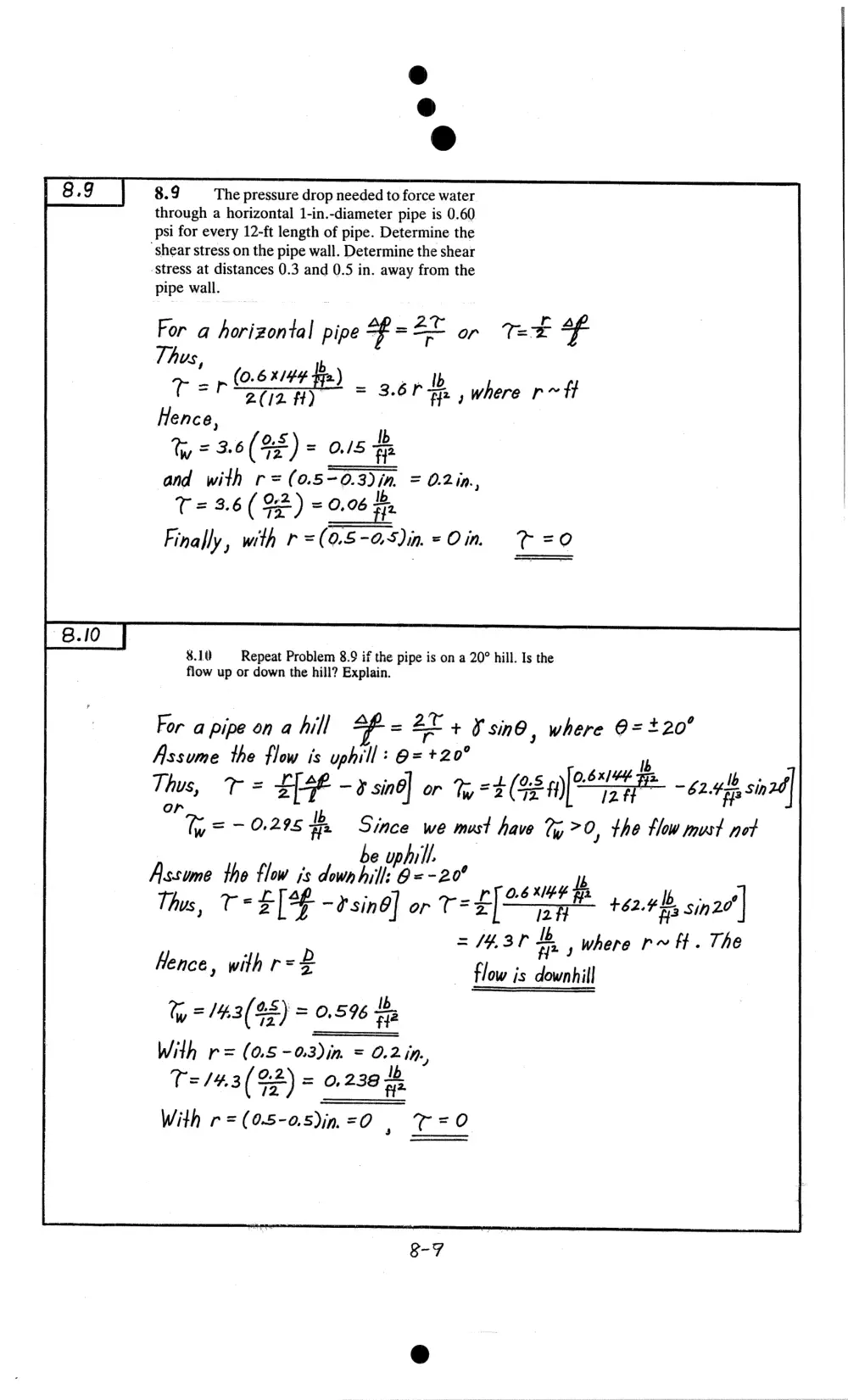
8.9 The pressure drop needed to force water
through a horizontal 1-in.-diameter pipe is 0.60
psi for every 12-ft length of pipe. Determine the
‘shear stress on the pipe wall. Determine the shear
Stress at distances 0.3 and 0.5 in. away from the
pipe wall.
For a horizontal pipe iia or Tet of
r
0.6 X44 fim =
=r Oe ff) d. 3.6r2 | where reff
and with r= (0.5-0.3)in. = 0.2in,
T= 3.6 (92) =0,06 0.06 sf
Finally, with Pr =(0.5-0,5)in. = O in, T=0
8.10 Repeat Problem 8.9 if the pipe is on a 20° hill. Is the
flow up or down the hill? Explain.
For a pipe on a hill G = Ft e sin@, where O=
Assume the flow is uphill : get
Thus, T= EF - ¥ sind] or - =¢ ore -62. wh, sinad]
a = - 0,295 1, Hs Since we must have % 70, the tlw must not
be uphill.
Assume the tlow js down hill: B- -20° m
b
Thus, rs] -dsin6] or r=_] +62 #1, sinzd’|
ft
=/£3r $ , Where r~ ft. The
flow is downhill
Hence, with r=
% =/43( 28) = 0.596
ih r= (05-03)in. = 0.2 in.,
T= 14,3 (92 92) = 0,238
With r=(05-0.5)in. =O , T=O
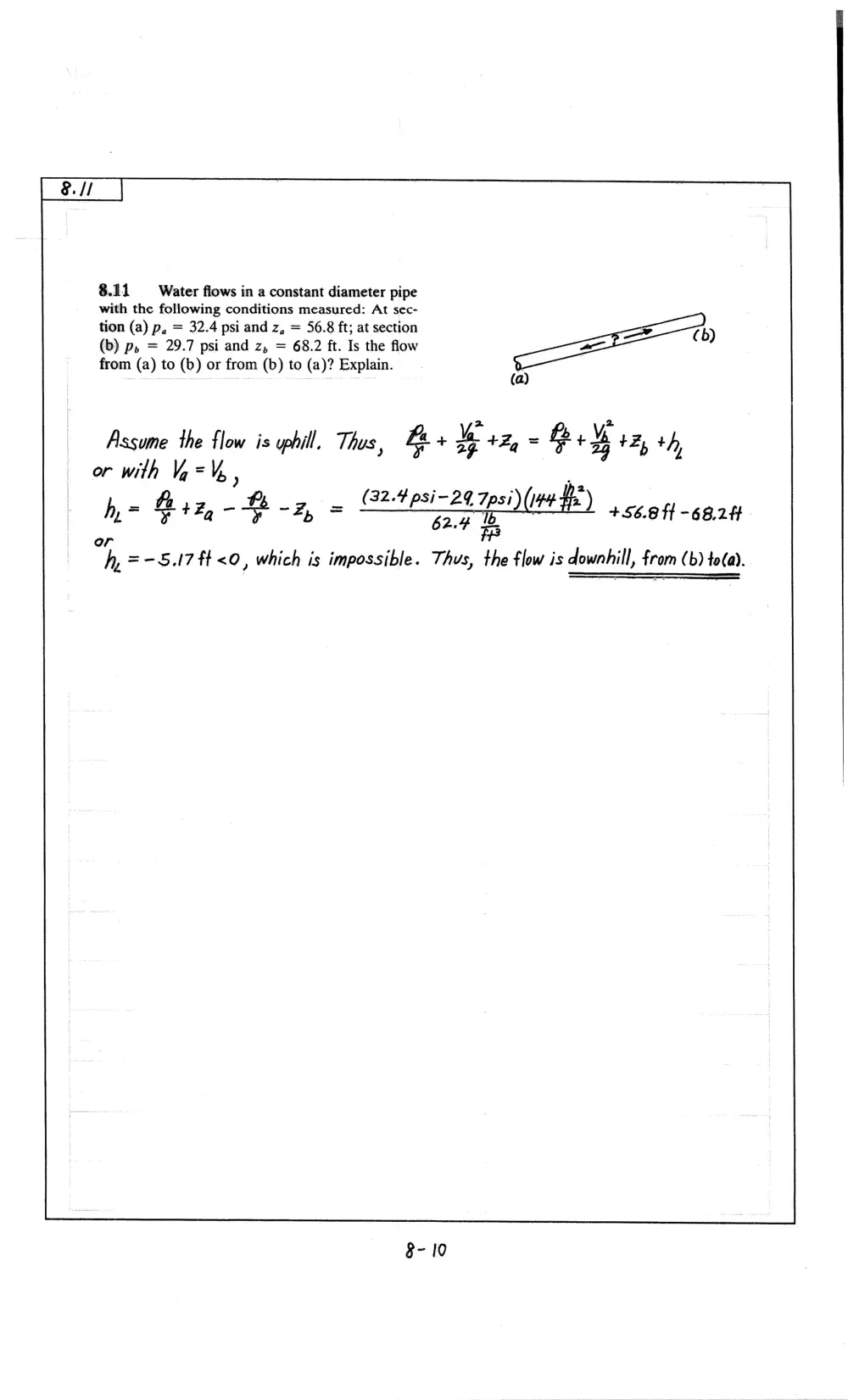
8/1
8.11 Water flows in a constant diameter pipe
with the following conditions measured: At sec-
tion (a) p, = 32.4 psi and z, = 56.8 ft; at section = (b)
(b) p, = 29.7 psi and z, = 68.2 ft. Is the flow
from (a) to (b) or from (b) to (a)? Explain. -
(a)
Assume the flow is ophill, Thos, a Me +Z, = Bit +Z, th
or with Va= Ve ,
32.4 psi- is
h,= & +z, -& “4 = f pai-24 7psi) 14 ) +56.8 ft -68.24
8
*h, =-5,17 11 <0, which is impossible. Thus, the flow is downhill, from (b) to(a).
—EEEEe———————
8-10