
MEN 321 Problems For Chapter 9 with Solution, Fall 2009
Notre Dame University–Louaize · Fluid Mechanics II · 101 pages · with solution




Showing the first 10 of 101 pages. Download the PDF to see all of it.
More MEN 321 files
- Problems For Chapter 11 with Solution · Fall 2009Chapter · with solutionView
- Problems For Chapter 12 with Solution · Fall 2009Chapter · with solutionView
- Problems For Chapter 4 with Solution · Fall 2009Chapter · with solutionView
- Problems For Chapter 6 with Solution · Fall 2009Chapter · with solutionView
- Problems For Chapter 8 with Solution · Fall 2009Chapter · with solutionView
- Exam 1 · Fall 2015ExamView
Show the text of this chapter
“9.3 The pressure distribution on the 1-m-diameter circular
disk in Fig. P9.3 is given in the table.
the disk.
Determine the drag on
D
reo
Pp = —5 kN/m2
FIGURE P9.3
D=(pdh-(pdh=( pletrdr) —p, £0? since df) =20rdr
! 2 r=o
Thus,
05m
D=20( pr dr — (~544)2 (in?) =20{ pr dr + 3.93 kN
°
(7)
where pp~ i rem
Evaluate the integral numerically ysing the following integrand:
rym £0 ._kN/m r(m) p (kN/m?)
0 4.34
0 0 0.05 4.28
0.05 0.2/4 ; ;
0.10 4.06
0.10 0.406 3.72
0.15 .
0.15 0.$58 0.20 3.10
0.20 0.620 0.25 2.78
0.25 0.695 0.30 2.37
0,30 0.7/1 0.35 1.89
0.35 0.662. 0.40 1.41
0.40 0. S64 0.45 0.74
O48 0-333 0.50 0.0
0.50 0.000 =
Using a standard numerical integration technique with the abwe
integrand gives oF = 5.43 kV
9-3
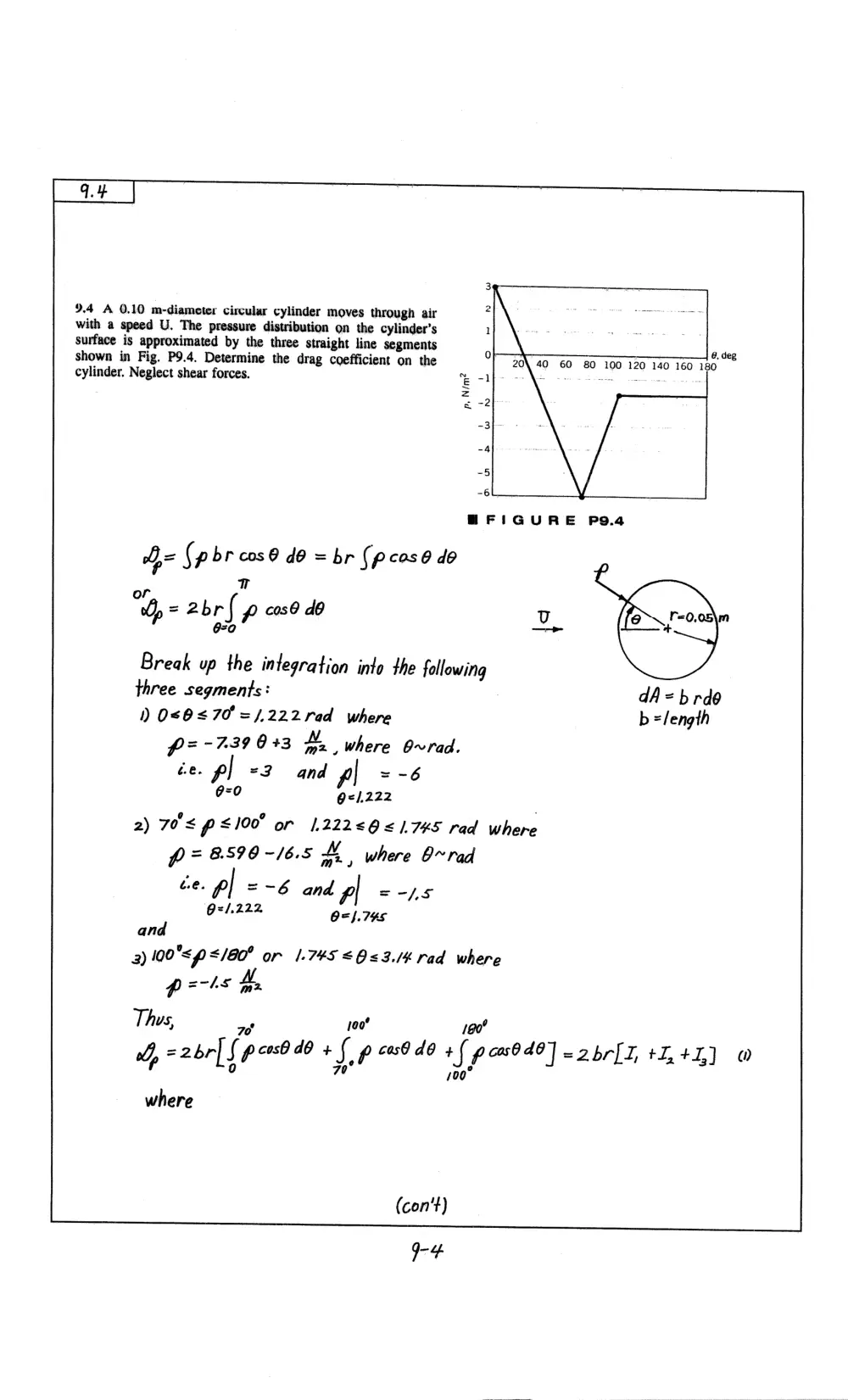
9.4 A 0.10 m-diameter circular cylinder moves through air
with a speed U. The pressure distribution on the cylinder’s 1
surface is approximated by the three straight line segments
shown in Fig, P9.4. Determine the drag coefficient on the
cylinder. Neglect shear forces.
20\ 40 60 80 100 120 140 160 180
HFIGURE P9.4
b= (pbr cose de = br (pcose do
TT
or
ef
Break up the integration into the following
three segments:
D) 0<0¢70=/,222rad where
p= -7390+3 where o~rad.
ée. pl =2 and pl =-6
6=0
@=/.222
2) 70°< p<l00’ or 1,222<6<1.7%5 rad where
f) = 8.590 -16.5 M where O~rad
te. pl =-6 and pI =-/5
@, deg
O=/.222 O=|.745
and
3) 100°<p </80° or 1.745 <0=3./%4 rad where
P =-1s Mw,
Thus, - joo? 190°
Lh = 2br| S pcvs0 de +p cas6 do +{ pcs do) =2br[ I, +L+L]
ty) 70 100°
where
(con't)
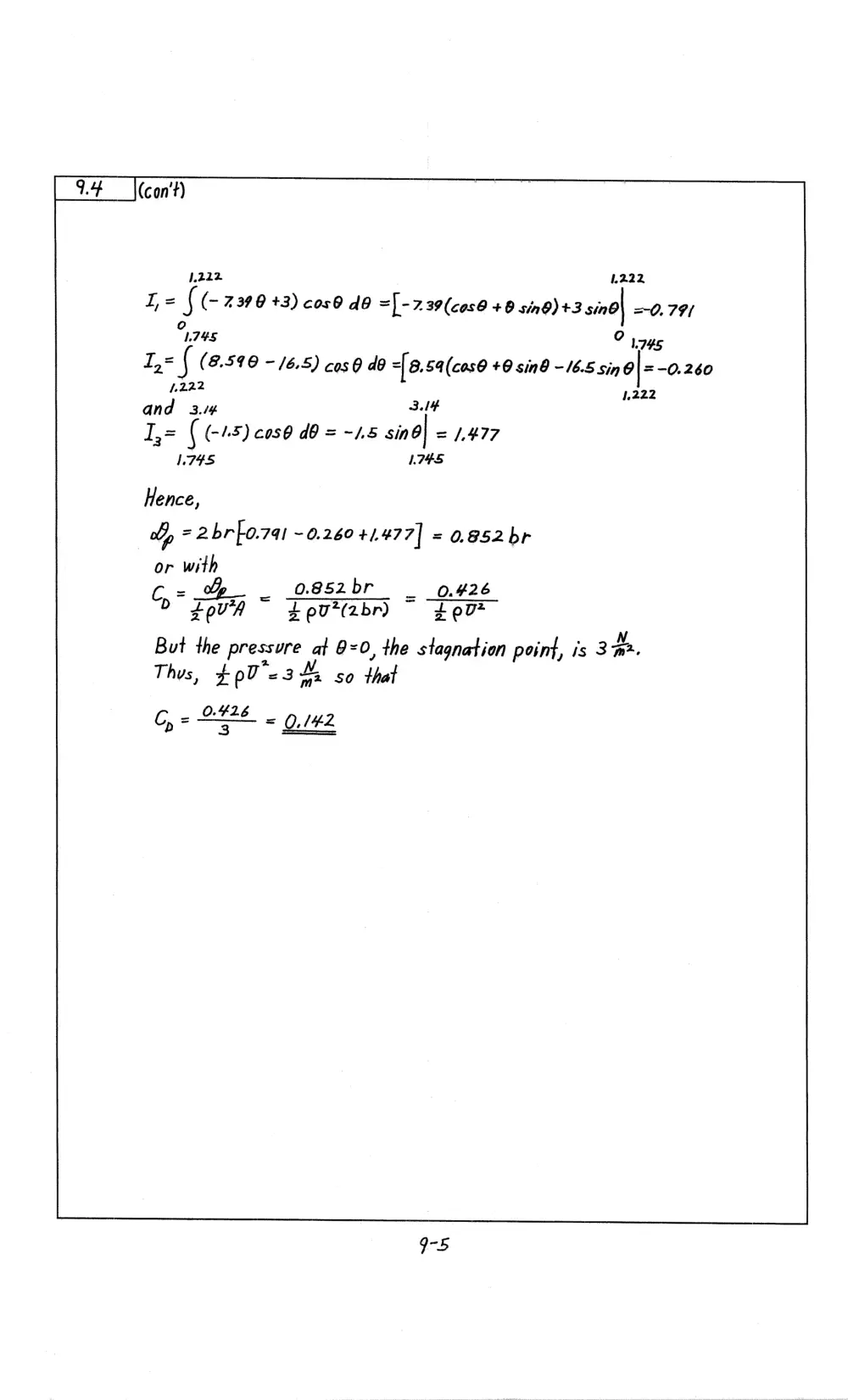
9.4 M(con't)
Via 12.22
= §(- 730 +3) caso dé =[-7.39(cas6 +8 sind)+3 sind| 0.791
174s © ious
1,={ (8.596 - /6.5) cos@ do =[8.54(coso +0 sin8 ~165 sin9| =-0.260
a 4,222
and 3.1% 3.14
I,= (15) c0s@ dO) = -/,5 sin9| = /,477
1745S L7ES
Hence,
oly = 2brfo.7a1 ~0.260 +1477] = 0.852br
or with
C= Lp - 0.852br _ 0,426
> Zev" ~ Feuvr(zbr) ~ For
But the pressure at @=0, the stagnation point, is 3 me.
Thus, ¢pU'<3 H. so that
_ 0426
G, = 3
= OS42Z
9.5 |
9.5 Repeat Problem 9.1 if the object is a cone made by rotating
the triangle A~B-C about the horizontal axis A—C rather than
the wedge-shaped bar.
3 2
= 40U7AC, where G,=0.5 and Az (0.3c) = 0.097 c* «)
Also
b= “Lpyq A + { Pac sin6 dA where dA=21rdx =2m (Xx sin®) dx
ence, X= 0.36/5/90
od = ~(-0.2) £0U" (0.097 c2) +{ Pac sino |2™(x sind)dx | @
x20
or with fy,= average pressure = constant Ey (2) becomes
Lf = (0.2) PU (0.097 c2) t Por sin @ can) { x dx
Xoo
= (0.2) 2 pV (0.092c*) + fp, sin?O (217) (0.36/sin6) /2
or
i =[(o2z pu'+ sc ](0.09 7c?) (3)
By combining Eqs. ()) and (2) we obtain
£ eV" (0.097?) (0.5) =[(o24 eU* + fg ] (0.09 Tc)
which gives
Pac = (0.3) zeU*
9.1
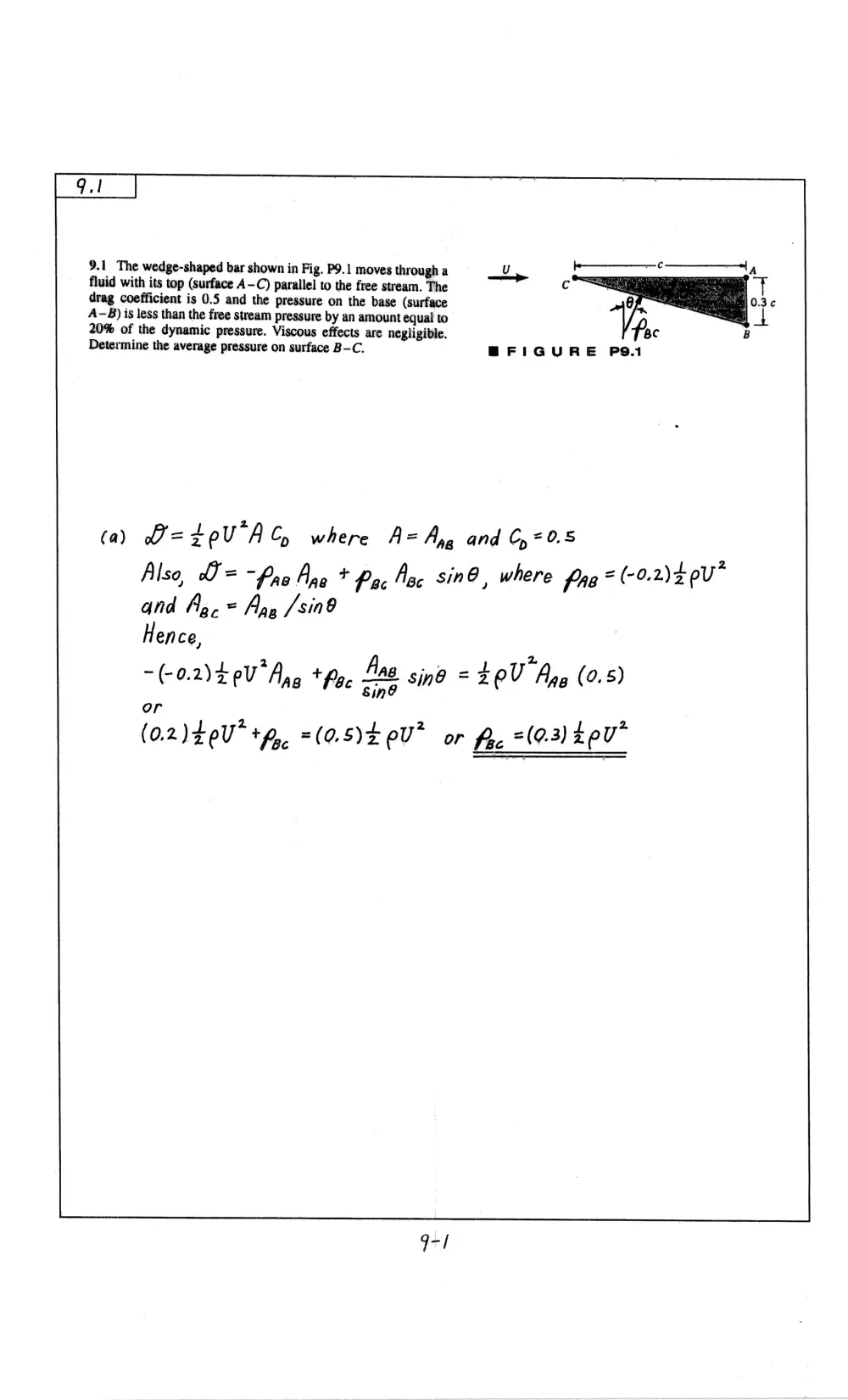
9.1 The wedge-shaped bar shown in Fig. P9.1 moves through a U
fluid with its top (surface A-C) parallel to the free stream. The
drag coefficient is 0.5 and the pressure on the base (surface
A~B) is less than the free stream pressure by an amount equal to
20% of the dynamic pressure. Viscous effects are negligible.
Determine the average pressure on surface B—C. BFIGURE P9.1
Also, = “fae Abe t Pac Ag, sin@, where frre = (-0.2)% U~
and Abe = Ang /sin9
Hence,
2
-(-0.2)4 0U "Aya + Poe fag sind = zeU Age (0.5)
or
(0.2)40U*+p,, =(0.5)£0U* or fe, =(0.3) 400"
9.2.
Pave = —1.2 kN/m?
. Tave = 5.8 x 10⁻² kN/m2
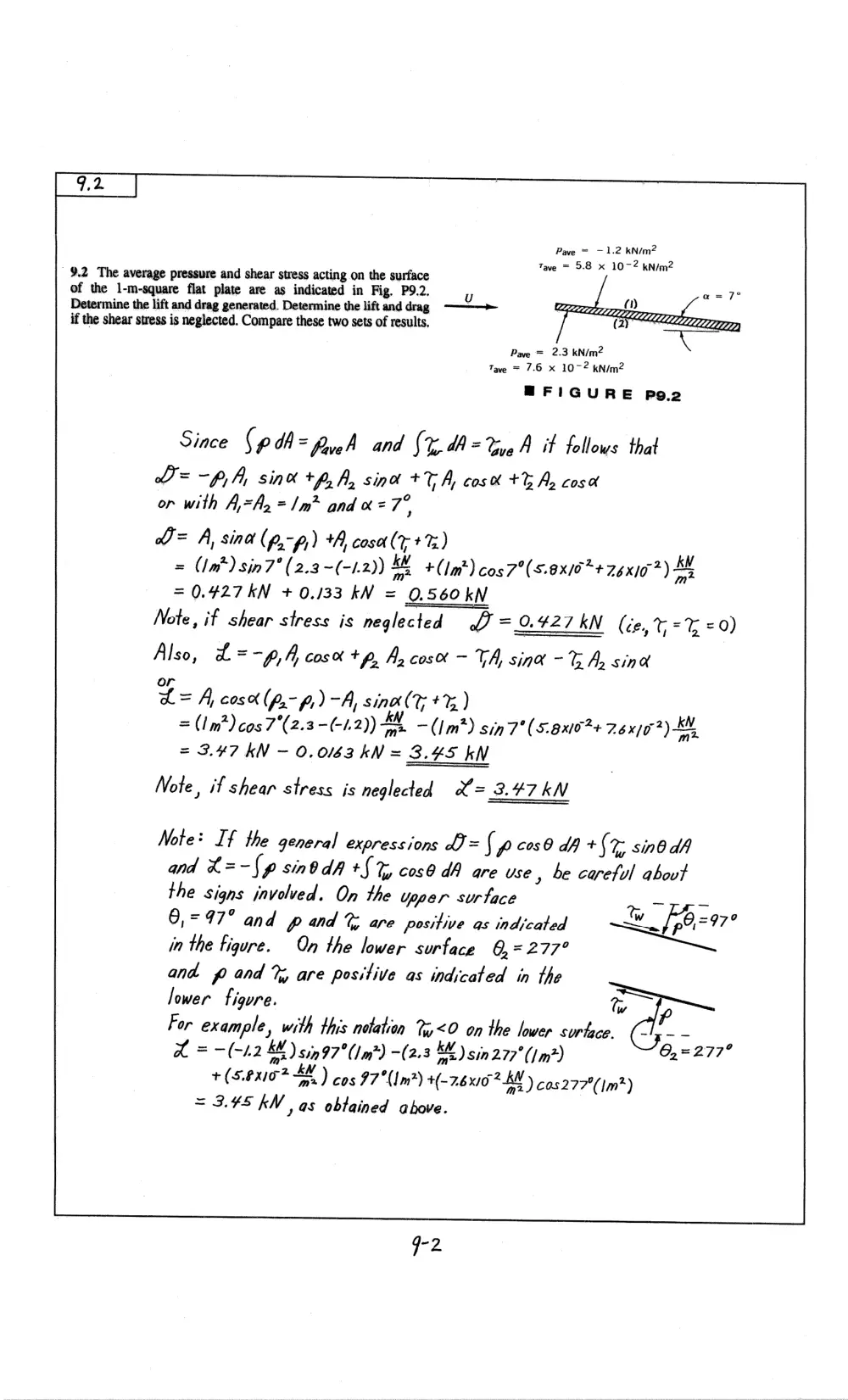
9.2 The average pressure and shear stress acting on the surface
of the 1-m-square flat plate are as indicated in Fig. P9.2. u a=7°
Determine the lift and drag generated, Determine the lift and drag_§ ———> Oo)
if the shear stress is neglected. Compare these two sets of results, (2
Paye = 2.3 KN/m2
Tave = 7.6 x 10⁻² kNém2
BFIGURE P9.2
Since Sp dA= Pye and (%.dA=%yg A if follows that
= -PA, sink +p, A, sinh +T A, cosk +& Ay cosd
or with 4,=Az =/m* and « = 7°
L= A, sind (p,-p) 14, cosale+%)
= (Im) sin?” (2.3 ~(-1.2)) 44 +(Im*) cos7°(s.9x10* + 26x10 7) AM
= 0.427kN + 0./33 kN = 0.560 kN
Note, if shear stress is neglected 7 = 0.427 kN (ce, 7 =% =)
Also, £L= -p,4, Cosx +p, Az cos — TA, sing - Te Ay sind
or
L= A, cosx (p,- p,)-A, sinx(T +%)
= (Im?) cos7°"(2.3 --1.2)) £4 —(Im®) sin 7°(5.8x10²+ 7.6 xj?) 4M
= 3.47 kN - 0.013 kN = 3.45 kN
Note , 'f shear stress is neglected X= 3.47kN
Mote: If the general expressions d) = if f 6080 dh +(% sin@ dA
and X=~-\p sinddA +f % cos@ dA are use, be careful abovt
the signs involved. On the yooer surtace
6,=97° and and % are positive as indicated ee ce
in the figure. On the lower surface 0,= 277°
and p and %, are positive as indicated in the
lower figure. lo ip
For example, with this notation 2% <0 on the lower surtece. (li - -
X= —(-1.2 1h) 51 97°(1m*) -(2.3 4) sin 277° (1m?) O,=277°
+ (5.0x10⁷ 4K ) 295 97°(1m?) +(-7.6x10 24M ) £95277?)
= 3Y¥S5 kV, as obtained above.
9.6 |
9.6 A 5-ft-long porpoise swims with a speed
of 30 ft/s. Would a boundary layer type flow be
developed along the sides of the animal? Explain.
Re= or with L= SH, U= 308, and v= L2xloSE
(i.e, 60°F water)
Re= isi gen = /,24x/0" This Reynolds number is Jarge
enough _to ensure boundary layer
flow. (Re */000 is often assumed
to be the lower limit.)
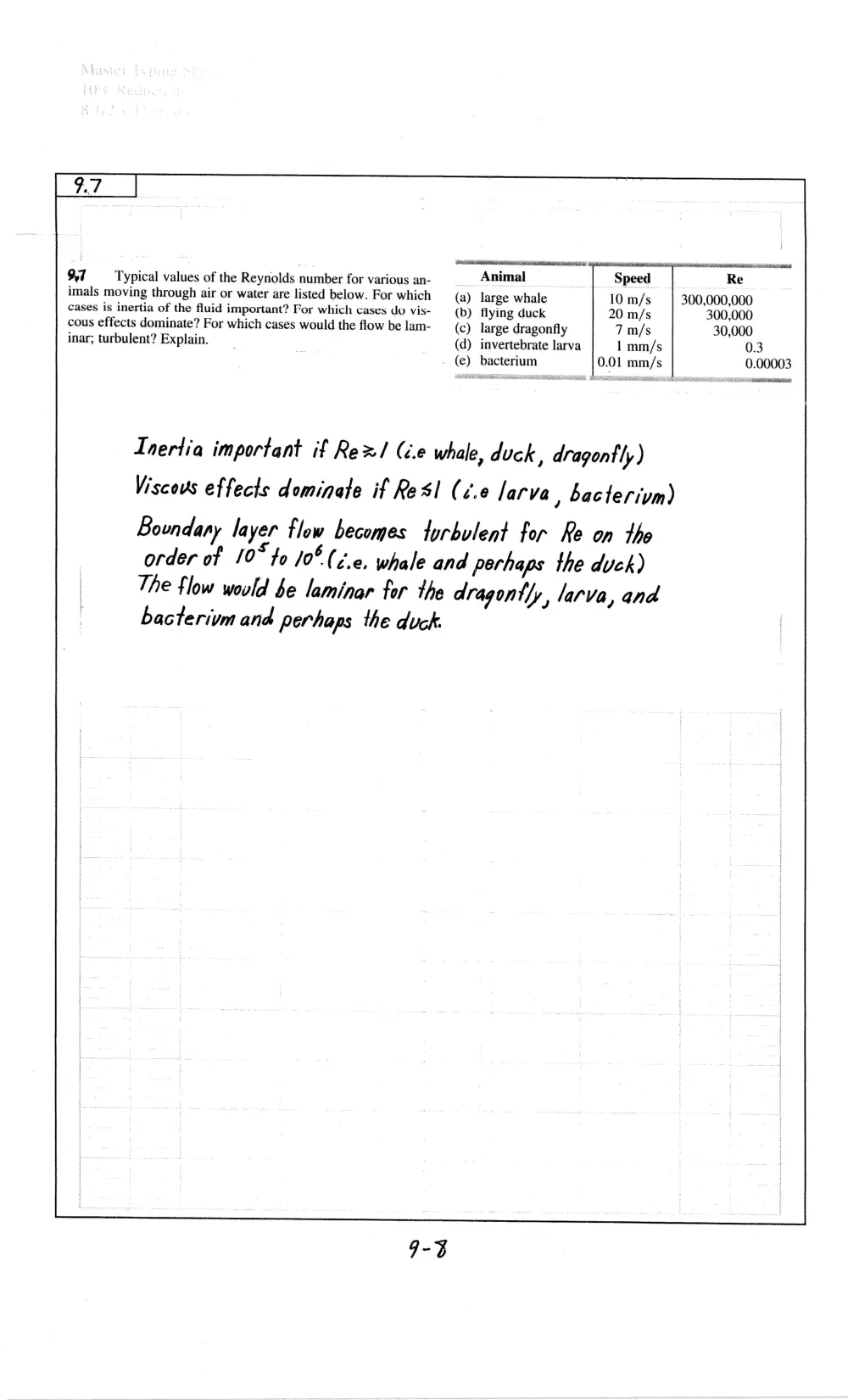
[9.7
X7
Typical values of the Reynolds number for various an-
imals moving through air or water are listed below. For which
cases is inertia of the fluid important? For which cases do vis-
cous effects dominate? For which cases would the flow be lam-
inar; turbulent? Explain.
- (e)
rccisiosioAd cin
(a)
(b)
(c)
(d)
Wi dN CN
Animal Re
large whale 300,000,000
flying duck 300,000
large dragonfly 30,000
invertebrate larva 0.3
0.00003
bacterium
(imams
Inertia important if Rex/ (c.e whale, duck, dragonfly)
Viscous effects dominate if Res! (¢.¢ larva, bacterivm)
Boundary layer flow becomes turbulent for Re on the
order of 10° to 105 (¢.e, whale and perhaps the duck)
The flow would be laminar for the dragontly, larva, and
bacterivm and perhaps the duck.
7-3
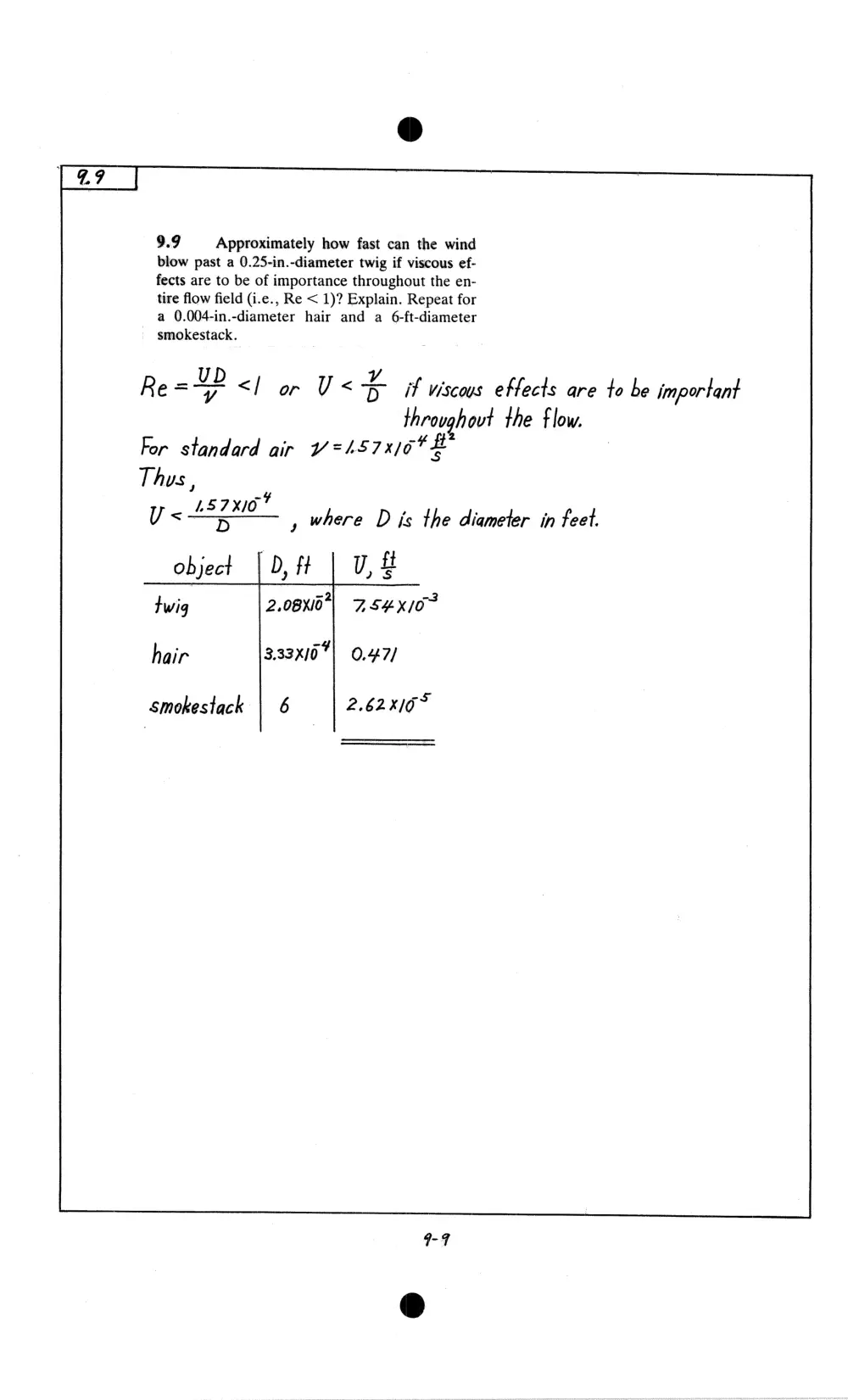
L.9
9.9 Approximately how fast can the wind
blow past a 0.25-in.-diameter twig if viscous ef-
fects are to be of importance throughout the en-
tire flow field (i.e., Re < 1)? Explain. Repeat for
a 0.004-in.-diameter hair and a 6-ft-diameter
smokestack.
Re=2 <) or U<& if viscms effects are to be important
throughout the flow.
For standard air V=4LS7x16 *£°
Thos,
~¥
57X10
V <Be , where D is the diameter in feet.
object |D, ft | U, ft
:
twig 2,08XI0"| 7 S4¥x/07
hair 3.33x/0"| 0.47/
smokestack | 6 2.62K/0>
1-9
9.10 A viscous fluid flows past a flat plate such
that the boundary layer thickness at a distance
1.3 m from the leading edge is 12 mm. Determine
the boundary layer thickness at distances of 0.20,
2.0, and 20 m from the leading edge. Assume
laminar flow.
For laminar flow &=CYX , where C is a constant,
Thus,
3
C= oe = PEM _ 0.0105 on $= 0.0105 1X where X~m §~m
Vx" yl.3m ?
x,m | 6,m | b,mm
0.2. 0.90¥70| “470
2.0 0.0/48 148
20.0 0.0470 | 420
—
LAL
9.11 If the upstream velocity of the flow in
Problem 9.10 is U = 1.5 m/s, determine the ki-
nematic viscosity of the fluid.
_ U5 2) (12x10)
—6 m*
=6.65X/0 =
25 (1.3m) 6.65X10