
CIVE 310 Exam 1, Fall 2000
American University of Beirut · Mechanics of Materials · 2 pages · Dr. Mounir Mabsout
More CIVE 310 files
- Exam 1 · Fall 2016ExamView
- Exam 1 All Exam 1 Previouses · Fall 2015ExamView
- Exam 1 Previouses (Zip File) · Fall 2015ExamView
- Exam 3 Previouses Zip File (No Solution) · Fall 2015Exam · with solutionView
- Exam 2 Quiz 2 Previouses Zip File (No Solution) · Fall 2015Exam · with solutionView
- Exam 1 · Spring 2013ExamView
- Exam 1 · Fall 2012ExamView
- Exam 1 · Spring 2011ExamView
Show the text of this exam
CVEV 041_Quiz 1_Fall 2000-2001
M. Mabsout
1
QUIZ 1- November 30, 2000
Fall 2000-2001
CVEV 041 – MECHANICS OF MATERIALS
CLOSED BOOK, 1 ½ HOURS
Name:
ID#:
2 Pages, 2 Problems
Read all questions before you start and manage your time carefully.
Return the question sheet with the answering booklet.
Problem I: (65 points + Take a Break)
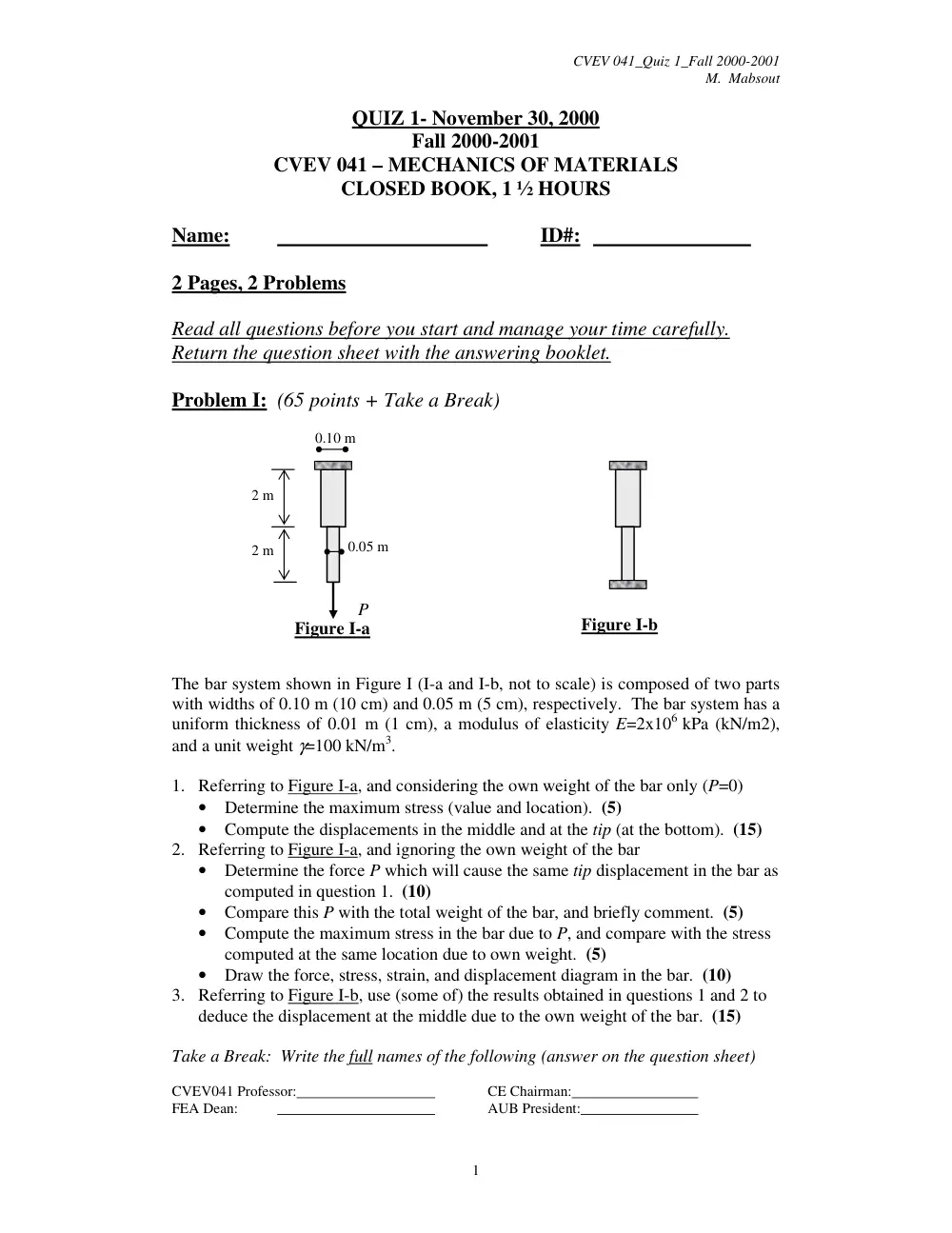
The bar system shown in Figure I (I-a and I-b, not to scale) is composed of two parts
with widths of 0.10 m (10 cm) and 0.05 m (5 cm), respectively. The bar system has a
uniform thickness of 0.01 m (1 cm), a modulus of elasticity E=2x10⁶ kPa (kN/m2),
and a unit weight γ=100 kN/m3.
1. Referring to Figure I-a, and considering the own weight of the bar only (P=0)
• Determine the maximum stress (value and location). (5)
• Compute the displacements in the middle and at the tip (at the bottom). (15)
2. Referring to Figure I-a, and ignoring the own weight of the bar
• Determine the force P which will cause the same tip displacement in the bar as
computed in question 1. (10)
• Compare this P with the total weight of the bar, and briefly comment. (5)
• Compute the maximum stress in the bar due to P, and compare with the stress
computed at the same location due to own weight. (5)
• Draw the force, stress, strain, and displacement diagram in the bar. (10)
3. Referring to Figure I-b, use (some of) the results obtained in questions 1 and 2 to
deduce the displacement at the middle due to the own weight of the bar. (15)
Take a Break: Write the full names of the following (answer on the question sheet)
CVEV041 Professor:
CE Chairman:
FEA Dean:
AUB President:
Figure I-a
0.05 m
0.10 m
2 m
2 m
P
Figure I-b
CVEV 041_Quiz 1_Fall 2000-2001
M. Mabsout
2
Problem II: (35 points + Bonus)
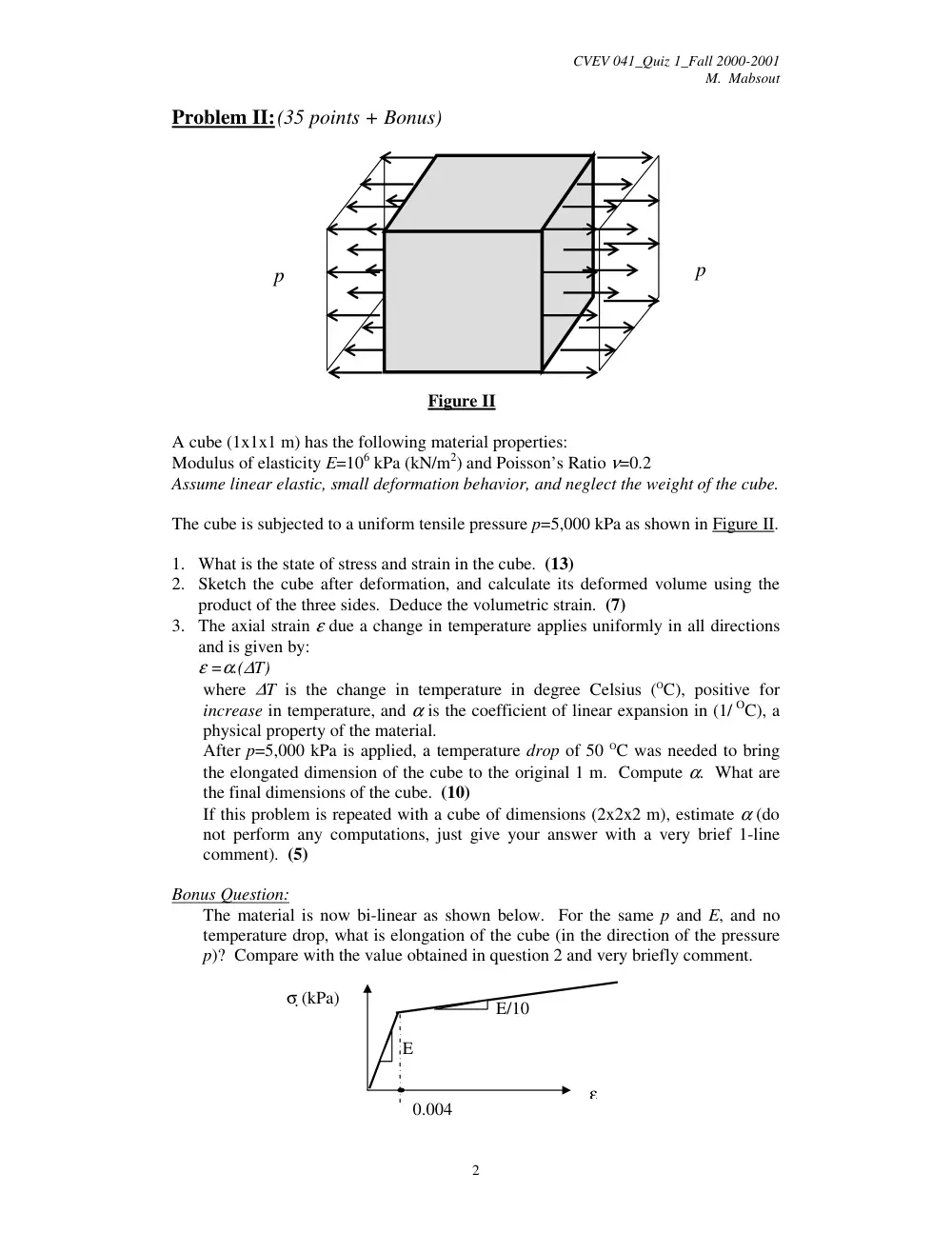
A cube (1x1x1 m) has the following material properties:
Modulus of elasticity E=106 kPa (kN/m2) and Poisson’s Ratio ν=0.2
Assume linear elastic, small deformation behavior, and neglect the weight of the cube.
The cube is subjected to a uniform tensile pressure p=5,000 kPa as shown in Figure II.
1. What is the state of stress and strain in the cube. (13)
2. Sketch the cube after deformation, and calculate its deformed volume using the
product of the three sides. Deduce the volumetric strain. (7)
3. The axial strain ε due a change in temperature applies uniformly in all directions
and is given by:
ε =α.(∆T)
where ∆T is the change in temperature in degree Celsius (OC), positive for
increase in temperature, and α is the coefficient of linear expansion in (1/ OC), a
physical property of the material.
After p=5,000 kPa is applied, a temperature drop of 50 OC was needed to bring
the elongated dimension of the cube to the original 1 m. Compute α. What are
the final dimensions of the cube. (10)
If this problem is repeated with a cube of dimensions (2x2x2 m), estimate α (do
not perform any computations, just give your answer with a very brief 1-line
comment). (5)
Bonus Question:
The material is now bi-linear as shown below. For the same p and E, and no
temperature drop, what is elongation of the cube (in the direction of the pressure
p)? Compare with the value obtained in question 2 and very briefly comment.
p
p
Figure II
E
E/10
0.004
σ �(kPa)
ε