
EDUC 215 Final, Spring 2008
American University of Beirut · Learning and Human Development · 2 pages
More EDUC 215 files
Show the text of this final exam
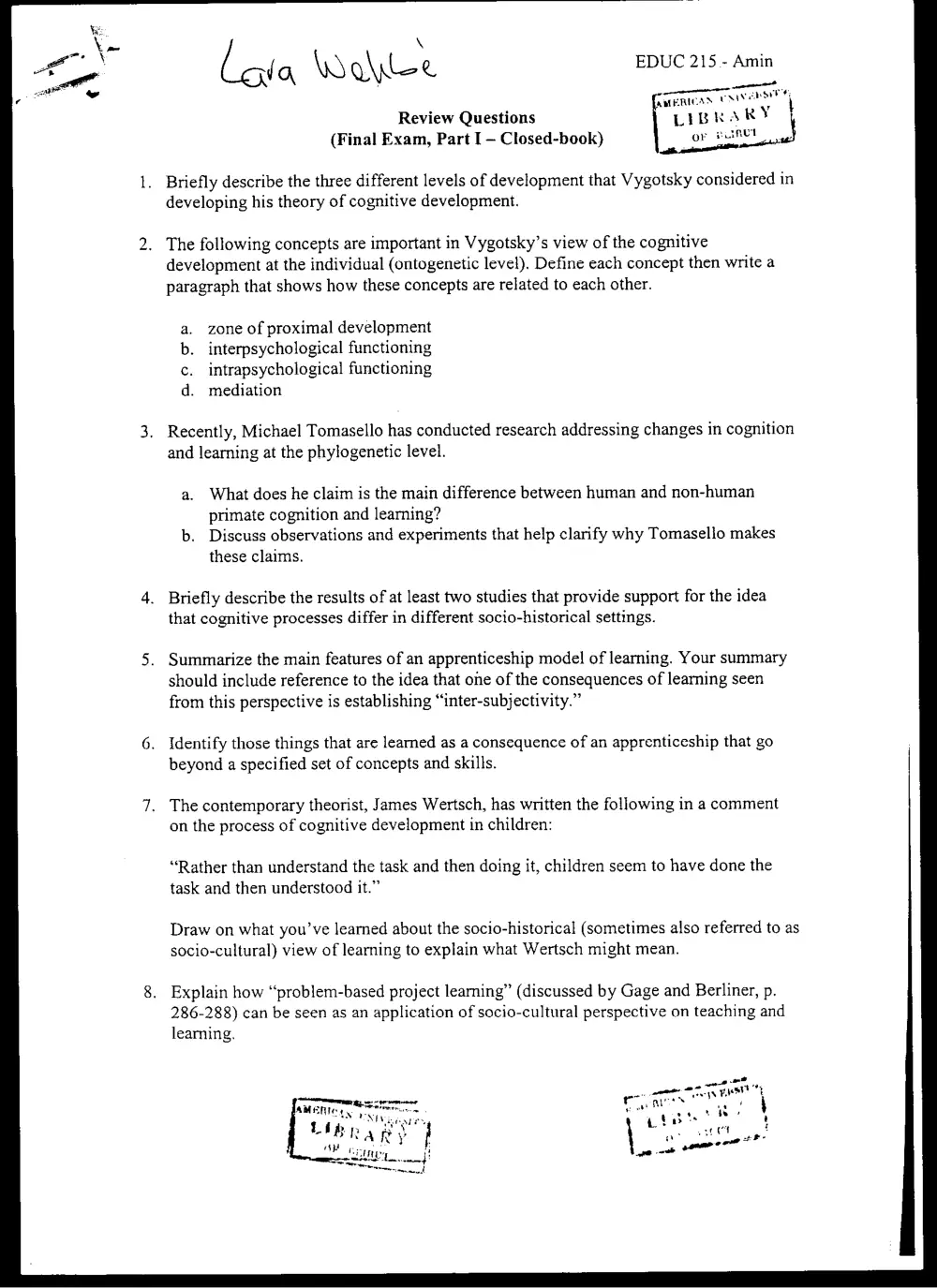
bad a W g\lee EDUC 215 - Amin
VE gee’
—o
AMERICAS UNS
Review Questions LIBRARY |
(Final Exam, Part I — Closed-book) or BLIRCT eed
Briefly describe the three different levels of development that Vygotsky considered in
developing his theory of cognitive development.
The following concepts are important in Vygotsky’s view of the cognitive
development at the individual (ontogenetic level). Define each concept then write a
paragraph that shows how these concepts are related to each other.
zone of proximal development
interpsychological functioning
intrapsychological functioning
mediation
Recently, Michael Tomasello has conducted research addressing changes in cognition
and learning at the phylogenetic level.
What does he claim is the main difference between human and non-human
primate cognition and learning?
Discuss observations and experiments that help clarify why Tomasello makes
these claims.
Briefly describe the results of at least two studies that provide support for the idea
that cognitive processes differ in different socio-historical settings.
Summarize the main features of an apprenticeship model of learning. Your summary
should include reference to the idea that one of the consequences of learning seen
from this perspective is establishing “inter-subjectivity.”
Identify those things that are learned as a consequence of an apprenticeship that go
beyond a specified set of concepts and skills.
The contemporary theorist, James Wertsch, has written the following in a comment
on the process of cognitive development in children:
“Rather than understand the task and then doing it, children seem to have done the
task and then understood it.”
Draw on what you’ve leamed about the socio-historical (sometimes also referred to as
socio-cultural) view of learning to explain what Wertsch might mean.
Explain how “problem-based project learning” (discussed by Gage and Berliner, p.
286-288) can be seen as an application of socio-cultural perspective on teaching and
learning.
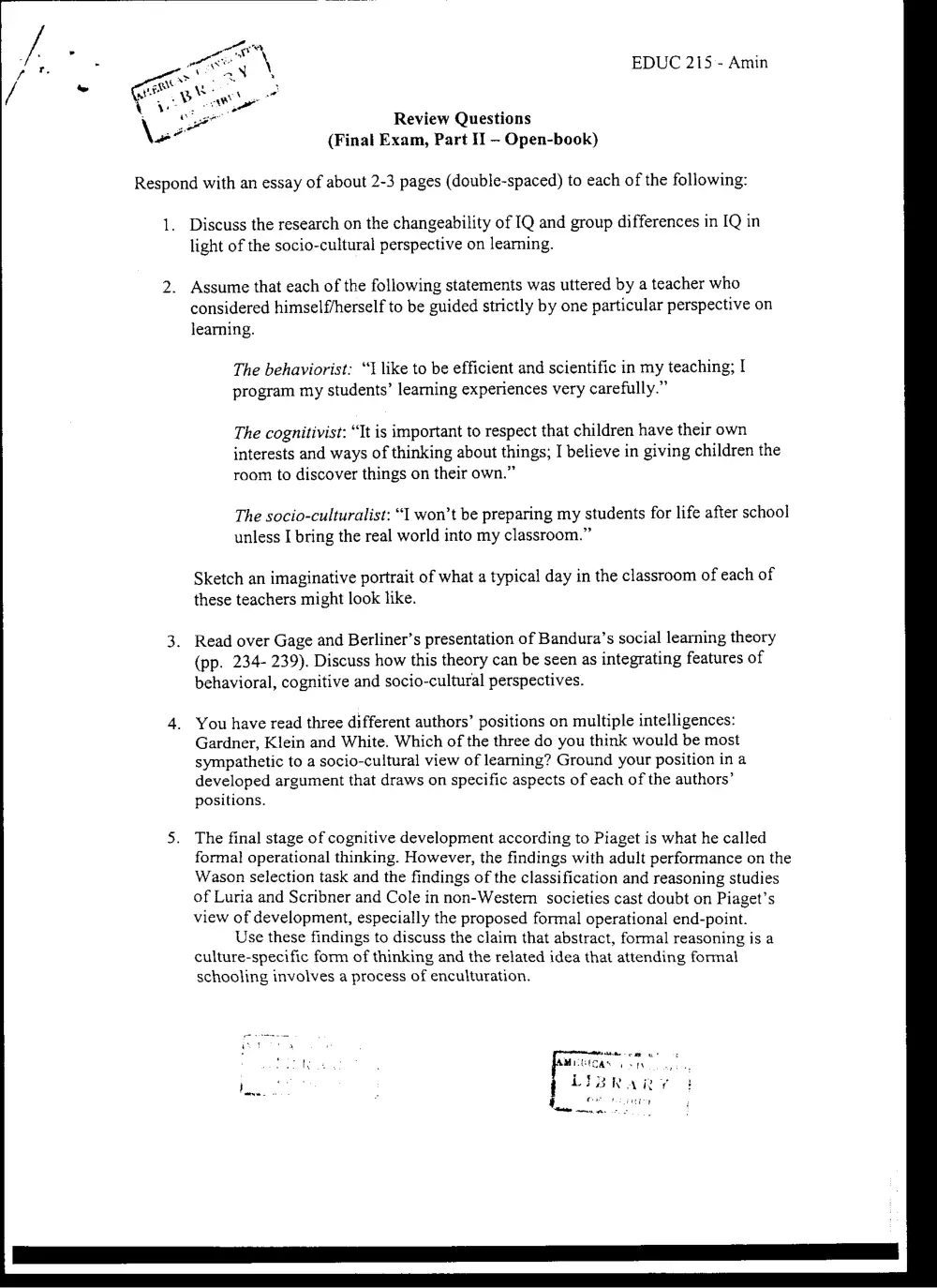
EDUC 215 - Amin
Review Questions
(Final Exam, Part IY - Open-book)
Respond with an essay of about 2-3 pages (double-spaced) to each of the following:
1. Discuss the research on the changeability of IQ and group differences in IQ in
light of the socio-cultural perspective on learning.
2. Assume that each of the following statements was uttered by a teacher who
considered himself/herself to be guided strictly by one particular perspective on
learning.
The behaviorist: “I like to be efficient and scientific in my teaching; I
program my students’ learning experiences very carefully.”
The cognitivist: “It is important to respect that children have their own
interests and ways of thinking about things; I believe in giving children the
room to discover things on their own.”
The socio-culturalist: “I won’t be preparing my students for life after school
unless I bring the real world into my classroom.”
Sketch an imaginative portrait of what a typical day in the classroom of each of
these teachers might look like.
3. Read over Gage and Berliner’s presentation of Bandura’s social learning theory
(pp. 234- 239). Discuss how this theory can be seen as integrating features of
behavioral, cognitive and socio-cultural perspectives.
4. You have read three different authors’ positions on multiple intelligences:
Gardner, Klein and White. Which of the three do you think would be most
sympathetic to a socio-cultural view of learning? Ground your position in a
developed argument that draws on specific aspects of each of the authors’
positions.
5. The final stage of cognitive development according to Piaget is what he called
formal operational thinking. However, the findings with adult performance on the
Wason selection task and the findings of the classification and reasoning studies
of Luria and Scribner and Cole in non-Westem societies cast doubt on Piaget’s
view of development, especially the proposed formal operational end-point.
Use these findings to discuss the claim that abstract, formal reasoning is a
culture-specific form of thinking and the related idea that attending formal
schooling involves a process of enculturation.