
EDUC 215 Chapter 1, Fall 2012
American University of Beirut · Learning and Human Development · 27 pages
Showing the first 10 of 27 pages. Download the PDF to see all of it.
More EDUC 215 files
Show the text of this chapter
1
1
2
3
C H A P T E R 1
EDUCATIONAL
PSYCHOLOGY:
A TOOL FOR
EFFECTIVE TEACHING
I touch the future. I teach.
— Christa McAuliff e
American Educator and Astronaut, 20th Century
Chapter Outline
Exploring Educational Psychology
Historical Background
Teaching: Art and Science
Effective Teaching
Professional Knowledge and Skills
Commitment, Motivation, and Caring
Research in Educational Psychology
Why Research Is Important
Research Methods
Program Evaluation Research, Action Research, and the
Teacher-as-Researcher
Quantitative and Qualitative Research
Learning Goals
Describe some basic ideas about the
field of educational psychology.
Identify the attitudes and skills of an
effective teacher.
Discuss why research is important to
effective teaching, and how educational
psychologists and teachers can conduct
and evaluate research.
2
Effective teachers know that principles of educational psychology
and educational research will help them guide students’ learning.
Margaret Metzger has been an English teacher at Brookline High
School in Massachusetts for more than 25 years. Here is some
advice she gave to a student teacher she was supervising that in-
corporates her understanding of basic principles of educational
psychology, such as the importance of teaching how to learn and
the need to apply educational research to teaching practice:
Emphasize how to learn, rather than what to learn. Students may
never know a particular fact, but they always will need to know
how to learn. Teach students how to read with a genuine com-
prehension, how to shape an idea, how to master diffi cult mate-
rial, how to use writing to clarify thinking. A former student,
Anastasia Korniaris, wrote to me, “Your class was like a hardware
store. All the tools were there. Years later I’m still using that hard-
ware store that’s in my head. . . .”
Include students in the process of teaching and learning. Every
day ask such basic questions as, “What did you think of this
homework? Did it help you learn the material? Was the assign-
ment too long or too short? How can we make the next assign-
ment more interesting? What should the criteria for assessment
be?” Remember that we want students to take ownership of their
learning. . . .
Useful research has been conducted lately on learning styles
and frames of intelligence. Read that research. The basic idea to
keep in mind is that students should think for themselves. Your job
is to teach them how to think and to give them the necessary tools.
Your students will be endlessly amazed at how intelligent they
are. You don’t need to show them how intelligent you are. . . .
In the early years of teaching you must expect to put in hours
and hours of time. You would invest similarly long hours if you
were an intern in medical school or an associate in a law fi rm.
Like other professionals, teachers work much longer hours than
outsiders know. . . .
You have the potential to be an excellent teacher. My only
concern is that you not exhaust yourself before you begin.
Naturally, you will want to work very hard as you learn the craft.
(Source: Metzger, 1996, pp. 346–351.)
Teaching Stories
Margaret Metzger
Preview
In the quotation that opens this chapter, twentieth-century teacher and astronaut Christa
McAuliffe commented that when she taught, she touched the future. As a teacher, you
will touch the future, because children are the future of any society. In this chapter,
we explore what the fi eld of educational psychology is all about and how it can help
you contribute positively to children’s futures.
Historical Background
EXPLORING EDUCATIONAL PSYCHOLOGY
Teaching: Art and Science
1
Psychology is the scientifi c study of behavior and mental processes. Educational
psychology is the branch of psychology that specializes in understanding teaching
and learning in educational settings. Educational psychology is a vast landscape that
will take us an entire book to describe.
HISTORICAL BACKGROUND
Th e fi eld of educational psychology was founded by several pioneers in psychology
in the late nineteenth century. Th ree pioneers—William James, John Dewey, and
E. L. Th orndike—stand out in the early history of educational psychology.
William James Soon aft er launching the fi rst psychology textbook, Principles of
Psychology (1890), William James (1842–1910) gave a series of lectures called “Talks
to Teachers” (James, 1899/1993) in which he discussed the applications of psychology
to educating children. James argued that laboratory psychology experiments oft en
can’t tell us how to eff ectively teach children. He emphasized the importance of
observing teaching and learning in classrooms for improving education. One of his
educational psychology The branch of psychol-
ogy that specializes in understanding teaching and
learning in educational settings.
www.mhhe.com/santrockep5e
Exploring Educational Psychology
3
recommendations was to start lessons at a point just beyond the child’s level of
knowledge and understanding to stretch the child’s mind.
John Dewey A second major fi gure in shaping the fi eld of educational psychology
was John Dewey (1859–1952), who became a driving force in the practical application
of psychology. Dewey established the fi rst major educational psychology laboratory in
the United States, at the University of Chicago in 1894. Later, at Columbia University,
he continued his innovative work. We owe many important ideas to John Dewey. First,
we owe to him the view of the child as an active learner. Before Dewey, it was believed
that children should sit quietly in their seats and passively learn in a rote manner. In
contrast, Dewey (1933) argued that children learn best by doing. Second, we owe to
Dewey the idea that education should focus on the whole child and emphasize the
child’s adaptation to the environment. Dewey reasoned that children should not be
just narrowly educated in academic topics but should learn how to think and adapt
to a world outside school. He especially thought that children should learn how to be
refl ective problem solvers. Th ird, we owe to Dewey the belief that all children deserve
to have a competent education. Th is democratic ideal was not in place at the beginning
of Dewey’s career in the latter part of the nineteenth century, when high-quality edu-
cation was reserved for a small portion of children, especially boys from wealthy
families. Dewey pushed for a competent education for all children—girls and boys, as
well as children from diff erent socioeconomic and ethnic groups.
E. L. Thorndike A third pioneer was E. L. Th orndike (1874–1949), who focused
on assessment and measurement and promoted the scientifi c underpinnings of learn-
ing. Th orndike argued that one of schooling’s most important tasks is to hone chil-
dren’s reasoning skills, and he excelled at doing exacting scientifi c studies of teaching
and learning. Th orndike especially promoted the idea that educational psychology
must have a scientifi c base and should focus strongly on measurement.
Diversity and Early Educational Psychology Th e most prominent fi gures
in the early history of educational psychology, as in most disciplines, were mainly
White males, such as James, Dewey, and Th orndike. Prior to changes in civil rights
laws and policies in the 1960s, only a few dedicated non-White individuals obtained
the necessary degrees and broke through racial exclusion barriers to take up research
in the fi eld (Koppelman & Goodhart, 2011; Spring, 2010).
Two pioneering African American psychologists, Mamie and Kenneth Clark,
conducted research on African American children’s self-conceptions and identity
(Clark & Clark, 1939). In 1971 Kenneth Clark became the fi rst African American
president of the American Psychological Association. In 1932 Latino psychologist
George Sanchez conducted research showing that intelligence tests were culturally
biased against ethnic minority children.
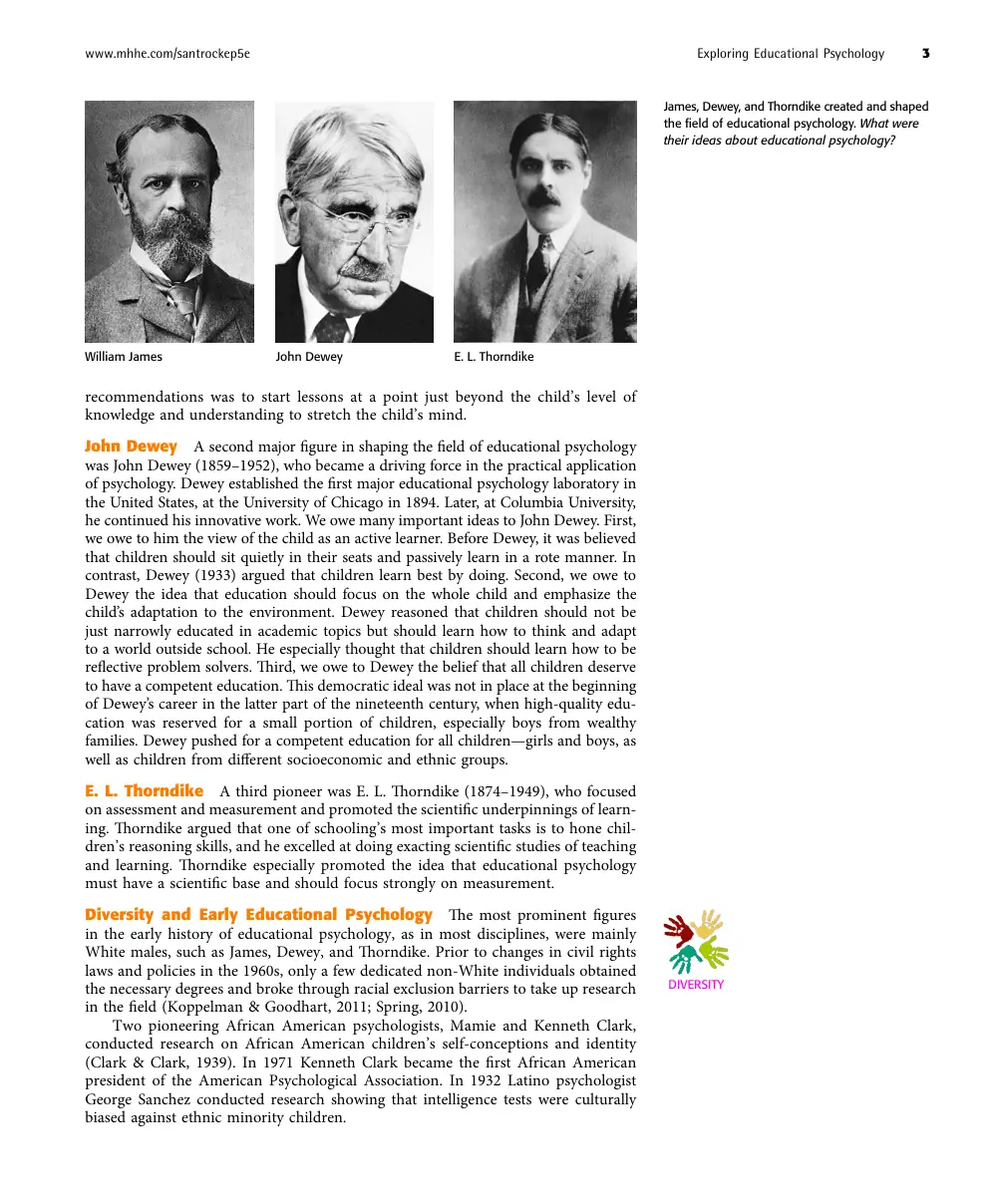
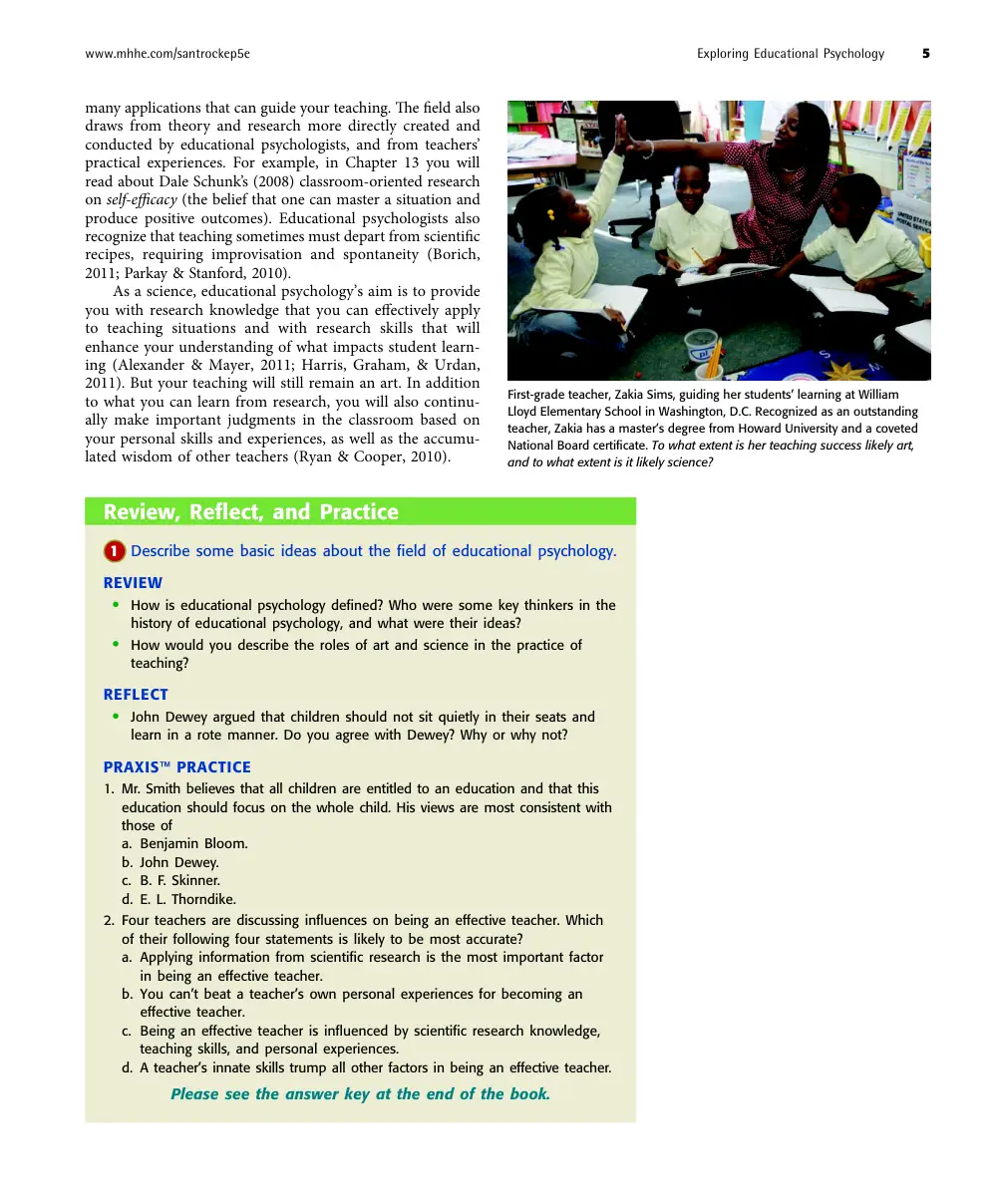
James, Dewey, and Thorndike created and shaped
the field of educational psychology. What were
their ideas about educational psychology?
John Dewey
William James
E. L. Thorndike
DIVERSITY
4
Chapter 1 Educational Psychology: A Tool for Effective Teaching
Like ethnic minorities, women also faced barriers in
higher education and so have only gradually become promi-
nent contributors to psychological research. One oft en over-
looked person in the history of educational psychology is Leta
Hollingworth. She was the fi rst individual to use the term
gift ed to describe children who scored exceptionally high on
intelligence tests (Hollingworth, 1916).
The Behavioral Approach Th orndike’s approach to the
study of learning guided educational psychology through the
fi rst half of the twentieth century. In American psychology,
B. F. Skinner’s (1938) view, which built on Th orndike’s ideas,
strongly infl uenced educational psychology in the middle of the
century. Skinner’s behavioral approach, which is described in
detail in Chapter 7, involved attempts to precisely determine
the best conditions for learning. Skinner argued that the men-
tal processes proposed by psychologists such as James and
Dewey were not observable and therefore could not be appro-
priate subject matter for a scientifi c study of psychology, which
he defi ned as the science of observable behavior and its control-
ling conditions. In the 1950s, Skinner (1954) developed the
concept of programmed learning, which involved reinforcing
the student’s behavior aft er each of a series of steps until the
student reached a learning goal. In an early technological eff ort,
he created a teaching machine to serve as a tutor and reinforce
students’ behavior for correct answers (Skinner, 1958).
The Cognitive Revolution However, the objectives spelled
out in the behavioral approach to learning did not address
many of the actual goals and needs of classroom educators
(Hilgard, 1996). In reaction, as early as the 1950s, Benjamin
Bloom created a taxonomy of cognitive skills that included
remembering, comprehending, synthesizing, and evaluating,
which he suggested teachers should help students develop. Th e cognitive revolution in
psychology began to take hold by the 1980s and ushered in a great deal of enthusiasm
for applying the concepts of cognitive psychology—memory, thinking, reasoning, and
so on—to helping students learn. Th us, toward the latter part of the twentieth century,
many educational psychologists returned to an emphasis on the cognitive aspects of
learning advocated by James and Dewey at the beginning of the century.
Both cognitive and behavioral approaches continue to be a part of educational
psychology today (Anderman & Dawson, 2011; Veenman, 2011). We have much
more to say about these approaches in Chapters 7 through 11.
More recently, educational psychologists have increasingly focused on the socio-
emotional aspects of students’ lives. For example, they are analyzing the school as a
social context and examining the role of culture in education (Campbell, 2010;
Spring, 2010). We explore the socioemotional aspects of teaching and learning in
many chapters of this book.
TEACHING: ART AND SCIENCE
How scientifi c can teachers be in their approach to teaching? Both science and the art
of skillful, experienced practice play important roles in a teacher’s success. Educational
psychology draws much of its knowledge from broader theory and research in psy-
chology (Bonney & Sternberg, 2011; Danielson, 2010). For example, the theories of
Jean Piaget and Lev Vygotsky were not created in an eff ort to inform teachers about
ways to educate children, yet in Chapter 2 you will see that both of these theories have
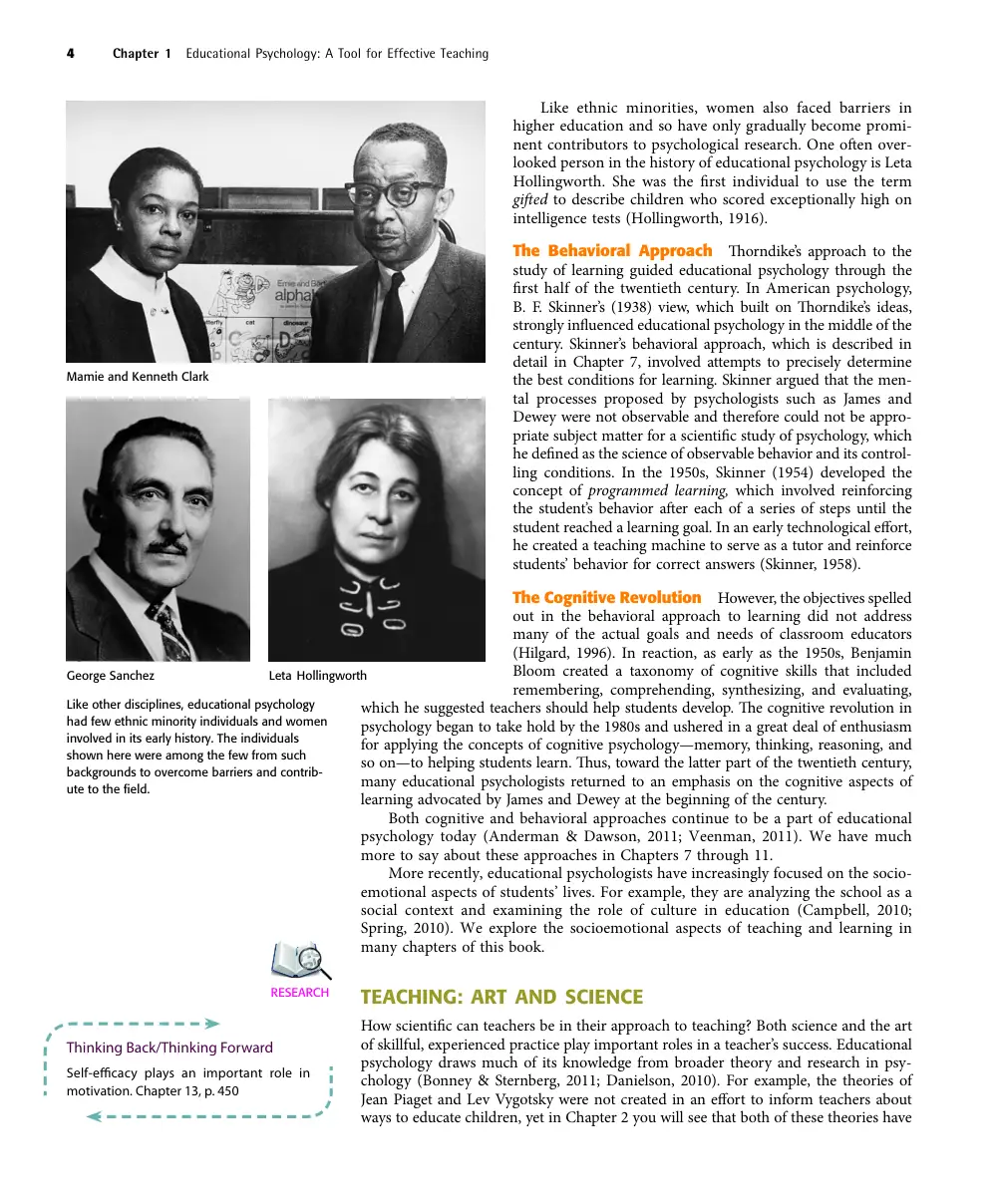
Like other disciplines, educational psychology
had few ethnic minority individuals and women
involved in its early history. The individuals
shown here were among the few from such
backgrounds to overcome barriers and contrib-
ute to the field.
Mamie and Kenneth Clark
Leta Hollingworth
George Sanchez
RESEARCH
Thinking Back/Thinking Forward
Self-effi cacy plays an important role in
motivation. Chapter 13, p. 450
many applications that can guide your teaching. Th e fi eld also
draws from theory and research more directly created and
conducted by educational psychologists, and from teachers’
practical experiences. For example, in Chapter 13 you will
read about Dale Schunk’s (2008) classroom-oriented research
on self-effi cacy (the belief that one can master a situation and
produce positive outcomes). Educational psychologists also
recognize that teaching sometimes must depart from scientifi c
recipes, requiring improvisation and spontaneity (Borich,
2011; Parkay & Stanford, 2010).
As a science, educational psychology’s aim is to provide
you with research knowledge that you can eff ectively apply
to teaching situations and with research skills that will
enhance your understanding of what impacts student learn-
ing (Alexander & Mayer, 2011; Harris, Graham, & Urdan,
2011). But your teaching will still remain an art. In addition
to what you can learn from research, you will also continu-
ally make important judgments in the classroom based on
your personal skills and experiences, as well as the accumu-
lated wisdom of other teachers (Ryan & Cooper, 2010).
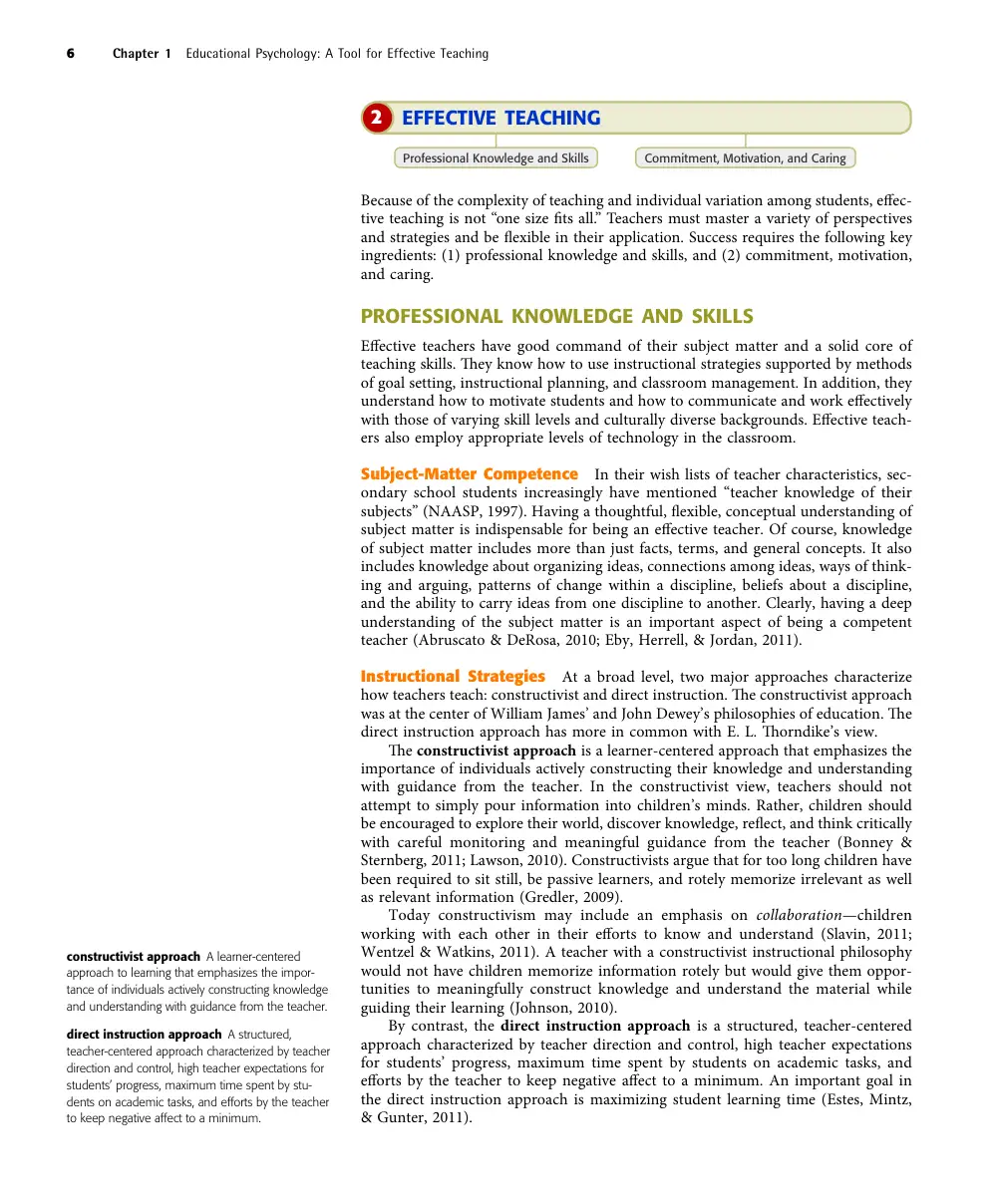
First-grade teacher, Zakia Sims, guiding her students’ learning at William
Lloyd Elementary School in Washington, D.C. Recognized as an outstanding
teacher, Zakia has a master’s degree from Howard University and a coveted
National Board certificate. To what extent is her teaching success likely art,
and to what extent is it likely science?
Review, Reflect, and Practice
Describe some basic ideas about the field of educational psychology.
REVIEW
● How is educational psychology defined? Who were some key thinkers in the
history of educational psychology, and what were their ideas?
● How would you describe the roles of art and science in the practice of
teaching?
REFLECT
● John Dewey argued that children should not sit quietly in their seats and
learn in a rote manner. Do you agree with Dewey? Why or why not?
PRAXIS™ PRACTICE
1. Mr. Smith believes that all children are entitled to an education and that this
education should focus on the whole child. His views are most consistent with
those of
a. Benjamin Bloom.
b. John Dewey.
c. B. F. Skinner.
d. E. L. Thorndike.
2. Four teachers are discussing influences on being an effective teacher. Which
of their following four statements is likely to be most accurate?
a. Applying information from scientific research is the most important factor
in being an effective teacher.
b. You can’t beat a teacher’s own personal experiences for becoming an
effective teacher.
c. Being an effective teacher is influenced by scientific research knowledge,
teaching skills, and personal experiences.
d. A teacher’s innate skills trump all other factors in being an effective teacher.
Please see the answer key at the end of the book.
1
www.mhhe.com/santrockep5e
Exploring Educational Psychology
5
6
Chapter 1 Educational Psychology: A Tool for Effective Teaching
Because of the complexity of teaching and individual variation among students, eff ec-
tive teaching is not “one size fi ts all.” Teachers must master a variety of perspectives
and strategies and be fl exible in their application. Success requires the following key
ingredients: (1) professional knowledge and skills, and (2) commitment, motivation,
and caring.
PROFESSIONAL KNOWLEDGE AND SKILLS
Eff ective teachers have good command of their subject matter and a solid core of
teaching skills. Th ey know how to use instructional strategies supported by methods
of goal setting, instructional planning, and classroom management. In addition, they
understand how to motivate students and how to communicate and work eff ectively
with those of varying skill levels and culturally diverse backgrounds. Eff ective teach-
ers also employ appropriate levels of technology in the classroom.
Subject-Matter Competence In their wish lists of teacher characteristics, sec-
ondary school students increasingly have mentioned “teacher knowledge of their
subjects” (NAASP, 1997). Having a thoughtful, fl exible, conceptual understanding of
subject matter is indispensable for being an eff ective teacher. Of course, knowledge
of subject matter includes more than just facts, terms, and general concepts. It also
includes knowledge about organizing ideas, connections among ideas, ways of think-
ing and arguing, patterns of change within a discipline, beliefs about a discipline,
and the ability to carry ideas from one discipline to another. Clearly, having a deep
understanding of the subject matter is an important aspect of being a competent
teacher (Abruscato & DeRosa, 2010; Eby, Herrell, & Jordan, 2011).
Instructional Strategies At a broad level, two major approaches characterize
how teachers teach: constructivist and direct instruction. Th e constructivist approach
was at the center of William James’ and John Dewey’s philosophies of education. Th e
direct instruction approach has more in common with E. L. Th orndike’s view.
Th e constructivist approach is a learner-centered approach that emphasizes the
importance of individuals actively constructing their knowledge and understanding
with guidance from the teacher. In the constructivist view, teachers should not
attempt to simply pour information into children’s minds. Rather, children should
be encouraged to explore their world, discover knowledge, refl ect, and think critically
with careful monitoring and meaningful guidance from the teacher (Bonney &
Sternberg, 2011; Lawson, 2010). Constructivists argue that for too long children have
been required to sit still, be passive learners, and rotely memorize irrelevant as well
as relevant information (Gredler, 2009).
Today constructivism may include an emphasis on collaboration —children
working with each other in their eff orts to know and understand (Slavin, 2011;
Wentzel & Watkins, 2011). A teacher with a constructivist instructional philosophy
would not have children memorize information rotely but would give them oppor-
tunities to meaningfully construct knowledge and understand the material while
guiding their learning (Johnson, 2010).
By contrast, the direct instruction approach is a structured, teacher-centered
approach characterized by teacher direction and control, high teacher expectations
for students’ progress, maximum time spent by students on academic tasks, and
eff orts by the teacher to keep negative aff ect to a minimum. An important goal in
the direct instruction approach is maximizing student learning time (Estes, Mintz,
& Gunter, 2011).
EFFECTIVE TEACHING
Professional Knowledge and Skills
Commitment, Motivation, and Caring
2
constructivist approach A learner-centered
approach to learning that emphasizes the impor-
tance of individuals actively constructing knowledge
and understanding with guidance from the teacher.
direct instruction approach A structured,
teacher-centered approach characterized by teacher
direction and control, high teacher expectations for
students’ progress, maximum time spent by stu-
dents on academic tasks, and efforts by the teacher
to keep negative affect to a minimum.
www.mhhe.com/santrockep5e
Effective Teaching
7
Some experts in educational psy-
chology emphasize that many eff ective
teachers use both a constructivist and a
direct instruction approach rather than
either exclusively (Darling-Hammond &
Bransford, 2005). Further, some circum-
stances may call more for a constructivist
approach, others for a direct instruction
approach. For example, experts increas-
ingly recommend an explicit, intellectu-
ally engaging direct instruction approach
when teaching students with a reading
or a writing disability (Berninger, 2006).
Whether you teach more from a con-
structivist approach or more from a di-
rect instruction approach, you can be an
eff ective teacher.
Thinking Skills Eff ective teachers
model and communicate good thinking
skills, especially critical thinking, which
involves thinking refl ectively and pro-
ductively and evaluating the evidence. Getting students to think critically is not easy;
many students develop a habit of passively learning material and rotely memorizing
concepts rather than thinking deeply and refl ectively (Bonney & Sternberg, 2011).
Th inking critically also means being open-minded and curious on the one hand, yet
being careful to avoid key mistakes in interpretation on the other.
Th roughout this book we will encourage you to think critically about topics and
issues. At the end of each main section in a chapter, you will be asked “Refl ect” ques-
tions related to the topic about which you have just read. In Chapter 9 you will read
more extensively about critical thinking and other higher-level cognitive processes
such as reasoning, decision making, and creative thinking, and you will learn how to
encourage critical thinking in your students by building it into your lessons.
Goal Setting and Instructional Planning Whether constructivist or more
traditional, eff ective teachers don’t just “wing it” in the classroom. Th ey set high
goals for their teaching and organize plans for reaching those goals (Anderman &
Dawson, 2011). Th ey also develop specifi c criteria for success. Th ey spend consid-
erable time in instructional planning, organizing their lessons to maximize stu-
dents’ learning (Burden & Byrd, 2010). As they plan, eff ective teachers refl ect and
think about how they can make learning both challenging and interesting. Good
planning requires consideration of the kinds of information, demonstrations, mod-
els, inquiry opportunities, discussion, and practice students need over time to
understand particular concepts and develop particular skills. Although research has
found that all of these features can support learning, the process of instructional
design requires that teachers fi gure out which things students should do when, in
what order, and how. (Darling-Hammond & others, 2005). Chapter 12 addresses
planning in detail.
Developmentally Appropriate Teaching Practices Competent teachers
have a good understanding of children’s development and know how to create
instruction materials appropriate for their developmental levels (Bredekamp, 2011;
NAEYC, 2009). U.S. schools are organized by grade and to some degree by age, but
these are not always good predictors of children’s development.
At any grade level there is usually a two- or three-year span of ages with an even
wider span of skills, abilities, and developmental stages. Understanding developmental
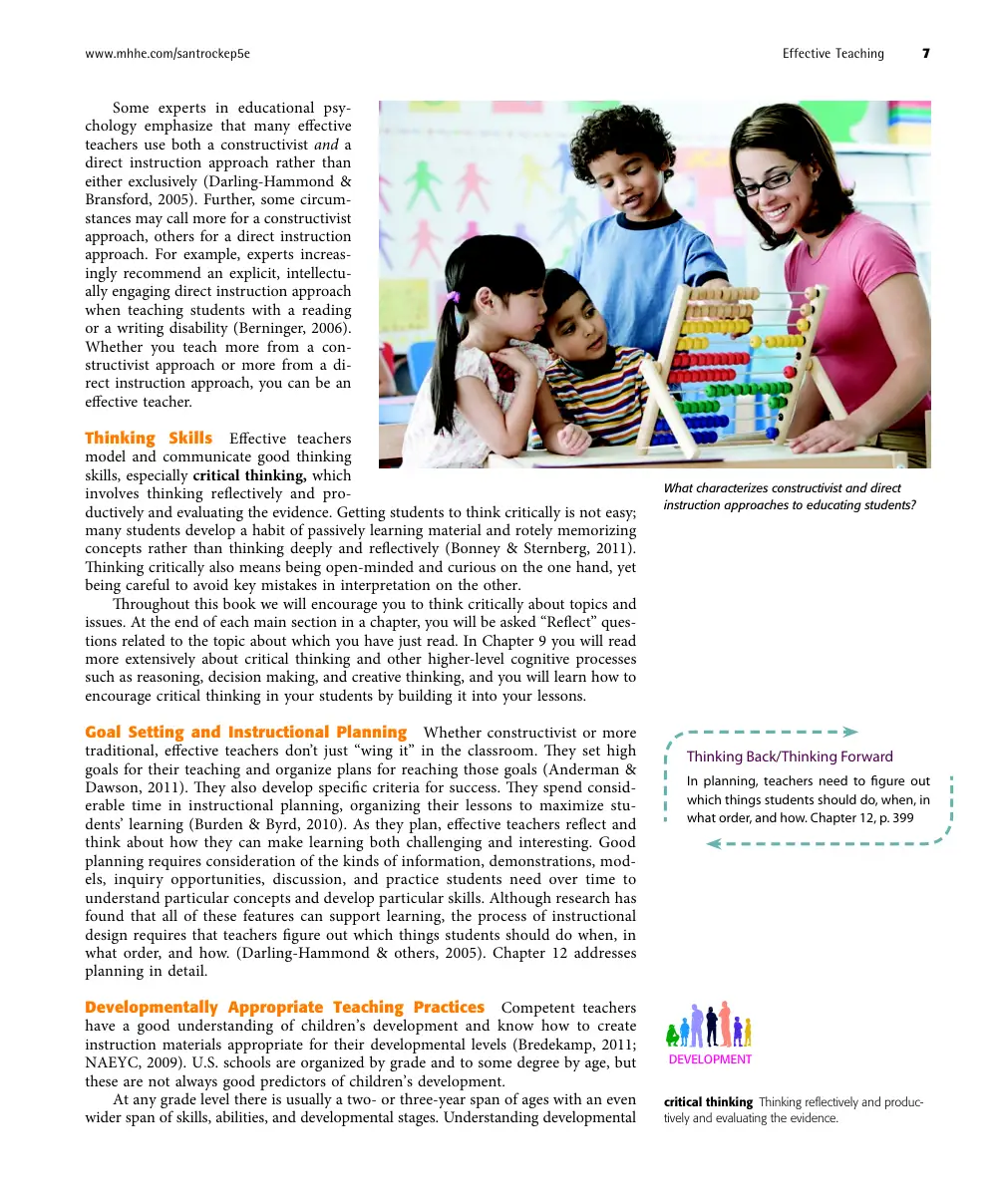
What characterizes constructivist and direct
instruction approaches to educating students?
critical thinking Thinking reflectively and produc-
tively and evaluating the evidence.
Thinking Back/Thinking Forward
In planning, teachers need to fi gure out
which things students should do, when, in
what order, and how. Chapter 12, p. 399
DEVELOPMENT
8
Chapter 1 Educational Psychology: A Tool for Effective Teaching
pathways and progressions is extremely important for teaching in ways that are opti-
mal for each child (Follari, 2011; Marion, 2010).
Th roughout this text, we call attention to developmental aspects of educating
children and provide examples of teaching and learning that take into account a
child’s developmental level. Chapters 2 and 3 are devoted exclusively to development.
Classroom Management Skills An important aspect of being an eff ective
teacher is keeping the class as a whole working together and oriented toward class-
room tasks. Eff ective teachers establish and maintain an environment in which learn-
ing can occur (Jones & Jones, 2010; Mertler & Charles, 2011). To create this optimal
learning environment, teachers need a repertoire of strategies for establishing rules
and procedures, organizing groups, monitoring and pacing classroom activities, and
handling misbehavior (ASCD, 2009).
Motivational Skills Eff ective teachers have good strategies for helping students
become self-motivated and take responsibility for their learning (Anderman &
Dawson, 2011). Educational psychologists increasingly stress that this is best accom-
plished by providing real-world learning opportunities of optimal diffi culty and nov-
elty for each student. Students are motivated when they can make choices in line
with their personal interests. Eff ective teachers give them the opportunity to think
creatively and deeply about projects.
In addition to guiding students to become self-motivated learners, teachers need
to establish high expectations for students’ achievement (Eccles & Roeser, 2009). Too
oft en children are rewarded for inferior or mediocre performance with the result that
they do not reach their full potential. When high expectations are created, however,
a key aspect of education is to provide children—especially low-achieving children—
with eff ective instruction and support to meet these expectations. Chapter 13 covers
the topic of motivation in detail.
Communication Skills Also indispensable to teaching are skills in speaking, lis-
tening, overcoming barriers to verbal communication, tuning in to students’ nonverbal
communication, and constructively resolving confl icts (Hybels & Weaver, 2009).
Communication skills are critical not only in teaching but also in interacting with
parents (Weiss & others, 2010). Eff ective teachers use good communication skills when
they talk “with” rather than “to” students, parents, administrators, and others; keep
criticism at a minimum; and have an assertive rather than aggressive, manipulative, or
passive communication style (Stewart, 2009). Eff ective teachers work to improve stu-
dents’ communication skills as well. Student communication skills are especially impor-
tant because they have been rated as the skills most sought aft er by today’s employers.
Paying More Than Lip Service to Individual Variations Virtually every
teacher knows that it is important to take individual variations into account when
teaching, but this is not always easy to do. Your students will have varying
levels of intelligence, use diff erent thinking and learning styles, and have
diff erent temperaments and personality traits (Martinez, 2010). You also
are likely to have some students who are gift ed and others with disabilities
of various types (Darragh, 2010; Friend, 2011).
Consider Amber Larkin’s challenges and experiences as a beginning
teacher (Wong Briggs, 2007). Her classroom was a trailer, and her stu-
dents included children who were homeless, non–English speaking, had
disabilities, or were refugees who had never worn shoes or experienced
any type of formal education. Aft er four years of teaching, she was
named one of USA Today ’s 2007 National All-Star Teachers. Almost all
of her students pass state-mandated No Child Left Behind (NCLB) tests,
but she is just as pleased about her students’ socioemotional growth.
Her principal described her in the following manner: “Th ere’s an unspoken
aura that great things are going to happen, and that’s how she goes
about her day” (Wong Briggs, 2007, p. 6D).
“My mom told me to tell you that I am the
educational challenge you were told about
in college.”
Reprinted by permission of Heiser Zedonek.
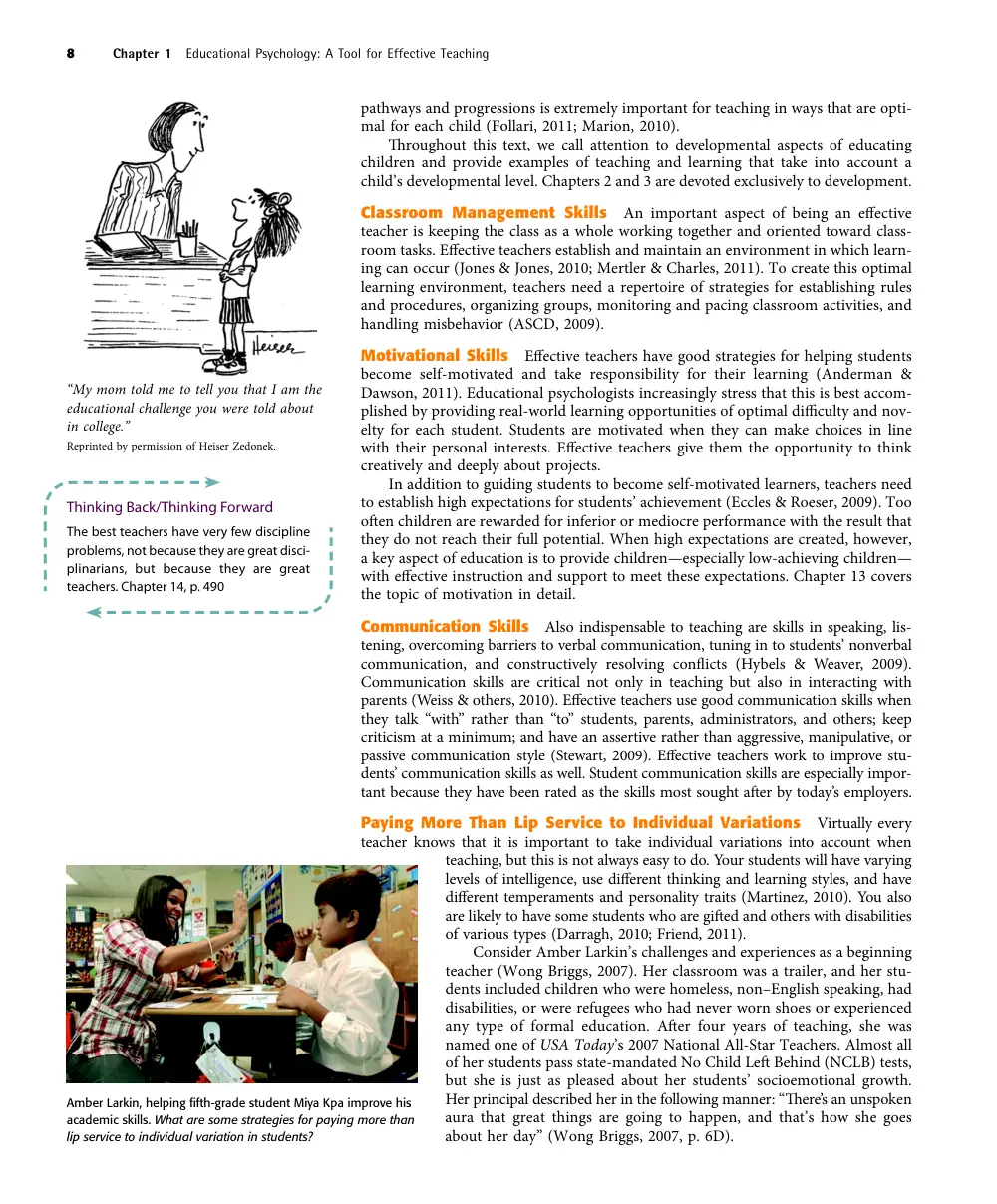
Amber Larkin, helping fifth-grade student Miya Kpa improve his
academic skills. What are some strategies for paying more than
lip service to individual variation in students?
Thinking Back/Thinking Forward
The best teachers have very few discipline
problems, not because they are great disci-
plinarians, but because they are great
teachers. Chapter 14, p. 490
Eff ectively teaching a class of students with such diverse characteristics requires
much thought and eff ort (Rosenberg, Westling, & McLesky, 2011). Diff erentiated
instruction addresses this challenge by recognizing individual variations in students’
knowledge, readiness, interests, and other characteristics, then taking these diff er-
ences into account in planning curriculum and engaging in instruction (Tomlinson,
2006). Th us, diff erentiated instruction aims to tailor assignments to meet students’
needs and abilities. It is unlikely that a teacher can generate 20 to 30 diff erent lesson
plans to address the needs of each student in a classroom. However, diff erentiated
instruction advocates discovering “zones” or “ball parks” in which students in a class-
room cluster, thus providing three or four types/levels of instruction rather than 20
to 30. In Chapters 4 and 6 we provide strategies to help you guide students with dif-
ferent levels of skills and diff erent characteristics to learn eff ectively.
Working Effectively with Students from Culturally Diverse Backgrounds
Today one of every fi ve children in the United States is from an immigrant family,
and by 2040 one of every three U.S. children is projected to fi t this description. Nearly
80 percent of the new immigrants are people of color from Latin America, Asia, and
the Caribbean. Approximately 75 percent of the new immigrants are of Spanish-
speaking origin, although children speaking more than 100 diff erent languages are
entering U.S. schools.
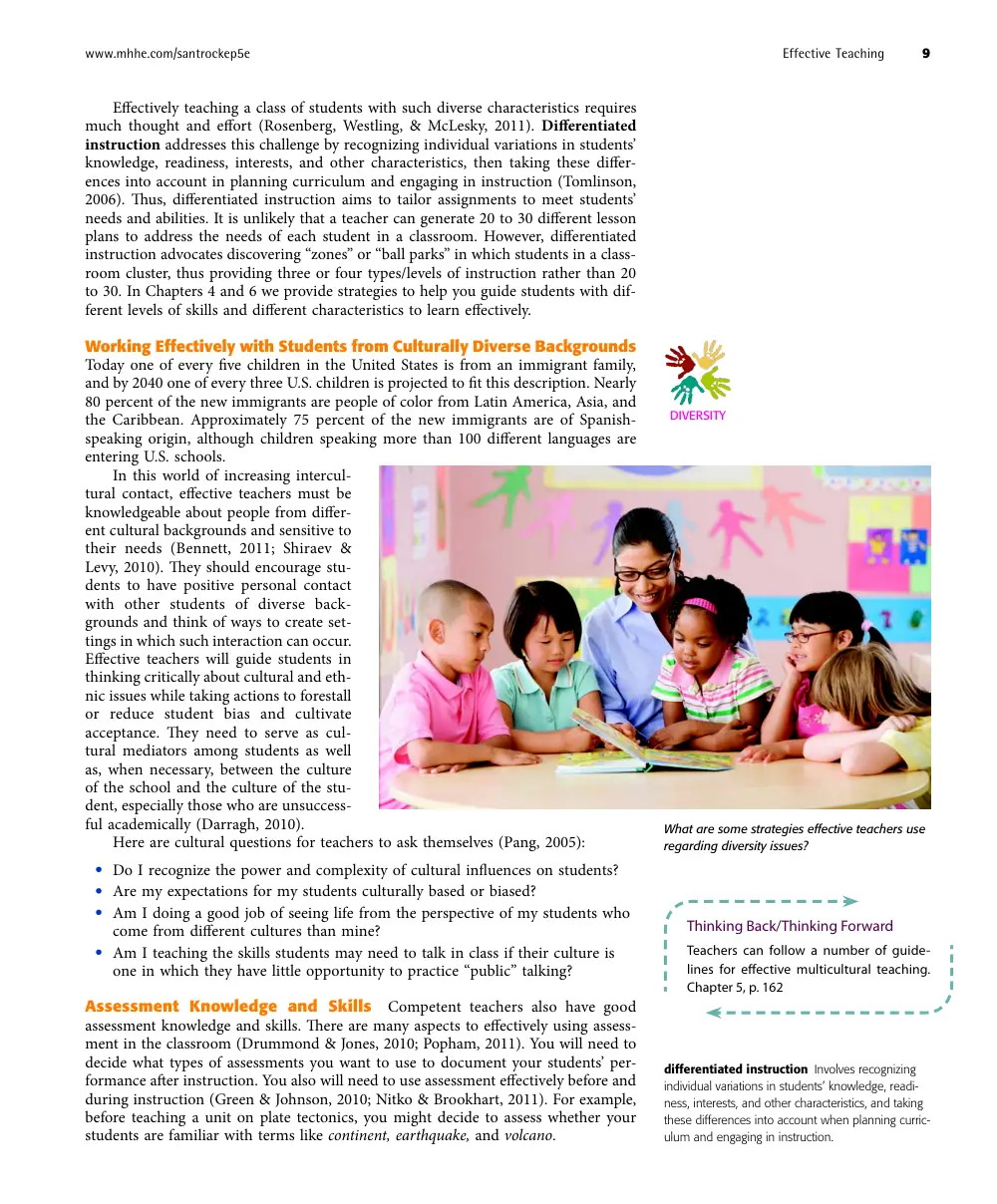
In this world of increasing intercul-
tural contact, eff ective teachers must be
knowledgeable about people from diff er-
ent cultural backgrounds and sensitive to
their needs (Bennett, 2011; Shiraev &
Levy, 2010). Th ey should encourage stu-
dents to have positive personal contact
with other students of diverse back-
grounds and think of ways to create set-
tings in which such interaction can occur.
Eff ective teachers will guide students in
thinking critically about cultural and eth-
nic issues while taking actions to forestall
or reduce student bias and cultivate
acceptance. Th ey need to serve as cul-
tural mediators among students as well
as, when necessary, between the culture
of the school and the culture of the stu-
dent, especially those who are unsuccess-
ful academically (Darragh, 2010).
Here are cultural questions for teachers to ask themselves (Pang, 20