
EDUC 215 Final, Spring 2010
American University of Beirut · Learning and Human Development · 13 pages · Dr. Vivian Khamis
Showing the first 10 of 13 pages. Download the PDF to see all of it.
More EDUC 215 files
Show the text of this final exam
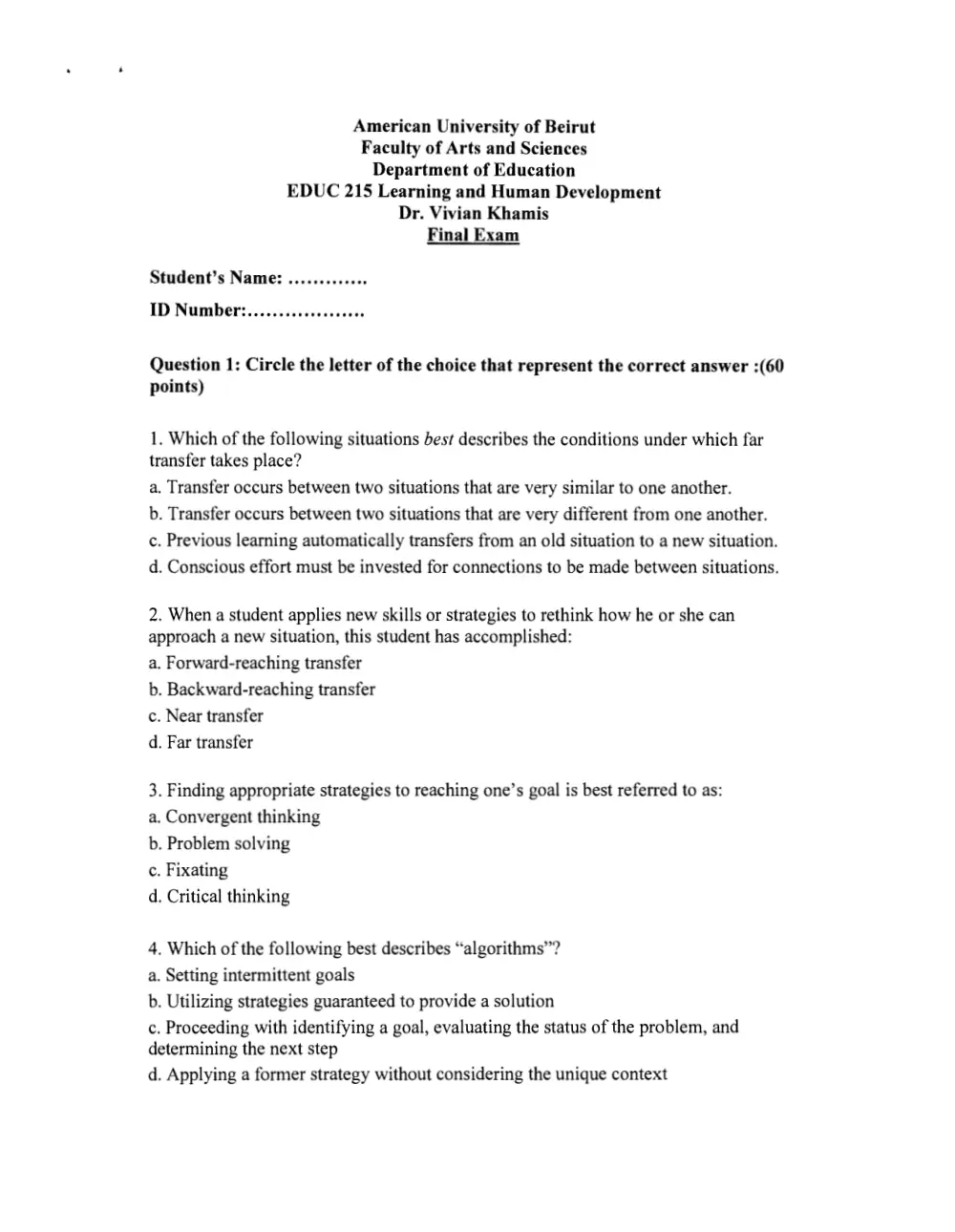
American University of Beirut
Faculty of Arts and Sciences
Department of Education
EDUC 215 Learning and Human Development
Dr. Vivian Khamis
Final Exam
Student’s Name: .............
ID Number........ seoeeeees vee
Question 1: Circle the letter of the choice that represent the correct answer :(60
points)
1. Which of the following situations best describes the conditions under which far
transfer takes place?
a. Transfer occurs between two situations that are very similar to one another.
b. Transfer occurs between two situations that are very different from one another.
c. Previous learning automatically transfers from an old situation to a new situation.
d. Conscious effort must be invested for connections to be made between situations.
2. When a student applies new skills or strategies to rethink how he or she can
approach a new situation, this student has accomplished:
a. Forward-reaching transfer
b. Backward-reaching transfer
c. Near transfer
d. Far transfer
3. Finding appropriate strategies to reaching one’s goal is best referred to as:
a. Convergent thinking
b. Problem solving
c. Fixating
d. Critical thinking
4. Which of the following best describes “algorithms”?
a. Setting intermittent goals
b. Utilizing strategies guaranteed to provide a solution
c. Proceeding with identifying a goal, evaluating the status of the problem, and
determining the next step
d. Applying a former strategy without considering the unique context
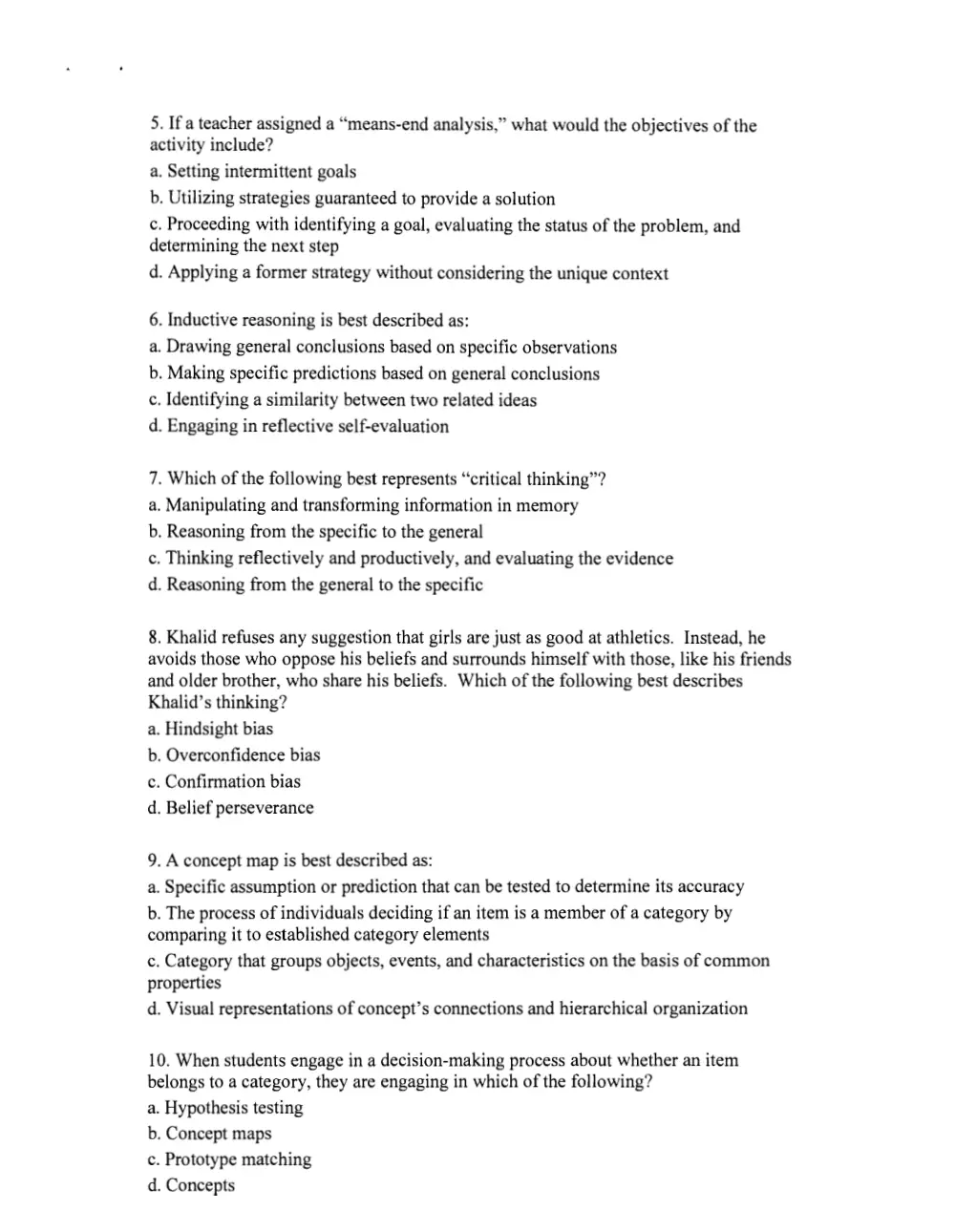
5. Ifa teacher assigned a “means-end analysis,” what would the objectives of the
activity include?
a. Setting intermittent goals
b. Utilizing strategies guaranteed to provide a solution
c. Proceeding with identifying a goal, evaluating the status of the problem, and
determining the next step
d. Applying a former strategy without considering the unique context
6. Inductive reasoning is best described as:
a. Drawing general conclusions based on specific observations
b. Making specific predictions based on general conclusions
c. Identifying a similarity between two related ideas
d. Engaging in reflective self-evaluation
7. Which of the following best represents “critical thinking”?
a. Manipulating and transforming information in memory
b. Reasoning from the specific to the general
c. Thinking reflectively and productively, and evaluating the evidence
d. Reasoning from the general to the specific
8. Khalid refuses any suggestion that girls are just as good at athletics. Instead, he
avoids those who oppose his beliefs and surrounds himself with those, like his friends
and older brother, who share his beliefs. Which of the following best describes
Khalid’s thinking?
a. Hindsight bias
b. Overconfidence bias
c. Confirmation bias
d. Belief perseverance
9. A concept map is best described as:
a. Specific assumption or prediction that can be tested to determine its accuracy
b. The process of individuals deciding if an item is a member of a category by
comparing it to established category elements
c. Category that groups objects, events, and characteristics on the basis of common
properties
d. Visual representations of concept’s connections and hierarchical organization
10. When students engage in a decision-making process about whether an item
belongs to a category, they are engaging in which of the following?
a. Hypothesis testing
b. Concept maps
c. Prototype matching
d. Concepts
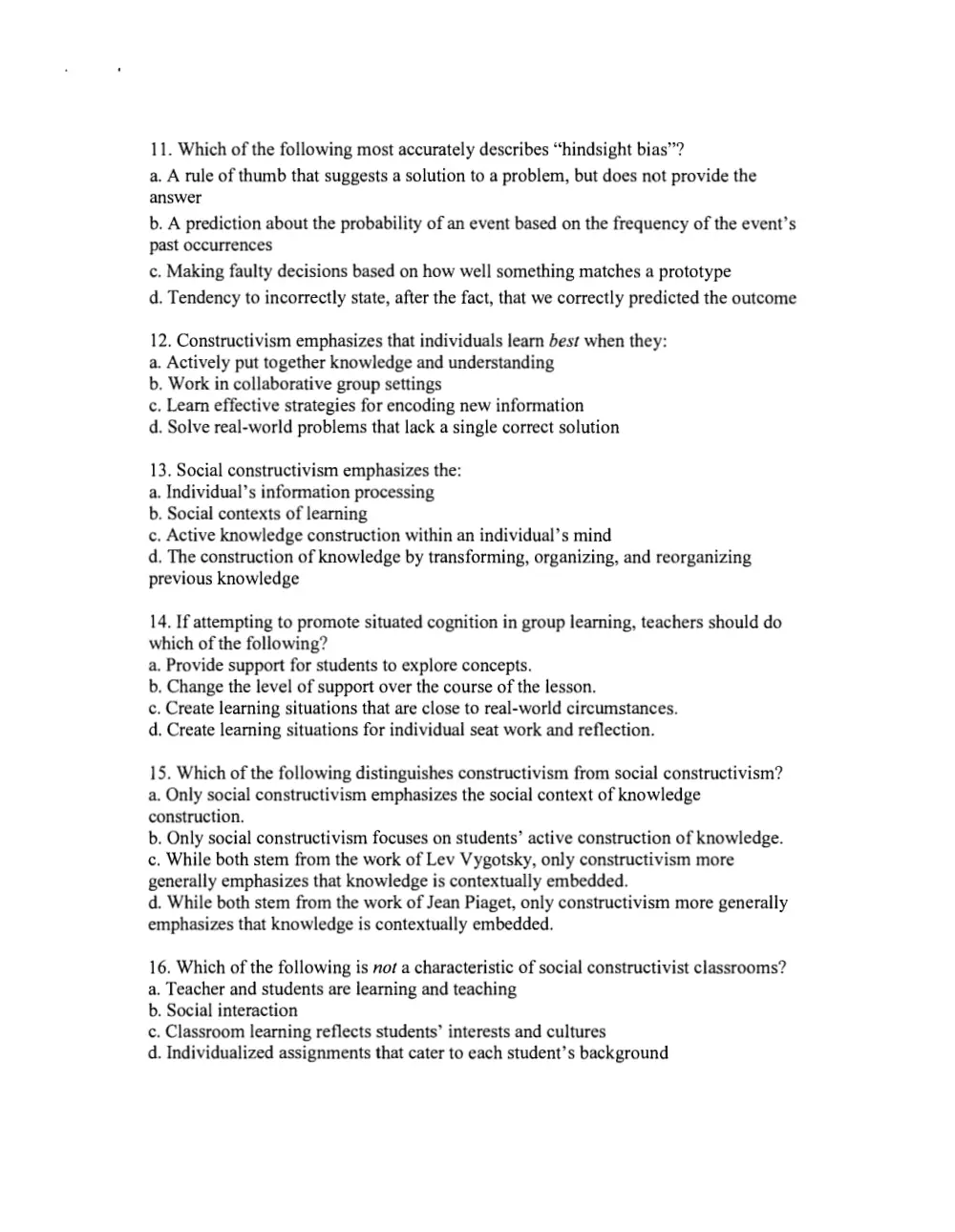
11. Which of the following most accurately describes “hindsight bias”?
a. A rule of thumb that suggests a solution to a problem, but does not provide the
answer
b. A prediction about the probability of an event based on the frequency of the event’s
past occurrences
c. Making faulty decisions based on how well something matches a prototype
d. Tendency to incorrectly state, after the fact, that we correctly predicted the outcome
12. Constructivism emphasizes that individuals learn best when they:
a. Actively put together knowledge and understanding
b. Work in collaborative group settings
c. Learn effective strategies for encoding new information
d. Solve real-world problems that lack a single correct solution
13. Social constructivism emphasizes the:
a. Individual’s information processing
b. Social contexts of learning
c. Active knowledge construction within an individual’s mind
d. The construction of knowledge by transforming, organizing, and reorganizing
previous knowledge
14. If attempting to promote situated cognition in group learning, teachers should do
which of the following?
a. Provide support for students to explore concepts.
b. Change the level of support over the course of the lesson.
c. Create learning situations that are close to real-world circumstances.
d. Create learning situations for individual seat work and reflection.
15. Which of the following distinguishes constructivism from social constructivism?
a. Only social constructivism emphasizes the social context of knowledge
construction.
b. Only social constructivism focuses on students’ active construction of knowledge.
c. While both stem from the work of Lev Vygotsky, only constructivism more
generally emphasizes that knowledge is contextually embedded.
d. While both stem from the work of Jean Piaget, only constructivism more generally
emphasizes that knowledge is contextually embedded.
16. Which of the following is not a characteristic of social constructivist classrooms?
a. Teacher and students are learning and teaching
b. Social interaction
c. Classroom learning reflects students’ interests and cultures
d. Individualized assignments that cater to each student’s background
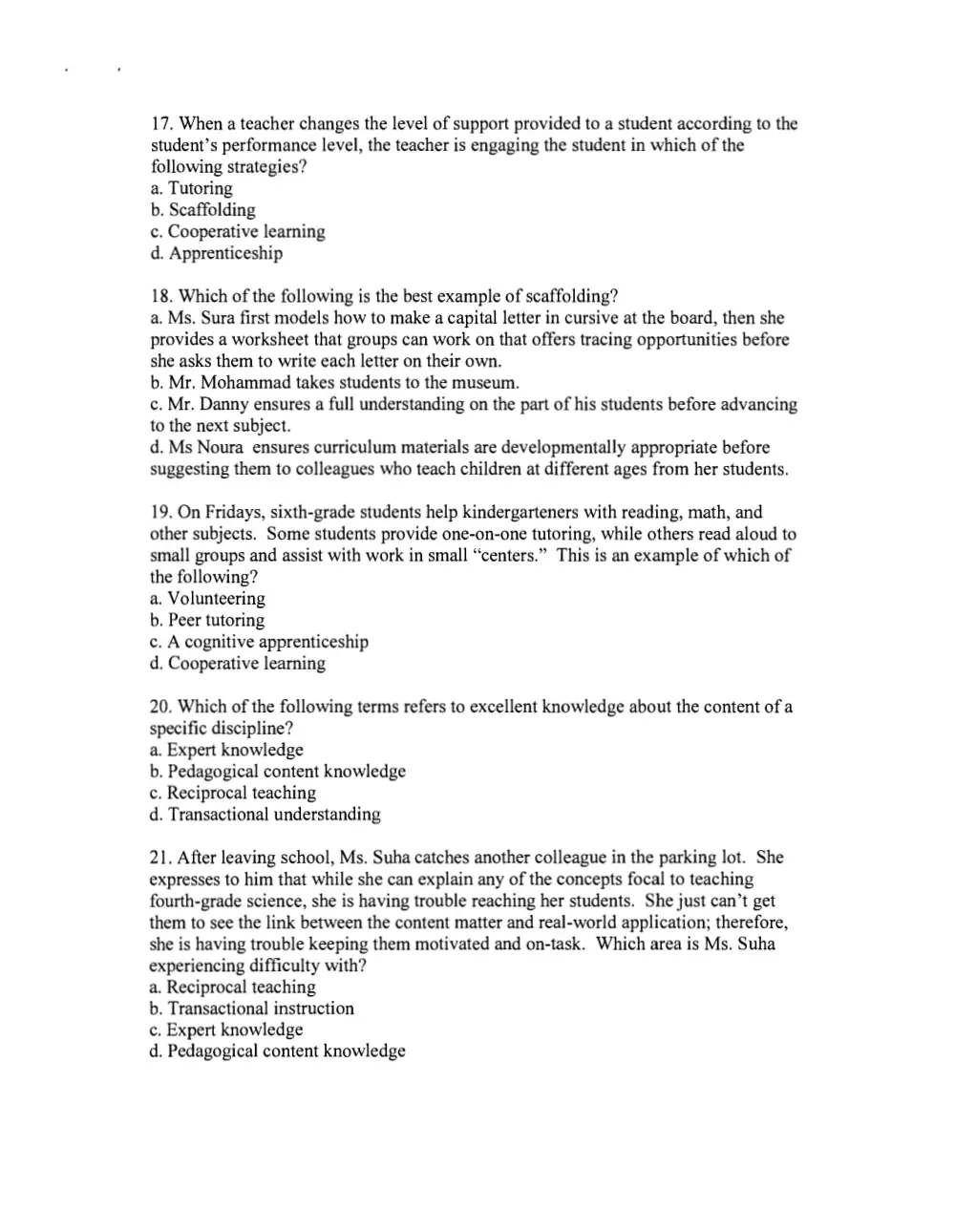
17. When a teacher changes the level of support provided to a student according to the
student’s performance level, the teacher is engaging the student in which of the
following strategies?
a. Tutoring
b. Scaffolding
c. Cooperative learning
d. Apprenticeship
18. Which of the following is the best example of scaffolding?
a. Ms. Sura first models how to make a capital letter in cursive at the board, then she
provides a worksheet that groups can work on that offers tracing opportunities before
she asks them to write each letter on their own.
b. Mr. Mohammad takes students to the museum.
c. Mr. Danny ensures a full understanding on the part of his students before advancing
to the next subject.
d. Ms Noura ensures curriculum materials are developmentally appropriate before
suggesting them to colleagues who teach children at different ages from her students.
19. On Fridays, sixth-grade students help kindergarteners with reading, math, and
other subjects. Some students provide one-on-one tutoring, while others read aloud to
small groups and assist with work in small “centers.” This is an example of which of
the following?
a. Volunteering
b. Peer tutoring
c. A cognitive apprenticeship
d. Cooperative learning
20. Which of the following terms refers to excellent knowledge about the content of a
specific discipline?
a. Expert knowledge
b. Pedagogical content knowledge
c. Reciprocal teaching
d. Transactional understanding
21. After leaving school, Ms. Suha catches another colleague in the parking lot. She
expresses to him that while she can explain any of the concepts focal to teaching
fourth-grade science, she is having trouble reaching her students. She just can’t get
them to see the link between the content matter and real-world application; therefore,
she is having trouble keeping them motivated and on-task. Which area is Ms. Suha
experiencing difficulty with?
a. Reciprocal teaching
b. Transactional instruction
c. Expert knowledge
d. Pedagogical content knowledge
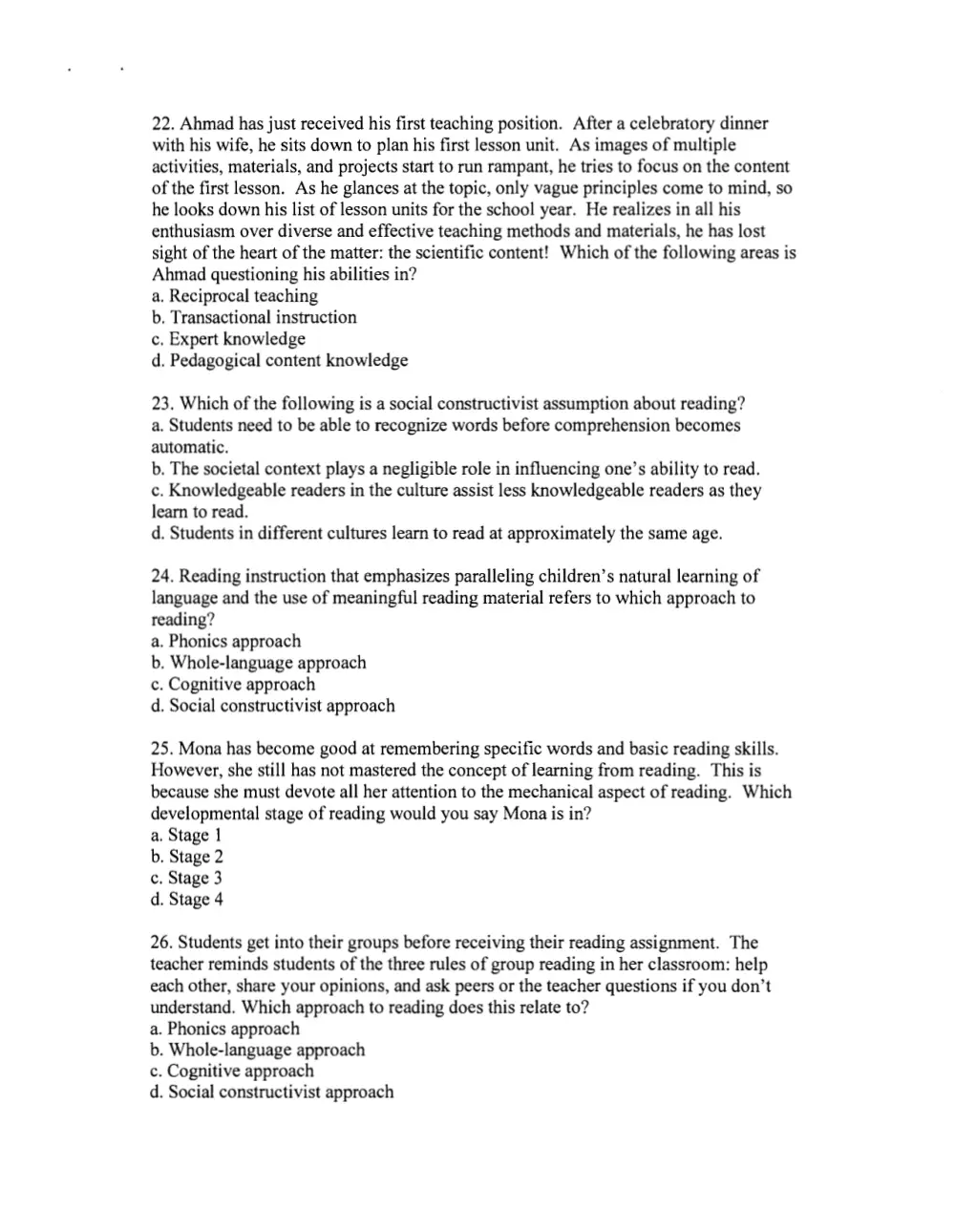
22. Ahmad has just received his first teaching position. After a celebratory dinner
with his wife, he sits down to plan his first lesson unit. As images of multiple
activities, materials, and projects start to run rampant, he tries to focus on the content
of the first lesson. As he glances at the topic, only vague principles come to mind, so
he looks down his list of lesson units for the school year. He realizes in all his
enthusiasm over diverse and effective teaching methods and materials, he has lost
sight of the heart of the matter: the scientific content! Which of the following areas is
Ahmad questioning his abilities in?
a. Reciprocal teaching
b. Transactional instruction
c. Expert knowledge
d. Pedagogical content knowledge
23. Which of the following is a social constructivist assumption about reading?
a, Students need to be able to recognize words before comprehension becomes
automatic.
b. The societal context plays a negligible role in influencing one’s ability to read.
c. Knowledgeable readers in the culture assist less knowledgeable readers as they
learn to read.
d. Students in different cultures learn to read at approximately the same age.
24. Reading instruction that emphasizes paralleling children’s natural learning of
language and the use of meaningful reading material refers to which approach to
reading?
a. Phonics approach
b. Whole-language approach
c. Cognitive approach
d. Social constructivist approach
25. Mona has become good at remembering specific words and basic reading skills.
However, she still has not mastered the concept of learning from reading. This is
because she must devote all her attention to the mechanical aspect of reading. Which
developmental stage of reading would you say Mona is in?
a. Stage |
b. Stage 2
c. Stage 3
d. Stage 4
26. Students get into their groups before receiving their reading assignment. The
teacher reminds students of the three rules of group reading in her classroom: help
each other, share your opinions, and ask peers or the teacher questions if you don’t
understand. Which approach to reading does this relate to?
a. Phonics approach
b. Whole-language approach
c. Cognitive approach
d. Social constructivist approach
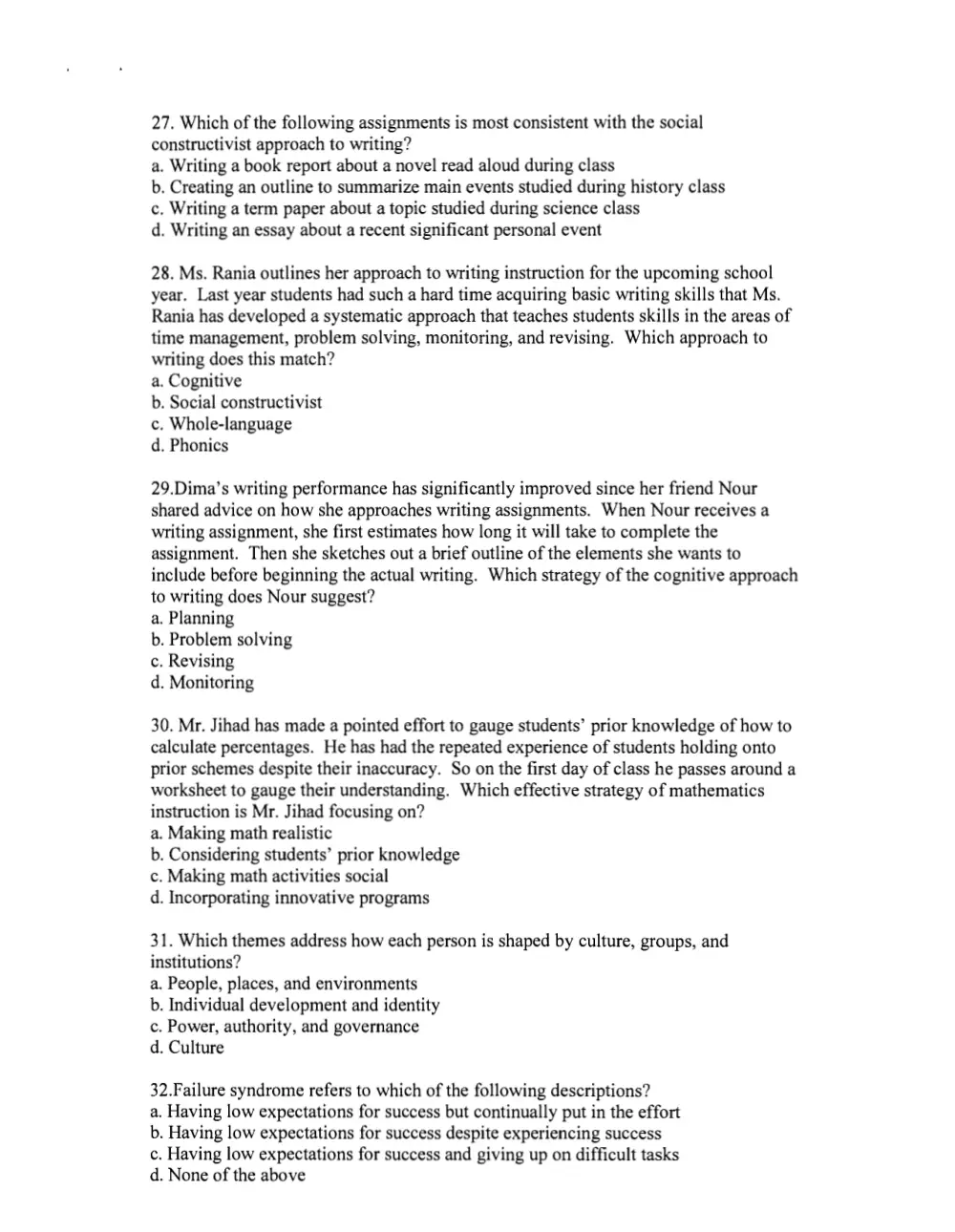
27. Which of the following assignments is most consistent with the social
constructivist approach to writing?
a. Writing a book report about a novel read aloud during class
b. Creating an outline to summarize main events studied during history class
c. Writing a term paper about a topic studied during science class
d. Writing an essay about a recent significant personal event
28. Ms. Rania outlines her approach to writing instruction for the upcoming school
year. Last year students had such a hard time acquiring basic writing skills that Ms.
Rania has developed a systematic approach that teaches students skills in the areas of
time management, problem solving, monitoring, and revising. Which approach to
writing does this match?
a. Cognitive
b. Social constructivist
c. Whole-language
d. Phonics
29.Dima’s writing performance has significantly improved since her friend Nour
shared advice on how she approaches writing assignments. When Nour receives a
writing assignment, she first estimates how long it will take to complete the
assignment. Then she sketches out a brief outline of the elements she wants to
include before beginning the actual writing. Which strategy of the cognitive approach
to writing does Nour suggest?
a. Planning
b. Problem solving
c. Revising
d. Monitoring
30. Mr. Jihad has made a pointed effort to gauge students’ prior knowledge of how to
calculate percentages. He has had the repeated experience of students holding onto
prior schemes despite their inaccuracy. So on the first day of class he passes around a
worksheet to gauge their understanding. Which effective strategy of mathematics
instruction is Mr. Jihad focusing on?
a. Making math realistic
b. Considering students’ prior knowledge
c. Making math activities social
d. Incorporating innovative programs
31. Which themes address how each person is shaped by culture, groups, and
institutions?
a. People, places, and environments
b. Individual development and identity
c. Power, authority, and governance
d. Culture
32.Failure syndrome refers to which of the following descriptions?
a. Having low expectations for success but continually put in the effort
b. Having low expectations for success despite experiencing success
c. Having low expectations for success and giving up on difficult tasks
d. None of the above
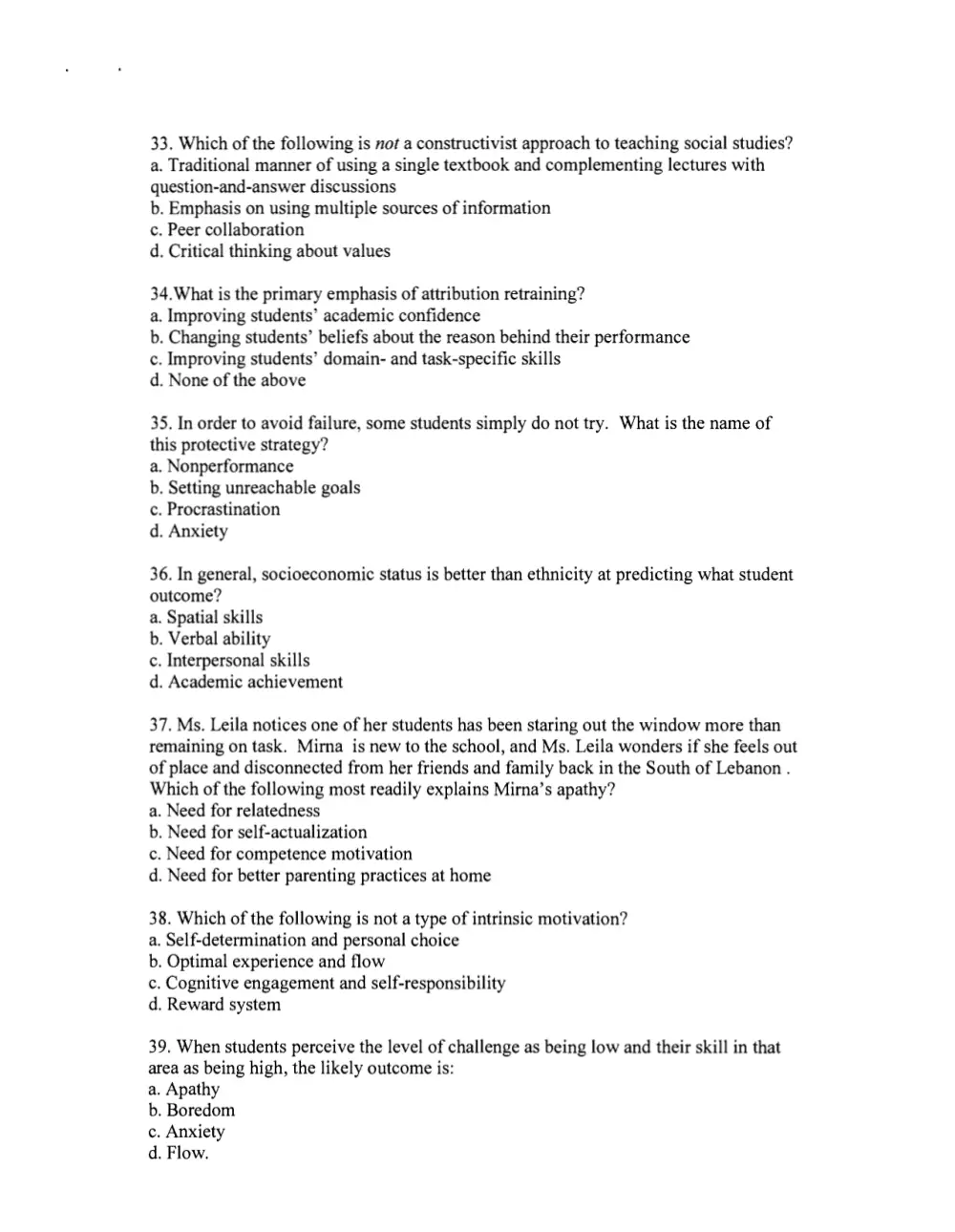
33. Which of the following is not a constructivist approach to teaching social studies?
a. Traditional manner of using a single textbook and complementing lectures with
question-and-answer discussions
b. Emphasis on using multiple sources of information
c. Peer collaboration
d. Critical thinking about values
34.What is the primary emphasis of attribution retraining?
a. Improving students’ academic confidence
b. Changing students’ beliefs about the reason behind their performance
c. Improving students’ domain- and task-specific skills
d. None of the above
35. In order to avoid failure, some students simply do not try. What is the name of
this protective strategy?
a. Nonperformance
b. Setting unreachable goals
c. Procrastination
d. Anxiety
36. In general, socioeconomic status is better than ethnicity at predicting what student
outcome?
a. Spatial skills
b. Verbal ability
c. Interpersonal skills
d. Academic achievement
37. Ms. Leila notices one of her students has been staring out the window more than
remaining on task. Mirna is new to the school, and Ms. Leila wonders if she feels out
of place and disconnected from her friends and family back in the South of Lebanon .
Which of the following most readily explains Mirna’s apathy?
a. Need for relatedness
b. Need for self-actualization
c. Need for competence motivation
d. Need for better parenting practices at home
38. Which of the following is not a type of intrinsic motivation?
a. Self-determination and personal choice
b. Optimal experience and flow
c. Cognitive engagement and self-responsibility
d. Reward system
39. When students perceive the level of challenge as being low and their skill in that
area as being high, the likely outcome is:
a. Apathy
b. Boredom
c. Anxiety
d. Flow.
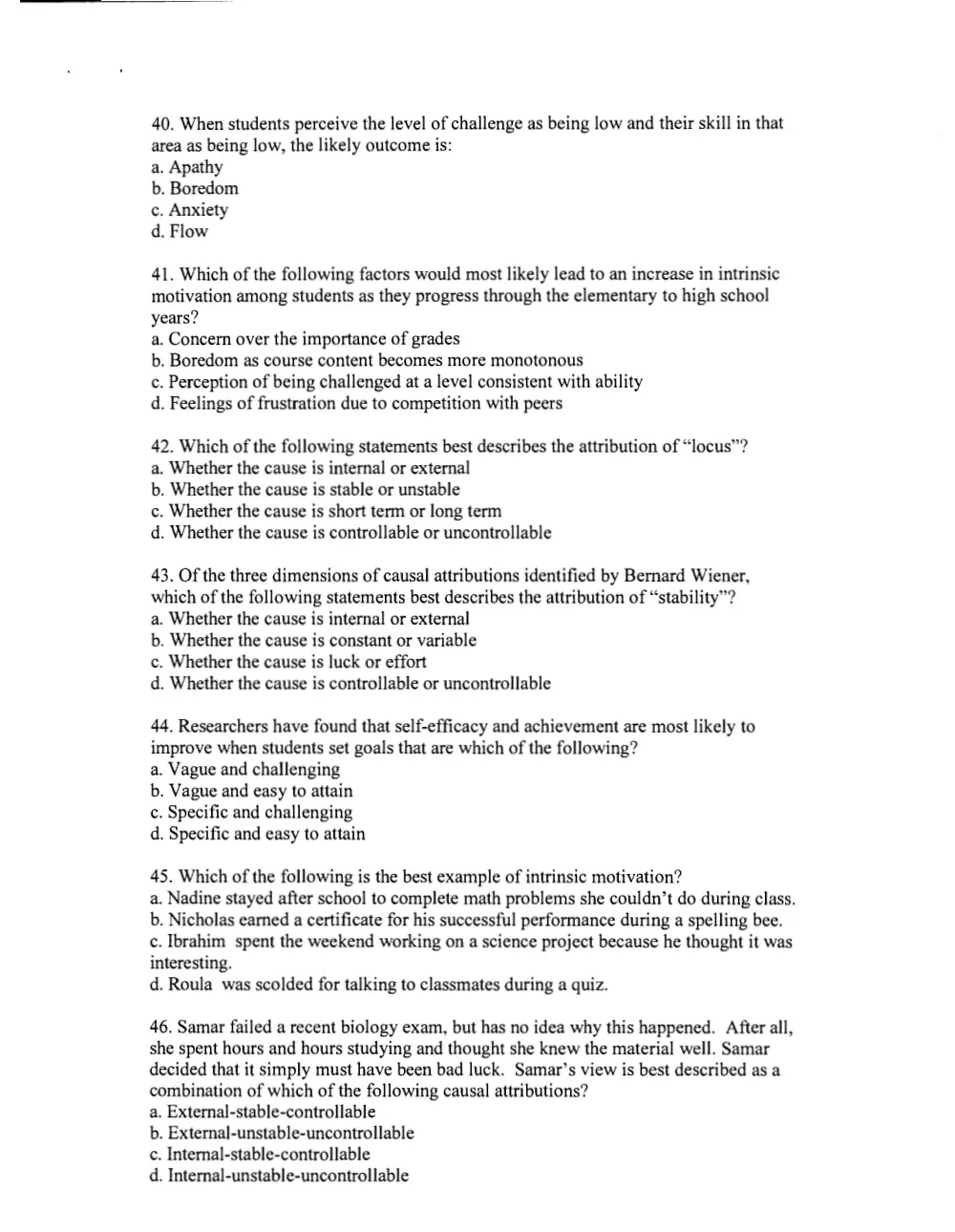
40. When students perceive the level of challenge as being low and their skill in that
area as being low, the likely outcome is:
a. Apathy
b. Boredom
c. Anxiety
d. Flow
41. Which of the following factors would most likely lead to an increase in intrinsic
motivation among students as they progress through the elementary to high school
years?
a. Concern over the importance of grades
b. Boredom as course content becomes more monotonous
c. Perception of being challenged at a level consistent with ability
d. Feelings of frustration due to competition with peers
42. Which of the following statements best describes the attribution of “locus”?
a. Whether the cause is internal or external
b. Whether the cause is stable or unstable
c. Whether the cause is short term or long term
d. Whether the cause is controllable or uncontrollable
43. Of the three dimensions of causal attributions identified by Bernard Wiener,
which of the following statements best describes the attribution of “stability”?
a. Whether the cause is internal or external
b. Whether the cause is constant or variable
c. Whether the cause is luck or effort
d. Whether the cause is controllable or uncontrollable
44. Researchers have found that self-efficacy and achievement are most likely to
improve when students set goals that are which of the following?
a. Vague and challenging
b. Vague and easy to attain
c. Specific and challenging
d. Specific and easy to attain
45. Which of the following is the best example of intrinsic motivation?
a. Nadine stayed after school to complete math problems she couldn’t do during class.
b. Nicholas earned a certificate for his successful performance during a spelling bee.
c. Ibrahim spent the weekend working on a science project because he thought it was
interesting.
d. Roula was scolded for talking to classmates during a quiz.
46. Samar failed a recent biology exam, but has no idea why this happened. After all,
she spent hours and hours studying and thought she knew the material well. Samar
decided that it simply must have been bad luck. Samar’s view is best described as a
combination of which of the following causal attributions?
a. External-stable-controllable
b. External-unstable-uncontrollable
c. Internal-stable-controllable
d. Internal-unstable-uncontrollable
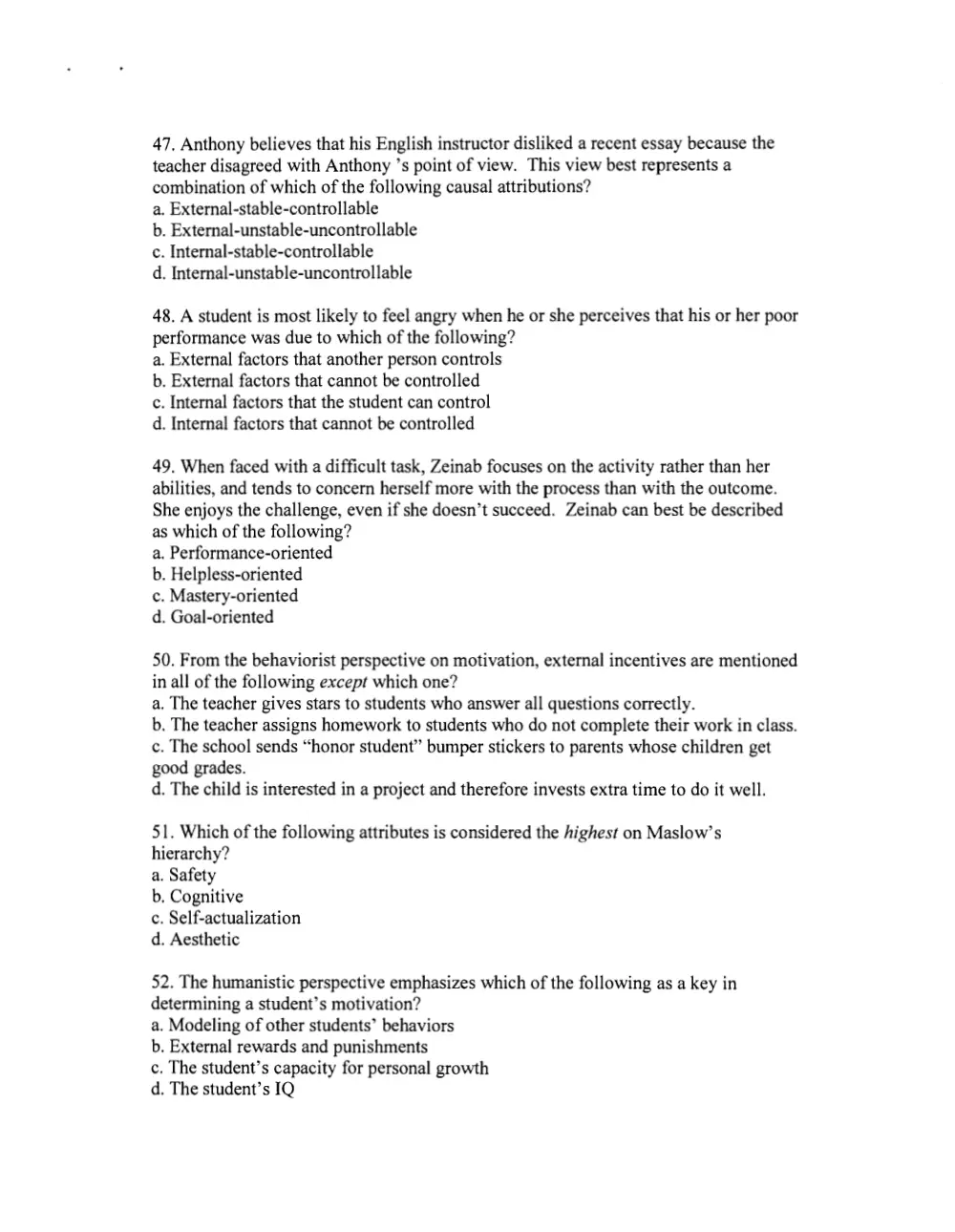
47. Anthony believes that his English instructor disliked a recent essay because the
teacher disagreed with Anthony ’s point of view. This view best represents a
combination of which of the following causal attributions?
a. External-stable-controllable
b. External-unstable-uncontrollable
c. Internal-stable-controllable
d. Internal-unstable-uncontrollable
48. A student is most likely to feel angry when he or she perceives that his or her poor
performance was due to which of the following?
a. External factors that another person controls
b. External factors that cannot be controlled
c. Internal factors that the student can control
d. Internal factors that cannot be controlled
49. When faced with a difficult task, Zeinab focuses on the activity rather than her
abilities, and tends to concern herself more with the process than with the outcome.
She enjoys the challenge, even if she doesn’t succeed. Zeinab can best be described
as which of the following?
a. Performance-oriented
b. Helpless-oriented
c. Mastery-oriented
d. Goal-oriented
50. From the behaviorist perspective on motivation, external incentives are mentioned
in all of the following except which one?
a. The teacher gives stars to students who answer all questions correctly.
b. The teacher assigns homework to students who do not complete their work in class.
c. The school sends “honor student” bumper stickers to parents whose children get
good grades.
d. The child is interested in a project and therefore invests extra time to do it well.
51. Which of the following attributes is considered the highest on Maslow’s
hierarchy?
a. Safety
b. Cognitive
c. Self-actualization
d. Aesthetic
52. The humanistic perspective emphasizes which of the following as a key in
determining a student’s motivation?
a. Modeling of other students’ behaviors
b. External rewards and punishments
c. The student’s capacity for personal growth
d. The student’s IQ
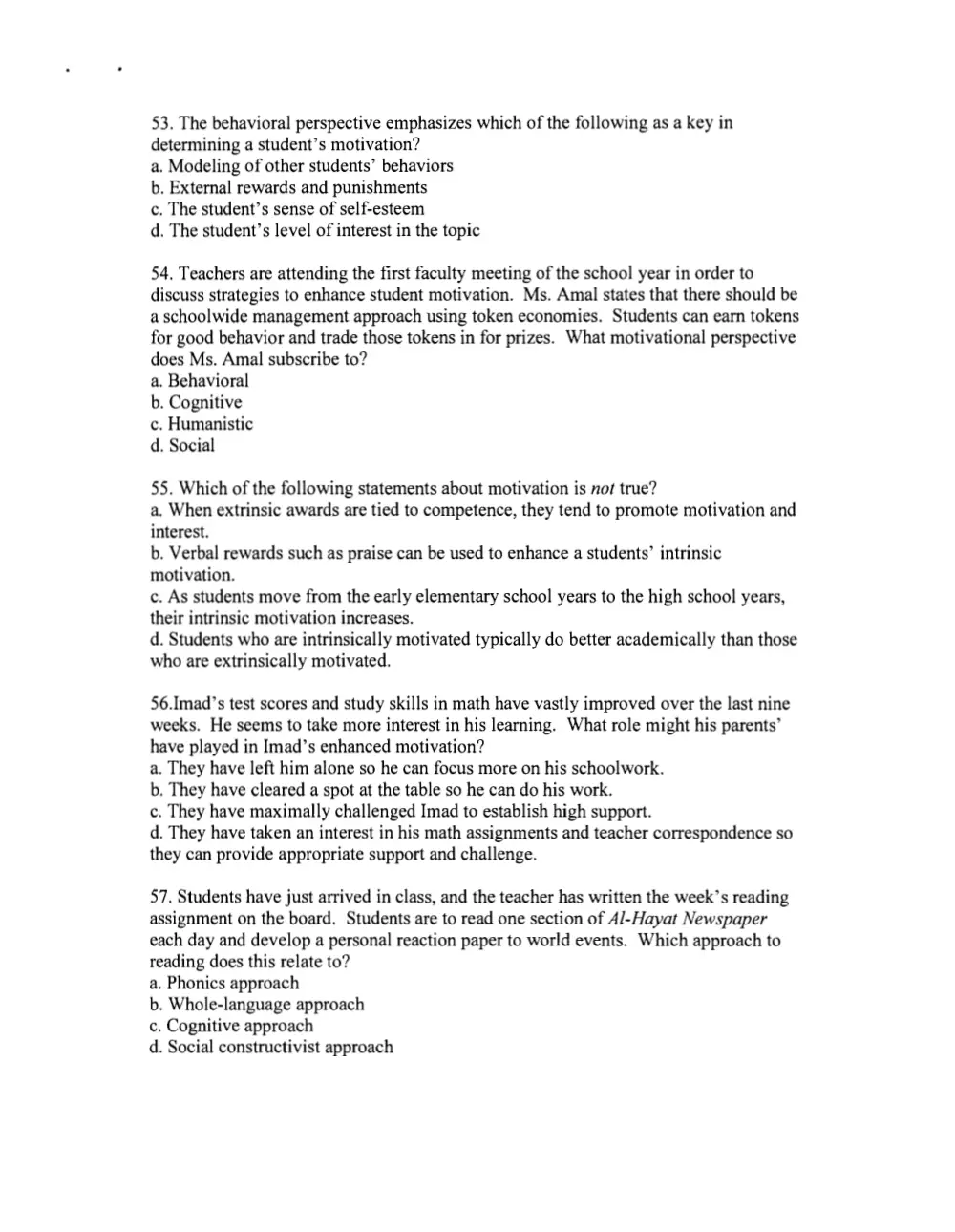
53. The behavioral perspective emphasizes which of the following as a key in
determining a student’s motivation?
a. Modeling of other students’ behaviors
b. External rewards and punishments
c. The student’s sense of self-esteem
d. The student’s level of interest in the topic
54. Teachers are attending the first faculty meeting of the school year in order to
discuss strategies to enhance student motivation. Ms. Amal states that there should be
a schoolwide management approach using token economies. Students can earn tokens
for good behavior and trade those tokens in for prizes. What motivational perspective
does Ms. Amal subscribe to?
a. Behavioral
b. Cognitive
c. Humanistic
d. Social
55. Which of the following statements about motivation is not true?
a. When extrinsic awards are tied to competence, they tend to promote motivation and
interest.
b. Verbal rewards such as praise can be used to enhance a students’ intrinsic
motivation.
c. As students move from the early elementary school years to the high school years,
their intrinsic motivation increases.
d. Students who are intrinsically motivated typically do better academically than those
who are extrinsically motivated.
56.Imad’s test scores and study skills in math have vastly improved over the last nine
weeks. He seems to take more interest in his learning. What role might his parents’
have played in Imad’s enhanced motivation?
a. They have left him alone so he can focus more on his schoolwork.
b. They have cleared a spot at the table so he can do his work.
c. They have maximally challenged Imad to establish high support.
d. They have taken an interest in his math assignments and teacher correspondence so
they can provide appropriate support and challenge.
57. Students have just arrived in class, and the teacher has written the week’s reading
assignment on the board. Students are to read one section of Al-Hayat Newspaper
each day and develop a personal reaction paper to world events. Which approach to
reading does this relate to?
a. Phonics approach
b. Whole-language approach
c. Cognitive approach
d. Social constructivist approach