
EDUC 215 Final, Spring 2009
American University of Beirut · Learning and Human Development · 4 pages

More EDUC 215 files
Show the text of this final exam
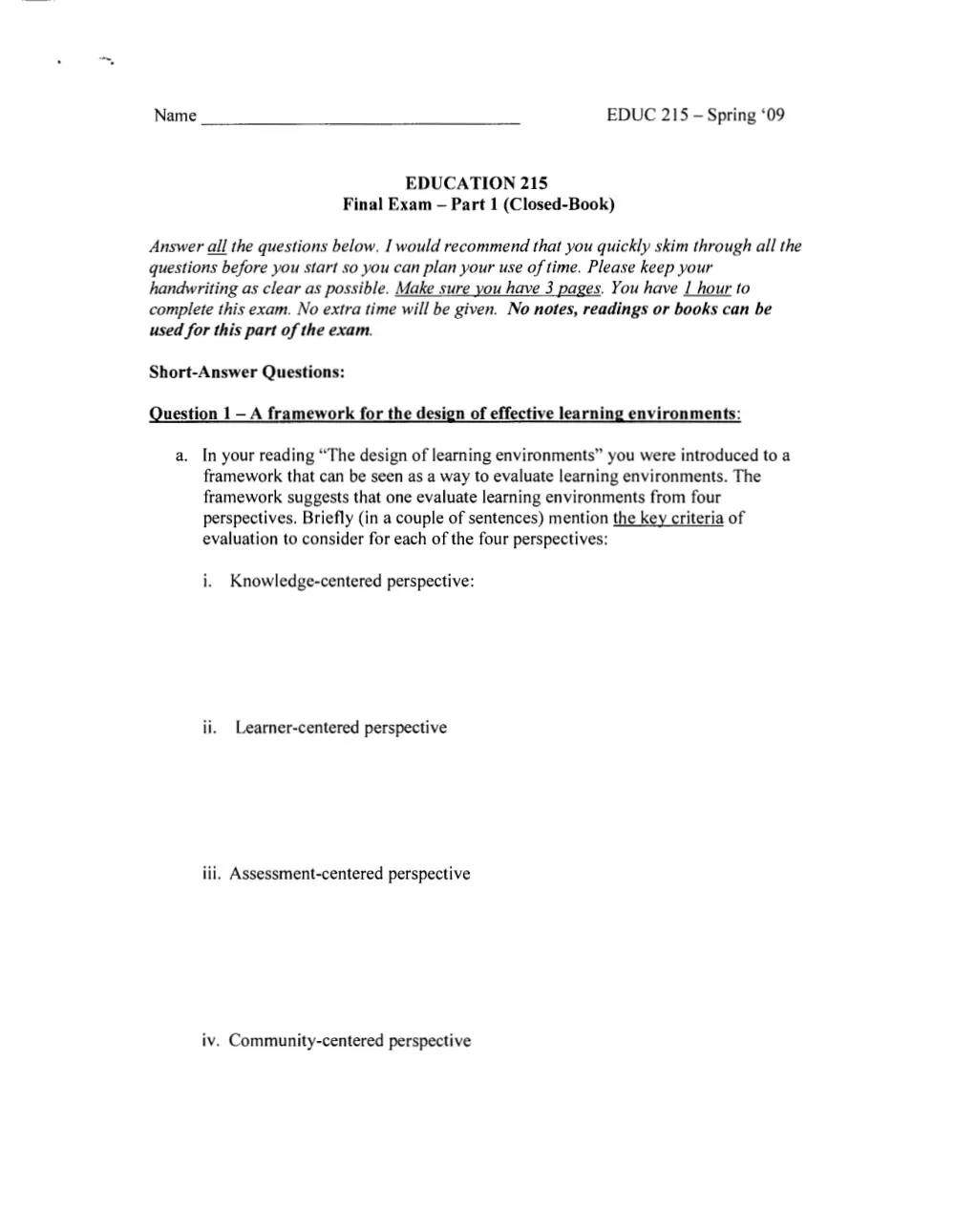
Name EDUC 215 — Spring ‘09
EDUCATION 215
Final Exam — Part 1 (Closed-Book)
Answer all the questions below. I would recommend that you quickly skim through all the
questions before you start so you can plan your use of time. Please keep your
handwriting as clear as possible. Make sure you have 3 pages. You have 1 hour to
complete this exam. No extra time will be given. No notes, readings or books can be
used for this part of the exam.
Short-Answer Questions:
Question 1 — A framework for the design of effective learning environments:
a. In your reading “The design of learning environments” you were introduced to a
framework that can be seen as a way to evaluate learning environments. The
framework suggests that one evaluate learning environments from four
perspectives. Briefly (in a couple of sentences) mention the key criteria of
evaluation to consider for each of the four perspectives:
i. Knowledge-centered perspective:
ii. Learner-centered perspective
iii. Assessment-centered perspective
iv. Community-centered perspective
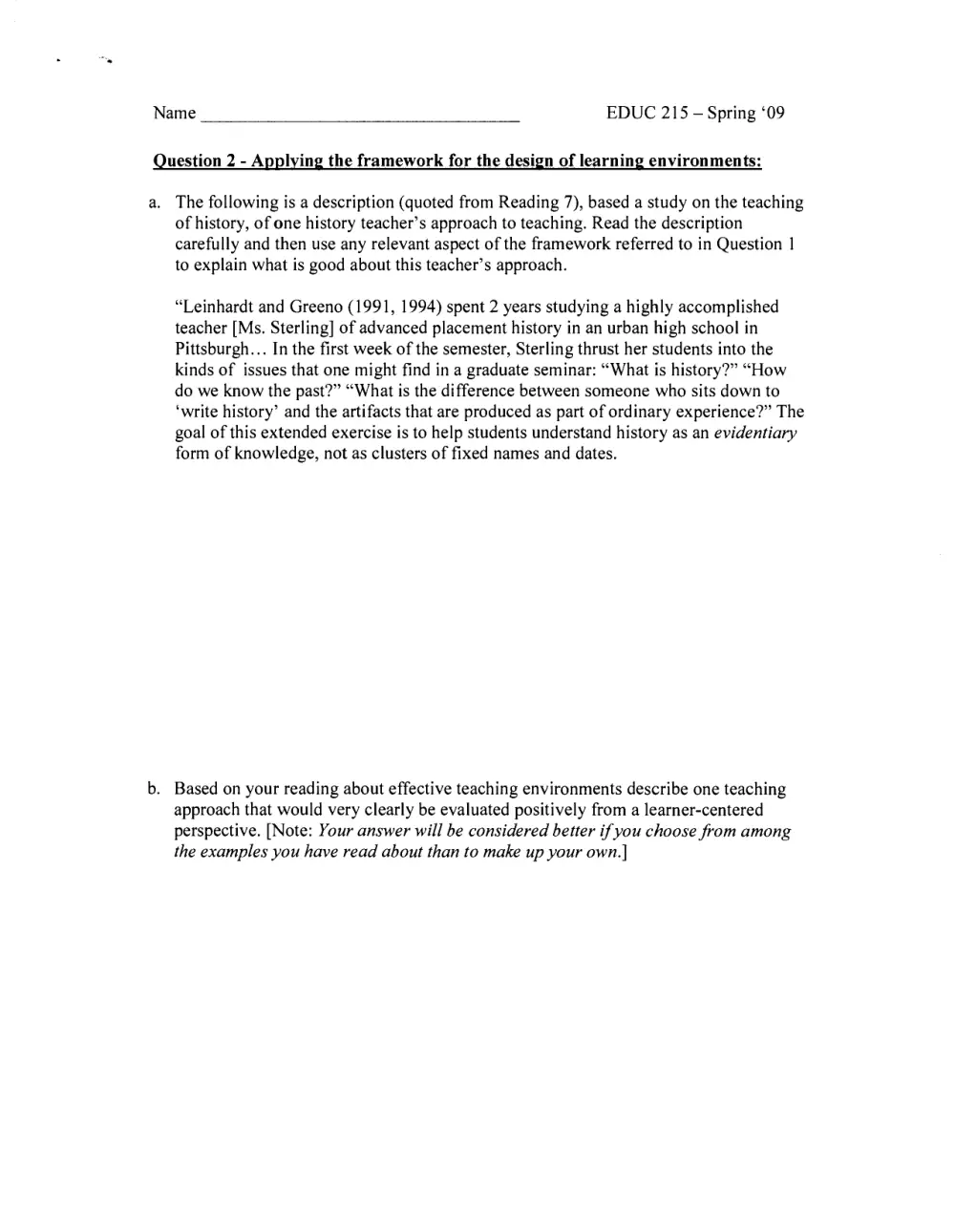
Name EDUC 215 — Spring ‘09
Question 2 - Applying the framework for the design of learning environments:
a. The following is a description (quoted from Reading 7), based a study on the teaching
of history, of one history teacher’s approach to teaching. Read the description
carefully and then use any relevant aspect of the framework referred to in Question 1
to explain what is good about this teacher’s approach.
“Leinhardt and Greeno (1991, 1994) spent 2 years studying a highly accomplished
teacher [Ms. Sterling] of advanced placement history in an urban high school in
Pittsburgh... In the first week of the semester, Sterling thrust her students into the
kinds of issues that one might find in a graduate seminar: “What is history?” “How
do we know the past?” “What is the difference between someone who sits down to
‘write history’ and the artifacts that are produced as part of ordinary experience?” The
goal of this extended exercise is to help students understand history as an evidentiary
form of knowledge, not as clusters of fixed names and dates.
b. Based on your reading about effective teaching environments describe one teaching
approach that would very clearly be evaluated positively from a learner-centered
perspective. [Note: Your answer will be considered better if you choose from among
the examples you have read about than to make up your own.]
Name EDUC 215 — Spring ‘09
Short Essay Question:
Question 3 — Integrating aspects of the framework:
It is all very well to design learning environments taking the four different perspectives
(knowledge, learner, assessment and community) into account. However, it is important
that these four perspectives are aligned. Explain.
oe A A eo
Name: EDUC 215 — Spring 2009
EDUCATION 215
Final Exam - Part 2 (Open Book)
You can use any books, notes or readings you have during this part of the exam but you
may not share any of these with classmates. Answer any ONE of the following two
questions in a well organized essay of about 3-4 booklet pages:
Question 1
A common pattern of verbal interaction in classrooms at many levels of education (from
elementary school to university) is what is referred to as the Initiation-Response-
Feedback (IRF) pattern. In this type of verbal interaction the teacher poses a question to
the class, receives a brief response from a student, and provides feedback on the
adequacy of the response. Write an essay that provides an extended critique of this style
teaching. Make sure to make use of relevant theories of learning and research findings to
support your critique.
OR,
Question 2
Many educational programs incorporate some kind of internship or practical training as
part of the requirements for the program. Someone studying finance might spend a
summer working at a bank, an architecture student may work at a design firm, a physics
student might work in a research lab and an English literature student might work at a
newspaper helping with the editing of the culture page.
Use theories of learning and research findings you have encountered in this course
to justify the inclusion of a practical training component in the requirements for a
university degree.