
EDUC 215 Chapter 2, Fall 2012
American University of Beirut · Learning and Human Development · 42 pages







Showing the first 10 of 42 pages. Download the PDF to see all of it.
More EDUC 215 files
Show the text of this chapter
28
1
3
2
Identify the key features of language,
the biological and environmental
influences on language, and the typical
growth of child’s language.
Discuss the development of the
brain and compare the cognitive
developmental theories of Jean Piaget
and Lev Vygotsky.
Define development and explain the
main processes, periods, and issues in
development, as well as links between
development and education.
Learning Goals
Chapter Outline
An Overview of Child Development
Exploring What Development Is
Processes and Periods
Developmental Issues
Development and Education
Cognitive Development
The Brain
Piaget’s Theory
Vygotsky’s Theory
Language Development
What Is Language?
Biological and Environmental Influences
Language Development
Ah! What would the world be to us
If the children were no more?
We should dread the desert behind us
Worse than the dark before.
— Henry Wadsworth Longfellow
American Poet, 19th Century
C H A P T E R 2
COGNITIVE AND
LANGUAGE
DEVELOPMENT
29
In this chapter you will study Lev Vygotsky’s sociocultural cogni-
tive theory of development. Donene Polson’s classroom refl ects
Vygotsky’s emphasis on the importance of collaboration among a
community of learners. Donene teaches at Washington Elementary
School in Salt Lake City, an innovative school that emphasizes
the importance of people learning together (Rogoff, Turkanis, &
Bartlett, 2001). Children as well as adults plan learning activities.
Throughout the day at school, students work in small groups.
Donene loves working in a school where students, teachers,
and parents work as a community to help children learn (Polson,
2001). Before the school year begins, she meets with parents at
each family’s home to prepare for the upcoming year, getting ac-
quainted and establishing schedules to determine when parents
can contribute to classroom instruction. At monthly teacher-
parent meetings, Donene and the parents plan the curriculum and
discuss children’s progress. They brainstorm about community re-
sources that can be used to promote children’s learning.
Many students come back to tell Donene that experiences in
her classroom made important contributions to their development
and learning. For example, Luisa Magarian refl ected on how her
experience in Donene’s classroom helped her work with others in
high school:
From having responsibility in groups, kids learn how to deal with
problems and listen to each other or try to understand different
points of view. They learn how to help a group work smoothly
and how to keep people interested in what they are doing. . . .
As coeditor of the student news magazine at my high school, I
have to balance my eagerness to get things done with patience
to work with other students. (Rogoff, Turkanis, & Bartlett, 2001,
pp. 84–85)
As Donene Polson’s story shows, theories of cognitive develop-
ment can form the basis of innovative instructional programs.
Teaching Stories
Donene Polson
Preview
Examining the shape of children’s development allows us to understand it better. This
chapter—the fi rst of two on development—focuses on children’s cognitive and lan-
guage development. Before we delve into these topics, though, we need to explore
some basic ideas about development.
Twentieth-century Spanish-born American philosopher George Santayana once
refl ected, “Children are on a diff erent plane. Th ey belong to a generation and way of
feeling properly their own.” Let’s explore what that plane is like.
EXPLORING WHAT DEVELOPMENT IS
Why study children’s development? As a teacher, you will be responsible for a new wave
of children each year in your classroom. Th e more you learn about children’s develop-
ment, the more you can understand at what level it is appropriate to teach them.
Just what do psychologists mean when they speak of a person’s “development”?
Development is the pattern of biological, cognitive, and socioemotional changes that
begins at conception and continues through the life span. Most development involves
growth, although it also eventually involves decay (dying).
PROCESSES AND PERIODS
Th e pattern of child development is complex because it is the product of several
processes: biological, cognitive, and socioemotional. Development also can be de-
scribed in terms of periods.
Exploring What
Development Is
AN OVERVIEW OF CHILD DEVELOPMENT
Processes and
Periods
Developmental
Issues
Development and
Education
1
development The pattern of biological, cognitive,
and socioemotional processes that begins at con-
ception and continues through the life span. Most
development involves growth, although it also even-
tually involves decay (dying).
DEVELOPMENT
30
Chapter 2 Cognitive and Language Development
Biological, Cognitive, and Socioemotional Processes Biological processes
produce changes in the child’s body and underlie brain development, height and
weight gains, motor skills, and puberty’s hormonal changes. Genetic inheritance
plays a large part.
Cognitive processes involve changes in the child’s thinking, intelligence, and lan-
guage. Cognitive developmental processes enable a growing child to memorize a
poem, fi gure out how to solve a math problem, come up with a creative strategy, or
speak meaningfully connected sentences.
Socioemotional processes involve changes in the child’s relationships with other
people, changes in emotion, and changes in personality. Parents’ nurturance toward
their child, a boy’s aggressive attack on a peer, a girl’s development of assertiveness,
and an adolescent’s feelings of joy aft er getting good grades all refl ect socioemotional
processes in development.
Biological, cognitive, and socioemotional processes are inextricably intertwined
(Diamond, Casey, & Munakata, 2011). Consider a child smiling in response to a
parent’s touch. Th is response depends on biological processes (the physical nature
of touch and responsiveness to it), cognitive processes (the ability to understand
intentional acts), and socioemotional processes (the act of smiling oft en refl ects a
positive emotional feeling, and smiling helps to connect us in positive ways with
other human beings). Two rapidly emerging fi elds further explore this connection
across biological, cognitive, and socioemotional processes:
● developmental cognitive neuroscience, which explores links between development,
cognitive processes, and the brain (Diamond, Casey, & Munakato, 2011; Nelson,
2011), For example, later in this chapter you will learn about connections between
developmental changes in regions of the brain and children’s thinking.
● developmental social neuroscience , which examines connections between socio-
emotional processes, development, and the brain (Bell, Greene, & Wolfe, 2010;
de Haan & Gunnar, 2009). For example, later in this chapter you will read
about developmental changes in the brain and adolescents’ decision making
and risk-taking behavior.
Periods of Development For the purposes of organization and understanding,
we commonly describe development in terms of periods. In the most widely used
system of classifi cation, the developmental periods are infancy, early childhood,
middle and late childhood, adolescence, early adulthood, middle adulthood, and late
adulthood.
Infancy extends from birth to 18 to 24 months. It is a time of extreme depen-
dence on adults. Many activities are just beginning, such as language development,
symbolic thought, sensorimotor coordination, and social learning.
Early childhood (sometimes called the preschool years) extends from the end of
infancy to about 5 years. During this period, children become more self-suffi cient,
develop school readiness skills (such as learning to follow instructions and identify
Children are the legacy we
leave for the time we will not
live to see.
—Aristotle
Greek Philosopher, 4th Century b.c.
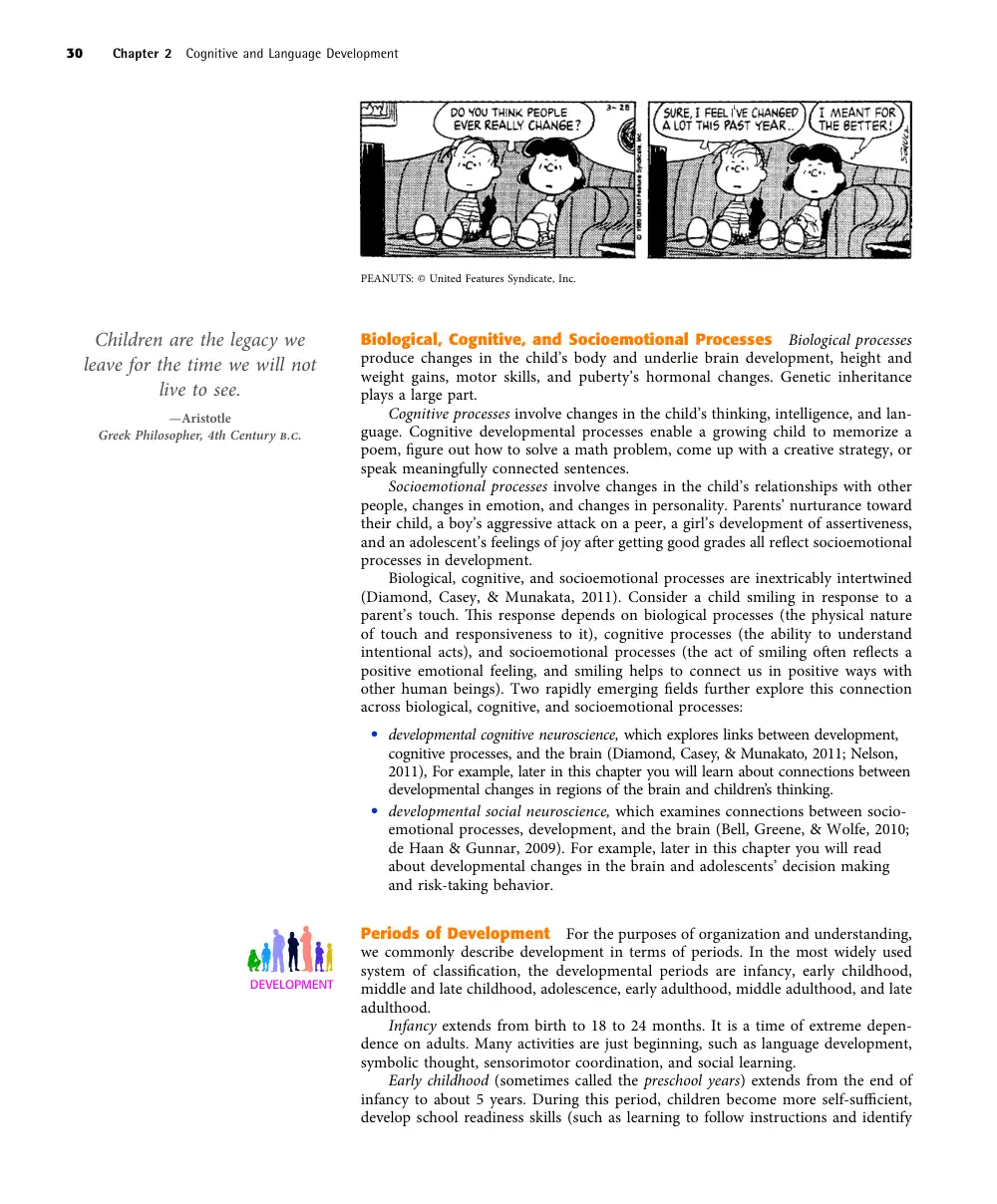
PEANUTS: © United Features Syndicate, Inc.
DEVELOPMENT
www.mhhe.com/santrockep5e
An Overview of Child Development
31
letters), and spend many hours with peers. First grade typically marks the end of
early childhood.
Middle and late childhood (sometimes called the elementary school years) extends
from about 6 to 11 years of age. Children master the fundamental skills of reading, writ-
ing, and math, achievement becomes a more central theme, and self-control increases.
In this period, children interact more with the wider social world beyond their family.
Adolescence involves the transition from childhood to adulthood. It begins
around ages 10 to 12 and ends around 18 to 21. Adolescence starts with rapid phys-
ical changes, including height and weight gains and development of sexual functions.
Adolescents intensely pursue independence and seek their own identity. Th eir
thought becomes more abstract, logical, and idealistic.
Adult developmental periods have been described, but we have confi ned our
discussion to the periods most relevant for children’s and adolescents’ education. Th e
child and adolescent periods of human development are shown in Figure 2.1 along
with the processes of development (biological, cognitive, and socioemotional). Th e
interplay of these processes produces the periods of human development.
DEVELOPMENTAL ISSUES
Despite all of the knowledge that developmentalists have acquired, debate continues
about the relative importance of factors that infl uence the developmental processes
and about how the periods of development are related. Th e most important issues
in the study of children’s development include nature and nurture, continuity and
discontinuity, and early and later experience.
Periods of Development
Prenatal period
(conception to
birth)
Infancy
(birth to 18–24
months)
Early childhood
(2–5 years)
Middle and
late childhood
(6–11 years)
Adolescence
(10–12 to
18–21 years)
Processes of Development
Biological
processes
Cognitive
processes
Socioemotional
processes
Biological
Processes
Cognitive
Processes
Socioemotional
Processes
FIGURE 2.1 PERIODS AND PROCESSES OF DEVELOPMENT
Development moves through the infancy, early childhood, middle and late childhood, and
adolescence periods. These periods of development are the result of biological, cognitive, and
socioemotional processes.
32
Chapter 2 Cognitive and Language Development
Nature and Nurture Th e nature-nurture issue involves the debate about
whether development is primarily infl uenced by nature or by nurture (Cosmides,
2011; Eagly & Wood, 2011). Nature refers to an organism’s biological inheritance,
nurture to its environmental experiences. Almost no one today argues that develop-
ment can be explained by nature or nurture alone. But some (“nature” proponents)
claim that the most important infl uence on development is biological inheritance,
and others (“nurture” proponents) claim that environmental experiences are the
most important infl uence.
According to the nature proponents, the range of environments can be vast, but
a genetic blueprint produces commonalities in growth and development (Mader,
2011). We walk before we talk, speak one word before two words, grow rapidly in
infancy and less so in early childhood, and experience a rush of sexual hormones in
puberty. Extreme environments—those that are psychologically barren or hostile—
can stunt development, but nature proponents emphasize the infl uence of tendencies
that are genetically wired into humans.
By contrast, other psychologists emphasize the importance of nurture, or envi-
ronmental experiences, to development (Grusec, 2011; Kopp, 2011). Experiences run
the gamut from the individual’s biological environment (nutrition, medical care,
drugs, and physical accidents) to the social environment (family, peers, schools, com-
munity, media, and culture). For example, a child’s diet can aff ect how tall the child
grows and even how eff ectively the child can think and solve problems.
Are children completely at the mercy of their genes and environment as they
develop? Th eir genetic heritage and environmental experiences are pervasive infl u-
ences on their development. However, children are more than the outcomes of their
heredity and the environment they experience; they also can author a unique devel-
opmental path by changing the environment. As one psychologist recently concluded,
In reality, we are both the creatures and creators of our worlds. We are . . . the prod-
ucts of our genes and environments. Nevertheless, . . . the stream of causation that
shapes the future runs through our present choices. . . . Mind matters. . . . Our hopes,
goals, and expectations infl uence our future. (Myers, 2010, p. 168)
Continuity and Discontinuity Th e continuity-discontinuity issue focuses on
the extent to which development involves gradual, cumulative change (continuity)
or distinct stages (discontinuity). For the most part, developmentalists who empha-
size nurture usually describe development as a gradual, continuous process, like the
seedling’s growth into an oak. Th ose who emphasize nature oft en describe develop-
ment as a series of distinct stages, like the change from caterpillar to butterfl y.
Consider continuity fi rst. A child’s fi rst word, though seemingly an abrupt, dis-
continuous event, is actually the result of weeks and months of growth and practice.
Puberty, another seemingly abrupt, discontinuous occurrence, is actually a gradual
process occurring over several years.
Viewed in terms of discontinuity, each person is described as passing through a
sequence of stages in which change is qualitatively rather than quantitatively diff er-
ent. A child moves at some point from not being able to think abstractly about the
world to being able to. Th is is a qualitative, discontinuous change in development,
not a quantitative, continuous change.
Early and Later Experience Th e early-later experience issue focuses on the
degree to which early experiences (especially in infancy) or later experiences are the
key determinants of the child’s development. Th at is, if infants experience harmful
circumstances, can those experiences be overcome by later, positive ones? Or are the
early experiences so critical—possibly because they are the infant’s fi rst, prototypical
experiences—that they cannot be overridden by a later, better environment?
Th e early-later experience issue has a long history and continues to be hotly
debated among developmentalists (Kopp, 2011; Schaie, 2011). Some developmentalists
nature-nurture issue Nature refers to an organ-
ism’s biological inheritance, nurture to environmen-
tal influences. The “nature” proponents claim
biological inheritance is the most important influ-
ence on development; the “nurture” proponents
claim environmental experiences are the most
important.
continuity-discontinuity issue The issue
regarding whether development involves gradual,
cumulative change (continuity) or distinct stages
(discontinuity).
early-later experience issue The issue of the
degree to which early experiences (especially
infancy) or later experiences are the key determi-
nants of the child’s development.
Children are busy becoming
something they have not quite
grasped yet, something which
keeps changing.
—Alastair Reid
American Poet, 20th Century
www.mhhe.com/santrockep5e
An Overview of Child Development
33
argue that, unless infants experience warm, nurturing care during the fi rst year or so
of life, their development will never quite be optimal (Sroufe, 2007). In contrast, later-
experience advocates argue that children are malleable throughout development, and
that later sensitive caregiving is just as important as earlier sensitive caregiving.
Evaluating the Developmental Issues Most developmentalists recognize that
it is unwise to take an extreme position on the issues of nature and nurture, continu-
ity and discontinuity, and early and later experiences. Development is not all nature
or all nurture, not all continuity or all discontinuity, and not all early or later experi-
ences. However, there is still spirited debate about how strongly development is infl u-
enced by each of these factors (Goldsmith, 2011; Phillips & Lowenstein, 2011).
DEVELOPMENT AND EDUCATION
In Chapter 1 we briefl y described the importance of engaging in developmentally
appropriate teaching practices. Here we expand on this important topic.
Developmentally appropriate teaching takes place at a level that is neither too
diffi cult and stressful nor too easy and boring for the child’s developmental level
(Bredekamp, 2011). One of the challenges of developmentally appropriate teaching
is that you likely will have children with an age range of several years and a range
of abilities and skills in the classes you teach. Competent teachers are aware of these
developmental diff erences. Rather than characterizing students as “advanced,” “aver-
age,” and “slow,” they recognize that their development and ability are complex, and
children oft en do not display the same competence across diff erent skills.
Splintered development refers to the circumstances in which development is
uneven across domains (Horowitz & others, 2005). One student may have excellent
math skills but poor writing skills. Within the area of language, another student may
have excellent verbal language skills but not have good reading and writing skills.
Yet another student may do well in science but lack social skills.
Cognitively advanced students whose socioemotional development is at a level
expected for much younger children present a special challenge. For example, a stu-
dent may excel at science, math, and language but be immature emotionally. Such a
child may not have any friends and be neglected or rejected by peers. Th is student
will benefi t considerably from having a teacher who helps her or him learn how to
manage emotions and behave in more socially appropriate ways.
As we discuss development in this chapter and the next, keep in mind how
the developmental changes we describe can help you understand the optimal level
for teaching and learning. For example, it is not a good strategy to try to push
children to read before they are developmentally ready—but when they are ready,
reading materials should be presented at the appropriate level (Bredekamp, 2011;
Jalongo, 2011).
splintered development The circumstances in
which development is uneven across domains.
Thinking Back/Thinking Forward
New guidelines exist for developmentally
appropriate education (NAEYC, 2009).
Chapter 3, p. 86
Review, Reflect, and Practice
Define development and explain the main processes, periods, and
issues in development, as well as links between development and
education.
REVIEW
● What is the nature of development?
● What three broad processes interact in a child’s development? What general
periods do children go through between birth and the end of adolescence?
1
(continued)
34
Chapter 2 Cognitive and Language Development
Review, Reflect, and Practice
REVIEW (CONTINUED)
● What are the main developmental issues? What conclusions can be reached
about these issues?
● What implications does the concept of development have for the notion of
“appropriate” learning?
REFLECT
● Give an example of how a cognitive process could influence a socioemo-
tional process in the age of children you plan to teach. Then give an exam-
ple of how a socioemotional process could influence a cognitive process in
this age group.
PRAXIS™ PRACTICE
1. Mr. Huxtaby is giving a talk on development to a parent-teacher organization.
In his talk, which of the following is he most likely to describe as not being
an example of development?
a. pubertal change
b. improvement in memory
c. change in friendship
d. an inherited tendency to be shy
2. Ms. Halle teaches third grade. Which period of development is likely to be of
most interest to her?
a. infancy
b. early childhood
c. middle childhood and late childhood
d. adolescence
3. Piaget argued that children progress through a series of cognitive development
stages. In contrast, Skinner stressed that individuals simply learn more as time
goes on. Which developmental issue is highlighted in their disagreement?
a. continuity and discontinuity
b. early and later experience
c. nature and nurture
d. biological and socioemotional development
4. Alexander’s scores on standardized mathematics achievement tests are always
very high—among the highest in the nation. In contrast, his scores on reading
achievement tests indicate that he is about average. This is an example of
a. developmentally appropriate teaching.
b. early versus later development.
c. nature versus nurture.
d. splintered development.
Please see the answer key at the end of the book.
COGNITIVE DEVELOPMENT
The Brain
Vygotsky’s Theory
Piaget’s Theory
2
Twentieth-century American poet Marianne Moore said that the mind is “an enchant-
ing thing.” How this enchanting thing develops has intrigued many psychologists.
First, we explore increasing interest in the development of the brain and then turn
to two major cognitive theories—Piaget’s and Vygotsky’s.
www.mhhe.com/santrockep5e
Cognitive Development
35
THE BRAIN
Until recently little was known about how the brain changes as children develop.
Not long ago scientists thought that genes determine how children’s brains are
“wired.” Whatever brain heredity dealt them, children were essentially stuck with it.
Th is view, however, turned out to be wrong. Instead, the brain has considerable
plasticity, or the ability to change, and its development depends on experience
(Nelson, 2011; Toga & Mazziotta, 2011). In other words, what children do can change
the development of their brain.
Development of Neurons and Brain Regions Th e number and size of the
brain’s nerve endings continue to grow at least into adolescence. Some of the brain’s
increase in size also is due to myelination, the process of encasing many cells in the
brain with a myelin sheath (see Figure 2.2). Th is process increases the speed at which
information travels through the nervous system (Schnaar & Lopez, 2009). Myelination
in brain areas important in focusing attention is not complete until about 10 years
of age. Th e implications for teaching are that children will have diffi culty focusing
their attention and maintaining it for very long in early childhood, but their attention
will improve as they move through the elementary school years. Th e most extensive
increase in myelination, which occurs in the brain’s frontal lobes, where reasoning
and thinking occur, takes place during adolescence (Giedd & others, 2009).
Another important aspect of the brain’s development at the cellular level is the
dramatic increase in connections between neurons (nerve cells) (Turrigiano, 2010).
Synapses are tiny gaps between neurons where connections between neurons are
made. Researchers have discovered an interesting aspect of synaptic connections.
Nearly twice as many of these connections are made than ever will be used
(Huttenlocher & Dabholkar, 1997). Th e connections that are used become strength-
ened and will survive, whereas the unused ones will be replaced by other pathways
or disappear. Th at is, in the language of neuroscience, these connections will be
“pruned.” Figure 2.3 vividly shows the dramatic growth and later pruning of synapses
in the visual, auditory, and prefrontal cortex areas of the brain. Th ese areas are crit-
ical for higher-order cognitive functioning such as learning, memory, and reasoning.
myelination The process of encasing many cells
in the brain with a myelin sheath that increases the
speed at which information travels through the
nervous system.
FIGURE 2.2 MYELINATED NERVE
Fiber. The myelin sheath, shown in brown,
encases the axon (white). This image was
produced by an electron microscope that
magnified the nerve fiber 12,000 times. What
role does myelination play in the brain’s
development?
Myelin Sheath
Axon
FIGURE 2.3 SYNAPTIC DENSITY
IN HUMAN BRAIN FROM INFANCY TO
ADULTHOOD
The graph shows the dramatic increase and
then pruning of synaptic density for three
regions of the brain: visual cortex, auditory
cortex, and prefrontal cortex. Synaptic density
is believed to be an important indication of
the extent of connectivity between neurons.
0
Age in days (from conception)
Synaptic density
60
50
40
30
20
10
100
200
300 400 500 600
800 1,000
1,500 2,000
3,000
4,000
6,000 8,000 10,000
birth
1 year
3 years
11 years
adult
Visual cortex (vision)
Auditory cortex (hearing)
Prefrontal cortex (reasoning,
self-regulation)
DEVELOPMENT
36
Chapter 2 Cognitive and Language Development
Notice that in the prefrontal cortex (discussed further later on),
where higher-level thinking and self-regulation take place, it is not
until middle to late adolescence that the adult density of the syn-
apses is achieved.
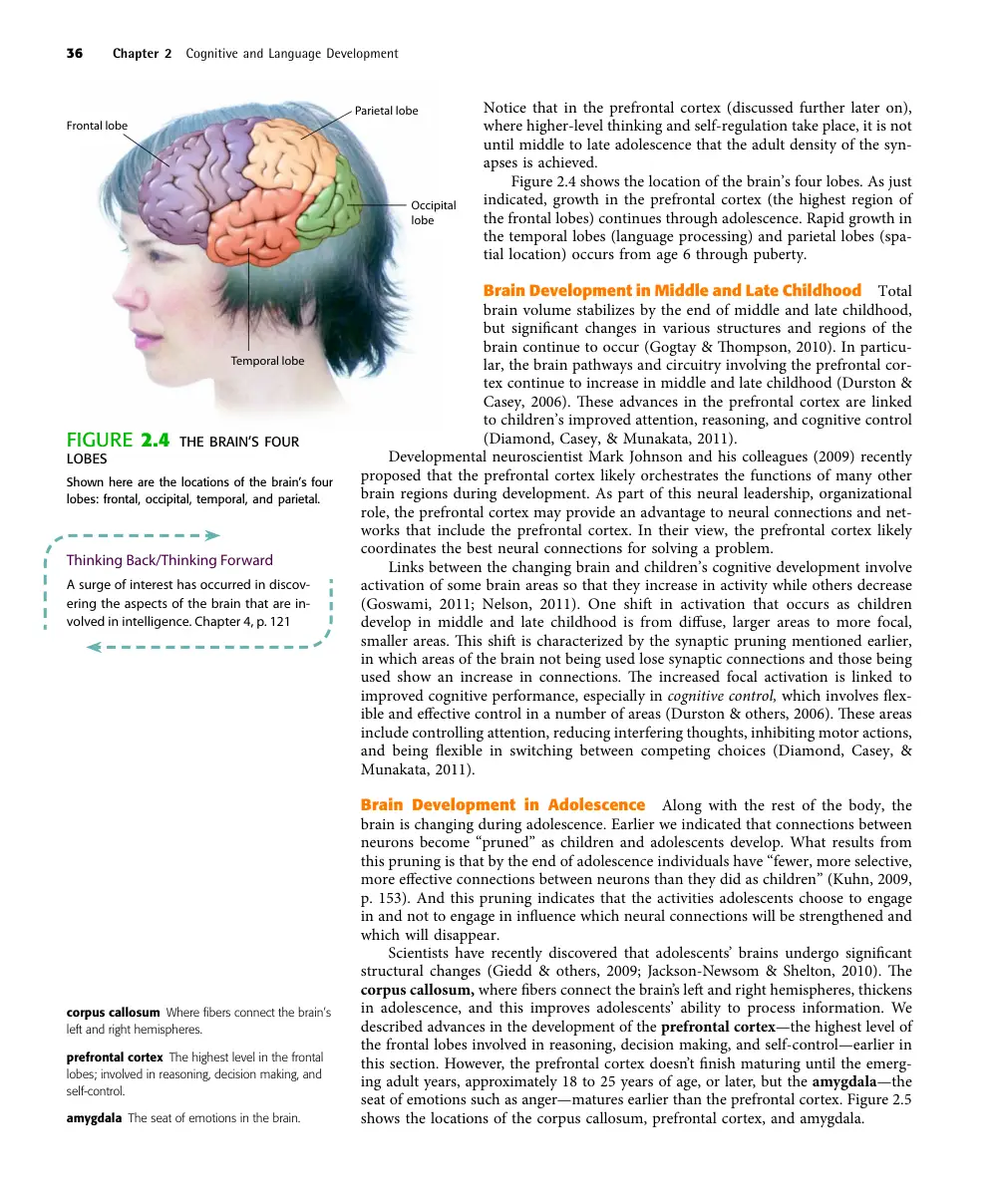
Figure 2.4 shows the location of the brain’s four lobes. As just
indicated, growth in the prefrontal cortex (the highest region of
the frontal lobes) continues through adolescence. Rapid growth in
the temporal lobes (language processing) and parietal lobes (spa-
tial location) occurs from age 6 through puberty.
Brain Development in Middle and Late Childhood Total
brain volume stabilizes by the end of middle and late childhood,
but signifi cant changes in various structures and regions of the
brain continue to occur (Gogtay & Th ompson, 2010). In particu-
lar, the brain pathways and circuitry involving the prefrontal cor-
tex continue to increase in middle and late childhood (Durston &
Casey, 2006). Th ese advances in the prefrontal cortex are linked
to children’s improved attention, reasoning, and cognitive control
(Diamond, Casey, & Munakata, 2011).
Developmental neuroscientist Mark Johnson and his colleagues (2009) recently
proposed that the prefrontal cortex likely orchestrates the functions of many other
brain regions during development. As part of this neural leadership, organizational
role, the prefrontal cortex may provide an advantage to neural connections and net-
works that include the prefrontal cortex. In their view, the prefrontal cortex likely
coordinates the best neural connections for solving a problem.
Links between the changing brain and children’s cognitive development involve
activation of some brain areas so that they increase in activity while others decrease
(Goswami, 2011; Nelson, 2011). One shift in activation that occurs as children
develop in middle and late childhood is from diff use, larger areas to more focal,
smaller areas. Th is shift is characterized by the synaptic pruning mentioned earlier,
in which areas of the brain not being used lose synaptic connections and those being
used show an increase in connections. Th e increased focal activation is linked to
improved cognitive performance, especially in cognitive control, which involves fl ex-
ible and eff ective control in a number of areas (Durston & others, 2006). Th ese areas
include controlling attention, reducing interfering thoughts, inhibiting motor actions,
and being fl exible in switching between competing choices (Diamond, Casey, &
Munakata, 2011).
Brain Development in Adolescence Along with the rest of the body, the
brain is changing during adolescence. Earlier we indicated that connections between
neurons become “pruned” as children and adolescents develop. What results from
this pruning is that by the end of adolescence individuals have “fewer, more selective,
more eff ective connections between neurons than they did as children” (Kuhn, 2009,
p. 153). And this pruning indicates that the activities adolescents choose to engage
in and not to engage in infl uence which neural connections will be strengthened and
which will disappear.
Scientists have recently discovered that adolescents’ brains undergo signifi cant
structural changes (Giedd & others, 2009; Jackson-Newsom & Shelton, 2010). Th e
corpus callosum , where fi bers connect the brain’s left and right hemispheres, thickens
in adolescence, and this improves adolescents’ ability to process information. We
described advances in the development of the prefrontal cortex —the highest level of
the frontal lobes involved in reasoning, decision making, and self-control—earlier in
this section. However, the prefrontal cortex doesn’t fi nish maturing until the emerg-
ing adult years, approximately 18 to 25 years of age, or later, but the amygdala —the
seat of emotions such as anger—matures earlier than the prefrontal cortex. Figure 2.5
shows the locations of the corpus callosum, prefrontal cortex, and amygdala.
Frontal lobe
Temporal lobe
Occipital
lobe
Parietal lobe
FIGURE 2.4 THE BRAIN’S FOUR
LOBES
Shown here are the locations of the brain’s four
lobes: frontal, occipital, temporal, and parietal.
Thinking Back/Thinking Forward
A surge of interest has occurred in discov-
ering the aspects of the brain that are in-
volved in intelligence. Chapter 4, p. 121
corpus callosum Where fibers connect the brain’s
left and right hemispheres.
prefrontal cortex The highest level in the frontal
lobes; involved in reasoning, decision making, and
self-control.
amygdala The seat of emotions in the brain.
www.mhhe.com/santrockep5e
Cognitive Development
37
Corpus callosum
These nerve fibers connect the brain’s
two hemispheres; they thicken in
adolescence to process information
more effectively.
Prefrontal cortex
This “judgment” region reins in
intense emotions but doesn’t
finish developing until at least
emerging adulthood.
Amygdala
The seat of emotions such as anger;
this area develops quickly before
other regions that help to control it.
FIGURE 2.5 CHANGES IN ADOLESCENT BRAIN
Leading researcher Charles Nelson (2011) points out
that although adolescents are capable of very strong emo-
tions, their prefrontal cortex hasn’t adequately developed to
the point at which they can control these passions. Th is
means that the brain region for putting the brakes on risky,
impulsive behavior is still under construction during ado-
lescence (Giedd & others, 2009). Or consider this interpre-
tation of the development of emotion and cognition in
adolescence: “early activation of strong ‘turbo-charged’
fe