
EECE 200 Syllabus, Fall 2013
American University of Beirut · Introduction to Electrical and Computer Engineering · 4 pages


More EECE 200 files
Show the text of this lab
Department of Electrical and Computer Engineering
Faculty of Engineering and Architecture
American University of Beirut
Course Information
Course title: Introduction to Electrical and Computer Engineering
Course number: EECE 200
Catalog description:
Overview of electrical and computer engineering; engineering as a profession; introduction to
the different areas of ECE such as biomedical systems, circuits, communications, computer
design, control, distributed systems, electromagnetics, energy, machines, and signal processing;
basic computer tools such as SPICE, MATLAB, and LabVIEW; basic laboratory instruments;
laboratory experiments and design project.
Credit hours: 3 credits
Required or elective:
Required for CCE / ECE students
Prerequisites:
By course: None
By topic: High school mathematics and physics.
Textbook(s) and/or required materials
R.M. Ford and C.S. Coulston, “Design of Electrical and Computer Engineers, “ McGraw-Hill
International Edition, 2008
References:
Introduction to Electrical Engineering, Sarma, Oxford University Press, 2001 (621.3:S246i)
Introduction to Electrical and Computer Engineering, Fleddermann and Bradshaw, Prentice
Hall, 2003
Introduction to Engineering, Burghardt, Harper Collins, 1992 (620.002:B956i)
Tools and Tactics of Design, Prentice Hall, Wiley, 2001 (620.004:T671d).
Course Objectives
The objectives of this course are to:
Correlates to
program
objectives
Introduce students to the engineering profession
3,4
Provide students with an overview of engineering ethics
4
Present to the students the various areas of electrical and computer engineering
1,4
Introduce students to some basic mathematical and computing tools used in
electrical and computer engineering
2
Foster effective communication and teamwork skills among students
3
2
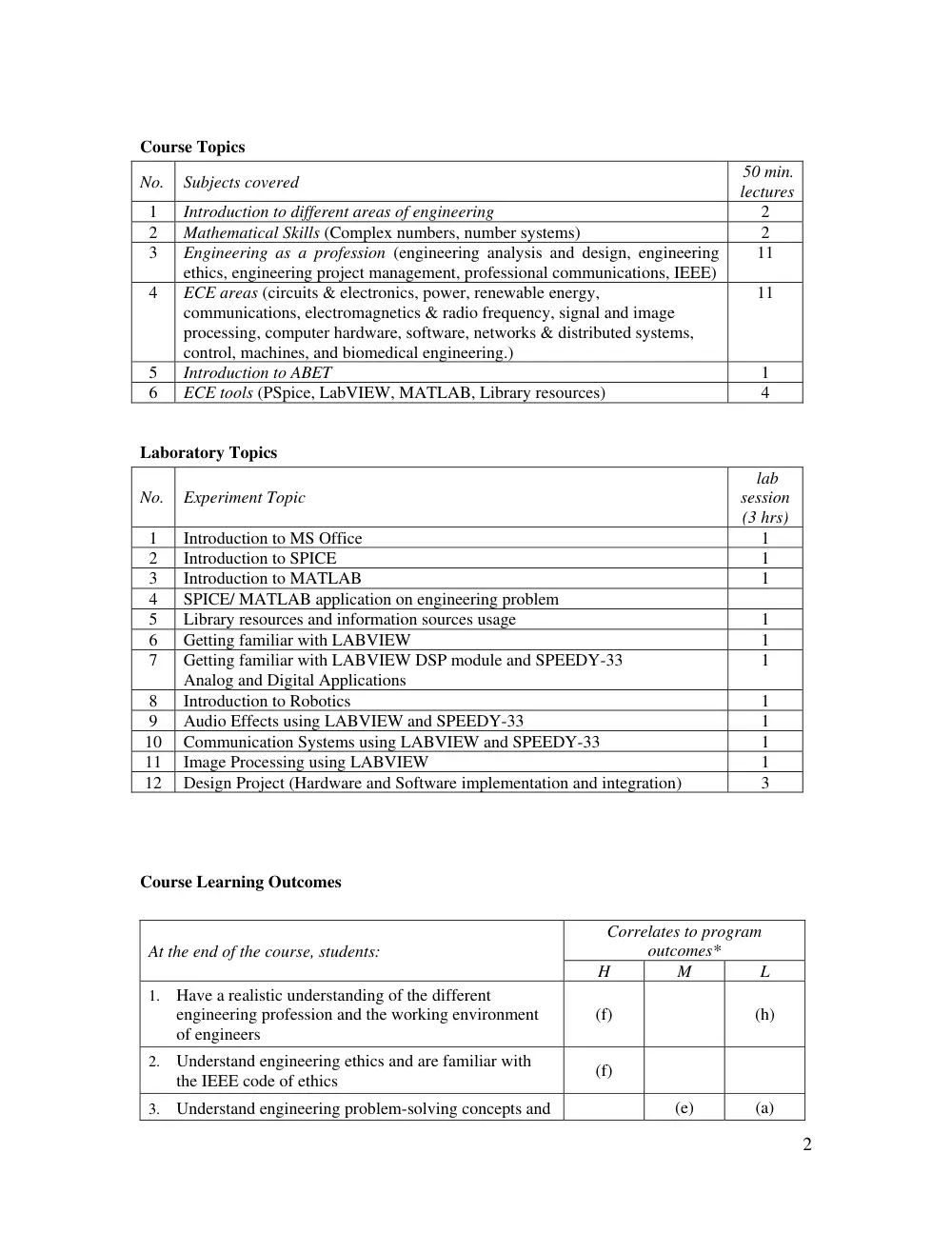
Course Topics
No.
Subjects covered
50 min.
lectures
1
Introduction to different areas of engineering
2
2
Mathematical Skills (Complex numbers, number systems)
2
3
Engineering as a profession (engineering analysis and design, engineering
ethics, engineering project management, professional communications, IEEE)
11
4
ECE areas (circuits & electronics, power, renewable energy,
communications, electromagnetics & radio frequency, signal and image
processing, computer hardware, software, networks & distributed systems,
control, machines, and biomedical engineering.)
11
5
Introduction to ABET
1
6
ECE tools (PSpice, LabVIEW, MATLAB, Library resources)
4
Laboratory Topics
No.
Experiment Topic
lab
session
(3 hrs)
1
Introduction to MS Office
1
2
Introduction to SPICE
1
3
Introduction to MATLAB
1
4
SPICE/ MATLAB application on engineering problem
5
Library resources and information sources usage
1
6
Getting familiar with LABVIEW
1
7
Getting familiar with LABVIEW DSP module and SPEEDY-33
Analog and Digital Applications
1
8
Introduction to Robotics
1
9
Audio Effects using LABVIEW and SPEEDY-33
1
10
Communication Systems using LABVIEW and SPEEDY-33
1
11
Image Processing using LABVIEW
1
12
Design Project (Hardware and Software implementation and integration)
3
Course Learning Outcomes
At the end of the course, students:
Correlates to program
outcomes*
H
M
L
1. Have a realistic understanding of the different
engineering profession and the working environment
of engineers
(f)
(h)
2. Understand engineering ethics and are familiar with
the IEEE code of ethics
(f)
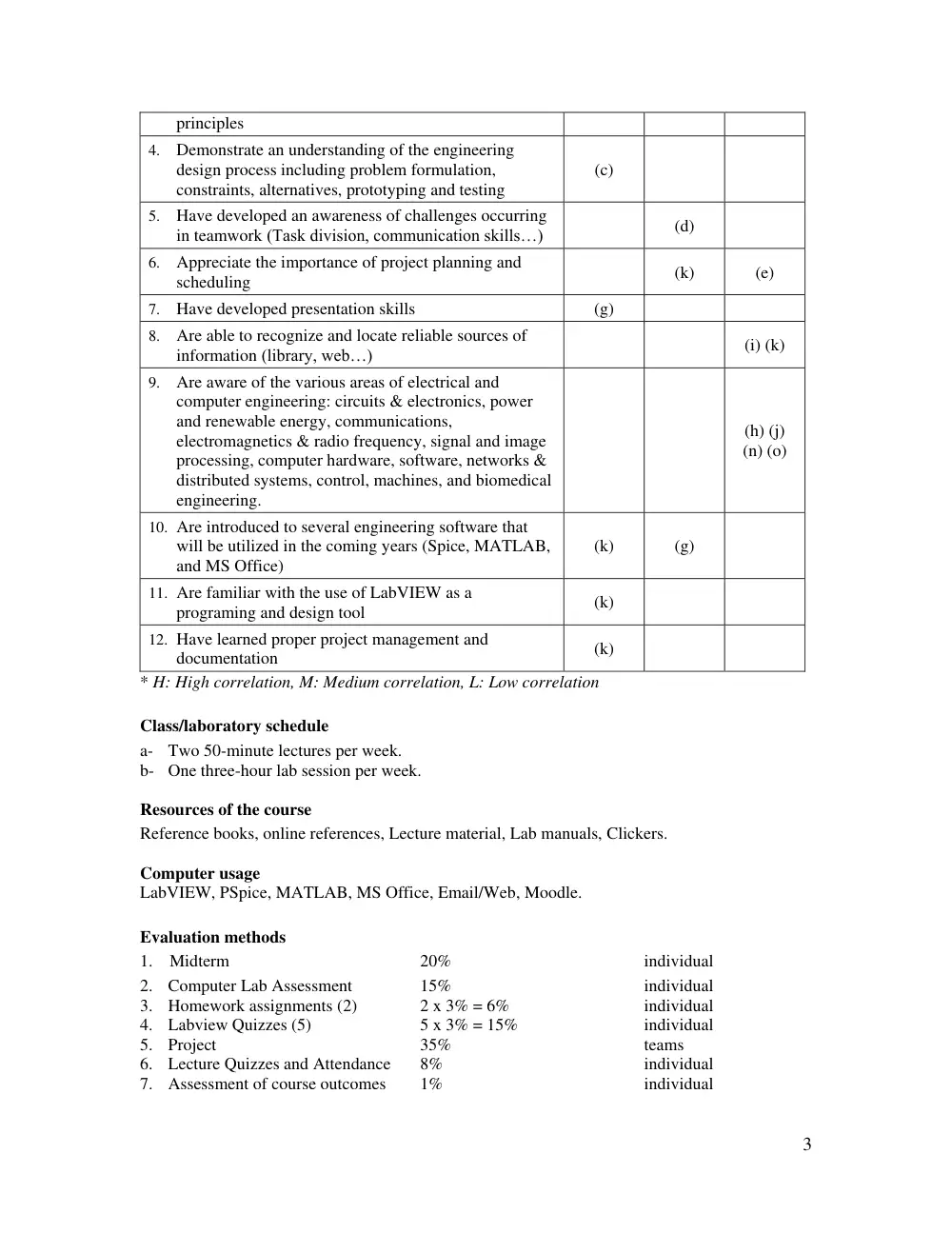
3. Understand engineering problem-solving concepts and
(e)
(a)
3
principles
4. Demonstrate an understanding of the engineering
design process including problem formulation,
constraints, alternatives, prototyping and testing
(c)
5. Have developed an awareness of challenges occurring
in teamwork (Task division, communication skills…)
(d)
6. Appreciate the importance of project planning and
scheduling
(k)
(e)
7. Have developed presentation skills
(g)
8. Are able to recognize and locate reliable sources of
information (library, web…)
(i) (k)
9. Are aware of the various areas of electrical and
computer engineering: circuits & electronics, power
and renewable energy, communications,
electromagnetics & radio frequency, signal and image
processing, computer hardware, software, networks &
distributed systems, control, machines, and biomedical
engineering.
(h) (j)
(n) (o)
10. Are introduced to several engineering software that
will be utilized in the coming years (Spice, MATLAB,
and MS Office)
(k)
(g)
11. Are familiar with the use of LabVIEW as a
programing and design tool
(k)
12. Have learned proper project management and
documentation
(k)
* H: High correlation, M: Medium correlation, L: Low correlation
Class/laboratory schedule
a- Two 50-minute lectures per week.
b- One three-hour lab session per week.
Resources of the course
Reference books, online references, Lecture material, Lab manuals, Clickers.
Computer usage
LabVIEW, PSpice, MATLAB, MS Office, Email/Web, Moodle.
Evaluation methods
1. Midterm
20%
individual
2. Computer Lab Assessment 15%
individual
3. Homework assignments (2) 2 x 3% = 6%
individual
4. Labview Quizzes (5) 5 x 3% = 15%
individual
5. Project
35%
teams
6. Lecture Quizzes and Attendance 8%
individual
7. Assessment of course outcomes
1%
individual
4
Professional component
Engineering topics: 95%
General education: 0%
Mathematics and basic sciences: 5%
Preparation and Revision
Prepared by Ayman Kayssi in September 2006
Revised by Ayman Kayssi in January 2009
Revised by EECE 200 Ad-Hoc Committee in June 2009
Revised by EECE 200 Ad-Hoc Committee in November 2012
Revised by EECE 200 Ad-Hoc Committee in August 2013