
EECE 310 Exam, Spring 2008
American University of Beirut · Electronics · 1 page
Stuck on a question? A tutor can walk you through it.
More EECE 310 files
- Midterm · Fall 2014ExamView
- Midterm with Solutions · Fall 2014Exam · with solutionView
- Midterm · Fall 2013ExamView
- Midterm · Fall 2012ExamView
- Midterm with Solution · Summer 2011Exam · with solutionView
- Exam 2 with Answers · Fall 2011Exam · with solutionView
- Exam 1 with Answers · Fall 2011Exam · with solutionView
- Exam 1 · Fall 2010ExamView
Show the text of this exam
Test 1
(Oct 8, 2007)
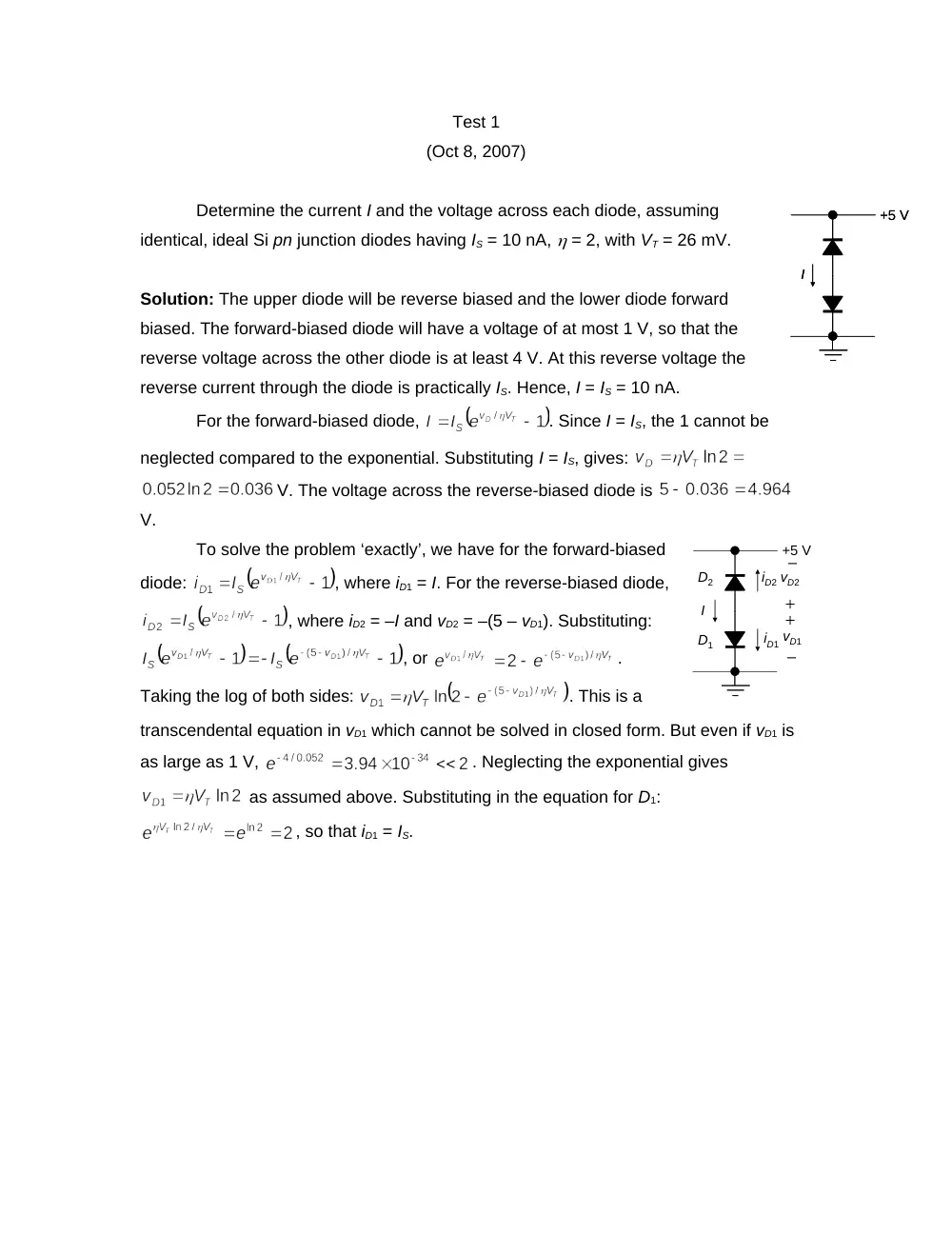
Determine the current I and the voltage across each diode, assuming
identical, ideal Si pn junction diodes having IS = 10 nA, = 2, with VT = 26 mV.
Solution: The upper diode will be reverse biased and the lower diode forward
biased. The forward-biased diode will have a voltage of at most 1 V, so that the
reverse voltage across the other diode is at least 4 V. At this reverse voltage the
reverse current through the diode is practically IS. Hence, I = IS = 10 nA.
For the forward-biased diode,
. Since I = IS, the 1 cannot be
neglected compared to the exponential. Substituting I = IS, gives:
V. The voltage across the reverse-biased diode is
V.
To solve the problem ‘exactly’, we have for the forward-biased
diode:
, where iD1 = I. For the reverse-biased diode,
, where iD2 = –I and vD2 = –(5 – vD1). Substituting:
, or
.
Taking the log of both sides:
. This is a
transcendental equation in vD1 which cannot be solved in closed form. But even if vD1 is
as large as 1 V,
. Neglecting the exponential gives
as assumed above. Substituting in the equation for D1:
, so that iD1 = IS.
+5 V
I
+5 V
I
+5 V
I
+
–
D1
D2
iD1 vD1
+
–
iD2 vD2