
EECE 310 Exam, Spring 2008
American University of Beirut · Electronics · 1 page
Stuck on a question? A tutor can walk you through it.
More EECE 310 files
- Midterm · Fall 2014ExamView
- Midterm with Solutions · Fall 2014Exam · with solutionView
- Midterm · Fall 2013ExamView
- Midterm · Fall 2012ExamView
- Midterm with Solution · Summer 2011Exam · with solutionView
- Exam 2 with Answers · Fall 2011Exam · with solutionView
- Exam 1 with Answers · Fall 2011Exam · with solutionView
- Exam 1 · Fall 2010ExamView
Show the text of this exam
Test 6
(Nov 19, 2007)
When vDS of an E-NMOS transistor is increased from 2 V to 4 V, with vGS
maintained constant, iD is multiplied by a factor of 1.5. If Vt = 1 V, determine the valid
value, or values, of vGS.
Solution: The transistor cannot be in saturation in both cases, because of the increase
in iD. Hence it must be in the triode region at vDS = 2 V, but could be in the triode region
or possibly in saturation at vDS = 4 V.
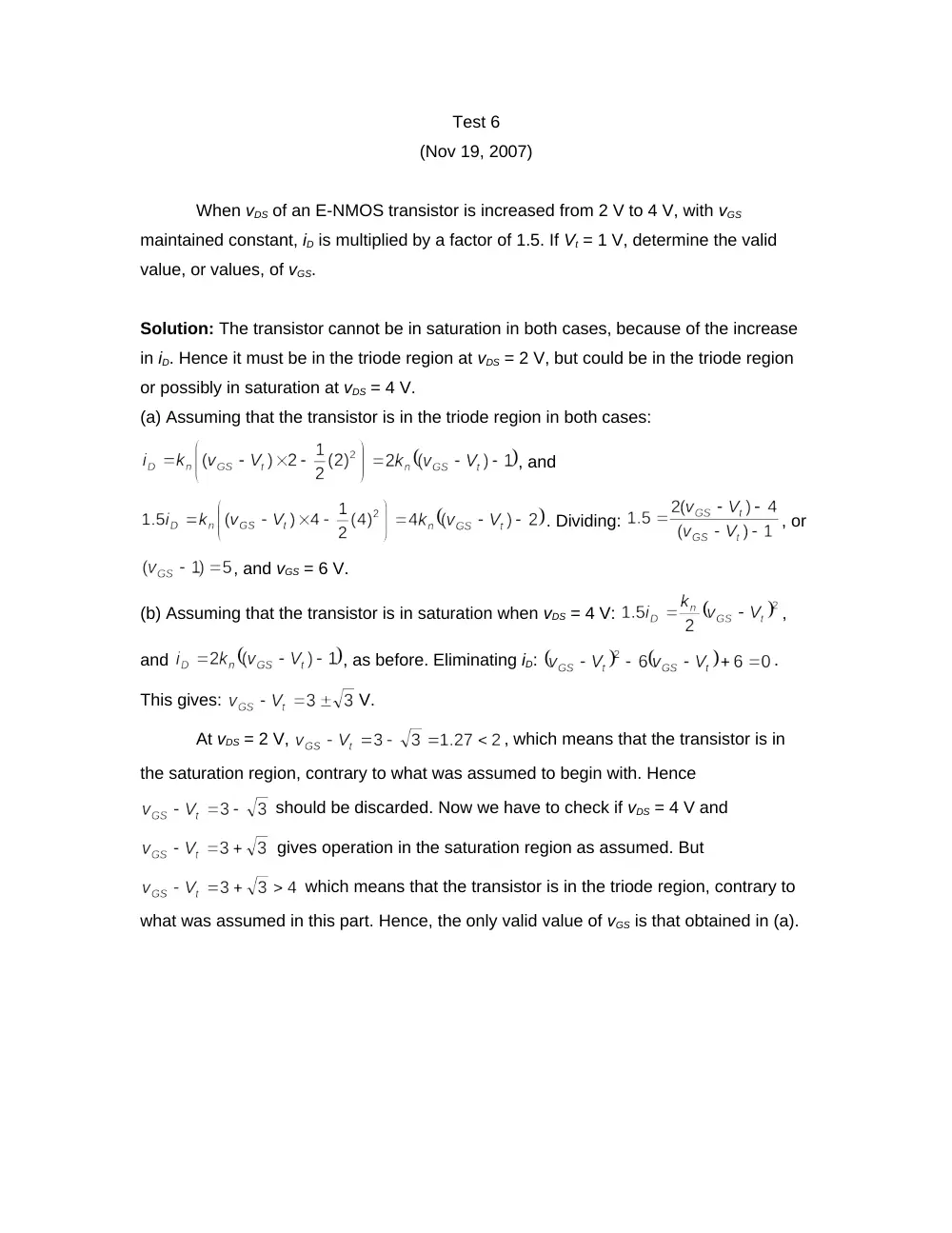
(a) Assuming that the transistor is in the triode region in both cases:
, and
. Dividing:
, or
, and vGS = 6 V.
(b) Assuming that the transistor is in saturation when vDS = 4 V:
,
and
, as before. Eliminating iD:
.
This gives:
V.
At vDS = 2 V,
, which means that the transistor is in
the saturation region, contrary to what was assumed to begin with. Hence
should be discarded. Now we have to check if vDS = 4 V and
gives operation in the saturation region as assumed. But
which means that the transistor is in the triode region, contrary to
what was assumed in this part. Hence, the only valid value of vGS is that obtained in (a).