
EECE 310 Exam, Spring 2008
American University of Beirut · Electronics · 1 page
Stuck on a question? A tutor can walk you through it.
More EECE 310 files
- Midterm · Fall 2014ExamView
- Midterm with Solutions · Fall 2014Exam · with solutionView
- Midterm · Fall 2013ExamView
- Midterm · Fall 2012ExamView
- Midterm with Solution · Summer 2011Exam · with solutionView
- Exam 2 with Answers · Fall 2011Exam · with solutionView
- Exam 1 with Answers · Fall 2011Exam · with solutionView
- Exam 1 · Fall 2010ExamView
Show the text of this exam
Test 8
(Dec 3, 2007)
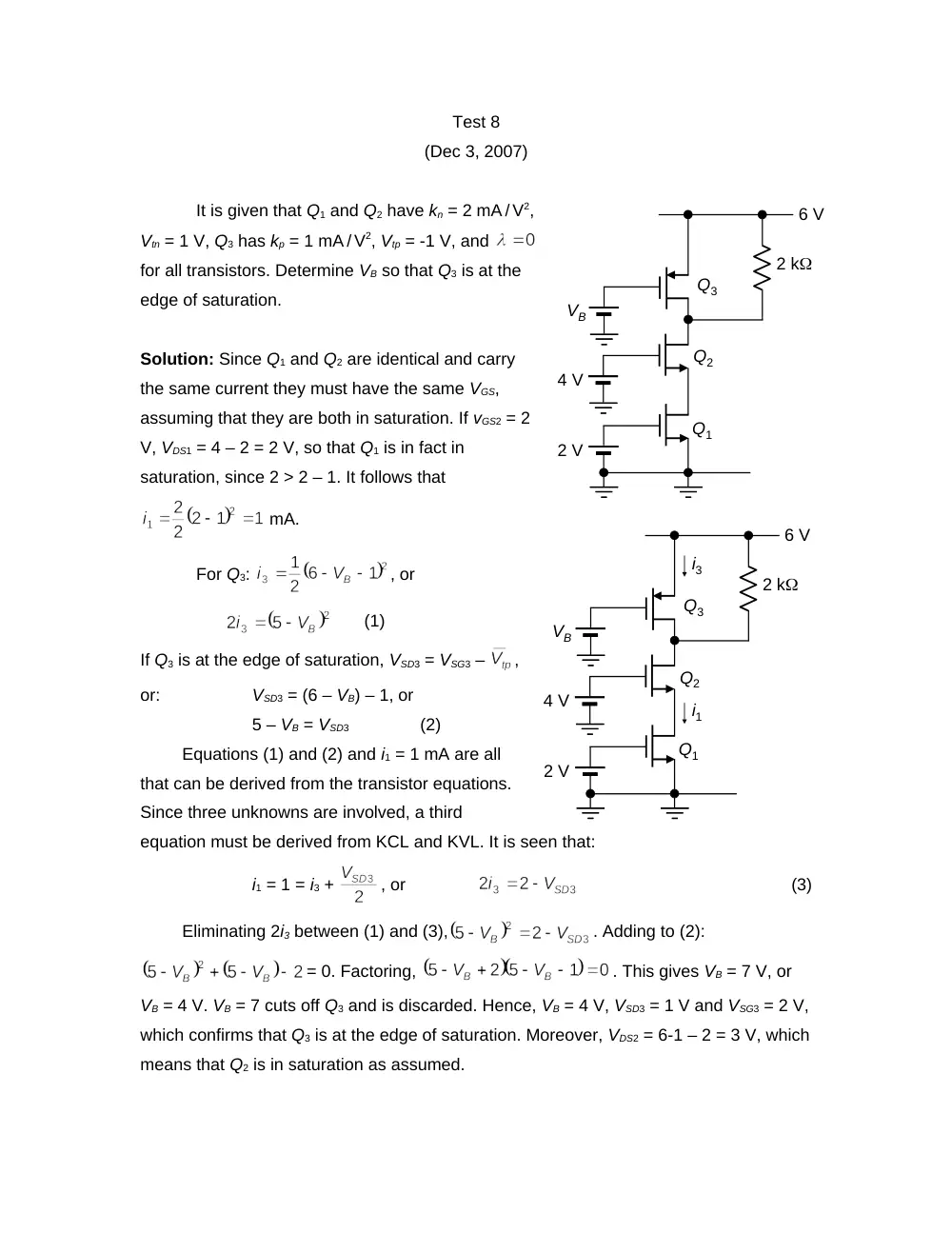
It is given that Q1 and Q2 have kn = 2 mA / V2,
Vtn = 1 V, Q3 has kp = 1 mA / V2, Vtp = -1 V, and
for all transistors. Determine VB so that Q3 is at the
edge of saturation.
Solution: Since Q1 and Q2 are identical and carry
the same current they must have the same VGS,
assuming that they are both in saturation. If vGS2 = 2
V, VDS1 = 4 – 2 = 2 V, so that Q1 is in fact in
saturation, since 2 > 2 – 1. It follows that
mA.
For Q3:
, or
(1)
If Q3 is at the edge of saturation, VSD3 = VSG3 –
,
or:
VSD3 = (6 – VB) – 1, or
5 – VB = VSD3
(2)
Equations (1) and (2) and i1 = 1 mA are all
that can be derived from the transistor equations.
Since three unknowns are involved, a third
equation must be derived from KCL and KVL. It is seen that:
i1 = 1 = i3 +
, or
(3)
Eliminating 2i3 between (1) and (3),
. Adding to (2):
= 0. Factoring,
. This gives VB = 7 V, or
VB = 4 V. VB = 7 cuts off Q3 and is discarded. Hence, VB = 4 V, VSD3 = 1 V and VSG3 = 2 V,
which confirms that Q3 is at the edge of saturation. Moreover, VDS2 = 6-1 – 2 = 3 V, which
means that Q2 is in saturation as assumed.
6 V
Q1
2 k
Q3
VB
Q2
4 V
2 V
6 V
Q1
2 k
Q3
VB
Q2
4 V
2 V
i1
i3