
EECE 330 Chapter, Fall 2011
American University of Beirut · Data Structures and Algorithms · 45 pages · Prof. Hassan Artail


Showing the first 10 of 45 pages. Download the PDF to see all of it.
More EECE 330 files
Show the text of this chapter
H.A. Artail
1
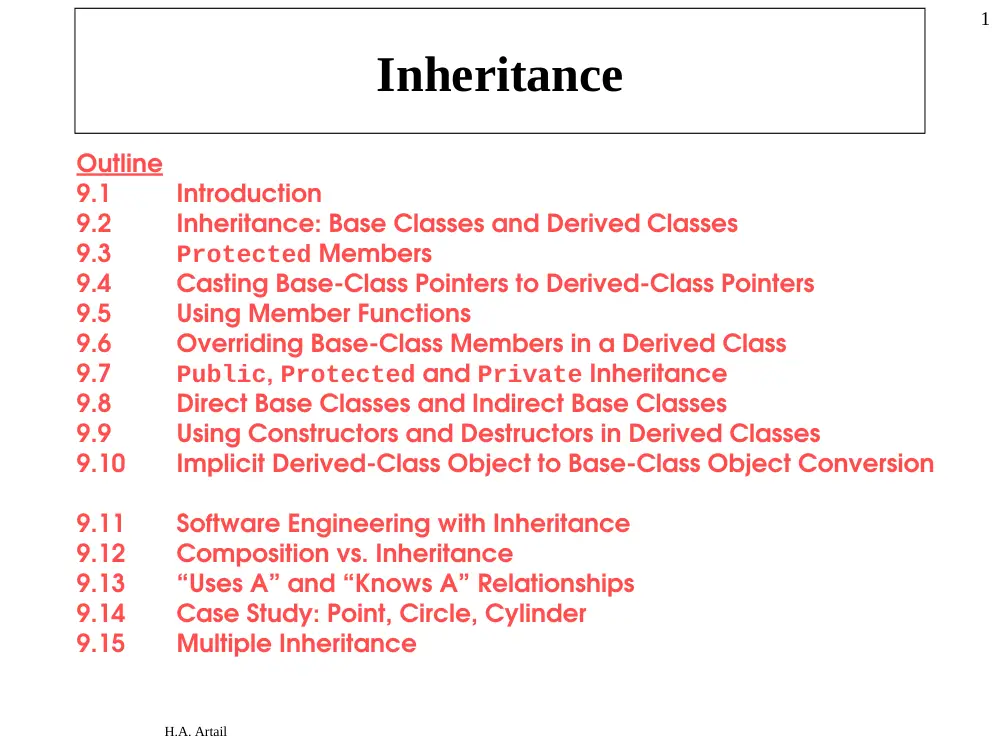
Inheritance
Outline
9.1
Introduction
9.2
Inheritance: Base Classes and Derived Classes
9.3
Protected Members
9.4
Casting Base-Class Pointers to Derived-Class Pointers
9.5
Using Member Functions
9.6
Overriding Base-Class Members in a Derived Class
9.7
Public, Protected and Private Inheritance
9.8
Direct Base Classes and Indirect Base Classes
9.9
Using Constructors and Destructors in Derived Classes
9.10
Implicit Derived-Class Object to Base-Class Object Conversion
9.11
Software Engineering with Inheritance
9.12
Composition vs. Inheritance
9.13
“Uses A” and “Knows A” Relationships
9.14
Case Study: Point, Circle, Cylinder
9.15
Multiple Inheritance
H.A. Artail
2
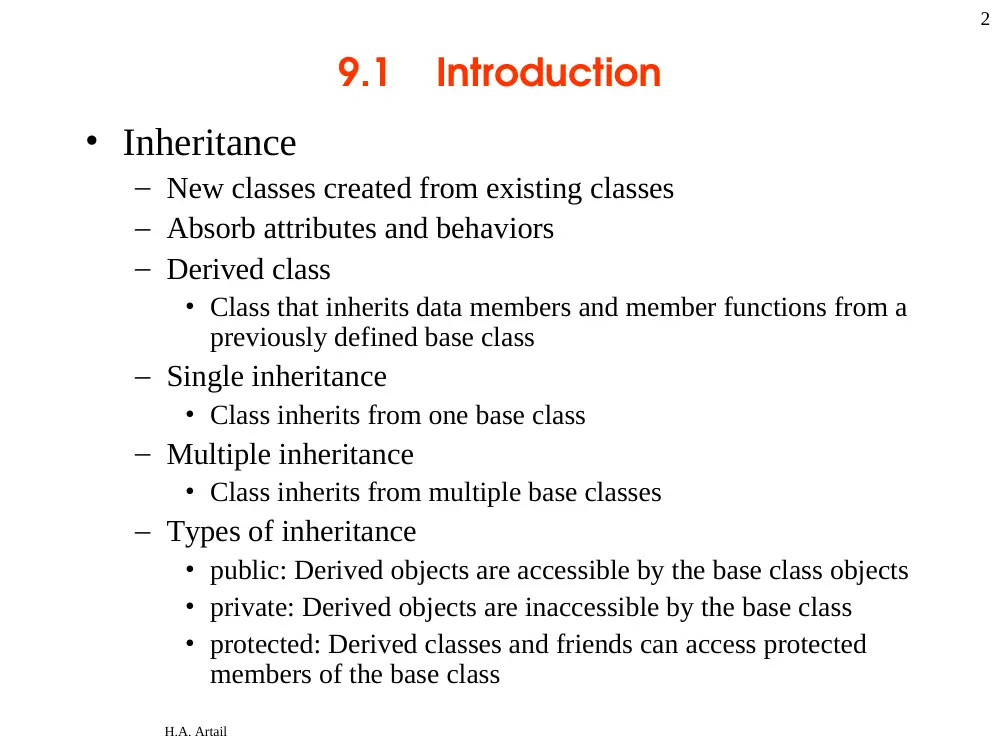
9.1 Introduction
• Inheritance
– New classes created from existing classes
– Absorb attributes and behaviors
– Derived class
• Class that inherits data members and member functions from a
previously defined base class
– Single inheritance
• Class inherits from one base class
– Multiple inheritance
• Class inherits from multiple base classes
– Types of inheritance
• public: Derived objects are accessible by the base class objects
• private: Derived objects are inaccessible by the base class
• protected: Derived classes and friends can access protected
members of the base class
H.A. Artail
3
9.1 Introduction
• Polymorphism
– Write programs in a general fashion
– Handle a wide variety of existing (and unspecified) related
classes
H.A. Artail
4
9.2 Inheritance: Base and Derived Classes
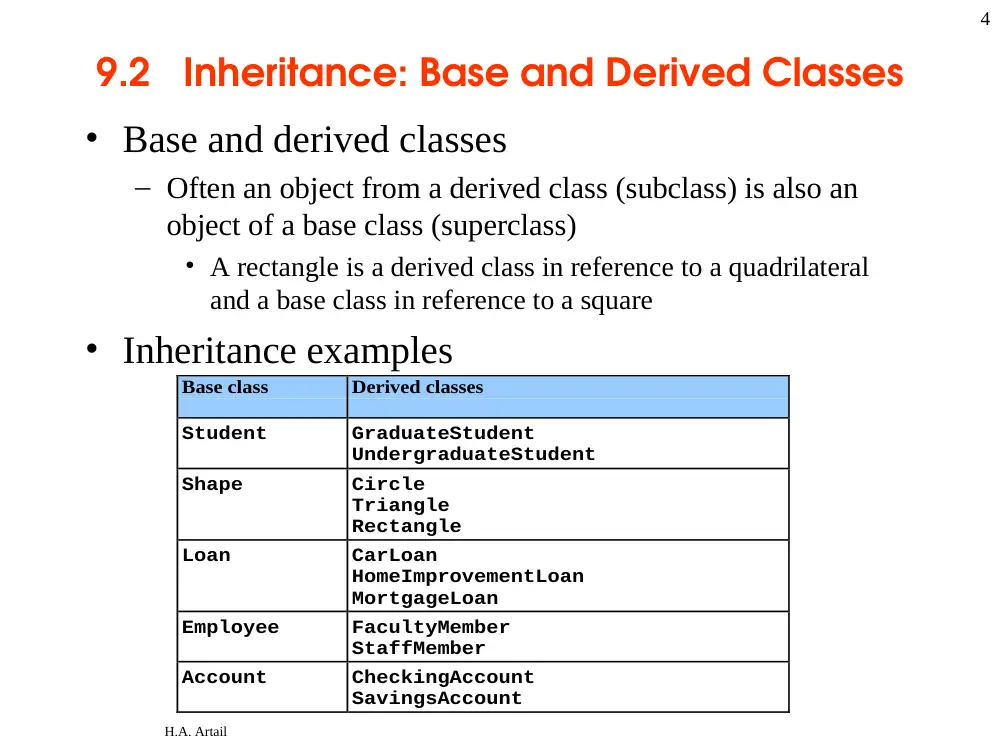
• Base and derived classes
– Often an object from a derived class (subclass) is also an
object of a base class (superclass)
• A rectangle is a derived class in reference to a quadrilateral
and a base class in reference to a square
• Inheritance examples
Base class
Derived classes
Student
GraduateStudent
UndergraduateStudent
Shape
Circle
Triangle
Rectangle
Loan
CarLoan
HomeImprovementLoan
MortgageLoan
Employee
FacultyMember
StaffMember
Account
CheckingAccount
SavingsAccount
H.A. Artail
5
9.2 Inheritance: Base and Derived Classes
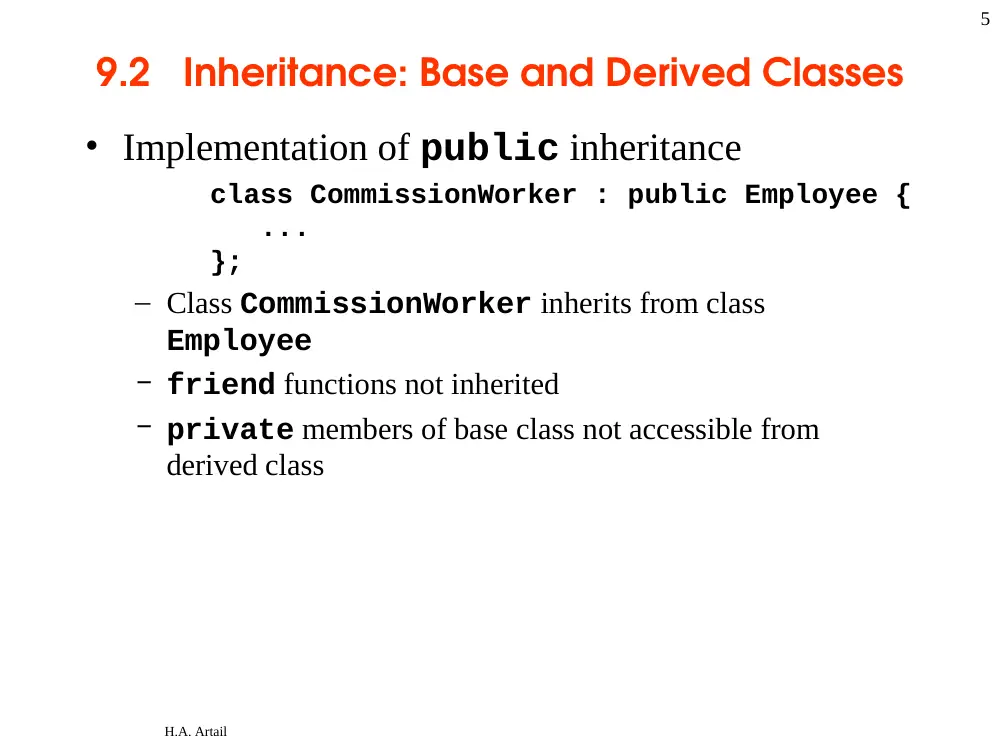
• Implementation of public inheritance
class CommissionWorker : public Employee {
...
};
– Class CommissionWorker inherits from class
Employee
– friend functions not inherited
– private members of base class not accessible from
derived class
H.A. Artail
6
9.3 protected Members
• protected access
– Intermediate level of protection between public and
private inheritance
– Derived-class members can refer to public and
protected members of the base class simply by using the
member names
– Note that protected data “breaks” encapsulation
H.A. Artail
7
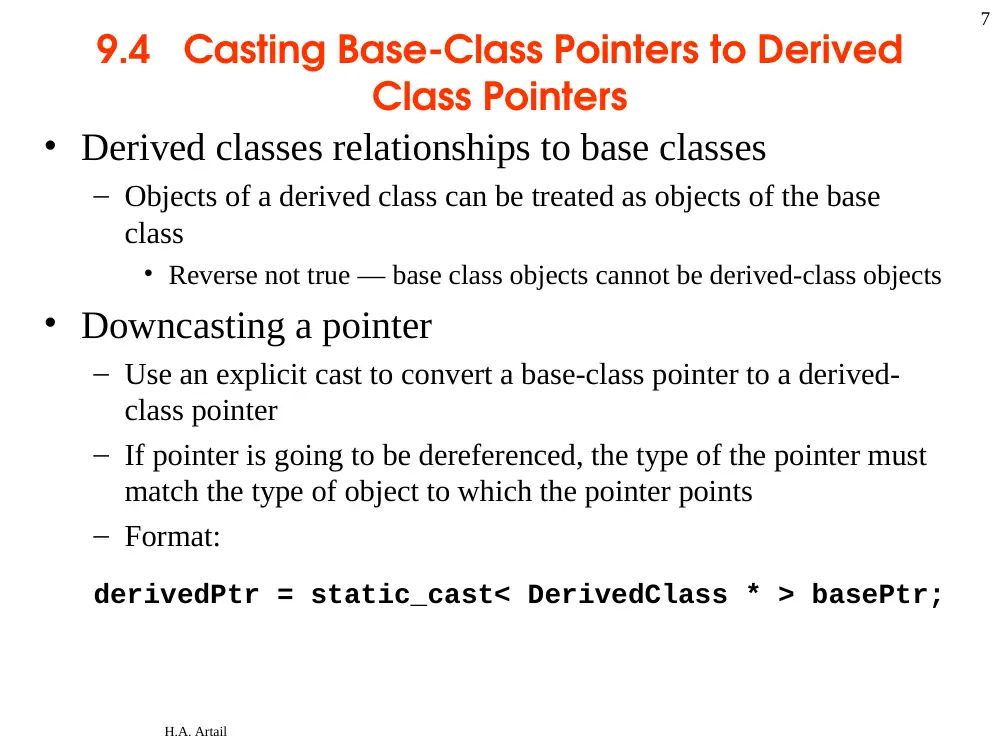
9.4 Casting Base-Class Pointers to Derived
Class Pointers
• Derived classes relationships to base classes
– Objects of a derived class can be treated as objects of the base
class
• Reverse not true — base class objects cannot be derived-class objects
• Downcasting a pointer
– Use an explicit cast to convert a base-class pointer to a derived-
class pointer
– If pointer is going to be dereferenced, the type of the pointer must
match the type of object to which the pointer points
– Format:
derivedPtr = static_cast< DerivedClass * > basePtr;
H.A. Artail
8
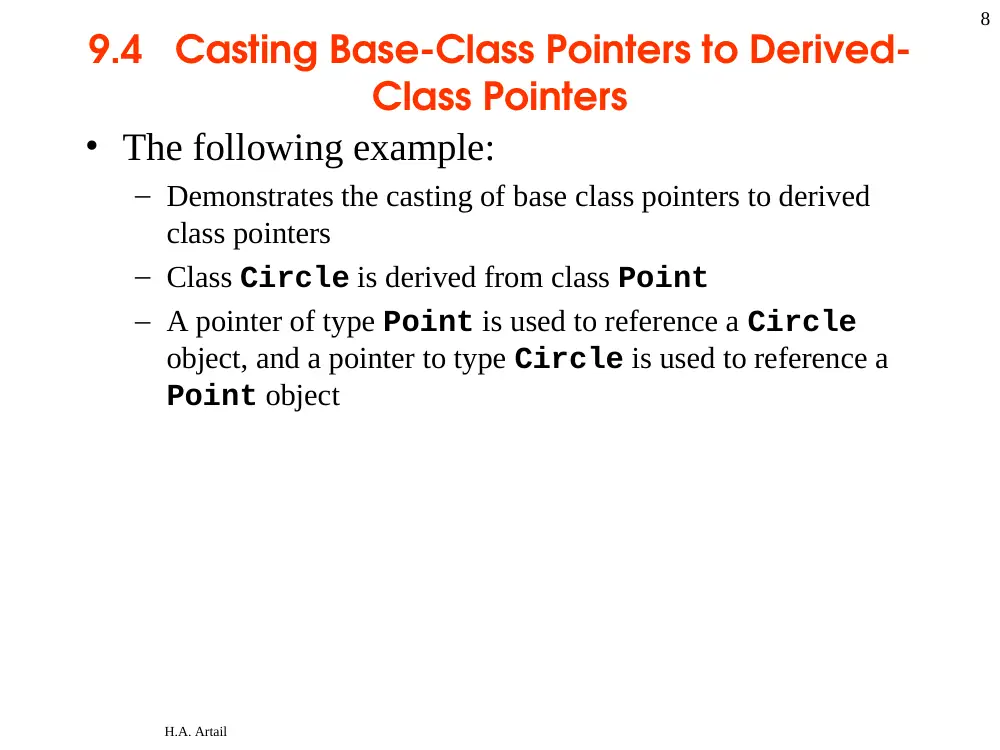
9.4 Casting Base-Class Pointers to Derived-
Class Pointers
• The following example:
– Demonstrates the casting of base class pointers to derived
class pointers
– Class Circle is derived from class Point
– A pointer of type Point is used to reference a Circle
object, and a pointer to type Circle is used to reference a
Point object
H. A. Artail
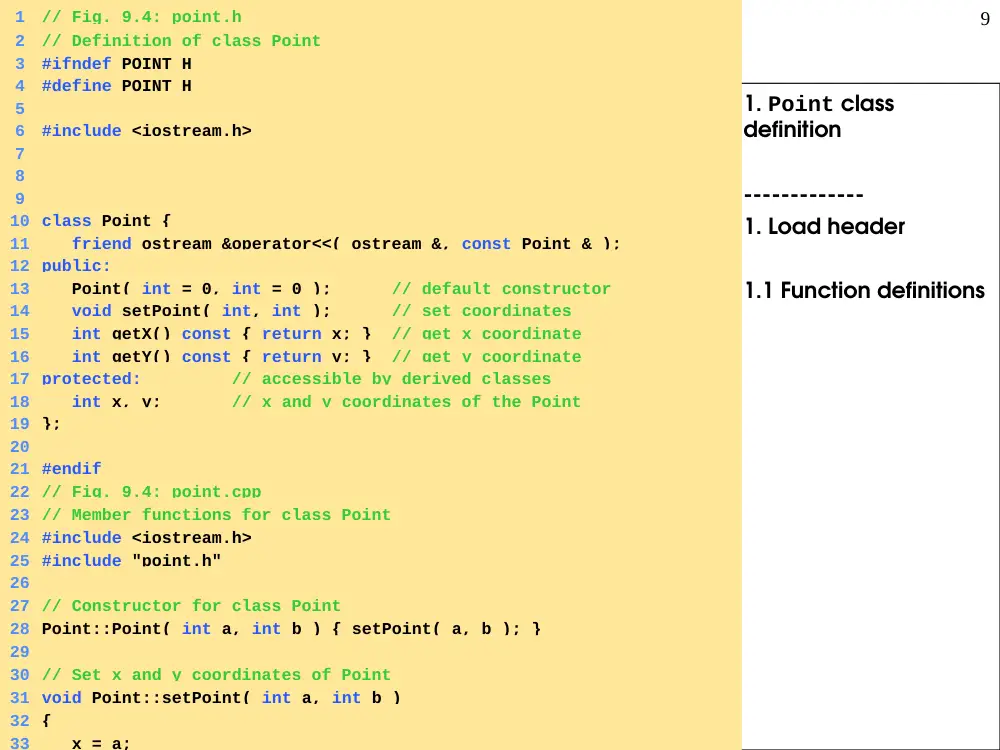
9
1. Point class
definition
-------------
1. Load header
1.1 Function definitions
1
// Fig. 9.4: point.h
2
// Definition of class Point
3
#ifndef POINT_H
4
#define POINT_H
5
6
#include <iostream.h>
7
8
9
10 class Point {
11 friend ostream &operator<<( ostream &, const Point & );
12 public:
13 Point( int = 0, int = 0 ); // default constructor
14 void setPoint( int, int ); // set coordinates
15 int getX() const { return x; } // get x coordinate
16 int getY() const { return y; } // get y coordinate
17 protected: // accessible by derived classes
18 int x, y; // x and y coordinates of the Point
19 };
20
21 #endif
22 // Fig. 9.4: point.cpp
23 // Member functions for class Point
24 #include <iostream.h>
25 #include "point.h"
26
27 // Constructor for class Point
28 Point::Point( int a, int b ) { setPoint( a, b ); }
29
30 // Set x and y coordinates of Point
31 void Point::setPoint( int a, int b )
32 {
33 x = a;
H. A. Artail
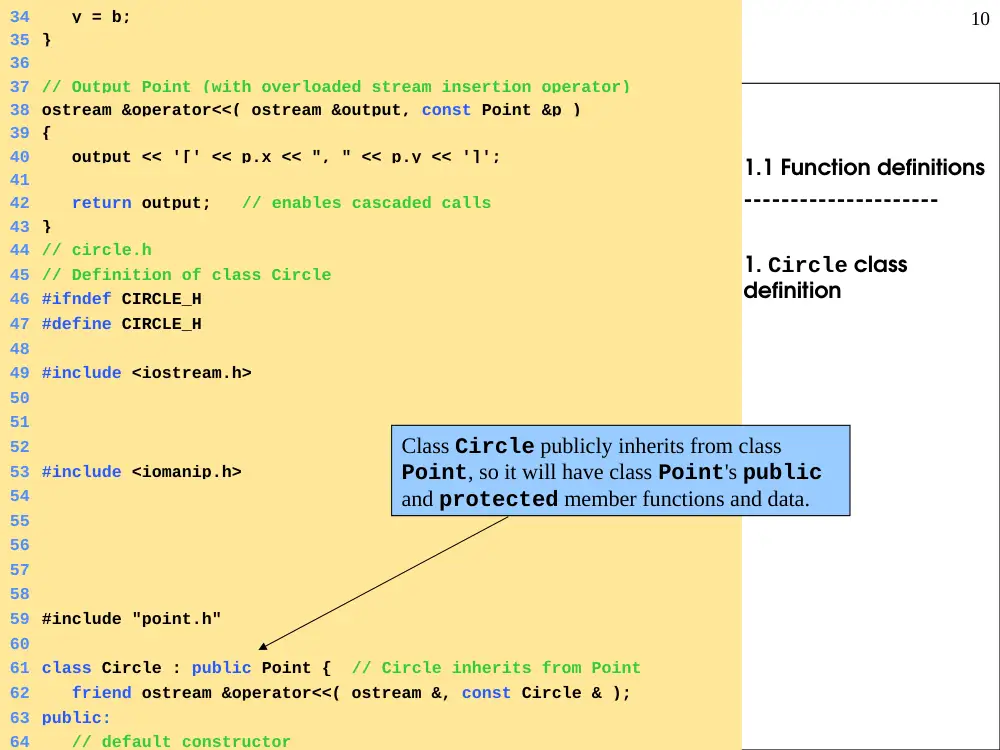
10
1.1 Function definitions
---------------------
1. Circle class
definition
34 y = b;
35 }
36
37 // Output Point (with overloaded stream insertion operator)
38 ostream &operator<<( ostream &output, const Point &p )
39 {
40 output << '[' << p.x << ", " << p.y << ']';
41
42 return output; // enables cascaded calls
43 }
44 // circle.h
45 // Definition of class Circle
46 #ifndef CIRCLE_H
47 #define CIRCLE_H
48
49 #include <iostream.h>
50
51
52
53 #include <iomanip.h>
54
55
56
57
58
59 #include "point.h"
60
61 class Circle : public Point { // Circle inherits from Point
62 friend ostream &operator<<( ostream &, const Circle & );
63 public:
64 // default constructor
Class Circle publicly inherits from class
Point, so it will have class Point's public
and protected member functions and data.
H. A. Artail
11
1. Circle definition
--------------------
1. Load header
1.1 Function Definitions
65 Circle( double r = 0.0, int x = 0, int y = 0 );
66
67 void setRadius( double ); // set radius
68 double getRadius() const; // return radius
69 double area() const; // calculate area
70 protected:
71 double radius;
72 };
73
74 #endif
75 // Fig. 9.4: circle.cpp
76 // Member function definitions for class Circle
77 #include "circle.h"
78
79 // Constructor for Circle calls constructor for Point
80 // with a member initializer then initializes radius.
81 Circle::Circle( double r, int a, int b )
82 : Point( a, b ) // call base-class constructor
83 { setRadius( r ); }
84
85 // Set radius of Circle
86 void Circle::setRadius( double r )
87 { radius = ( r >= 0 ? r : 0 ); }
88
Circle inherits from Point,
and has Point's data members
(which are set by calling
Point's constructor).
H. A. Artail
12
1. 1 Function
Definitions
----------------------
Driver
1. Load headers
1.1 Initialize objects
89 // Get radius of Circle
90 double Circle::getRadius() const { return radius; }
91
92 // Calculate area of Circle
93 double Circle::area() const
94 { return 3.14159 * radius * radius; }
95
96 // Output a Circle in the form:
97 // Center = [x, y]; Radius = #.##
98 ostream &operator<<( ostream &output, const Circle &c )
99 {
100 output << "Center = " << static_cast< Point >( c )
101 << "; Radius = "
102 << setiosflags( ios::fixed | ios::showpoint )
103 << setprecision( 2 ) << c.radius;
104
105 return output; // enables cascaded calls
106}
107// driver.cpp
108// Casting base-class pointers to derived-class pointers
109#include <iostream.h>
110
111
112
113
114#include <iomanip.h>
115 #include "point.h"
116 #include "circle.h"
117
118 int main()
119 {
120 Point p( 30, 50 );
121 Point *pointPtr = & p;
H. A. Artail
13
134 cout << "\nCircle c (via *circlePtr):\n" << *circlePtr
135 << "\nArea of c (via circlePtr): "
136 << circlePtr->area() << '\n';
137
138 // DANGEROUS: Treat a Point as a Circle
139 pointPtr = &p; // assign address of Point to pointPtr
140
141 // cast base-class pointer to derived-class pointer
142 circlePtr = static_cast< Circle * >( pointPtr );
143 cout << "\nPoint p (via *circlePtr):\n" << *circlePtr
144 << "\nArea of object circlePtr points to: "
145 << circlePtr->area() << endl;
146 return 0;
147 }
122 Circle c( 2.7, 120, 89 );
123 Circle *circlePtr = & c;
124 cout << "Point p: " << p << "\nCircle c: " << c << '\n';
125
126 // Treat a Circle as a Point (see only the base class part)
127 pointPtr = &c; // assign address of Circle to pointPtr
128 cout << "\nCircle c (via *pointPtr): "
129 << *pointPtr << '\n';
130
131 // Treat a Circle as a Circle (with some casting)
132 // cast base-class pointer to derived-class pointer
133 circlePtr = static_cast< Circle * >( pointPtr );
Assign derived-class pointer (&c) to
base class pointer pointPtr.
The base class pointer only "sees"
the base-class part of the object it
points to.
Cast pointPtr into a Circle * , and assign
to circlePtr.
circlePtr will treat c (the object to which it
points) as a Circle.
Point p: [30, 50]
Circle c: Center = [120, 89]; Radius = 2.70
Circle c (via *pointPtr): [120, 89]
Circle c (via *circlePtr):
Center = [120, 89]; Radius = 2.70
Area of c (via circlePtr): 22.90
Assign pointPtr to a Point object. It has no
derived-class information.
When it is cast to a Circle *, circlePtr is
really assigned to a base-class object with no
derived-class information. This is dangerous.
Point p (via *circlePtr):
Center = [30, 50]; Radius = 0.00
Area of object circlePtr points to: 0.00
H.A. Artail
14
9.6 Overriding Base-Class Members in a
Derived Class
• To override a base-class member function
– In the derived class, supply a new version of that function
with the same signature
• same function name, different definition
– When the function is then mentioned by name in the derived
class, the derived version is automatically called
– The scope-resolution operator may be used to access the
base class version from the derived class
H. A. Artail
15
1. Employee class
definition
-----------------------
1. Load header
1.1 Function definitions
1
// employ.h
2
// Definition of class Employee
3
#ifndef EMPLOY_H
4
#define EMPLOY_H
5
6
class Employee {
7
public:
8
Employee( const char *, const char * ); // constructor
9
void print() const; // output first and last name
10 ~Employee(); // destructor
11 private:
12 char *firstName; // dynamically allocated string
13 char *lastName; // dynamically allocated string
14 };
15
16 #endif
17 // employ.cpp
18 // Member function definitions for class Employee
19 #include <iostream.h>
20
21
22
23 #include <string.h>
24 #include <assert.h>
25 #include "employ.h"
26
27 // Constructor dynamically allocates space for the
28 // first and last name and uses strcpy to copy
29 // the first and last names into the object.
30 Employee::Employee( const char *first, const char *last )
31 {
32 firstName = new char[ strlen( first ) + 1 ];
H. A. Artail
16
1.1 Function definitions
---------------------
1. HourlyWorker class
definition
33 assert( firstName != 0 ); // terminate if not allocated
34 strcpy( firstName, first );
35
36 lastName = new char[ strlen( last ) + 1 ];
37 assert( lastName != 0 ); // terminate if not allocated
38 strcpy( lastName, last );
39 }
40
41 // Output employee name
42 void Employee::print() const
43 { cout << firstName << ' ' << lastName; }
44
45 // Destructor deallocates dynamically allocated memory
46 Employee::~Employee()
47 {
48 delete [] firstName; // reclaim dynamic memory
49 delete [] lastName; // reclaim dynamic memory
50 }
51 // Fig. 9.5: hourly.h
52 // Definition of class HourlyWorker
53 #ifndef HOURLY_H
54 #define HOURLY_H
55
56 #include "employ.h"
57
58 class HourlyWorker : public Employee {
59 public:
60 HourlyWorker( const char*, const char*, double, double );
61 double getPay() const; // calculate and return salary
62 void print() const; // overridden base-class print
63 private:
HourlyWorker inherits from
Employee.
HourlyWorker will override the print
function.
H. A. Artail
17
1. Load header
1.1 Function definitions
64 double wage; // wage per hour
65 double hours; // hours worked for week
66 };
67
68 #endif
69 // hourly.cpp
70 // Member function definitions for class HourlyWorker
71 #include <iostream.h>
72
73
74
75
76 #include <iomanip.h>
77
78
79
80
81
82 #include "hourly.h"
83
84 // Constructor for class HourlyWorker
85 HourlyWorker::HourlyWorker( const char *first,
86 const char *last,
87 double initHours, double initWage )
88 : Employee( first, last ) // call base-class constructor
89 {
90 hours = initHours; // should validate
91 wage = initWage; // should validate
92 }
93
94 // Get the HourlyWorker's pay
95 double HourlyWorker::getPay() const { return wage * hours; }
H. A. Artail
18
1.1 Function Definitions
--------------------
1. Load header
1.1 Initialize object
2. Function call
Program Output
96
97 // Print the HourlyWorker's name and pay
98 void HourlyWorker::print() const
99 {
100 cout << "HourlyWorker::print() is executing\n\n";
101 Employee::print(); // call base-class print function
102
103 cout << " is an hourly worker with pay of $"
104 << setiosflags( ios::fixed | ios::showpoint )
105 << setprecision( 2 ) << getPay() << endl;
106}
107// driver.cpp
108// Overriding a base-class member function in a
109// derived class.
110#include "hourly.h"
111
112int main()
113{
114 HourlyWorker h( "Bob", "Smith", 40.0, 10.00 );
115 h.print();
116 return 0;
117}
HourlyWorker::print() is executing
Bob Smith is an hourly worker with pay of $400.00
The print function is overriden in
HourlyWorker. However, the new
function still can call the original
print function using ::
H.A. Artail
19
9.8 Direct and Indirect Base Classes
• Direct base class
– Explicitly listed derived class’s header with the colon (:)
notation when that derived class is declared
class HourlyWorker : public Employee
• Employee is a direct base class of HourlyWorker
• Indirect base class
– Not listed in derived class’s header
– Inherited from two or more levels up the class hierarchy
class MinuteWorker : public HourlyWorker
• Employee is an indirect base class of MinuteWorker
H.A. Artail
20
9.9 Using Constructors and Destructors in
Derived Classes
• Base class initializer
– Uses member-initializer syntax
– Can be provided in the derived class constructor to call the
base-class constructor explicitly
• Otherwise base class’s default constructor called implicitly
– Base-class constructors and base-class assignment operators
are not inherited by derived classes
• Derived-class constructors and assignment operators, however,
can call base-class constructors and assignment operators
H.A. Artail
21
9.9 Using Constructors and Destructors in
Derived Classes
• A derived-class constructor
– Calls the constructor for its base class first to initialize its
base-class members
– If the derived-class constructor is omitted, its default
constructor calls the base-class’ default constructor
• Destructors are called in the reverse order of
constructor calls
– So a derived-class destructor is called before its base-class
destructor
H. A. Artail
22
1. Point definition
-----------------
1. Load header
1.1 Function definitions
1
// point2.h
2
// Definition of class Point
3
#ifndef POINT2_H
4
#define POINT2_H
5
6
class Point {
7
public:
8
Point( int = 0, int = 0 ); // default constructor
9
~Point(); // destructor
10 protected: // accessible by derived classes
11 int x, y; // x and y coordinates of Point
12 };
13
14 #endif
15 // point2.cpp
16 // Member function definitions for class Point
17 #include <iostream.h>
18
19
20
21
22 #include "point2.h"
23
24 // Constructor for class Point
25 Point::Point( int a, int b )
26 {
27 x = a;
28 y = b;
29
30 cout << "Point constructor: "
31 << '[' << x << ", " << y << ']' << endl;
32 }
H. A. Artail
23
1.1 Function definitions
----------------------
1. Load header
1.1 Circle Definition
33
34 // Destructor for class Point
35 Point::~Point()
36 {
37 cout << "Point destructor: "
38 << '[' << x << ", " << y << ']' << endl;
39 }
40 // circle2.h
41 // Definition of class Circle
42 #ifndef CIRCLE2_H
43 #define CIRCLE2_H
44
45 #include "point2.h"
46
47 class Circle : public Point {
48 public:
49 // default constructor
50 Circle( double r = 0.0, int x = 0, int y = 0 );
51
52 ~Circle();
53 private:
54 double radius;
55 };
56
57 #endif
Circle inherits from Point.
H. A. Artail
24
1. Load header
1.1 Function Definitions
58 // circle2.cpp
59 // Member function definitions for class Circle
60 #include <iostream.h>
61
62
63
64
65 #include "circle2.h"
66
67 // Constructor for Circle calls constructor for Point
68 Circle::Circle( double r, int a, int b )
69 : Point( a, b ) // call base-class constructor
70 {
71 radius = r; // should validate
72 cout << "Circle constructor: radius is "
73 << radius << " [" << x << ", " << y << ']' << endl;
74 }
75
76 // Destructor for class Circle
77 Circle::~Circle()
78 {
79 cout << "Circle destructor: radius is "
80 << radius << " [" << x << ", " << y << ']' << endl;
81 }
Constructor for Circle calls
constructor for Point, first. Uses
member-initializer syntax.
Destructor for Circle calls
destructor for Point, last.
H. A. Artail
25
82 // driver.cpp
83 // Demonstrate when base-class and derived-class
84 // constructors and destructors are called.
85 #include <iostream.h>
86
87
88
89
90 #include "point2.h"
91 #include "circle2.h"
92
93 int main()
94 {
95 // Show constructor and destructor calls for Point
96 {
97 Point p( 11, 22 );
98 }
99
100 cout << endl;
101 Circle circle1( 4.5, 72, 29 );
102 cout << endl;
103 Circle circle2( 10, 5, 5 );
104 cout << endl;
105 return 0;
106}
Point constructor: [11, 22]
Point destructor: [11, 22]
Object created inside a block destroyed once it leaves
scope.
Remember that the Point constructor
is called for Circle objects before the
Circle constructor (inside to out).
Point constructor: [72, 29]
Circle constructor: radius is 4.5 [72, 29]
Point constructor: [5, 5]
Circle constructor: radius is 10 [5, 5]
Point destructor called after Circle
destructor (outside in).
Circle destructor: radius is 10 [5, 5]
Point destructor: [5, 5]
Circle destructor: radius is 4.5 [72, 29]
Point destructor: [72, 29]
H. A. Artail
26
Program Output
Point constructor: [11, 22]
Point destructor: [11, 22]
Point constructor: [72, 29]
Circle constructor: radius is 4.5 [72, 29]
Point constructor: [5, 5]
Circle constructor: radius is 10 [5, 5]
Circle destructor: radius is 10 [5, 5]
Point destructor: [5, 5]
Circle destructor: radius is 4.5 [72, 29]
Point destructor: [72, 29]
H.A. Artail
27
9.10 Implicit Derived-Class Object to Base-
Class Object Conversion
• Assignment of derived and base classes
– Derived-class type and base-class type are different
– Derived-class object can be treated as a base-class object
• Derived class has members corresponding to all of the base
class’s members
• Derived-class has more members than the base-class object
• Base-class can be assigned a derived-class
– Base-class object cannot be treated as a derived-class object
• Would leave additional derived class members undefined
• Derived-class cannot be assigned a base-class
H.A. Artail
28
9.10 Implicit Derived-Class Object to Base-
Class Object Conversion
• Mixing base and derived class pointers and objects
– Referring to a base-class object with a base-class pointer
• Allowed
– Referring to a derived-class object with a derived-class pointer
• Allowed
– Referring to a derived-class object with a base-class pointer
• Possible syntax error
• Code can only refer to base-class members, or syntax error
– Referring to a base-class object with a derived-class pointer
• Syntax error
• The derived-class pointer must first be cast to a base-class pointer
H.A. Artail
29
9.12 Composition vs. Inheritance
• “Is a” relationships
– Inheritance
• Relationship in which a class is derived from another class
• “Has a” relationships
– Composition
• Relationship in which a class contains other classes as
members
H.A. Artail
30
9.13 “Uses A” And “Knows A” Relationships
• “Uses a”
– One object issues a function call to a member function of
another object
• “Knows a”
– One object is aware of another
• Contains a pointer or handle to another object
– Also called an association
H.A. Artail
31
9.14 Case Study: Point, Circle, Cylinder
• Point, circle, cylinder hierarchy
– Point class is base class
– Circle class is derived from Point class
– Cylinder class is derived from Circle class
H. A. Artail
32
1
// point2.h
2
// Definition of class Point
3
#ifndef POINT2_H
4
#define POINT2_H
5
6
#include <iostream.h>
7
8
9
10 class Point {
11 friend ostream &operator<<( ostream &, const Point & );
12 public:
13 Point( int = 0, int = 0 ); // default constructor
14 void setPoint( int, int ); // set coordinates
15 int getX() const { return x; } // get x coordinate
16 int getY() const { return y; } // get y coordinate
17 protected: // accessible to derived classes
18 int x, y; // coordinates of the point
19 };
20
21 #endif
22 // point2.cpp
23 // Member functions for class Point
24 #include "point2.h"
25
26 // Constructor for class Point
27 Point::Point( int a, int b ) { setPoint( a, b ); }
28
29 // Set the x and y coordinates
30 void Point::setPoint( int a, int b )
31 {
32 x = a;
Point data members are
protected to be made accessible
by Circle.
H. A. Artail
33
33 y = b;
34 }
35
36 // Output the Point
37 ostream &operator<<( ostream &output, const Point &p )
38 {
39 output << '[' << p.x << ", " << p.y << ']';
40
41 return output; // enables cascading
42 }
H. A. Artail
34
1
// circle2.h
2
// Definition of class Circle
3
#ifndef CIRCLE2_H
4
#define CIRCLE2_H
5
6
#include <iostream.h>
7
8
9
10 #include "point2.h"
11
12 class Circle : public Point {
13 friend ostream &operator<<( ostream &, const Circle & );
14 public:
15 // default constructor
16 Circle( double r = 0.0, int x = 0, int y = 0 );
17 void setRadius( double ); // set radius
18 double getRadius() const; // return radius
19 double area() const; // calculate area
20 protected: // accessible to derived classes
21 double radius; // radius of the Circle
22 };
23
24 #endif
25 // circle2.cpp
26 // Member function definitions for class Circle
27 #include <iomanip.h>
28
29
30
31
32
33 #include "circle2.h"
Circle data members are
protected to be made accessible
by Cylinder.
H. A. Artail
35
34
35 // Constructor for Circle calls constructor for Point
36 // with a member initializer and initializes radius
37 Circle::Circle( double r, int a, int b )
38 : Point( a, b ) // call base-class constructor
39 { setRadius( r ); }
40
41 // Set radius
42 void Circle::setRadius( double r )
43 { radius = ( r >= 0 ? r : 0 ); }
44
45 // Get radius
46 double Circle::getRadius() const { return radius; }
47
48 // Calculate area of Circle
49 double Circle::area() const
50 { return 3.14159 * radius * radius; }
51
52 // Output a circle in the form:
53 // Center = [x, y]; Radius = #.##
54 ostream &operator<<( ostream &output, const Circle &c )
55 {
56 output << "Center = " << static_cast< Point > ( c )
57 << "; Radius = "
58 << setiosflags( ios::fixed | ios::showpoint )
59 << setprecision( 2 ) << c.radius;
60
61 return output; // enables cascaded calls
62 }
H. A. Artail
36
1
// cylindr2.h
2
// Definition of class Cylinder
3
#ifndef CYLINDR2_H
4
#define CYLINDR2_H
5
6
#include <iostream.h>
7
8
9
10 #include "circle2.h"
11
12 class Cylinder : public Circle {
13 friend ostream &operator<<( ostream &, const Cylinder & );
14
15 public:
16 // default constructor
17 Cylinder( double h = 0.0, double r = 0.0,
18 int x = 0, int y = 0 );
19
20 void setHeight( double ); // set height
21 double getHeight() const; // return height
22 double area() const; // calculate and return area
23 double volume() const; // calculate and return volume
24
25 protected:
26 double height; // height of the Cylinder
27 };
28
29 #endif
H. A. Artail
37
30 // cylindr2.cpp
31 // Member and friend function definitions
32 // for class Cylinder.
33 #include "cylindr2.h"
34
35 // Cylinder constructor calls Circle constructor
36 Cylinder::Cylinder( double h, double r, int x, int y )
37 : Circle( r, x, y ) // call base-class constructor
38 { setHeight( h ); }
39
40 // Set height of Cylinder
41 void Cylinder::setHeight( double h )
42 { height = ( h >= 0 ? h : 0 ); }
43
44 // Get height of Cylinder
45 double Cylinder::getHeight() const { return height; }
46
47 // Calculate area of Cylinder (i.e., surface area)
48 double Cylinder::area() const
49 {
50 return 2 * Circle::area() +
51 2 * 3.14159 * radius * height;
52 }
53
54 // Calculate volume of Cylinder
55 double Cylinder::volume() const
56 { return Circle::area() * height; }
57
58 // Output Cylinder dimensions
59 ostream &operator<<( ostream &output, const Cylinder &c )
60 {
Circle::area() is overidden.
H. A. Artail
38
61 output << static_cast< Circle >( c )
62 << "; Height = " << c.height;
63
64 return output; // enables cascaded calls
65 }
66 // driver.cpp
67 // Driver for class Cylinder
68 #include <iostream.h>
69
70
71
72
73 #include "point2.h"
74 #include "circle2.h"
75 #include "cylindr2.h"
76
77 int main()
78 {
79 // create Cylinder object
80 Cylinder cyl( 5.7, 2.5, 12, 23 );
81
82 // use get functions to display the Cylinder
83 cout << "X coordinate is " << cyl.getX()
84 << "\nY coordinate is " << cyl.getY()
85 << "\nRadius is " << cyl.getRadius()
86 << "\nHeight is " << cyl.getHeight() << "\n\n";
87
88 // use set functions to change the Cylinder's attributes
89 cyl.setHeight( 10 );
90 cyl.setRadius( 4.25 );
91 cyl.setPoint( 2, 2 );
X coordinate is 12
Y coordinate is 23
Radius is 2.5
Height is 5.7
H. A. Artail
39
92 cout << "The new location, radius, and height of cyl are:\n"
93 << cyl << '\n';
94
95 cout << "The area of cyl is:\n"
96 << cyl.area() << '\n';
97
98 // display the Cylinder as a Point
99 Point &pRef = cyl; // pRef "thinks" it is a Point
100 cout << "\nCylinder printed as a Point is: "
101 << pRef << "\n\n";
102
103 // display the Cylinder as a Circle
104 Circle &circleRef = cyl; // circleRef thinks it is a Circle
105 cout << "Cylinder printed as a Circle is:\n" << circleRef
106 << "\nArea: " << circleRef.area() << endl;
107
108 return 0;
109}
X coordinate is 12
Y coordinate is 23
Radius is 2.5
Height is 5.7
The new location, radius, and height of cyl are:
Center = [2, 2]; Radius = 4.25; Height = 10.00
The area of cyl is:
380.53
Cylinder printed as a Point is: [2, 2]
Cylinder printed as a Circle is:
Center = [2, 2]; Radius = 4.25
Area: 56.74
The new location, radius, and height of cyl are:
Center = [2, 2]; Radius = 4.25; Height = 10.00
The area of cyl is:
380.53
Cylinder printed as a Point is: [2, 2]
pref "thinks" cyl is a Point, so it prints as one.
circleref "thinks" cyl is a Circle, so it prints
as one.
Cylinder printed as a Circle is:
Center = [2, 2]; Radius = 4.25
Area: 56.74
H.A. Artail
40
9.15 Multiple Inheritance
• Multiple Inheritance
– Derived-class inherits from multiple base-classes
– Encourages software reuse, but can create ambiguities
H. A. Artail
41
1
// base1.h
2
// Definition of class Base1
3
#ifndef BASE1_H
4
#define BASE1_H
5
6
class Base1 {
7
public:
8
Base1( int x ) { value = x; }
9
int getData() const { return value; }
10 protected: // accessible to derived classes
11 int value; // inherited by derived class
12 };
13
14 #endif
15 // base2.h
16 // Definition of class Base2
17 #ifndef BASE2_H
18 #define BASE2_H
19
20 class Base2 {
21 public:
22 Base2( char c ) { letter = c; }
23 char getData() const { return letter; }
24 protected: // accessible to derived classes
25 char letter; // inherited by derived class
26 };
27
28 #endif
H. A. Artail
42
29 // derived.h
30 // Definition of class Derived which inherits
31 // multiple base classes (Base1 and Base2).
32 #ifndef DERIVED_H
33 #define DERIVED_H
34
35 #include <iostream.h>
36
37
38
39 #include "base1.h"
40 #include "base2.h"
41
42 // multiple inheritance
43 class Derived : public Base1, public Base2 {
44 friend ostream &operator<<( ostream &, const Derived & );
45
46 public:
47 Derived( int, char, double );
48 double getReal() const;
49
50 private:
51 double real; // derived class's private data
52 };
53
54 #endif
Derived inherits from Base1 and
Base2.
H. A. Artail
43
55 // derived.cpp
56 // Member function definitions for class Derived
57 #include "derived.h"
58
59 // Constructor for Derived calls constructors for
60 // class Base1 and class Base2.
61 // Use member initializers to call base-class constructors
62 Derived::Derived( int i, char c, double f )
63 : Base1( i ), Base2( c ) { real=( f ); }
64
65 // Return the value of real
66 double Derived::getReal() const { return real; }
67
68 // Display all the data members of Derived
69 ostream &operator<<( ostream &output, const Derived &d )
70 {
71 output << " Integer: " << d.value
72 << "\n Character: " << d.letter
73 << "\nReal number: " << d.real;
74
75 return output; // enables cascaded calls
76 }
77 // driver.cpp
78 // Driver for multiple inheritance example
79 #include <iostream.h>
80
81
82
83
84 #include "base1.h"
85 #include "base2.h"
H. A. Artail
44
86 #include "derived.h"
87
88 int main()
89 {
90 Base1 b1( 10 ), *base1Ptr = 0; // create Base1 object
91 Base2 b2( 'Z' ), *base2Ptr = 0; // create Base2 object
92 Derived d( 7, 'A', 3.5 ); // create Derived object
93
94 // print data members of base class objects
95 cout << "Object b1 contains integer " << b1.getData()
96 << "\nObject b2 contains character " << b2.getData()
97 << "\nObject d contains:\n" << d << "\n\n";
98
99 // print data members of derived class object
100 // scope resolution operator resolves getData ambiguity
101 cout << "Data members of Derived can be"
102 << " accessed individually:"
103 << "\n Integer: " << d.Base1::getData()
104 << "\n Character: " << d.Base2::getData()
105 << "\nReal number: " << d.getReal() << "\n\n";
106
107 cout << "Derived can be treated as an "
108 << "object of either base class:\n";
109
110 // treat Derived as a Base1 object
111 base1Ptr = &d;
112 cout << "base1Ptr->getData() yields "
113 << base1Ptr->getData() << '\n';
114
115 // treat Derived as a Base2 object
116 base2Ptr = &d;
Treat d as a Base1 object.
Treat d as a Base2 object.
Object b1 contains integer 10
Object b2 contains character Z
Object d contains:
Integer: 7
Character: A
Real number: 3.5
Data members of Derived
can be accessed
individually:
Integer: 7
Character: A
Real number: 3.5
Derived can be treated as an
object of either base class:
base1Ptr->getData() yields 7
H. A. Artail
45
117 cout << "base2Ptr->getData() yields "
118 << base2Ptr->getData() << endl;
119
120 return 0;
121}
Object b1 contains integer 10
Object b2 contains character Z
Object d contains:
Integer: 7
Character: A
Real number: 3.5
Data members of Derived