
EECE 330 Chapter, Fall 2011
American University of Beirut · Data Structures and Algorithms · 28 pages · Prof. Hassan Artail

Showing the first 10 of 28 pages. Download the PDF to see all of it.
More EECE 330 files
Show the text of this chapter
Indexing
Goals:
– Store large files
– Support multiple search keys
– Support efficient insert, delete, and range
queries
Terms(1)
Entry sequenced file: records ordered by
time of insertion.
– Search with sequential search
Index file: stores pointers to actual records.
– Could be organized with a tree or other data
structure.
Terms(2)
Primary Key: A unique identifier for records.
May be inconvenient for search.
example: ID
Secondary Key: An alternate search key,
often not unique for each record. Often
used for search key.
example: last name
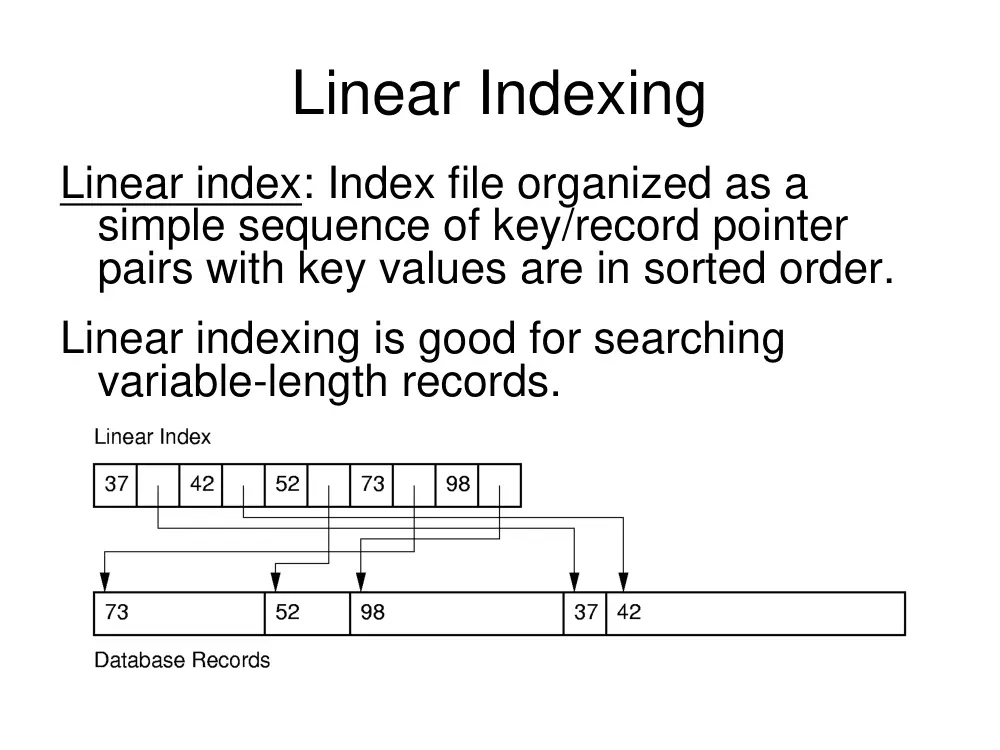
Linear Indexing
Linear index: Index file organized as a
simple sequence of key/record pointer
pairs with key values are in sorted order.
Linear indexing is good for searching
variable-length records.
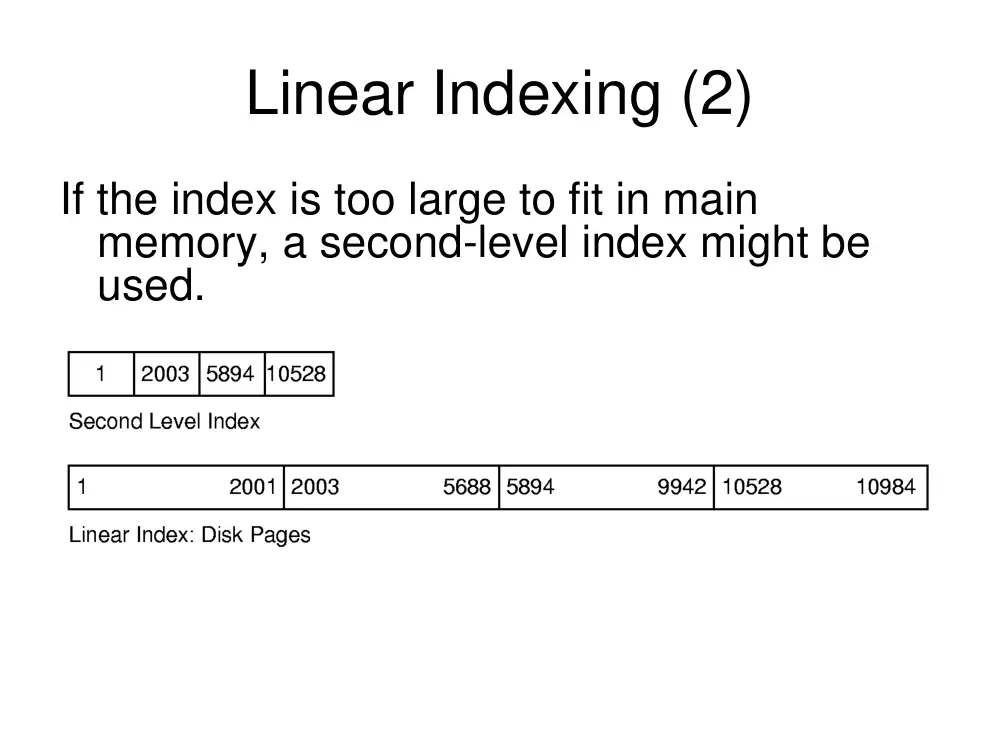
Linear Indexing (2)
If the index is too large to fit in main
memory, a second-level index might be
used.
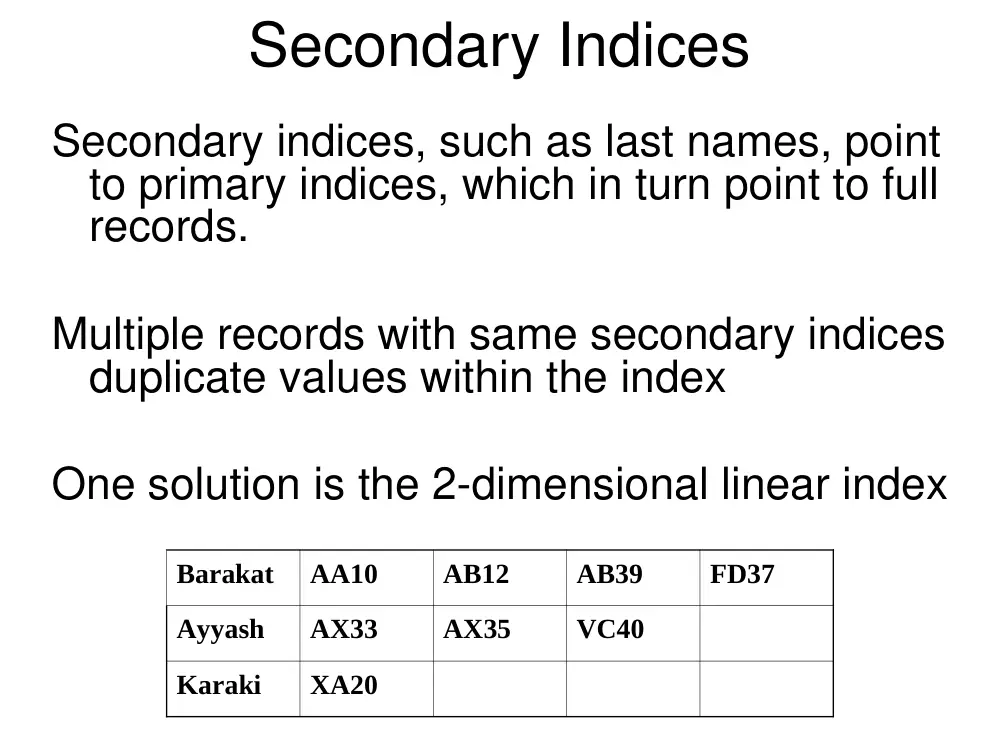
Secondary Indices
Secondary indices, such as last names, point
to primary indices, which in turn point to full
records.
Multiple records with same secondary indices
duplicate values within the index
One solution is the 2-dimensional linear index
Barakat
AA10
AB12
AB39
FD37
Ayyash
AX33
AX35
VC40
Karaki
XA20
Secondary Indices (2)
With 2-dimensional linear index, there is no
duplication and the cost of insertion/deletion is
reduced;
A new row must be added when a new secondary
key is added
Array size is fixed which poses an upper limit
There is wasted space (empty table cells)
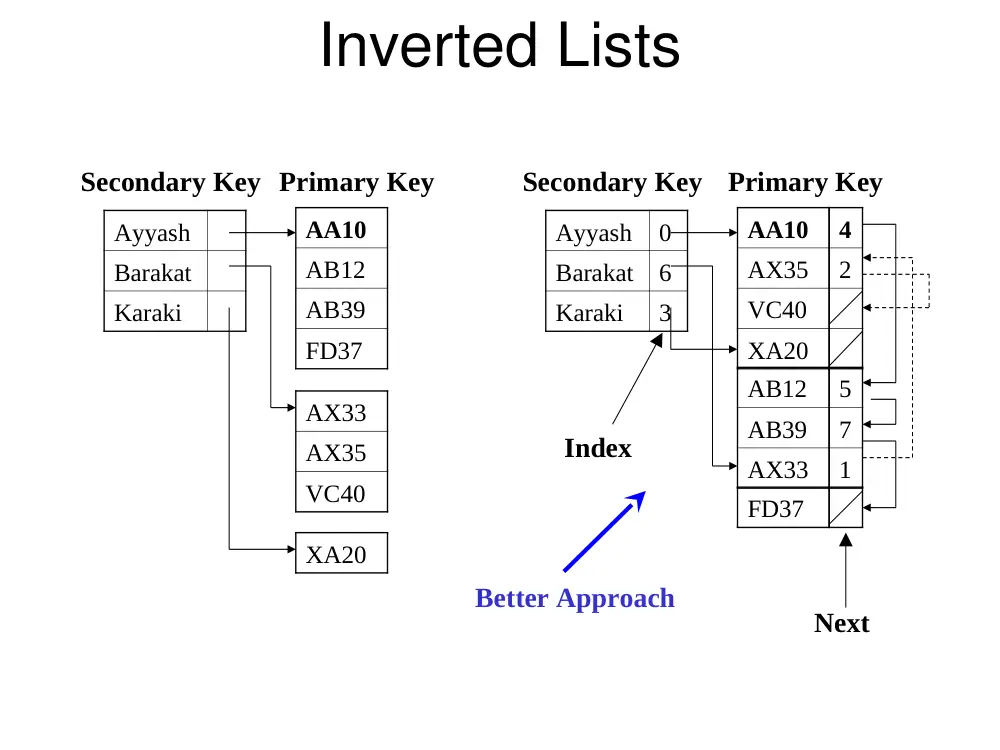
Alternative: Inverted Lists
Inverted Lists
Ayyash
Barakat
Karaki
AA10
AB12
AB39
FD37
AX33
AX35
VC40
XA20
Secondary Key Primary Key
Ayyash
0
Barakat
6
Karaki
3
AA10
AX35
VC40
XA20
AB12
AB39
AX33
FD37
Secondary Key
Primary Key
4
2
5
7
1
Index
Next
Better Approach
Tree Indexing (1)
Linear index is poor for insertion/deletion.
Tree index can efficiently support all desired
operations:
– Insert/delete
– Multiple search keys (multiple indices)
– Key range search
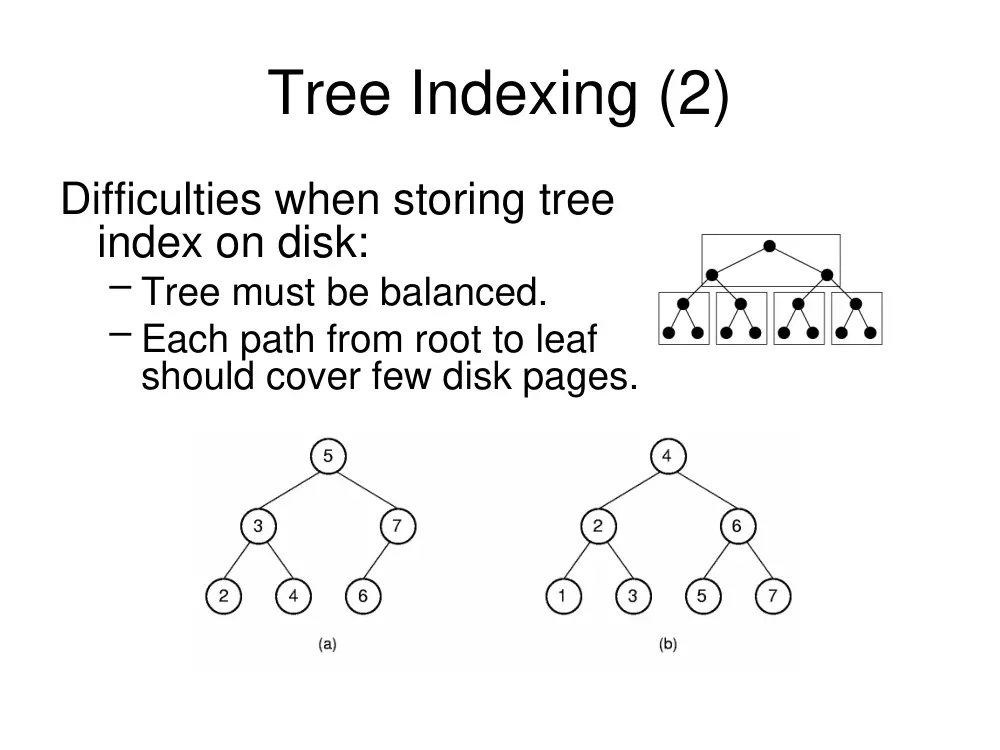
Tree Indexing (2)
Difficulties when storing tree
index on disk:
– Tree must be balanced.
– Each path from root to leaf
should cover few disk pages.
2-3 Tree (1)
A 2-3 Tree has the following properties:
1. A node contains one or two keys
2. Every internal node has either two children
(if it contains one key) or three children (if it
contains two keys).
3. All leaves are at the same level in the tree,
so the tree is always height balanced.
The 2-3 Tree has a search tree property
analogous to the BST.
2-3 Tree (2)
The advantage of the 2-3 Tree over the BST
is that it can be updated at low cost.
2-3 Tree Insertion (tree grows upward)
-Find the leaf node that would contain the key (if it were in the tree)
-If that node (L) contains 1 value
The new key can just be added without any modifications
-Else
More space must be created:
- Split this node (L) into two nodes
- Now we have 3 keys: The new key and the two keys of
L
- Left most node receives smallest key
- New node receives largest key
- Middle key is passed up to the parent with a pointer to
new
node
- If parent has only one key
promoted key gets added to parent
- Else
li
d
d
i
2-3 Tree Insertion (1)
Insert 14
Case 1: available slot
2-3 Tree Insertion (2)
Insert 55
55 should go here
Case 2: full leaf node, available slot in parent
2-3 Tree Insertion (3)
Insert 19 in tree – 2 slides earlier
Split the node 20|21 and promote 20: Parent (23|30) is full split and promote 23
Parent (18|33) is full split and promote 23: No Parent Create one
B-Trees (1)
The B-Tree is an extension of the 2-3 Tree.
The B-Tree is now the standard file
organization for applications requiring
insertion, deletion, and key range
searches.
B-Trees (2)
1. B-Trees are always balanced.
2. B-Trees keep similar-valued records
together on a disk page, which takes
advantage of locality of reference.
3. B-Trees guarantee that every node in the
tree will be full at least to a certain
minimum percentage. This improves
space efficiency while reducing the
typical number of disk fetches necessary
during a search or update operation.
B-Tree Definition
A B-Tree of order m has these properties:
–
The root is either a leaf or has two children.
–
Each node, except for the root and the
leaves, has between m/2 and m children.
–
All leaves are at the same level in the tree,
so the tree is always height balanced.
A B-Tree node is usually selected to match
the size of a disk block.
–
A B-Tree node could have hundreds of
children.
B-Tree Search (1)
Search in a B-Tree is a generalization of
search in a 2-3 Tree.
1. Do binary search on keys in current node. If
search key is found, then return record. If
current node is a leaf node and key is not
found, then report an unsuccessful search.
2. Otherwise, follow the proper branch and
repeat the process.
B+-Trees
The most commonly implemented form of the B-
Tree is the B+-Tree.
Internal nodes of the B+-Tree do not store record --
only values to guide the search.
Leaf nodes store records or pointers to records.
A leaf node may store more or less records than
an internal node stores values.
B+-Tree Example
B+-Tree Insertion
B+-Tree Deletion (1)
B+-Tree Deletion (2)
B+-Tree Deletion (3)
B-Tree Space Analysis (1)
B+-Trees nodes are always at least half full.
The B*-Tree splits two pages for three, and
combines three pages into two. In this
way, nodes are always 2/3 full.
Asymptotic cost of search, insertion, and
deletion of nodes from B-Trees is (log
n).
–
Base of the log is the (average) branching
factor of the tree.
B-Tree Space Analysis (2)
Example: Consider a B+-Tree of order 100
with leaf nodes containing 100 records.
1 level B+-tree:
2 level B+-tree:
3 level B+-tree:
4 level B+-tree:
Ways to reduce the number of disk fetches:
–
Keep the upper levels in memory.
–
Manage B+-Tree pages with a buffer pool.