
EECE 340 Homework 1, Spring 2015
American University of Beirut · Signals and Systems · 3 pages

More EECE 340 files
- Homework 2 · Spring 2016HomeworkView
- Homework 1 Solution · Spring 2016Homework · with solutionView
- Homework 2 Solution · Spring 2016Homework · with solutionView
- Homework 3 Solution · Spring 2016Homework · with solutionView
- Homework 1 · Spring 2016HomeworkView
- Homework 4 · Spring 2016HomeworkView
- Homework 4 Solution · Spring 2016Homework · with solutionView
- Homework 3 · Spring 2016HomeworkView
Show the text of this homework
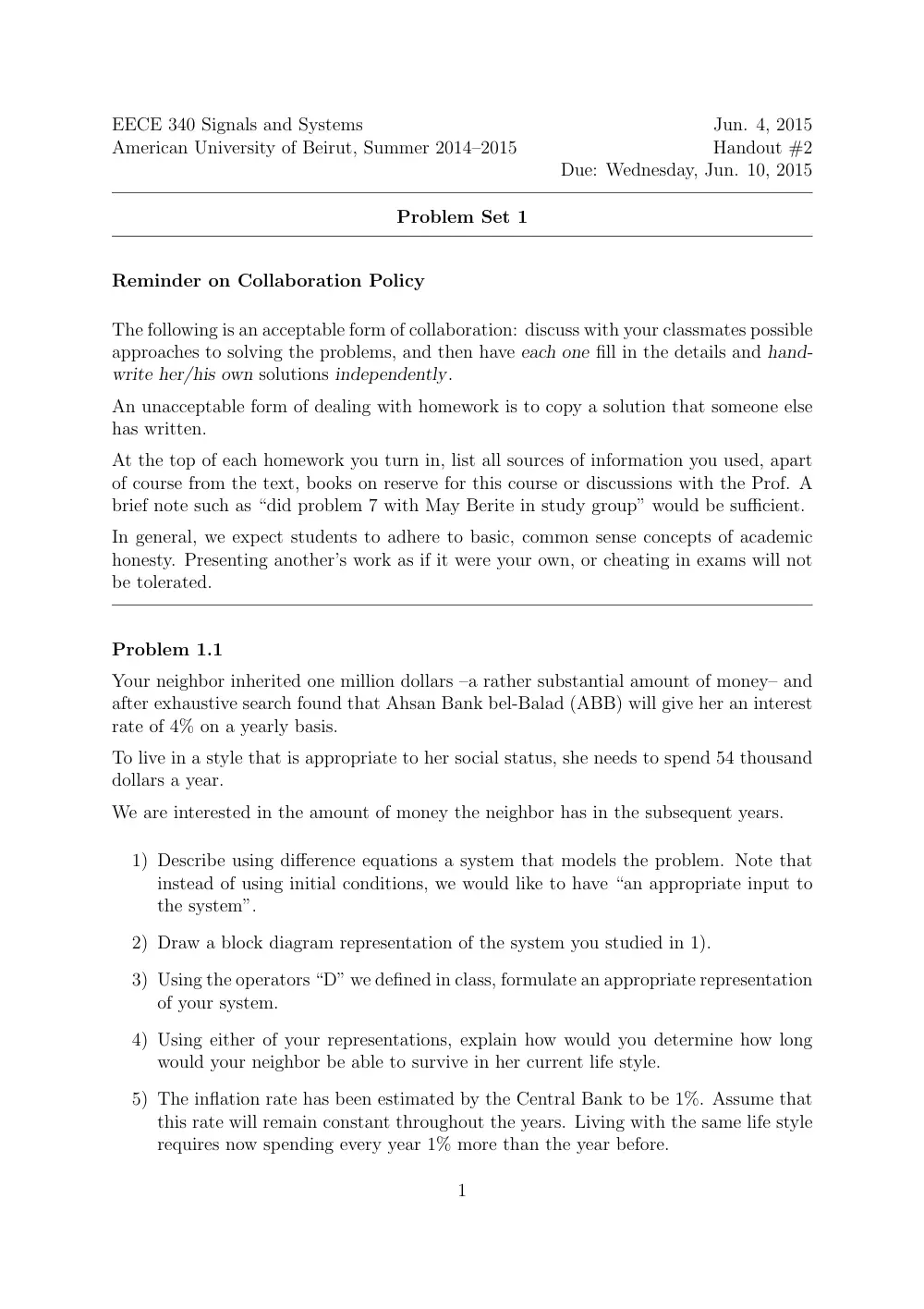
EECE 340 Signals and Systems
Jun. 4, 2015
American University of Beirut, Summer 2014–2015
Handout #2
Due: Wednesday, Jun. 10, 2015
Problem Set 1
Reminder on Collaboration Policy
The following is an acceptable form of collaboration: discuss with your classmates possible
approaches to solving the problems, and then have each one fill in the details and hand-
write her/his own solutions independently.
An unacceptable form of dealing with homework is to copy a solution that someone else
has written.
At the top of each homework you turn in, list all sources of information you used, apart
of course from the text, books on reserve for this course or discussions with the Prof. A
brief note such as “did problem 7 with May Berite in study group” would be sufficient.
In general, we expect students to adhere to basic, common sense concepts of academic
honesty. Presenting another’s work as if it were your own, or cheating in exams will not
be tolerated.
Problem 1.1
Your neighbor inherited one million dollars –a rather substantial amount of money– and
after exhaustive search found that Ahsan Bank bel-Balad (ABB) will give her an interest
rate of 4% on a yearly basis.
To live in a style that is appropriate to her social status, she needs to spend 54 thousand
dollars a year.
We are interested in the amount of money the neighbor has in the subsequent years.
1) Describe using difference equations a system that models the problem. Note that
instead of using initial conditions, we would like to have “an appropriate input to
the system”.
2) Draw a block diagram representation of the system you studied in 1).
3) Using the operators “D” we defined in class, formulate an appropriate representation
of your system.
4) Using either of your representations, explain how would you determine how long
would your neighbor be able to survive in her current life style.
5) The inflation rate has been estimated by the Central Bank to be 1%. Assume that
this rate will remain constant throughout the years. Living with the same life style
requires now spending every year 1% more than the year before.
1
Answer question 4) with the inflation rate taken into account.
Problem 1.2
A real-valued DT signal is called even if
x[−n] = x[n],
∀n ∈ Z.
Similarly, a real-value DT signal is called odd if
x[−n] = −x[n],
∀n ∈ Z.
1) Is the impulse defined in class even or odd ?
2) Consider a signal that is both even and odd. What can you say about the signal?
3) Is it possible to have a signal that is neither? If your answer is no, prove it, if your
answer is yes provide an example.
4) If one were to find the even part of a signal, one can define
xe[n] = 1
2 [x[n] + x[−n]] .
Prove that xe[n] is indeed even.
5) Is such a decomposition unique? Explain.
6) If you were to decompose every signal into an even and an odd part,
x[n] = xe[n] + xo[n],
what would be the definition of xo[n]? Make sure that it is indeed odd.
7) What are the even and odd parts of the signal
x[n] =
�1
3
�n
,
n ≥ 0?
8) Plot a schematic diagram of your answer in 7).
2
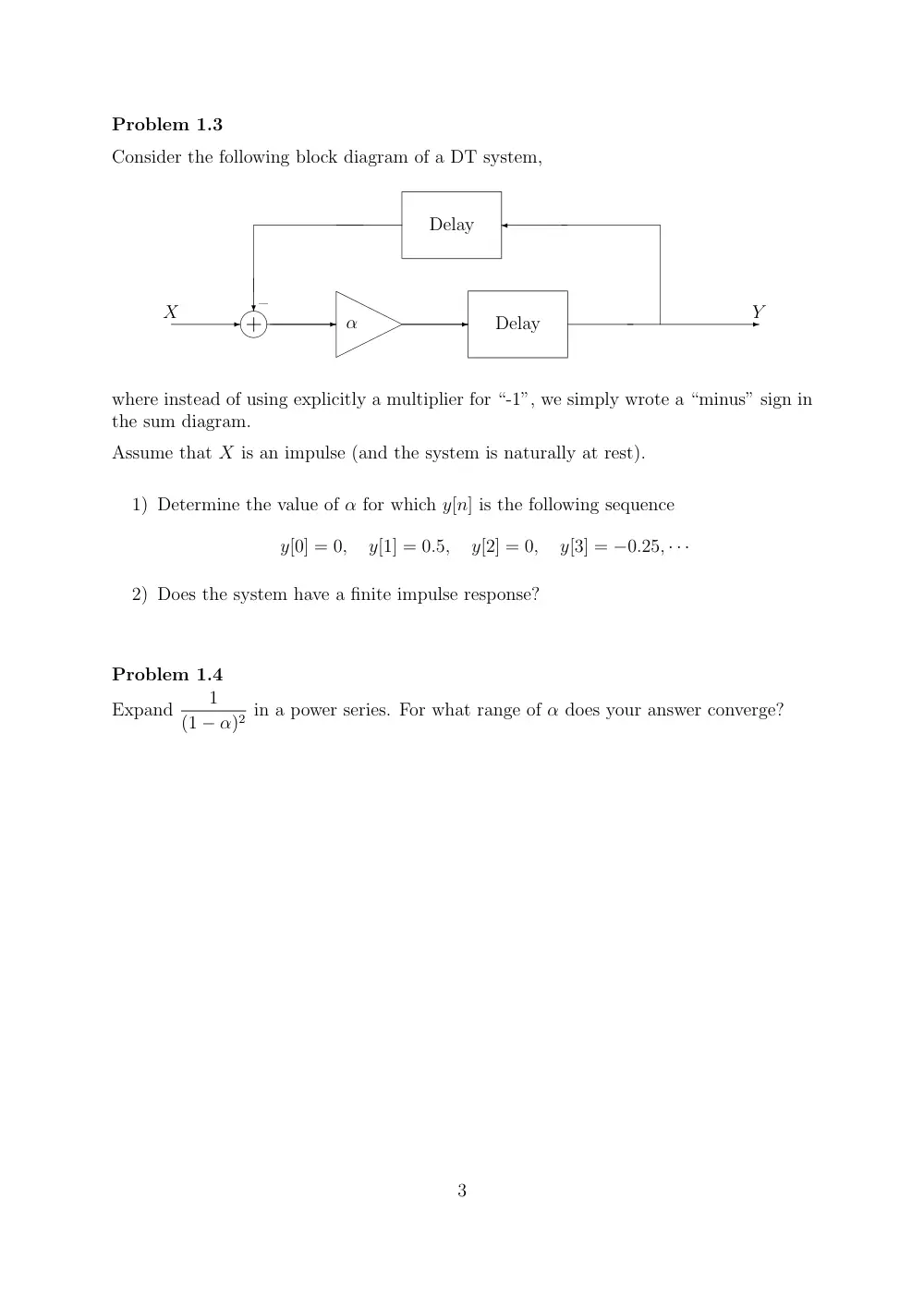
Problem 1.3
Consider the following block diagram of a DT system,
✲
X
+
–
❄
✲ α
✲
Delay
✲Y
✛
Delay
where instead of using explicitly a multiplier for “-1”, we simply wrote a “minus” sign in
the sum diagram.
Assume that X is an impulse (and the system is naturally at rest).
1) Determine the value of α for which y[n] is the following sequence
y[0] = 0,
y[1] = 0.5,
y[2] = 0,
y[3] = −0.25, · · ·
2) Does the system have a finite impulse response?
Problem 1.4
Expand
1
(1 − α)2 in a power series. For what range of α does your answer converge?
3