
EECE 340 Homework 1, Spring 2016
American University of Beirut · Signals and Systems · 3 pages · Prof. Karim Kabalan

More EECE 340 files
- Homework 2 · Spring 2016HomeworkView
- Homework 1 Solution · Spring 2016Homework · with solutionView
- Homework 2 Solution · Spring 2016Homework · with solutionView
- Homework 3 Solution · Spring 2016Homework · with solutionView
- Homework 4 Solution · Spring 2016Homework · with solutionView
- Homework 5 Solution · Spring 2016Homework · with solutionView
- Homework 4 · Spring 2016HomeworkView
- Homework 3 · Spring 2016HomeworkView
Show the text of this homework
Homework I. Spring 2016
1/3
AMERICAN UNIVERSITY OF BEIRUT
Electrical and Computer Engineering Department
EECE 340
Homework I
Problem 1
Determine whether the following signal is periodic. If it is periodic, find
its period.
t
sin
x(t )
2
13
5
Problem 2
Determine whether or not the following signal f(t)=4u(t)+2sin(3t) is
periodic. If the signal is periodic, determine its fundamental period.
Problem 3
Determine whether or not each of the following signals is periodic. If the
signal is periodic, determine its fundamental period.
a)
)]3
[cos(3
( )
t
x t
b)
)
4
sin(3
cos(3 )
( )
t
t
x t
Problem 4
Consider the periodic signal x(t) given by the expression
j t
j t
j t
j t
j e
je
je
j e
t
x
3
2
2
3
2 )
(2
3
5
3
2 )
(2
( )
Determine the period of x(t) and its fundamental frequency.
Problem 5
Consider the everlasting signal
e at
X t( )
. Is X(t) an energy signal?
For which values of “a” X(t) is a power signal? Determine its average
power.
Homework I. Spring 2016
2/3
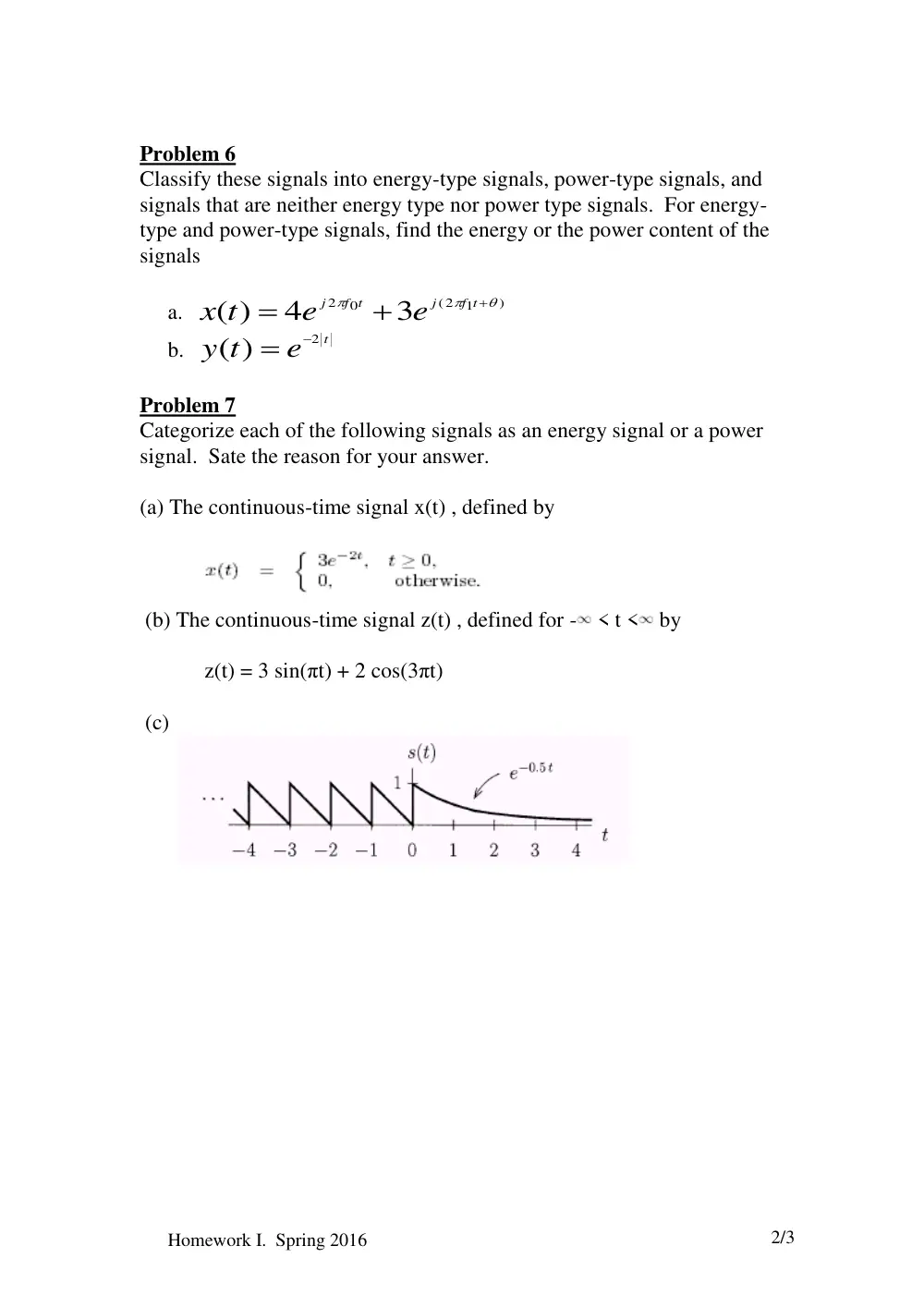
Problem 6
Classify these signals into energy-type signals, power-type signals, and
signals that are neither energy type nor power type signals. For energy-
type and power-type signals, find the energy or the power content of the
signals
a.
)
1
(2
2 0
3
4
)
(
f t
j
j f t
e
e
x t
b.
e t
t
y
2
)
(
Problem 7
Categorize each of the following signals as an energy signal or a power
signal. Sate the reason for your answer.
(a) The continuous-time signal x(t) , defined by
(b) The continuous-time signal z(t) , defined for - < t < by
z(t) = 3 sin(πt) + 2 cos(3πt)
(c)
Homework I. Spring 2016
3/3
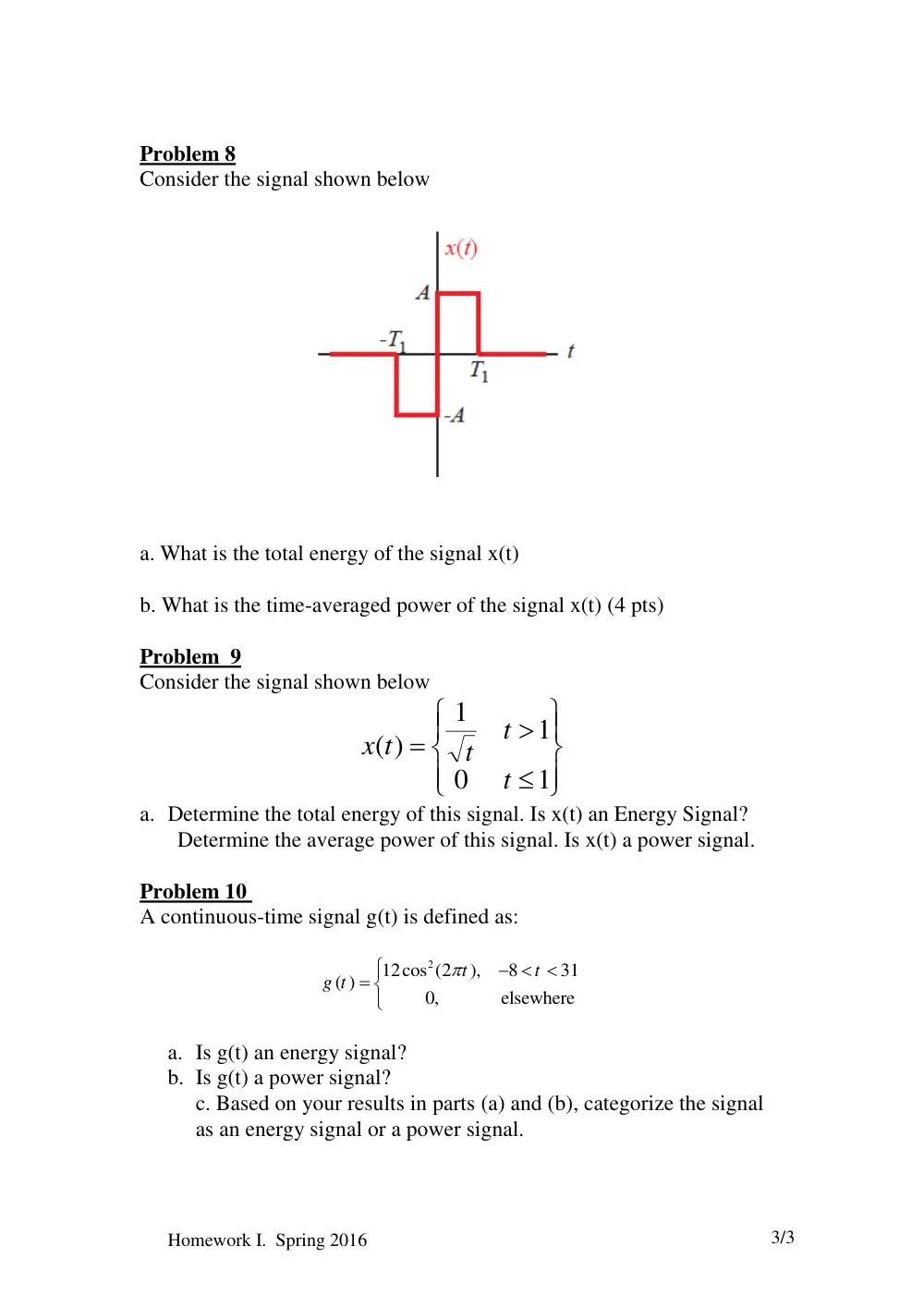
Problem 8
Consider the signal shown below
a. What is the total energy of the signal x(t)
b. What is the time-averaged power of the signal x(t) (4 pts)
Problem 9
Consider the signal shown below
1
0
1
1
)
(
t
t
t
x t
a. Determine the total energy of this signal. Is x(t) an Energy Signal?
Determine the average power of this signal. Is x(t) a power signal.
Problem 10
A continuous-time signal g(t) is defined as:
2
12cos (2
),
8
31
( )
0,
elsewhere
t
t
g t
a. Is g(t) an energy signal?
b. Is g(t) a power signal?
c. Based on your results in parts (a) and (b), categorize the signal
as an energy signal or a power signal.