
EECE 340 Homework 4 Solution, Spring 2016
American University of Beirut · Signals and Systems · 3 pages · Prof. Karim Kabalan · with solution

More EECE 340 files
- Homework 3 · Spring 2016HomeworkView
- Homework 1 Solution · Spring 2016Homework · with solutionView
- Homework 5 Solution · Spring 2016Homework · with solutionView
- Homework 3 Solution · Spring 2016Homework · with solutionView
- Homework 4 · Spring 2016HomeworkView
- Homework 1 · Spring 2016HomeworkView
- Homework 2 Solution · Spring 2016Homework · with solutionView
- Homework 2 · Spring 2016HomeworkView
Show the text of this homework
CMPS 211
Assignment 3 - Solution
Section 3.2
2 -
a) f(x) = 17x + 11; yes C = 1, k = 11
c) f(x) = xlogx; yes C = 1 k = 1
d) f(x) = x4=2; no
e) f(x) = 2x; no
8-
b) f(x) = 3x5 + (log x) 4
3x5 ≤ 3x5
for x > 1
log x < x
for x > 1
⇒ 3x5 + (log x) 4 < 3x5 + (x)4 = 3x5 + x4 < 3x5 + x5 = 4x5
⇒ f(x) = Ο (x 5 ) for c = 4 and x > 1
c) f(x) =
1
1
4
2
4
+
+
+
x
x
x
x4 + x2 + 1 ≤ x4 + x4 + x4 = 3 x4
for x > 1
x4 + 1 ≥ x -4
for x > 1
⇒
1
1
4 +
x
≤ x4
for x > 1
⇒
1
1
4
2
4
+
+
+
x
x
x
≤
4
3 4
x
x
= 3
⇒ f(x) = Ο (x 0 ) = Ο (1 ) for c = 3 and x > 1
14-
a) Is x3 = Ο (x2) ?
NO
Want to show that there doesn’t exist a pair of c and k to satisfy the equation
x3 ≤ c x2
and x > k
Since x is positive, we can divide both sides of the inequality by x, then
x2 ≤ c x
and x > k
but there are no values of c and k to satisfy this inequality, if we set k = 1.
⇒ x3 ≠ Ο (x2).
d) Is x3 = Ο (x2 + x4) ?
YES
x3 ≤ x4
for x > 1
⇒ x3 ≤ x4 + x2
for x > 1
since x2 > 0
⇒ x3 ≤ x4 + x4 = 2 x4
for x > 1
since x2 ≤ x4
⇒ x3 = Ο (x2 + x4)
for c = 2 and x > 1
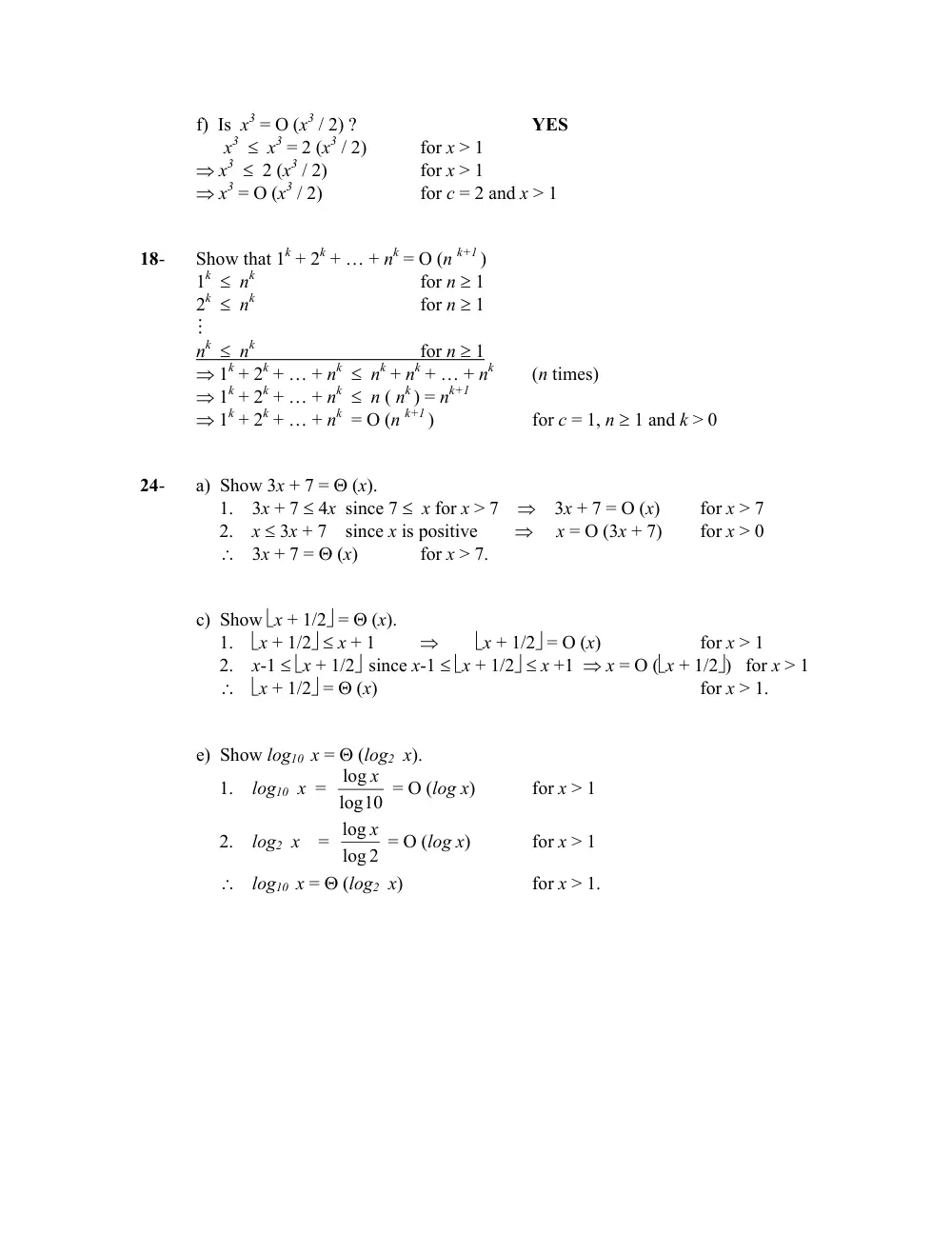
f) Is x3 = Ο (x3 / 2) ?
YES
x3 ≤ x3 = 2 (x3 / 2)
for x > 1
⇒ x3 ≤ 2 (x3 / 2)
for x > 1
⇒ x3 = Ο (x3 / 2)
for c = 2 and x > 1
18-
Show that 1k + 2k + … + nk = Ο (n k+1 )
1k ≤ nk
for n ≥ 1
2k ≤ nk
for n ≥ 1
M
nk ≤ nk
for n ≥ 1
⇒ 1k + 2k + … + nk ≤ nk + nk + … + nk
(n times)
⇒ 1k + 2k + … + nk ≤ n ( nk ) = nk+1
⇒ 1k + 2k + … + nk = Ο (n k+1 )
for c = 1, n ≥ 1 and k > 0
24-
a) Show 3x + 7 = Θ (x).
1. 3x + 7 ≤ 4x since 7 ≤ x for x > 7 ⇒ 3x + 7 = Ο (x)
for x > 7
2. x ≤ 3x + 7 since x is positive ⇒ x = Ο (3x + 7)
for x > 0
∴ 3x + 7 = Θ (x)
for x > 7.
c) Show x + 1/2 = Θ (x).
1. x + 1/2 ≤ x + 1
⇒
x + 1/2 = Ο (x)
for x > 1
2. x-1 ≤ x + 1/2 since x-1 ≤ x + 1/2 ≤ x +1 ⇒ x = Ο (x + 1/2) for x > 1
∴ x + 1/2 = Θ (x)
for x > 1.
e) Show log10 x = Θ (log2 x).
1. log10 x =
log10
log x = Ο (log x)
for x > 1
2. log2 x =
log 2
log x = Ο (log x)
for x > 1
∴ log10 x = Θ (log2 x)
for x > 1.
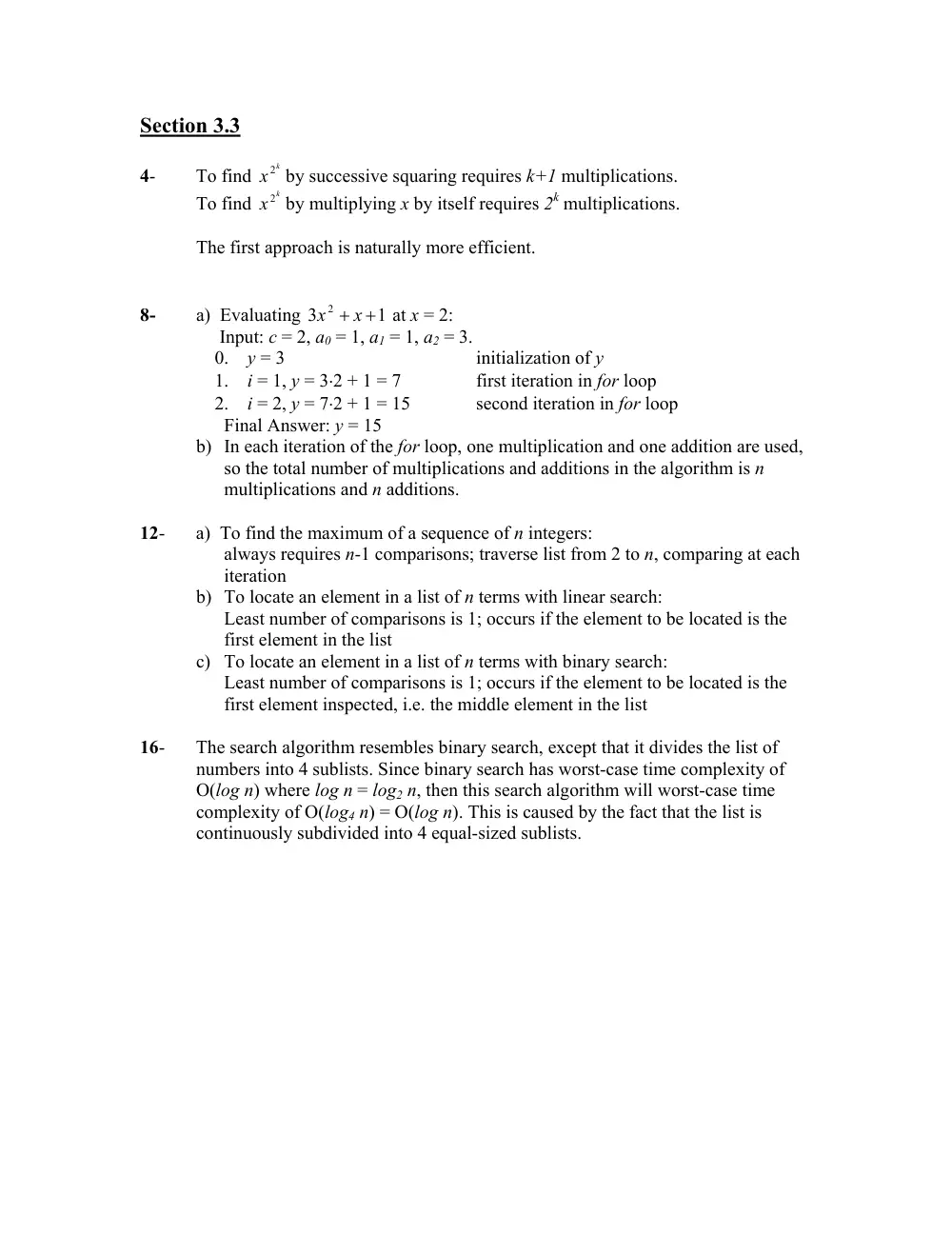
Section 3.3
4-
To find
k
x 2 by successive squaring requires k+1 multiplications.
To find
k
x 2 by multiplying x by itself requires 2k multiplications.
The first approach is naturally more efficient.
8-
a) Evaluating
1
3
2
x + x +
at x = 2:
Input: c = 2, a0 = 1, a1 = 1, a2 = 3.
0. y = 3
initialization of y
1. i = 1, y = 3⋅2 + 1 = 7
first iteration in for loop
2. i = 2, y = 7⋅2 + 1 = 15
second iteration in for loop
Final Answer: y = 15
b) In each iteration of the for loop, one multiplication and one addition are used,
so the total number of multiplications and additions in the algorithm is n
multiplications and n additions.
12-
a) To find the maximum of a sequence of n integers:
always requires n-1 comparisons; traverse list from 2 to n, comparing at each
iteration
b) To locate an element in a list of n terms with linear search:
Least number of comparisons is 1; occurs if the element to be located is the
first element in the list
c) To locate an element in a list of n terms with binary search:
Least number of comparisons is 1; occurs if the element to be located is the
first element inspected, i.e. the middle element in the list
16-
The search algorithm resembles binary search, except that it divides the list of
numbers into 4 sublists. Since binary search has worst-case time complexity of
O(log n) where log n = log2 n, then this search algorithm will worst-case time
complexity of O(log4 n) = O(log n). This is caused by the fact that the list is
continuously subdivided into 4 equal-sized sublists.