
EECE 340 Homework 2 Solution, Spring 2016
American University of Beirut · Signals and Systems · 4 pages · Prof. Karim Kabalan · with solution

More EECE 340 files
- Homework 2 · Spring 2016HomeworkView
- Homework 1 Solution · Spring 2016Homework · with solutionView
- Homework 5 Solution · Spring 2016Homework · with solutionView
- Homework 3 Solution · Spring 2016Homework · with solutionView
- Homework 4 Solution · Spring 2016Homework · with solutionView
- Homework 1 · Spring 2016HomeworkView
- Homework 4 · Spring 2016HomeworkView
- Homework 3 · Spring 2016HomeworkView
Show the text of this homework
1 |
P a g e
AMERICAN UNIVERSITY OF BEIRUT
ELECTRICAL AND COMPUTER ENGINEERING DEPARTMENT
EECE 340
Homework II - Topic: System Properties
Solution
Problem 1
The input-output relationship of a system is given by:
d
e x
t
y
t
( )
)1
(
( )
a. Is this system stable? Justify your answer.
M e d
d
e x
t
y
t
( )
)1
(
( )
Not stable
a. Is this system linear? Justify your answer.
Yes, apply the definition
b. Is this system Time invariant? Justify your answer.
No, the system is a time varying system
Problem 2
The input-output relationship of a system is given by:
( )
( ) (
1)
2 (
2)
y t
x t x t
x t
a. Is this system linear? Justify your answer.
System is not linear, because
1
1
1
1
1
( )
( )
( )
(
1)
2 (
2)
x t
y t
x t x t
x t
2
2
2
2
2
( )
( )
( )
(
1)
2
(
2)
x t
y t
x t x t
x t
1
2
1
2
1
2
1
2
1
2
1
1
2
2
1
( )
( )
( )
( )
( )
(
1)
(
1)
2
(
2)
(
2)
ay ( )
( )
=
( ) (
1)
( )
(
1)
2
(
ax t
bx t
y t
ax t
bx t
ax t
bx t
ax t
bx t
t
by t
ax t x t
bx t x t
ax t
2
2)
(
2)
bx t
b. Is this system time-invariant? Justify your answer.
( )
( ) (
1)
2 (
2)
x t
x t x t
x t
=y(t)
0
0
0
0
0
(
)
(
) (
1)
2 (
2)
(
)
x t
t
x t
t x t
t
x t
t
y t
t
2 |
P a g e
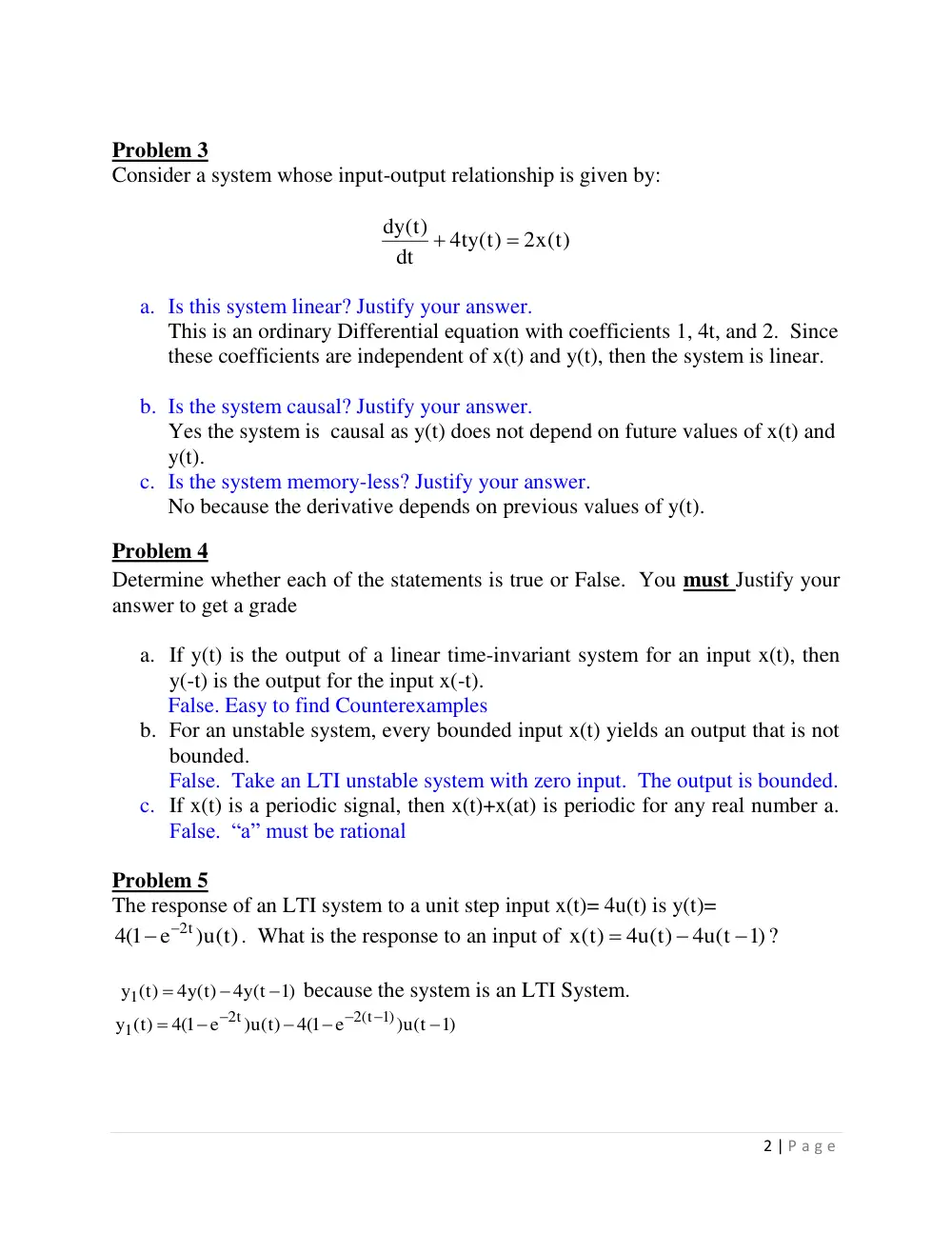
Problem 3
Consider a system whose input-output relationship is given by:
2x )t(
4ty )t(
dt
dy )t(
a. Is this system linear? Justify your answer.
This is an ordinary Differential equation with coefficients 1, 4t, and 2. Since
these coefficients are independent of x(t) and y(t), then the system is linear.
b. Is the system causal? Justify your answer.
Yes the system is causal as y(t) does not depend on future values of x(t) and
y(t).
c. Is the system memory-less? Justify your answer.
No because the derivative depends on previous values of y(t).
Problem 4
Determine whether each of the statements is true or False. You must Justify your
answer to get a grade
a. If y(t) is the output of a linear time-invariant system for an input x(t), then
y(-t) is the output for the input x(-t).
False. Easy to find Counterexamples
b. For an unstable system, every bounded input x(t) yields an output that is not
bounded.
False. Take an LTI unstable system with zero input. The output is bounded.
c. If x(t) is a periodic signal, then x(t)+x(at) is periodic for any real number a.
False. “a” must be rational
Problem 5
The response of an LTI system to a unit step input x(t)= 4u(t) is y(t)=
)u )t(
e
4 1(
2t
. What is the response to an input of
)1
4u t(
4u )t(
x )t(
?
)1
4y t(
4y )t(
y1 )t(
because the system is an LTI System.
)1
)u t(
e
4 1(
)u )t(
e
4 1(
)t(
y
)1
2 t(
t
2
1
3 |
P a g e
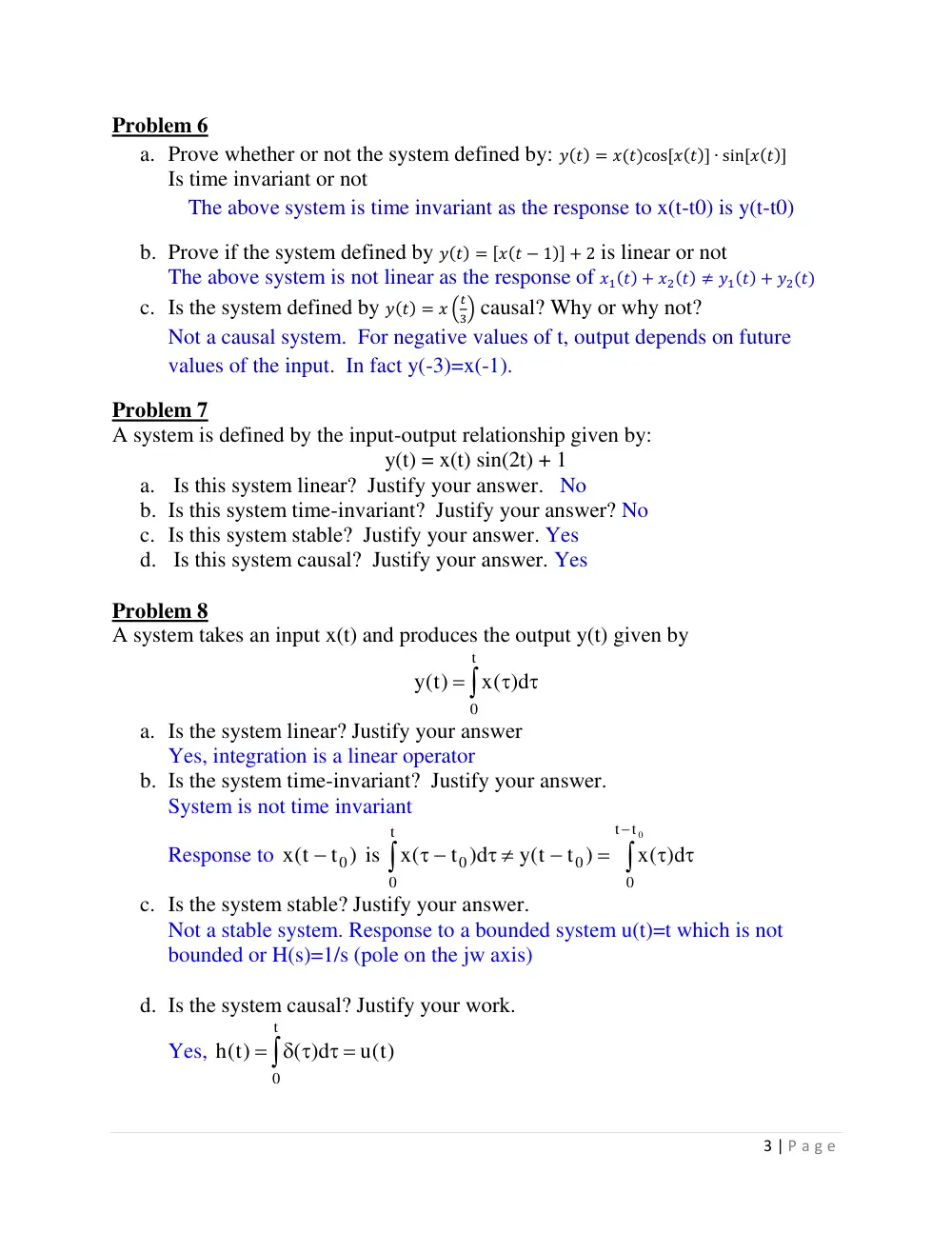
Problem 6
a. Prove whether or not the system defined by: 𝑦(𝑡) = 𝑥(𝑡)cos[𝑥(𝑡)] ∙ sin[𝑥(𝑡)]
Is time invariant or not
The above system is time invariant as the response to x(t-t0) is y(t-t0)
b. Prove if the system defined by 𝑦(𝑡) = [𝑥(𝑡 − 1)] + 2 is linear or not
The above system is not linear as the response of 𝑥1(𝑡) + 𝑥2(𝑡) ≠ 𝑦1(𝑡) + 𝑦2(𝑡)
c. Is the system defined by 𝑦(𝑡) = 𝑥 (
𝑡
3) causal? Why or why not?
Not a causal system. For negative values of t, output depends on future
values of the input. In fact y(-3)=x(-1).
Problem 7
A system is defined by the input-output relationship given by:
y(t) = x(t) sin(2t) + 1
a. Is this system linear? Justify your answer. No
b. Is this system time-invariant? Justify your answer? No
c. Is this system stable? Justify your answer. Yes
d. Is this system causal? Justify your answer. Yes
Problem 8
A system takes an input x(t) and produces the output y(t) given by
t
0
x( )d
y )t(
a. Is the system linear? Justify your answer
Yes, integration is a linear operator
b. Is the system time-invariant? Justify your answer.
System is not time invariant
Response to
t )
x t(
0
is
t )
y t(
t )d
x(
0
t
0
0
0t
t
0
x( )d
c. Is the system stable? Justify your answer.
Not a stable system. Response to a bounded system u(t)=t which is not
bounded or H(s)=1/s (pole on the jw axis)
d. Is the system causal? Justify your work.
Yes,
u )t(
( )d
)t(
h
t
0
4 |
P a g e
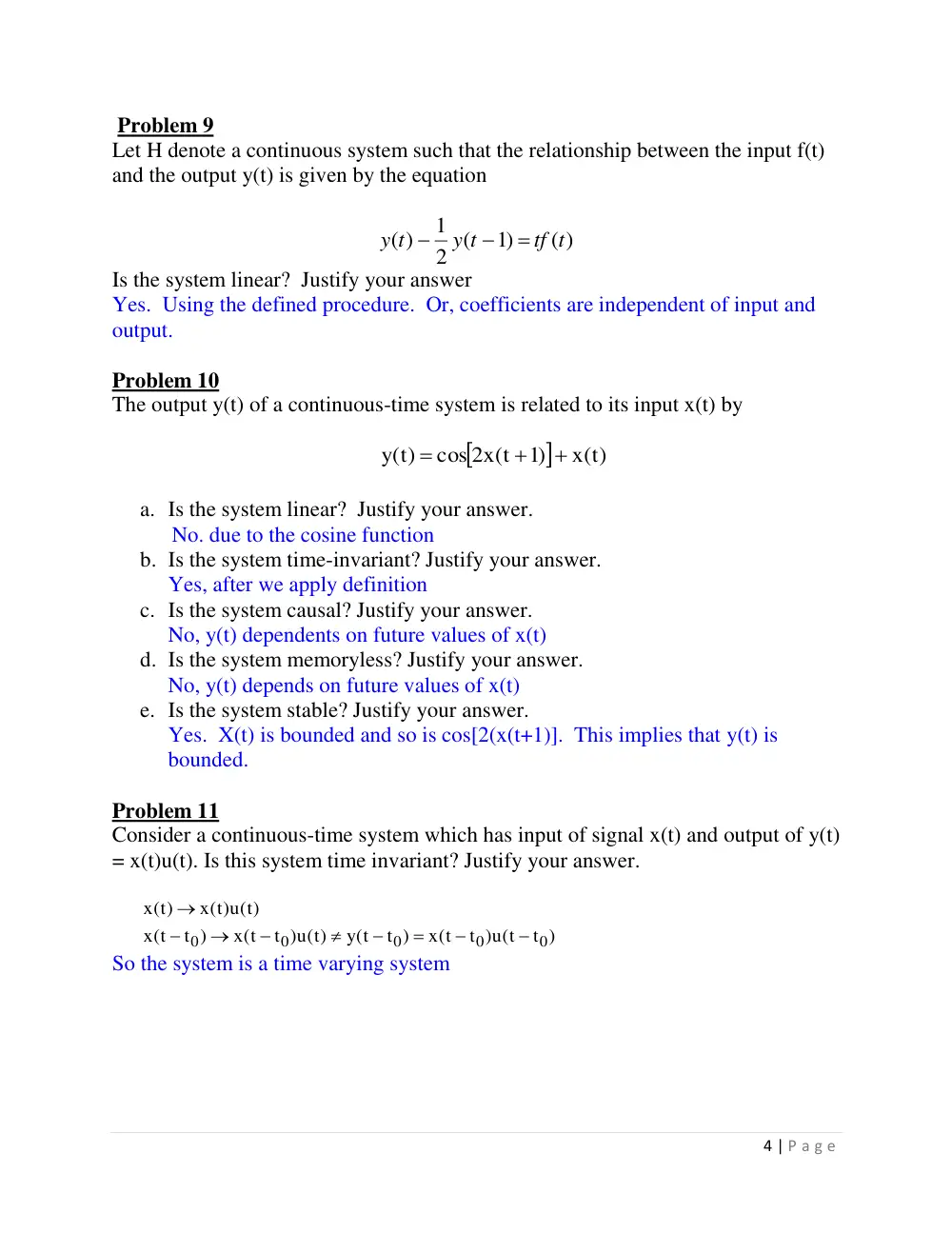
Problem 9
Let H denote a continuous system such that the relationship between the input f(t)
and the output y(t) is given by the equation
( )
)1
2 (
1
( )
tf t
y t
y t
Is the system linear? Justify your answer
Yes. Using the defined procedure. Or, coefficients are independent of input and
output.
Problem 10
The output y(t) of a continuous-time system is related to its input x(t) by
x )t(
)1
cos 2x t(
y )t(
a. Is the system linear? Justify your answer.
No. due to the cosine function
b. Is the system time-invariant? Justify your answer.
Yes, after we apply definition
c. Is the system causal? Justify your answer.
No, y(t) dependents on future values of x(t)
d. Is the system memoryless? Justify your answer.
No, y(t) depends on future values of x(t)
e. Is the system stable? Justify your answer.
Yes. X(t) is bounded and so is cos[2(x(t+1)]. This implies that y(t) is
bounded.
Problem 11
Consider a continuous-time system which has input of signal x(t) and output of y(t)
= x(t)u(t). Is this system time invariant? Justify your answer.
t )
t )u t(
x t(
t )
y t(
t )u )t(
x t(
t )
t(
x
x )t( u )t(
)t(
x
0
0
0
0
0
So the system is a time varying system