
EECE 340 Homework 5 Solution, Spring 2016
American University of Beirut · Signals and Systems · 6 pages · Prof. Karim Kabalan · with solution


More EECE 340 files
- Homework 3 · Spring 2016HomeworkView
- Homework 1 Solution · Spring 2016Homework · with solutionView
- Homework 4 · Spring 2016HomeworkView
- Homework 3 Solution · Spring 2016Homework · with solutionView
- Homework 4 Solution · Spring 2016Homework · with solutionView
- Homework 1 · Spring 2016HomeworkView
- Homework 2 Solution · Spring 2016Homework · with solutionView
- Homework 2 · Spring 2016HomeworkView
Show the text of this homework
AMERICAN UNIVERSITY OF BEIRUT
ELECTRICAL AND COMPUTER ENGINEERING DEPARTMENT
EECE 340
Homework V – Routh Hurwitz Stability Criterion
Solution
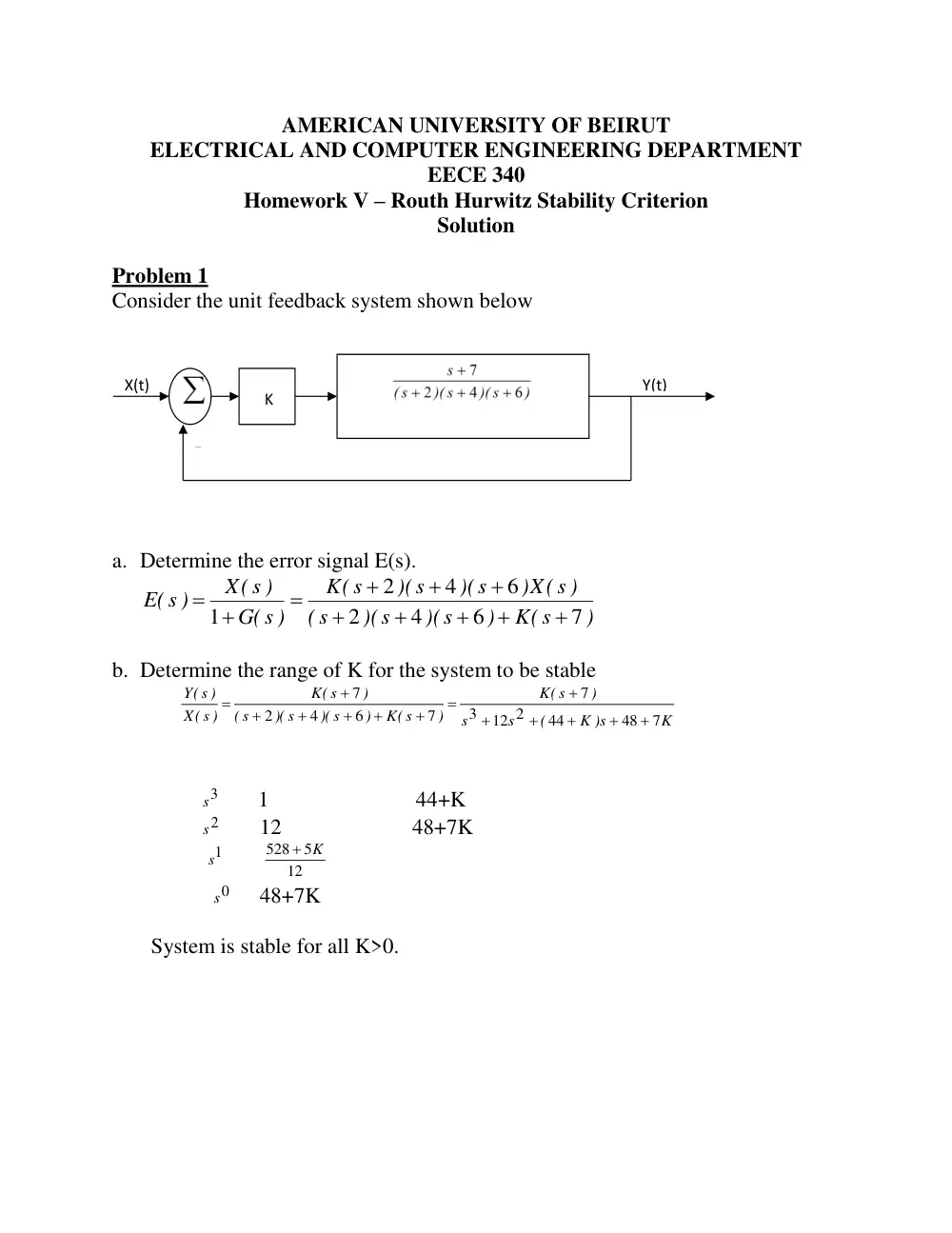
Problem 1
Consider the unit feedback system shown below
a. Determine the error signal E(s).
)
K( s
)
)(s
)(s
s
(
)X( s )
)(s
)(s
( s
K
( s )
G
X( s )
E( s )
7
6
4
2
6
4
2
1
b. Determine the range of K for the system to be stable
K
K s)
(
s
s
)
( s
K
)
K( s
)
)( s
)( s
s
(
)
( s
K
( s )
X
( s )
Y
7
48
44
12 2
3
7
7
6
4
2
7
3
s 1 44+K
2
s 12 48+7K
1
s
12
5
528
K
0
s 48+7K
System is stable for all K>0.
K
-
X(t)
Y(t)
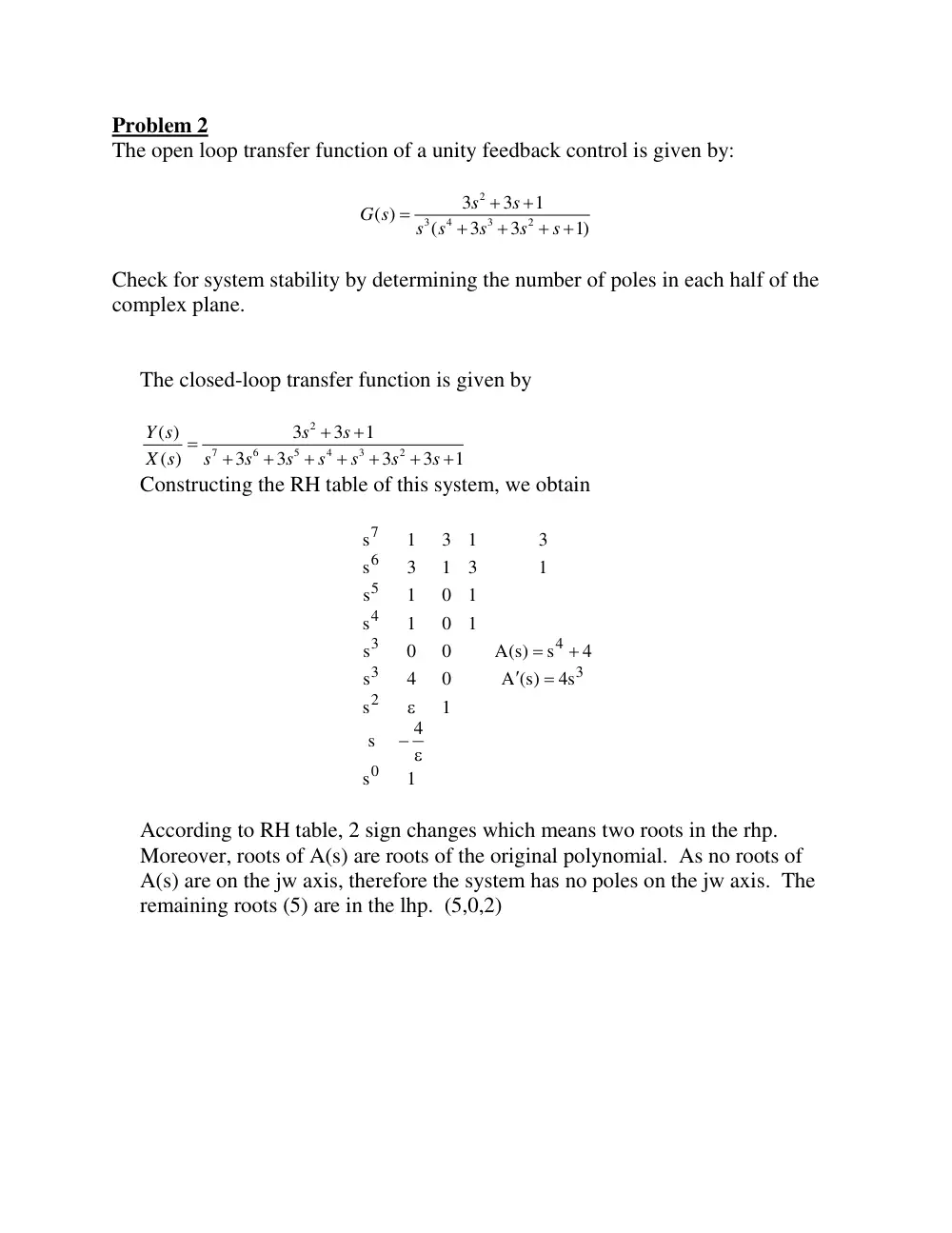
Problem 2
The open loop transfer function of a unity feedback control is given by:
2
3
4
3
2
3
3
1
( )
(
3
3
1)
s
s
G s
s s
s
s
s
Check for system stability by determining the number of poles in each half of the
complex plane.
The closed-loop transfer function is given by
2
7
6
5
4
3
2
( )
3
3
1
( )
3
3
3
3
1
Y s
s
s
X s
s
s
s
s
s
s
s
Constructing the RH table of this system, we obtain
1
s
4
s
1
s
4s
)s(
A
0
4
s
4
s
A )s(
0
0
s
1
0
1
s
1
0
1
s
1
3
1
3
s
3
1
3
1
s
0
2
3
3
4
3
4
5
6
7
According to RH table, 2 sign changes which means two roots in the rhp.
Moreover, roots of A(s) are roots of the original polynomial. As no roots of
A(s) are on the jw axis, therefore the system has no poles on the jw axis. The
remaining roots (5) are in the lhp. (5,0,2)
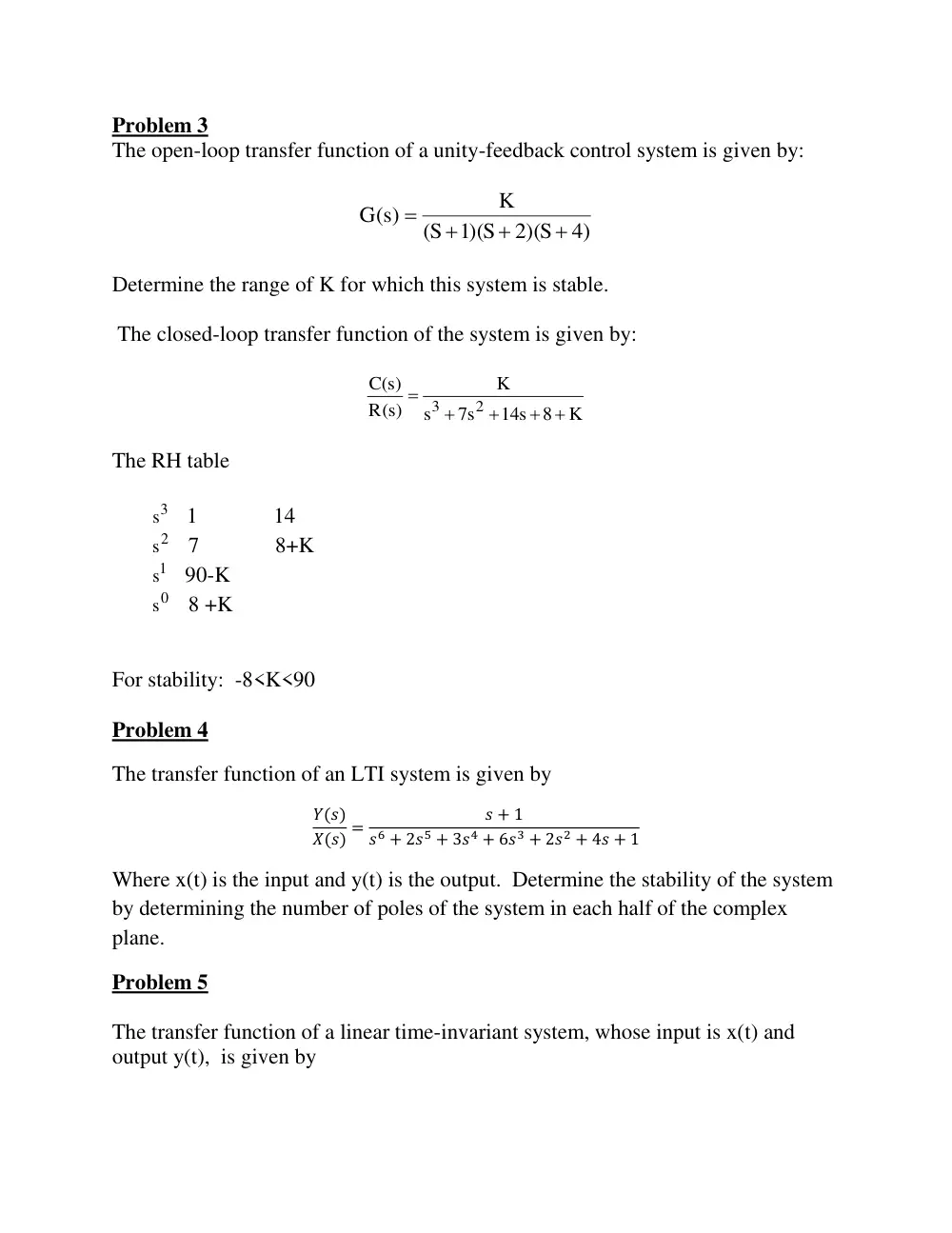
Problem 3
The open-loop transfer function of a unity-feedback control system is given by:
4)
2)(S
S 1)(S
(
K
G )s(
Determine the range of K for which this system is stable.
The closed-loop transfer function of the system is given by:
K
8
14s
7s
s
K
)s(
R
)s(
C
2
3
The RH table
3
s 1 14
2
s 7 8+K
1s 90-K
0
s 8 +K
For stability: -8<K<90
Problem 4
The transfer function of an LTI system is given by
𝑌(𝑠)
𝑋(𝑠) =
𝑠 + 1
𝑠6 + 2𝑠5 + 3𝑠4 + 6𝑠3 + 2𝑠2 + 4𝑠 + 1
Where x(t) is the input and y(t) is the output. Determine the stability of the system
by determining the number of poles of the system in each half of the complex
plane.
Problem 5
The transfer function of a linear time-invariant system, whose input is x(t) and
output y(t), is given by
10
5s
3s
s
s
2
10
s
3
)s(
X
)s(
Y
2
3
4
Check the stability of the system by determining the number of poles of the system
in each half of the complex-plane.
Problem 6
The transfer function of a linear time-invariant system, whose input is x(t) and
output y(t), is given by
1
s
s
s
10
s
3
)s(
X
)s(
Y
3
4
Check the stability of the system by determining the number of poles of the system
in each half of the complex-plane.
Problem 7
The forward transfer function of a unity feedback control system is given by:
4)
2s
3s
s
s(s
)1
5 s(
)s(
G
2
3
4
Check the stability of the system by determining the number of poles in each half
of the complex plane.
Solution
System transfer function
5
s
2s
3s
s
s
)1
s(
5
G )s(
1
)s(
G
)s(
X
)s(
Y
2
3
4
5
Using RH stability criterion
S5 1 3 1
S4 1 2 5
S3 1 -4
S2 6 5
S1 -29/6
S0 5
System is not stable with 2 poles in the RHP; (3, 0, 2)
Problem 8
The closed-loop transfer function of a unity feedback control system, whose input
is Y(s) and output is R(s), is given by
56
8s
42s
6s
7s
s
10
)s(
R
)s(
Y
2
3
4
5
Check the stability of the above system by determining the number of poles in each
half of the complex plane.
S5
1
6
8
S4
1
6
8
S3
0
0
A(s)=s4+6s2+8
S3
4
12
A/(s)=4s3+12s
S2
3
8
S1
4
S0
8
2j
2 ,j and s
s
0
A )s(
Root Distributions: (1, 4, 0)
Problem 9
The block Diagram of a unity feedback control system is shown below
Find the number of poles in the left-half-plane, the right-half-plane, and on the jω-
axis.
Solution
1
2s
3s
2s
3s
s
2
1
)s(
R
C )s(
TF
2
3
4
5
Using RH table, we obtain
From the above table, we conclude (3, 0, 2)