
EECE 340 Homework 3 Solution, Spring 2015
American University of Beirut · Signals and Systems · 7 pages · with solution


More EECE 340 files
- Homework 3 · Spring 2016HomeworkView
- Homework 1 Solution · Spring 2016Homework · with solutionView
- Homework 4 · Spring 2016HomeworkView
- Homework 3 Solution · Spring 2016Homework · with solutionView
- Homework 4 Solution · Spring 2016Homework · with solutionView
- Homework 1 · Spring 2016HomeworkView
- Homework 2 Solution · Spring 2016Homework · with solutionView
- Homework 2 · Spring 2016HomeworkView
Show the text of this homework
EECE 340 Signals and Systems
Jun. 24, 2015
American University of Beirut, Summer 2014–2015
Handout #8
Problem Set 3 – Solutions
Problem 3.1
(a) Using the definition,
X(z) =
∞
�
n=−∞
x[n]z−n =
∞
�
n=2
�1
3
�n
z−n
= 1
9z−2
1
1 − 1
3z−1
whenever |z| > (1/3). Also the signal is causal and therefore “∞” is also in the
ROC.
(b) Y (z) = �∞
n=−∞ y[n]z−n = −z + z−1 + 2z−2, which exists whenever z is neither “0”
nor “∞”.
Problem 3.2
(a)
y[n] =
∞
�
k=−∞
u[k]u[n − k] =
∞
�
k=0
u[n − k]
=
� �n
k=0 1 = (n + 1)
n ≥ 0
0
o.w.
= (n + 1)u[n].
(b)
y[n] =
∞
�
k=−∞
u[k]
�1
2
�n−k
u[n − k] =
∞
�
k=0
�1
2
�n−k
u[n − k]
=
� �n
k=0
� 1
2
�n−k = �n
l=0
� 1
2
�l = 1−(1/2)n+1
1−(1/2)
n ≥ 0
0
o.w.
= 2
�
1 −
�1
2
�n+1�
u[n].
1
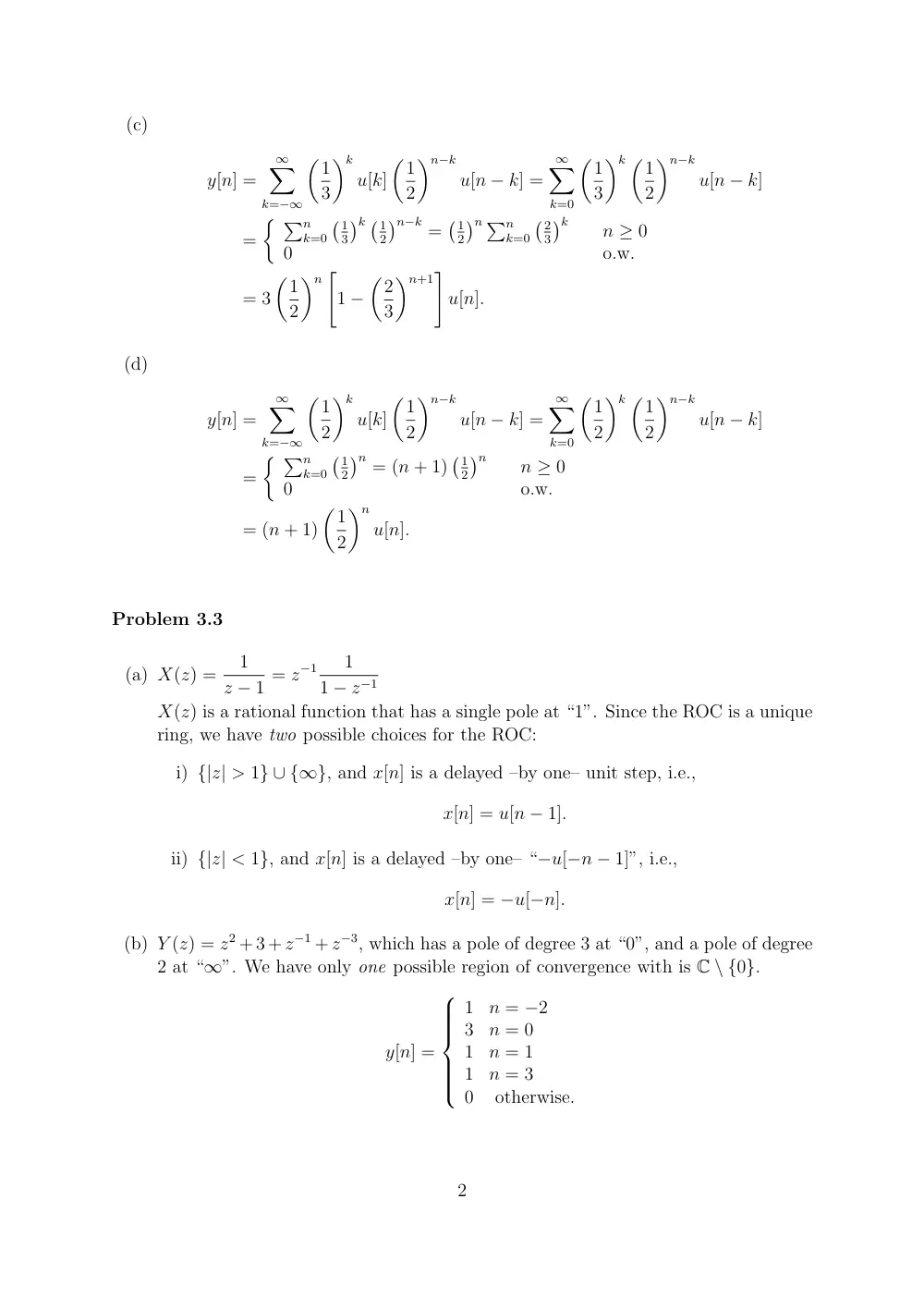
(c)
y[n] =
∞
�
k=−∞
�1
3
�k
u[k]
�1
2
�n−k
u[n − k] =
∞
�
k=0
�1
3
�k �1
2
�n−k
u[n − k]
=
� �n
k=0
�1
3
�k �1
2
�n−k =
�1
2
�n �n
k=0
� 2
3
�k
n ≥ 0
0
o.w.
= 3
�1
2
�n �
1 −
�2
3
�n+1�
u[n].
(d)
y[n] =
∞
�
k=−∞
�1
2
�k
u[k]
�1
2
�n−k
u[n − k] =
∞
�
k=0
�1
2
�k �1
2
�n−k
u[n − k]
=
� �n
k=0
�1
2
�n = (n + 1)
� 1
2
�n
n ≥ 0
0
o.w.
= (n + 1)
�1
2
�n
u[n].
Problem 3.3
(a) X(z) =
1
z − 1 = z−1
1
1 − z−1
X(z) is a rational function that has a single pole at “1”. Since the ROC is a unique
ring, we have two possible choices for the ROC:
i) {|z| > 1} ∪ {∞}, and x[n] is a delayed –by one– unit step, i.e.,
x[n] = u[n − 1].
ii) {|z| < 1}, and x[n] is a delayed –by one– “−u[−n − 1]”, i.e.,
x[n] = −u[−n].
(b) Y (z) = z2 + 3 + z−1 + z−3, which has a pole of degree 3 at “0”, and a pole of degree
2 at “∞”. We have only one possible region of convergence with is C \ {0}.
y[n] =
1
n = −2
3
n = 0
1
n = 1
1
n = 3
0
otherwise.
2
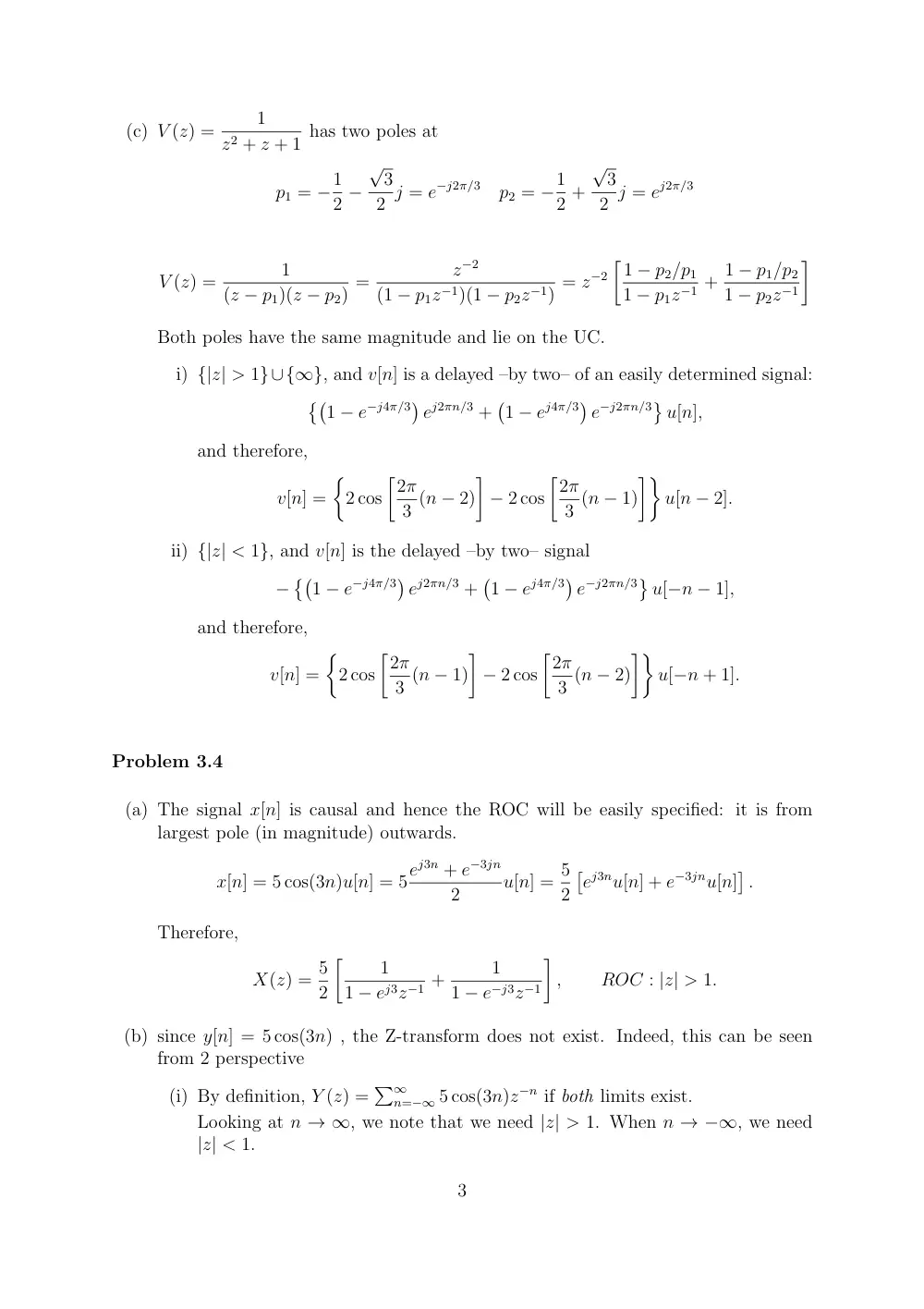
(c) V (z) =
1
z2 + z + 1 has two poles at
p1 = −1
2 −
√
3
2 j = e−j2π/3
p2 = −1
2 +
√
3
2 j = ej2π/3
V (z) =
1
(z − p1)(z − p2) =
z−2
(1 − p1z−1)(1 − p2z−1) = z−2
�1 − p2/p1
1 − p1z−1 + 1 − p1/p2
1 − p2z−1
�
Both poles have the same magnitude and lie on the UC.
i) {|z| > 1}∪{∞}, and v[n] is a delayed –by two– of an easily determined signal:
��
1 − e−j4π/3�
ej2πn/3 +
�
1 − ej4π/3�
e−j2πn/3�
u[n],
and therefore,
v[n] =
�
2 cos
�2π
3 (n − 2)
�
− 2 cos
�2π
3 (n − 1)
��
u[n − 2].
ii) {|z| < 1}, and v[n] is the delayed –by two– signal
−
��
1 − e−j4π/3�
ej2πn/3 +
�
1 − ej4π/3�
e−j2πn/3�
u[−n − 1],
and therefore,
v[n] =
�
2 cos
�2π
3 (n − 1)
�
− 2 cos
�2π
3 (n − 2)
��
u[−n + 1].
Problem 3.4
(a) The signal x[n] is causal and hence the ROC will be easily specified: it is from
largest pole (in magnitude) outwards.
x[n] = 5 cos(3n)u[n] = 5ej3n + e−3jn
2
u[n] = 5
2
�
ej3nu[n] + e−3jnu[n]
�
.
Therefore,
X(z) = 5
2
�
1
1 − ej3z−1 +
1
1 − e−j3z−1
�
,
ROC : |z| > 1.
(b) since y[n] = 5 cos(3n) , the Z-transform does not exist. Indeed, this can be seen
from 2 perspective
(i) By definition, Y (z) = �∞
n=−∞ 5 cos(3n)z−n if both limits exist.
Looking at n → ∞, we note that we need |z| > 1. When n → −∞, we need
|z| < 1.
3
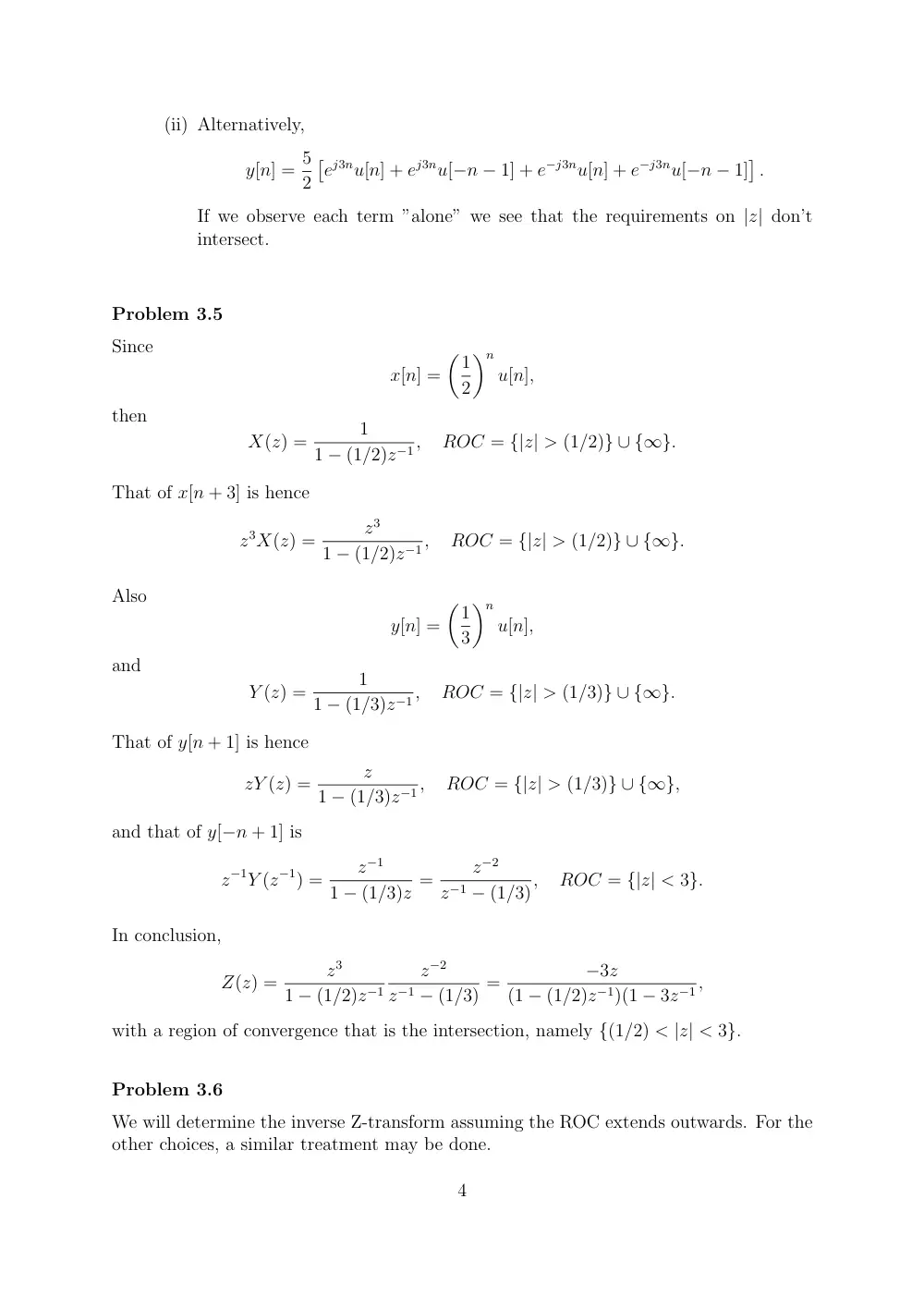
(ii) Alternatively,
y[n] = 5
2
�
ej3nu[n] + ej3nu[−n − 1] + e−j3nu[n] + e−j3nu[−n − 1]
�
.
If we observe each term ”alone” we see that the requirements on |z| don’t
intersect.
Problem 3.5
Since
x[n] =
�1
2
�n
u[n],
then
X(z) =
1
1 − (1/2)z−1,
ROC = {|z| > (1/2)} ∪ {∞}.
That of x[n + 3] is hence
z3X(z) =
z3
1 − (1/2)z−1,
ROC = {|z| > (1/2)} ∪ {∞}.
Also
y[n] =
�1
3
�n
u[n],
and
Y (z) =
1
1 − (1/3)z−1,
ROC = {|z| > (1/3)} ∪ {∞}.
That of y[n + 1] is hence
zY (z) =
z
1 − (1/3)z−1,
ROC = {|z| > (1/3)} ∪ {∞},
and that of y[−n + 1] is
z−1Y (z−1) =
z−1
1 − (1/3)z =
z−2
z−1 − (1/3),
ROC = {|z| < 3}.
In conclusion,
Z(z) =
z3
1 − (1/2)z−1
z−2
z−1 − (1/3) =
−3z
(1 − (1/2)z−1)(1 − 3z−1,
with a region of convergence that is the intersection, namely {(1/2) < |z| < 3}.
Problem 3.6
We will determine the inverse Z-transform assuming the ROC extends outwards. For the
other choices, a similar treatment may be done.
4
i) Using our treatment in class and the problem sets,
(1/4)z−1
�
1 − 1
4z−1�2 ↔ n
�1
4
�n
u[n]
12 (1/4)z−1
�
1 − 1
4z−1�2 ↔ 12n
�1
4
�n
u[n]
z−2
3z−1
�
1 − 1
4z−1�2 ↔ 12(n − 2)
�1
4
�n−2
u[n − 2]
ii) Conducting a Taylor series’ expansion:
X(z) = z7 − 2
1 − z−7 = −z7z7 − 2
1 − z7
= −z7(z7 − 2)[1 + z7 + z14 + z7·3 + · · · ]
= −[z7·2 + z7·3 + z7·4 + · · · ] + 2[z7 + z7·2 + z7·3 + z7·4 + · · · ].
In the time domain
x[n] =
2
n = 7
1
n = 7k, k ∈ N∗
0
otherwise
Problem 3.7
First note that at infinity the value is finite and therefore, the ROC contains infinity.
Therefore the sequence is causal and we need to determine it only for n ≥ 0.
We have two simple poles at ±(1/3), and we take a trigonometric contour in the ROC.
The poles ±(1/3) are also poles for
zn−1X(z) = f(z) = zn−1z2 − 1
4
z2 − 1
9
and therefore whenever n ≥ 0,
x[n] = Res(f, 1/3) + Res(f, −1/3).
Computing the residues:
Res(f, 1/3) = lim
z→1/3 zn−1z2 − 1
4
z + 1
3
=
�1
3
�n−1 1
24
Res(f, −1/3) =
lim
z→−1/3 zn−1z2 − 1
4
z − 1
3
= −
�−1
3
�n−1 7
24
x[n] =
� 0
n < 0
�1
3
�n−1 1
24 −
�−1
3
�n−1 7
24
n ≥ 0
5
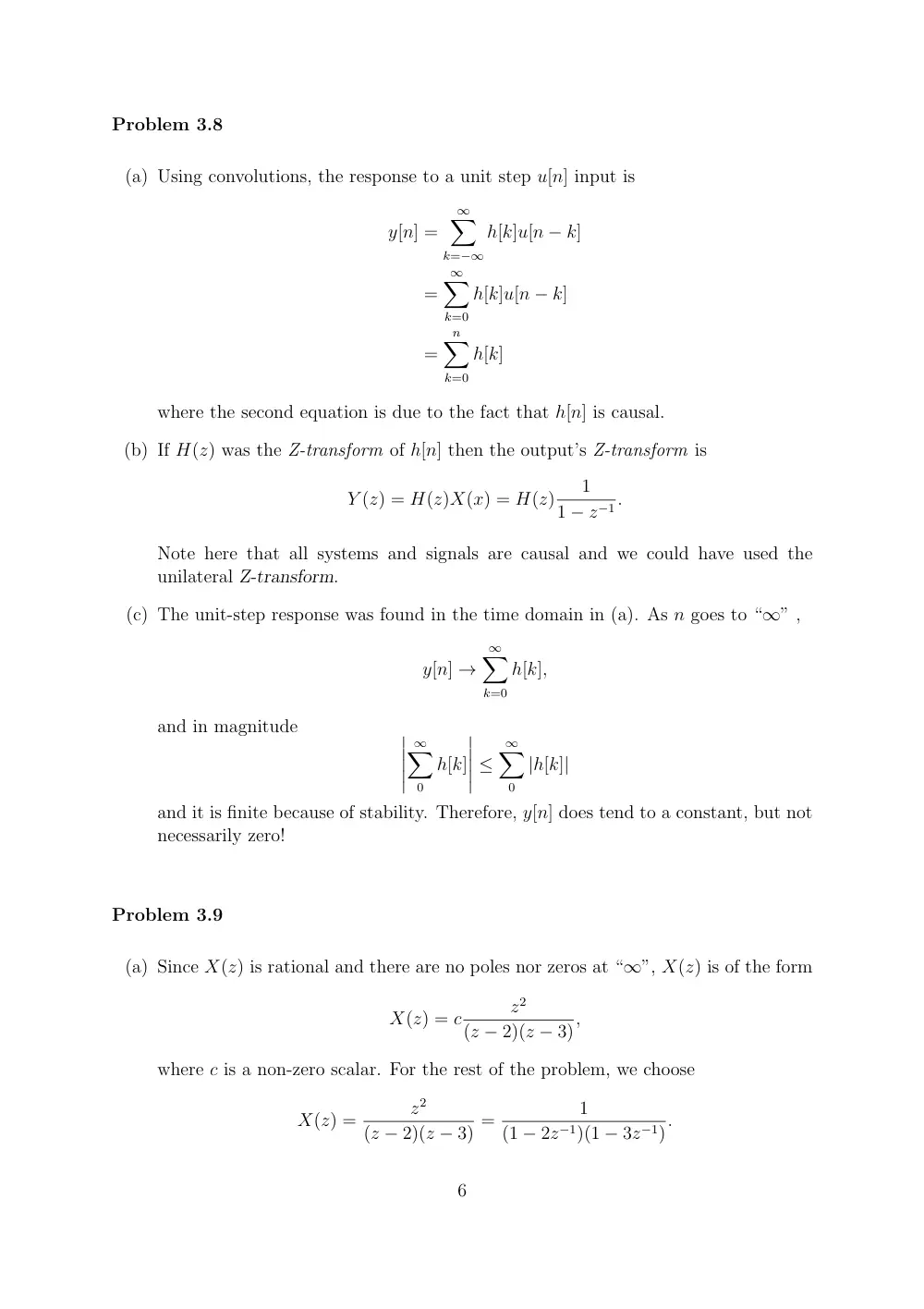
Problem 3.8
(a) Using convolutions, the response to a unit step u[n] input is
y[n] =
∞
�
k=−∞
h[k]u[n − k]
=
∞
�
k=0
h[k]u[n − k]
=
n
�
k=0
h[k]
where the second equation is due to the fact that h[n] is causal.
(b) If H(z) was the Z-transform of h[n] then the output’s Z-transform is
Y (z) = H(z)X(x) = H(z)
1
1 − z−1.
Note here that all systems and signals are causal and we could have used the
unilateral Z-transform.
(c) The unit-step response was found in the time domain in (a). As n goes to “∞” ,
y[n] →
∞
�
k=0
h[k],
and in magnitude
�����
∞
�
0
h[k]
����� ≤
∞
�
0
|h[k]|
and it is finite because of stability. Therefore, y[n] does tend to a constant, but not
necessarily zero!
Problem 3.9
(a) Since X(z) is rational and there are no poles nor zeros at “∞”, X(z) is of the form
X(z) = c
z2
(z − 2)(z − 3),
where c is a non-zero scalar. For the rest of the problem, we choose
X(z) =
z2
(z − 2)(z − 3) =
1
(1 − 2z−1)(1 − 3z−1).
6
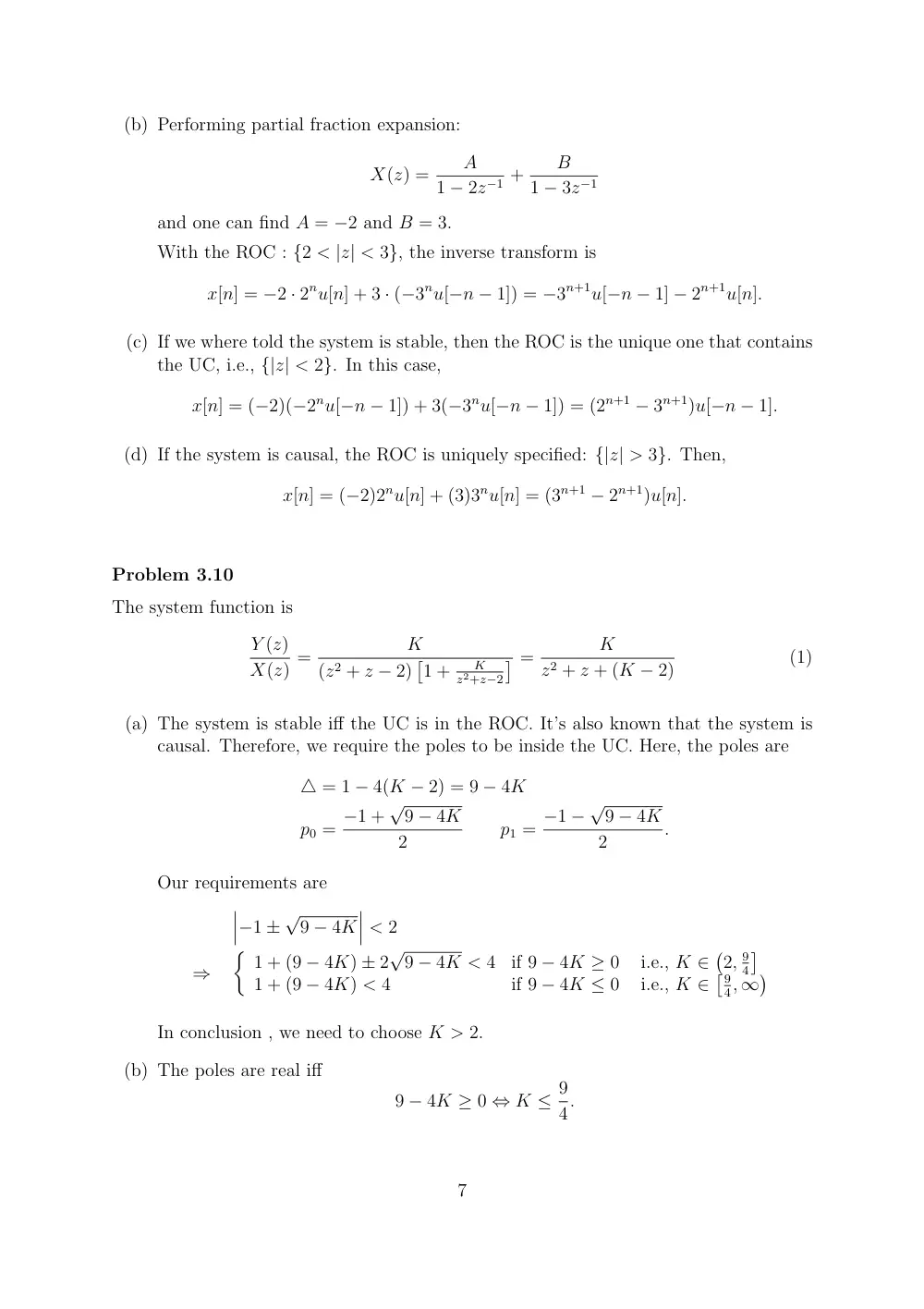
(b) Performing partial fraction expansion:
X(z) =
A
1 − 2z−1 +
B
1 − 3z−1
and one can find A = −2 and B = 3.
With the ROC : {2 < |z| < 3}, the inverse transform is
x[n] = −2 · 2nu[n] + 3 · (−3nu[−n − 1]) = −3n+1u[−n − 1] − 2n+1u[n].
(c) If we where told the system is stable, then the ROC is the unique one that contains
the UC, i.e., {|z| < 2}. In this case,
x[n] = (−2)(−2nu[−n − 1]) + 3(−3nu[−n − 1]) = (2n+1 − 3n+1)u[−n − 1].
(d) If the system is causal, the ROC is uniquely specified: {|z| > 3}. Then,
x[n] = (−2)2nu[n] + (3)3nu[n] = (3n+1 − 2n+1)u[n].
Problem 3.10
The system function is
Y (z)
X(z) =
K
(z2 + z − 2)
�
1 +
K
z2+z−2
� =
K
z2 + z + (K − 2)
(1)
(a) The system is stable iff the UC is in the ROC. It’s also known that the system is
causal. Therefore, we require the poles to be inside the UC. Here, the poles are
△ = 1 − 4(K − 2) = 9 − 4K
p0 = −1 +
√
9 − 4K
2
p1 = −1 −
√
9 − 4K
2
.
Our requirements are
���−1 ±
√
9 − 4K
��� < 2
⇒
�
1 + (9 − 4K) ± 2
√
9 − 4K < 4
if 9 − 4K ≥ 0
i.e., K ∈
�
2, 9
4
�
1 + (9 − 4K) < 4
if 9 − 4K ≤ 0
i.e., K ∈
� 9
4, ∞
�
In conclusion , we need to choose K > 2.
(b) The poles are real iff
9 − 4K ≥ 0 ⇔ K ≤ 9
4.
7