
EECE 340 Homework 3, Spring 2015
American University of Beirut · Signals and Systems · 3 pages
More EECE 340 files
- Homework 3 · Spring 2016HomeworkView
- Homework 1 Solution · Spring 2016Homework · with solutionView
- Homework 4 · Spring 2016HomeworkView
- Homework 3 Solution · Spring 2016Homework · with solutionView
- Homework 4 Solution · Spring 2016Homework · with solutionView
- Homework 1 · Spring 2016HomeworkView
- Homework 2 Solution · Spring 2016Homework · with solutionView
- Homework 2 · Spring 2016HomeworkView
Show the text of this homework
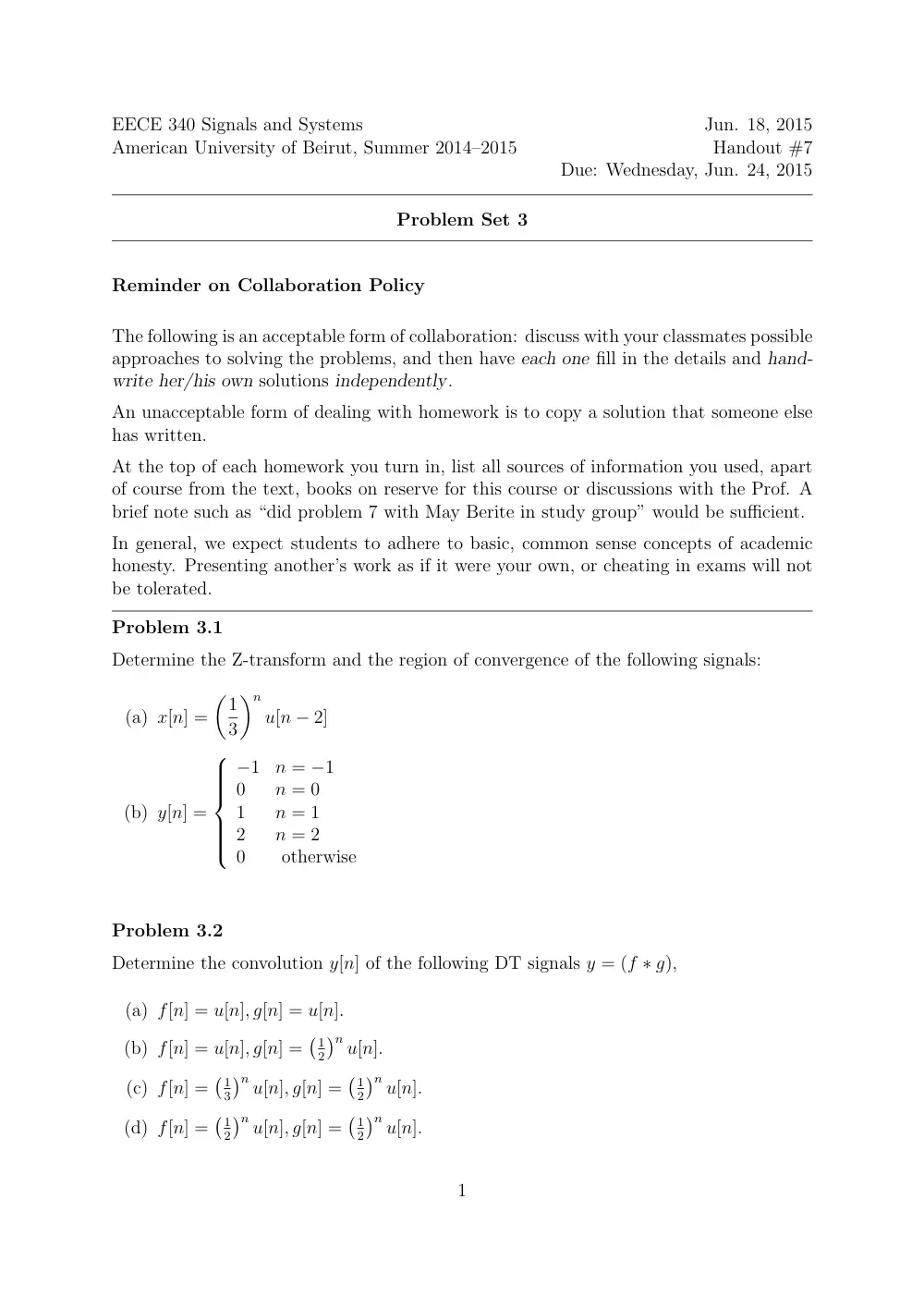
EECE 340 Signals and Systems
Jun. 18, 2015
American University of Beirut, Summer 2014–2015
Handout #7
Due: Wednesday, Jun. 24, 2015
Problem Set 3
Reminder on Collaboration Policy
The following is an acceptable form of collaboration: discuss with your classmates possible
approaches to solving the problems, and then have each one fill in the details and hand-
write her/his own solutions independently.
An unacceptable form of dealing with homework is to copy a solution that someone else
has written.
At the top of each homework you turn in, list all sources of information you used, apart
of course from the text, books on reserve for this course or discussions with the Prof. A
brief note such as “did problem 7 with May Berite in study group” would be sufficient.
In general, we expect students to adhere to basic, common sense concepts of academic
honesty. Presenting another’s work as if it were your own, or cheating in exams will not
be tolerated.
Problem 3.1
Determine the Z-transform and the region of convergence of the following signals:
(a) x[n] =
�1
3
�n
u[n − 2]
(b) y[n] =
−1
n = −1
0
n = 0
1
n = 1
2
n = 2
0
otherwise
Problem 3.2
Determine the convolution y[n] of the following DT signals y = (f ∗ g),
(a) f[n] = u[n], g[n] = u[n].
(b) f[n] = u[n], g[n] =
� 1
2
�n u[n].
(c) f[n] =
� 1
3
�n u[n], g[n] =
�1
2
�n u[n].
(d) f[n] =
� 1
2
�n u[n], g[n] =
�1
2
�n u[n].
1
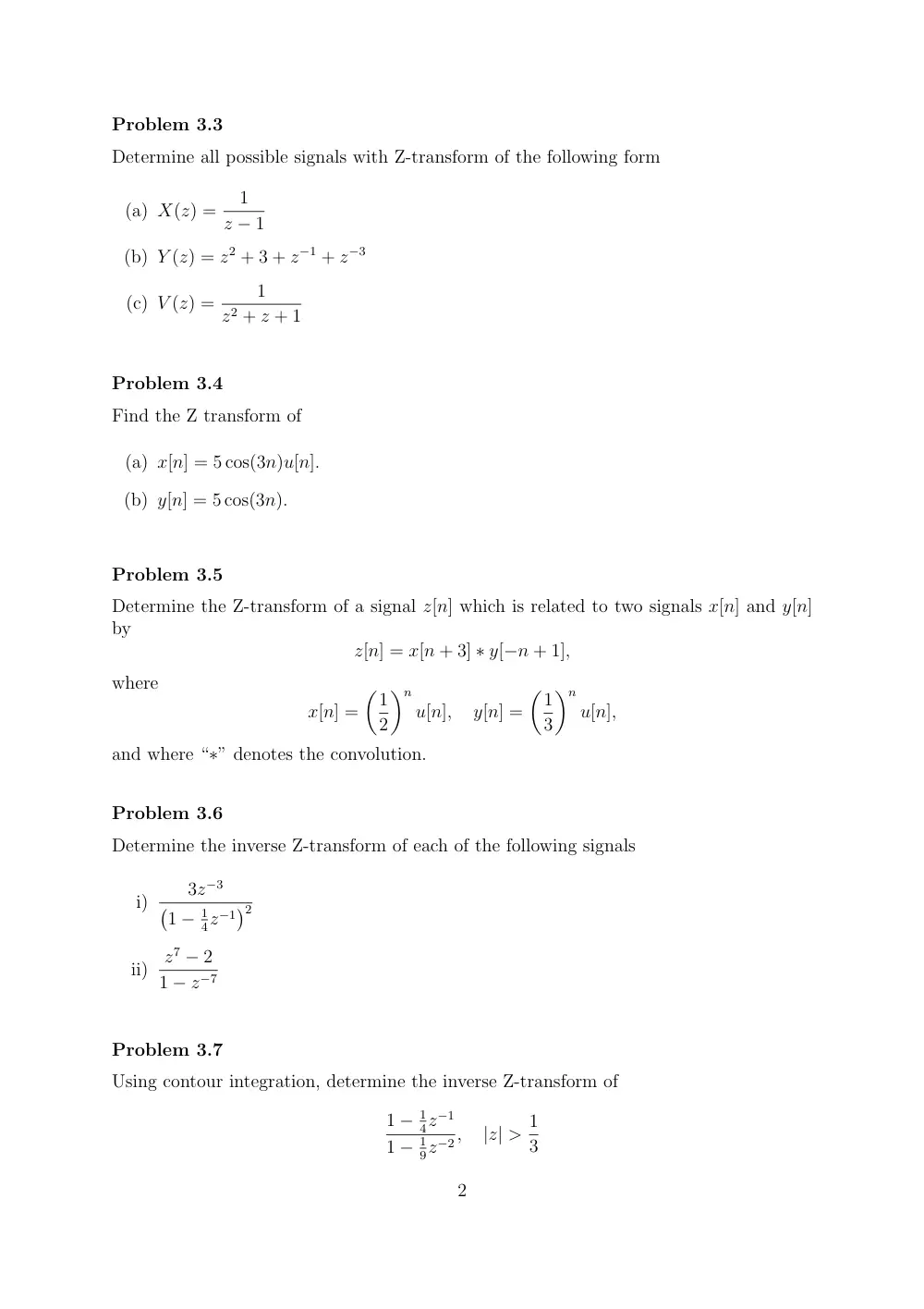
Problem 3.3
Determine all possible signals with Z-transform of the following form
(a) X(z) =
1
z − 1
(b) Y (z) = z2 + 3 + z−1 + z−3
(c) V (z) =
1
z2 + z + 1
Problem 3.4
Find the Z transform of
(a) x[n] = 5 cos(3n)u[n].
(b) y[n] = 5 cos(3n).
Problem 3.5
Determine the Z-transform of a signal z[n] which is related to two signals x[n] and y[n]
by
z[n] = x[n + 3] ∗ y[−n + 1],
where
x[n] =
�1
2
�n
u[n],
y[n] =
�1
3
�n
u[n],
and where “∗” denotes the convolution.
Problem 3.6
Determine the inverse Z-transform of each of the following signals
i)
3z−3
�
1 − 1
4z−1�2
ii)
z7 − 2
1 − z−7
Problem 3.7
Using contour integration, determine the inverse Z-transform of
1 − 1
4z−1
1 − 1
9z−2,
|z| > 1
3
2
Problem 3.8
You are given a stable causal system specified by its impulse response h[n].
We are
interested in its unit-step response.
(a) Determine the unit-step response of the system in the time domain.
(b) Determine the unit-step response of the system in the z-domain.
(c) Does the unit-step response go to zero at “infinity”? Explain.
Problem 3.9
You are told that X(z) is rational, it has a zero of degree two at z = 0, a pole of degree
one at z = 2 and a pole of degree one at z = 3 (and no poles nor zeros at “infinity”).
(a) What are the possible expressions of X(z) ? If you have more that one expression,
for the remainder of this problem choose one of those expressions.
(b) Assume that the ROC is: 2 < |z| < 3. Use the method of partial fraction expansions
to find the inverse Z transform.
(c) If you were told instead that the system is stabe, would that give you a unique
solution for the inverse Z transform? Explain.
(d) If the system is known to be causal. Find the inverse Z transforms (if you have
more than one solution) if any.
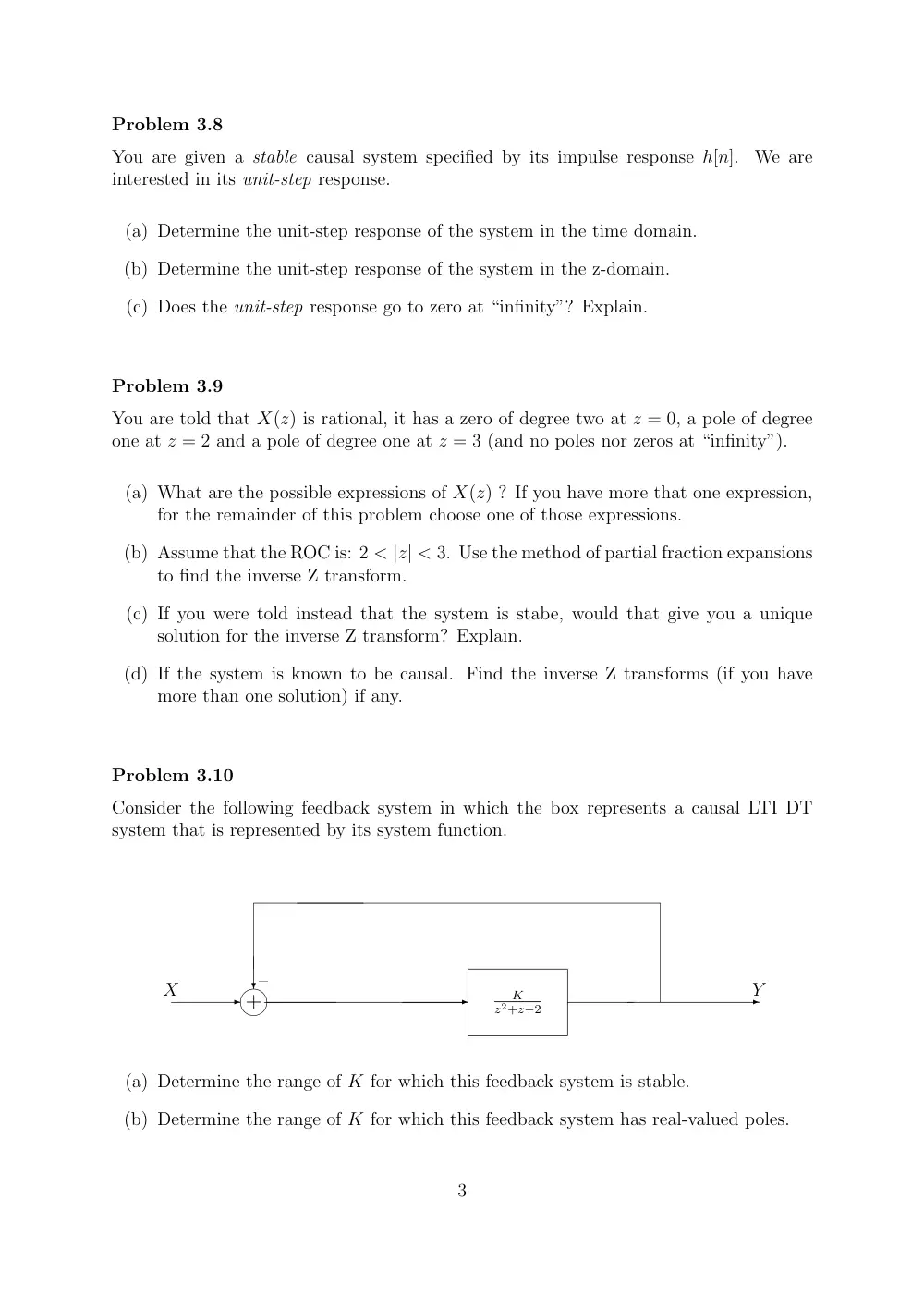
Problem 3.10
Consider the following feedback system in which the box represents a causal LTI DT
system that is represented by its system function.
✲
X
+
–
❄
✲
K
z2+z−2
✲Y
(a) Determine the range of K for which this feedback system is stable.
(b) Determine the range of K for which this feedback system has real-valued poles.
3