
EECE 340 Homework, Fall 2007
American University of Beirut · Signals and Systems · 9 pages
More EECE 340 files
- Homework 3 · Spring 2016HomeworkView
- Homework 1 Solution · Spring 2016Homework · with solutionView
- Homework 4 · Spring 2016HomeworkView
- Homework 3 Solution · Spring 2016Homework · with solutionView
- Homework 4 Solution · Spring 2016Homework · with solutionView
- Homework 1 · Spring 2016HomeworkView
- Homework 2 Solution · Spring 2016Homework · with solutionView
- Homework 2 · Spring 2016HomeworkView
Show the text of this homework
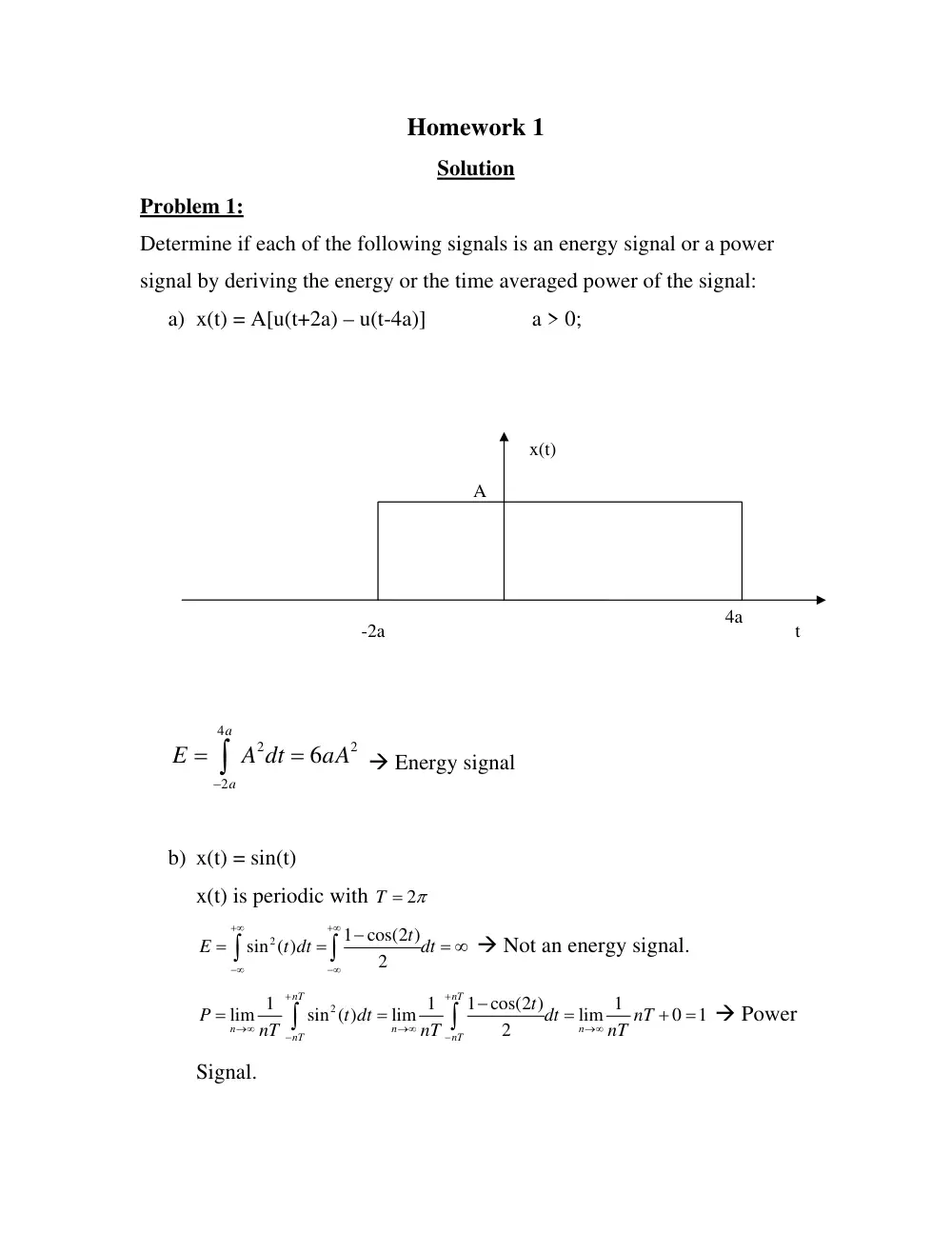
Homework 1
Solution
Problem 1:
Determine if each of the following signals is an energy signal or a power
signal by deriving the energy or the time averaged power of the signal:
a) x(t) = A[u(t+2a) – u(t-4a)]
a > 0;
4
2
2
2
6
a
a
E
A dt
aA
−
=
=
∫
� Energy signal
b) x(t) = sin(t)
x(t) is periodic with
2
T
= π
2
1 cos(2 )
sin ( )
2
t
E
t dt
dt
+∞
+∞
−∞
−∞
−
=
=
= ∞
∫
∫
� Not an energy signal.
2
1
1
1 cos(2 )
1
lim
sin ( )
lim
lim
0
1
2
nT
nT
n
n
n
nT
nT
t
P
t dt
dt
nT
nT
nT
nT
+
+
→∞
→∞
→∞
−
−
−
=
=
=
+
=
∫
∫
� Power
Signal.
t
x(t)
A
-2a
4a
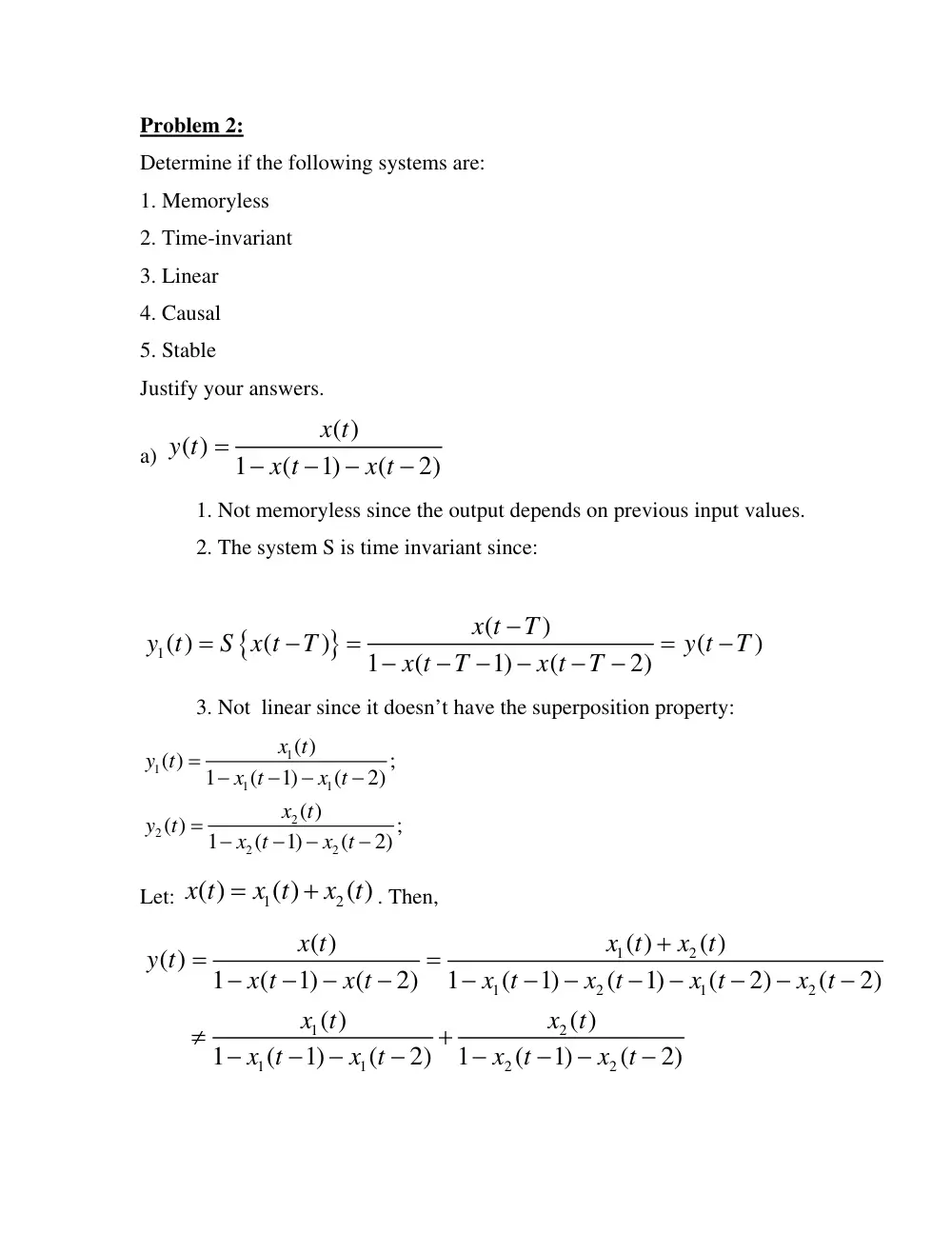
Problem 2:
Determine if the following systems are:
1. Memoryless
2. Time-invariant
3. Linear
4. Causal
5. Stable
Justify your answers.
a)
( )
( )
1
(
1)
(
2)
x t
y t
x t
x t
=
−
−
−
−
1. Not memoryless since the output depends on previous input values.
2. The system S is time invariant since:
{
}
1
(
)
( )
(
)
(
)
1
(
1)
(
2)
x t
T
y t
S x t
T
y t
T
x t
T
x t
T
−
=
−
=
=
−
−
−
−
−
−
−
3. Not linear since it doesn’t have the superposition property:
1
1
1
1
2
2
2
2
( )
( )
;
1
(
1)
(
2)
( )
( )
;
1
(
1)
(
2)
x t
y t
x t
x t
x t
y t
x t
x t
= −
−
−
−
= −
−
−
−
Let:
1
2
( )
( )
( )
x t
x t
x t
=
+
. Then,
1
2
1
2
1
2
1
2
1
1
2
2
( )
( )
( )
( )
1
(
1)
(
2)
1
(
1)
(
1)
(
2)
(
2)
( )
( )
1
(
1)
(
2)
1
(
1)
(
2)
x t
x t
x t
y t
x t
x t
x t
x t
x t
x t
x t
x t
x t
x t
x t
x t
+
=
=
−
−
−
−
−
−
−
−
−
−
−
−
≠
+
−
−
−
−
−
−
−
−
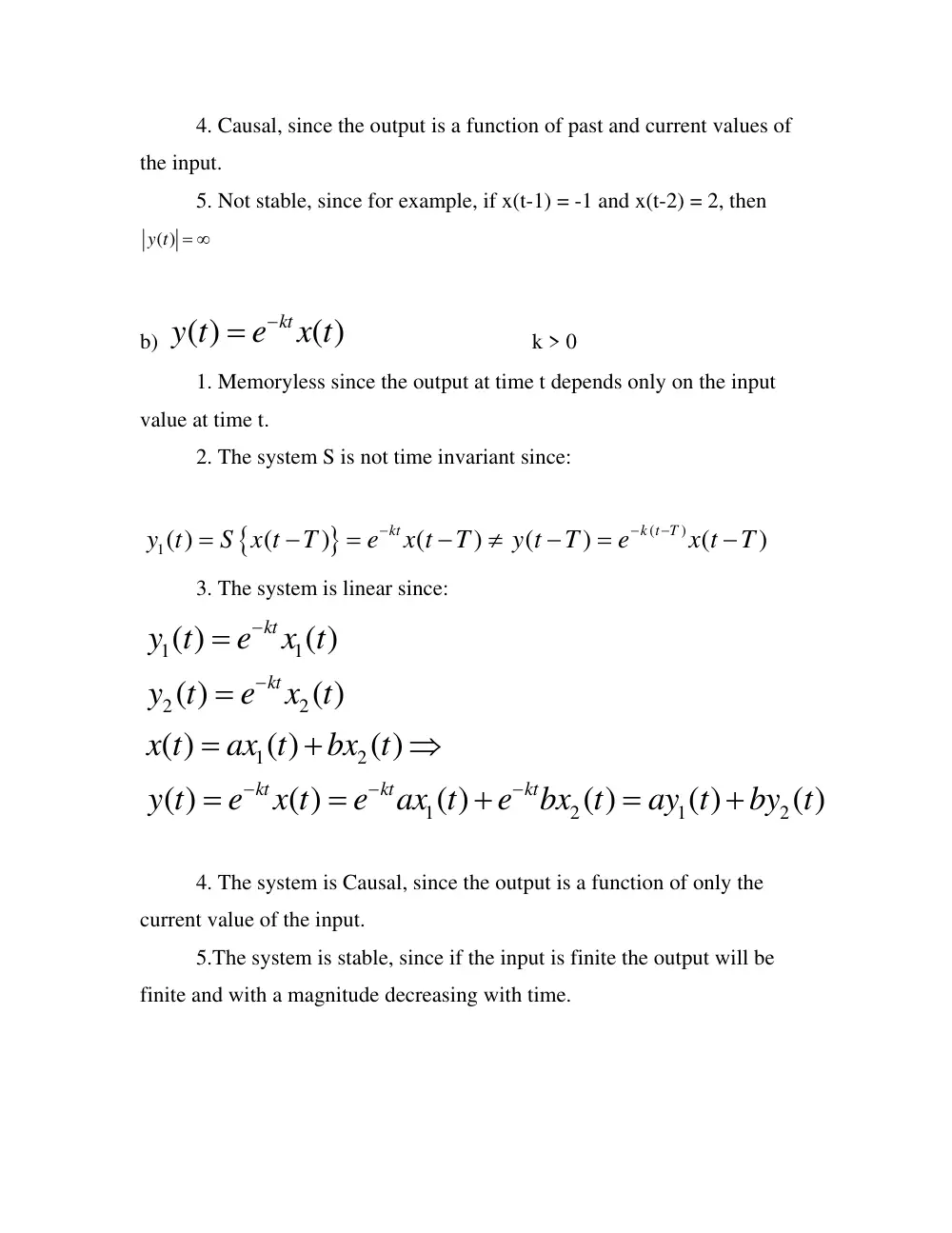
4. Causal, since the output is a function of past and current values of
the input.
5. Not stable, since for example, if x(t-1) = -1 and x(t-2) = 2, then
( )
y t = ∞
b) ( )
kt ( )
y t
e
− x t
=
k > 0
1. Memoryless since the output at time t depends only on the input
value at time t.
2. The system S is not time invariant since:
{
}
(
)
1( )
(
)
(
)
(
)
(
)
kt
k t T
y t
S x t
T
e
x t
T
y t
T
e
x t
T
−
−
−
=
−
=
−
≠
−
=
−
3. The system is linear since:
1
1
2
2
1
2
1
2
1
2
( )
( )
( )
( )
( )
( )
( )
( )
( )
( )
( )
( )
( )
kt
kt
kt
kt
kt
y t
e
x t
y t
e
x t
x t
ax t
bx t
y t
e
x t
e
ax t
e
bx t
ay t
by t
−
−
−
−
−
=
=
=
+
⇒
=
=
+
=
+
4. The system is Causal, since the output is a function of only the
current value of the input.
5.The system is stable, since if the input is finite the output will be
finite and with a magnitude decreasing with time.
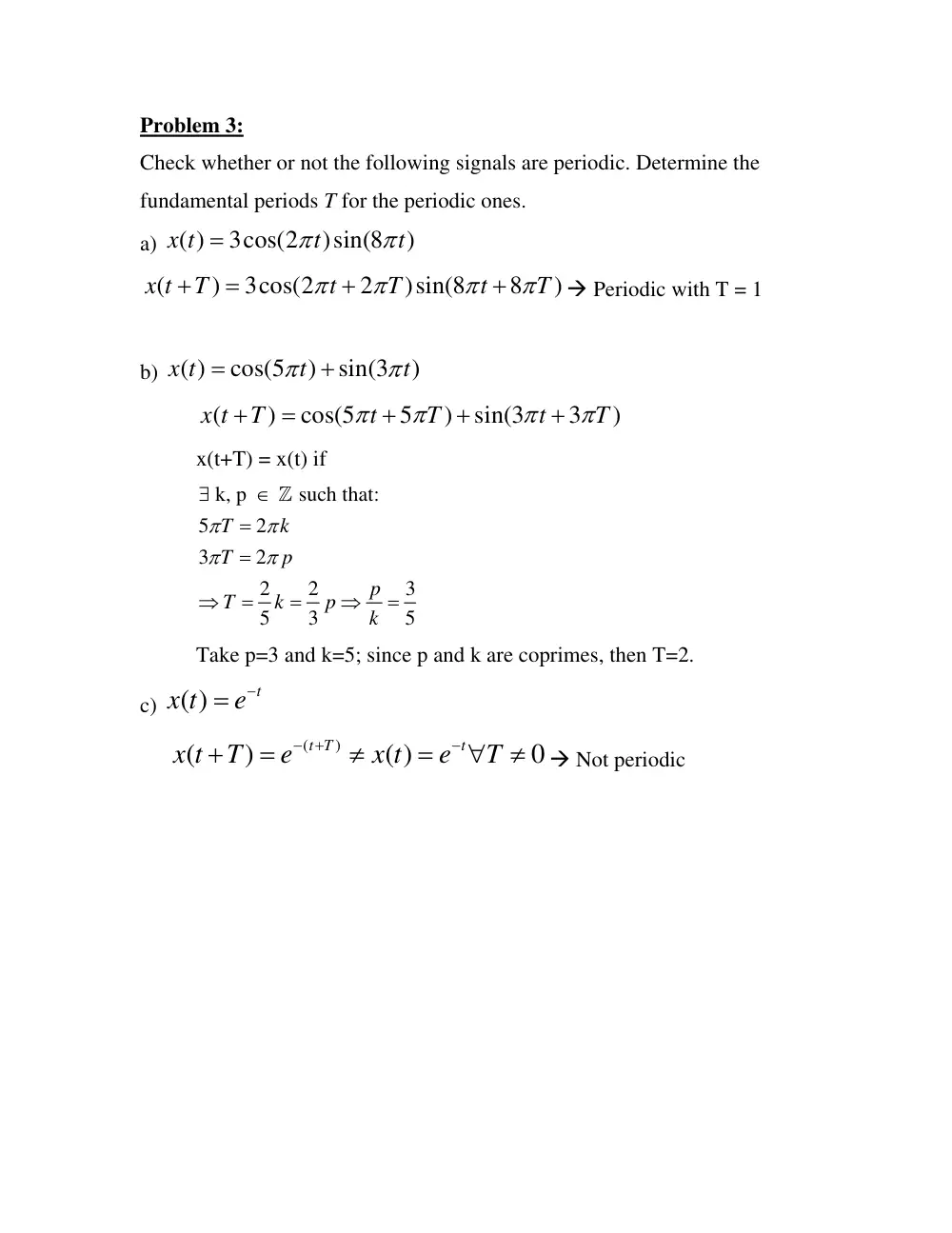
Problem 3:
Check whether or not the following signals are periodic. Determine the
fundamental periods T for the periodic ones.
a) ( )
3cos(2
)sin(8
)
x t
t
t
π
π
=
(
)
3cos(2
2
)sin(8
8
)
x t
T
t
T
t
T
π
π
π
π
+
=
+
+
� Periodic with T = 1
b) ( )
cos(5
)
sin(3
)
x t
t
t
π
π
=
+
(
)
cos(5
5
)
sin(3
3
)
x t
T
t
T
t
T
π
π
π
π
+
=
+
+
+
x(t+T) = x(t) if
k, p
such that:
5
2
3
2
2
2
3
5
3
5
T
k
T
p
p
T
k
p
k
π
π
π
π
∃
∈
=
=
⇒
=
=
⇒
=
�
Take p=3 and k=5; since p and k are coprimes, then T=2.
c) ( )
t
x t
= e−
(
)
(
)
( )
0
t T
t
x t
T
e
x t
e
T
−
+
−
+
=
≠
=
∀
≠
� Not periodic
Problem 4:
Compute and Graph the derivatives of the following functions:
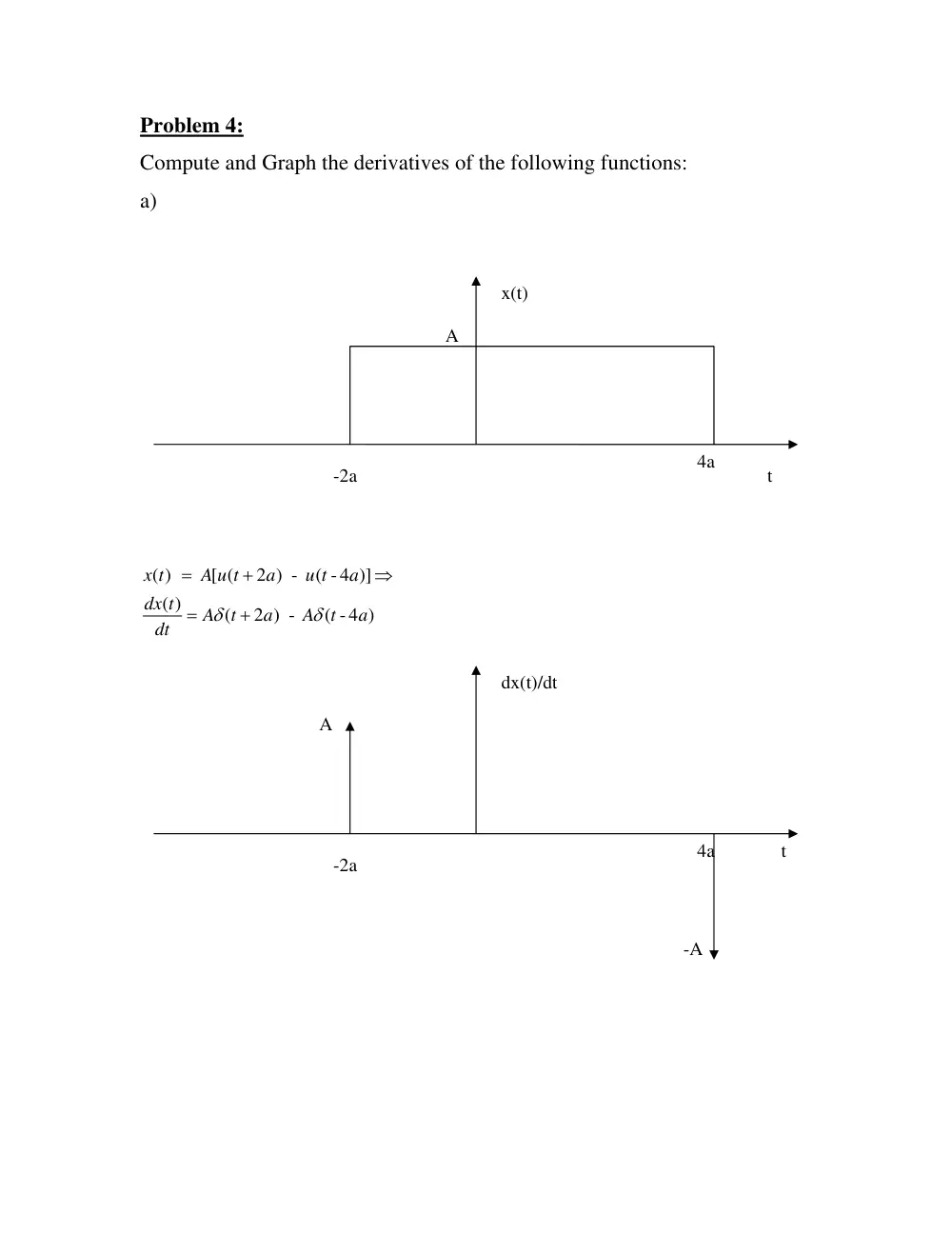
a)
( )
[ (
2 ) - ( - 4 )]
( )
(
2 ) -
( -4 )
x t
A u t
a
u t
a
dx t
A
t
a
A
t
a
dt
δ
δ
=
+
⇒
=
+
t
dx(t)/dt
A
-2a
4a
-A
t
x(t)
A
-2a
4a
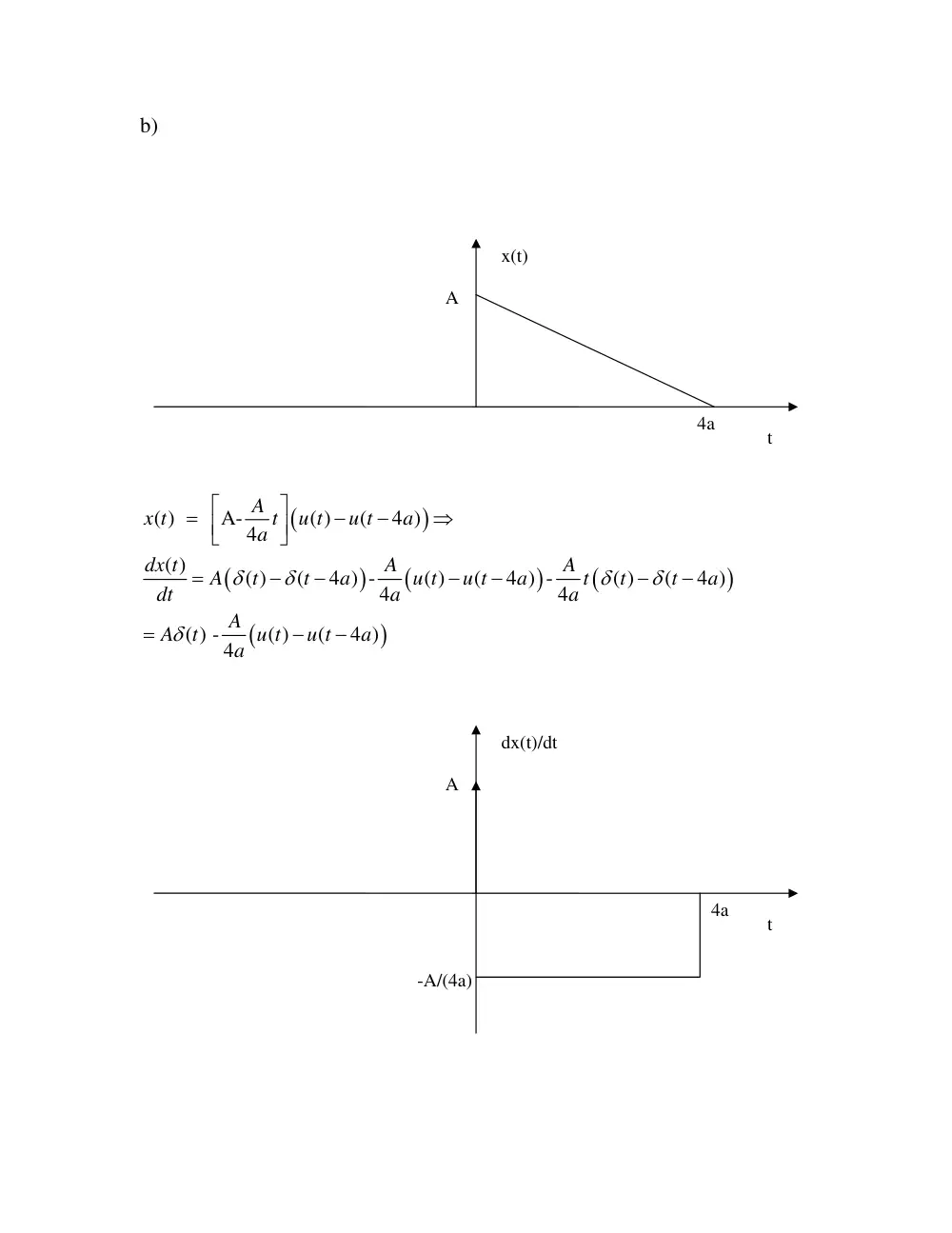
b)
(
)
(
)
(
)
(
)
(
)
( )
A-
( )
(
4 )
4
( )
( )
(
4 ) -
( )
(
4 ) -
( )
(
4 )
4
4
( ) -
( )
(
4 )
4
A
x t
t
u t
u t
a
a
dx t
A
A
A
t
t
a
u t
u t
a
t
t
t
a
dt
a
a
A
A
t
u t
u t
a
a
δ
δ
δ
δ
δ
⎡
⎤
=
−
−
⇒
⎢
⎥
⎣
⎦
=
−
−
−
−
−
−
=
−
−
t
dx(t)/dt
A
4a
-A/(4a)
t
x(t)
A
4a
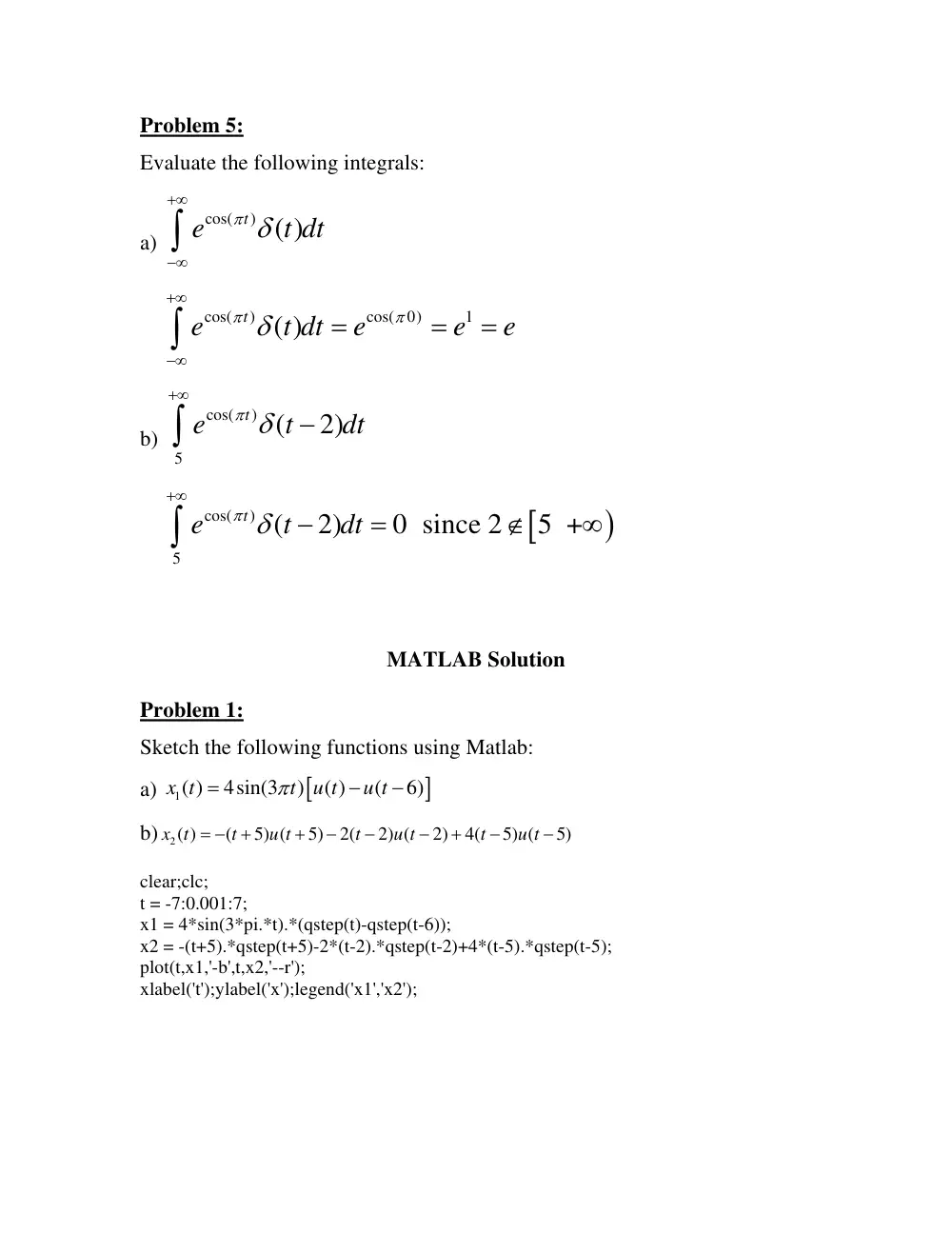
Problem 5:
Evaluate the following integrals:
a)
cos(
t) ( )
e
t dt
π δ
+∞
−∞∫
cos(
)
cos( 0)
1
( )
t
e
t dt
e
e
e
π
π
δ
+∞
−∞
=
=
=
∫
b)
cos(
)
5
(
2)
t
e
t
dt
π δ
+∞
−
∫
[
)
cos(
)
5
(
2)
0 since 2
5 +
t
e
t
dt
π δ
+∞
−
=
∉
∞
∫
MATLAB Solution
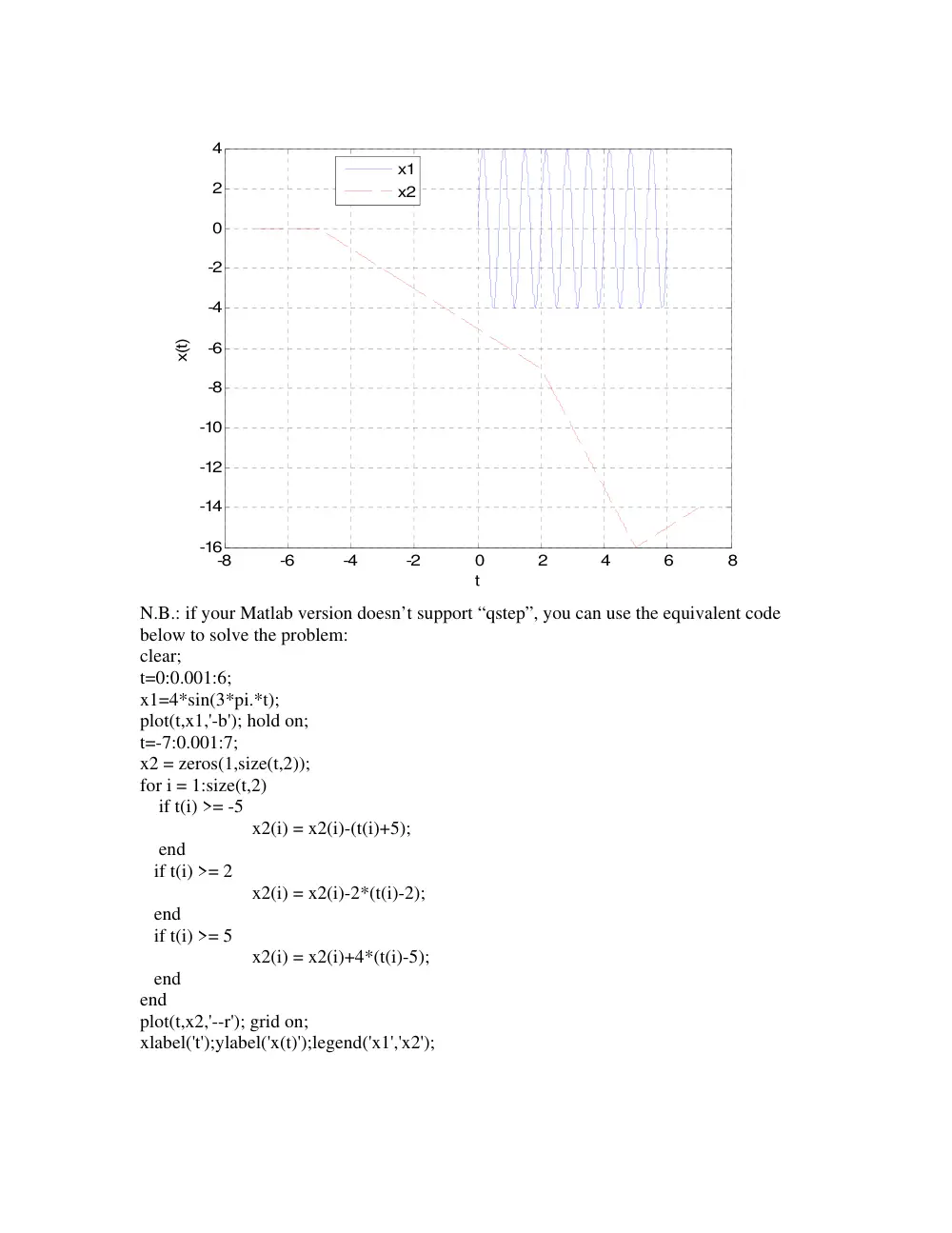
Problem 1:
Sketch the following functions using Matlab:
a)
[
]
1( )
4sin(3
)
( )
(
6)
x t
t
u t
u t
π
=
−
−
b)
2( )
(
5) (
5)
2(
2) (
2)
4(
5) (
5)
x t
t
u t
t
u t
t
u t
= −
+
+
−
−
−
+
−
−
clear;clc;
t = -7:0.001:7;
x1 = 4*sin(3*pi.*t).*(qstep(t)-qstep(t-6));
x2 = -(t+5).*qstep(t+5)-2*(t-2).*qstep(t-2)+4*(t-5).*qstep(t-5);
plot(t,x1,'-b',t,x2,'--r');
xlabel('t');ylabel('x');legend('x1','x2');
-8
-6
-4
-2
0
2
4
6
8
-16
-14
-12
-10
-8
-6
-4
-2
0
2
4
t
x(t)
x1
x2
N.B.: if your Matlab version doesn’t support “qstep”, you can use the equivalent code
below to solve the problem:
clear;
t=0:0.001:6;
x1=4*sin(3*pi.*t);
plot(t,x1,'-b'); hold on;
t=-7:0.001:7;
x2 = zeros(1,size(t,2));
for i = 1:size(t,2)
if t(i) >= -5
x2(i) = x2(i)-(t(i)+5);
end
if t(i) >= 2
x2(i) = x2(i)-2*(t(i)-2);
end
if t(i) >= 5
x2(i) = x2(i)+4*(t(i)-5);
end
end
plot(t,x2,'--r'); grid on;
xlabel('t');ylabel('x(t)');legend('x1','x2');
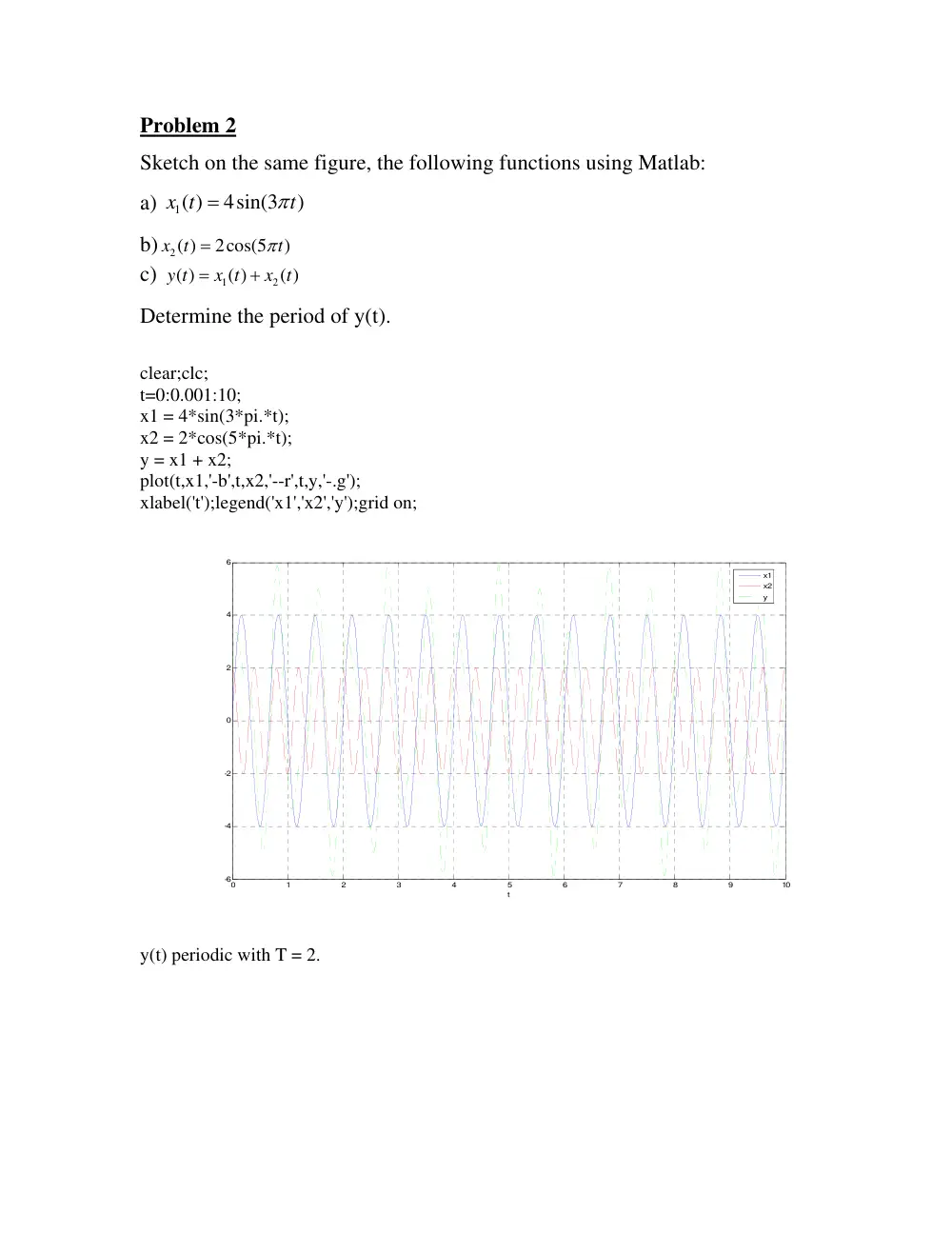
Problem 2
Sketch on the same figure, the following functions using Matlab:
a)
1( )
4sin(3
)
x t
πt
=
b)
2( )
2cos(5
)
x t
πt
=
c)
1
2
( )
( )
( )
y t
x t
x t
=
+
Determine the period of y(t).
clear;clc;
t=0:0.001:10;
x1 = 4*sin(3*pi.*t);
x2 = 2*cos(5*pi.*t);
y = x1 + x2;
plot(t,x1,'-b',t,x2,'--r',t,y,'-.g');
xlabel('t');legend('x1','x2','y');grid on;
0
1
2
3
4
5
6
7
8
9
10
-6
-4
-2
0
2
4
6
t
x1
x2
y
y(t) periodic with T = 2.