
EECE 340 Homework, Fall 2007
American University of Beirut · Signals and Systems · 3 pages
More EECE 340 files
- Homework 3 · Spring 2016HomeworkView
- Homework 1 Solution · Spring 2016Homework · with solutionView
- Homework 4 · Spring 2016HomeworkView
- Homework 3 Solution · Spring 2016Homework · with solutionView
- Homework 4 Solution · Spring 2016Homework · with solutionView
- Homework 1 · Spring 2016HomeworkView
- Homework 2 Solution · Spring 2016Homework · with solutionView
- Homework 2 · Spring 2016HomeworkView
Show the text of this homework
American University of Beirut
Department of Electrical and Computer Engineering
EECE 440 Signals and Systems
Homework 3: Due Friday March 30, 2007
Problem 1
a. If FT{g(t)} = G(ω), show that FT{g(t-a)} = exp(-jka) G(ω).
b. Calculate the Fourier Transform of A cos(k0 t + a), for a/ k0 ={0, π/4, π/2, π}.
Plot the result.
c. If FT{g(t)} = G(ω), show that FT{g(at)} = (1/a) G(ω /a).
Problem 2
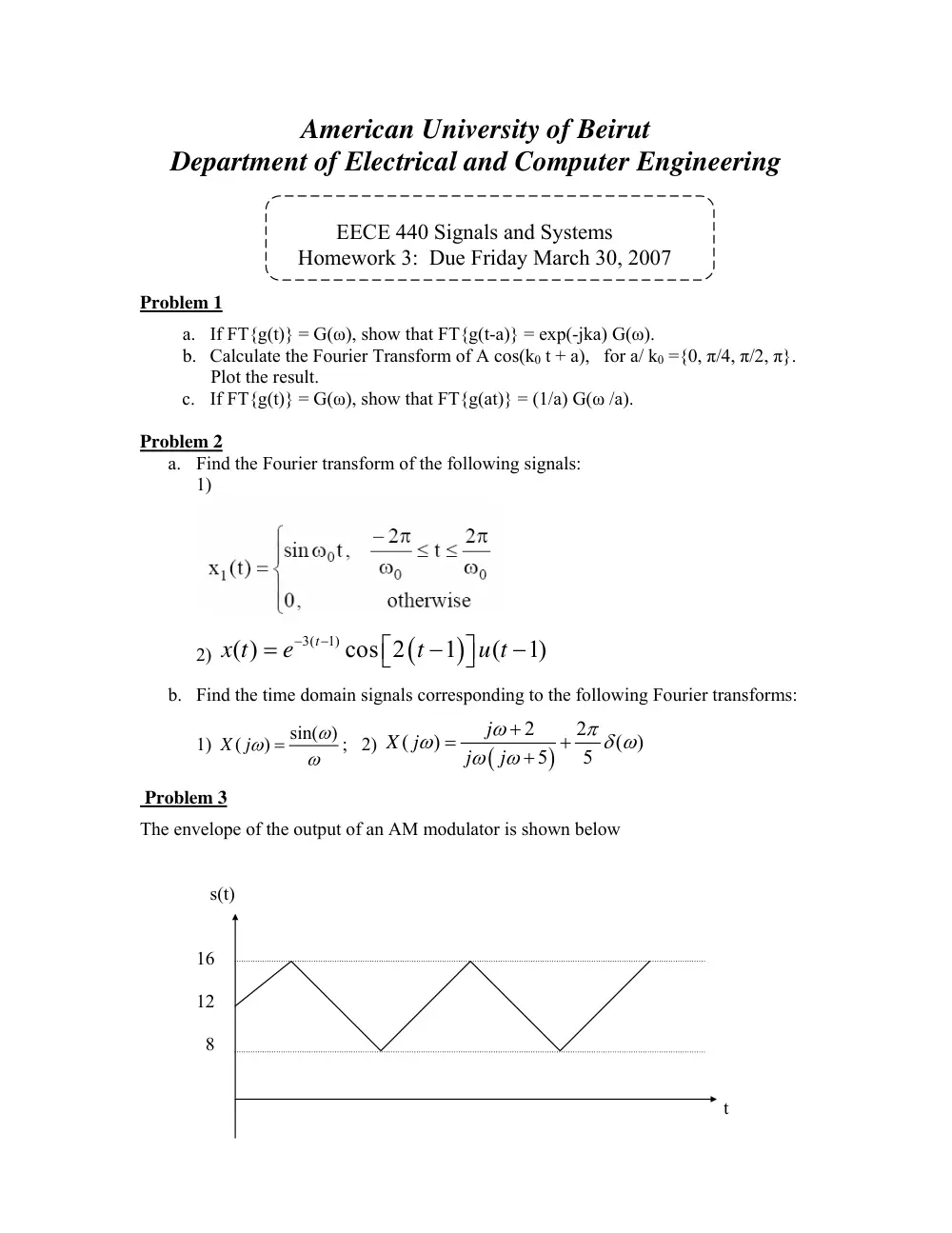
a. Find the Fourier transform of the following signals:
1)
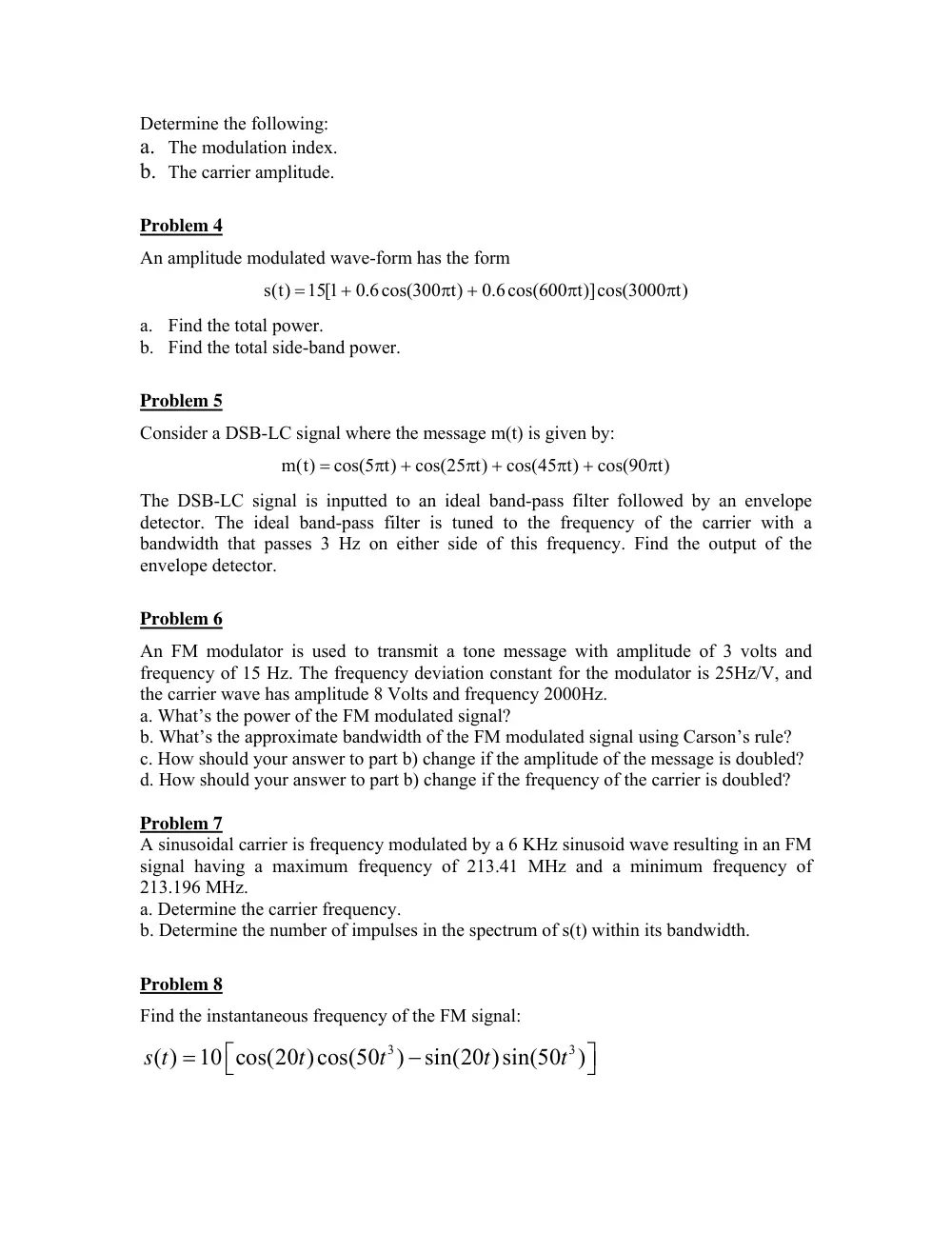
2)
(
)
3(
1)
( )
cos 2
1
(
1)
t
x t
e
t
u t
−
−
=
−
−
⎡
⎤
⎣
⎦
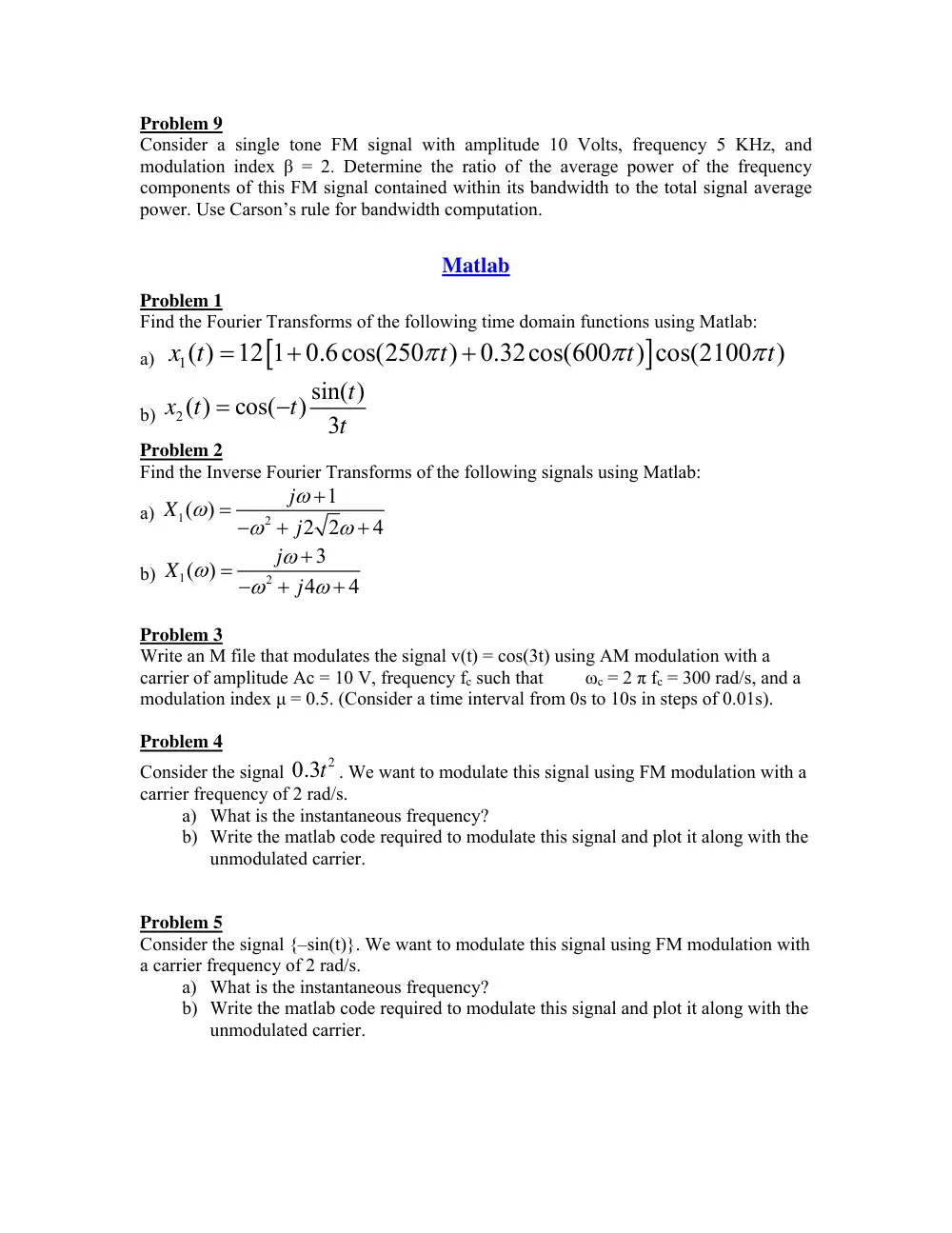
b. Find the time domain signals corresponding to the following Fourier transforms:
1)
sin( )
(
X j )
ω
ω
ω
=
; 2)
(
)
2
2
(
)
( )
5
5
j
X j
j
j
ω
π
ω
δ ω
ω
ω
+
=
+
+
Problem 3
The envelope of the output of an AM modulator is shown below
s(t)
16
12
8
t
Determine the following:
a. The modulation index.
b. The carrier amplitude.
Problem 4
An amplitude modulated wave-form has the form
)t
cos(600 t)]cos(3000
6.0
)t
cos(300
6.0
15 1[
)t(s
π
π
+
π
+
=
a. Find the total power.
b. Find the total side-band power.
Problem 5
Consider a DSB-LC signal where the message m(t) is given by:
)t
cos(90
)t
cos(45
)t
cos(25
)t
cos(5
m )t(
π
+
π
+
π
+
π
=
The DSB-LC signal is inputted to an ideal band-pass filter followed by an envelope
detector. The ideal band-pass filter is tuned to the frequency of the carrier with a
bandwidth that passes 3 Hz on either side of this frequency. Find the output of the
envelope detector.
Problem 6
An FM modulator is used to transmit a tone message with amplitude of 3 volts and
frequency of 15 Hz. The frequency deviation constant for the modulator is 25Hz/V, and
the carrier wave has amplitude 8 Volts and frequency 2000Hz.
a. What’s the power of the FM modulated signal?
b. What’s the approximate bandwidth of the FM modulated signal using Carson’s rule?
c. How should your answer to part b) change if the amplitude of the message is doubled?
d. How should your answer to part b) change if the frequency of the carrier is doubled?
Problem 7
A sinusoidal carrier is frequency modulated by a 6 KHz sinusoid wave resulting in an FM
signal having a maximum frequency of 213.41 MHz and a minimum frequency of
213.196 MHz.
a. Determine the carrier frequency.
b. Determine the number of impulses in the spectrum of s(t) within its bandwidth.
Problem 8
Find the instantaneous frequency of the FM signal:
3
3
( )
10 cos(20 )cos(50 )
sin(20 )sin(50 )
s t
t
t
t
t
⎡
⎤
=
−
⎣
⎦
Problem 9
Consider a single tone FM signal with amplitude 10 Volts, frequency 5 KHz, and
modulation index β = 2. Determine the ratio of the average power of the frequency
components of this FM signal contained within its bandwidth to the total signal average
power. Use Carson’s rule for bandwidth computation.
Matlab
Problem 1
Find the Fourier Transforms of the following time domain functions using Matlab:
a)
[
]
1( )
12 1 0.6cos(250
)
0.32cos(600
) cos(2100
)
x t
t
t
t
π
π
π
=
+
+
b)
2
sin( )
( )
cos(
)
3
t
x t
t
t
=
−
Problem 2
Find the Inverse Fourier Transforms of the following signals using Matlab:
a)
1
2
1
( )
2 2
4
j
X
j
ω
ω
ω
ω
+
=
−
+
+
b)
1
2
3
( )
4
4
j
X
j
ω
ω
ω
ω
+
= −
+
+
Problem 3
Write an M file that modulates the signal v(t) = cos(3t) using AM modulation with a
carrier of amplitude Ac = 10 V, frequency fc such that ωc = 2 π fc = 300 rad/s, and a
modulation index µ = 0.5. (Consider a time interval from 0s to 10s in steps of 0.01s).
Problem 4
Consider the signal
2
0.3t . We want to modulate this signal using FM modulation with a
carrier frequency of 2 rad/s.
a) What is the instantaneous frequency?
b) Write the matlab code required to modulate this signal and plot it along with the
unmodulated carrier.
Problem 5
Consider the signal {–sin(t)}. We want to modulate this signal using FM modulation with
a carrier frequency of 2 rad/s.
a) What is the instantaneous frequency?
b) Write the matlab code required to modulate this signal and plot it along with the
unmodulated carrier.