
EECE 340 Homework Problem Set 2, Summer 2011
American University of Beirut · Signals and Systems · 5 pages · Dr. Fadi Karameh
More EECE 340 files
- Homework 3 · Spring 2016HomeworkView
- Homework 1 Solution · Spring 2016Homework · with solutionView
- Homework 4 · Spring 2016HomeworkView
- Homework 3 Solution · Spring 2016Homework · with solutionView
- Homework 4 Solution · Spring 2016Homework · with solutionView
- Homework 1 · Spring 2016HomeworkView
- Homework 2 Solution · Spring 2016Homework · with solutionView
- Homework 2 · Spring 2016HomeworkView
Show the text of this homework
EECE340– Prof. F Karameh
1
AMERICAN UNIVERSITY OF BEIRUT
Department of Electrical and Computer Engineering
EECE340 Signals and Systems -Summer 2011
Prof Karameh
Problem Set 2
Out: Thursday, June 30, 2011
Due: Thursday, July 7, 2011
Work individually and write your complete solutions on clean paper. .
Problem 1
(a) Using Routh Hurwitz criterion, find the range of the parameter K for which the char-
acteristic polynomial
s3 + s2 + s + k = 0
represents a stable system.
(b) In general the characteristic equation of a third-order system is defined by
D(s) = a3s3 + a2s2 + a1s + a0 = 0
Using R-H criterion, determine all the conditions that a0, a1, a2, and a3 must satisfy
for the system to be stable
(c) Revisit part (a) in light of part (b).
Problem 2
Magnetic Levitation:
Consider a system which is designed to suspend a weight in a
magnetic field in free air. Such systems are often inherently unstable because the magnetic
force on an armature grows rapidly as the gap is reduced. In this problem we will try to
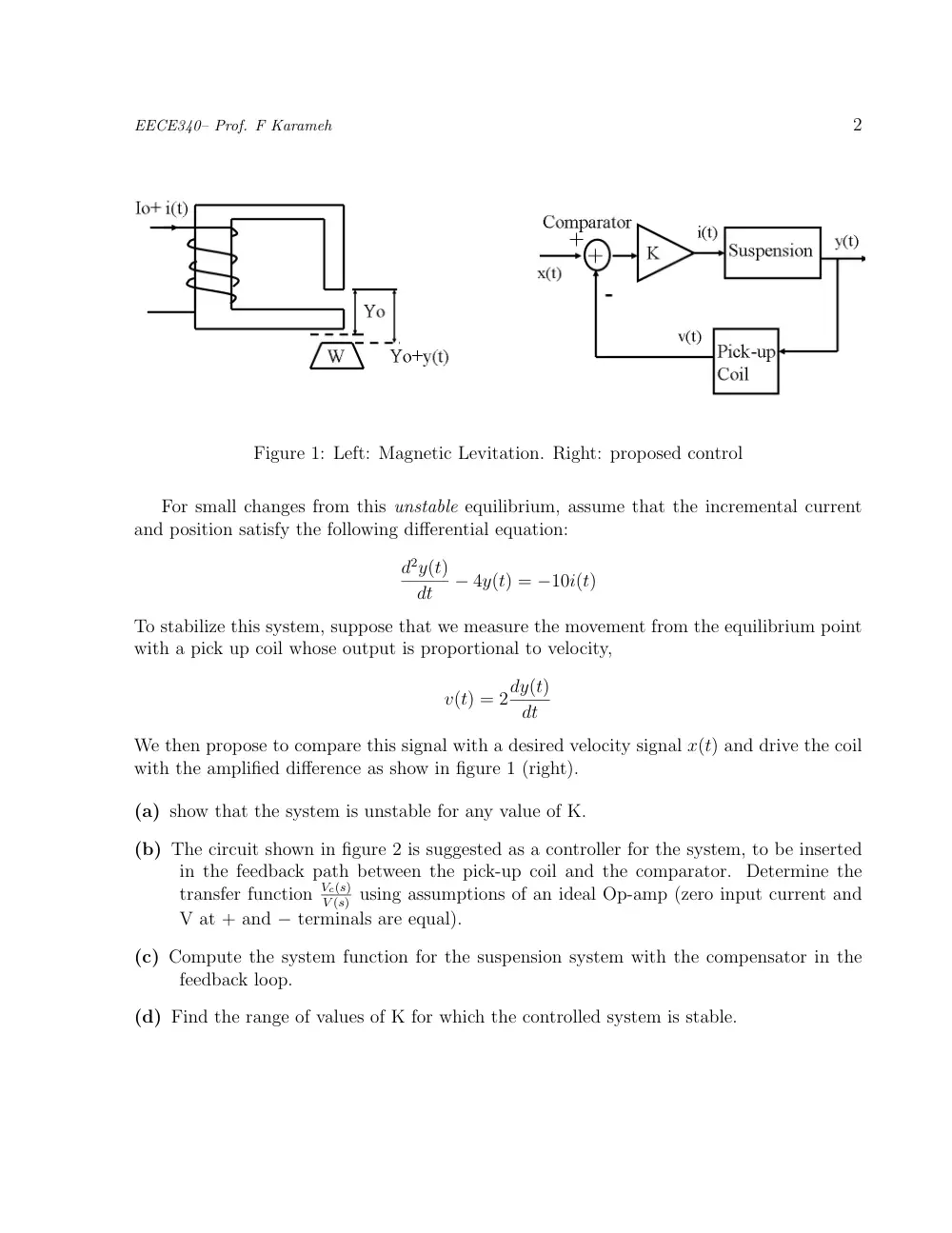
design a controller that can achieve such suspension task. As shown in figure 1, let Yo be the
position at which the magnetic force due to the current Io just balances the gravitational
force due to the weight.
EECE340– Prof. F Karameh
2
Figure 1: Left: Magnetic Levitation. Right: proposed control
For small changes from this unstable equilibrium, assume that the incremental current
and position satisfy the following differential equation:
d2y(t)
dt
− 4y(t) = −10i(t)
To stabilize this system, suppose that we measure the movement from the equilibrium point
with a pick up coil whose output is proportional to velocity,
v(t) = 2dy(t)
dt
We then propose to compare this signal with a desired velocity signal x(t) and drive the coil
with the amplified difference as show in figure 1 (right).
(a) show that the system is unstable for any value of K.
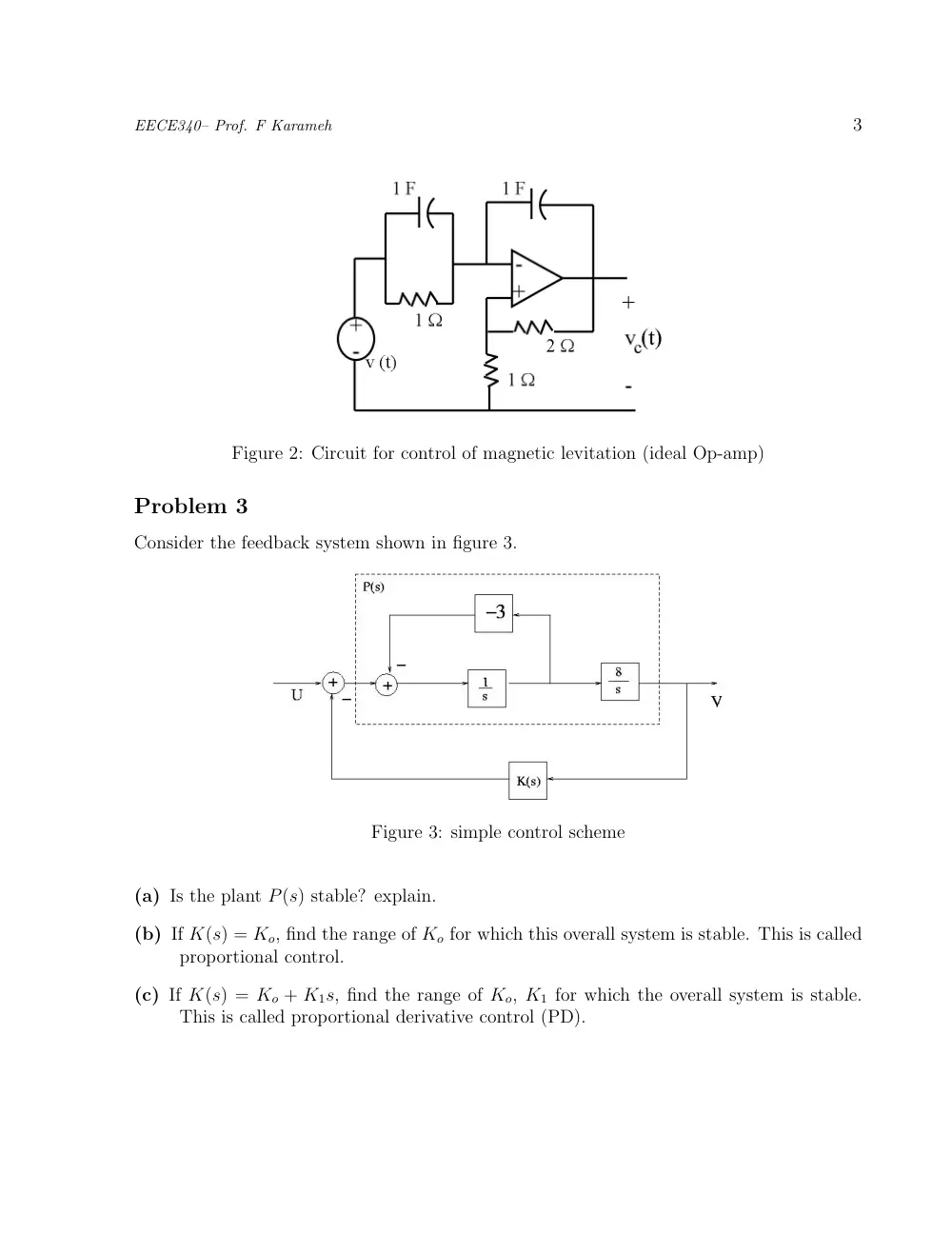
(b) The circuit shown in figure 2 is suggested as a controller for the system, to be inserted
in the feedback path between the pick-up coil and the comparator. Determine the
transfer function Vc(s)
V (s) using assumptions of an ideal Op-amp (zero input current and
V at + and − terminals are equal).
(c) Compute the system function for the suspension system with the compensator in the
feedback loop.
(d) Find the range of values of K for which the controlled system is stable.
EECE340– Prof. F Karameh
3
Figure 2: Circuit for control of magnetic levitation (ideal Op-amp)
Problem 3
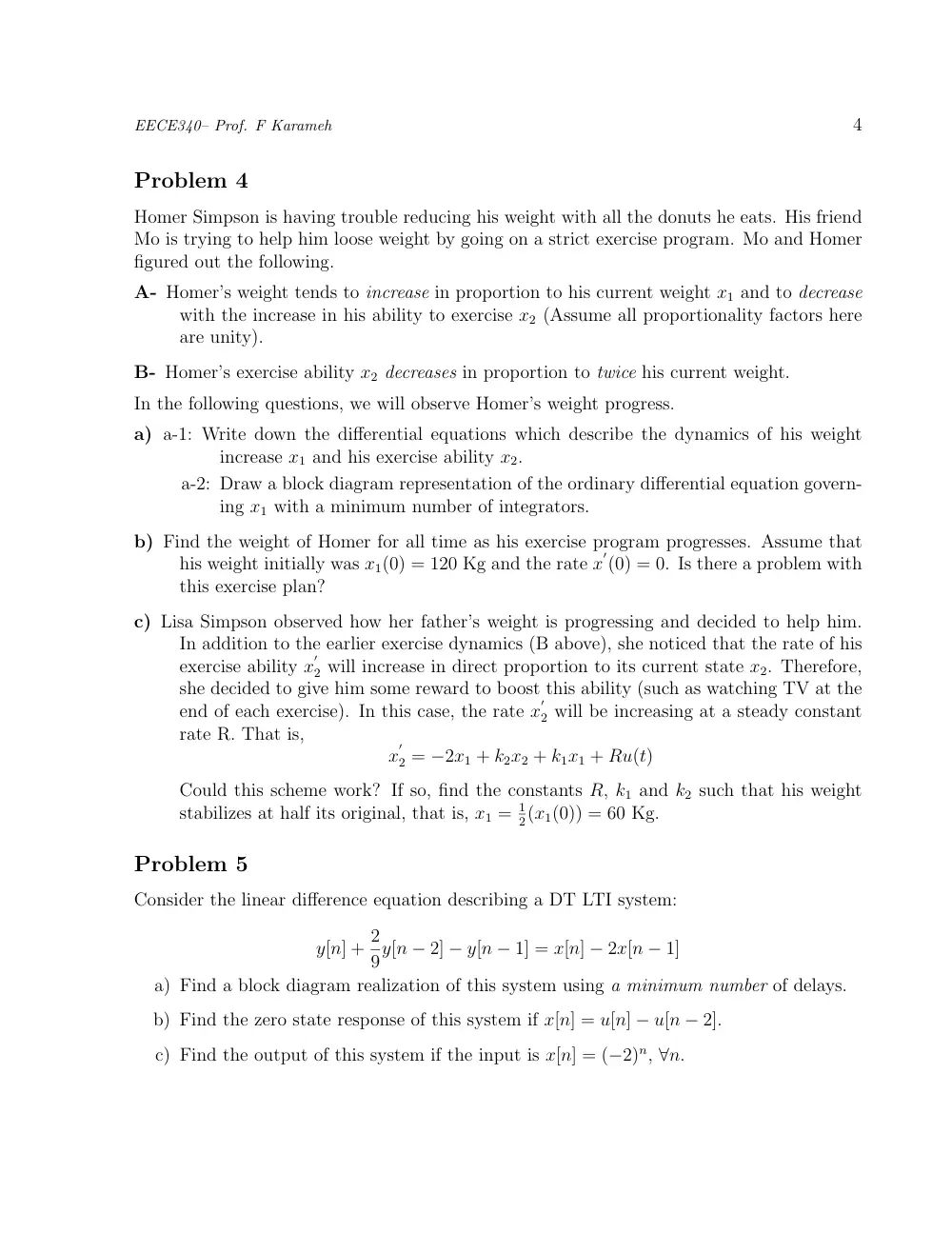
Consider the feedback system shown in figure 3.
Figure 3: simple control scheme
(a) Is the plant P(s) stable? explain.
(b) If K(s) = Ko, find the range of Ko for which this overall system is stable. This is called
proportional control.
(c) If K(s) = Ko + K1s, find the range of Ko, K1 for which the overall system is stable.
This is called proportional derivative control (PD).
EECE340– Prof. F Karameh
4
Problem 4
Homer Simpson is having trouble reducing his weight with all the donuts he eats. His friend
Mo is trying to help him loose weight by going on a strict exercise program. Mo and Homer
figured out the following.
A- Homer’s weight tends to increase in proportion to his current weight x1 and to decrease
with the increase in his ability to exercise x2 (Assume all proportionality factors here
are unity).
B- Homer’s exercise ability x2 decreases in proportion to twice his current weight.
In the following questions, we will observe Homer’s weight progress.
a) a-1: Write down the differential equations which describe the dynamics of his weight
increase x1 and his exercise ability x2.
a-2: Draw a block diagram representation of the ordinary differential equation govern-
ing x1 with a minimum number of integrators.
b) Find the weight of Homer for all time as his exercise program progresses. Assume that
his weight initially was x1(0) = 120 Kg and the rate x
′(0) = 0. Is there a problem with
this exercise plan?
c) Lisa Simpson observed how her father’s weight is progressing and decided to help him.
In addition to the earlier exercise dynamics (B above), she noticed that the rate of his
exercise ability x
′
2 will increase in direct proportion to its current state x2. Therefore,
she decided to give him some reward to boost this ability (such as watching TV at the
end of each exercise). In this case, the rate x
′
2 will be increasing at a steady constant
rate R. That is,
x
′
2 = −2x1 + k2x2 + k1x1 + Ru(t)
Could this scheme work? If so, find the constants R, k1 and k2 such that his weight
stabilizes at half its original, that is, x1 = 1
2(x1(0)) = 60 Kg.
Problem 5
Consider the linear difference equation describing a DT LTI system:
y[n] + 2
9y[n − 2] − y[n − 1] = x[n] − 2x[n − 1]
a) Find a block diagram realization of this system using a minimum number of delays.
b) Find the zero state response of this system if x[n] = u[n] − u[n − 2].
c) Find the output of this system if the input is x[n] = (−2)n, ∀n.
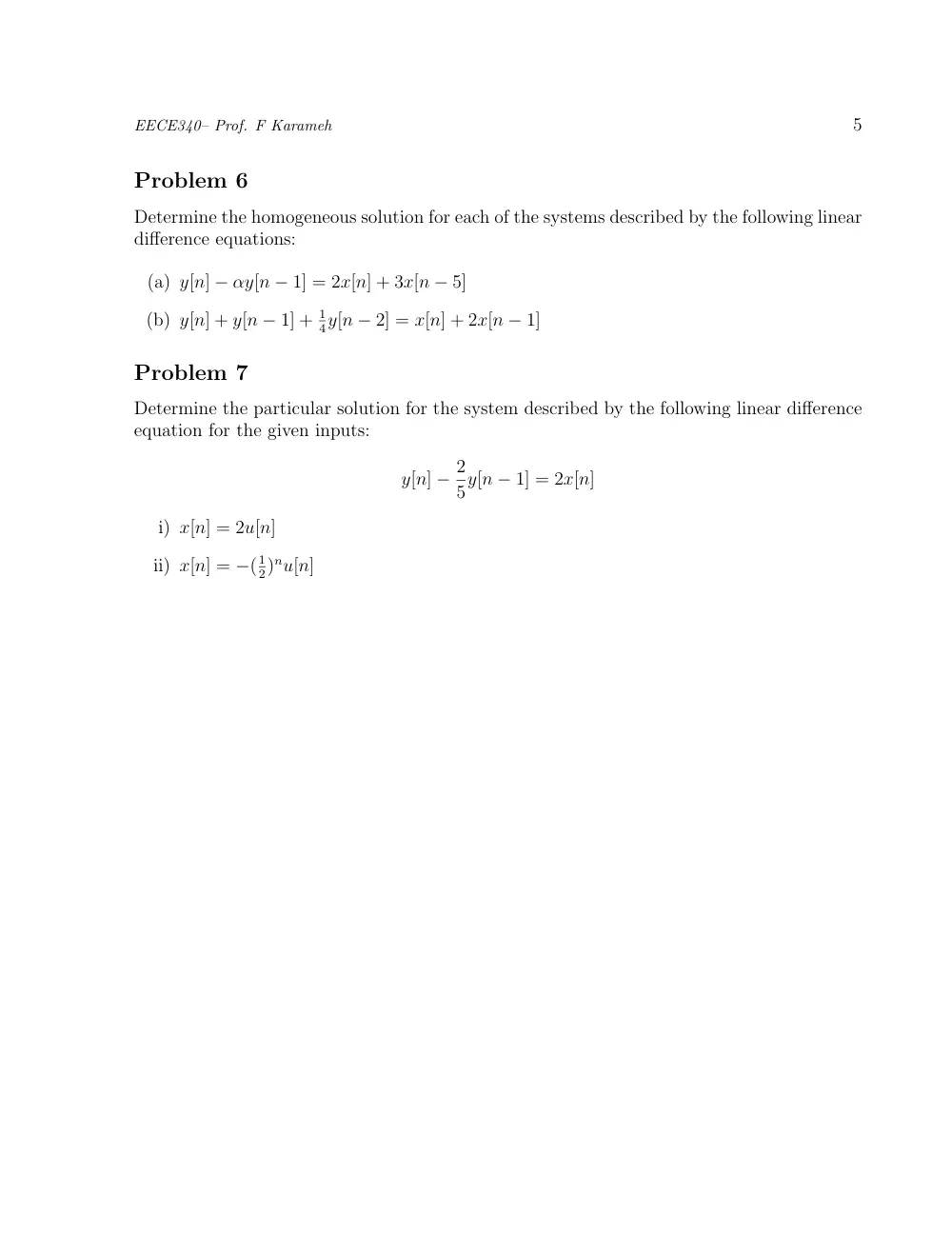
EECE340– Prof. F Karameh
5
Problem 6
Determine the homogeneous solution for each of the systems described by the following linear
difference equations:
(a) y[n] − αy[n − 1] = 2x[n] + 3x[n − 5]
(b) y[n] + y[n − 1] + 1
4y[n − 2] = x[n] + 2x[n − 1]
Problem 7
Determine the particular solution for the system described by the following linear difference
equation for the given inputs:
y[n] − 2
5y[n − 1] = 2x[n]
i) x[n] = 2u[n]
ii) x[n] = −(1
2)nu[n]