
EECE 340 Homework, Spring 2002
American University of Beirut · Signals and Systems · 11 pages

Showing the first 10 of 11 pages. Download the PDF to see all of it.
More EECE 340 files
- Homework 3 · Spring 2016HomeworkView
- Homework 1 Solution · Spring 2016Homework · with solutionView
- Homework 4 · Spring 2016HomeworkView
- Homework 3 Solution · Spring 2016Homework · with solutionView
- Homework 4 Solution · Spring 2016Homework · with solutionView
- Homework 1 · Spring 2016HomeworkView
- Homework 2 Solution · Spring 2016Homework · with solutionView
- Homework 2 · Spring 2016HomeworkView
Show the text of this homework
EECE 340- Signals and Systems
Homework # 2
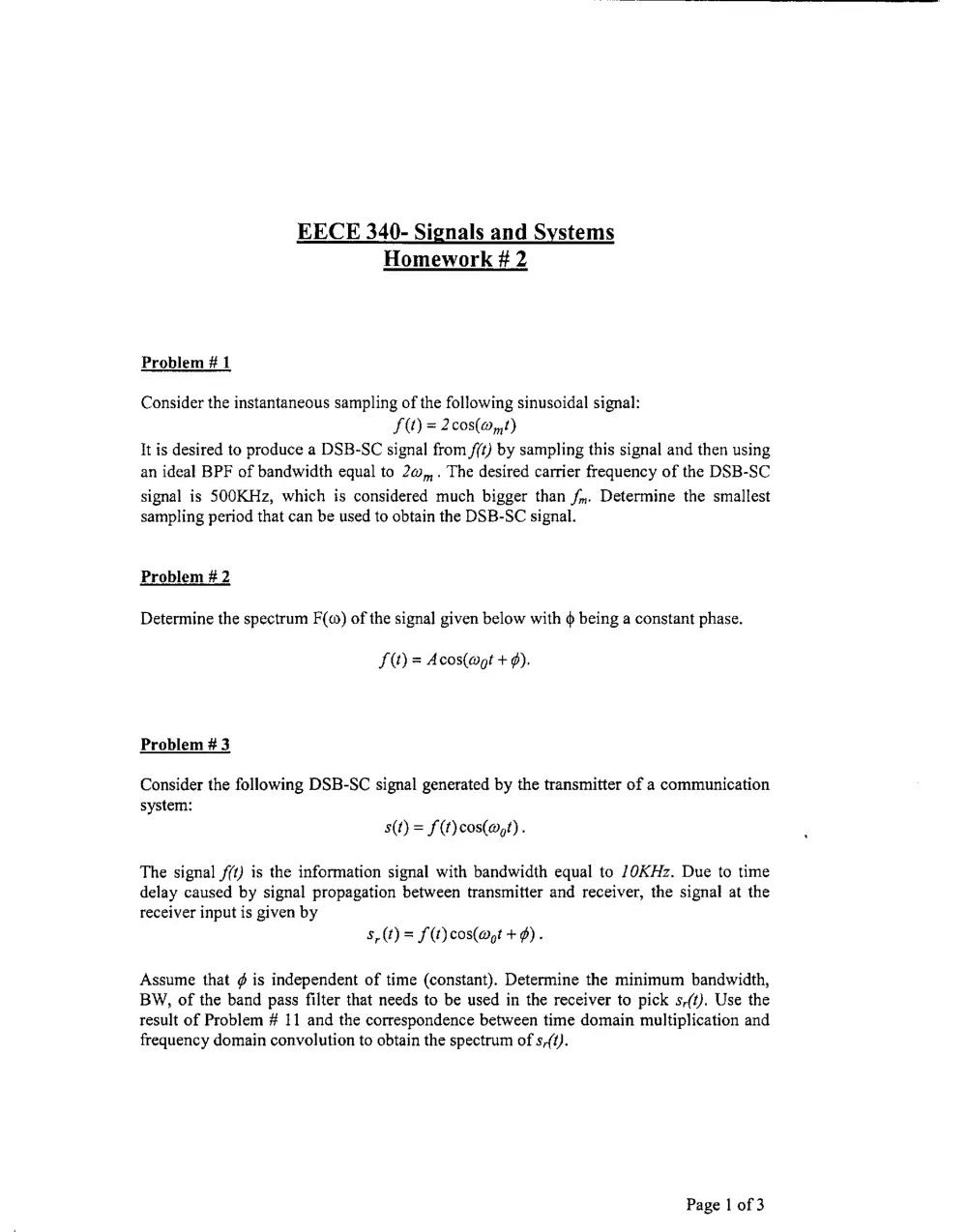
Problem # 1
Consider the instantaneous sampling of the following sinusoidal signal:
FQ) = 2c0s(@yt)
It is desired to produce a DSB-SC signal from /(t) by sampling this signal and then using
an ideal BPF of bandwidth equal to 2@,,. The desired carrier frequency of the DSB-SC
signal is 500KHz, which is considered much bigger than f,,, Determine the smallest
sampling period that can be used to obtain the DSB-SC signal.
Problem #2
Determine the spectrum F(«) of the signal given below with > being a constant phase.
S(t) = Acos(@@t + #).
Problem # 3
Consider the following DSB-SC signal generated by the transmitter of a communication
system:
s(t) = f(P)cos(a@gft) .
The signal f(t) is the information signal with bandwidth equal to J/OKHz. Due to time
delay caused by signal propagation between transmitter and receiver, the signal at the
receiver input is given by
5(0) = f@)cos(wgt + 4).
Assume that ¢ is independent of time (constant). Determine the minimum bandwidth,
BW, of the band pass filter that needs to be used in the receiver to pick s,(t). Use the
result of Problem # 11 and the correspondence between time domain multiplication and
frequency domain convolution to obtain the spectrum of s,(#).
Page | of 3
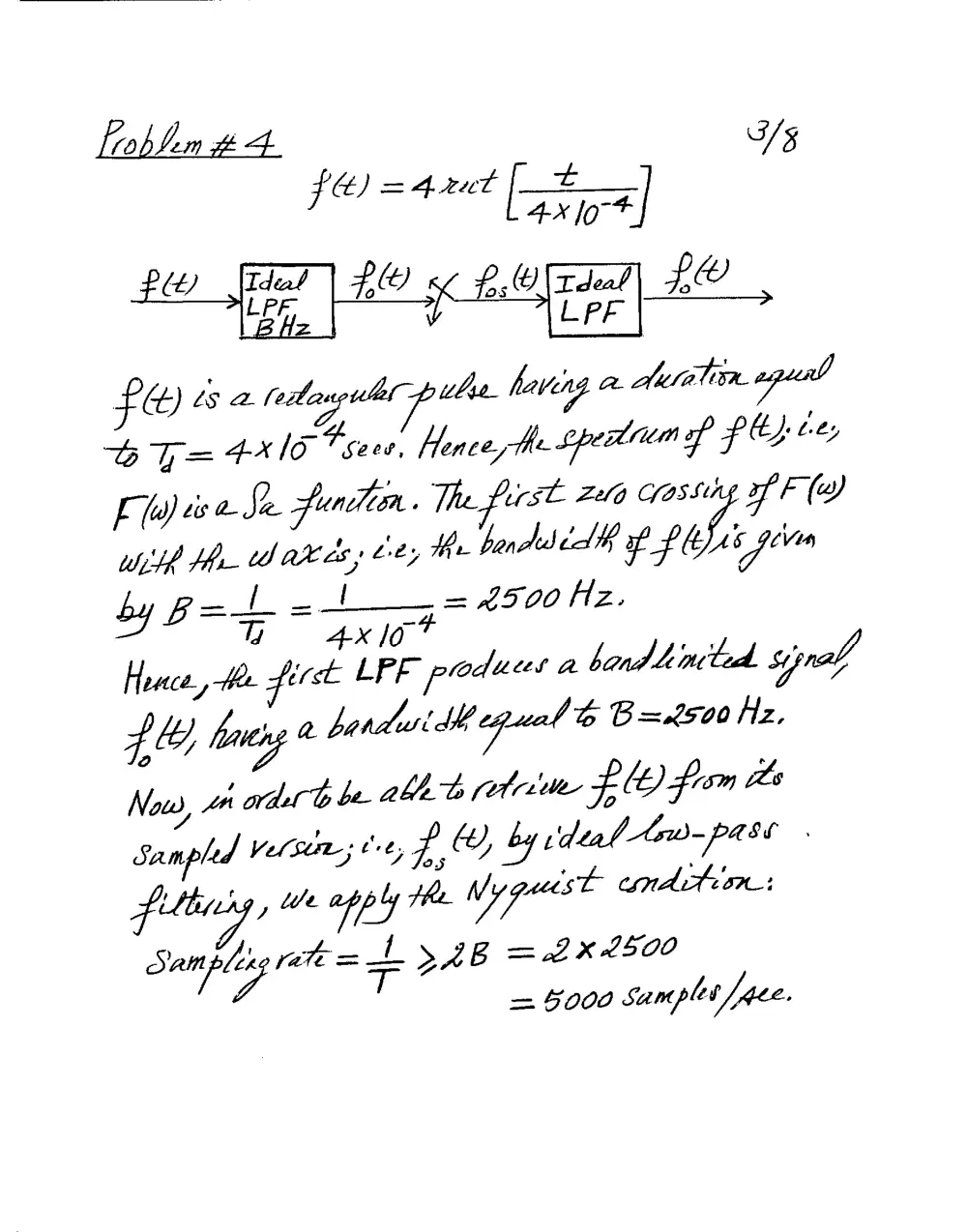
Problem #4
Consider the following signal:
t
f®O=4 rea — 704 }
Let f(t) be present at the input of a LPF of bandwidth B Hz. The LPF output is sampled at
the rate of (//T) samples/sec, Assume that the LPF is ideal and the sampling is
instantaneous. Let B Hz be also the bandwidth of f(t) defined by the first zero-crossing of
the spectrum of f(t) with the frequency axis. Determine the sampling rate that permits the
LPF output signal to be retrieved from its sampled version by ideal low-pass filtering.
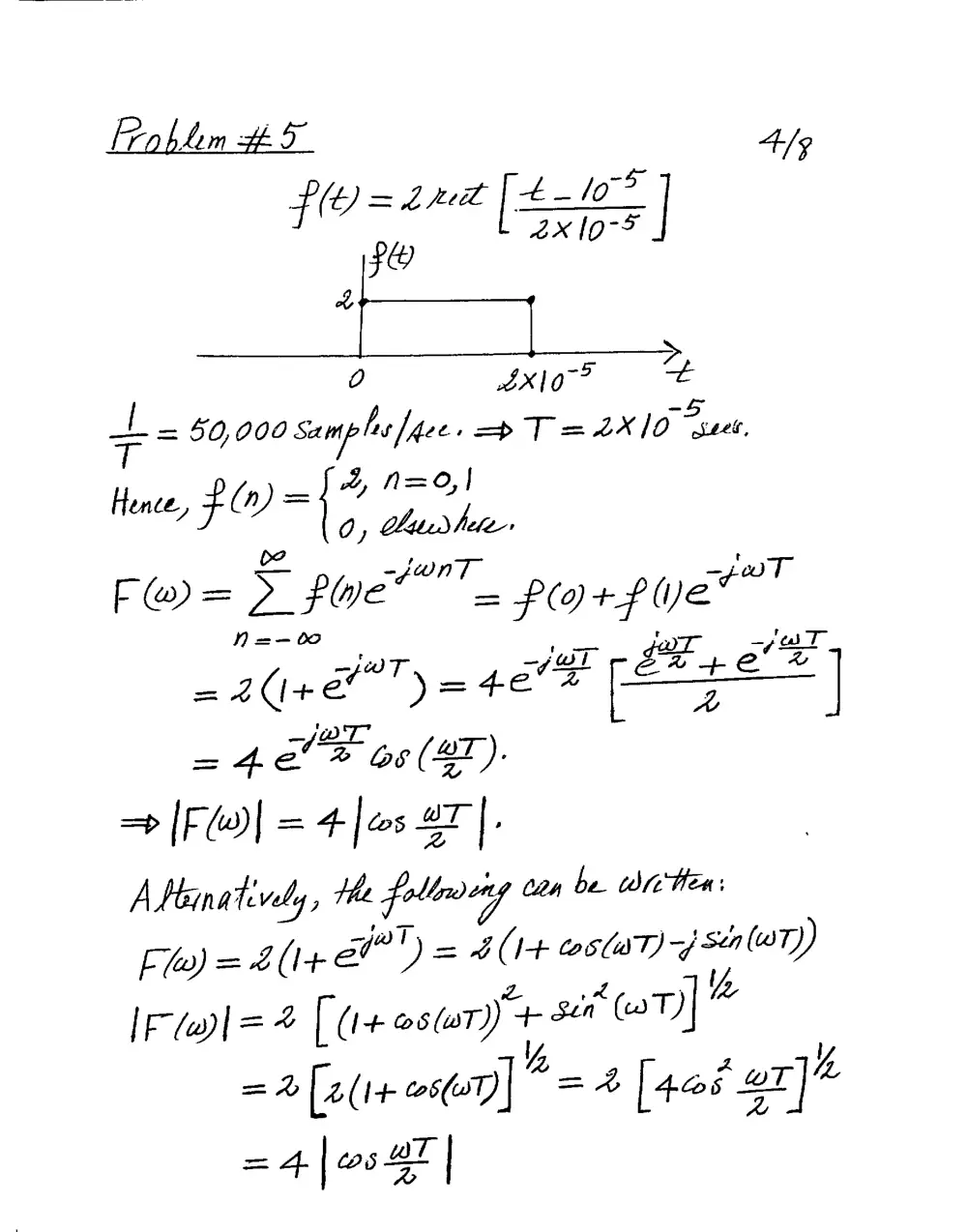
Problem #5
Consider the following signal:
t-10°
t) = 2 rect .
fO : x |
Let f(t) be sampled at the rate of 50,000 samples/sec to obtain the discrete time signal
f(a). Determine the magnitude of the Fourier transform of f(n); i.e., \F(@)h
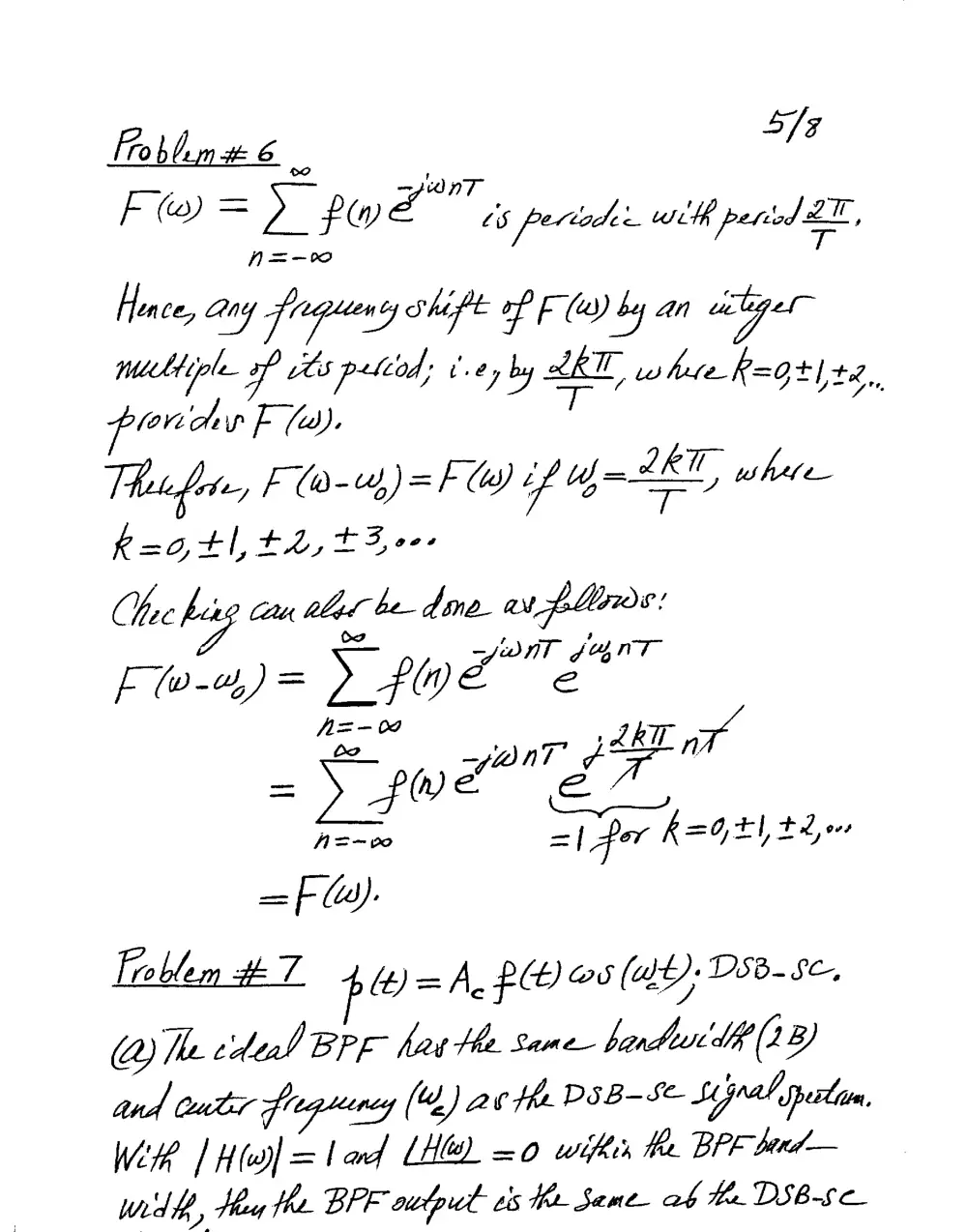
Problem # 6
Consider the periodicity of the Fourier transform, F(@), of a discrete time signal, ffn), and
the frequency shift property of F(a); i.e. f(n)e/*"” <> F(a). Determine all the
values of @ that make F(@-@)=F(a).
Problem #7
Consider a DSB-SC signal p(t) given as follows:
pP(t)= A, f(t)cos(@,t).
The signal f(f) is of low-pass type and having no frequency components above BHz. The
DSB-SC signal is present at the input of an ideal BPF having a center frequency a,
bandwidth equal to 2B Hz and frequency response H(@). The height of the magnitude
frequency response of the BPF is 1 and its phase frequency response is equal to zero,
(a) Determine the output of the BPF.
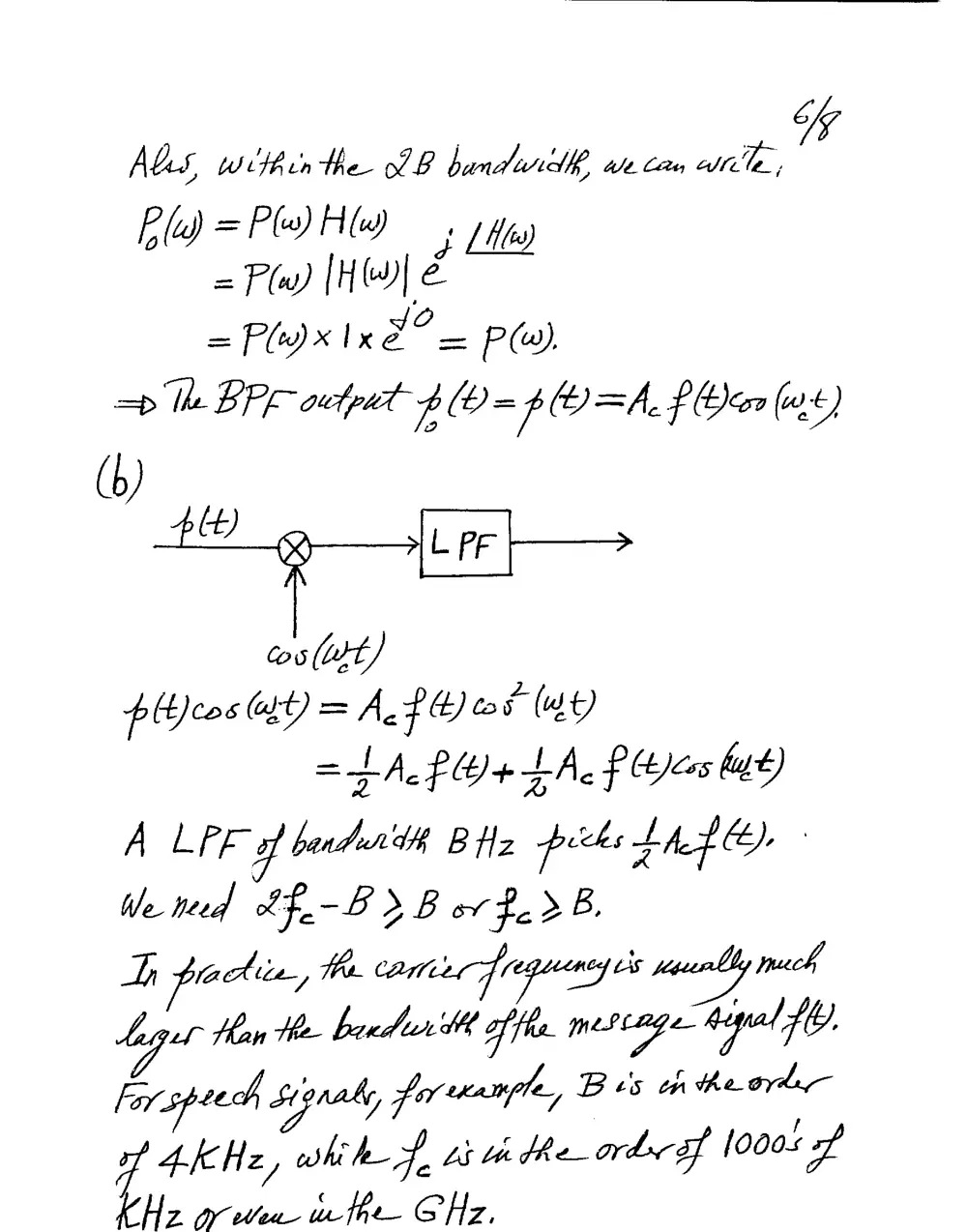
(b) Draw the block diagram of a system that can be used to demodulate the DSB-SC
signal.
Page 2 of 3
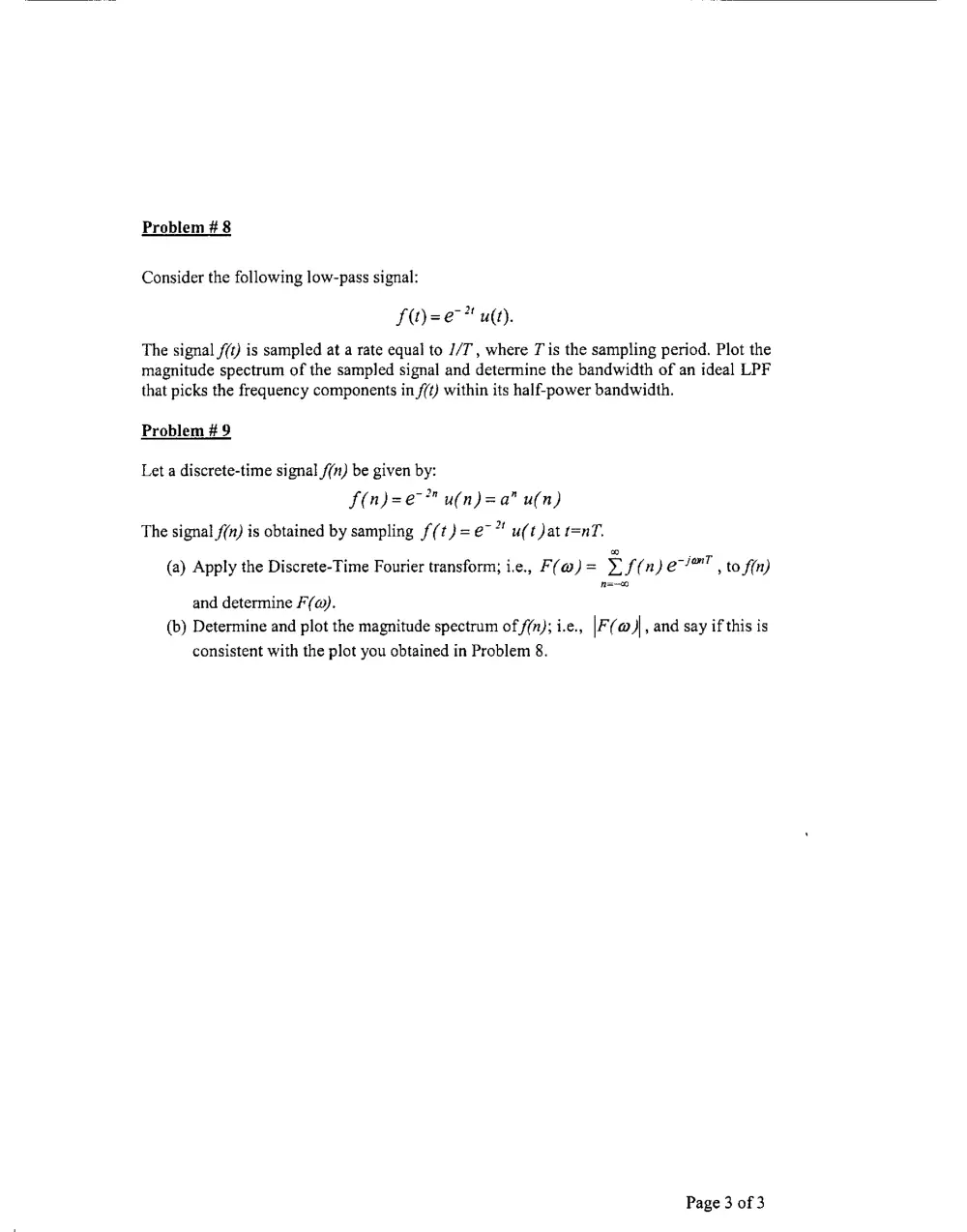
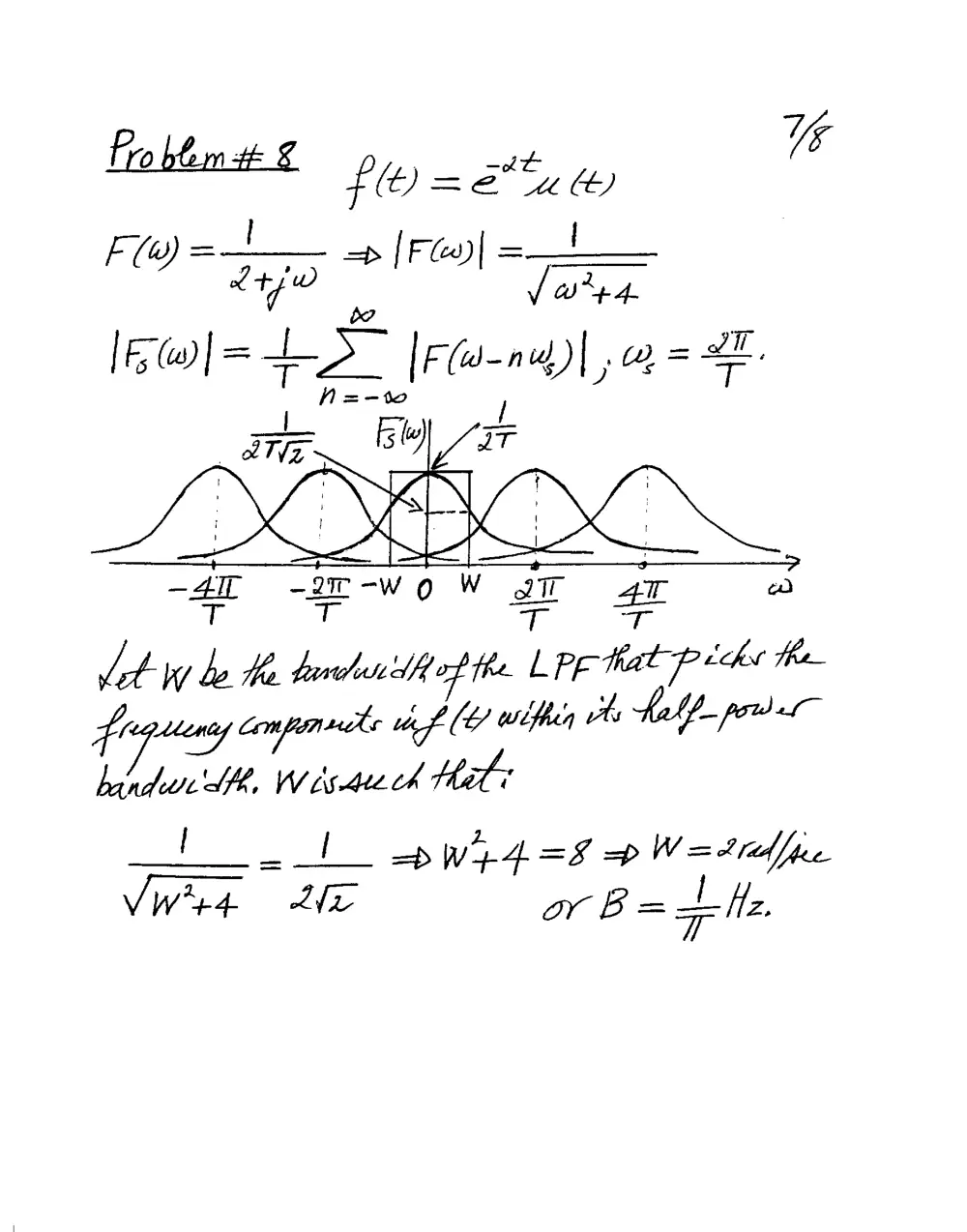
Problem # 8
Consider the following low-pass signal:
fse* ult).
The signal /(t) is sampled at a rate equal to //T , where T is the sampling period. Plot the
magnitude spectrum of the sampled signal and determine the bandwidth of an ideal LPF
that picks the frequency components in f(t) within its half-power bandwidth.
Problem # 9
Let a discrete-time signal fn) be given by:
f(n)=e°"" u(n)=a" u(n)
The signal f(n) is obtained by sampling f(t) =@7 7 u(t )at t=nT.
(a) Apply the Discrete-Time Fourier transform; i.e. F(@) = vf(n) el? to fn)
n=—00
and determine F(a).
(b) Determine and plot the magnitude spectrum of /(n); i.e., |F(a,]| , and say if this is
consistent with the plot you obtained in Problem 8.
Page 3 of 3
/
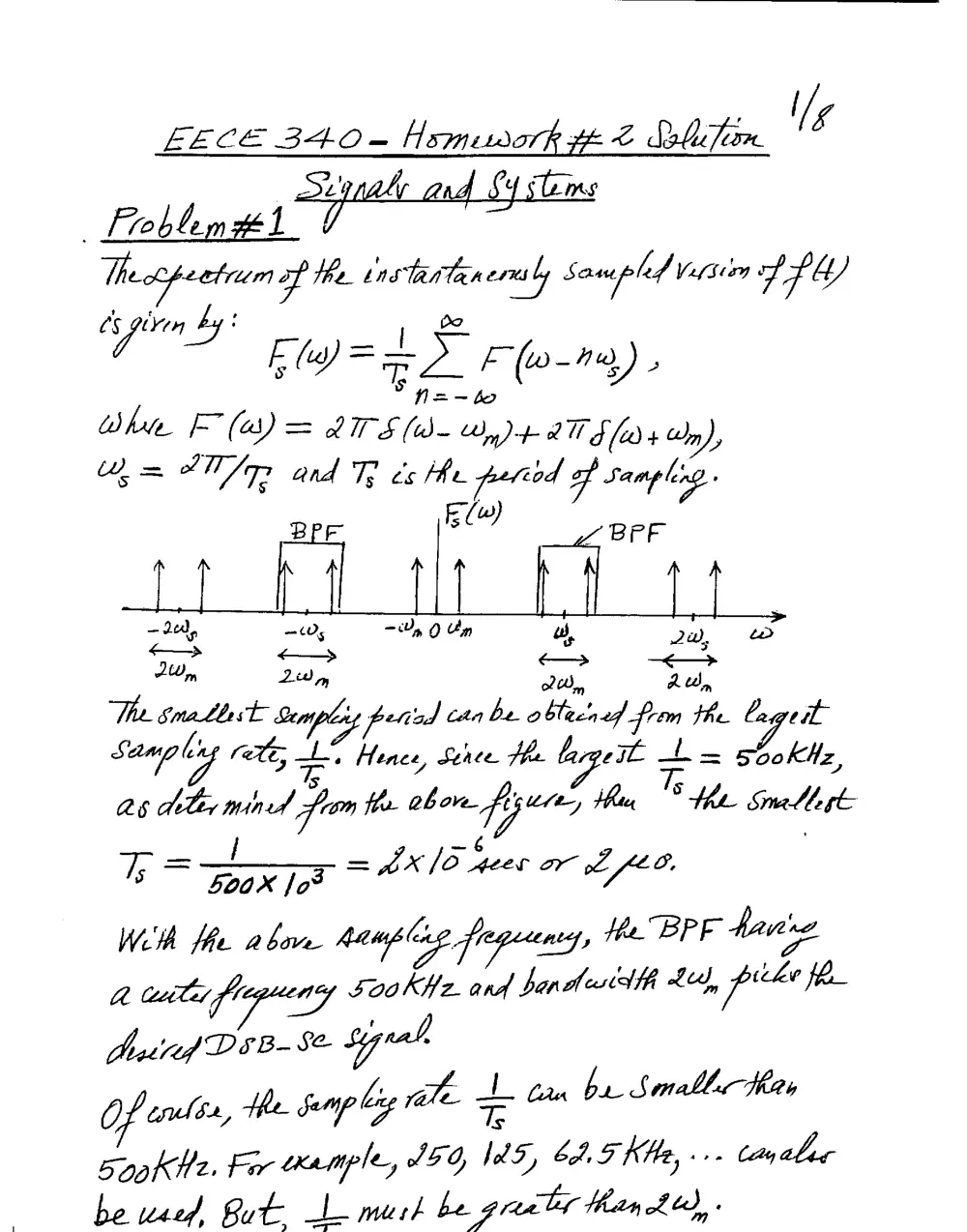
EECE 34.0 — Homiwork #- 2 ReluJon ( £
onary 4 stems
| Frebhm#é1 j :
The ccpeetrim a the tnslartaa eres ly Sampled Visseey ff 4)
a tren by 4 po
Figg= =D F(w-4).
Sebo
Whe F(a) = LTS (W- Wy)-4- 27 § (id + Udy),
“= aT / 73 and Ts e's the period f Sampling
f PE Bo) i BPF
— ded, =, —Uy 0 Un L LJ a?
-— > -— > <—>
Ay aw Awd,
™ Wy
Th Smallest Sampleig petiad Cn be o blacn ed Fram the Ca cil
Sanplig ee, ae Hence, Seance Pe Ager t= o0kKHz,
aS deter mined oom fh bon fisure, thu Ts yy Smallest
= 8 fx /5 eer x Leo,
boax /o*
Of cote the. Samp leig ra Zz a Cdn ha Small Hay
7
Saakhe. Fer Kemple, AGO, 15, 6,5 KHe,... tay aber
be 14.7, But. LL mush be grecly Han Le}, -
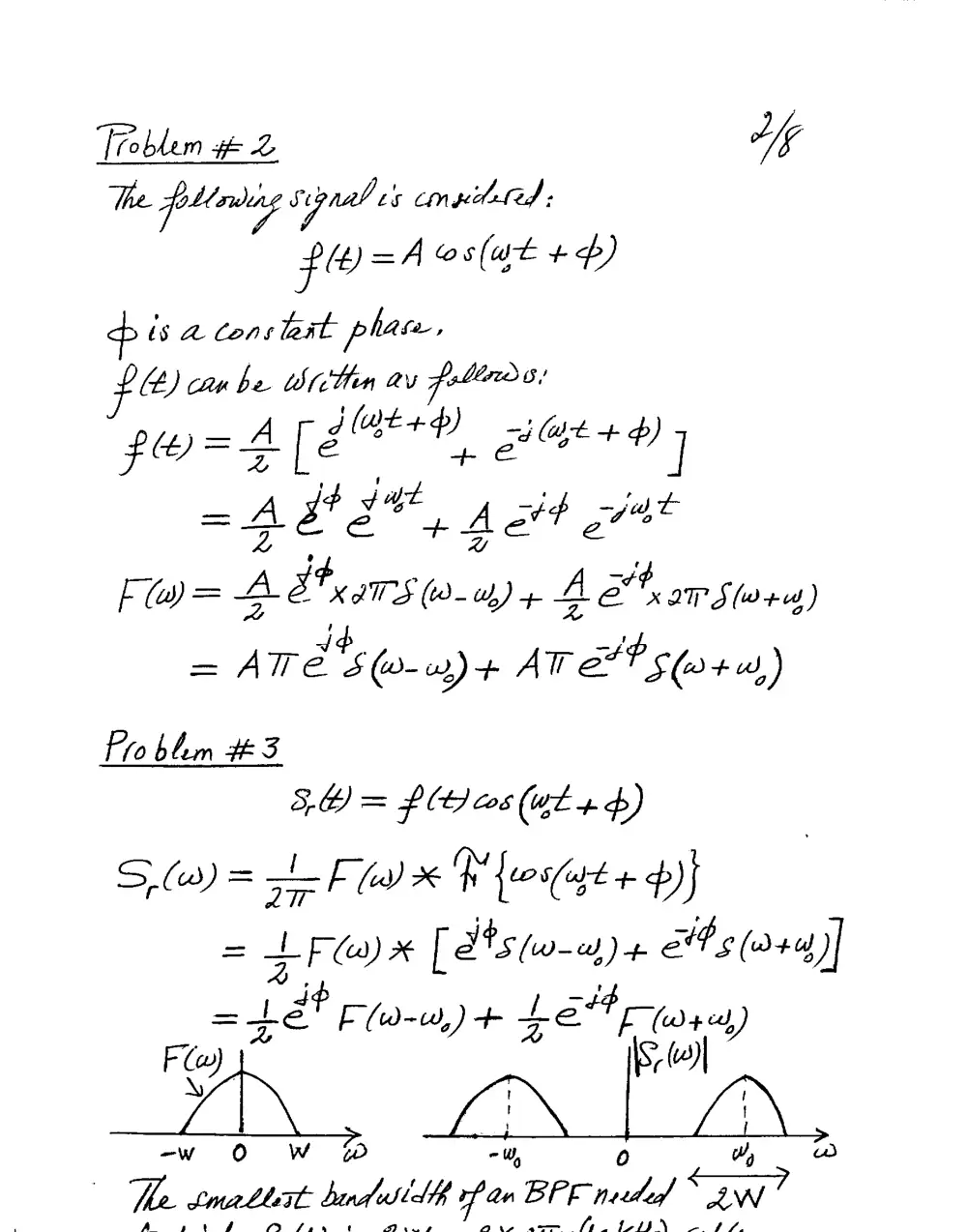
Troblem #2 WA
The olanding signal es conpeteled :
f= Aws(ut +)
p is a Cons lait phace,
vod Srctten av i
= A re, jue ver vat
rw= Adt OTe cy) + A AuarS lor)
= _ Are 15 (o-03) + AT EP (e040)
Fro bhm #3
5.4) = $lt) cos (ut +d)
S (os) = oF lux f Bfer(aee b)}
le F (w- ~wW,) + LE Posey)
Fe) A QD ane
Th. uate 2 neti fan BPE node “Zeal? =
y, t £ 1% fart aa fp fod N - te.
Liohlen # A Ss
f Gé) =4.2ut [- ap)
) [Wal | PY «¢ £.Wltded| LY
so cara te
f Ue) ts 2. (edaug lat ? hae haveng a. Atlalisn. equal
GT=4*1o Face. Hence he spetrim ff PEL Ley
Fide a Se funn The fuse Zea fas st of Fly
wtp pi di ate dsy Et, Me bend of Pte fais ge
by Ba -! = £5700 Hz.
4xig7
Hyeece. yp hee first LPF produces a hand hinttad. syyrall
Z y hotcng a bordut dl epual é B=.2500 Hz,
Now, ade be Ahab potrime $b) from Ls
7
Sampled Vel sre; tt, Z, © fy heal pees .
#: / “4? lt apply Hee ln CHIL. ZIAL!
Svat plex yea 4B =2x#500
2. 7 oO T 7 a = 4000 samples figec.
Fiobhm #5
4/9
Fb) = dpel [ £1077 ]
y 5
ply X10
0 JEXlor? >
[ _ . -
= 50, 000 samples [fee => T=2X/0 Ppt,
a, n=0,|
Hen a =
aa ro. 1° BLardshee
FmM= > ple?’
= FO +pye?
N=- 00
' — gor a
APéinatively, the folladeag can be wWre'Hen:
Fie) = ai4e) = J (I+ esl
[F-(w)| = 2 [ lit 05 (iT) y Sen ‘an!
=2[a(i+ stat] ” = 4 [4o8 27 wT le
= 25 =
4 | oot
5/3
Fo hbem te 6 .
F @& = > fw 0 is pertiada wth petisd Zt,
N=-00 r
Hence, any frpeny Shift of F (wy by an algal
miltiple. xf ts petdod; . ey by LRT ww hue R=0+| +00
prenoup E(w). qT —
Thelefse,, F (0-04) =F (ed) of t= a ushete
faotl t+2,t3---
Mee beig tay bled be din av pls:
F (w-4) = > fae Er"
As — 02 2k py
—yleonT” n.
= foe EX
Az=-wo =| per k=42)44
=f (id).
[roblem #7 pl)= A. Pb) 6 (ub). DS8-Se,
Q) le cleat BPE hat Phe. Same bardevi'dify (2B)
and Qutlir regione (4)ac the DsB— Se. Lyra perio,
Wee | Hl] = lar LHle). = 0 wifes Me BPE bead —
will, Hey the BPE output tis the. Same ob He. DSB-Se.
Wy
Aas within the LB bandurclh, we car wile,
Bld) = Plo) Hl) {LHe
= Pla) [Hey €
= Pl) x |x? = Pl)
phe BPE ontpet BO =pO=A.f Beer (ust)
(b)
ee
cos (ett)
pli}cos alt) = A, fH tof (ut)
=tA LO + tA. fb Ut)
A LPF of bandenth BHz peeks LALE),
We teed &f.-B > B ov fee >B,
Tt pracis, He. cartier frequen ds seunlly much
ut than tee bavdinr th af fhe. mescage. egal f)
far speed sigsahy fer eanple, Bits chhe-erte
f 4kHz, whi he. 23 vk the order gf 1000 Zz
KHz qe uc the CHz,
a
Lew be he. tarelusech fh of fhe. L pp that picks The
fi Lene Conprnncs def (t/ wifhin As tab af
handure ltt, Wbsaueck Hits
Pt pW Hd Wat fper
op il