
EECE 340 Homework, Spring 2005
American University of Beirut · Signals and Systems · 11 pages
Showing the first 10 of 11 pages. Download the PDF to see all of it.
More EECE 340 files
- Homework 3 · Spring 2016HomeworkView
- Homework 1 Solution · Spring 2016Homework · with solutionView
- Homework 4 · Spring 2016HomeworkView
- Homework 3 Solution · Spring 2016Homework · with solutionView
- Homework 4 Solution · Spring 2016Homework · with solutionView
- Homework 1 · Spring 2016HomeworkView
- Homework 2 Solution · Spring 2016Homework · with solutionView
- Homework 2 · Spring 2016HomeworkView
Show the text of this homework
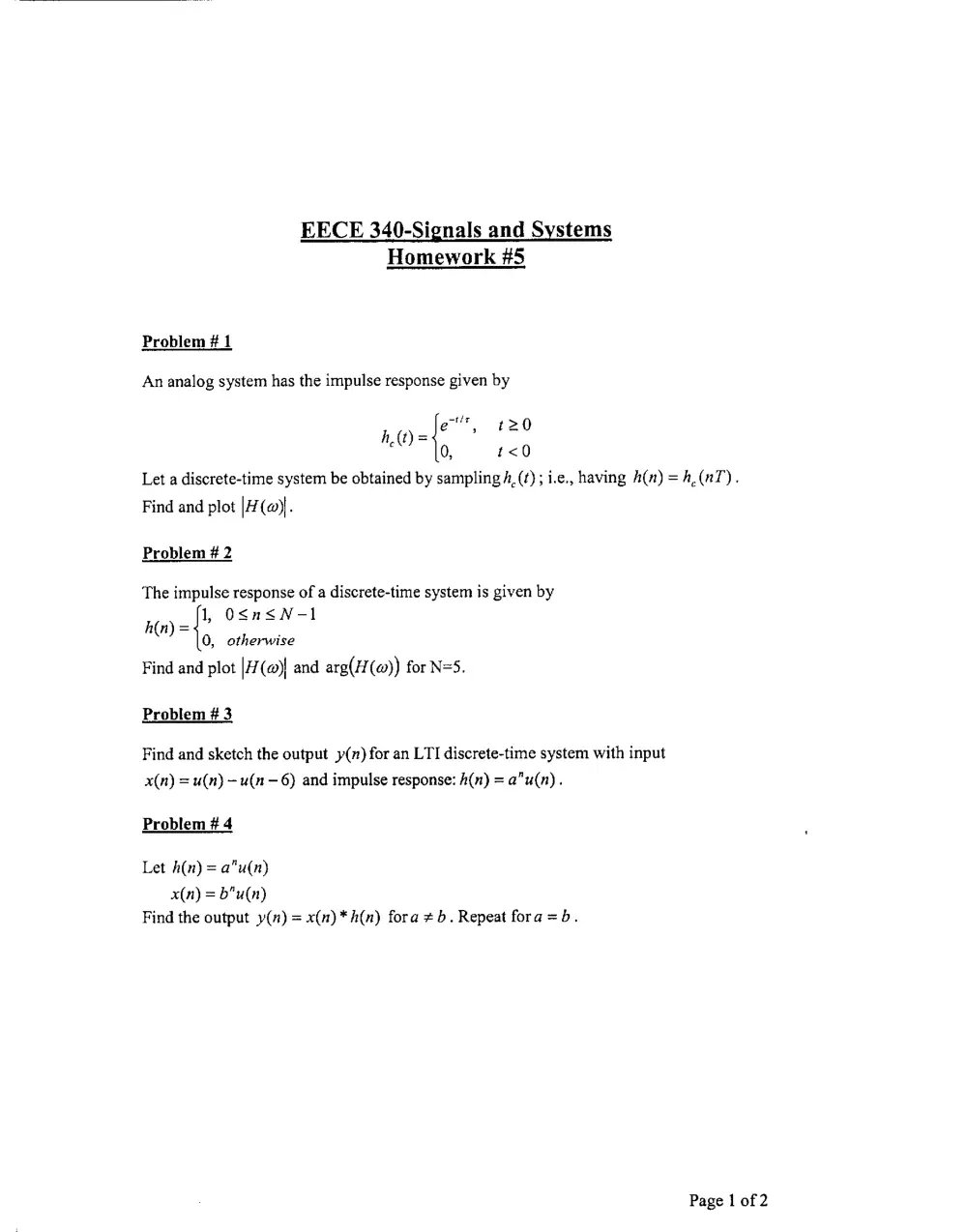
EECE 340-Signals and Systems
Homework #5
Problem # 1
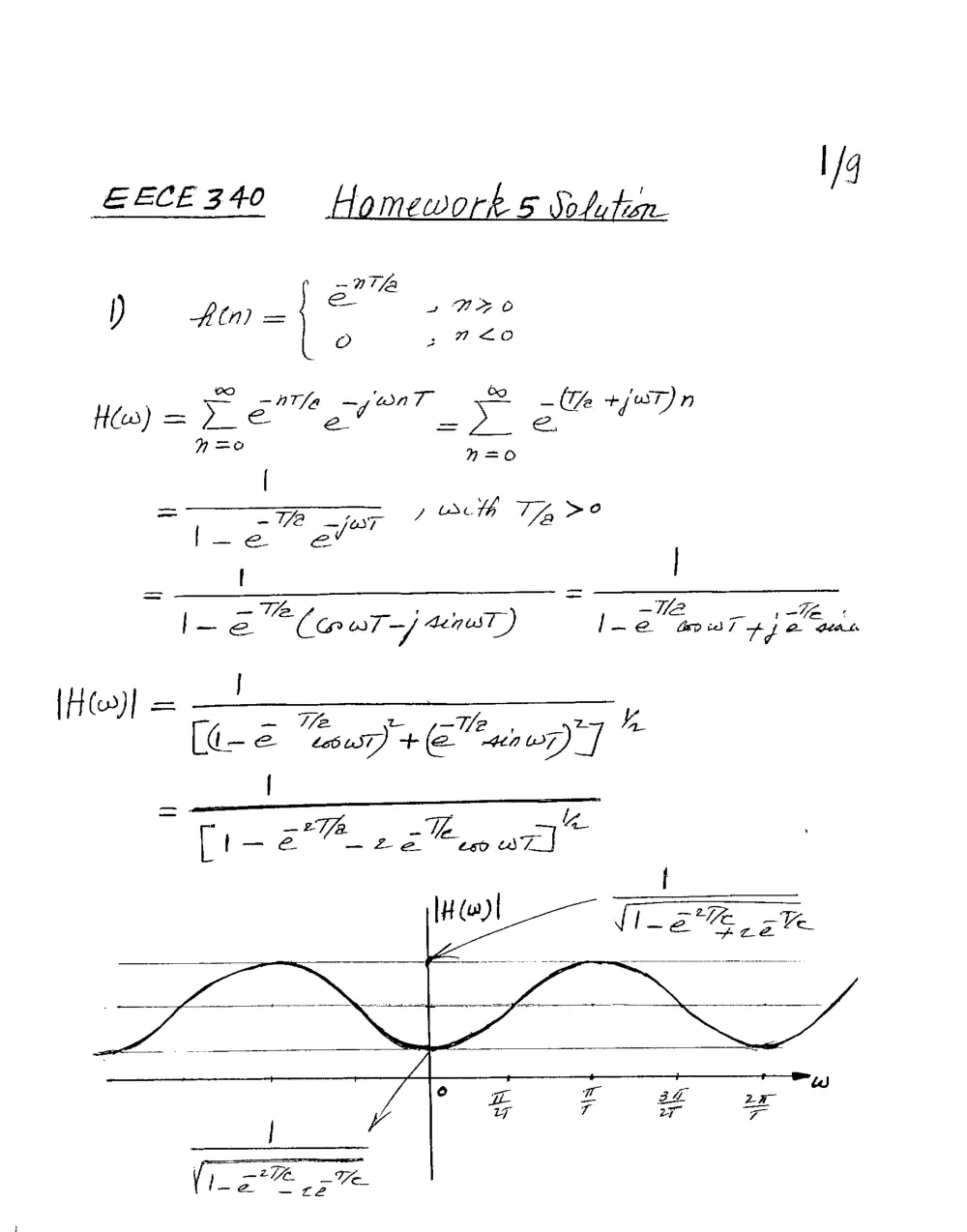
An analog system has the impulse response given by
ee, 120
A= ,
) ( <0
Let a discrete-time system be obtained by sampling h,(4); i.e., having h(n) =h, (nT).
Find and plot |H(a) .
Problem # 2
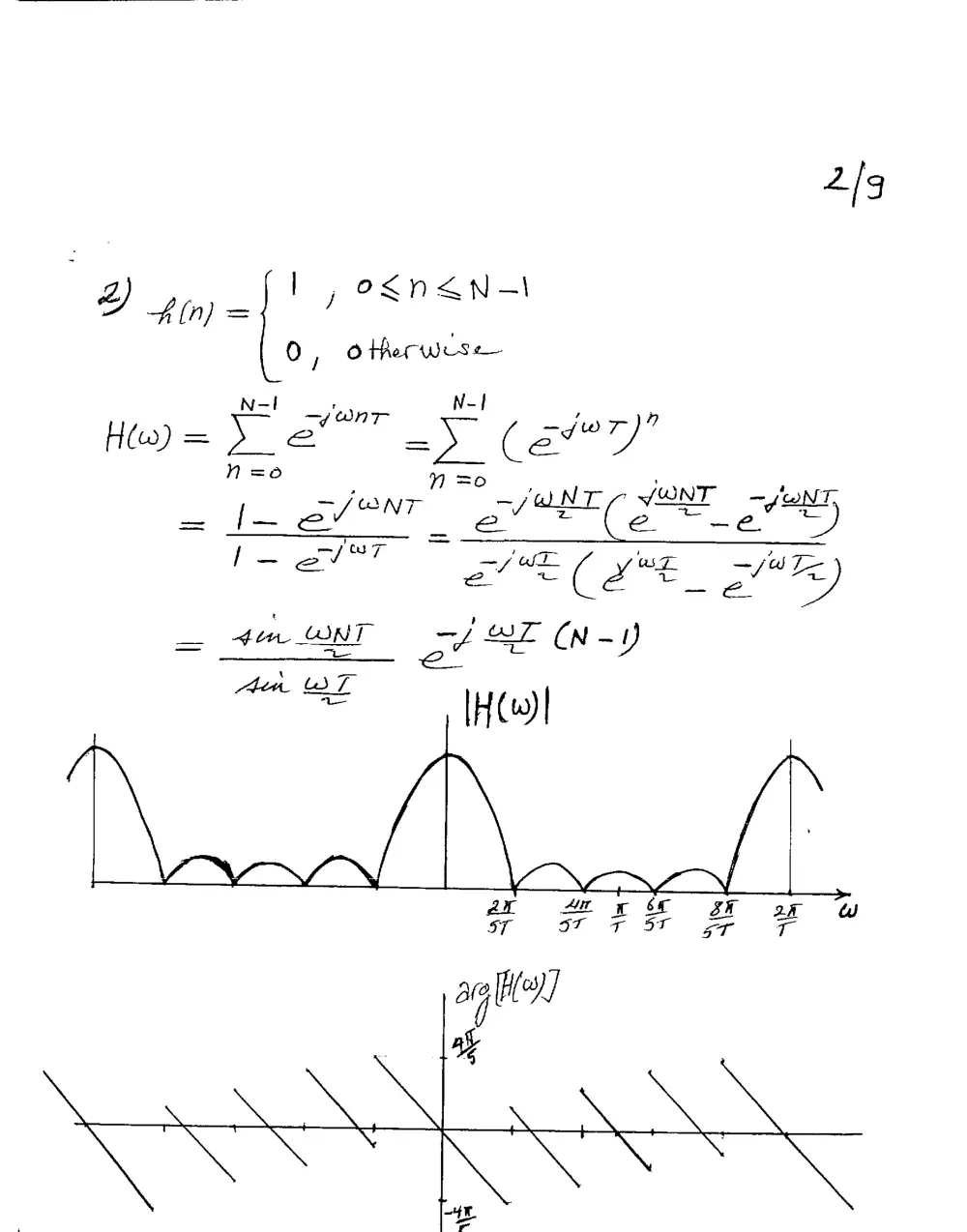
The impulse response of a discrete-time system is given by
1, O<nsN-1
ion= Osn
0, otherwise
Find and plot |H (@)| and arg(H! (a)) for N=5.
Problem # 3
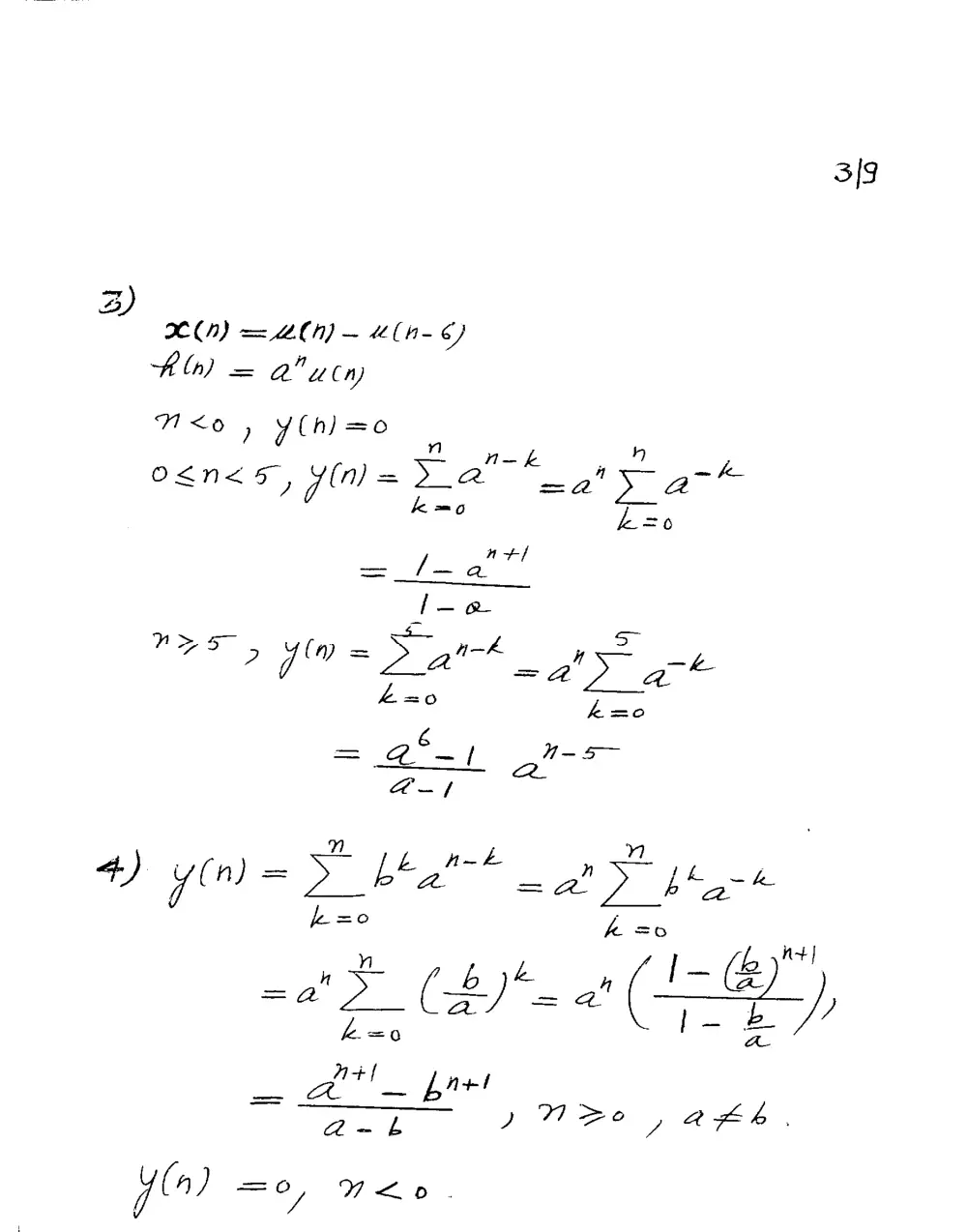
Find and sketch the output y(n) for an LTI discrete-time system with input
x(n) = u(n) —u(n — 6) and impulse response: h(n) = a"u(n).
Problem #4
Let A(n) = a"u(n)
x(n) = b"u(n)
Find the output y(n) = x(1)*h(n) fora #b. Repeat fora=b.
Page 1 of 2
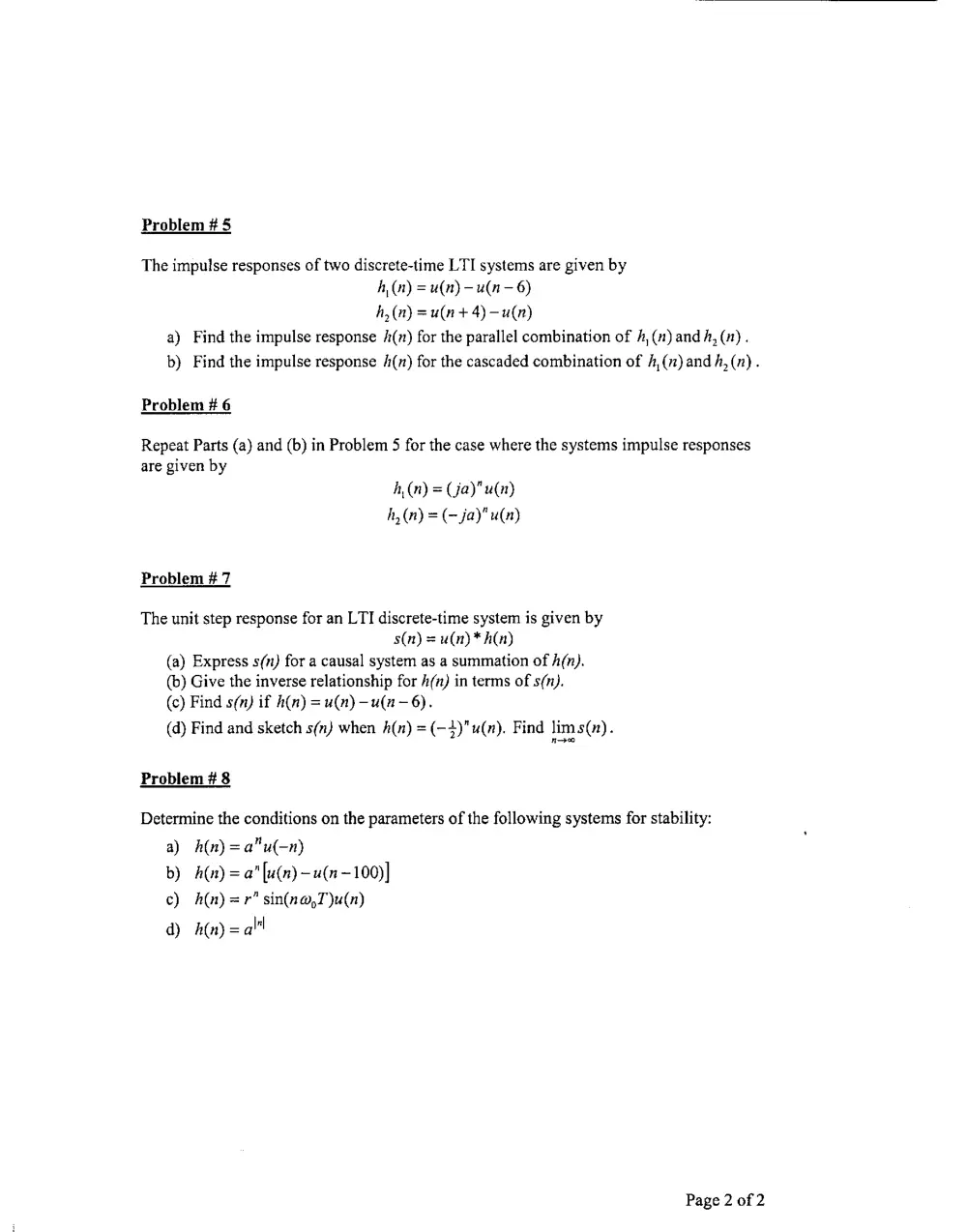
Problem #5
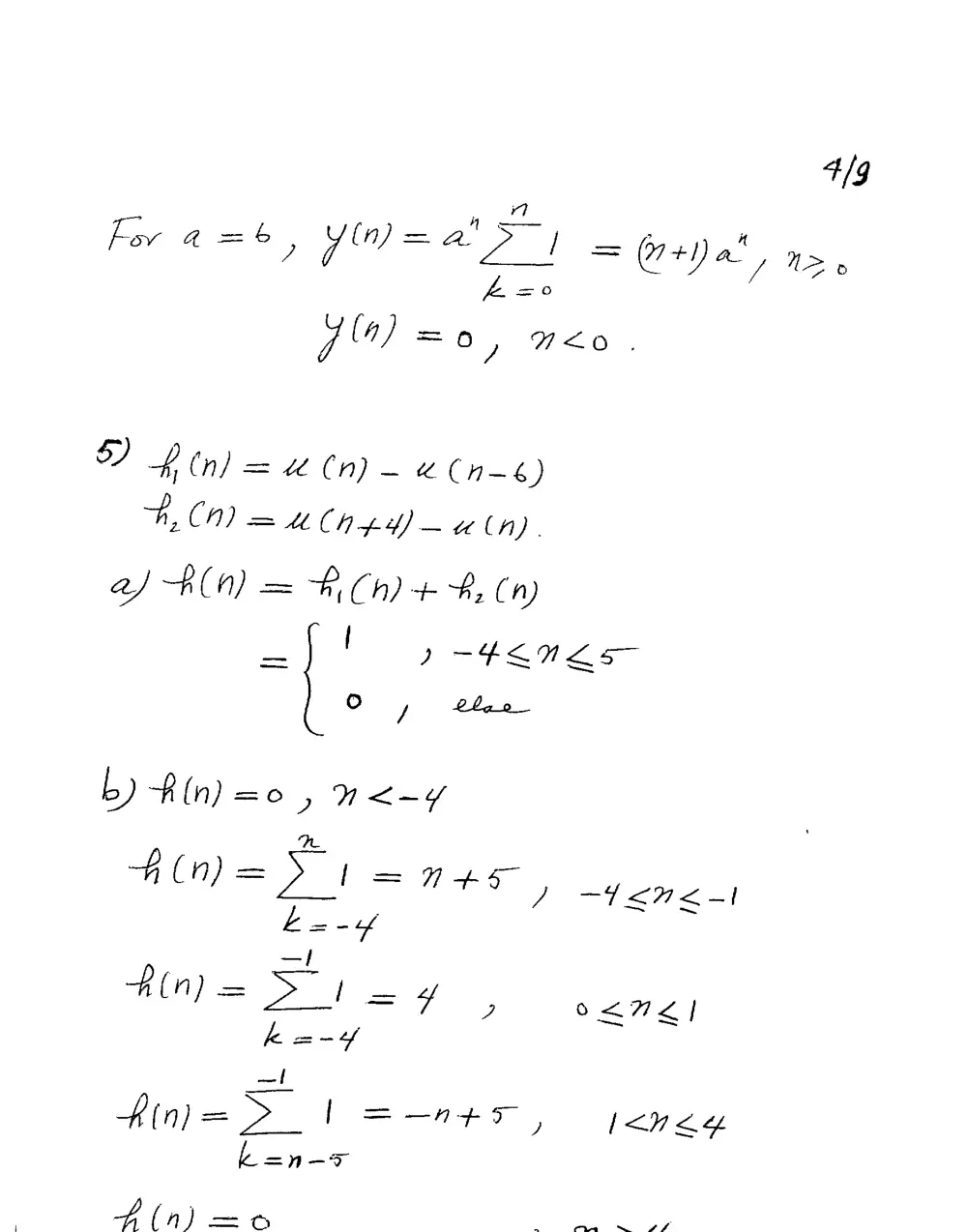
The impulse responses of two discrete-time LTI systems are given by
h(n) = u(n) —u(n - 6)
hy (n) =u(n+4)-u(n)
a) Find the impulse response A(7) for the parallel combination of /,(”) and /,().
b) Find the impulse response /() for the cascaded combination of /, (7) and h, (n) .
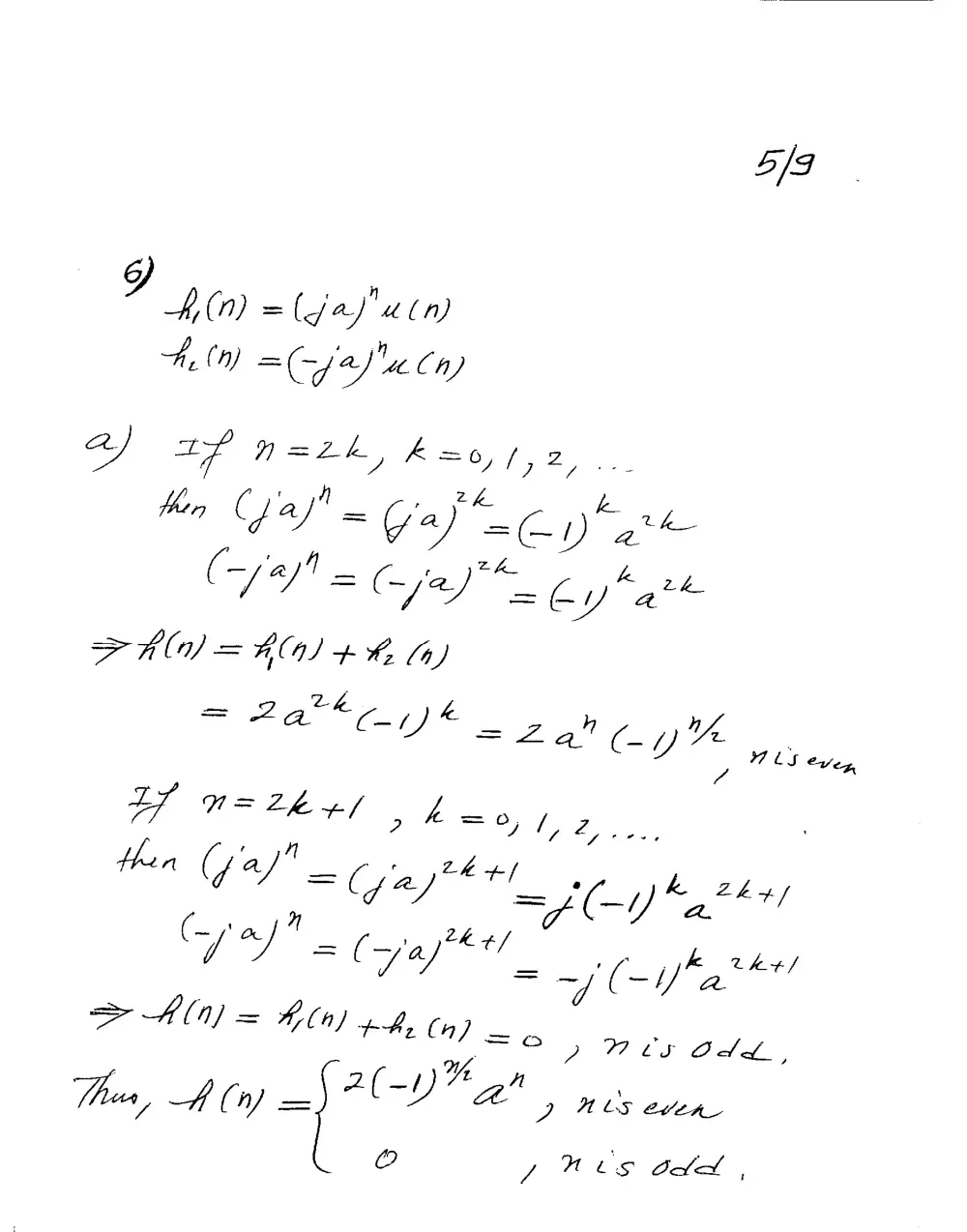
Problem # 6
Repeat Parts (a) and (b) in Problem 5 for the case where the systems impulse responses
are given by
h(n) = Ga)"u(n)
h,(n) = (-jay"u(n)
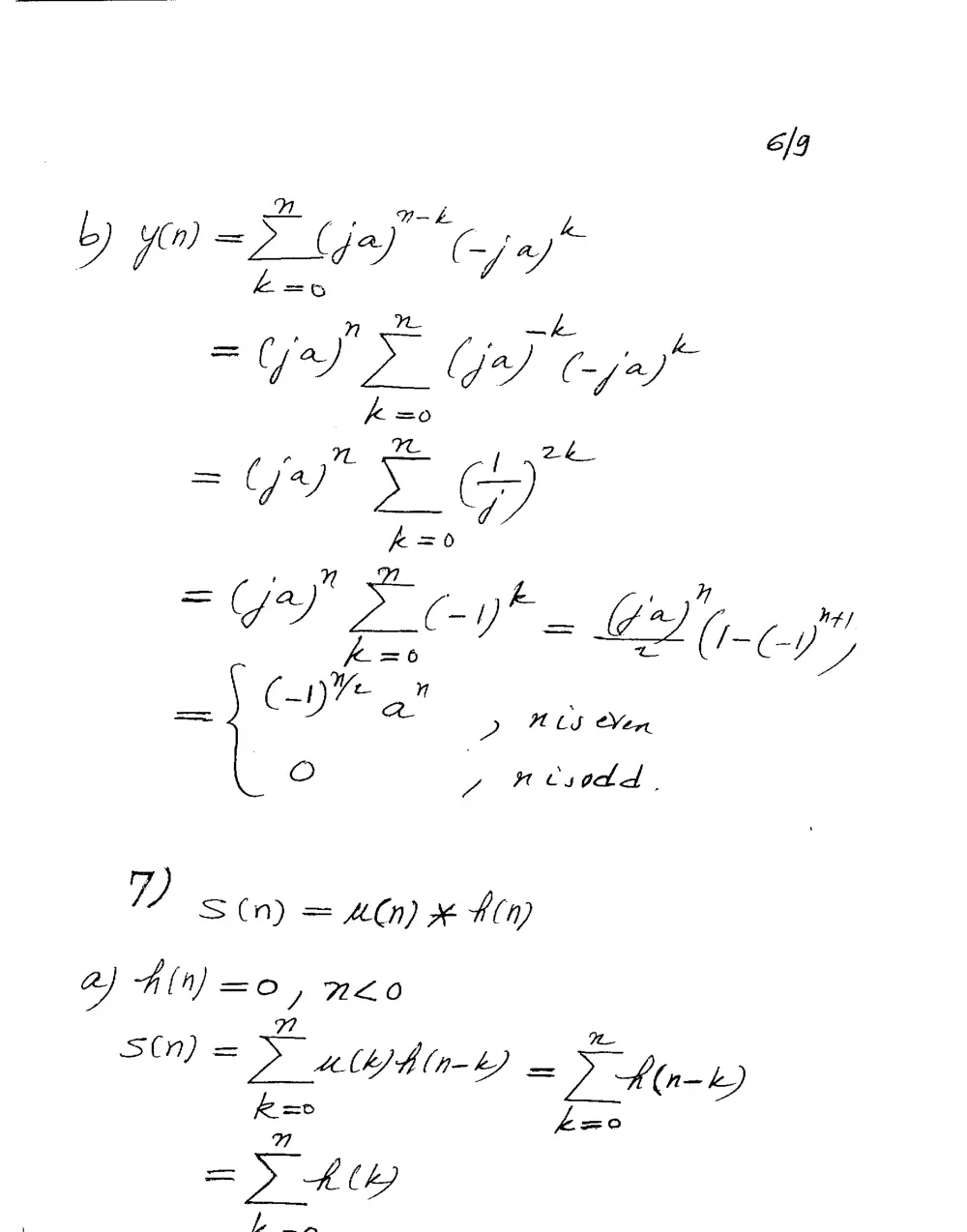
Problem #7
The unit step response for an LTI discrete-time system is given by
s(1) = u(n)* h(a)
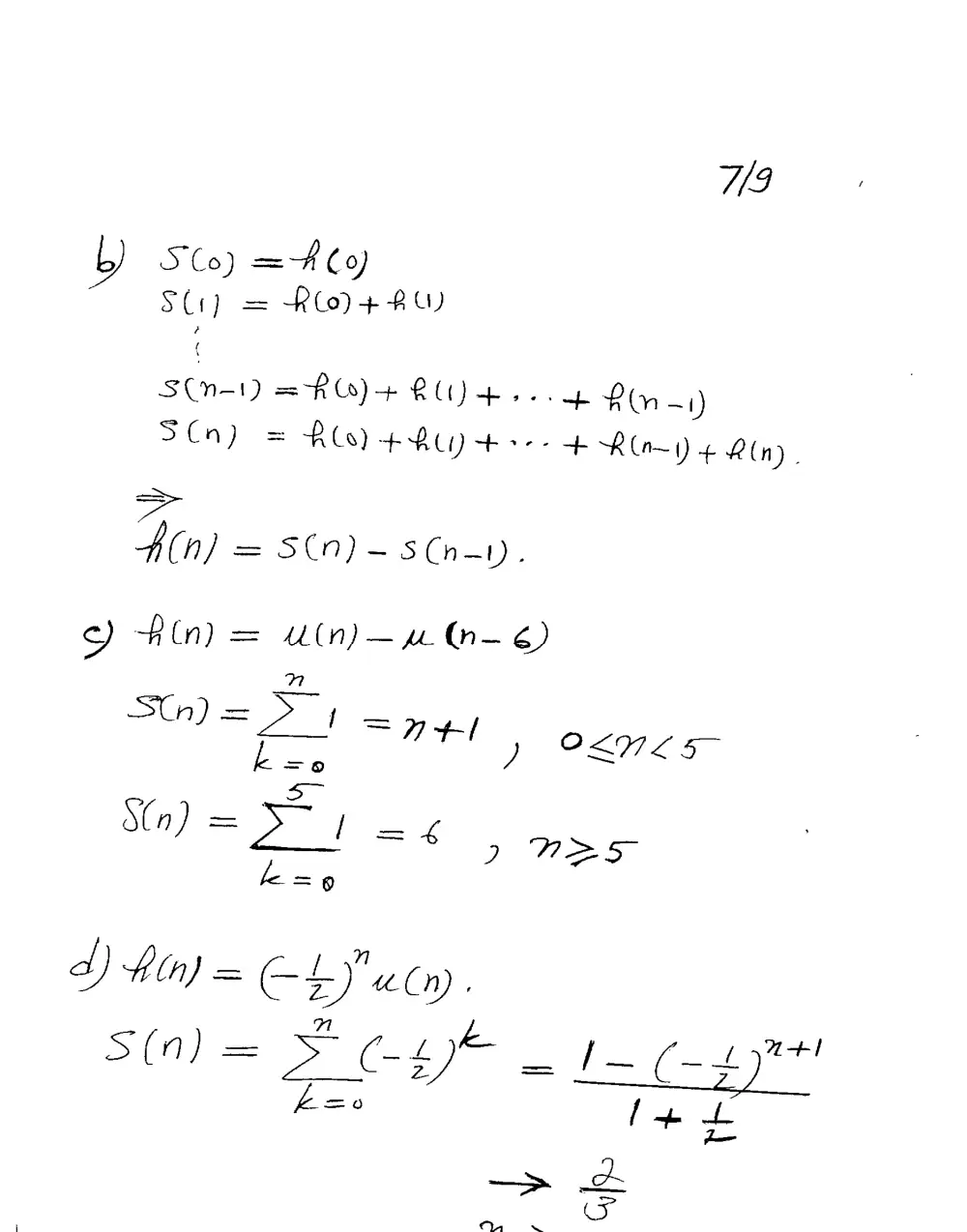
(a) Express s(n) for a causal system as a summation of h(n).
(b) Give the inverse relationship for A(n) in terms of s(n).
(c) Find s(n) if h(n) = u(1)-u(n-6).
(d) Find and sketch s(n) when h(n) =(-4)"u(n). Find lims(n).
Problem # 8
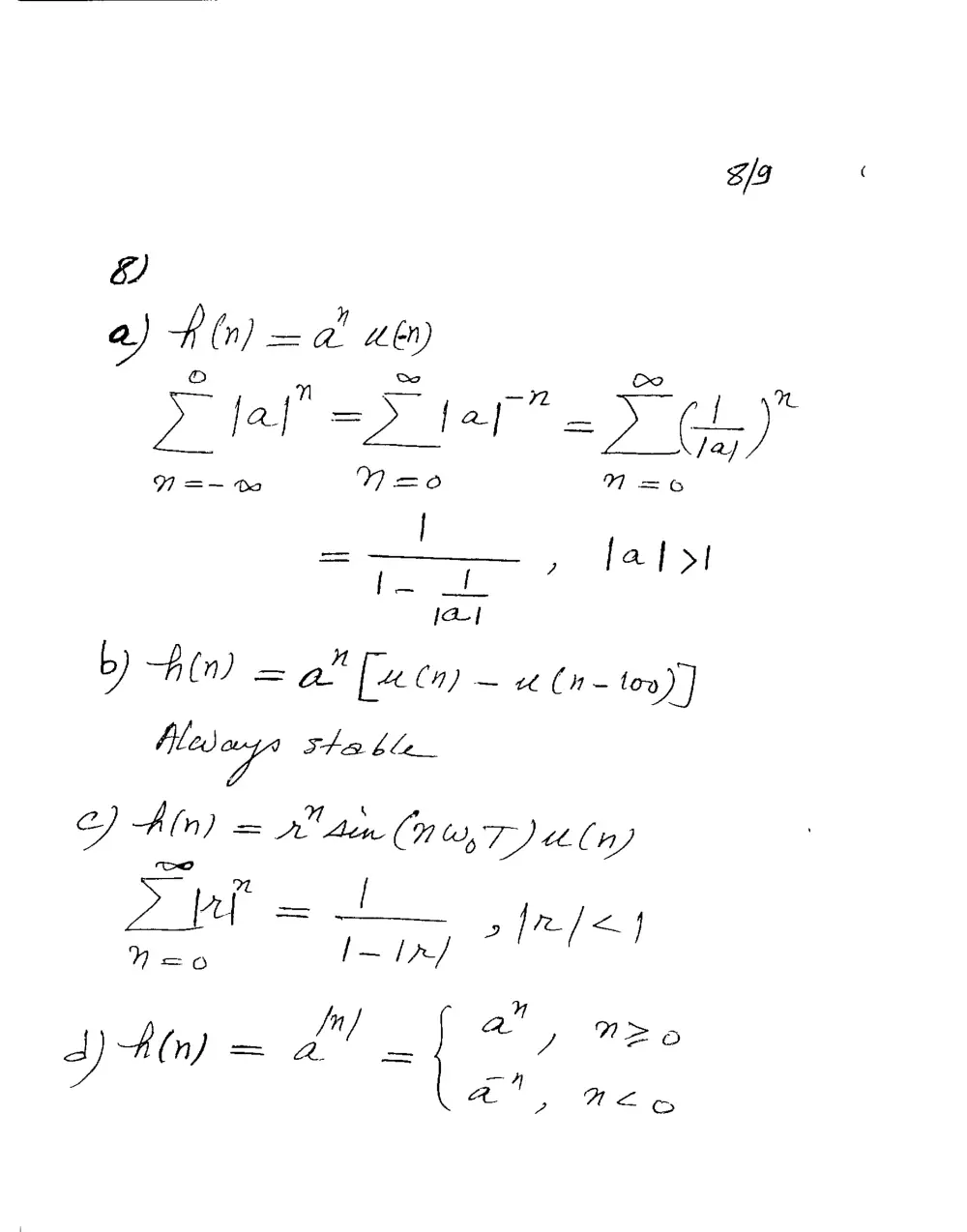
Determine the conditions on the parameters of the following systems for stability:
a) hA(n)=a"u(-n)
b) h(n) = a" [u(n) —u(n~100)]
c) A(n)=r" sin(na,T)u(n)
d) A(n)= al"
Page 2 of 2
0, 0 Herwrese—
NF ne Ne!
Hw) — s- 2 _ ( sJe7)”
n=o0 <—
_ yi =o , '
a fn VOUT ET EN)
/— ev MT a a = 2
ay wt ( ae
elu Vebe
cus Ot =)
_— te _QUNT —/
ae” Se ONY)
Ain WT
w HON) = 4h) — &h- €)
Ah) = 2” un)
HW <o ) y Chi =o
a onek J
O<n<5, Y(n)= 2 2 =a") a A
k=o L=o
/ a?!
__s
oo _—
"Zs 17 => alt _ "gr
Zao kmo
6
= Ce. —/ 4-S
vara
a /
p
for @ = 8) YO= ATT = orsia, ny
a C
Ji) =o, WMO.
&) 4 tn) = 4 (n)~ &€(n-~s)
h, CN) = 40h pu) — “n).
a) BN) = Fi Ch) +R CH)
“| 2 -4F¢RNZ 5S
Hh
_D __ _ —
n(n)= > |= nee , ~1<7<-!
ba-4
#(n) = > / — 4 a ON]
=-+
_I
Ainj= > | =-n4r, [<Neg
k=n-7
4ln)=o _ a a
4/9
7 0
5/9
9
“
7 “
;
1) .
°
oa
im 5
:
) - : ,
” :
tn : |
g
| ’
he :
(n) =
4
>
&
i)
hi
Zz
a.
pr
7/9
7) S'Co) = (0)
Sr) = Ro + RW)
s(n-1) =f Us) + RU) +--+ Pon ~1)
SCn) = RO) +2 4+-- + Rm) + Rin).
>
4(n) = Sn) ~ SCh-t).
S) A(n) = U(n)—~“(n- 6)
SO) =D 1 =a 4)
kL =o )
s
ke =6
OK £5
7 AES
J) Hh) = C4)'2cn)
“a
S(n) = (-4£ & _ /— (--L a+!
2/9
oy
ee
> a "=> Gb)"
9 =~. _ 7 =6
— ; fa}>l
[a]
b) A(n) = a [4207 ~ (ne tov) }
Medags Stable _
2) An) = Aten (2, F) et Cn)
2 bP = + pay,
Yeo /—/r/
y
A) #ln) = a =| “7 720