
EECE 340 Homework, Spring 2008
American University of Beirut · Signals and Systems · 9 pages





More EECE 340 files
- Homework 3 · Spring 2016HomeworkView
- Homework 1 Solution · Spring 2016Homework · with solutionView
- Homework 4 · Spring 2016HomeworkView
- Homework 3 Solution · Spring 2016Homework · with solutionView
- Homework 4 Solution · Spring 2016Homework · with solutionView
- Homework 1 · Spring 2016HomeworkView
- Homework 2 Solution · Spring 2016Homework · with solutionView
- Homework 2 · Spring 2016HomeworkView
Show the text of this homework
EECE 340-Signals and Systems
Homework #9
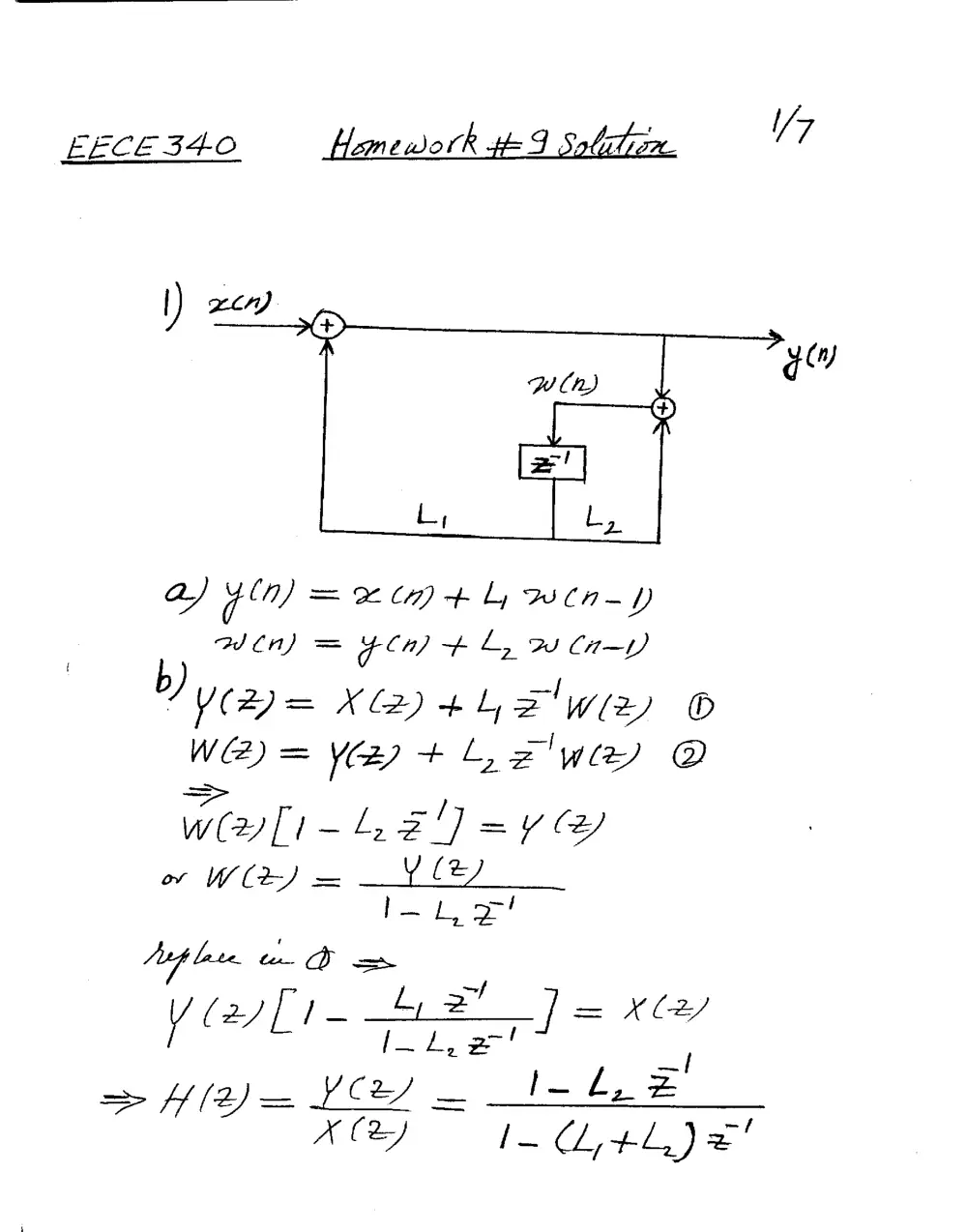
Problem #1
The block diagram of a discrete-time system is shown in the figure below.
x(n) y(n)
—+O) >
w(n)
-
z!
L; L2
a) Write the difference equations relating x(7), w()and y(n).
b) Find the transfer function, H(z), of the system by applying the Z-transform
to the equations determined in Part (a).
c) Plot the signal flow graph of the above block diagram.
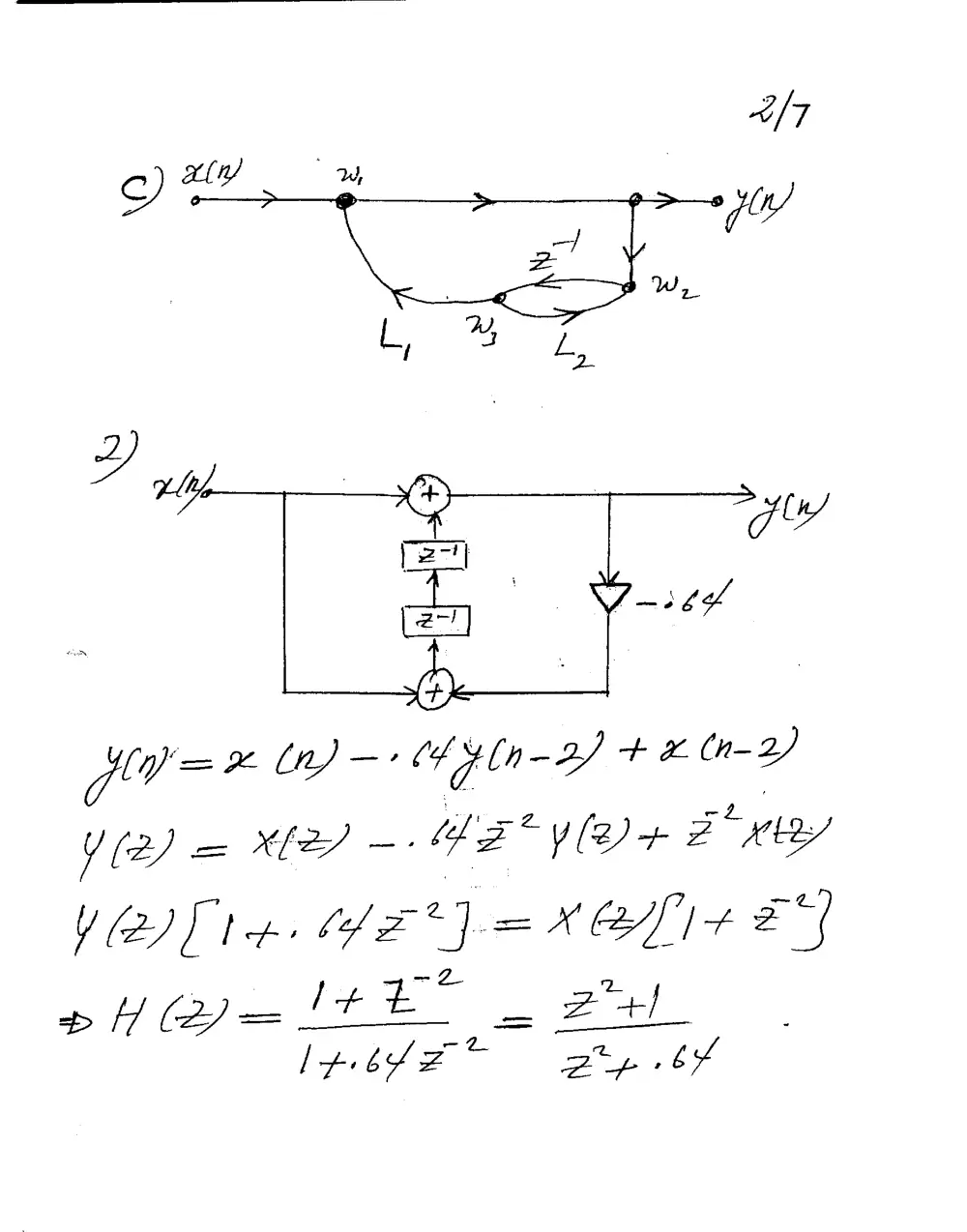
Problem # 2
The block diagram of a discrete-time system is shown in the figure below.
x(n) ~p y(n),
ry v -0.64
a) Determine the transfer function, H (z), of the system.
b) Determine the magnitude frequency responsre, |H(@)|, of the system using
the pole-zero plot of H (z).
Page 1 of 2
Problem # 3
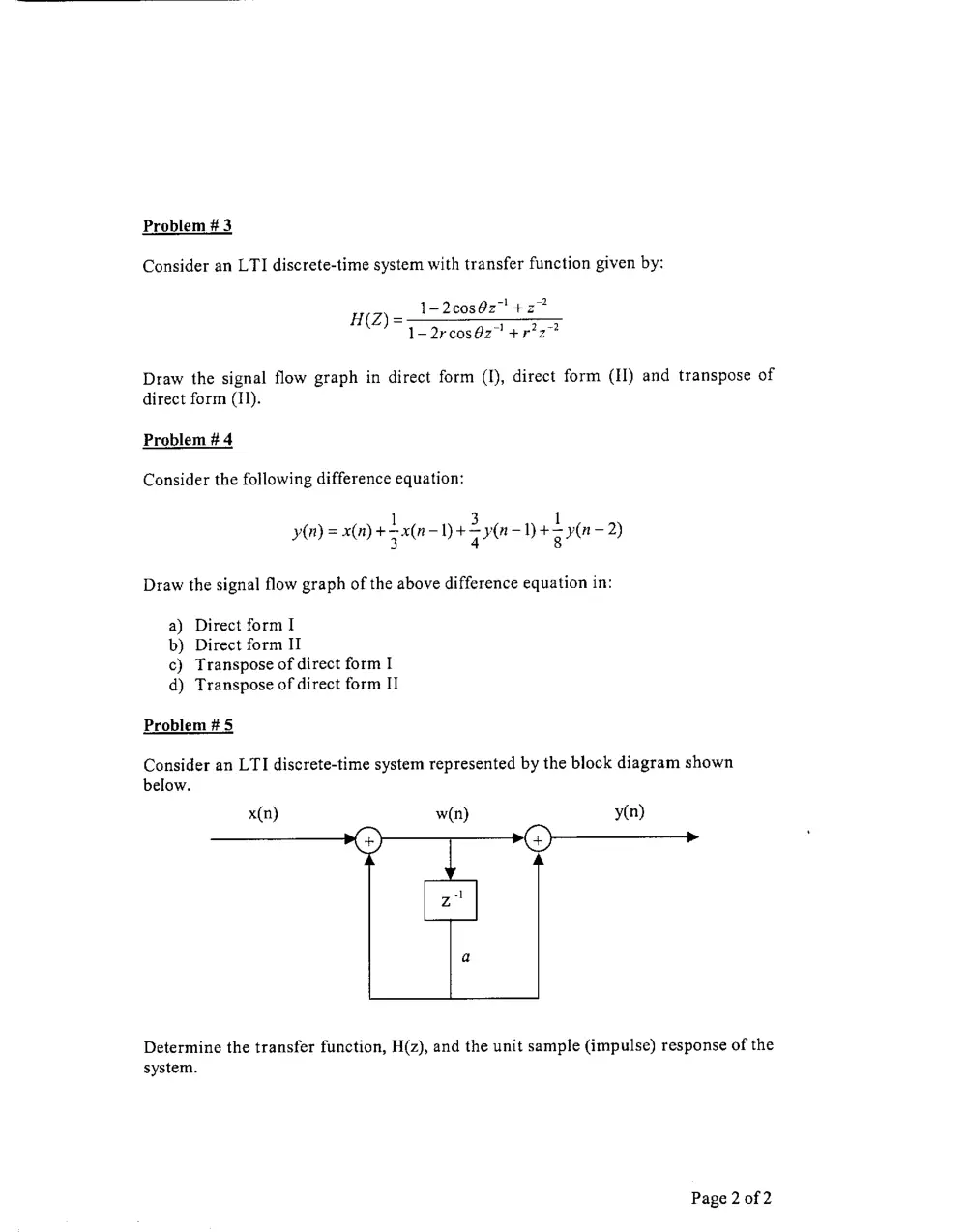
Consider an LTI discrete-time system with transfer function given by:
1-2cosOz! +z7
H(Z)=—_——
(2) 1-2rcos@z1+r?27
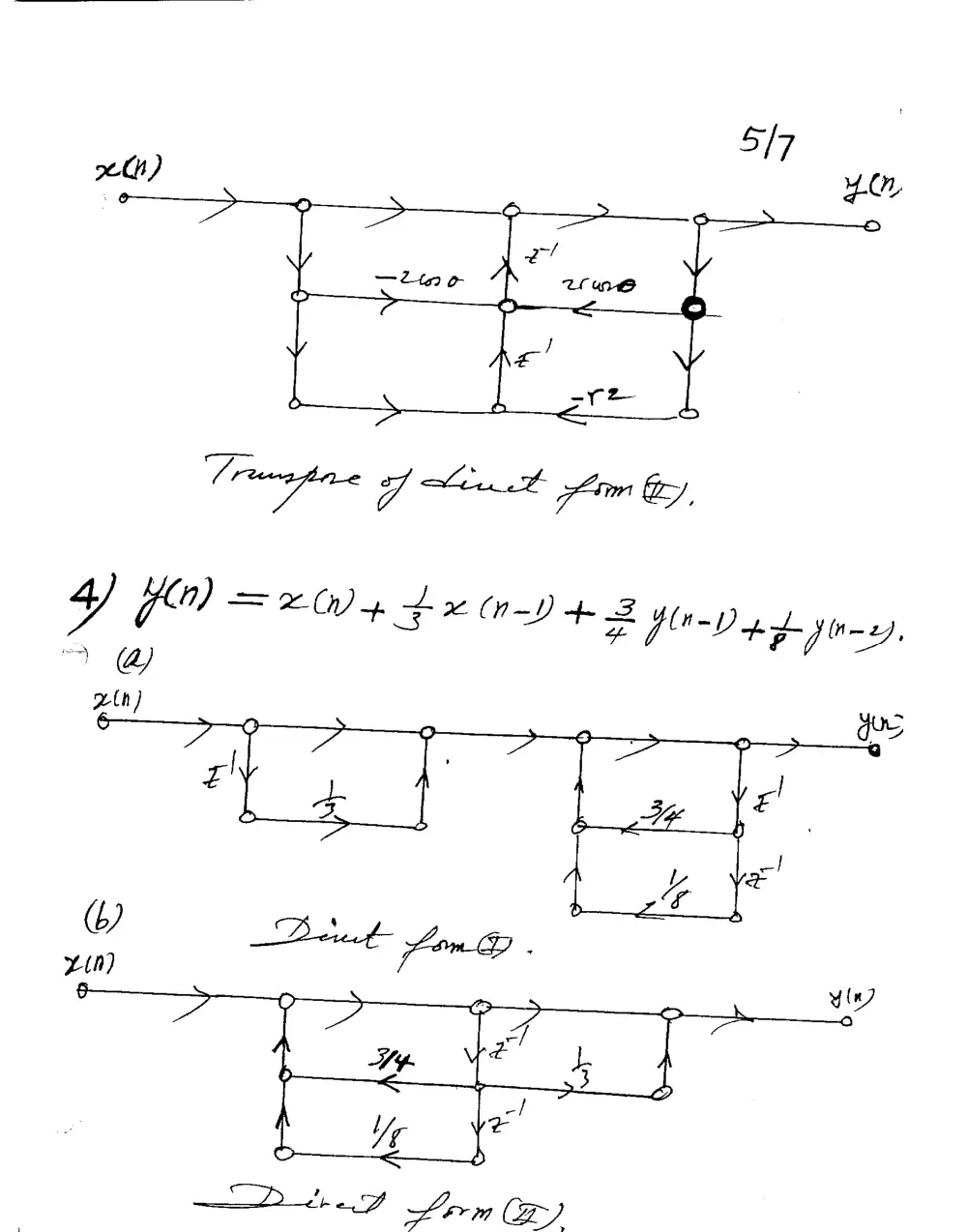
Draw the signal flow graph in direct form (I), direct form (II) and transpose of
direct form (II).
Problem # 4
Consider the following difference equation:
1 3 1
y(n) = x(n) +x -1) +79 -) ten -2)
Draw the signal flow graph of the above difference equation in:
a) Direct form I
b) Direct form II
c) Transpose of direct form I
d) Transpose of direct form II
Problem #5
Consider an LTI discrete-time system represented by the block diagram shown
below.
x(n) w(n) y(n)
Determine the transfer function, H(z), and the unit sample (impulse) response of the
system.
Page 2 of 2
; /
EECE 34-0 HenewotR #29 Soliton /7
i ge
jar! |
a) 7) =r iy+h WCA-~P)
Won) = 46) +4 L, w Cn—L)
Dz = Xj 4+hzZ'wiey ©
WE) = YX + L, 2! wl) @
=>
wwli-l.¢/] =v @
Ii, g@!
Hip lave a Dox
Ya)[1- 4 2 _] = x02
(L.L, 2°
=> WW (ey— VOY — !-4. =
AOQY 1 CL, +h)!
fl = x (n)—? Ap ln - 3) + & Or 2)
VY (2) = Le — aE yer 2 Key
PN I Ye = = x Ca) )4 F°S
; e*)
207g
Kah!
427]
Te
yz) l-20en
-2)
Cn
x
—-
~y
C70. (h
2p
(nh) —
pa
(1) =
>t
|) -- Cyiey)
-!
te cae Wn