
EECE 340 Homework, Spring 2008
American University of Beirut · Signals and Systems · 2 pages
More EECE 340 files
- Homework 3 · Spring 2016HomeworkView
- Homework 1 Solution · Spring 2016Homework · with solutionView
- Homework 4 · Spring 2016HomeworkView
- Homework 3 Solution · Spring 2016Homework · with solutionView
- Homework 4 Solution · Spring 2016Homework · with solutionView
- Homework 1 · Spring 2016HomeworkView
- Homework 2 Solution · Spring 2016Homework · with solutionView
- Homework 2 · Spring 2016HomeworkView
Show the text of this homework
American University of Beirut
Department of Electrical and Computer Engineering
EECE 440 Signals and Systems
Homework 1: Due Tuesday July 4, 2006
Part I
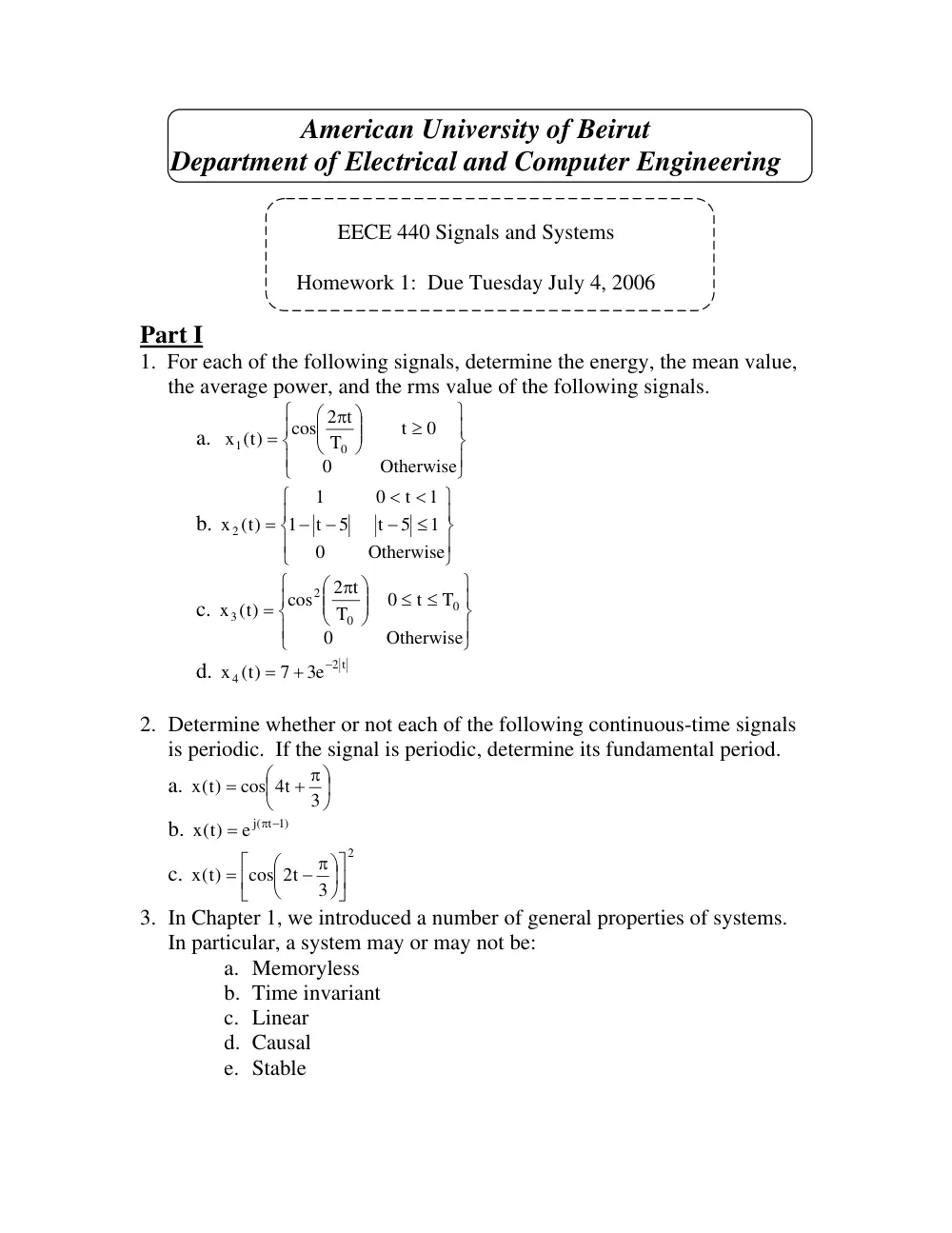
1. For each of the following signals, determine the energy, the mean value,
the average power, and the rms value of the following signals.
a.
⎪⎭
⎪⎬
⎫
⎪⎩
⎪⎨
⎧
≥
⎟⎟
⎠
⎞
⎜⎜
⎝
⎛ π
=
Otherwise
0
0
t
T
cos 2 t
)t(
x
0
1
b.
⎪⎭
⎪⎬
⎫
⎪⎩
⎪⎨
⎧
≤
−
−
−
<
<
=
Otherwise
0
1
5
t
5
t
1
1
t
0
1
x 2 )t(
c.
⎪⎭
⎪⎬
⎫
⎪⎩
⎪⎨
⎧
≤
≤
⎟⎟
⎠
⎞
⎜⎜
⎝
⎛ π
=
Otherwise
0
T
t
0
T
2 t
cos
)t(
x
0
0
2
3
d.
2 t
4
3e
7
)t(
x
−
+
=
2. Determine whether or not each of the following continuous-time signals
is periodic. If the signal is periodic, determine its fundamental period.
a.
⎟
⎠
⎞
⎜
⎝
⎛
+ π
=
3
cos 4t
x )t(
b.
)1
t
(je
)t(
x
π −
=
c.
2
3
cos 2t
x )t(
⎥⎦
⎤
⎢⎣
⎡
⎟
⎠
⎞
⎜
⎝
⎛
− π
=
3. In Chapter 1, we introduced a number of general properties of systems.
In particular, a system may or may not be:
a. Memoryless
b. Time invariant
c. Linear
d. Causal
e. Stable
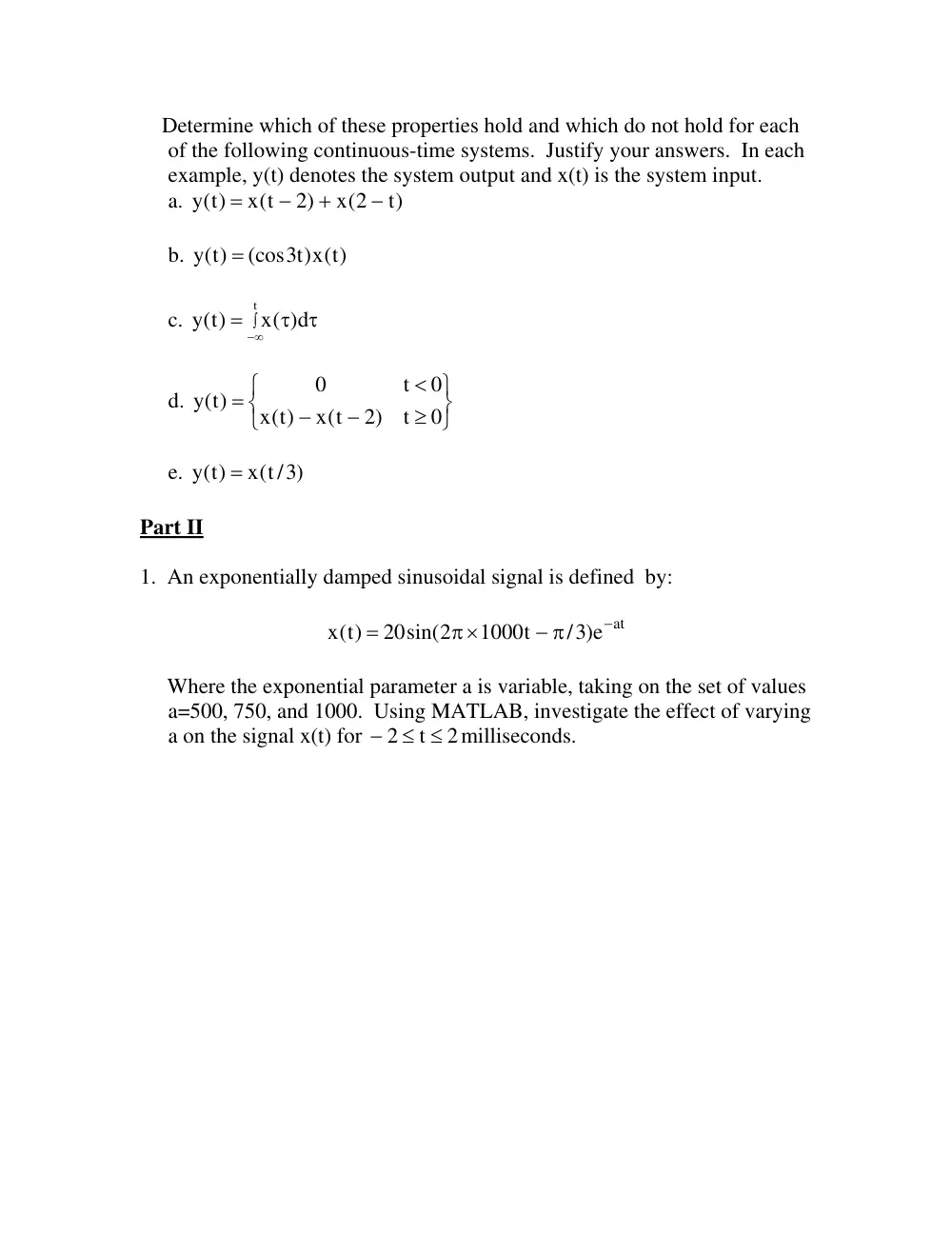
Determine which of these properties hold and which do not hold for each
of the following continuous-time systems. Justify your answers. In each
example, y(t) denotes the system output and x(t) is the system input.
a.
)t
x(2
2)
x t(
y )t(
−
+
−
=
b.
)t3 x )t(
(cos
y )t(
=
c.
∫
−∞
τ
τ
=
t
x( )d
y )t(
d.
⎭
⎬
⎫
⎩
⎨
⎧
≥
−
−
<
=
0
t
2)
x t(
x )t(
0
t
0
y )t(
e.
3)
/t(
x
y )t(
=
Part II
1. An exponentially damped sinusoidal signal is defined by:
at
/3 e)
1000t
20sin(2
)t(
x
−
− π
π×
=
Where the exponential parameter a is variable, taking on the set of values
a=500, 750, and 1000. Using MATLAB, investigate the effect of varying
a on the signal x(t) for
2
t
2
≤ ≤
−
milliseconds.