
EECE 340 Homework, Spring 2008
American University of Beirut · Signals and Systems · 4 pages

More EECE 340 files
- Homework 3 · Spring 2016HomeworkView
- Homework 1 Solution · Spring 2016Homework · with solutionView
- Homework 4 · Spring 2016HomeworkView
- Homework 3 Solution · Spring 2016Homework · with solutionView
- Homework 4 Solution · Spring 2016Homework · with solutionView
- Homework 1 · Spring 2016HomeworkView
- Homework 2 Solution · Spring 2016Homework · with solutionView
- Homework 2 · Spring 2016HomeworkView
Show the text of this homework
1
American University of Beirut
Department of Electrical and Computer Engineering
EECE 440 Signals and Systems
Homework 2: Due July 18, 2006
Part I
Problem 1
Consider a unity feedback linear time-invariant control system whose input is r(t) and
output is c(t). The forward transfer function of this system is given by:
4)
2)(S
S(S
)1
20(S
G(S)
+
+
+
=
Represent this system in a state variable form by determining the state equation and the
output equation.
Problem 2
The open-loop transfer function of a unity feedback control system is given by:
1
aS
4S
4S
S
2
)1
(S
A(S)
2
3
4
+
+
+
+
+
=
Determine the stability of the system (state the reason) for the following two cases when
a=0 and a=8.
Problem 3
The dynamic equations of a linear time-invariant system whose output is y(t) and input
r(t) are given by:
a. Determine the stability of the above system.
b. Determine the gains (f1, f2) of the input
[
]
⎥⎦
⎤
⎢⎣
⎡
=
)t(
X
)t(
f 2 X
f1
)t(r
2
1
in order to force the closed-loop system poles in the desired locations in the s-plane
(-5 and –3).
[
]
⎥⎦
⎤
⎢⎣
⎡
=
⎥⎦
⎤
⎢⎣
+ ⎡
⎥⎦
⎤
⎢⎣
⎡
⎥⎦
⎤
⎢⎣
= ⎡−
⎥⎦
⎤
⎢⎣
⎡
′
′
)t(
X
)t(
1 1 X
t(r ), y )t(
1
1
)t(
X
)t(
X
0
2
2
1
)t(
X
)t(
X
2
1
2
1
2
1
2
Problem 4
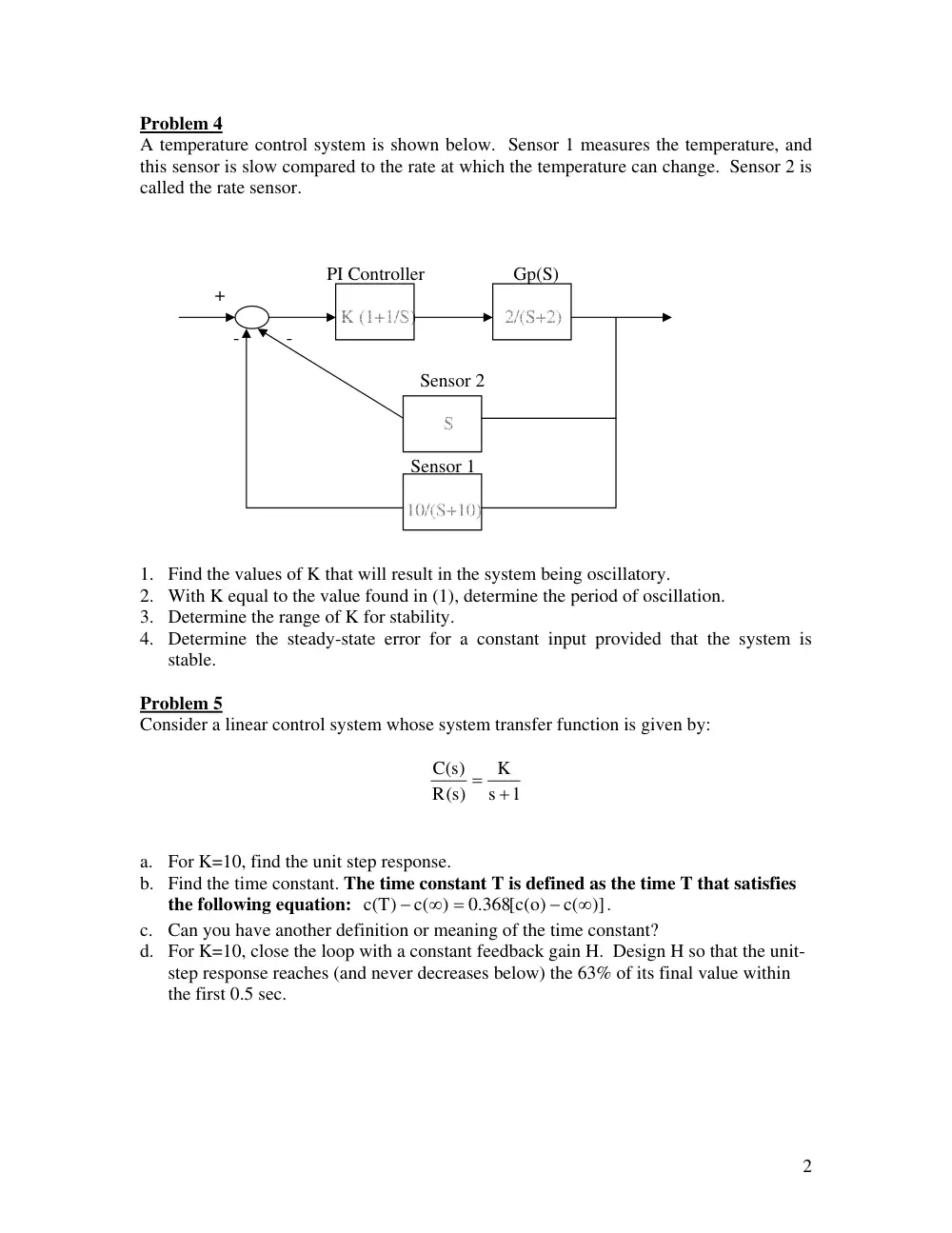
A temperature control system is shown below. Sensor 1 measures the temperature, and
this sensor is slow compared to the rate at which the temperature can change. Sensor 2 is
called the rate sensor.
PI Controller Gp(S)
+
K (1+1/S) 2/(S+2)
- -
Sensor 2
S
Sensor 1
10/(S+10)
1. Find the values of K that will result in the system being oscillatory.
2. With K equal to the value found in (1), determine the period of oscillation.
3. Determine the range of K for stability.
4. Determine the steady-state error for a constant input provided that the system is
stable.
Problem 5
Consider a linear control system whose system transfer function is given by:
1
s
K
R )s(
C )s(
+
=
a. For K=10, find the unit step response.
b. Find the time constant. The time constant T is defined as the time T that satisfies
the following equation:
)]
(c
o)
.0 368 (c[
)
(c
(c T)
∞
−
∞ =
−
.
c. Can you have another definition or meaning of the time constant?
d. For K=10, close the loop with a constant feedback gain H. Design H so that the unit-
step response reaches (and never decreases below) the 63% of its final value within
the first 0.5 sec.
3
Problem 6
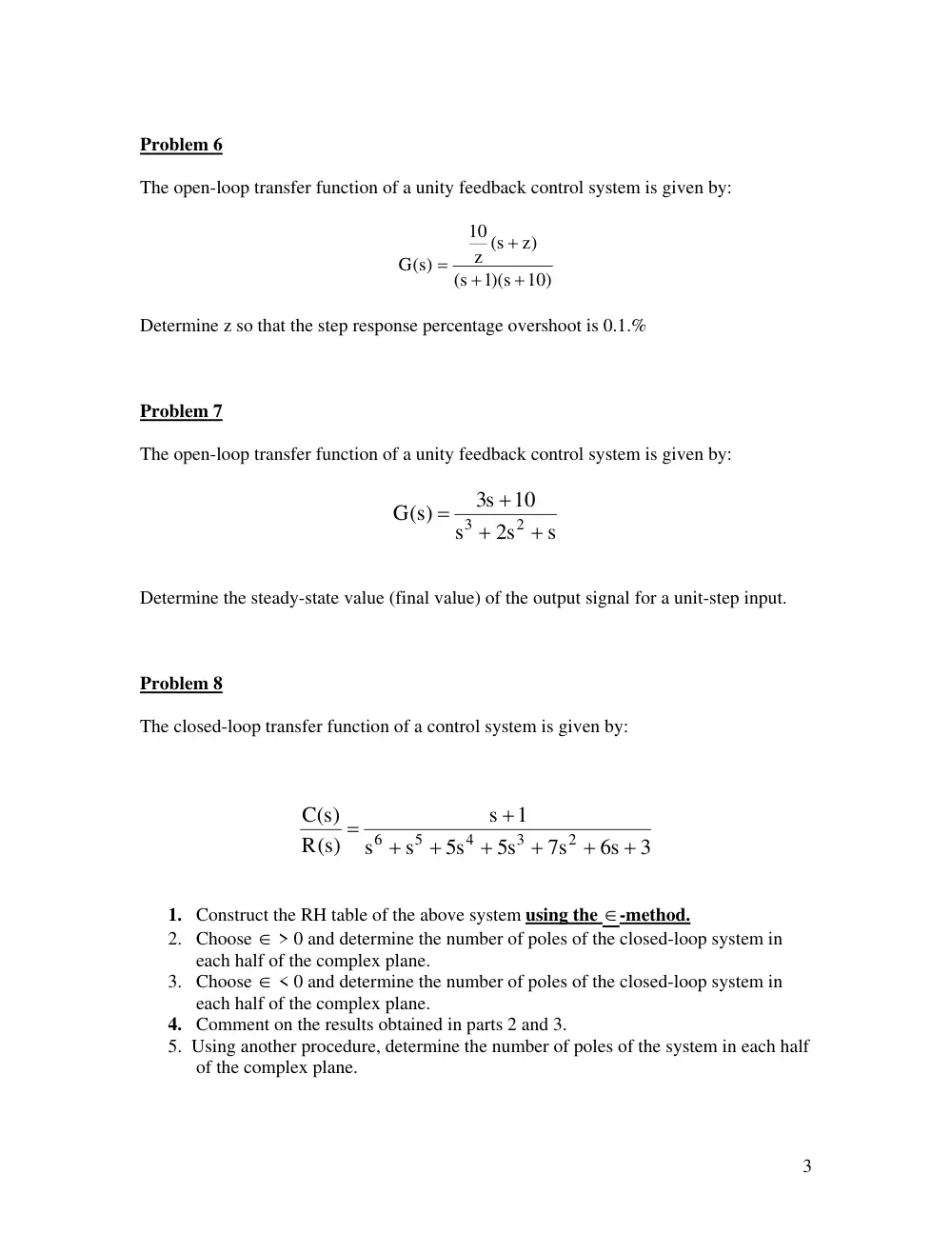
The open-loop transfer function of a unity feedback control system is given by:
10)
1)(s
s(
z)
z s(
10
G )s(
+
+
+
=
Determine z so that the step response percentage overshoot is 0.1.%
Problem 7
The open-loop transfer function of a unity feedback control system is given by:
s
2s
s
10
3s
)s(
G
2
3
+
+
+
=
Determine the steady-state value (final value) of the output signal for a unit-step input.
Problem 8
The closed-loop transfer function of a control system is given by:
3
6s
7s
5s
5s
s
s
1
s
)s(
R
)s(
C
2
3
4
5
6
+
+
+
+
+
+
+
=
1. Construct the RH table of the above system using the ∈-method.
2. Choose ∈ > 0 and determine the number of poles of the closed-loop system in
each half of the complex plane.
3. Choose ∈ < 0 and determine the number of poles of the closed-loop system in
each half of the complex plane.
4. Comment on the results obtained in parts 2 and 3.
5. Using another procedure, determine the number of poles of the system in each half
of the complex plane.
4
Part 2: Matlab Project
1. Stability using MATLAB.
You are requested to determine a procedure to check on the stability of a LTI
continuous using MATLAB. Give procedure and a minimum of two examples.
2. State Variable Analysis using MATLAB.
Determine a MATLAB procedure for representing a system defined by its transfer
function in a State-variable representation. Give a minimum of two examples.