
EECE 340 Homework, Spring 2008
American University of Beirut · Signals and Systems · 7 pages


More EECE 340 files
- Homework 3 · Spring 2016HomeworkView
- Homework 1 Solution · Spring 2016Homework · with solutionView
- Homework 4 · Spring 2016HomeworkView
- Homework 3 Solution · Spring 2016Homework · with solutionView
- Homework 4 Solution · Spring 2016Homework · with solutionView
- Homework 1 · Spring 2016HomeworkView
- Homework 2 Solution · Spring 2016Homework · with solutionView
- Homework 2 · Spring 2016HomeworkView
Show the text of this homework
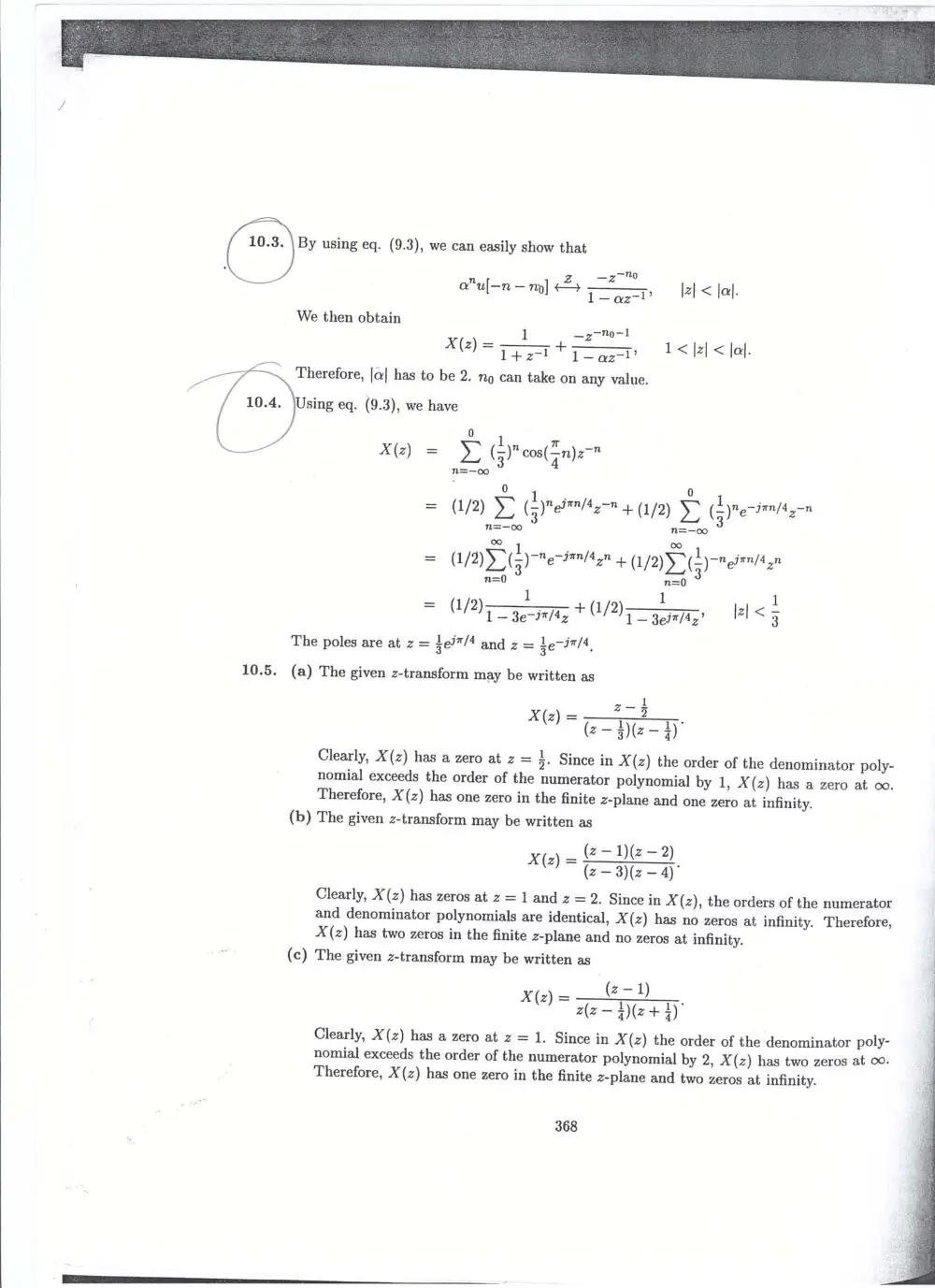
By using eq. (9.3), we can easily show that
n. z agent
a™ul—n — ny] > Troan? lzl < Jal.
We then obtain
1 —z7no-1
Tet tToaer 1 <A <lel-
Therefore, |a| has to be 2. ng can take on any value.
A (z=
Using eq. (9.3), we have
Xe X(z) = > (5)" cos(Zn)e-”
: 7 ;
= (1/2) > (Gye + (1/2) > (Gyevntan
n=—00 n=—co
= UDG Med Mteh + (1/2) “(Rm n
n=0
n=0
1 1 1
= (1/2); ~Besay t (1/2)z — 3ei7/4z’ lal < 3
The poles are at z = 4e/7/4 and z = fe I7/4,
10.5. (a) The given z-transform may be written as
z
(2)= .
Clearly, X(z) has a zero at z = 3: Since in X (z) the order of the denominator poly-
nomial exceeds the order of the numerator polynomial by 1, X(z) has a zero at oo.
Therefore, X(z) has one zero in the finite z-plane and one zero at infinity.
(b) The given z-transform may be written as
(z — 1)(z — 2)
(z — 3)(z — 4)"
Clearly, X(z) has zeros at z = 1 and z = 2. Since in X (z), the orders of the numerator
and denominator polynomials are identical, X(z) has no zeros at infinity. Therefore,
X(z) has two zeros in the finite 2-plane and no zeros at infinity.
(c) The given z-transform may be written as
X(z) =
(z-1)
2(z—- H(z + ) :
Clearly, X(z) has a zero at z = 1. Since in X (z) the order of the denominator poly-
nomial exceeds the order of the numerator polynomial by 2, X(z) has two zeros at 00.
Therefore, X(z) has one zero in the finite z-plane and two zeros at infinity.
X(z) =
368
ow
(c) From Section 10.4, we know that the magi
expressed as
nitude of the Fourier transform may
[Hye™)| = (Length of 2)?
3 (Length of 03) (Length of v3)’
where vj, vj, and v3 are as shown in the figure above.
Clearly, for small value
w (w near zero),
and for values of w near 7 the numerator of the right-hand sid
the above equation is almost the same as the denominator.
But when |w| is ;
m/2, the numerator of the right-hand side of the above equatio:
nm is much larger t
the denominator. Therefore, Hj (e”) is large near w =
in = 1/2. Therefore, Hy(e%
Z \ approximately bandpass.
10.13. (a) The signal g[n] is
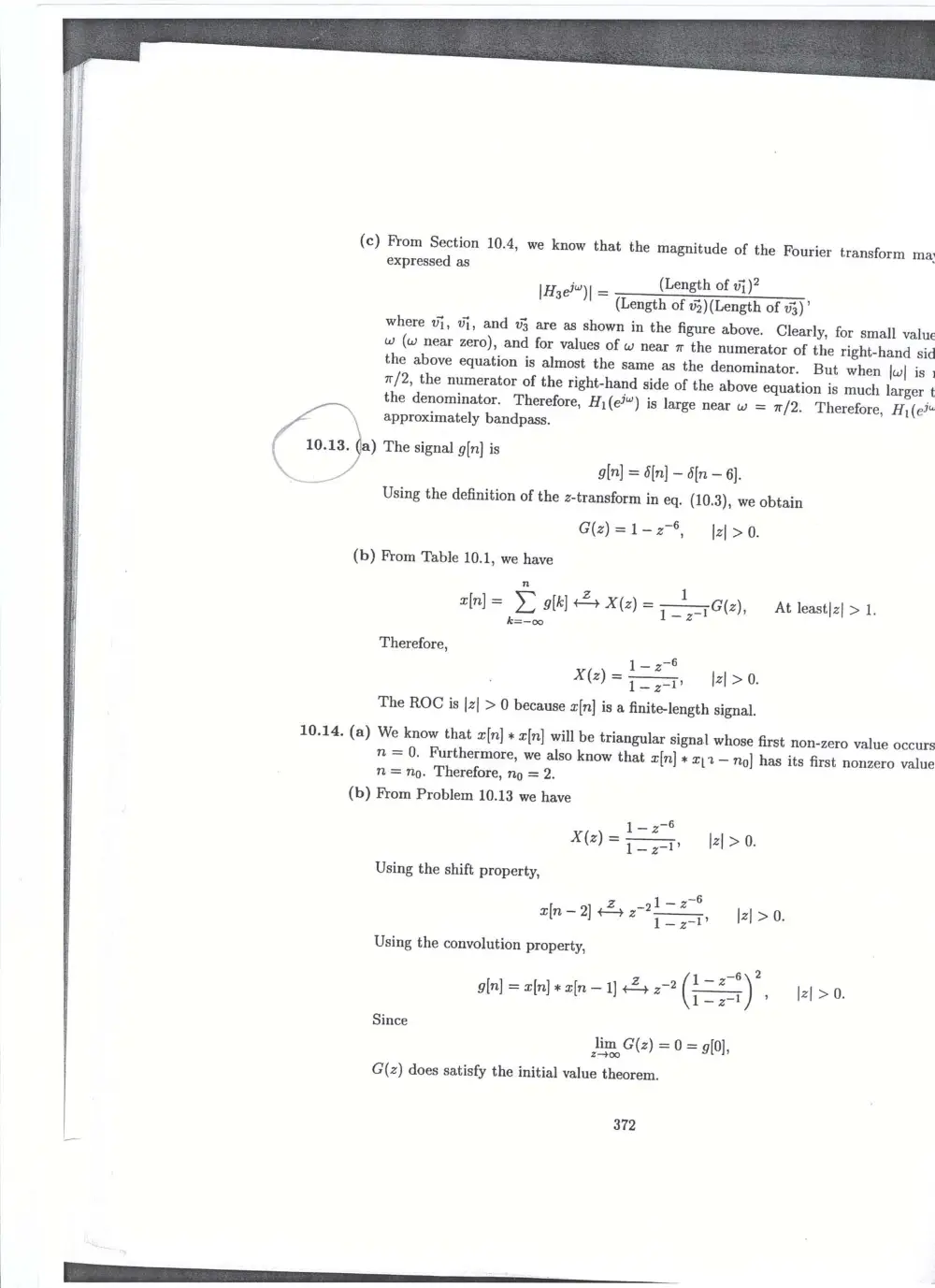
4 g[n] = 6[n] - d[n — 6}.
Using the definition of the z-transform in eq. (10.3), we obtain
G(z)=1-27%, [al >0.
(b) From Table 10.1, we have
n
a[n] = S> gfk] 4 x(z) =
k=-00
Tz pi G (2); At least|z| > 1.
Therefore,
X@)== flo
2) = s
The ROC is |z| > 0 because 2[n] is a finite-length signal.
10.14. (a) We know that z[n] + x[n] will be triangular signal whose first non-zero value occurs
n= 0. Furthermore, we also know that a(n] * 1,2 — no] has its first nonzero value
n= ng. Therefore, no = 2.
(b) From Problem 10.13 we have
1-276
X(e) = >, |z| > 0.
Using the shift property,
_ 2-6
a[n — 2] 25 2-21 ad
Using the convolution property,
—z78\?
g{n] = 2[n] * x[n — 1] Ay? (; ==) s fal >0.
Since
lim G(z) = 0 = g(0],
2-400
G(z) does satisfy the initial value theorem.
372
10.15. Taking the z-transform of y[{n], we have
1 1
Y@)= Tal >
Now from Table 10.1, we have
nbo}=aaind={ Hh PEI 2a yey =VE), bal>
, n# 2r
Therefore,
vil] =1, wll] =0, mf) = 5, nl) =0, mld) = 2.
This may be written as
uate) = 5] (5) wind + (aye (3) ut.
If we now choose x(n] to be 3 {(4)” un], then
Yi(2) = ¥(2*) = (1/2)[X(2) + X(-2)}, fal > 5.
Furthermore, since X(z) has only one pole and one zero, this choice of x[n] satisfies both
the given conditions.
We may also choose x{n] to be 4 [(-1)" (1)” u{n]]. This would still satisfy both given
conditions.
For a system to be both causal and stable, the corresponding z-transform must not have
any poles outside the unit circle.
(a) The given z-transform has a pole at infinity. Therefore, it is not causal.
(b) The poles of this z-transform are at z = } and z= -}. Therefore, it is causal.
(c) This z-transform has a pole at -4. Therefore, it is not causal.
9.17. (a) Since lim,,o = 1, H(z) has no poles at infinity. Furthermore, since h[n] is given to be
right-sided, h[n] has to be causal.
(b) Since Afn] is causal, the numerator and denominator polynomials of H(z) have the
same order. Since H(z) is given to have two zeros, we may conclude that it also has
two poles.
Since h{n] is real, the poles must occur in conjugate pairs. Also, it is given that one
of the poles lies on the circle defined by |z| = 3. Therefore, the other pole also lies on
the same circle.
Clearly, the ROC for H(z) will be of the form |z| > 3. and will include the unit
circle. Therefore, we may conclude that the system is stable.
373
X(z)= 2
{ w ke may be rewritten as
/ (2- 5)(z-1))
Using partial fraction expansion, we may rewrite this as
X(z) = 22 |- 1 + |
z~z z-1
z z
~ [p+]
If z[n] is right-sided, then the ROC for this signal is |z| > 1. Using this fact, we may
find the inverse z-transform of the term within square brackets above to be yln] =
—(1/2)"ufn] + u[n]. Note that X(z) = 2zX(z). Therefore, a[n] = 2y[n + 1]. This gives
a[n] = -2 (5) um 1] + 2ujn + 1).
Noting that [—1] = 0, we may rewrite this as
zn] = — (5) wm + 2u[n].
This is the answer that we obtained in part (a).
f 10.26. (a) From part (b) of the previous problem,
2
2
X(z) = ——___.
"Gea
(b) From part (b) of the previous problem,
x)= 22. — 2 |
z-3 62-1
(c) If z{n] is left-sided, then the ROC for this signal is |z| < 1/2. Using this fact, we may
find the inverse z-transform of the term within Square brackets above to be y[n] =
(1/2)"u[—n — 1] — u[-n — 1]. Note that X(z) = 2zX(z). Therefore, z[n] = 2y[n + 1).
This gives
a{n] =2 G)" uf—n ~ 2} — 2u{—n — 2}.
27. We perform long-division on X(z) so as to obtain a right-sided sequence. This gives us
X(z) = 23 4427 4524...,
Therefore, comparing this with eq. (10.3) we get
z[-3]=1, a[-2] =4, 2(-1) = 5,
and z{n] = 0 for n < —3.
Then,
z{n]=0, forn<-t,
a{-1] = 2/3 - 2/3 =0,
g[n]}=0, forn>0.
It follows that 2[n] = 4{n]. It can similarly be shown that ho[n] and h(n} satisfy the
difference equation.
10.36. Taking the z-transform of both sides of the given difference equation and simplifying, we
get
_Y(@) _ 1 _ zt
H(z) = X@ 2t-@4z2 1-2 $272
The partial fraction expansion of H (z) is
3/8
—i,z-1
1-32
3/8
H(z) =- Toast
+
Since H(z) corresponds to a stable system, the ROC has to be (1/3) < |z| <3. Therefore,
3 (1\" 3 an
h[n] = 3 G) u{n] — 3°) u[—n — 1].
10.37. (a) The block-diagram may be redrawn as shown in part (a) of the figure below. This may
be treated as a cascade of the two systems shown within the dotted lines in Figure
$10.37. These two systems may be interchanged as shown in part (b) of the figure
Figure $10.37 without changing the system function of the overall system. From the
figure below, it is clear-that—— ~—
- % a
vn) =e) pete ~~ dyn — 11+ Sulr — 2)
ray
4 <4 L
389 . vy
\ Ay A 4
\ 3%
(b) Taking the z-transform of the above difference equation and simplifying, we get
_ ¥(z) _ 1+ 2-1 1+ g2-1
AH = = .
(2) X(z) 14+ 42-1- gz-2 (1+ 22-1)\(1— 4271)
H(z) has poles at z = 1/3 and z= —2/3. Since the system is causal, the ROC has t
be |z| > 2/3. The ROC includes the unit circle and hence the system is stable.
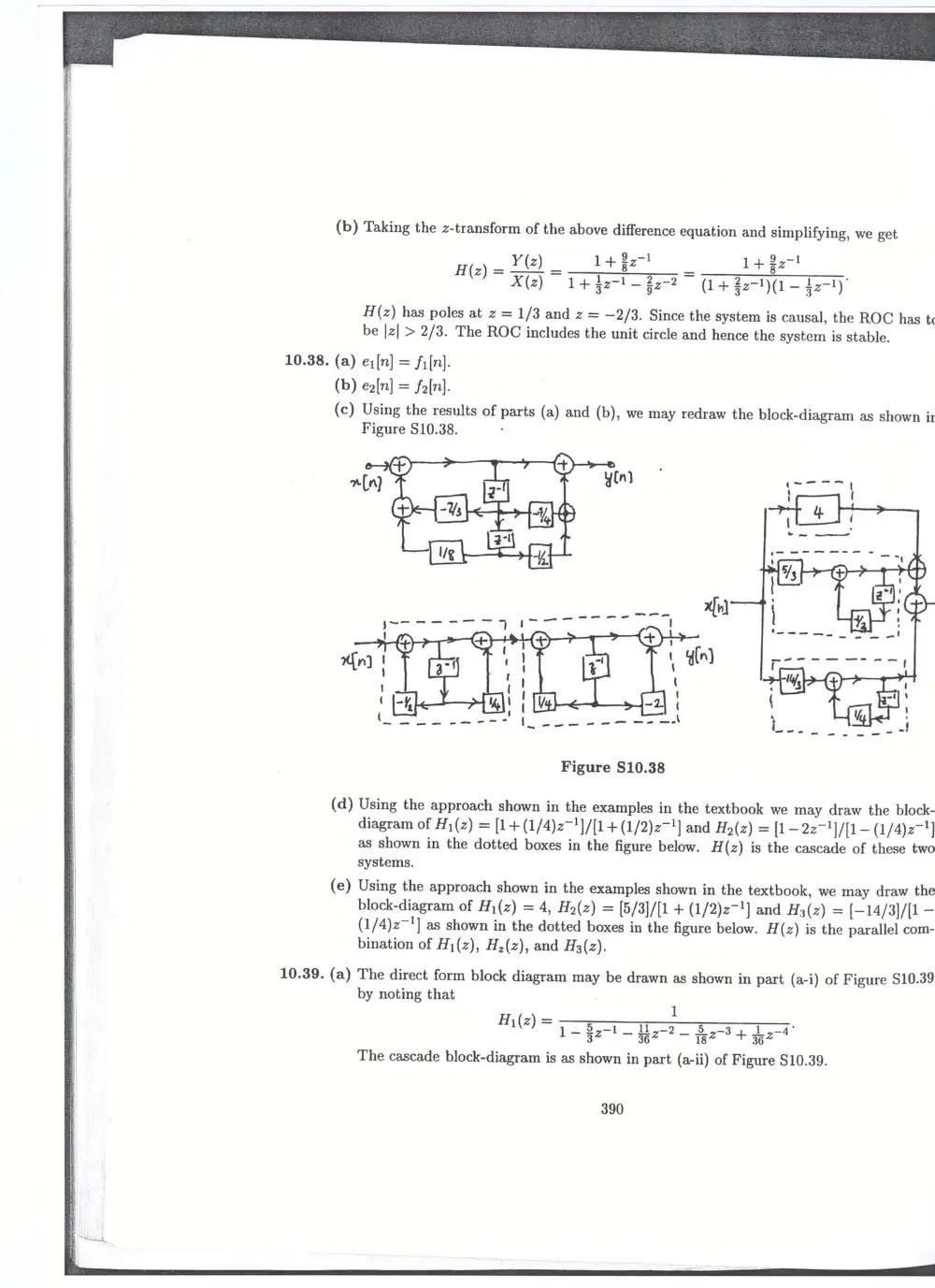
10.38. (a) e:[n] = f,[n].
(b) e2[n] = fo[n].
(c) Using the results of parts (a) and (b), we may redraw the block-diagram as shown ir
Figure $10.38.
Figure $10.38
(d) Using the approach shown in the examples in the textbook we may draw the block-
diagram of Hy(z) = [1+ (1/4)27"]/[1+ (1/2)2z71] and Ho(z) = [1—227Y/[1 — (1/4) 274]
as shown in the dotted boxes in the figure below. H(z) is the cascade of these two
systems.
(e) Using the approach shown in the examples shown in the textbook, we may draw the
block-diagram of Hi(z) = 4, Ho(z) = (5/3]/{1 + (1/2)z~4] and H(z) = [-14/3]/(1 —
(1/4)z~'] as shown in the dotted boxes in the figure below. H(z) is the parallel com-
bination of H(z), H,(z), and H3(z).
10.39. (a) The direct form block diagram may be drawn as shown in part (a-i) of Figure $10.39
by noting that
1
Ay(z) = .
(2) 1- 32-1 - ie? = ye3 + ae4
The cascade block-diagram is as shown in part (a-ii) of Figure $10.39.
390
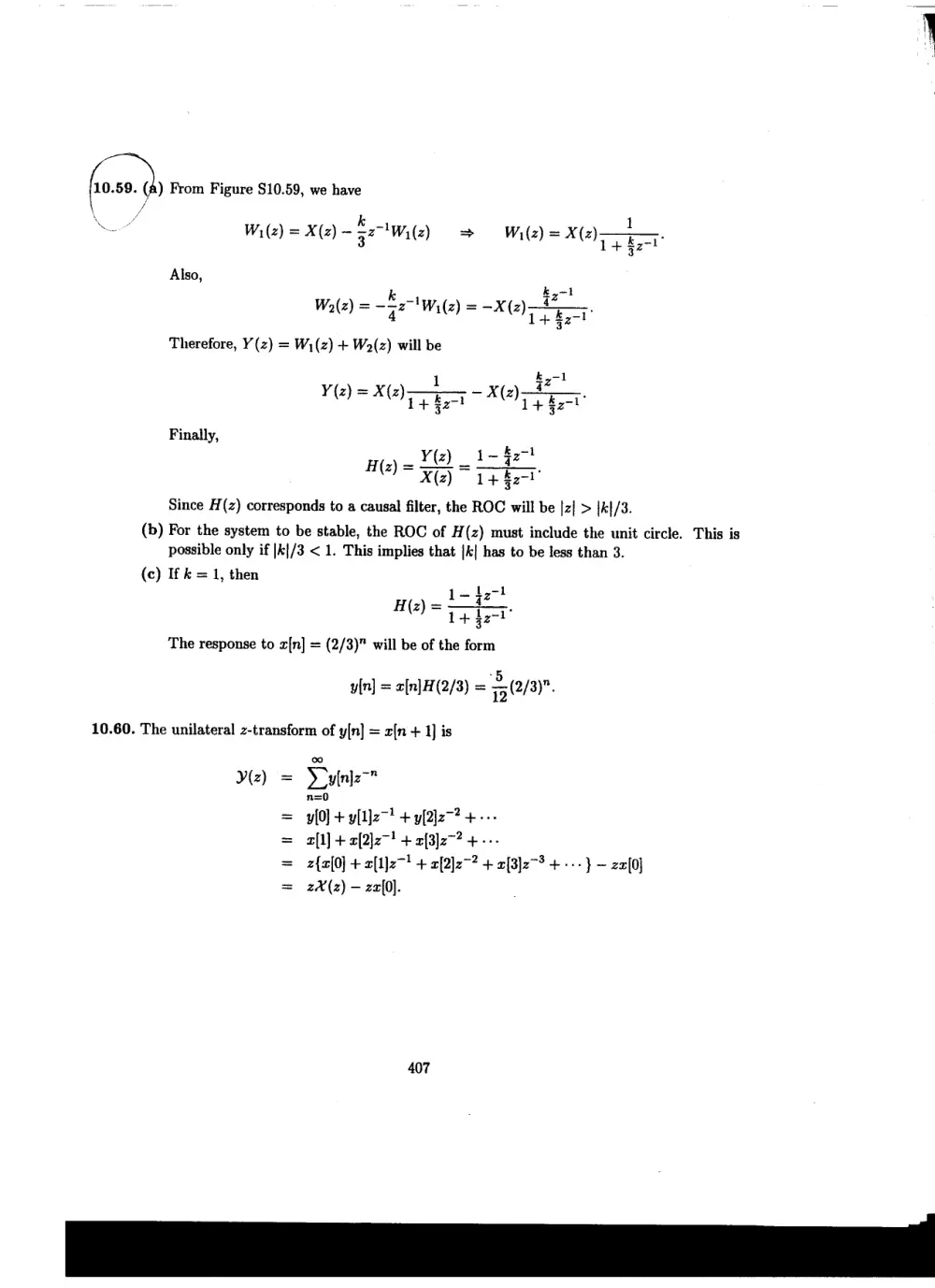
10.59. (a) From Figure $10.59, we have
)
NL Wi (z) = X(z) - $21Wi(2) => W,(z) = X(z) !
1+ gl
Also,
koa fac!
W2(z) = —qe M(z) = AQT
Therefore, Y(z) = Wi(z) + Wo(z) will be
1 ae
Y(z) =X -X .
@= XOT Ea OK Ea
Finally,
Y(z)_ 1-271
A(z) = = 4
X(z) 14 E,-V
Since H(z) corresponds to a causal filter, the ROC will be |z| > |k{/3.
(b) For the system to be stable, the ROC of H(z) must include the unit circle. This is
possible only if |k|/3 < 1. This implies that || has to be less than 3.
(c) If k = 1, then
1—}2-1
1+ 4271 :
The response to z[n] = (2/3)" will be of the form
A(z) =
vin] = a[n]H (2/3) = (2/3)".
10.60. The unilateral z-transform of y[n] = z[n + 1] is
Yvinje-*
n=0
= ylO] + yllJz7 + yldjz-? + ---
= a[l)+2[2]z7! + 2[3]2-? +---
= 2{x[0] + 2[1Jz7! + 2[2]z~? + 2[3]z79 +. ---} — 2x0}
= 2X(z) — zz([0].
Y(z)
407