
EECE 433 Syllabus, Spring 2012
American University of Beirut · Database Systems · 5 pages · Dr. Hazem Hajj

More EECE 433 files
- Problems Chapter 3 · Spring 2012ChapterView
- Chapter 8 · Spring 2012ChapterView
- Notes Asp.net Tutorial · Spring 2012FileView
- Notes · Spring 2012NotesView
- Problems Chapter 1 & 2 · Spring 2012ChapterView
- Problems Chapter 5 · Spring 2012ChapterView
- Useful File Solution Manual · Spring 2012File · with solutionView
- Problems Chapter 6 Handout · Spring 2012ChapterView
Show the text of this lab
Department of Electrical and Computer Engineering
Faculty of Engineering and Architecture
American University of Beirut
Course Information
Course title: Database Systems
Course number: EECE 433
Instructor:
Dr. Hazem Hajj
Class I:
Sessions: 20303 and 20304;
Class Times: T-TR 11:00 – 12:15 PM; Bechtel 403
LAB Times: 2:00- 4:45 PM; Tuesdays
Class II:
Sessions: 23167 and 23168;
Class Times: M-W-F 8:00 – 8:50 AM; Bechtel 537
LAB Times: 2:00- 4:45 PM; Wednesdays
Office Hours:
o
Monday-Friday: 9:00-10:00 AM, or by appointment
o
M-W-F: 10:00-11:00 AM, or by appointment
Lab and/or Project:
Lab Instructor: Mr. Zaher Kanafani
Regular assignments on weekly basis starting from second week.
Lab and Project Questions should be directly addressed to Lab instructor.
Lab Assignments should be handed to Lab Instructor directly.
For the semester project, students will be grouped into groups of 3. Exception only if
number of students in class is not multiple of 3, or students drop.
Lab assignments and HW will be individual.
LAB will include lab lectures, Q&A on lab assignments, and grading of lab
assignments.
Catalog description:
This course covers the nature and purposes of database systems and an introduction to data
modeling: entity relationship model, relational model with relational algebra, relational calculus
and SQL, integrity constraints, file organization and index files, and normalization.
Credit hours: 3 credits
Required or elective:
Required for CCE / ECE students
Prerequisites:
By course: EECE330
By topic: Data Structures and Algorithms
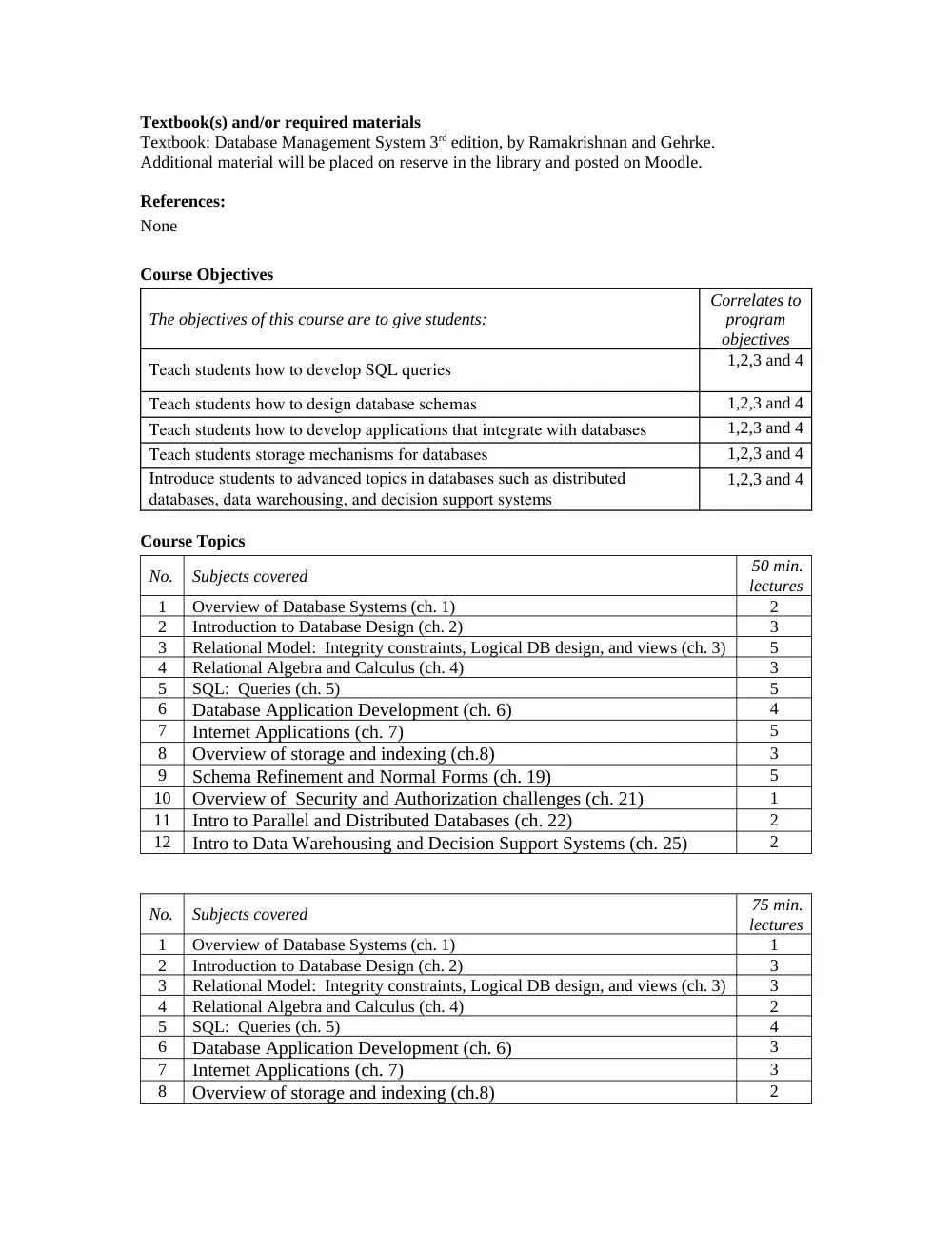
Textbook(s) and/or required materials
Textbook: Database Management System 3rd edition, by Ramakrishnan and Gehrke.
Additional material will be placed on reserve in the library and posted on Moodle.
References:
None
Course Objectives
The objectives of this course are to give students:
Correlates to
program
objectives
Teach students how to develop SQL queries
1,2,3 and 4
Teach students how to design database schemas
1,2,3 and 4
Teach students how to develop applications that integrate with databases
1,2,3 and 4
Teach students storage mechanisms for databases
1,2,3 and 4
Introduce students to advanced topics in databases such as distributed
databases, data warehousing, and decision support systems
1,2,3 and 4
Course Topics
No.
Subjects covered
50 min.
lectures
1
Overview of Database Systems (ch. 1)
2
2
Introduction to Database Design (ch. 2)
3
3
Relational Model: Integrity constraints, Logical DB design, and views (ch. 3)
5
4
Relational Algebra and Calculus (ch. 4)
3
5
SQL: Queries (ch. 5)
5
6
Database Application Development (ch. 6)
4
7
Internet Applications (ch. 7)
5
8
Overview of storage and indexing (ch.8)
3
9
Schema Refinement and Normal Forms (ch. 19)
5
10
Overview of Security and Authorization challenges (ch. 21)
1
11
Intro to Parallel and Distributed Databases (ch. 22)
2
12
Intro to Data Warehousing and Decision Support Systems (ch. 25)
2
No.
Subjects covered
75 min.
lectures
1
Overview of Database Systems (ch. 1)
1
2
Introduction to Database Design (ch. 2)
3
3
Relational Model: Integrity constraints, Logical DB design, and views (ch. 3)
3
4
Relational Algebra and Calculus (ch. 4)
2
5
SQL: Queries (ch. 5)
4
6
Database Application Development (ch. 6)
3
7
Internet Applications (ch. 7)
3
8
Overview of storage and indexing (ch.8)
2
9
Schema Refinement and Normal Forms (ch. 19)
3
10
Overview of Security and Authorization challenges (ch. 21)
1
11
Intro to Parallel and Distributed Databases (ch. 22)
1
12
Intro to Data Warehousing and Decision Support Systems (ch. 25)
2
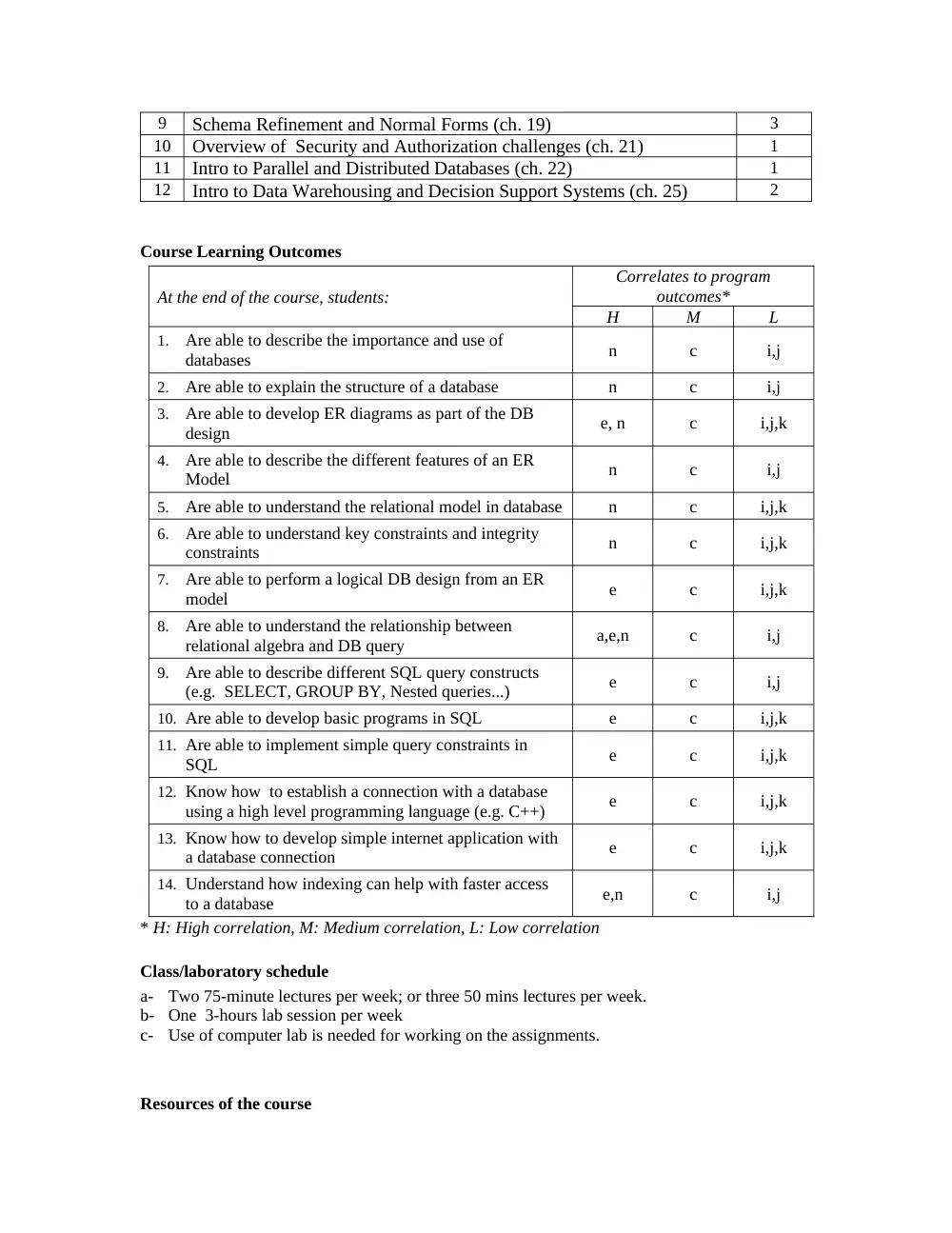
Course Learning Outcomes
At the end of the course, students:
Correlates to program
outcomes*
H
M
L
1.
Are able to describe the importance and use of
databases
n
c
i,j
2.
Are able to explain the structure of a database
n
c
i,j
3.
Are able to develop ER diagrams as part of the DB
design
e, n
c
i,j,k
4.
Are able to describe the different features of an ER
Model
n
c
i,j
5.
Are able to understand the relational model in database
n
c
i,j,k
6.
Are able to understand key constraints and integrity
constraints
n
c
i,j,k
7.
Are able to perform a logical DB design from an ER
model
e
c
i,j,k
8.
Are able to understand the relationship between
relational algebra and DB query
a,e,n
c
i,j
9.
Are able to describe different SQL query constructs
(e.g. SELECT, GROUP BY, Nested queries...)
e
c
i,j
10. Are able to develop basic programs in SQL
e
c
i,j,k
11. Are able to implement simple query constraints in
SQL
e
c
i,j,k
12. Know how to establish a connection with a database
using a high level programming language (e.g. C++)
e
c
i,j,k
13. Know how to develop simple internet application with
a database connection
e
c
i,j,k
14. Understand how indexing can help with faster access
to a database
e,n
c
i,j
* H: High correlation, M: Medium correlation, L: Low correlation
Class/laboratory schedule
a-
Two 75-minute lectures per week; or three 50 mins lectures per week.
b-
One 3-hours lab session per week
c-
Use of computer lab is needed for working on the assignments.
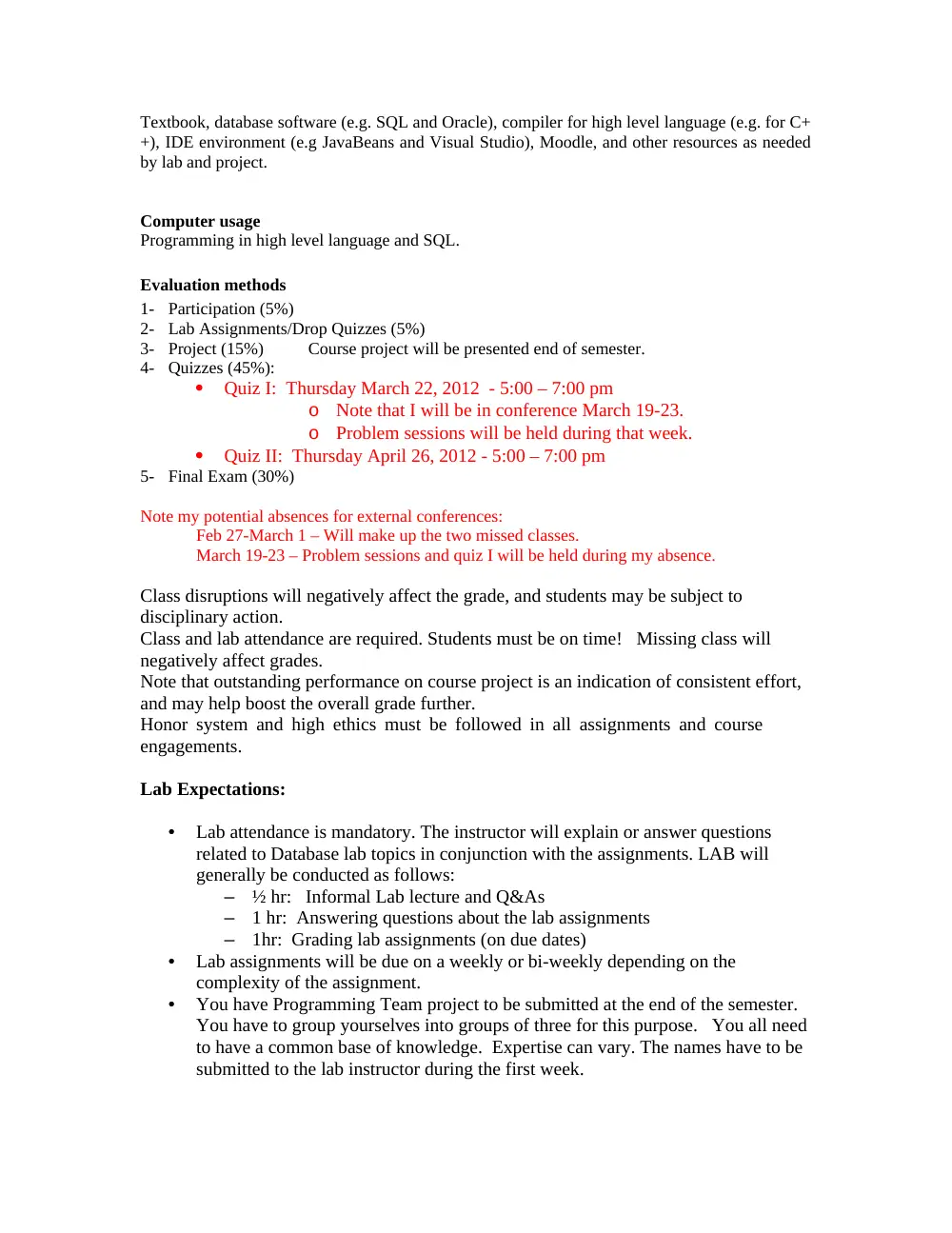
Resources of the course
Textbook, database software (e.g. SQL and Oracle), compiler for high level language (e.g. for C+
+), IDE environment (e.g JavaBeans and Visual Studio), Moodle, and other resources as needed
by lab and project.
Computer usage
Programming in high level language and SQL.
Evaluation methods
1-
Participation (5%)
2-
Lab Assignments/Drop Quizzes (5%)
3-
Project (15%)
Course project will be presented end of semester.
4-
Quizzes (45%):
Quiz I: Thursday March 22, 2012 - 5:00 – 7:00 pm
o
Note that I will be in conference March 19-23.
o
Problem sessions will be held during that week.
Quiz II: Thursday April 26, 2012 - 5:00 – 7:00 pm
5-
Final Exam (30%)
Note my potential absences for external conferences:
Feb 27-March 1 – Will make up the two missed classes.
March 19-23 – Problem sessions and quiz I will be held during my absence.
Class disruptions will negatively affect the grade, and students may be subject to
disciplinary action.
Class and lab attendance are required. Students must be on time! Missing class will
negatively affect grades.
Note that outstanding performance on course project is an indication of consistent effort,
and may help boost the overall grade further.
Honor system and high ethics must be followed in all assignments and course
engagements.
Lab Expectations:
•
Lab attendance is mandatory. The instructor will explain or answer questions
related to Database lab topics in conjunction with the assignments. LAB will
generally be conducted as follows:
–
½ hr: Informal Lab lecture and Q&As
–
1 hr: Answering questions about the lab assignments
–
1hr: Grading lab assignments (on due dates)
•
Lab assignments will be due on a weekly or bi-weekly depending on the
complexity of the assignment.
•
You have Programming Team project to be submitted at the end of the semester.
You have to group yourselves into groups of three for this purpose. You all need
to have a common base of knowledge. Expertise can vary. The names have to be
submitted to the lab instructor during the first week.
•
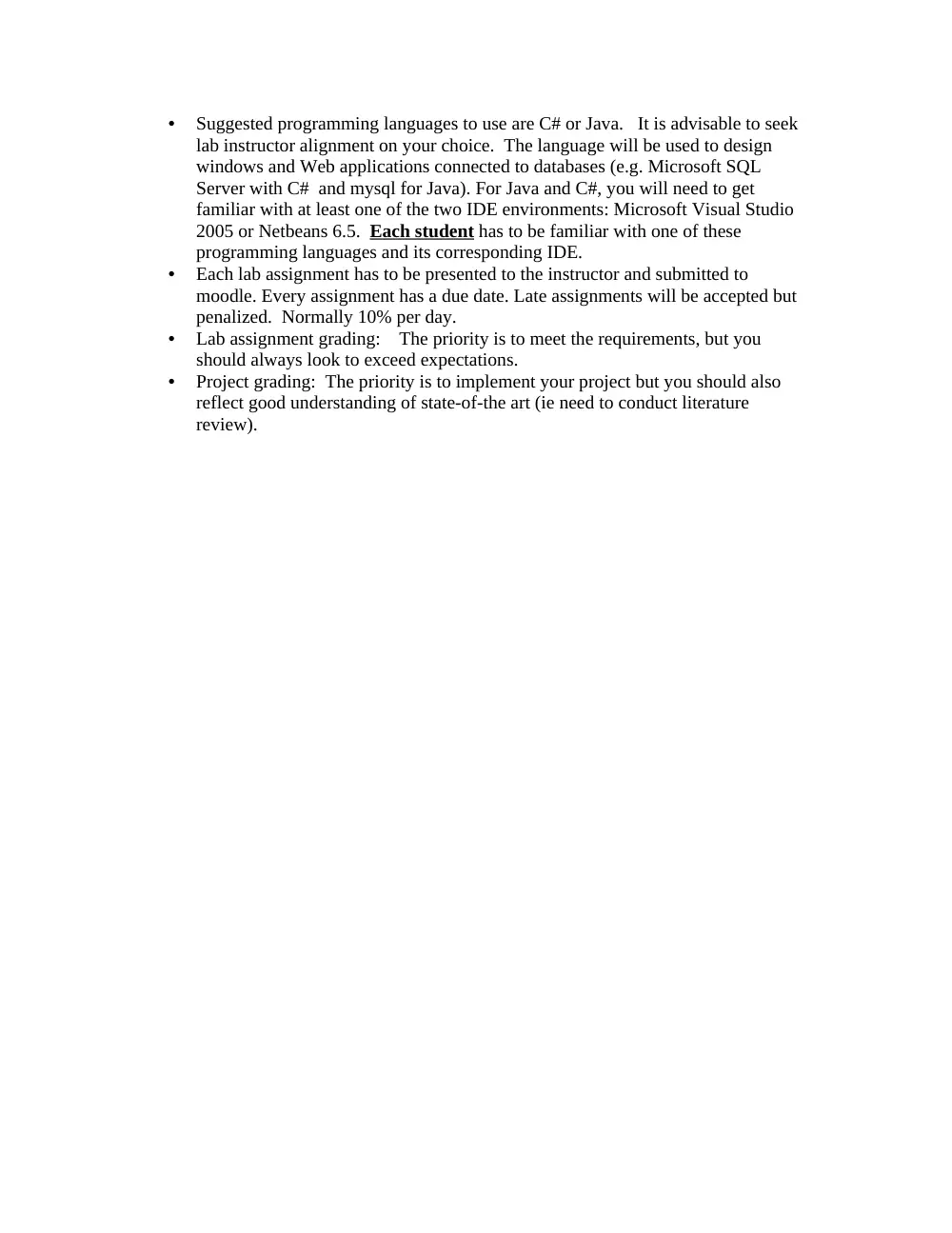
Suggested programming languages to use are C# or Java. It is advisable to seek
lab instructor alignment on your choice. The language will be used to design
windows and Web applications connected to databases (e.g. Microsoft SQL
Server with C# and mysql for Java). For Java and C#, you will need to get
familiar with at least one of the two IDE environments: Microsoft Visual Studio
2005 or Netbeans 6.5. Each student has to be familiar with one of these
programming languages and its corresponding IDE.
•
Each lab assignment has to be presented to the instructor and submitted to
moodle. Every assignment has a due date. Late assignments will be accepted but
penalized. Normally 10% per day.
•
Lab assignment grading: The priority is to meet the requirements, but you
should always look to exceed expectations.
•
Project grading: The priority is to implement your project but you should also
reflect good understanding of state-of-the art (ie need to conduct literature
review).