
EECE 433 Chapter 8, Spring 2012
American University of Beirut · Database Systems · 42 pages
Showing the first 10 of 42 pages. Download the PDF to see all of it.
More EECE 433 files
- Problems Chapter 3 · Spring 2012ChapterView
- Chapter 6 · Spring 2012ChapterView
- Chapter 7 · Spring 2012ChapterView
- Problems Chapter 1 & 2 · Spring 2012ChapterView
- Problems Chapter 5 · Spring 2012ChapterView
- Problems Chapter 6 Handout · Spring 2012ChapterView
- Chapter 19 · Spring 2012ChapterView
- Problems Chapter 4 · Spring 2012ChapterView
Show the text of this chapter
Database Management Systems 3ed, R. Ramakrishnan and J. Gehrke
Overview of Storage and
Indexing
Chapter 8
“How index-learning turns no student pale
Yet holds the eel of science by the tail.”
-- Alexander Pope (1688-1744)
Database Management Systems 3ed, R. Ramakrishnan and J. Gehrke
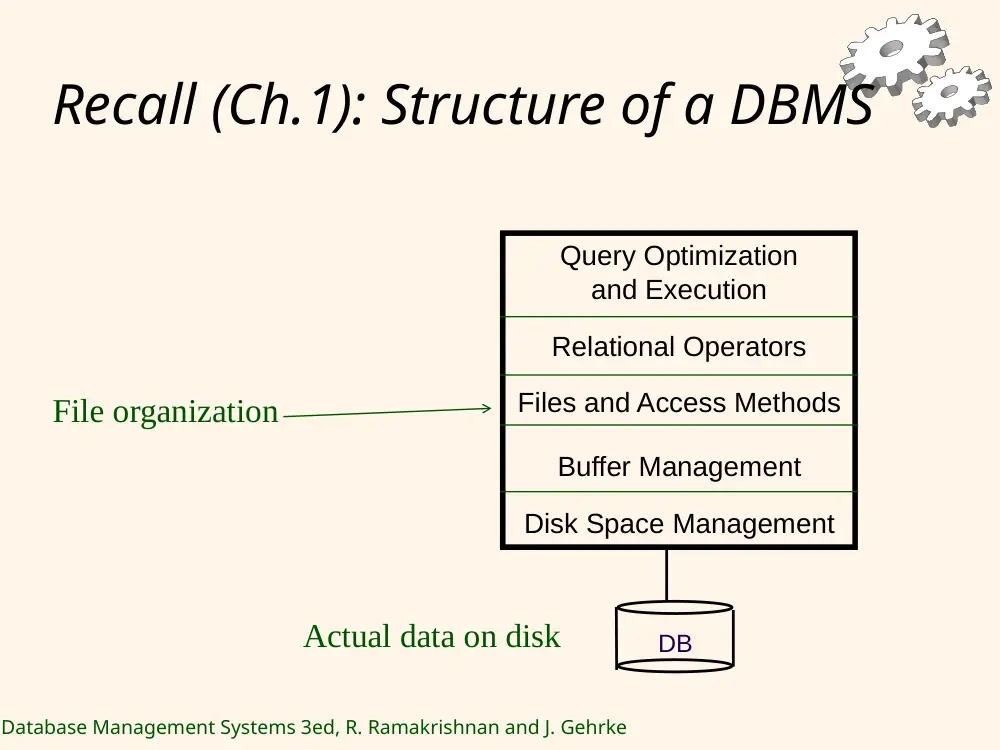
Recall (Ch.1): Structure of a DBMS
Query Optimization
and Execution
Relational Operators
Files and Access Methods
Buffer Management
Disk Space Management
DB
Actual data on disk
File organization
Database Management Systems 3ed, R. Ramakrishnan and J. Gehrke
Data on External Storage
Disks: Can retrieve random page at fixed cost
But reading several consecutive pages is much cheaper than
reading them in random order
Tapes: Can only read pages in sequence
Cheaper than disks; used for archival storage
File organization: Method of arranging a file of
records on external storage.
Record id (rid) is sufficient to physically locate record
Indexes are data structures that allow us to find the record
ids of records with given values in index search key fields
Architecture: Buffer manager stages pages from
external storage to main memory buffer pool. File
and index layers make calls to the buffer manager.
Database Management Systems 3ed, R. Ramakrishnan and J. Gehrke
Alternative File Organizations
Many alternatives exist, each ideal for some
situations, and not so good in others:
Heap (random order) files: Suitable when typical
access is a file scan retrieving all records.
Sorted Files: Best if records must be retrieved in
some order, or only a `range’ of records is
needed.
Indexes: Data structures to organize records via
trees or hashing.
• Like sorted files, they speed up searches for a subset of
records, based on values in certain (“search key”) fields
• Updates are much faster than in sorted files.
Database Management Systems 3ed, R. Ramakrishnan and J. Gehrke
Indexes
An index on a file speeds up selections on
the search key fields for the index.
Any subset of the fields of a relation can be the
search key for an index on the relation.
Search key is not the same as key (minimal set of
fields that uniquely identify a record in a
relation).
An index contains a collection of data
entries, and supports efficient retrieval of
all data entries k* with a given key value k.
Database Management Systems 3ed, R. Ramakrishnan and J. Gehrke
Alternatives for Data Entry k* in
Index
Three alternatives:
Data record with key value k
<k, rid of data record with search key value k>
<k, list of rids of data records with search key k>
Choice of alternative for data entries is
orthogonal to the indexing technique used
to locate data entries with a given key value
k.
Examples of indexing techniques: B+ trees, hash-
based structures
Typically, index contains auxiliary information
that directs searches to the desired data entries
Database Management Systems 3ed, R. Ramakrishnan and J. Gehrke
Index Classification
Primary vs. secondary: If search key contains
primary key, then called primary index.
Unique index: Search key contains a candidate
key.
Clustered vs. unclustered: If order of data
records is the same as, or `close to’, order of
data entries, then called clustered index.
Alternative 1 implies clustered; in practice,
clustered also implies Alternative 1 (since sorted
files are rare).
A file can be clustered on at most one search key.
Cost of retrieving data records through index
varies greatly based on whether index is clustered
Database Management Systems 3ed, R. Ramakrishnan and J. Gehrke
INDEX DATA STRUCTURE
HASHING and B+ Trees
Database Management Systems 3ed, R. Ramakrishnan and J. Gehrke
Hash-Based Indexes
Good for equality selections.
• Index is a collection of buckets. Bucket =
primary page plus zero or more overflow
pages.
• Hashing function h: h(r) = bucket in which
record r belongs. h looks at the search key
fields of r.
If Alternative (1) is used, the buckets contain
the data records; otherwise, they contain
<key, rid> or <key, rid-list> pairs.
Database Management Systems 3ed, R. Ramakrishnan and J. Gehrke
1
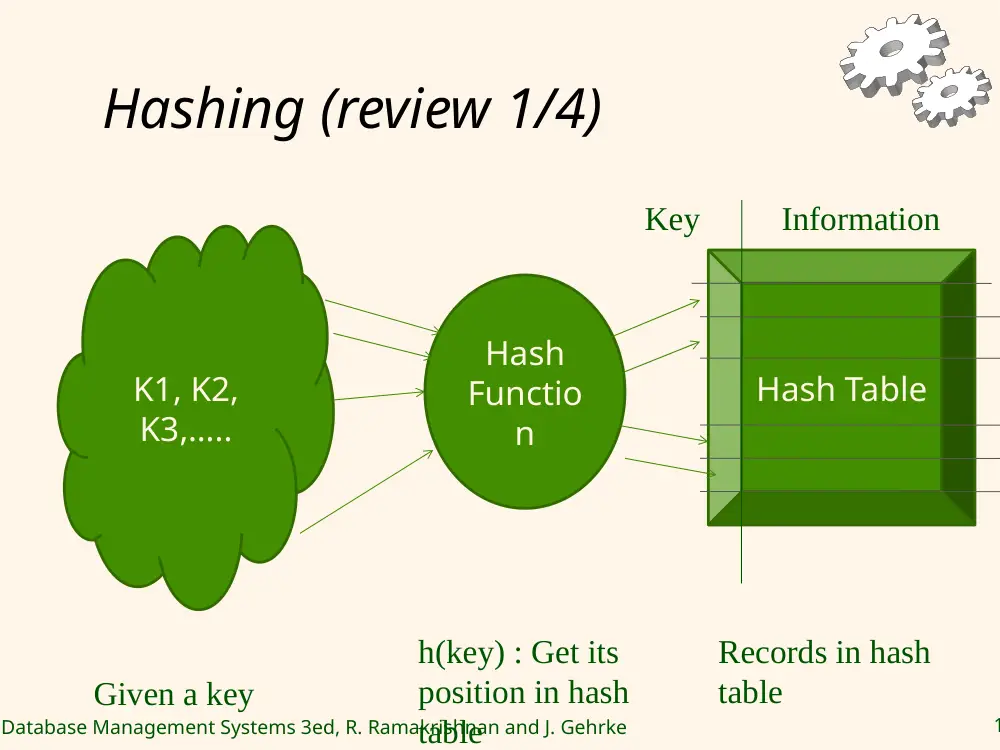
Hashing (review 1/4)
K1, K2,
K3,…..
Hash
Functio
n
Hash Table
Key
Information
Given a key
h(key) : Get its
position in hash
table
Records in hash
table
Database Management Systems 3ed, R. Ramakrishnan and J. Gehrke
1
Hashing (review 2/4)
Hashing: The process of mapping a key value to a
position in a table.
A hash function h maps key values to positions.
A hash table HT is an array that holds the records.
HT has M buckets, (each with N slots), indexed
form 0 to M-1.
Database Management Systems 3ed, R. Ramakrishnan and J. Gehrke
1
B+ Tree Indexes
Leaf pages contain data entries, and are chained (prev & next)
Non-leaf pages contain index entries and direct searches:
P0
K 1
P 1
K 2
P 2
K m
P m
index entry
Non-leaf
Pages
Pages
Leaf
Database Management Systems 3ed, R. Ramakrishnan and J. Gehrke
1
Tree Indexing (2)
Difficulties when storing tree index
on disk:
Tree must be balanced for efficient
searches.
Each path from root to leaf should
cover few disk pages.
BST can be used but with difficulty
to maintain balance, affecting too
many blocks:
Inserting 1
Database Management Systems 3ed, R. Ramakrishnan and J. Gehrke
1
2-3 Tree (1)
A 2-3 Tree has the following properties:
1.
A node contains one or two keys
2.
Every internal node has either two children (if it
contains one key) or three children (if it contains two
keys).
3.
All leaves are at the same level in the tree, so the
tree is always height balanced.
The 2-3 Tree has a search tree property analogous
to the BST.
FYI
Database Management Systems 3ed, R. Ramakrishnan and J. Gehrke
1
Example B+ Tree
Find 28*? 29*? All > 15* and < 30*
Insert/delete: Find data entry in leaf, then
change it. Need to adjust parent sometimes.
And change sometimes bubbles up the tree
2*
3*
Root
17
30
14* 16*
33* 34* 38* 39*
13
5
7*
5*
8*
22* 24*
27
27* 29*
Entries <= 17
Entries > 17
Database Management Systems 3ed, R. Ramakrishnan and J. Gehrke
1
Cost Model for Our Analysis
We ignore CPU costs, for simplicity:
B: The number of data pages
R: Number of records per page
D: (Average) time to read or write disk page
Measuring number of page I/O’s ignores gains of
pre-fetching a sequence of pages; thus, even I/O
cost is only approximated.
Average-case analysis; based on several
simplistic assumptions.
Good enough to show the overall trends!
Database Management Systems 3ed, R. Ramakrishnan and J. Gehrke
1
Comparing File Organizations
Heap files (random order; insert at eof)
Sorted files, sorted on <age, sal>
Clustered B+ tree file, Alternative (1),
search key <age, sal>
Heap file with unclustered B + tree index
on search key <age, sal>
Heap file with unclustered hash index on
search key <age, sal>
Database Management Systems 3ed, R. Ramakrishnan and J. Gehrke
1
Operations to Compare
Scan: Fetch all records from disk
Equality search
Range selection
Insert a record
Delete a record
Database Management Systems 3ed, R. Ramakrishnan and J. Gehrke
1
Assumptions in Our Analysis
Heap Files:
Equality selection on key; exactly one match.
Sorted Files:
Files compacted after deletions.
Indexes:
Alt (2), (3): data entry size = 10% size of record
Hash: No overflow buckets.
• 80% page occupancy => File size = 1.25 data size
Tree: 67% occupancy (this is typical).
• Implies file size = 1.5 data size
Database Management Systems 3ed, R. Ramakrishnan and J. Gehrke
2
Cost of Operations
(a) Scan
(b)
Equality
(c ) Range
(d) Insert
(e) Delete
(1) Heap
(2) Sorted
(3) Clustered
(4) Unclustered
Tree index
(5) Unclustered
Hash index
Several assumptions underlie these (rough) estimates!
Database Management Systems 3ed, R. Ramakrishnan and J. Gehrke
2
Cost of Operations
(a) Scan
(b) Equality
(c ) Range
(d) Insert
(e) Delete
(1) H eap
BD
0.5BD
BD
2D
Search
+D
(2) Sorted
BD
Dlog 2B
Dlog 2 B +
# matches
Search
+ BD
Search
+BD
(3) Clustered
1.5BD
Dlog F 1.5B Dlog F 1.5B
+ # matches
Search
+ D
Search
+D
(4) Unclustered
Tree index
BD(R+0.15) D(1 +
log F 0.15B)
Dlog F 0.15B
+ # matches
D(3 +
log F 0.15B)
Search
+ 2D
(5) Unclustered
H ash index
BD(R+0.1
25)
2D
BD
4D
Search
+ 2D
Several assumptions underlie these (rough) estimates!
Database Management Systems 3ed, R. Ramakrishnan and J. Gehrke
2
Understanding the Workload
For each query in the workload:
Which relations does it access?
Which attributes are retrieved?
Which attributes are involved in selection/join
conditions? How selective are these conditions likely to
be?
For each update in the workload:
Which attributes are involved in selection/join
conditions? How selective are these conditions likely to
be?
The type of update (INSERT/DELETE/UPDATE), and the
attributes that are affected.
Database Management Systems 3ed, R. Ramakrishnan and J. Gehrke
2
Choice of Indexes
What indexes should we create?
Which relations should have indexes? What
field(s) should be the search key? Should we
build several indexes?
For each index, what kind of an index should
it be?
Clustered? Hash/tree?
Database Management Systems 3ed, R. Ramakrishnan and J. Gehrke
2
Choice of Indexes (Contd.)
One approach: Consider the most important
queries in turn. Consider the best plan using the
current indexes, and see if a better plan is possible
with an additional index. If so, create it.
Obviously, this implies that we must understand how a
DBMS evaluates queries and creates query evaluation
plans!
For now, we discuss simple 1-table queries.
Before creating an index, must also consider the
impact on updates in the workload!
Trade-off: Indexes can make queries go faster, updates
slower. Require disk space, too.
Database Management Systems 3ed, R. Ramakrishnan and J. Gehrke
2
Index Selection Guidelines
Attributes in WHERE clause are candidates for index keys.
Exact match condition suggests hash index.
Range query suggests tree index.
• Clustering is especially useful for range queries; can also help on
equality queries if there are many duplicates.
Multi-attribute search keys should be considered when a
WHERE clause contains several conditions.
Order of attributes is important for range queries.
Such indexes can sometimes enable index-only strategies for
important queries.
• For index-only strategies, clustering is not important!
Try to choose indexes that benefit as many queries as
possible. Since only one index can be clustered per
relation, choose it based on important queries that
would benefit the most from clustering.
Database Management Systems 3ed, R. Ramakrishnan and J. Gehrke
2
Examples of Clustered Indexes
B+ tree index on E.age can be
used to get qualifying tuples.
How selective is the condition?
Choices:
If “E.age>40” not selective:
sequential search will do as well as
clustered
If “E.age>40” selective, then
clustered will do much better due
to faster access on age.
SELECT E.dno
FROM Emp E
WHERE E.age>40
Database Management Systems 3ed, R. Ramakrishnan and J. Gehrke
2
Examples of Clustered Indexes
Consider the GROUP BY query.
If many tuples have E.age > 10,
using E.age index and sorting the
retrieved tuples may be costly.
Clustered E.dno index may be
better!
Basically select the index for the
attribute that gives higher
selectivity
SELECT E.dno, COUNT (*)
FROM Emp E
WHERE E.age>10
GROUP BY E.dno
Database Management Systems 3ed, R. Ramakrishnan and J. Gehrke
2
Examples of Clustered Indexes
Equality queries and duplicates:
Clustering on E.hobby helps if
many people collect stamps.
Unclustered works ok if
only one (or few) has the bobby.
SELECT E.dno
FROM Emp E
WHERE E.hobby=Stamps
Database Management Systems 3ed, R. Ramakrishnan and J. Gehrke
2
Indexes with Composite Search
Keys
Composite Search Keys:
Search on a combination of
fields.
Equality query: Every field
value is equal to a constant
value. E.g. wrt <sal,age>
index:
• age=20 and sal =75
Range query: Some field
value is not a constant. E.g.:
• age =20; or age=20 and sal >
10
Data entries in index sorted
by search key to support
range queries.
Lexicographic order or
sue 13
75
bob
cal
joe
12
10
20
80
11
12
name age sal
<sal, age>
<age, sal>
<age>
<sal>
12,20
12,10
11,80
13,75
20,12
10,12
75,13
80,11
11
12
12
13
10
20
75
80
Data records
sorted by name
Data entries in index
sorted by <sal,age>
Data entries
sorted by <sal>
Examples of composite key
indexes using lexicographic order.
Database Management Systems 3ed, R. Ramakrishnan and J. Gehrke
3
Composite Search Keys
To retrieve Emp records with age=30 AND
sal=4000, an index on <age,sal> would be better
than an index on age or an index on sal.
Choice of index key orthogonal to clustering etc.
If condition is: 20<age<30 AND 3000<sal<5000:
Clustered tree index on <age,sal> or <sal,age> is best.
If condition is: age=30 AND 3000<sal<5000:
Clustered <age,sal> index much better than <sal,age>
index!
Composite indexes are larger, updated more
often.
Database Management Systems 3ed, R. Ramakrishnan and J. Gehrke
3
Index-Only Plans
A number of
queries can
be answered
without
retrieving
any tuples
from one or
more of the
relations
involved if a
suitable
index is
available.
SELECT D.mgr, E.eid
FROM Dept D, Emp E
WHERE D.dno=E.dno
SELECT E.dno, COUNT(*)
FROM Emp E
GROUP BY E.dno
SELECT E.dno, MIN(E.sal)
FROM Emp E
GROUP BY E.dno
SELECT AVG(E.sal)
FROM Emp E
WHERE E.age=25 AND
E.sal BETWEEN 3000 AND 5000
<E.dno,E.eid>
Tree index!
<E.dno>
<E.dno,E.sal>
Tree index!
<E. age,E.sal>
or
<E.sal, E.age>
Tree!
Database Management Systems 3ed, R. Ramakrishnan and J. Gehrke
3
Index-Only Plans (Contd.)
Index-only plans
are possible if
the key is
<dno,age> or
we have a tree
index with key
<age,dno>
Which is better?
What if we
consider the
second query?
SELECT E.dno, COUNT (*)
FROM Emp E
WHERE E.age=30
GROUP BY E.dno
SELECT E.dno, COUNT (*)
FROM Emp E
WHERE E.age>30
GROUP BY E.dno
Database Management Systems 3ed, R. Ramakrishnan and J. Gehrke
3
Summary
Many alternative file organizations exist,
each appropriate in some situation.
If selection queries are frequent, sorting
the file or building an index is important.
Hash-based indexes only good for equality
search.
Sorted files and tree-based indexes best for
range search; also good for equality search.
(Files rarely kept sorted in practice; B+ tree
index is better.)
Index is a collection of data entries plus a
way to quickly find entries with given key
Database Management Systems 3ed, R. Ramakrishnan and J. Gehrke
3
Summary (Contd.)
Data entries can be actual data records,
<key, rid> pairs, or <key, rid-list> pairs.
Choice orthogonal to indexing technique used to
locate data entries with a given key value.
Can have several indexes on a given file of
data records, each with a different search
key.
Indexes can be classified as clustered vs.
unclustered, primary vs. secondary, and
dense vs. sparse. Differences have
important consequences for
utility/performance
Database Management Systems 3ed, R. Ramakrishnan and J. Gehrke
3
Summary (Contd.)
Understanding the nature of the workload for the
application, and the performance goals, is
essential to developing a good design.
What are the important queries and updates? What
attributes/relations are involved?
Indexes must be chosen to speed up important
queries (and perhaps some updates!).
Index maintenance overhead on updates to key fields.
Choose indexes that can help many queries, if
possible.
Build indexes to support index-only strategies.
Clustering is an important decision; only one index on
a given relation can be clustered!
Order of fields in composite index key can be
important.
Database Management Systems 3ed, R. Ramakrishnan and J. Gehrke
3
BACKUP
Database Management Systems 3ed, R. Ramakrishnan and J. Gehrke
3
Alternatives for Data Entries
(Contd.)
Alternative 1:
If this is used, index structure is a file
organization for data records (instead of a Heap
file or sorted file).
At most one index on a given collection of data
records can use Alternative 1. (Otherwise, data
records are duplicated, leading to redundant
storage and potential inconsistency.)
If data records are very large, # of pages
containing data entries is high. Implies size of
auxiliary information in the index is also large,
typically.
FYI
Database Management Systems 3ed, R. Ramakrishnan and J. Gehrke
3
Alternatives for Data Entries
(Contd.)
Alternatives 2 and 3:
Data entries typically much smaller than data
records. So, better than Alternative 1 with large
data records, especially if search keys are small.
(Portion of index structure used to direct search,
which depends on size of data entries, is much
smaller than with Alternative 1.)
Alternative 3 more compact than Alternative 2,
but leads to variable sized data entries even if
search keys are of fixed length.
FYI
Database Management Systems 3ed, R. Ramakrishnan and J. Gehrke
3
Hashing (review 3/4)
For any value K in the key range and some hash
function h, h(K) = i, 0 <= i < M, such that
key(HT[i]) = K.
Hashing is appropriate only for no duplicate key
Good for both in-memory and disk-based
applications.
Answers the question “What record, if any, has
key value K?”
Not suitable for range searches, finding records
with min or max key, visit records in key order.
Use Indexing
FYI
Database Management Systems 3ed, R. Ramakrishnan and J. Gehrke
4
Bucket Hashing (review 4/4)
Groups hash table slots into
buckets.
Example: 8 slots/bucket, M=10
Include an overflow bucket.
Records hash to the first slot of the
bucket, and fill bucket. Go to
overflow if necessary.
When searching, first check the proper
bucket. Then check the overflow.
Expensive if overflow bucket contains
many records
If stored on disk: set bucket size to a
disk block: one disk access/op
Home Position
1 Bucket
Overflow
Bucket
1
2
3
4
5
6
7
8
9
10
FYI
Database Management Systems 3ed, R. Ramakrishnan and J. Gehrke
4
Tree Indexing (1)
Linear index is poor for insertion/deletion.
Tree index can efficiently support all desired
operations:
Insert/delete
Multiple search keys (multiple indices)
Key range search
FYI
Database Management Systems 3ed, R. Ramakrishnan and J. Gehrke
4
2-3 Tree (2)
The advantage of the 2-3 Tree over the BST is that
it can be updated at low cost.
FYI